


 |
市場調查報告書
商品編碼
2122172
機油:市場佔有率分析、產業趨勢與統計、成長預測(2026-2031)Engine Oil - Market Share Analysis, Industry Trends & Statistics, Growth Forecasts (2026 - 2031) |
||||||

※ 本網頁內容可能與最新版本有所差異。詳細情況請與我們聯繫。
根據 Mordor Intelligence 預測,機油市場預計將從 2025 年的 178.5 億公升成長到 2026 年的 180.3 億公升,到 2031 年達到 189.7 億公升,2026 年至 2031 年的複合年預計成長率為 1.02%。
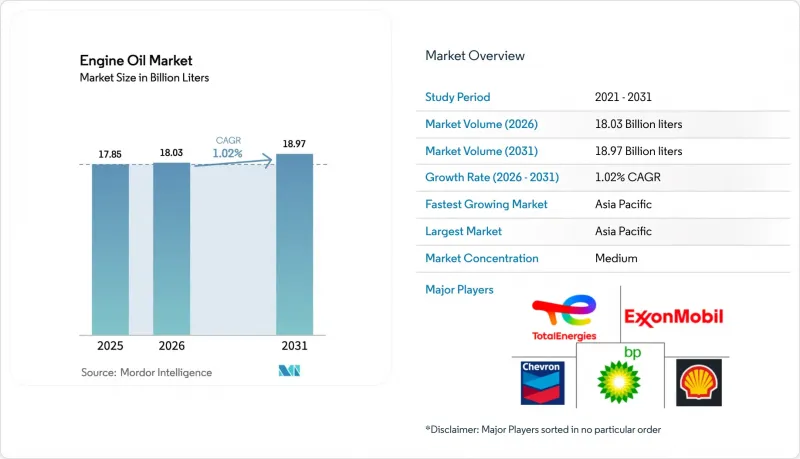
本報告按基礎油類型(礦物油、半合成油、全合成油、生物基油)、車輛類型(乘用車、輕型商用車、重型卡車和客車、摩托車和踏板車、越野車和施工機械)、終端用戶行業(汽車和運輸業、其他)以及地區(亞太地區、其他)進行細分。市場預測以銷售量(公升)為單位。
全球機油市場趨勢及洞察
新興國家汽車產量增加
2024年,全球輕型汽車產量成長,亞洲對總產量貢獻顯著。中國擴大了生產規模,而印度則實現了顯著成長,這主要得益於SUV需求的激增,以及古吉拉突邦和泰米爾納德邦出口基地的支持。墨西哥鞏固了其作為北美第三大供應商的地位,並作為南美轉口貿易樞紐發揮關鍵作用。產能的擴張不僅將提升工廠的產能,也將確保售後市場的穩定供應,尤其是在保養週期低於1萬公里的地區。展望未來,國際汽車製造商協會(OICA)預測,到2028年,亞太地區將在全球輕型汽車產量中佔據較大佔有率,這意味著市場對注重性價比的礦物油和半合成潤滑油的需求將持續強勁。
對高性能合成潤滑油的需求不斷成長
隨著汽車製造商為滿足燃油效率標準而轉向使用低黏度機油,全合成引擎油的市場佔有率在全球範圍內不斷擴大。在北美和歐洲,III類基礎油目前佔據了大部分供應量,並逐步取代了老舊的I類基礎油。計畫於2028年實施的ILSAC GF-8A標準將要求0W-8機油在高溫高剪切條件下維持2.6厘泊的黏度,這將進一步增強對合成潤滑油的需求。埃克森美孚的Mobil 1和殼牌的Helix Ultra取得了顯著的成功,這得益於本田、豐田和大眾等主要汽車製造商的聯合OEM認證。
使用原廠加註的長效機油延長換油週期。
在北美,汽車製造商正在延長保養週期,而在歐洲,保養週期則更長。這種延長是透過在原廠機油中添加抗氧化劑和摩擦改進劑來實現的,從而使機油黏度能夠維持長達兩年。豐田凱美瑞混合動力車使用0W-16機油,並遵循特定的換油週期。相較之下,本田原廠0W-20引擎機油的換油週期則較短。通用汽車在其Dexos1 Gen 3機油中加入了鉬和硼等化學成分,從而專注於提升機油的耐久性。
細分市場分析
生物基油是機油市場中成長最快的細分市場,預計到2031年將以每年2.80%的速度成長。然而,截至2025年,礦物油仍將以56.18%的市佔率佔據主導地位。歐盟的「生態標章」規定,可再生碳含量必須至少達到25%,並且要求在28天內達到60%以上的生物分解性。這項措施正推動政府車輛轉向使用植物來源酯類混合潤滑油。同樣,美國的「生物優先」(BioPreferred)計畫也正在蓬勃發展,聯邦政府的合約授予也越來越注重生物基含量認證。在德國,RAVENOL計劃於2024年推出「BioSyntoLub」產品。本產品為菜籽油及葵花籽油酯與III類基油的混合物,符合ACEA C3標準。這凸顯了該產業為爭取公共採購預算所做的努力。
由於價格敏感性,礦物油仍然佔據主導地位,尤其是在南亞和東南亞地區。含有III類或IV類組分的半合成混合油主要針對主流轎車的API SN Plus標準。全合成油,主要由聚α烯烴衍生而來,深受汽車製造商的青睞。然而,對低黏度的需求迫使潤滑油生產商轉向性能更優的III+類成分產品,同時也面臨成本上升的挑戰。生物基機油市場目前小規模,但考慮到法規和企業碳排放目標的影響,預計2031年將實現顯著成長。
區域分析
預計到2025年,亞太地區將佔全球潤滑油需求的58.17%,年複合成長率(CAGR)為1.30%。這一成長主要由中國、印度和東南亞國協的組裝總合能推動。隨著2024年中國全面實施“中國VI-b標準”,低SAPS(亞硫酸氫鹽和磷)SAE 0W-20和5W-30潤滑油的需求激增。同時,在印度,受摩托車普及和完善的零售網路的推動,潤滑油消費量也隨之成長。
在北美,隨著電動車(EV)在2025年進入銷售結構,市場規模以年度為基礎萎縮。儘管如此,高階合成混合機油產品仍保持了其價值佔有率。美國環保署(EPA)2024年的硫含量禁令要求重新配製添加劑,但此舉使埃克森美孚、雪佛龍和勝牌等供應商受益。雖然由於加拿大聯邦政府的零排放政策,不列顛哥倫比亞省和魁北克省的需求有所放緩,但墨西哥的產量能夠滿足市場對原廠灌裝的Dexos1和Motorcraft認證機油的需求。
在歐洲,市場全年持續萎縮,而電動車(EV)在挪威和荷蘭等國的佔有率則顯著成長。該地區複雜的法規,包括歐7排放標準、ACEA標準以及各國二氧化碳稅,推高了潤滑油調配成本,並且該行業正向大型綜合企業轉移。到2027年,德國聯邦公路運輸管理局計劃強制要求使用市售潤滑油進行曲軸箱排放氣體測試,這可能會增加認證成本。在英國,Safety-Kleen和Fuchs Petrolub的閉合迴路項目正在推動精煉基礎油市場佔有率的擴大。
在南美洲,受巴西靈活燃料汽車(需要耐腐蝕機油)的推動,市場逐年穩定成長。巴西石油公司(Petrobras)旗下的「Lubrax」品牌憑藉其公司自營加油站和獨立經銷商網路,在售後市場佔據了主導地位。阿根廷YPF公司採取了一項策略性舉措,開設了一家調配工廠,旨在同時滿足對南方共同市場(Mercosur)的出口和國內農業機械產業的需求。
在中東和非洲,市場實現了同比成長。沙烏地阿拉伯公共投資基金(PIF)投資的組裝合資企業以及南非強勁的礦用車輛需求支撐了市場。 2024年,沙烏地阿美旗下的Luberef擴大了II類產品的生產,聚焦於印度和東非市場。同時,Engen推出了一款獲得ACEA E9認證的10W-40機油,目標客戶全部區域的重型卡車。
其他好處:
- Excel格式的市場預測(ME)表
- 3個月的分析師支持
目錄
第1章:引言
- 研究假設和市場定義
- 調查範圍
第2章:調查方法
第3章執行摘要
第4章 市場狀況
- 市場概覽
- 市場促進因素
- 新興國家汽車產量增加
- 對高性能合成潤滑油的需求日益成長
- 平均車輛擁有年限和行駛里程增加
- 更嚴格的二氧化碳排放法規/鼓勵使用低黏度潤滑油的燃油效率標準
- 微出行維護生態系的興起
- 市場限制因素
- 使用原廠正品長效機油,延長換油週期。
- 加速推廣電動車
- 原始設備製造商正在推出「終身潤滑」系統。
- 價值鏈分析
- 波特五力模型
第5章 市場規模與成長預測
- 依基礎油類型
- 礦物油
- 半合成
- 完全合成
- 生物基
- 車輛類型
- 搭乘用車
- 輕型商用車
- 大型卡車和巴士
- 摩托車和踏板車
- 越野/建築
- 按最終用戶行業分類
- 汽車和運輸業
- 發電
- 重型機械和採礦
- 冶金/金屬加工
- 化學製造
- 其他行業
- 按地區
- 亞太地區
- 中國
- 印度
- 日本
- 韓國
- 東南亞國協
- 其他亞太國家
- 北美洲
- 美國
- 加拿大
- 墨西哥
- 歐洲
- 德國
- 英國
- 法國
- 義大利
- 西班牙
- 北歐國家
- 其他歐洲國家
- 南美洲
- 巴西
- 阿根廷
- 其他南美國家
- 中東和非洲
- 沙烏地阿拉伯
- 南非
- 其他中東和非洲國家
- 亞太地區
第6章 競爭情勢
- 市場集中度
- 策略趨勢
- 市佔率和排名分析
- 公司簡介
- AMSOIL INC
- Bharat Petroleum Corporation Limited
- BP plc
- Chevron Corporation
- China Petrochemical Corporation
- Eni SPA
- Exxon Mobil Corporation
- FUCHS
- Gazpromneft-Lubricants, Ltd
- Gulf Oil International
- Hindustan Petroleum Corporation Limited
- Idemitsu Kosan Co.,Ltd
- Illinois Tool Works Inc.
- Indian Oil Corporation Ltd
- JX Nippon Oil & Gas Exploration Corporation
- Liqui Moly GmbH
- LUKOIL
- Motul
- Petrobras
- PETRONAS Lubricants International
- Phillips 66 Company
- PT Pertamina Lubricants
- Repsol
- Shell PLC
- SK Enmove CO., Ltd
- Tide Water Oil Co.(India)Ltd
- TotalEnergies
- Valvoline Cummins Pvt. Ltd.
第7章 市場機會與未來展望
According to Mordor Intelligence, the engine oil market size is expected to increase from 17.85 Billion liters in 2025 to 18.03 Billion liters in 2026 and reach 18.97 Billion liters by 2031, growing at a CAGR of 1.02% over 2026-2031.
This report is Segmented by Base-Oil Type (Mineral, Semi-Synthetic, Fully-Synthetic, and Bio-Based), Vehicle Type (Passenger Cars, Light Commercial Vehicles, Heavy-Duty Trucks and Buses, Motorcycles and Scooters, and Off-Road/Construction), End-User Industry (Automotive and Transportation, and More), and Geography (Asia-Pacific, and More). The Market Forecasts are Provided in Terms of Volume (Liters).
Global Engine Oil Market Trends and Insights
Increasing Automotive Production in Emerging Economies
In 2024, global light-vehicle production increased, with Asia contributing significantly to the total output. China ramped up its production, while India, driven by a surge in SUV demand and bolstered by export hubs in Gujarat and Tamil Nadu, experienced notable growth. Mexico solidifies its position as the third key player in North America and acts as a re-export conduit to South America. This added capacity not only boosts factory-fill volumes but also ensures a robust aftermarket replenishment, especially in regions with service intervals under 10,000 kilometers. Looking to the future, the OICA projects that by 2028, the Asia-Pacific region will account for a significant share of the global output, signaling a continued strong demand for cost-sensitive mineral and semi-synthetic lubricant grades.
Rising Demand for High-Performance Synthetic Lubricants
As automakers increasingly turn to low-viscosity fluids to comply with fuel-economy standards, the share of fully synthetic engine oils in the global market has grown. In North America and Europe, Group III base oils now account for a significant portion of the supply, steadily displacing the older Group I stocks. The upcoming ILSAC GF-8A standard, set for 2028, mandates 0W-8 oils to maintain a high-temperature high-shear viscosity of 2.6 centipoise, further solidifying the demand for synthetics. Mobil 1 from ExxonMobil and Shell's Helix Ultra have achieved notable success, bolstered by securing OEM co-approvals from automotive giants like Honda, Toyota, and Volkswagen.
Extended Drain Intervals via OEM Factory-Fill Long-Life Oils
In North America, automakers have extended service windows, while in Europe, the limit is set at longer intervals. This extension is achieved by infusing factory fills with antioxidants and friction modifiers, ensuring they maintain viscosity for up to two years. Toyota's Camry Hybrid, using 0W-16 oil, adheres to a specific schedule. In contrast, Honda's 0W-20 Genuine Motor Oil follows a shorter interval. General Motors, with its Dexos1 Gen 3, focuses on endurance by incorporating molybdenum and boron chemistry.
Other drivers and restraints analyzed in the detailed report include:
- Growing Average Vehicle Age and Miles-Driven
- Stricter CO2/Fuel-Economy Norms Favoring Low-Viscosity Oils
- Accelerating EV Penetration
For complete list of drivers and restraints, kindly check the Table Of Contents.
Segment Analysis
Bio-based oils are the fastest-growing slice of the engine oil market, advancing 2.80% each year through 2031, even though mineral oils still dominate with 56.18% volume in 2025. The European Union's Ecolabel mandates a minimum of 25% renewable carbon and stipulates that biodegradability must exceed 60% within 28 days. This move is steering government fleets towards plant-ester blends. Similarly, the United States BioPreferred program is gaining traction, awarding federal contracts based on certified bio content. In Germany, RAVENOL is set to launch its 2024 BioSyntoLub, blending rapeseed and sunflower esters with Group III stock to align with ACEA C3 standards. This underscores the industry's pursuit of public-procurement budgets.
Price sensitivity maintains the mineral category's dominant share, particularly in South and Southeast Asia. Semi-synthetic blends, containing Group III or IV content, target API SN Plus standards for mainstream sedans. Fully synthetic oils, primarily derived from polyalphaolefin, enjoy premium OEM endorsements. However, they grapple with rising costs as mandates for low viscosity drive formulators towards enhanced Group III+ options. While the market for bio-based engine oils is currently modest, regulatory influences and corporate carbon objectives indicate a significant upward trend by 2031.
Complete Report Scope:
- By Base-Oil Type
- Mineral
- Semi-Synthetic
- Fully-Synthetic
- Bio-based
- By Vehicle Type
- Passenger Cars
- Light Commercial Vehicles
- Heavy-Duty Trucks and Buses
- Motorcycles and Scooters
- Off-Road / Construction
- By End-user Industry
- Automotive and Transportation
- Power Generation
- Heavy Equipment and Mining
- Metallurgy / Metalworking
- Chemical Manufacturing
- Other Industries
- By Geography
- Asia-Pacific
- China
- India
- Japan
- South Korea
- ASEAN Countries
- Rest of Asia-Pacific
- North America
- United States
- Canada
- Mexico
- Europe
- Germany
- United Kingdom
- France
- Italy
- Spain
- NORDIC Countries
- Rest of Europe
- South America
- Brazil
- Argentina
- Rest of South America
- Middle-East and Africa
- Saudi Arabia
- South Africa
- Rest of Middle-East and Africa
- Asia-Pacific
Geography Analysis
Asia-Pacific delivered 58.17% of global demand in 2025 and is projected to grow at a 1.30% CAGR. This growth is bolstered by China's production, India's output, and ASEAN's combined assemblies. China's nationwide rollout of the China VI-b standard in 2024 led to a surge in demand for low-SAPS SAE 0W-20 and 5W-30 oils. Meanwhile, in India, lubricant consumption increased, driven by the proliferation of two-wheelers and a robust retail network.
North America experienced an annual contraction, coinciding with the adoption of electric vehicles (EVs) in the 2025 sales mix. Despite this, premium synthetic blends managed to maintain their value share. The EPA's 2024 sulfur cap necessitated additive reformulations, a move that benefitted suppliers like ExxonMobil, Chevron, and Valvoline. While Canada's federal zero-emission mandate has dampened demand in British Columbia and Quebec, Mexico's output is meeting the factory-fill needs for Dexos1 and Motorcraft-approved oils.
Europe saw an annual contraction, with countries like Norway and the Netherlands elevating their EV shares significantly. The region's regulatory intricacies - spanning Euro 7, ACEA sequences, and national CO2 taxes - have escalated formulation costs, steering business towards integrated majors. By 2027, Germany's Federal Motor Transport Authority will mandate crankcase-emission testing with market lubricants, potentially increasing certification expenses. In the UK, initiatives by Safety-Kleen and Fuchs Petrolub's closed-loop programs have bolstered the share of re-refined base oils.
South America saw modest annual growth, spearheaded by Brazil's flex-fuel fleet, which necessitates corrosion-resistant oils. Petrobras' Lubrax brand, leveraging a network of company stations and independents, secured a dominant share in the aftermarket. In a strategic move, Argentina's YPF inaugurated a blending facility, catering to both Mercosur exports and the domestic agricultural machinery sector.
The Middle East and Africa recorded yearly growth. Demand was bolstered by assembly ventures funded by Saudi Arabia's PIF and a robust mining fleet in South Africa. In 2024, Aramco's Luberef expanded its Group II output, with a focus on markets in India and East Africa. Concurrently, Engen introduced its ACEA E9-approved 10W-40 oil, targeting heavy-duty trucks across the Southern African Development Community (SADC) region.
- AMSOIL INC
- Bharat Petroleum Corporation Limited
- BP p.l.c
- Chevron Corporation
- China Petrochemical Corporation
- Eni SPA
- Exxon Mobil Corporation
- FUCHS
- Gazpromneft - Lubricants, Ltd
- Gulf Oil International
- Hindustan Petroleum Corporation Limited
- Idemitsu Kosan Co.,Ltd
- Illinois Tool Works Inc.
- Indian Oil Corporation Ltd
- JX Nippon Oil & Gas Exploration Corporation
- Liqui Moly GmbH
- LUKOIL
- Motul
- Petrobras
- PETRONAS Lubricants International
- Phillips 66 Company
- PT Pertamina Lubricants
- Repsol
- Shell PLC
- SK Enmove CO., Ltd
- Tide Water Oil Co. (India) Ltd
- TotalEnergies
- Valvoline Cummins Pvt. Ltd.
Additional Benefits:
- The market estimate (ME) sheet in Excel format
- 3 months of analyst support
TABLE OF CONTENTS
1 Introduction
- 1.1 Study Assumptions and Market Definition
- 1.2 Scope of the Study
2 Research Methodology
3 Executive Summary
4 Market Landscape
- 4.1 Market Overview
- 4.2 Market Drivers
- 4.2.1 Increasing automotive production in emerging economies
- 4.2.2 Rising demand for high-performance synthetic lubricants
- 4.2.3 Growing average vehicle age and miles-driven
- 4.2.4 Stricter CO2 / fuel-economy norms favouring low-viscosity oils
- 4.2.5 Emergence of micro-mobility maintenance ecosystems
- 4.3 Market Restraints
- 4.3.1 Extended drain intervals via OEM factory-fill long-life oils
- 4.3.2 Accelerating EV penetration
- 4.3.3 OEM move toward sealed-for-life lubrication systems
- 4.4 Value Chain Analysis
- 4.5 Porter's Five Forces
- 4.5.1 Bargaining Power of Suppliers
- 4.5.2 Bargaining Power of Buyers
- 4.5.3 Threat of New Entrants
- 4.5.4 Threat of Substitutes
- 4.5.5 Degree of Competition
5 Market Size and Growth Forecasts (Volume)
- 5.1 By Base-Oil Type
- 5.1.1 Mineral
- 5.1.2 Semi-Synthetic
- 5.1.3 Fully-Synthetic
- 5.1.4 Bio-based
- 5.2 By Vehicle Type
- 5.2.1 Passenger Cars
- 5.2.2 Light Commercial Vehicles
- 5.2.3 Heavy-Duty Trucks and Buses
- 5.2.4 Motorcycles and Scooters
- 5.2.5 Off-Road / Construction
- 5.3 By End-user Industry
- 5.3.1 Automotive and Transportation
- 5.3.2 Power Generation
- 5.3.3 Heavy Equipment and Mining
- 5.3.4 Metallurgy / Metalworking
- 5.3.5 Chemical Manufacturing
- 5.3.6 Other Industries
- 5.4 By Geography
- 5.4.1 Asia-Pacific
- 5.4.1.1 China
- 5.4.1.2 India
- 5.4.1.3 Japan
- 5.4.1.4 South Korea
- 5.4.1.5 ASEAN Countries
- 5.4.1.6 Rest of Asia-Pacific
- 5.4.2 North America
- 5.4.2.1 United States
- 5.4.2.2 Canada
- 5.4.2.3 Mexico
- 5.4.3 Europe
- 5.4.3.1 Germany
- 5.4.3.2 United Kingdom
- 5.4.3.3 France
- 5.4.3.4 Italy
- 5.4.3.5 Spain
- 5.4.3.6 NORDIC Countries
- 5.4.3.7 Rest of Europe
- 5.4.4 South America
- 5.4.4.1 Brazil
- 5.4.4.2 Argentina
- 5.4.4.3 Rest of South America
- 5.4.5 Middle-East and Africa
- 5.4.5.1 Saudi Arabia
- 5.4.5.2 South Africa
- 5.4.5.3 Rest of Middle-East and Africa
- 5.4.1 Asia-Pacific
6 Competitive Landscape
- 6.1 Market Concentration
- 6.2 Strategic Moves
- 6.3 Market Share(%)/Ranking Analysis
- 6.4 Company Profiles (includes Global level Overview, Market level overview, Core Segments, Financials as available, Strategic Information, Products and Services, and Recent Developments)
- 6.4.1 AMSOIL INC
- 6.4.2 Bharat Petroleum Corporation Limited
- 6.4.3 BP p.l.c
- 6.4.4 Chevron Corporation
- 6.4.5 China Petrochemical Corporation
- 6.4.6 Eni SPA
- 6.4.7 Exxon Mobil Corporation
- 6.4.8 FUCHS
- 6.4.9 Gazpromneft - Lubricants, Ltd
- 6.4.10 Gulf Oil International
- 6.4.11 Hindustan Petroleum Corporation Limited
- 6.4.12 Idemitsu Kosan Co.,Ltd
- 6.4.13 Illinois Tool Works Inc.
- 6.4.14 Indian Oil Corporation Ltd
- 6.4.15 JX Nippon Oil & Gas Exploration Corporation
- 6.4.16 Liqui Moly GmbH
- 6.4.17 LUKOIL
- 6.4.18 Motul
- 6.4.19 Petrobras
- 6.4.20 PETRONAS Lubricants International
- 6.4.21 Phillips 66 Company
- 6.4.22 PT Pertamina Lubricants
- 6.4.23 Repsol
- 6.4.24 Shell PLC
- 6.4.25 SK Enmove CO., Ltd
- 6.4.26 Tide Water Oil Co. (India) Ltd
- 6.4.27 TotalEnergies
- 6.4.28 Valvoline Cummins Pvt. Ltd.
7 Market Opportunities and Future Outlook
- 7.1 White-space and Unmet-Need Assessment
- 7.2 Growing Innovation in Bio-based Engine Oil

 2026年全球輕型商用車機油市場報告
 變壓器油冷卻器市場規模、佔有率和成長分析:按冷卻器類型、變壓器類型、冷卻方式、最終用戶、安裝類型和地區分類-2026-2033年產業預測
 汽車引擎機油冷卻器市場-2026-2032年全球市場預測
 冬青油市場規模、佔有率和成長分析:按產品類型、性質、應用、分銷管道、最終用戶產業、包裝類型和地區分類-2026-2033年產業預測2026年全球高里程引擎油市場報告曳引機油壓缸市場:按缸體類型、安裝方式、缸徑、最終用途和分銷管道分類-2026-2032年全球預測
 日本機油市場規模、佔有率、趨勢和預測:按等級、銷售管道、引擎類型、車輛類型和地區分類,2026-2034年
 汽車三輪車引擎油市場-全球產業規模、佔有率、趨勢、機會及預測(依等級、需求類別、地區及競爭格局分類,2021-2031年)汽車中重型商用車引擎油市場-全球產業規模、佔有率、趨勢、機會及預測(依等級、需求類別、地區及競爭格局分類,2021-2031年)曳引機液壓油市場按油品類型、黏度等級、分銷管道、應用和最終用戶分類-2026-2032年全球預測