


 |
市場調查報告書
商品編碼
2122166
順丁烯二酸酐:市場佔有率分析、產業趨勢與統計、成長預測(2026-2031)Maleic Anhydride - Market Share Analysis, Industry Trends & Statistics, Growth Forecasts (2026 - 2031) |
||||||

※ 本網頁內容可能與最新版本有所差異。詳細情況請與我們聯繫。
據 Mordor Intelligence 稱,2026 年順丁烯二酸酐的市場規模估計為 323 萬噸,預計到 2031 年將達到 398 萬噸,在預測期(2026-2031 年)內以 4.28% 的複合年成長率成長。
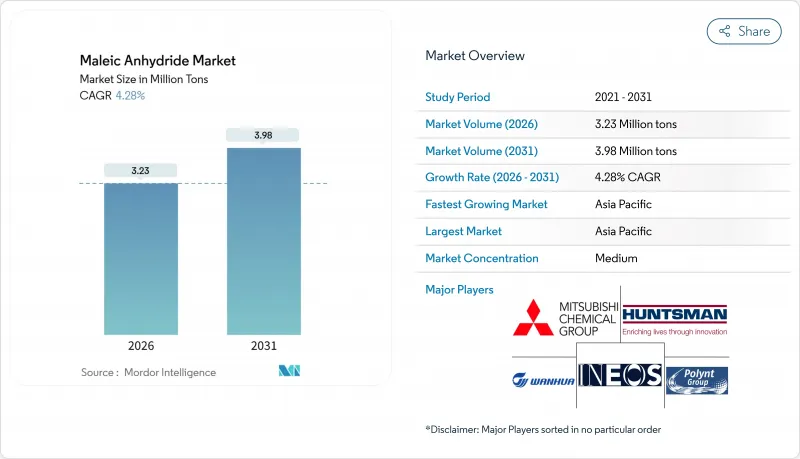
本報告按產品類型(不飽和聚酯樹脂、1,4-丁二醇、潤滑油添加劑等)、原料(正丁烷和苯)、形態(固體和熔融態)、終端用戶產業(建築、汽車等)以及地區(亞太、北美、歐洲、南美、中東和非洲)進行細分。市場預測以噸為單位。
全球順丁烯二酸酐市場趨勢及洞察
歐洲建設產業對再生PET UPR的採用正在迅速增加。
為回應歐盟2022/1616號法規(該法規強制要求在塑膠中添加再生材料)和2024年生態設計法規(該法規要求使用數位產品護照來認證循環性),歐洲複合材料製造商正積極採取措施。他們將廢舊PET與經過順丁烯二酸酐改質的不飽和聚酯樹脂混合。這項策略不僅有助於獲得綠建築積分,還能減少隱含碳排放。德國、法國和荷蘭等國引領著這一趨勢,在這些國家,對不飽和聚酯樹脂(UPR)的需求正轉向這些環保型混合產品。隨著強制性護照要求將於2026年7月生效,預計這些措施的推廣將進一步加速,從而鞏固順丁烯二酸酐作為低碳建築複合材料領域相容劑的關鍵作用。
提高正丁烷裝置的產能將降低原料成本。
到2024年,正丁烷氧化製程將佔據全球產能的主導地位。尤其值得一提的是,中國和阿曼的新建廠利用先進的磷酸釩和三葉催化劑,實現了高產率。這些進步不僅提高了生產效率,還減少了苯的排放,使這些工廠無需承擔遵守美國環保署(EPA)國家清潔空氣法排放標準(NESHAP)的成本。此外,原物料市場趨勢已轉向丁烷,使得亞太地區的生產商能夠以低於苯的成本購買丁烷。這種顯著的成本差異推動了三大洲轉化和待開發區項目的激增,鞏固了正丁烷路線的競爭優勢。
中國新增產能擴張導致全球供應過剩
2024年,以恆力工廠為首的中國新增產能使其全球產能佔有率超過70%。工廠價格大幅下跌,與北美現貨價格形成鮮明對比,推動出口激增。然而,運轉率卻有所下降。西方企業因固定成本飆升而苦苦掙扎,開始關閉工廠。亨斯邁公司於2025年中期停止了其位於莫爾斯的工廠運營,南亞公司也於2024年底暫時關閉了其位於台灣的工廠。為了因應這些挑戰,業內老牌企業目前正專注於高純度熔融產品和特種共聚物領域,這些領域來自中國的競爭仍然有限。
細分市場分析
預計到2025年,不飽和聚酯樹脂將佔順丁烯二酸酐市場佔有率的50.15%,並預計在2031年之前以4.98%的複合年成長率成長,超過整體市場表現。歐洲的法規正在推動再生PET共混物的使用。在北美,順丁烯二酸酐被用於電動車(EV)的電池機殼。這些應用起到緩衝作用,保護供應免受通用樹脂常見的周期性需求下降的影響。受亞洲地區對氨綸和PBT投資的推動,1,4-丁二醇(1,4-BDO)的需求逐年增加。雖然隨著內燃機的衰落,潤滑油添加劑的使用量也在下降,但順丁烯二酸酐共聚物表現良好。這些共聚物用於水處理和生物基包裝,有助於緩解潤滑油產業的低迷。此外,富馬酸和蘋果酸衍生物的年成長率也保持穩定,這主要得益於它們作為飲料酸味劑的應用。
特種產品雖然產量較小,但利潤率很高。例如,生物基琥珀酸共聚物在高階包裝領域擁有極高的溢價。製造商正積極進軍這些細分市場,以應對供應過剩的挑戰。尤其值得注意的是,日本在研發方面取得了顯著進展,重點是透過夫喃甲醇途徑及其下游製程生產順丁烯二酸酐的環保型共聚物。這兩個趨勢不僅鞏固了不飽和聚酯在順丁烯二酸酐銷售中的核心地位,也凸顯了其衍生物帶來的收入來源多元化。
預計到2025年,正丁烷製程將佔總產量的70.45%,成長速度超過順丁烯二酸酐市場整體成長速度。丁烷氧化反應可消除苯排放並回收氫氣(產品特有的成分),從而降低現金成本並簡化授權程序。BASF的Tri-Leaf催化劑可提高產率並降低反應器壓降,從而顯著節省成本,尤其是在能源成本佔第二大可變成本的情況下。
儘管苯基產品的市佔率有所下降,但預計到2031年,其複合年成長率仍將達到4.72%,超過整體市場成長率。這是因為現有的苯生產裝置集中在綜合石化聯合企業中,在這些聯合企業中,苯是石腦油裂解的低成本產品,而且生產商已經攤銷了合規投資。現有的苯生產設施只有在苯是其自身裂解裝置的產品時才能保持競爭力,例如亨斯邁公司位於美國墨西哥灣沿岸的工廠,該工廠與其UPR反應器位於同一廠址。然而,即使在這樣的廠址,持續運作也依賴已經攤銷的洗滌器。
區域分析
至2025年,亞太地區將佔全球糠醛產量的69.45%,預計到2031年將以4.66%的複合年成長率成長。儘管亨利石油公司(Henry Oil)的產能提升正在推動中國糠醛產量成長,但由於運轉率仍維持在70%左右,出口壓力依然龐大。印度石油公司(Indian Oil)在帕尼帕特的計畫標誌著印度從70%的進口依賴邁向自給自足的重要一步。同時,日本和韓國正致力於高純度和生物基糠醛的研發,為2028年後夫喃甲醇生產的商業性轉型奠定基礎。
北美正處於成長軌道,這主要得益於電動車的生產以及美墨加協定(USMCA)對國內含量的要求。伊利諾伊州和西維吉尼亞新建的丁烷工廠專門用於內部樹脂生產,而墨西哥灣沿岸地區的苯生產廠僅在洗滌器折舊免稅額後才運作。該地區的銷售價格通常高於中國出口價格,這表明存在基於物流成本和純度的溢價。
歐洲的需求量佔相當大的比例,但由於能源價格飆升和苯排放法規日益嚴格,其成長速度略顯緩慢。然而,歐洲再生PET複合複合材料的激增以及即將推出的數位護照,正在緩衝順丁烯二酸酐市場免受來自亞洲進口產品的衝擊。在南美洲以及中東和非洲地區,一些戰略投資項目正在湧現,例如ABP在阿曼的工廠,該工廠利用廉價的丁烷來滿足非洲和中東地區長期供應不足的樹脂市場需求。
其他好處:
- Excel格式的市場預測(ME)表
- 3個月的分析師支持
目錄
第1章:引言
- 研究假設和市場定義
- 調查範圍
第2章:調查方法
第3章執行摘要
第4章 市場狀況
- 市場概覽
- 市場促進因素
- 歐洲建設產業對再生PET UPR的採用正在迅速增加。
- 正丁烷工廠產能的提高導致原料成本下降。
- 北美地區對電動車用輕質SMC面板的需求不斷成長,推動了UPR的需求上升。
- 亞洲對用於氨綸和PBT布料的1,4-丁二醇的需求不斷成長
- 生物基琥珀酸共聚物可實現高利潤率。
- 市場限制因素
- 中國新增產能擴張導致全球供應過剩。
- 經合組織收緊苯排放限制,導致合規成本增加。
- 內燃機的逐步淘汰減少了與潤滑油添加劑相關的衍生物的產量。
- 價值鏈分析
- 波特五力模型
- 價格趨勢
第5章 市場規模與成長預測
- 依產品類型
- 不飽和聚酯樹脂
- 1,4-丁二醇
- 潤滑劑添加劑
- 順丁烯二酸酐共聚物
- 蘋果酸
- 富馬酸
- 烷基琥珀酸酐
- 表面活性劑和塑化劑
- 其他產品類型
- 按原料
- 正丁烷
- 苯
- 按形式
- 固體(片狀/顆粒狀)
- 熔融狀態
- 按最終用戶行業分類
- 建造
- 車
- 電子設備
- 食品/飲料
- 石油產品
- 個人護理
- 製藥
- 農業
- 按地區
- 亞太地區
- 中國
- 印度
- 日本
- 韓國
- 其他亞太國家
- 北美洲
- 美國
- 加拿大
- 墨西哥
- 歐洲
- 德國
- 英國
- 法國
- 義大利
- 其他歐洲國家
- 南美洲
- 巴西
- 阿根廷
- 其他南美國家
- 中東和非洲
- 沙烏地阿拉伯
- 南非
- 其他中東和非洲國家
- 亞太地區
第6章 競爭情勢
- 市場集中度
- 策略趨勢
- 市佔率分析
- 公司簡介
- AOC
- Arkema
- Ashland
- Bartek Ingredients Inc.
- BASF
- Borealis AG
- Clariant
- Evonik Industries AG
- Huntsman International LLC
- IG Petrochemicals Ltd.(IGPL)
- INEOS AG
- LANXESS
- Mitsubishi Chemical Group Corporation
- NAN YA PLASTICS CORPORATION
- NIPPON SHOKUBAI CO., LTD.
- PETRONAS Chemicals Group Berhad
- Polynt SpA
- Sinopec Qilu Petrochemical
- SK Functional Polymer
- Thirumalai Chemicals
- Wanhua
第7章 市場機會與未來展望
According to Mordor Intelligence, the maleic anhydride market size is estimated at 3.23 million tons in 2026, and is expected to reach 3.98 million tons by 2031, at a CAGR of 4.28% during the forecast period (2026-2031).
This report is Segmented by Product Type (Unsaturated Polyester Resin, 1, 4-Butanediol, Lubricant Additives, and More), Raw Material (N-Butane and Benzene), Physical Form (Solid and Molten), End-User Industry (Construction, Automobile, and More), and Geography (Asia-Pacific, North America, Europe, South America, and Middle-East and Africa). The Market Forecasts are Provided in Terms of Volume (Tons).
Global Maleic Anhydride Market Trends and Insights
Surging Adoption of Recycled-PET UPR in European Construction
In response to EU Regulation 2022/1616, which mandates recycled content in plastics, and the 2024 Ecodesign Regulation, requiring digital product passports to certify circular attributes, European composite producers are taking proactive steps. They are blending post-consumer PET with maleic-anhydride-modified unsaturated polyester resin. This strategy not only helps them secure green-building credits but also enables a reduction in embodied carbon. Countries like Germany, France, and the Netherlands are leading the charge, channeling their UPR demand into these eco-friendly blends. With passport obligations set to take effect in July 2026, the adoption of these practices is poised to accelerate, solidifying maleic anhydride's pivotal role as a compatibilizer in the realm of low-carbon construction composites.
Capacity Additions of N-Butane Plants Lowering Feedstock Cost
In 2024, n-butane oxidation dominated with a commanding share of global capacity. Notably, new facilities in China and Oman, leveraging cutting-edge vanadium-phosphate and tri-leaf catalysts, are achieving high yields. These advancements not only enhance productivity but also mitigate benzene emissions, allowing these facilities to dodge EPA NESHAP compliance costs. Furthermore, feedstock dynamics tilt in favor of butane, while producers in the Asia-Pacific region paid less for butane than for benzene. This pronounced cost disparity is fueling a surge in conversions and greenfield projects across three continents, solidifying the n-butane route's competitive advantage.
Global Oversupply Driven by New Chinese Capacities
In 2024, China unveiled new capacity, spearheaded by Hengli's complex, pushing China's global output share past the 70% mark. Ex-works prices plummeted, a stark contrast to North America's spot prices, igniting a surge in exports. Meanwhile, utilization rates dipped. Western players, grappling with elevated fixed costs, began shuttering plants: Huntsman ceased operations at its Moers facility in mid-2025, and Nan Ya put its Taiwan site on hold in late 2024. In a bid to navigate these challenges, industry incumbents are now focusing on high-purity molten supplies and specialty copolymers, areas where competition from China remains limited.
Other drivers and restraints analyzed in the detailed report include:
- Lightweight SMC Panels for EVs Boosting UPR Demand in North America
- Rising 1,4-BDO Demand for Spandex and PBT in Asia
- Stricter OECD Benzene-Emission Caps Raising Compliance Cost
For complete list of drivers and restraints, kindly check the Table Of Contents.
Segment Analysis
Unsaturated polyester resin secured 50.15% of the maleic anhydride market share in 2025 and is tracking a 4.98% CAGR to 2031, ahead of the overall market. European regulations are pushing for the use of recycled-PET blends. In North America, electric vehicle (EV) battery enclosures are utilizing maleic anhydride for each vehicle. These applications act as a buffer, shielding volumes from the cyclical downturns often seen in commodity resins. Demand for 1,4-BDO is on an annual growth trajectory, driven by investments in spandex and PBT across Asia. While the usage of lubricant additives has seen a decline as combustion engines wane, maleic anhydride copolymers are thriving. These copolymers, utilized in water treatment and bio-based packaging, are helping to mitigate the downturn in lubricants. Additionally, fumaric and malic acid derivatives are witnessing steady annual growth, primarily fueled by their use as beverage acidulants.
Specialty products, despite their lower volumes, command significant margins. For instance, bio-based succinic-acid copolymers are achieving impressive premiums in the premium packaging sector. Producers are strategically tapping into these niche markets to navigate the challenges of oversupply. Notably, Japanese research and development is making strides, focusing on the furfural-route maleic anhydride and its downstream green copolymers. This dual landscape not only solidifies unsaturated polyester's central role in the maleic anhydride market's revenue but also highlights the diversification of profit pools through its derivatives.
The n-butane route dominated 70.45% of production in 2025 and is projected to grow faster than the overall maleic anhydride market. Butane oxidation eliminates benzene emissions and captures co-product hydrogen, delivering lower cash costs and simpler permitting. BASF's tri-leaf catalyst boosts yield and reduces reactor pressure drop, translating to significant savings, especially with energy being the second-largest variable cost.
Benzene-based production, though declining in share, is forecast to grow at a 4.72% CAGR through 2031, faster than the overall market, because surviving benzene-route plants are concentrated in integrated petrochemical complexes where benzene is a low-cost byproduct of naphtha cracking and where producers have already amortized compliance investments. Surviving benzene units remain competitive only where benzene is an internal cracker by-product, for example, Huntsman's U.S. Gulf Coast sites co-located with UPR reactors. Even there, continued operation hinges on already-amortized scrubbers.
Complete Report Scope:
- By Product Type
- Unsaturated Polyester Resin
- 1,4-Butanediol
- Lubricant Additives
- Maleic Anhydride Copolymers
- Malic Acid
- Fumaric Acid
- Alkyl Succinic Anhydrides
- Surfactants and Plasticizers
- Other Product Types
- By Raw Material
- N-Butane
- Benzene
- By Physical Form
- Solid (Flake / Prill)
- Molten
- By End-user Industry
- Construction
- Automobile
- Electronics
- Food and Beverage
- Oil Products
- Personal Care
- Pharmaceuticals
- Agriculture
- By Geography
- Asia-Pacific
- China
- India
- Japan
- South Korea
- Rest of Asia-Pacific
- North America
- United States
- Canada
- Mexico
- Europe
- Germany
- United Kingdom
- France
- Italy
- Rest of Europe
- South America
- Brazil
- Argentina
- Rest of South America
- Middle-East and Africa
- Saudi Arabia
- South Africa
- Rest of Middle-East and Africa
- Asia-Pacific
Geography Analysis
Asia-Pacific held 69.45% of global volume in 2025 and advances at a 4.66% CAGR to 2031. Hengli alone boosts China's output, but with utilization rates lingering around 70%, export pressures remain pronounced. Indian Oil's project in Panipat signals India's pivot from a 70% reliance on imports to a stride towards self-sufficiency. Meanwhile, Japan and South Korea are channeling efforts into high-purity and bio-based research and development, setting the stage for a commercial leap into furfural routes after 2028.
North America is on a growth trajectory, buoyed by EV production and USMCA content stipulations. New butane facilities in Illinois and West Virginia are dedicated to in-house resin production, and Gulf Coast benzene units operate solely where scrubbers have seen their depreciation. Selling prices in the region often surpass Chinese exports, underscoring the logistics and purity premiums commanded.
Europe, holding a share of demand, is expanding at a more tempered pace, grappling with energy-price challenges and stringent benzene-emission regulations. However, Europe's surge in recycled-PET composites and the impending rollout of digital passports provide a cushion for the maleic anhydride market against the influx of Asian imports. South America and the MEA region see strategic investments like ABP's plant in Oman, which capitalizes on affordable butane to cater to the resin markets in Africa and the Middle East that have long been underserved.
- AOC
- Arkema
- Ashland
- Bartek Ingredients Inc.
- BASF
- Borealis AG
- Clariant
- Evonik Industries AG
- Huntsman International LLC
- I G Petrochemicals Ltd. (IGPL)
- INEOS AG
- LANXESS
- Mitsubishi Chemical Group Corporation
- NAN YA PLASTICS CORPORATION
- NIPPON SHOKUBAI CO., LTD.
- PETRONAS Chemicals Group Berhad
- Polynt S.p.A.
- Sinopec Qilu Petrochemical
- SK Functional Polymer
- Thirumalai Chemicals
- Wanhua
Additional Benefits:
- The market estimate (ME) sheet in Excel format
- 3 months of analyst support
TABLE OF CONTENTS
1 Introduction
- 1.1 Study Assumptions and Market Definition
- 1.2 Scope of the Study
2 Research Methodology
3 Executive Summary
4 Market Landscape
- 4.1 Market Overview
- 4.2 Market Drivers
- 4.2.1 Surging adoption of recycled-PET UPR in European construction
- 4.2.2 Capacity additions of n-butane plants lowering feedstock cost
- 4.2.3 Lightweight SMC panels for EVs boosting UPR demand in North America
- 4.2.4 Rising 1,4-BDO demand for spandex and PBT in Asia
- 4.2.5 Bio-based succinic-acid copolymers unlocking premium margins
- 4.3 Market Restraints
- 4.3.1 Global oversupply driven by new Chinese capacities
- 4.3.2 Stricter OECD benzene-emission caps raising compliance cost
- 4.3.3 ICE phase-out curbing lube-oil-additive derivatives
- 4.4 Value Chain Analysis
- 4.5 Porter's Five Forces
- 4.5.1 Bargaining Power of Suppliers
- 4.5.2 Bargaining Power of Buyers
- 4.5.3 Threat of New Entrants
- 4.5.4 Threat of Substitutes
- 4.5.5 Competitive Rivalry
- 4.6 Price Trend
5 Market Size and Growth Forecasts (Volume)
- 5.1 By Product Type
- 5.1.1 Unsaturated Polyester Resin
- 5.1.2 1,4-Butanediol
- 5.1.3 Lubricant Additives
- 5.1.4 Maleic Anhydride Copolymers
- 5.1.5 Malic Acid
- 5.1.6 Fumaric Acid
- 5.1.7 Alkyl Succinic Anhydrides
- 5.1.8 Surfactants and Plasticizers
- 5.1.9 Other Product Types
- 5.2 By Raw Material
- 5.2.1 N-Butane
- 5.2.2 Benzene
- 5.3 By Physical Form
- 5.3.1 Solid (Flake / Prill)
- 5.3.2 Molten
- 5.4 By End-user Industry
- 5.4.1 Construction
- 5.4.2 Automobile
- 5.4.3 Electronics
- 5.4.4 Food and Beverage
- 5.4.5 Oil Products
- 5.4.6 Personal Care
- 5.4.7 Pharmaceuticals
- 5.4.8 Agriculture
- 5.5 By Geography
- 5.5.1 Asia-Pacific
- 5.5.1.1 China
- 5.5.1.2 India
- 5.5.1.3 Japan
- 5.5.1.4 South Korea
- 5.5.1.5 Rest of Asia-Pacific
- 5.5.2 North America
- 5.5.2.1 United States
- 5.5.2.2 Canada
- 5.5.2.3 Mexico
- 5.5.3 Europe
- 5.5.3.1 Germany
- 5.5.3.2 United Kingdom
- 5.5.3.3 France
- 5.5.3.4 Italy
- 5.5.3.5 Rest of Europe
- 5.5.4 South America
- 5.5.4.1 Brazil
- 5.5.4.2 Argentina
- 5.5.4.3 Rest of South America
- 5.5.5 Middle-East and Africa
- 5.5.5.1 Saudi Arabia
- 5.5.5.2 South Africa
- 5.5.5.3 Rest of Middle-East and Africa
- 5.5.1 Asia-Pacific
6 Competitive Landscape
- 6.1 Market Concentration
- 6.2 Strategic Moves
- 6.3 Market Share Analysis
- 6.4 Company Profiles (includes Global-level Overview, Market-level Overview, Core Segments, Financials as available, Strategic Information, Products and Services, and Recent Developments)
- 6.4.1 AOC
- 6.4.2 Arkema
- 6.4.3 Ashland
- 6.4.4 Bartek Ingredients Inc.
- 6.4.5 BASF
- 6.4.6 Borealis AG
- 6.4.7 Clariant
- 6.4.8 Evonik Industries AG
- 6.4.9 Huntsman International LLC
- 6.4.10 I G Petrochemicals Ltd. (IGPL)
- 6.4.11 INEOS AG
- 6.4.12 LANXESS
- 6.4.13 Mitsubishi Chemical Group Corporation
- 6.4.14 NAN YA PLASTICS CORPORATION
- 6.4.15 NIPPON SHOKUBAI CO., LTD.
- 6.4.16 PETRONAS Chemicals Group Berhad
- 6.4.17 Polynt S.p.A.
- 6.4.18 Sinopec Qilu Petrochemical
- 6.4.19 SK Functional Polymer
- 6.4.20 Thirumalai Chemicals
- 6.4.21 Wanhua
7 Market Opportunities and Future Outlook
- 7.1 White-space and Unmet-Need Assessment
- 7.2 Commercialization of Bio-based Maleic Anhydride

 無水馬來酸市場:依原料、製造流程、形態、終端用戶產業、應用及通路分類-2026-2032年全球市場預測
 全球順丁烯二酸酐市場(至2035年):依原料(正丁烷/苯)、應用(UPR/1,4-丁二醇/潤滑油添加劑/共聚物)及地區分類
 順丁烯二酸酐市場規模、佔有率和成長分析:按原料、應用、終端用戶產業和地區分類-2026-2033年產業預測
 順丁烯二酸酐市場:依原料、應用及地區分類
 馬來酸酐市場:依原料、應用、終端用戶產業及地區分類(2026-2034 年)
 全球馬來酸酐市場規模、佔有率、趨勢和成長分析報告(2026-2034年)
 2026年順丁烯二酸酐全球市場報告
 順丁烯二酸酐產能、需求、平均價格及產業展望:至2034年熔融順丁烯二酸酐市場:按等級、形態、製造流程、通路、應用和最終用途行業分類 - 全球預測(2026-2032年)2026-2032年順丁烯二酸酐市場(按原始材料、應用、最終用戶產業和地區分類)