


 |
市場調查報告書
商品編碼
2122049
高性能纖維:市場佔有率分析、產業趨勢與統計、成長預測(2026-2031)High-Performance Fibers - Market Share Analysis, Industry Trends & Statistics, Growth Forecasts (2026 - 2031) |
||||||

※ 本網頁內容可能與最新版本有所差異。詳細情況請與我們聯繫。
據 Mordor Intelligence 稱,高性能紡織品市場在 2025 年的價值為 179.1 億美元,預計到 2031 年將達到 284.3 億美元,而 2026 年為 193.5 億美元,預測期(2026-2031 年)的複合年成長率為 8.01%。
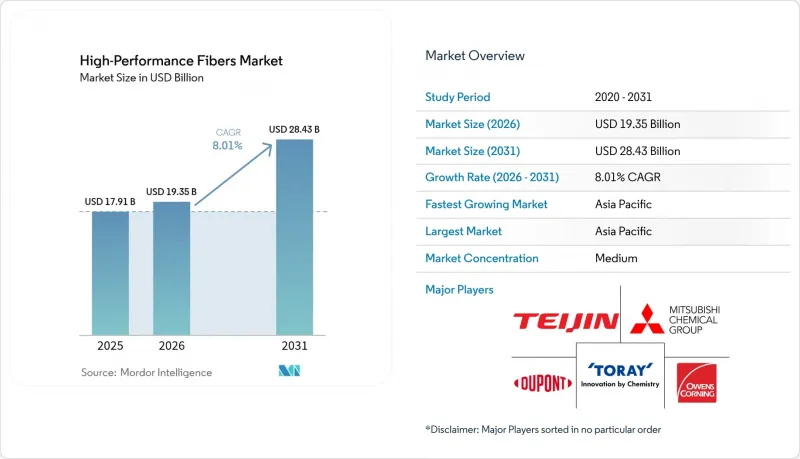
本報告按類型(碳纖維、醯胺纖維、玻璃纖維、聚亞苯硫醚(PPS)等)、終端用戶產業(航太與國防、汽車、運動用品、替代能源、電子與通訊等)以及地區(亞太、北美、歐洲、南美、中東和非洲)進行細分。市場預測以美元(USD)計價。
全球高性能纖維市場趨勢與洞察
對輕型離岸風力發電機葉片的需求正在激增。
長度超過100公尺的風力渦輪機葉片如今消耗的碳纖維量遠超過以往車型。此外,自動化纖維鋪放技術的進步降低了生產成本,使得風電成為部分製造商最大的市場,甚至超過了航太業。碳纖維和玻璃纖維的混合材料正被用於平衡剛性、耐腐蝕性和防雷性能。中國和歐洲的葉片製造商擁有自己的纖維生產線,隨著他們在北海和東海地區快速擴大產能,正獲得成本優勢。
來自航太和國防工業的高需求
隨著戰鬥機中隊的現代化、無人機系統和航太運載火箭的發展,國防預算持續投入超高模量碳纖維和陶瓷纖維。隨著民用航空的復甦,複合材料的寬體飛機訂單再次增加,而「更電氣化」飛機架構的引入也帶來了電磁屏蔽方面的新要求,使得碳纖維和醯胺纖維的混合層壓板成為首選。
聚丙烯腈(PAN)前驅物的高度可變供應鏈
2024年聚丙烯腈價格30-40%的波動擠壓了那些未整合上游工程的獨立紡絲企業的利潤空間。掌握前體產能的東麗和中國主要生產商得以避免價格飆升的影響,而歐美多家生產商則推遲了擴張計劃,直到原料供應前景更加穩定。美國先導計畫預計將原料多元化,但商業化生產預計仍需數年時間。
細分市場分析
預計到2025年,碳纖維將佔據高性能纖維市場42.35%的佔有率,並在2031年之前以8.88%的複合年成長率持續成長,這主要得益於汽車輕量化法規和可再生能源基礎設施建設的推動。亞洲生產商如中復神鷹正在江蘇省投資8.66億美元,新增年產能3萬噸的碳纖維生產線,進軍對成本高度敏感的工業領域。醯胺纖維在防彈和通訊應用領域繼續保持主導地位。帝人公司位於荷蘭的工業規模回收工廠將芳香聚醯胺紗線再加工,可再生新型纖維,進而降低整個生命週期的排放。玻璃纖維仍然是建築和標準汽車面板的低成本主要材料。同時,由於電動車電池組對耐熱性和耐化學性的需求,聚亞苯硫醚(PPS)正經歷兩位數的成長。超高分子量聚乙烯(UHMWPE)纖維和陶瓷纖維分別在低溫儲存和高超音波平台中發揮獨特的作用。
工業級碳纖維整體的快速下降正促使籌資策略重組。汽車製造商正在簽署多年期合約以確保供應,而風力渦輪機製造商則在談判代工協議,以價格上限換取供應量的保證。材料複合材料生產商正在將碳纖維絲束與低黏度環氧樹脂結合,以實現高產量的葉片生產目標。同時,高性能纖維市場正在加大對木質素衍生碳的風險投資,以減少對聚丙烯腈(PAN)的依賴並提高環境性能。儘管仍處於商業化前期階段,但試點生產線已能生產出彈性模量為35 Msi或更高的纖維,適用於運動用品的層壓結構,這表明未來五年內,現有供應鏈有望發生變革。
區域分析
預計到2025年,亞太地區將主導高性能纖維市場,佔40.10%的市場佔有率,主要得益於中國積極推動可再生能源部署和汽車電氣化。中國的「十四五」規劃正推動每年離岸風力發電,預計大直徑葉片中纖維的使用量將增加一倍。國內製造商已打破西方公司在T1000級碳纖維領域的壟斷地位,使本土OEM廠商能夠滿足先進戰鬥機的國防和航太標準。日本的東麗和帝人繼續引領高階細分市場,而韓國則將PPS和玻璃纖維應用於電池外殼和電子基板。
在北美,國內碳纖維生產正被優先發展,這得益於《通膨控制法案》和「購買美國貨」政策的支持。到2027年,華盛頓州、阿拉巴馬州和魁北克省的新生產線將每年新增超過15,000噸的產能,從而減少對亞洲前體的依賴,並符合戰鬥機計畫和航太火箭的國家安全目標。隨著墨西哥擴大其電動車組裝能,醯胺纖維和玻璃纖維的進口正向墨西哥轉移,導致區域加工商將業務集中到更靠近最終組裝地點的地方。
歐洲市場趨勢強調永續性和循環經濟原則,在法律規範內,生物基和可回收纖維解決方案正日益優先於傳統材料。該地區的風電產業是碳纖維需求的主要驅動力,而汽車應用則專注於支援減排目標的輕量化解決方案。德國汽車製造商正在檢驗易於重熔的熱塑性碳纖維結構,北歐能源開發公司則在離岸風力發電原型中測試生物基環氧樹脂基體。儘管該地區的成長速度落後於亞洲,但嚴格的品質和環境標準使得平均售價高於亞洲。
南美和中東的新需求正利用基礎設施和可再生能源領域的大型企劃帶來的機遇,但外匯波動和熟練工人短缺抑制了其發展勢頭。
其他好處:
- Excel格式的市場預測(ME)表
- 3個月的分析師支持
目錄
第1章:引言
- 研究假設和市場定義
- 調查範圍
第2章:調查方法
第3章執行摘要
第4章 市場狀況
- 市場概覽
- 市場促進因素
- 對輕型離岸風力發電機葉片的需求正在激增。
- 來自航太和國防工業的高需求
- IV型氫氣壓力容器的商業化應用
- 5G光纖電纜向芳香聚醯胺紗線過渡
- 體育用品和防護裝備需求量大。
- 市場限制因素
- 聚丙烯腈(PAN)前驅物的高度可變供應鏈
- 多材料複合材料缺乏回收基礎設施
- 中國產能過剩導致價格承壓。
- 價值鏈分析
- 波特五力模型
第5章 市場規模與成長預測
- 按類型
- 碳纖維
- 複合材料
- 碳纖維增強塑膠(CFRP)
- 碳纖維增強碳纖維(RCC)
- 紡織品
- 微電極
- 催化劑
- 複合材料
- 醯胺纖維
- 間位芳香聚醯胺
- 對位芳香聚醯胺
- 玻璃纖維
- 聚亞苯硫醚(PPS)
- 其他類型(超高分子量聚乙烯(UHMWPE)、Polybenzimidazole(PBI)、聚(對苯撐-2,6-苯並雙噁唑)(PBO)、碳化矽(SiC)、玄武岩)
- 碳纖維
- 按最終用戶行業分類
- 航太/國防
- 車
- 體育用品
- 替代能源
- 電子與通訊
- 建築和基礎設施
- 其他終端用戶產業(醫療保健、醫療設備等)
- 按地區
- 亞太地區
- 中國
- 日本
- 印度
- 韓國
- 東南亞國協
- 其他亞太國家
- 北美洲
- 美國
- 加拿大
- 墨西哥
- 歐洲
- 德國
- 英國
- 法國
- 義大利
- 西班牙
- 俄羅斯
- 北歐國家
- 其他歐洲國家
- 南美洲
- 巴西
- 阿根廷
- 其他南美國家
- 中東和非洲
- 沙烏地阿拉伯
- 南非
- 其他中東和非洲國家
- 亞太地區
第6章 競爭情勢
- 市場集中度
- 策略趨勢
- 市佔率和排名分析
- 公司簡介
- Avient Corporation
- Bally Ribbon Mills
- China Jushi Co., Ltd.
- DuPont
- Hexcel Corporation
- Honeywell International Inc.
- Huvis Corp
- Kolon Industries, Inc.
- Kureha Corporation
- Mitsubishi Chemical Carbon Fiber and Composites, Inc.
- Owens Corning
- PBI Performance Products, Inc.
- Sarla Performance Fibers Limited
- Solvay
- Teijin Limited
- Toray Industries Inc.
- Toyobo Co., Ltd.
- TOYOBO MC Corporation
- Weihai Guangwei Group Co., Ltd.
- WL Gore & Associates
- Yantai Tayho Advanced Materials Co., Ltd.
第7章 市場機會與未來展望
According to Mordor Intelligence, the high-Performance fibers market size was valued at USD 17.91 billion in 2025 and estimated to grow from USD 19.35 billion in 2026 to reach USD 28.43 billion by 2031, at a CAGR of 8.01% during the forecast period (2026-2031).
This report is Segmented by Type (Carbon Fiber, Aramid Fiber, Glass Fiber, Polyphenylene Sulfide (PPS), and More), End-User Industry (Aerospace and Defense, Automotive, Sporting Goods, Alternative Energy, Electronics & Telecommunications, and More), and Geography (Asia-Pacific, North America, Europe, South America, and Middle-East and Africa). The Market Forecasts are Provided in Value (USD).
Global High-Performance Fibers Market Trends and Insights
Surging Demand for Lightweight Offshore-Wind Blades
Turbine blades topping 100 m now consume far greater volumes of carbon fiber than earlier models, and automated fiber placement is lowering production costs, allowing wind to surpass aerospace as the single largest volume outlet for some manufacturers. Hybrids that combine carbon and glass are being adopted to balance stiffness, corrosion resistance, and lightning-strike protection. Chinese and European blade makers with captive fiber lines gain cost advantages during rapid capacity build-outs in the North Sea and East China Sea.
High Demand from Aerospace and Defense Industry
Modernization of fighter fleets, uncrewed aerial systems, and space-launch vehicles keeps defense budgets invested in ultra-high-modulus carbon and ceramic fibers. Commercial aviation recovery has renewed orders for composite-rich wide-body platforms, while "more-electric" aircraft architectures introduce electromagnetic-shielding requirements that favor hybrid carbon-aramid lay-ups.
Volatile Polyacrylonitrile (PAN)-Precursor Supply Chain
Polyacrylonitrile price swings of 30-40% in 2024 curtailed margins for independent spinners lacking backward integration. Toray and domestic Chinese majors that control precursor capacity insulated themselves from spikes, while several Western producers postponed expansion plans pending more stable feedstock visibility. Bio-based acrylonitrile pilot projects in the United States could diversify inputs, yet commercial output remains years away.
Other drivers and restraints analyzed in the detailed report include:
- Commercial Rollout of Type-IV Hydrogen Pressure Vessels
- 5G Fiber-Optic Cabling Shift to Aramid Yarn
- Limited Recycling Infrastructure for Multi-Material Composites
For complete list of drivers and restraints, kindly check the Table Of Contents.
Segment Analysis
Carbon fiber captured 42.35% of the high-performance fibers market share in 2025 and is forecast to climb at a 8.88% CAGR to 2031, underpinned by automotive lightweighting mandates and renewable-energy infrastructure roll-outs. Asia-based producers such as Zhongfu Shenying are injecting fresh capacity-USD 866 million for 30,000 t/y in Jiangsu-to penetrate cost-sensitive industrial segments. Aramid continues to dominate ballistic and telecom applications; Teijin's industrial-scale recycling plant in the Netherlands now reprocesses aramid yarn into new fiber, lowering lifecycle emissions. Glass fiber remains the low-cost mainstay for construction and standard automotive panels, while polyphenylene sulfide (PPS) enjoys double-digit growth as electric-vehicle battery packs require thermal and chemical resilience. UHMWPE and ceramic fibers fill niche roles in cryogenic storage and hypersonic platforms, respectively.
Rapid cost erosion across industrial-grade carbon is reshaping procurement strategies. Automakers are locking multiyear contracts to assure supply, while wind OEMs negotiate tolling arrangements that exchange volume commitments for price ceilings. Material formulators are coupling carbon tow with low-viscosity epoxy resins to meet high-throughput blade production targets. Concurrently, the high-performance fibers market is witnessing growing venture investment in lignin-derived carbon to ease PAN dependence and improve environmental credentials. Although still pre-commercial, pilot lines have produced 35+ Msi modulus fibers suitable for sporting-goods laminates, signaling potential to disrupt incumbent supply chains later in the decade.
Complete Report Scope:
- By Type
- Carbon Fiber
- Composite Materials
- Carbon Fiber Reinforced Polymer (CFRP)
- Reinforced Carbon Carbon (RCC)
- Textiles
- Microelectrodes
- Catalysis
- Composite Materials
- Aramid Fiber
- Meta-Aramid
- Para-Aramid
- Glass Fiber
- Polyphenylene Sulfide (PPS)
- Other Types (Ultra-High Molecular Weight Polyethylene (UHMWPE), Polybenzimidazole (PBI), Poly(p-phenylene-2,6-benzobisoxazole)(PBO), Silicon Carbide (SiC), Basalt)
- Carbon Fiber
- By End-user Industry
- Aerospace & Defense
- Automotive
- Sporting Goods
- Alternative Energy
- Electronics & Telecommunications
- Construction & Infrastructure
- Other End User Industries (Healthcare & Medical Devices, etc.)
- By Geography
- Asia-Pacific
- China
- Japan
- India
- South Korea
- ASEAN Countries
- Rest of Asia-Pacific
- North America
- United States
- Canada
- Mexico
- Europe
- Germany
- United Kingdom
- France
- Italy
- Spain
- Russia
- NORDIC Countries
- Rest of Europe
- South America
- Brazil
- Argentina
- Rest of South America
- Middle East and Africa
- Saudi Arabia
- South Africa
- Rest of Middle East and Africa
- Asia-Pacific
Geography Analysis
Asia-Pacific dominates with 40.10% of the high-performance fibers market share in 2025, propelled by China's renewable-energy deployment and aggressive vehicle-electrification timelines. Beijing's Five-Year Plan backs >100 GW/year of offshore-wind additions, doubling fiber usage in large-diameter blades. Domestic producers have broken Western monopoly on T1000-class carbon, enabling local OEMs to meet defense and aerospace specifications for advanced fighter jets. Japan's Toray and Teijin continue to command premium niches, while South Korea channels PPS and glass fiber into battery housings and electronic substrates.
North America, supported by the Inflation Reduction Act and Buy-American policies, is prioritizing domestic carbon-fiber output. New lines in Washington State, Alabama, and Quebec will add >15,000 t/y by 2027, mitigating reliance on Asian precursors and aligning with national-security objectives for fighter programs and space launchers. Mexico's growing EV assembly capacity is pulling aramid and glass imports south of the border, prompting regional converters to co-locate near final assembly hubs.
Europe's market evolution emphasizes sustainability and circular economy principles, with regulatory frameworks that increasingly favor bio-based and recyclable fiber solutions over conventional materials. The region's wind energy sector drives significant carbon fiber demand, while automotive applications focus on lightweight solutions that support emission reduction targets . German automakers validate thermoplastic carbon architectures that allow easier re-melt, while Nordic energy developers test bio-based epoxy matrices in offshore prototypes. Regional growth lags Asia's pace yet commands higher average selling prices due to stringent quality and environmental standards.
Emerging demand in South America and the Middle East remains opportunistic, tied to infrastructure and renewable-energy megaprojects but tempered by currency volatility and skills shortages.
- Avient Corporation
- Bally Ribbon Mills
- China Jushi Co., Ltd.
- DuPont
- Hexcel Corporation
- Honeywell International Inc.
- Huvis Corp
- Kolon Industries, Inc.
- Kureha Corporation
- Mitsubishi Chemical Carbon Fiber and Composites, Inc.
- Owens Corning
- PBI Performance Products, Inc.
- Sarla Performance Fibers Limited
- Solvay
- Teijin Limited
- Toray Industries Inc.
- Toyobo Co., Ltd.
- TOYOBO MC Corporation
- Weihai Guangwei Group Co., Ltd.
- W. L. Gore & Associates
- Yantai Tayho Advanced Materials Co., Ltd.
Additional Benefits:
- The market estimate (ME) sheet in Excel format
- 3 months of analyst support
TABLE OF CONTENTS
1 Introduction
- 1.1 Study Assumptions & Market Definition
- 1.2 Scope of the Study
2 Research Methodology
3 Executive Summary
4 Market Landscape
- 4.1 Market Overview
- 4.2 Market Drivers
- 4.2.1 Surging Demand for Lightweight Offshore-Wind Blades
- 4.2.2 High Demand from Aerodpace and Defense Industry
- 4.2.3 Commercial Rollout of Type-IV Hydrogen Pressure Vessels
- 4.2.4 5G fiber-optic Cabling Shift to Aramid Yarn
- 4.2.5 High Demand for Sporting and Protective Products
- 4.3 Market Restraints
- 4.3.1 Volatile Polyacrylonitrile (PAN)-Precursor Supply Chain
- 4.3.2 Limited Recycling Infrastructure for Multi-Material Composites
- 4.3.3 Chinese Over-Capacity Driving Price Compression
- 4.4 Value Chain Analysis
- 4.5 Porter's Five Forces
- 4.5.1 Bargaining Power of Suppliers
- 4.5.2 Bargaining Power of Buyers
- 4.5.3 Threat of New Entrants
- 4.5.4 Threat of Substitutes
- 4.5.5 Degree of Competition
5 Market Size & Growth Forecasts (Value)
- 5.1 By Type
- 5.1.1 Carbon Fiber
- 5.1.1.1 Composite Materials
- 5.1.1.1.1 Carbon Fiber Reinforced Polymer (CFRP)
- 5.1.1.1.2 Reinforced Carbon Carbon (RCC)
- 5.1.1.2 Textiles
- 5.1.1.3 Microelectrodes
- 5.1.1.4 Catalysis
- 5.1.1.1 Composite Materials
- 5.1.2 Aramid Fiber
- 5.1.2.1 Meta-Aramid
- 5.1.2.2 Para-Aramid
- 5.1.3 Glass Fiber
- 5.1.4 Polyphenylene Sulfide (PPS)
- 5.1.5 Other Types (Ultra-High Molecular Weight Polyethylene (UHMWPE), Polybenzimidazole (PBI), Poly(p-phenylene-2,6-benzobisoxazole)(PBO), Silicon Carbide (SiC), Basalt)
- 5.1.1 Carbon Fiber
- 5.2 By End-user Industry
- 5.2.1 Aerospace & Defense
- 5.2.2 Automotive
- 5.2.3 Sporting Goods
- 5.2.4 Alternative Energy
- 5.2.5 Electronics & Telecommunications
- 5.2.6 Construction & Infrastructure
- 5.2.7 Other End User Industries (Healthcare & Medical Devices, etc.)
- 5.3 By Geography
- 5.3.1 Asia-Pacific
- 5.3.1.1 China
- 5.3.1.2 Japan
- 5.3.1.3 India
- 5.3.1.4 South Korea
- 5.3.1.5 ASEAN Countries
- 5.3.1.6 Rest of Asia-Pacific
- 5.3.2 North America
- 5.3.2.1 United States
- 5.3.2.2 Canada
- 5.3.2.3 Mexico
- 5.3.3 Europe
- 5.3.3.1 Germany
- 5.3.3.2 United Kingdom
- 5.3.3.3 France
- 5.3.3.4 Italy
- 5.3.3.5 Spain
- 5.3.3.6 Russia
- 5.3.3.7 NORDIC Countries
- 5.3.3.8 Rest of Europe
- 5.3.4 South America
- 5.3.4.1 Brazil
- 5.3.4.2 Argentina
- 5.3.4.3 Rest of South America
- 5.3.5 Middle East and Africa
- 5.3.5.1 Saudi Arabia
- 5.3.5.2 South Africa
- 5.3.5.3 Rest of Middle East and Africa
- 5.3.1 Asia-Pacific
6 Competitive Landscape
- 6.1 Market Concentration
- 6.2 Strategic Moves
- 6.3 Market Share(%)/Ranking Analysis
- 6.4 Company Profiles (includes Global-level Overview, Market-level Overview, Core Segments, Financials, Strategic Information, Market Rank/Share, Products & Services, Recent Developments)
- 6.4.1 Avient Corporation
- 6.4.2 Bally Ribbon Mills
- 6.4.3 China Jushi Co., Ltd.
- 6.4.4 DuPont
- 6.4.5 Hexcel Corporation
- 6.4.6 Honeywell International Inc.
- 6.4.7 Huvis Corp
- 6.4.8 Kolon Industries, Inc.
- 6.4.9 Kureha Corporation
- 6.4.10 Mitsubishi Chemical Carbon Fiber and Composites, Inc.
- 6.4.11 Owens Corning
- 6.4.12 PBI Performance Products, Inc.
- 6.4.13 Sarla Performance Fibers Limited
- 6.4.14 Solvay
- 6.4.15 Teijin Limited
- 6.4.16 Toray Industries Inc.
- 6.4.17 Toyobo Co., Ltd.
- 6.4.18 TOYOBO MC Corporation
- 6.4.19 Weihai Guangwei Group Co., Ltd.
- 6.4.20 W. L. Gore & Associates
- 6.4.21 Yantai Tayho Advanced Materials Co., Ltd.
7 Market Opportunities & Future Outlook
- 7.1 White-space & Unmet-need Assessment
- 7.2 Emerging of Nanofibers and Ceramic Fibers

 高性能纖維市場-2026-2032年全球市場預測
 高性能纖維市場規模、佔有率和成長分析:按纖維類型、產品形式、應用、最終用戶、製造流程、特性類型和地區分類-2026-2033年產業預測
 高性能光纖市場預測—按光纖類型、產品類型、應用、最終用戶和地區分類的全球分析—2034年
 高性能纖維市場規模、佔有率和趨勢分析報告:按產品、應用、地區和細分市場預測(2026-2033 年)
 中小企業的光纖全球變色紡織品市場按技術、材料、產品類型、應用、分銷管道和最終用途分類的預測(2026-2032年)高性能塑膠光纖市場:按類型、應用、最終用戶和分銷管道分類,全球預測(2026-2032年)
 按材料類型、應用、最終用途產業、地理區域和預測分類的全球高性能纖維市場規模
 高性能織物濾袋市場報告:趨勢、預測和競爭分析(至 2031 年)
 高性能纖維市場 - 全球產業規模、佔有率、趨勢、機會和預測,按類型、應用、地區、競爭細分,2020-2030 年