


 |
市場調查報告書
商品編碼
2122028
先進製程控制:市場佔有率分析、產業趨勢與統計、成長預測(2026-2031)Advanced Process Control - Market Share Analysis, Industry Trends & Statistics, Growth Forecasts (2026 - 2031) |
||||||

※ 本網頁內容可能與最新版本有所差異。詳細情況請與我們聯繫。
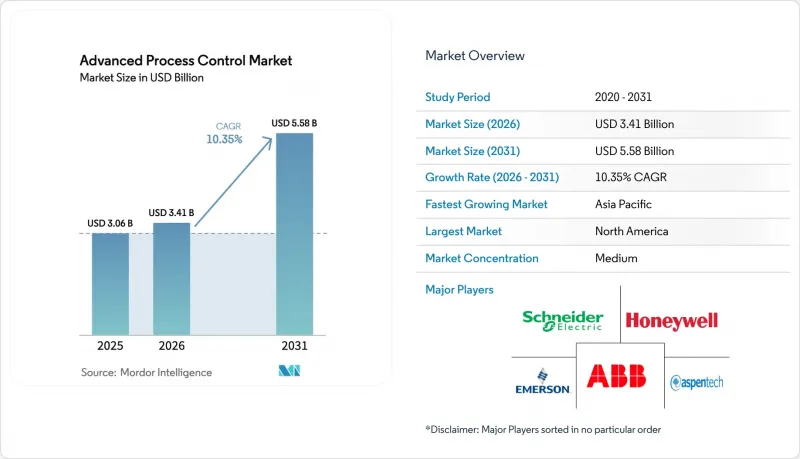
據 Mordor Intelligence 稱,2025 年先進製程控制市場價值為 30.6 億美元,預計到 2031 年將達到 55.8 億美元,而 2026 年為 34.1 億美元,預測期(2026-2031 年)複合年成長率為 10.35%。
本報告按組件(硬體、軟體、服務)、產品類型(例如,高級監管控制)、部署模式(本地部署、雲端部署、混合部署)、製程類型(連續製程、間歇製程)、最終用戶業(例如,石油和天然氣、化學和石化業)以及地區進行細分。市場預測以價值(美元)表示。
全球先進製程控制市場趨勢及洞察
即時能源成本最佳化的必要性
電力和天然氣現貨價格的劇烈波動迫使工廠經濟團隊將能源視為波動性約束,而非固定成本。在德國的自由化市場中,日前競標價格在單次交易中波動幅度可能超過100歐元(113美元),迫使化學企業將批次生產轉移到非尖峰時段,或在高峰時段降低負載。先進的製程控制阻礙因素能夠自動調節回流比、壓縮機進氣量和蒸氣壓力,以獲取速率數據並維持獲利能力。當區域天然氣樞紐與亨利樞紐斷開連接時,美國墨西哥灣沿岸地區的煉油廠也面臨類似的壓力。透過實施能夠每隔幾分鐘重新分配原料流量並調整加熱器運作的控制系統,公用事業成本可以降低兩位數。實施這些功能的工廠通常可以在12到18個月內收回軟體訂閱成本,從而加快董事會對後續最佳化專案的批准速度。
將APC與工業物聯網和人工智慧分析結合
邊緣閘道器現在可以對振動、溫度和頻譜資料進行本地預處理,並將異常評分直接輸入模型預測約束矩陣。這種融合使控制負責人能夠在故障發生之前降低設備的額定輸出,而不是在警報響起後做出反應。艾默生的 DeltaV 邊緣環境將 TensorFlow-Lite 模型整合到現場控制器中,利用壓力損失和熱通量代理來估算成分,從而避免了線上色譜分析所需的 10 分鐘延遲。 AspenTech 在其墨西哥灣沿岸地區裂解裝置中將 Mtell 的預測性維護與 DMC3 控制系統相結合,使檢修時間延長了近一年,並節省了價值 2500 萬美元的運作。政策也為此提供了助力。中國國務院的目標是到 2025 年使一半的大型工廠採用智慧製造系統,而工業物聯網 (IIoT) 和高級預測控制 (APC) 的整合正逐漸成為一項董事會層面的評估指標。
初始成本高且整合複雜
最佳化整個工廠的成本可能高達50萬美元(單一控制器)或1000萬美元(全廠套件)。改造舊式控制系統需要升級歷史資料、建置分段網路和客製化現場匯流排閘道器,這給預算和進度帶來了壓力。近期行業研究表明,當試運行超出供應商計劃30%以上時,42%的運營商會推遲項目,這通常是由於意外的迴路間交互作用造成的。建於20世紀80年代、採用氣動儀器的南美工廠需要將類比訊號數位化,這將增加數月的工作量,並超越公司可接受的投資回收期。雖然基於訂閱的許可模式可以減輕初始財務負擔,但超過10萬美元的年費仍然是那些需要在兩年內收回投資的公司面臨的一大障礙。
細分市場分析
到2025年,軟體收入將佔總收入的51.71%,其中模型預測控制軟體包、推理感測器和即時最佳化器構成了先進製程控制市場的核心價值。然而,預計服務領域的成長速度將超過硬體,到2031年將以11.22%的複合年成長率成長。這是因為工廠需要每季進行調整、與數位孿生體同步以及符合IEC 62443標準的滲透測試,以確保控制器始終處於最佳性能狀態。訂閱模式將資本支出轉化為營運成本,並滿足週期性產業的財務需求。艾默生的DeltaV SaaS為每個控制器提供許可、託管和季度健康檢查的一站式解決方案,降低了中型製造商的准入門檻。在延遲限制導致無法與雲端進行往返通訊的情況下,硬體仍然至關重要。聚合物反應器和催化劑裂解裝置繼續在現場部署邊緣伺服器,以保持循環時間小於100毫秒。
第二代控制器的推出揭示了一個殘酷的教訓:如果無人維護,模型效能就會劣化。二十年前,近一半部署的控制器在三年內就運作。如今,供應商將維護服務納入契約,有些甚至提供性能保證。如果未能達到關鍵績效指標 (KPI)閾值,訂閱費用也會隨之降低。這種以服務為導向的模式不僅穩定了收入,還增強了客戶忠誠度,並加劇了擁有豐富行業經驗的供應商之間的競爭。
到2025年,複雜的監管控制將佔收入的38.28%,但由於原料的變異性以及生物製藥發酵等無法用線性模型捕捉的工藝,非線性模型預測控制(MPC)預計將以10.84%的複合年成長率成長。多元預測控制在增益保持準線性的穩態裝置(例如原油蒸餾)中仍然發揮核心作用。推理控制擴大應用於分析儀器稀缺的場所。中東一家煉油廠用神經軟感測器取代了六台色譜儀,每年節省了40萬美元的維護成本。
連續式製藥發酵槽清晰地展現了這種變化。由於細胞增殖動態幾乎每小時都在變化,Aspen混合模型結合了基本原理和機器學習,能夠即時更新增益,從而將活性成分的變異性降低18%。聚合物製造商也有類似的需求。自適應模型至關重要,因為目標熔融指數(MI)值會隨著催化劑批次的變化而波動。在監管機構對黑箱人工智慧進行嚴格審查的同時,供應商正透過邊界約束最佳化和模型可解釋性模組來提高透明度,以滿足安全儀器系統負責人的要求。
區域分析
預計到2025年,亞太地區將佔全球銷售額的34.53%,並在2031年之前以11.81%的複合年成長率成長,成為全球成長最快的地區。中國正透過津貼支持智慧工廠維修,補貼金額最高可達自動化成本的20%,這推動了內蒙古一家煤化工聯合企業和浙江省一家煉油廠規模的模型預測控制(MPC)系統。印度的「生產連結獎勵計畫計畫」為新建設(待開發區)製藥自動化計畫提供補貼,光是2025年就有12家工廠開始運作雲端控制器。日本的「社會5.0」政策正在推動老舊食品和精細化工生產線向更直覺的操作支援系統轉型。同時,韓國石化產業叢集正在維修上世紀90年代的控制系統,以履行其在2030年溫室氣體排放量減少35%的承諾。
北美和歐洲的先進技術部署水平已接近市場平均水平,但仍處於領先地位。自2020年以來,美國墨西哥灣沿岸新建的15組乙烯裂解裝置均配備了最佳化系統,可調整爐膛運作、淬火和分離過程,以最大限度地提高烯烴收率。歐洲日益嚴格的排放法規正在推動水泥廠和鋼鐵廠整合連續監測和燃燒控制技術,而這種組合非常適合採用多變量演算法。德國的化學公司面臨著比美國高出三倍的天然氣成本,他們正在利用模型預測控制(MPC)來平衡其蒸氣管網,並在一年內實現投資回報。
在中東、非洲、南美和亞洲等新興經濟體,邊緣人工智慧的部署情況各不相同。在沙烏地阿拉伯的傑夫拉加斯計畫中,邊緣人工智慧被部署在遠端撬裝設備上,使達蘭的工程師能夠監控數百公里外的油井。巴西的近海油田正在使用海底多相最佳化技術,以提高產量,以應對亞太地區地面設施產能不足的問題。南非的一家煤液化廠正在實施基於監管的費托反應器控制,以在每噸190蘭特(約10美元)的碳排放稅下降低二氧化碳排放強度。然而,仍存在許多障礙,例如當地人才短缺、資金預算有限以及供應商支援不足,這些因素往往限制了專案只能進行單一試點,而無法實現全廠部署。
其他好處:
- Excel格式的市場預測(ME)表
- 3個月的分析師支持
目錄
第1章:引言
- 研究假設和市場定義
- 調查範圍
第2章:調查方法
第3章執行摘要
第4章 市場狀況
- 市場概覽
- 市場促進因素
- 即時能源成本最佳化的必要性
- 將APC與工業物聯網和人工智慧分析結合
- 由於排放問題,監管更加嚴格。
- 大規模特種化學品和液化天然氣專案的複雜性
- 適用於模組化撬裝設備的即插即用型雲端APC
- 邊緣嵌入式人工智慧可實現遠端操作的自我最佳化。
- 市場限制因素
- 初始成本高且整合複雜
- 缺乏APC專業知識以及車款維護負擔
- 雲端原生控制迴路中的網路安全風險
- 生物基連續發酵生產線中的模型劣化
- 宏觀經濟因素對市場的影響
- 產業價值鏈分析
- 監理情勢
- 技術展望
- 新型APC系統及其現代化改造的比較分析。
- 波特五力分析
第5章 市場規模與成長預測
- 按組件
- 硬體
- 軟體
- 服務
- 依產品類型
- 高級監管控制(ARC)
- 模型預測控制(MPC)
- 非線性模型預測控制
- 多變量預測控制
- 其他推斷控制
- 部署模式
- 現場
- 基於雲端的
- 混合
- 依工藝類型
- 連續製程
- 批量處理
- 按最終用戶行業分類
- 石油和天然氣
- 化工/石油化工
- 製藥
- 食品/飲料
- 能源與電力
- 水泥
- 金屬加工
- 紙漿和造紙
- 其他終端用戶產業
- 按地區
- 北美洲
- 美國
- 加拿大
- 墨西哥
- 南美洲
- 巴西
- 阿根廷
- 其他南美國家
- 歐洲
- 德國
- 英國
- 法國
- 義大利
- 俄羅斯
- 其他歐洲國家
- 亞太地區
- 中國
- 日本
- 印度
- 韓國
- 澳洲和紐西蘭
- 其他亞太國家
- 中東和非洲
- 中東
- 沙烏地阿拉伯
- 阿拉伯聯合大公國
- 土耳其
- 其他中東國家
- 非洲
- 南非
- 奈及利亞
- 其他非洲國家
- 中東
- 北美洲
第6章 競爭情勢
- 市場集中度
- 策略趨勢
- 市佔率分析
- 公司簡介
- ABB Ltd.
- Aspen Technology, Inc.
- Emerson Electric Co.
- General Electric Company
- Honeywell International Inc.
- Rockwell Automation, Inc.
- Schneider Electric SE
- Siemens AG
- Yokogawa Electric Corporation
- SUPCON Technology Co., Ltd.
- Hollysys Automation Technologies Ltd.
- Endress+Hauser Group Services AG
- Valmet Oyj
- Metso Corporation
- FLSmidth & Co. A/S
- AVEVA Group plc
- Azbil Corporation
- Imubit Inc.
- Onto Innovation Inc.
第7章 市場機會與未來展望
According to Mordor Intelligence, the advanced process control market size was valued at USD 3.06 billion in 2025 and is estimated to grow from USD 3.41 billion in 2026 to reach USD 5.58 billion by 2031, at a CAGR of 10.35% during the forecast period (2026-2031).
This report is Segmented by Component (Hardware, Software, and Services), Product Type (Advanced Regulatory Control, and More), Deployment Mode (On-Premises, Cloud-Based, and Hybrid), Process Type (Continuous Processes, and Batch Processes), End-User Industry (Oil and Gas, Chemicals and Petrochemicals, and More), and Geography. The Market Forecasts are Provided in Terms of Value (USD).
Global Advanced Process Control Market Trends and Insights
Real-Time Energy Cost Optimisation Needs
Volatile spot power and gas prices are forcing plant economics teams to treat energy as a moving constraint, not a fixed line item. In Germany's liberalized market, day-ahead auction prices now swing by more than EUR 100 (USD 113) within a single session, compelling chemical complexes to shift batch starts to off-peak windows or curtail load during spikes. Advanced process control loops ingest tariff feeds, then automatically trim reflux ratios, compressor draws, and steam let-downs to preserve margin. U.S. Gulf Coast refiners face similar pressure when regional gas hubs decouple from Henry Hub; controllers capable of re-routing feed and adjusting heater duty every few minutes can unlock double-digit percentage savings in utility spend. Plants that deploy these capabilities typically recover software subscription costs within 12-18 months, accelerating board approval for follow-on optimization projects.
Integration of APC with IIoT and AI Analytics
Edge gateways now preprocess vibration, temperature, and spectral data locally, pushing anomaly scores straight into model predictive constraint matrices. This fusion lets controllers derate equipment before failure rather than reacting to alarms. Emerson's DeltaV Edge Environment embeds TensorFlow-Lite models on field controllers, using pressure-drop and heat-flux proxies to estimate composition and sidestep the 10-minute lag of on-line chromatographs. When AspenTech coupled Mtell predictive maintenance with DMC3 control at a Gulf Coast cracker, turnaround intervals stretched by nearly a year, freeing USD 25 million of uptime. Policy adds tailwinds: China's State Council wants half of large factories to run smart manufacturing systems by 2025, making IIoT-APC convergence a board-level metric.
High Upfront Cost and Integration Complexity
Full-plant optimisation can cost USD 500 000 for a single controller or USD 10 million for a site-wide suite. Retrofitting older control systems demands historian upgrades, segmented networks, and custom fieldbus gateways, stretching budgets and schedules. A recent industry survey found 42% of operators delayed projects when commissioning overshot vendor timelines by more than 30 percent, usually due to unplanned loop interactions. South American plants built with 1980s pneumatic instrumentation must first digitize analog signals, adding months of work and pushing payback beyond corporate hurdles. Subscription licensing eases the initial cash hit, yet annual fees above USD 100 000 still deter companies whose balance sheets require two-year payback.
Other drivers and restraints analyzed in the detailed report include:
- Emission-Driven Regulatory Stringency
- Complexity of Mega Specialty Chemical and LNG Projects
- Scarcity of APC Expertise and Model Maintenance Burden
For complete list of drivers and restraints, kindly check the Table Of Contents.
Segment Analysis
In 2025, software represented 51.71% of revenue as model predictive control packages, inferential sensors, and real-time optimizers formed the core of advanced process control market value. Services, however, are forecast to expand at an 11.22% CAGR through 2031, outpacing hardware because plants need quarterly retuning, digital-twin synchronization, and IEC 62443 penetration tests to keep controllers at peak performance. Subscription models convert capital expense to operating expense, aligning with financial preferences in cyclical industries. Emerson's DeltaV SaaS bundles licenses, hosting, and quarterly health checks under a per-controller fee, cutting entry friction for mid-tier producers. Hardware still matters where latency permits no cloud round-trip; polymer reactors and catalytic crackers keep edge servers local to maintain sub-100 millisecond loop times.
Second-generation deployments expose a hard lesson: neglected models decay. Two decades ago, nearly half of installed controllers drifted out of service within three years. Today, vendors bake maintenance into contracts, and some even guarantee performance; if KPI thresholds slip, subscription discounts kick in. This service-heavy approach not only stabilizes revenue but also tightens customer lock-in, intensifying competition among suppliers that can marshal deep benches of domain specialists.
Advanced regulatory control accounted for 38.28% of revenue in 2025, yet non-linear MPC is projected to rise at a 10.84% CAGR thanks to feedstock variability and biologics fermentation that linear models cannot capture. Multivariable predictive control remains the backbone for steady-state units such as crude distillation where gains stay quasi-linear. Inferential controls flourish where analyzers are scarce; a Middle East refinery replaced six chromatographs with neural soft sensors and saved USD 400 000 in annual maintenance.
Continuous pharmaceutical fermenters illustrate the shift. Cell growth kinetics vary almost hourly, so Aspen Hybrid Models blend first-principles and machine learning to update gains on the fly, cutting potency variation by 18%. Polymer producers echo the need; melt-index targets move with catalyst lot changes, making adaptive models essential. While regulators scrutinize black-box AI, vendors improve transparency with bound-constrained optimization and model explainability modules, satisfying safety-instrumented-system auditors.
Complete Report Scope:
- By Component
- Hardware
- Software
- Services
- By Product Type
- Advanced Regulatory Control (ARC)
- Model Predictive Control (MPC)
- Non-Linear MPC
- Multivariable Predictive Control
- Inferential and Other Controls
- By Deployment Mode
- On-Premises
- Cloud-Based
- Hybrid
- By Process Type
- Continuous Processes
- Batch Processes
- By End-User Industry
- Oil and Gas
- Chemicals and Petrochemicals
- Pharmaceutical
- Food and Beverage
- Energy and Power
- Cement
- Metal Processing
- Pulp and Paper
- Rest of End-User Industry
- By Geography
- North America
- United States
- Canada
- Mexico
- South America
- Brazil
- Argentina
- Rest of South America
- Europe
- Germany
- United Kingdom
- France
- Italy
- Russia
- Rest of Europe
- Asia Pacific
- China
- Japan
- India
- South Korea
- Australia and New Zealand
- Rest of Asia Pacific
- Middle East and Africa
- Middle East
- Saudi Arabia
- United Arab Emirates
- Turkey
- Rest of Middle East
- Africa
- South Africa
- Nigeria
- Rest of Africa
- Middle East
- North America
Geography Analysis
Asia Pacific held 34.53% of 2025 revenue and will advance at an 11.81% CAGR through 2031, the fastest pace worldwide. China backs smart-factory retrofits with grants that refund up to 20% of automation spend, prompting coal-to-chemicals complexes in Inner Mongolia and refinery-petrochemical hubs in Zhejiang to install plant-wide MPC. India's Production-Linked Incentive scheme reimburses greenfield pharmaceutical automation, with twelve plants commissioning cloud-hosted controllers in 2025 alone. Japan's Society 5.0 policy steers aging food and fine-chemical lines toward intuitive operator support, while South Korean petrochemical clusters retrofit 1990s control systems to meet 35% greenhouse-gas cut mandates by 2030.
North America and Europe grow nearer to the overall market rate yet lead in advanced deployments. Fifteen ethylene crackers added since 2020 on the U.S. Gulf Coast all include optimisation suites that juggle furnace duty, quench cooling, and separation to maximize olefin yields. Europe's stricter emissions limits push cement and steel mills to integrate continuous monitoring with combustion control, a match suited to multivariable algorithms. German chemical complexes facing triple the U.S. gas cost rely on steam-network balancing MPC to hit one-year paybacks.
Middle East and Africa, South America, and emerging Asian nations display mixed adoption. Saudi Arabia's Jafurah gas program installs edge AI on remote skids so technologists in Dhahran supervise wells hundreds of kilometers away. Offshore Brazil fields use subsea multiphase optimisation to lift production when topside Asia Pacific pinches. South Africa's coal-to-liquid plants adopt regulatory-driven control of Fischer-Tropsch reactors to curb CO2 intensity under a ZAR 190 (USD 10) per ton carbon tax. Barriers persist; scarce local talent, lean capital budgets, and patchy vendor support often limit projects to single-unit pilots rather than full-site rollouts.
- ABB Ltd.
- Aspen Technology, Inc.
- Emerson Electric Co.
- General Electric Company
- Honeywell International Inc.
- Rockwell Automation, Inc.
- Schneider Electric SE
- Siemens AG
- Yokogawa Electric Corporation
- SUPCON Technology Co., Ltd.
- Hollysys Automation Technologies Ltd.
- Endress+Hauser Group Services AG
- Valmet Oyj
- Metso Corporation
- FLSmidth & Co. A/S
- AVEVA Group plc
- Azbil Corporation
- Imubit Inc.
- Onto Innovation Inc.
Additional Benefits:
- The market estimate (ME) sheet in Excel format
- 3 months of analyst support
TABLE OF CONTENTS
1 INTRODUCTION
- 1.1 Study Assumptions and Market Definition
- 1.2 Scope of the Study
2 RESEARCH METHODOLOGY
3 EXECUTIVE SUMMARY
4 MARKET LANDSCAPE
- 4.1 Market Overview
- 4.2 Market Drivers
- 4.2.1 Real-Time Energy Cost Optimisation Needs
- 4.2.2 Integration of APC with IIoT and AI Analytics
- 4.2.3 Emission-Driven Regulatory Stringency
- 4.2.4 Complexity of Mega Specialty Chemical and LNG Projects
- 4.2.5 Plug-and-Play Cloud APC for Modular Skids
- 4.2.6 Edge-Embedded AI Enables Self-Optimising Remote Operations
- 4.3 Market Restraints
- 4.3.1 High Upfront Cost and Integration Complexity
- 4.3.2 Scarcity of APC Expertise and Model Maintenance Burden
- 4.3.3 Cybersecurity Exposure in Cloud-Native Control Loops
- 4.3.4 Model Degradation in Bio-Based Continuous Fermentation Lines
- 4.4 Impact of Macroeconomic Factors on the Market
- 4.5 Industry Value-Chain Analysis
- 4.6 Regulatory Landscape
- 4.7 Technological Outlook
- 4.8 Analysis of New APC Systems vs Modernization
- 4.9 Porter's Five Forces Analysis
- 4.9.1 Bargaining Power of Suppliers
- 4.9.2 Bargaining Power of Buyers
- 4.9.3 Threat of New Entrants
- 4.9.4 Threat of Substitute Products
- 4.9.5 Degree of Competition
5 MARKET SIZE AND GROWTH FORECASTS (VALUE)
- 5.1 By Component
- 5.1.1 Hardware
- 5.1.2 Software
- 5.1.3 Services
- 5.2 By Product Type
- 5.2.1 Advanced Regulatory Control (ARC)
- 5.2.2 Model Predictive Control (MPC)
- 5.2.3 Non-Linear MPC
- 5.2.4 Multivariable Predictive Control
- 5.2.5 Inferential and Other Controls
- 5.3 By Deployment Mode
- 5.3.1 On-Premises
- 5.3.2 Cloud-Based
- 5.3.3 Hybrid
- 5.4 By Process Type
- 5.4.1 Continuous Processes
- 5.4.2 Batch Processes
- 5.5 By End-User Industry
- 5.5.1 Oil and Gas
- 5.5.2 Chemicals and Petrochemicals
- 5.5.3 Pharmaceutical
- 5.5.4 Food and Beverage
- 5.5.5 Energy and Power
- 5.5.6 Cement
- 5.5.7 Metal Processing
- 5.5.8 Pulp and Paper
- 5.5.9 Rest of End-User Industry
- 5.6 By Geography
- 5.6.1 North America
- 5.6.1.1 United States
- 5.6.1.2 Canada
- 5.6.1.3 Mexico
- 5.6.2 South America
- 5.6.2.1 Brazil
- 5.6.2.2 Argentina
- 5.6.2.3 Rest of South America
- 5.6.3 Europe
- 5.6.3.1 Germany
- 5.6.3.2 United Kingdom
- 5.6.3.3 France
- 5.6.3.4 Italy
- 5.6.3.5 Russia
- 5.6.3.6 Rest of Europe
- 5.6.4 Asia Pacific
- 5.6.4.1 China
- 5.6.4.2 Japan
- 5.6.4.3 India
- 5.6.4.4 South Korea
- 5.6.4.5 Australia and New Zealand
- 5.6.4.6 Rest of Asia Pacific
- 5.6.5 Middle East and Africa
- 5.6.5.1 Middle East
- 5.6.5.1.1 Saudi Arabia
- 5.6.5.1.2 United Arab Emirates
- 5.6.5.1.3 Turkey
- 5.6.5.1.4 Rest of Middle East
- 5.6.5.2 Africa
- 5.6.5.2.1 South Africa
- 5.6.5.2.2 Nigeria
- 5.6.5.2.3 Rest of Africa
- 5.6.5.1 Middle East
- 5.6.1 North America
6 COMPETITIVE LANDSCAPE
- 6.1 Market Concentration
- 6.2 Strategic Moves
- 6.3 Market Share Analysis
- 6.4 Company Profiles (includes Global Level Overview, Market Level Overview, Core Segments, Financials as available, Strategic Information, Market Rank/Share for Key Companies, Products and Services, and Recent Developments)
- 6.4.1 ABB Ltd.
- 6.4.2 Aspen Technology, Inc.
- 6.4.3 Emerson Electric Co.
- 6.4.4 General Electric Company
- 6.4.5 Honeywell International Inc.
- 6.4.6 Rockwell Automation, Inc.
- 6.4.7 Schneider Electric SE
- 6.4.8 Siemens AG
- 6.4.9 Yokogawa Electric Corporation
- 6.4.10 SUPCON Technology Co., Ltd.
- 6.4.11 Hollysys Automation Technologies Ltd.
- 6.4.12 Endress+Hauser Group Services AG
- 6.4.13 Valmet Oyj
- 6.4.14 Metso Corporation
- 6.4.15 FLSmidth & Co. A/S
- 6.4.16 AVEVA Group plc
- 6.4.17 Azbil Corporation
- 6.4.18 Imubit Inc.
- 6.4.19 Onto Innovation Inc.
7 MARKET OPPORTUNITIES AND FUTURE OUTLOOK
- 7.1 White-Space and Unmet-Need Assessment

 OEE軟體全球市場規模、佔有率、趨勢和成長分析報告(2026-2034年)
 泡沫滅火設備市場:全球市場預測(2026-2032)
 人工智慧驅動的生產調度市場預測至2034年:按部署類型、調度類型、技術、應用、最終用戶和地區分類的全球分析工業人工智慧決策支援系統市場預測至2034年-全球部署模式、產品/服務、服務類型、人工智慧技術、決策功能、最終使用者和區域分析工業製程自動化軟體市場預測至2034年-按部署類型、軟體類型、技術、應用、最終用戶和地區分類的全球分析
 先進製程控制市場規模、佔有率、趨勢和預測:按組件、最終用途行業和地區分類,2026-2034 年全球先進製程控制市場規模、佔有率、趨勢和成長分析報告(2026-2034年)
 先進製程控制市場分析及預測(至2035年):依類型、產品類型、服務、技術、組件、應用、部署類型、最終用戶及功能分類
 2026年全球先進製程控制市場報告
 先進製程控制市場-全球產業規模、佔有率、趨勢、機會及預測(依部署方式、控制類型、產業垂直領域、地區及競爭格局分類,2021-2031年)