


 |
市場調查報告書
商品編碼
2122024
汽車煞車系統:市場佔有率分析、產業趨勢與統計、成長預測(2026-2031)Automotive Brake Systems - Market Share Analysis, Industry Trends & Statistics, Growth Forecasts (2026 - 2031) |
||||||

※ 本網頁內容可能與最新版本有所差異。詳細情況請與我們聯繫。
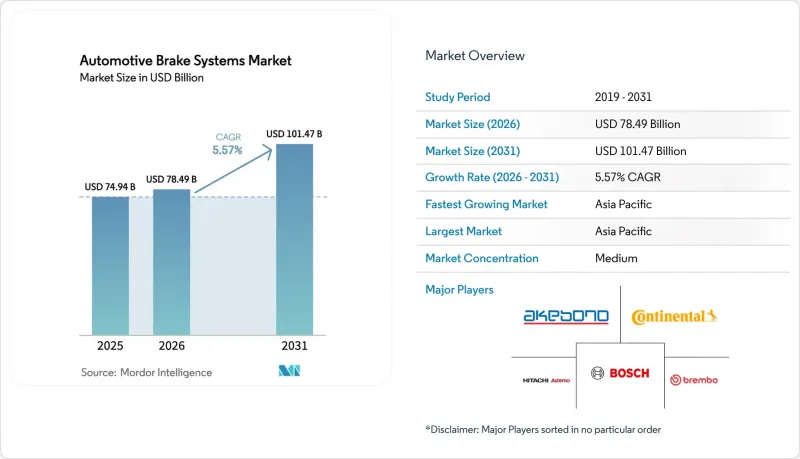
根據 Mordor Intelligence 預測,汽車煞車系統市場預計將從 2025 年的 749.4 億美元成長到 2026 年的 784.9 億美元,到 2031 年達到 1,014.7 億美元,2026 年至 2031 年的複合年成長率為 5.57%。
本報告按車輛類型(例如,乘用車)、產品類型(例如,碟式煞車)、技術(例如,防鎖死煞車系統 (ABS))、操作機制(例如,液壓)、零件(例如,煞車皮和煞車蹄片)、煞車片材質(例如,有機材料)、銷售管道、系統和地區進行細分。市場預測以價值(美元)和銷售量(單位)表示。
全球汽車煞車系統市場趨勢與洞察
快速的電氣化正在推動與再生煞車相容的煞車硬體的發展。
隨著純電動車(BEV)產量的擴大,汽車煞車系統供應商被迫重新設計卡鉗、煞車碟盤和軟體,以實現能源回收最大化的混合煞車。 Polestar 和特斯拉正在展示“單踏板模式”,該模式可減少都市區駕駛循環中的煞車片接觸,從而將保養間隔延長至 10 萬公里以上。這些需求促使一級供應商開發能夠即時傳輸電池狀態資料的整合控制單元。中國修訂的乘用車煞車系統標準 GB 21670-2025 預計將對新能源車(NEV)的能量回收煞車/單踏板模式標定策略產生影響。整車製造商(OEM)和供應商之間的聯合工程項目正在取代傳統的「黑盒子」採購模式,從而確保軟體所有權並符合網路安全標準。
全球電動車產量加速成長,需要低粉塵、無銅的摩擦材料。
加州的「更安全消費品法規」以及華盛頓州的相應法律將從2025年起限制煞車皮的銅含量不超過0.5%(重量比),這將迫使煞車片轉向使用陶瓷纖維和芳香聚醯胺漿料。博世已推出符合提案的歐7顆粒物排放標準的ECE R90認證低金屬煞車皮。同時,曙光煞車工業株式會社的「ProACT」系列聲稱,與半金屬煞車皮相比,其粉塵減少量超過60%。歐盟的歐7框架提案將煞車粉塵限值設定為7毫克/公里,並進一步收緊了認證測試。由於再生煞車降低了接觸頻率,殘留粉塵變得更加明顯,這進一步強化了汽車製造商對「清潔煞車」化學成分的偏好,以維護品牌形象和空氣品質。
再生煞車減少磨損,給售後市場煞車皮銷售帶來了壓力。
在汽車煞車系統市場,維修數據顯示,電池式電動車(BEV) 的煞車皮更換週期是同類內燃機 (ICE) 車型的兩倍,這導致獨立維修店利潤下降,經銷商之間的整合加劇。雖然車隊營運商樂見總擁有成本 (TCO) 的降低,但依賴大批量煞車片銷售的供應商卻面臨銷量下滑的困境,被迫轉向高階複合材料和整合感測器服務以重獲價值。
細分市場分析
到2025年,碟式煞車將佔據75.21%的市場佔有率,憑藉其成熟的溫度控管性能、一致的踏板腳感和快速的煞車力道調節,為汽車煞車系統市場奠定了堅實的基礎。其廣泛的供應鏈網路以及與ABS和ESC的向下相容性,確保了即使在混合煞車策略日益普及的情況下,碟式煞車仍能保持其主導地位。鼓式煞車在入門級乘用車和輕型貨車的後軸上仍然具有成本效益,但由於強制安裝穩定性控制設備,其重要性正在下降。再生煞車模組雖然體積小巧,但預計其年複合成長率將達到7.77%,因為汽車製造商正在追求精確到瓦特的能源回收,以延長純電動車的續航里程。 Brembo的輕量化碳陶瓷煞車碟盤完美融合了傳統摩擦材料和電氣化技術的需求。
大陸集團的模組化能量回收控制器展示了以軟體為中心的架構如何重新定義一級供應商的產品藍圖。該控制器旨在即時傳輸電池充電狀態,並實現馬達扭矩和液壓系統之間的無縫切換。這種整合縮短了全球平台的檢驗週期,並降低了校驗成本。同時,電動駐煞車系統因其釋放車內空間和便於自動泊車而日益普及。這些進步共同推動著從純液壓硬體轉向混合能量回收拓撲結構的長期轉變。
到2025年,防鎖死煞車系統(ABS)的銷售額將佔45.65%,它構成車輛穩定性的基礎,並滿足大多數主要市場的傳統監管要求。然而,其預計複合年成長率落後於電子穩定控制系統(ESC),後者受益於與自動緊急煞車和車道維持輔助系統緊密的監管協調。透過共用車輪速度和橫擺角速度感測器,ESC使一級供應商能夠在單一網域控制器中整合多種功能,從而減輕佈線重量。博斯的「車輛運動管理系統」(VEM)已計劃量產,該系統整合了ESC、扭力向量分配和主動式車距維持定速系統,可將煞車距離縮短8%以上。這種功能整合趨勢提高了軟體的價值,同時降低了硬體成本。
牽引力控制系統和電子控制煞車力道分配系統整合在同一半導體晶片上,進一步抑制了零件成本的增加。歐洲新車安全評估協會(Euro NCAP)2025年的五星級評級標準和美國自動緊急煞車(AEB)法規均將電子穩定控制系統(ESC)列為高速碰撞避免認證的強制性要求,加速了其在入門車型中的普及。採埃孚(ZF)的cubiX平台將ESC與電動方向盤和主動懸吊系統整合,實現了預測性車輪扭矩控制,可在駕駛員做出反應之前穩定車輛。在新興經濟體,印度的AIS-145法規促進了本地模組生產,降低了進口關稅,並確保了供應。這些因素共同促成了ESC成為軟體定義底盤控制領域的新標準。
液壓執行器憑藉數十年的技術進步、低廉的單位成本以及區域組裝廠廣泛使用的模具設備,預計到2025年將佔據84.02%的市場佔有率。然而,其複合年成長率落後於電磁式和線控刹車解決方案,後者預計隨著電池式電動車(BEV)和自動駕駛技術的成熟,複合年成長率將達到9.69%。氣動系統對於重型卡車仍然至關重要,但面臨著許多不利因素,例如歐洲柴油車註冊量的下降和更嚴格的噪音法規。線控刹車無需真空輔助器,縮短了踏板行程,並實現了低於100毫秒的響應時間,這對於ADAS(高級駕駛輔助系統)的防碰撞操作至關重要。大陸集團的無液「MK C2」系統標誌著向乾式卡鉗的轉變,該系統可減輕25%的重量,並簡化電動SUV的溫度控管。
採埃孚訂單的500萬套電子機械煞車系統表明,這類系統不僅在豪華車品牌中廣受歡迎,在普通車市場也備受青睞。奈克斯特的線控轉向和線控刹車原型展示了獨立車輪扭力控制如何提升自動泊車、車道居中和低速行駛操控性能。 ISO 26262功能安全標準要求冗餘運行路徑,提高了設計要求,並使擁有充足檢驗預算的一級供應商更具優勢。因此,供應商正與半導體製造商合作,共同設計經安全認證、可降低延遲的微控制器。隨著成本差距的縮小,原始設備製造商(OEM)開始意識到「空中升級(OTA)功能」的價值,而液壓管路則無法實現這項功能。
區域分析
預計到2025年,亞太地區將佔全球銷售量的42.41%,並在2031年之前以6.88%的複合年成長率成長,成為所有地區中成長最快的地區。中國的「雙抵」政策鼓勵新能源車的生產,比亞迪、吉利和蔚來汽車目前已在其所有新平台上採用具備再生煞車功能的煞車模組。印度的生產連結獎勵計畫促使博世和採埃孚在當地建立電子穩定控制系統(ESC)和電子停車煞車工廠,從而減少了對進口的依賴並縮短了前置作業時間。在日本,曙光、日清和日立阿斯泰莫等公司正利用其精密製造技術,在國內產量趨於穩定的情況下,並維持其高階市場佔有率。
儘管北美地區的ABS系統應用已趨於成熟,但美國即將實施的自動緊急煞車法規(該法規訂單的500萬個機電電子機械卡鉗,凸顯了向軟體定義煞車系統的快速轉型。加拿大的零排放銷售強制令正在加速對無銅煞車皮和再生煞車軟體的需求,而墨西哥的成本優勢則推動了鑄鐵轉子加工的近岸外包。售後市場銷售受益於電子商務,但純電動汽車煞車皮片的使用壽命延長,導致銷售週期放緩,促使經銷商轉向高階套件和增值診斷服務。
在歐洲,由於柴油廂型車產量下降和鋼製煞車盤供不應求,ADAS(高級搭載率輔助系統)的普及率逐漸提高,成長速度相對緩慢。儘管如此,歐洲新車安全評估協會(Euro NCAP)2025年的評估以及計畫實施的歐7排放標準,促使企業繼續投資線控刹車、陶瓷煞車片和顆粒物卡鉗。大陸集團、博世和採埃孚三家公司均位於德國,它們正攜手致力於研發符合ISO 26262標準的無液煞車執行器,以減輕重量。雖然安賽樂米塔爾將生產轉移到西班牙在一定程度上緩解了供應鏈緊張的局面,但高等級鋼材的供應仍然有限,迫使供應商轉向鋁製和複合材料煞車盤。南歐港口正在考慮可能也適用於物流卡車的碼頭電力需求,這表明未來對支援再生煞車的商用車煞車系統將有需求。
其他好處:
- Excel格式的市場預測(ME)表
- 3個月的分析師支持
目錄
第1章:引言
- 研究假設和市場定義
- 調查範圍
第2章:調查方法
第3章執行摘要
第4章 市場狀況
- 市場概覽
- 市場促進因素
- 快速的電氣化正在推動向與再生煞車相容的煞車硬體的轉變。
- 隨著全球電動車產量的加速成長,對低粉塵、無銅摩擦材料的需求日益成長。
- ADAS(先進駕駛輔助系統)的日益普及推動了對線控刹車架構的需求。
- 美國 FMVSS 126 和 UNECE R140 的更嚴格規定正在推動 ABS/ESC 的採用。
- 新冠疫情後電子商務的激增擴大了輕型商用車 (LCV) 煞車的售後市場。
- 原廠設備製造商提供的延長保固期正在推動長壽命陶瓷煞車片的普及。
- 市場限制因素
- 再生煞車減少磨損,導致售後市場煞車皮銷量下降。
- 稀土元素價格波動推高了電子煞車執行器的成本。
- 歐盟高等級鋼轉子供應鏈瓶頸
- 柴油商用車產量下降導致對氣動煞車的需求放緩。
- 價值鏈分析
- 監理展望
- 技術展望
- 波特五力模型
第5章 市場規模與成長預測
- 依產品類型
- 碟煞
- 鼓式煞車
- 電動駐煞車系統
- 再生煞車模組
- 透過技術
- 防鎖死煞車系統(ABS)
- 電子穩定控制系統(ESC)
- 牽引力控制系統(TCS)
- 電子煞車力道分配(EBD)
- 透過操作機制
- 油壓
- 氣壓
- 電磁式/線控刹車
- 機械式(電纜式)
- 按組件
- 煞車皮和煞車蹄
- 卡尺
- 轉子和滾筒
- 煞車增壓器和主缸
- 電控系統和執行器
- 按墊材質
- 有機(不含石棉)
- 半金屬
- 金屬
- 陶瓷製品
- 按銷售管道
- 目的地設備製造商 (OEM)
- 售後市場
- 車輛類型
- 搭乘用車
- 輕型商用車
- 大型商用車輛和巴士
- 透過推進力
- 內燃機車
- 混合動力電動車(HEV/PHEV)
- 電池式電動車(BEV)
- 燃料電池汽車(FCEV)
- 按地區
- 北美洲
- 美國
- 加拿大
- 其他北美國家
- 南美洲
- 巴西
- 阿根廷
- 其他南美國家
- 歐洲
- 德國
- 英國
- 法國
- 義大利
- 西班牙
- 其他歐洲國家
- 亞太地區
- 中國
- 印度
- 日本
- 韓國
- 其他亞太國家
- 中東和非洲
- 沙烏地阿拉伯
- 阿拉伯聯合大公國
- 南非
- 埃及
- 其他中東和非洲國家
- 北美洲
第6章 競爭情勢
- 市場集中度
- 策略性舉措(併購、合資、新產品發布)
- 市佔率分析
- 公司簡介
- Continental AG
- Robert Bosch GmbH
- ZF Friedrichshafen AG
- Brembo SpA
- Akebono Brake Industry Co. Ltd
- Aisin Corporation
- ADVICS Co. Ltd
- Knorr-Bremse AG
- Hyundai Mobis Co. Ltd
- Mando Corporation
- Federal-Mogul Motorparts(Tenneco)
- Hitachi Astemo, Ltd.
- WABCO(ZF CVS)
- Meritor Inc.
- Nissin Kogyo Co. Ltd
- Bendix Commercial Vehicle Systems
- Aptiv PLC
- Haldex AB
- HELLA GmbH & Co. KGaA
- Carlisle Brake & Friction
第7章 市場機會與未來展望
According to Mordor Intelligence, the automotive brake system market size is expected to increase from USD 74.94 billion in 2025 to USD 78.49 billion in 2026 and reach USD 101.47 billion by 2031, growing at a CAGR of 5.57% over 2026-2031.
This report is Segmented by Vehicle Type (Passenger Cars and More), Product Type (Disc Brakes and More), Technology (Anti-Lock Braking System (ABS) and More), Actuation Mechanism (Hydraulic and More), Component (Brake Pads and Shoes and More), Pad Material (Organic and More), Sales Channel, Propulsion, and Geography. The Market Forecasts are Provided in Terms of Value (USD) and Volume (Units).
Global Automotive Brake Systems Market Trends and Insights
Rapid Electrification Driving Regenerative-Compatible Brake Hardware
Growing BEV production is compelling suppliers in the Automotive Brake System Market to redesign calipers, rotors, and software for blended braking that maximizes energy recovery. Polestar and Tesla have demonstrated one-pedal modes that cut pad contact in urban duty cycles, extending service intervals beyond 100,000 kilometers. These requirements push tier ones toward integrated control units that can communicate battery-state data in real-time. China's GB 21670-2025 updates passenger-car braking system requirements and is expected to influence regenerative-braking/one-pedal calibration strategies in NEVs. Joint engineering programs between OEMs and suppliers are replacing the traditional black-box sourcing model, ensuring software ownership and compliance with cybersecurity standards.
Accelerating Global BEV Production Necessitating Low-Dust, Copper-Free Friction Materials
California's Safer Consumer Products rule and equivalent Washington legislation cap pad copper content at 0.5% by weight beginning in 2025, forcing a shift toward ceramic fibers and aramid pulp. Bosch rolled out an ECE R90-certified low-metallic pad that meets proposed Euro 7 particulate limits, while Akebono's ProACT line claims over 60% dust reduction relative to semi-metallic analogs. The European Union's draft Euro 7 framework adds a 7 mg/km brake-dust ceiling, further tightening qualification tests. Because regenerative braking reduces contact frequency, any residual dust becomes more visible, intensifying OEMs' preference for clean-brake chemistries that protect brand image and air quality.
Reduced Wear in Regenerative Braking Curtailing Aftermarket Pad Revenues
In the Automotive Brake System Market, Service data indicates that BEVs can double the pad-replacement interval compared with comparable ICE models, trimming independent workshop revenue and encouraging consolidation among distributors. Fleet operators welcome the lower total cost of ownership, yet suppliers reliant on high-volume pad sales face declining unit sales and must pivot toward premium composites or embedded sensor services to restore value capture.
Other drivers and restraints analyzed in the detailed report include:
- Heightened ADAS Penetration Raising Demand for Brake-by-Wire Architectures
- Stricter U.S. FMVSS 126 and UNECE R140 Mandates Boosting ABS/ESC Installations
- Volatility in Rare-Earth Prices Inflating Electronic Brake Actuator Costs
For complete list of drivers and restraints, kindly check the Table Of Contents.
Segment Analysis
Disc brakes captured 75.21% of the 2025 market size, underpinning the automotive brake system market through proven heat management, consistent pedal feel, and rapid pressure modulation. Their extensive supply networks and backward compatibility with ABS and ESC help defend their position even as blended-braking strategies proliferate. Drum brakes remain cost-effective for rear axles in entry-level cars and light vans, yet mandatory stability control erodes their relevance. Regenerative modules, although smaller in absolute terms, are projected to advance at a 7.77% CAGR as OEMs seek every watt of energy recovery to extend the driving range of BEVs. Lightweight carbon-ceramic discs from Brembo illustrate convergence between traditional friction materials and electrification requirements.
Continental's modular regenerative controller showcases how software-centric architectures are redefining product roadmaps across tier-one suppliers. The controller is designed to communicate the battery's state of charge in real-time, enabling seamless transitions between motor torque and hydraulic pressure. Such integration shortens validation cycles and lowers calibration costs for global platforms. In parallel, electric parking brakes are gaining popularity by freeing cabin space and facilitating automated parking functions. Together, these developments reinforce the long-term pivot from purely hydraulic hardware toward hybrid energy-recovery topologies.
Anti-lock braking systems accounted for 45.65% of 2025 revenue, anchoring stability performance and satisfying legacy mandates across most major markets. Nonetheless, their forecasted CAGR trails electronic stability control, which benefits from a tight regulatory link with automatic emergency braking and lane-keeping assist. ESC leverages shared wheel-speed and yaw-rate sensors, allowing tier-one manufacturers to package multiple functions inside a single domain controller and reduce wiring weight. Bosch's Vehicle Motion Management, already scheduled for a volume launch, unifies ESC, torque vectoring, and adaptive cruise control to reduce stopping distance by over 8%. This bundling trend elevates software value while flattening hardware cost curves.
Traction control and electronic brake-force distribution are integrated into the same silicon, further reducing incremental component costs. Euro NCAP's 2025 five-star protocol and the U.S. AEB rule both list ESC as a prerequisite for high-speed collision-avoidance certification, thereby accelerating its penetration in entry-level trims. ZF's cubiX platform links the ESC to electric power steering and active suspension, enabling predictive wheel-torque commands that stabilize the vehicle before the driver reacts. In emerging economies, India's AIS-145 mandate has spurred local module production, trimmed import duties, and secured supply. Collectively, these triggers position ESC as the new baseline for software-defined chassis control.
Hydraulic actuation commands 84.02% of the 2025 market size, supported by decades of engineering refinement, low unit cost, and pervasive tooling across regional assembly plants. Even so, its CAGR lags behind electromagnetic and brake-by-wire solutions, which post a 9.69% CAGR as BEV and autonomous programs mature. Pneumatic systems remain essential for heavy trucks but face headwinds from Europe's declining diesel registrations and tightening noise regulations. Brake-by-wire eliminates the vacuum booster, shortens pedal travel, and enables sub-100-millisecond response, a key specification for ADAS collision-avoidance maneuvers. Continental's fluid-free MK C2 system highlights the shift toward dry calipers that reduce mass by 25% and simplify thermal management in electric SUVs.
ZF's record order for 5 million electro-mechanical units demonstrates mainstream acceptance beyond luxury nameplates. Nexteer's steer-by-wire and brake-by-wire prototype shows how independent wheel-torque control can enhance automated parking, lane centering, and low-speed maneuvering. ISO 26262 functional-safety rules enforce redundant actuation paths, raising the engineering bar and favoring tier-ones with deep validation budgets. Suppliers are therefore partnering with semiconductor houses to co-design safety-certified microcontrollers that lower latency. As the cost differential narrows, OEMs see value in over-the-air upgradability that hydraulic lines can never match.
Complete Report Scope:
- By Product Type
- Disc Brakes
- Drum Brakes
- Electric Parking Brakes
- Regenerative Braking Modules
- By Technology
- Anti-lock Braking System (ABS)
- Electronic Stability Control (ESC)
- Traction Control System (TCS)
- Electronic Brake-force Distribution (EBD)
- By Actuation Mechanism
- Hydraulic
- Pneumatic
- Electromagnetic / Brake-by-Wire
- Mechanical (Cable)
- By Component
- Brake Pads and Shoes
- Calipers
- Rotors and Drums
- Brake Boosters and Master Cylinders
- Electronic Control Units and Actuators
- By Pad Material
- Organic (Non-Asbestos)
- Semi-Metallic
- Metallic
- Ceramic
- By Sales Channel
- Original Equipment Manufacturers (OEM)
- Aftermarket
- By Vehicle Type
- Passenger Cars
- Light Commercial Vehicles
- Heavy Commercial Vehicles and Buses
- By Propulsion
- Internal Combustion Engine (ICE) Vehicles
- Hybrid Electric Vehicles (HEV/PHEV)
- Battery Electric Vehicles (BEV)
- Fuel-Cell Electric Vehicles (FCEV)
- By Geography
- North America
- United States
- Canada
- Rest of North America
- South America
- Brazil
- Argentina
- Rest of South America
- Europe
- Germany
- United Kingdom
- France
- Italy
- Spain
- Rest of Europe
- Asia-Pacific
- China
- India
- Japan
- South Korea
- Rest of Asia-Pacific
- Middle East and Africa
- Saudi Arabia
- United Arab Emirates
- South Africa
- Egypt
- Rest of Middle East and Africa
- North America
Geography Analysis
Asia-Pacific produced 42.41% of global 2025 revenue and is projected to grow at a 6.88% CAGR through 2031, the fastest among all regions. China's dual-credit policy rewards new-energy vehicle output, pushing BYD, Geely, and NIO to specify regenerative-ready brake modules on every fresh platform. India's production-linked incentives lure Bosch and ZF into local ESC and electronic parking brake plants, reducing reliance on imports and shortening lead times. Japan's Akebono, Nissin, and Hitachi Astemo leverage precision manufacturing to hold a premium share even as domestic volumes plateau.
North America advances with mature ABS penetration, yet is invigorated by the U.S. automatic emergency braking rule that mandates compliant hardware by 2029. ZF's order for 5 million electromechanical calipers from a Detroit automaker underscores the rapid migration toward software-defined braking. Canada's zero-emission sales mandate accelerates demand for copper-free pads and regenerative control software, while Mexico's cost advantage encourages near-shoring of cast-iron rotor machining. Aftermarket revenue benefits from e-commerce, although longer pad life in BEVs moderates sales cycles, nudging distributors toward premium kits and value-added diagnostics.
Europe grows at a comparatively modest rate as declining diesel van production and steel-rotor shortages offset incremental ADAS content. Euro NCAP's 2025 assessment and pending Euro 7 dust limits nonetheless sustain investment in brake-by-wire, ceramic pads, and particulate-capture calipers. Germany hosts Continental, Bosch, and ZF, which together channel R&D into fluid-free actuators that meet ISO 26262 while lowering mass. Supply-chain tension eased somewhat after ArcelorMittal shifted volumes to Spain, but high-grade sheet remains tight, nudging suppliers toward aluminum and composite rotors. Southern European ports explore shore-power requirements that may extend to logistics trucks, implying future demand for regenerative-compatible commercial-vehicle brakes.
- Continental AG
- Robert Bosch GmbH
- ZF Friedrichshafen AG
- Brembo S.p.A
- Akebono Brake Industry Co. Ltd
- Aisin Corporation
- ADVICS Co. Ltd
- Knorr-Bremse AG
- Hyundai Mobis Co. Ltd
- Mando Corporation
- Federal-Mogul Motorparts (Tenneco)
- Hitachi Astemo, Ltd.
- WABCO (ZF CVS)
- Meritor Inc.
- Nissin Kogyo Co. Ltd
- Bendix Commercial Vehicle Systems
- Aptiv PLC
- Haldex AB
- HELLA GmbH & Co. KGaA
- Carlisle Brake & Friction
Additional Benefits:
- The market estimate (ME) sheet in Excel format
- 3 months of analyst support
TABLE OF CONTENTS
1 Introduction
- 1.1 Study Assumptions and Market Definition
- 1.2 Scope of the Study
2 Research Methodology
3 Executive Summary
4 Market Landscape
- 4.1 Market Overview
- 4.2 Market Drivers
- 4.2.1 Rapid Electrification Driving Shift to Regenerative-Compatible Brake Hardware
- 4.2.2 Accelerating Global BEV Production Necessitating Low-Dust, Copper-Free Friction Materials
- 4.2.3 Heightened ADAS Penetration Raising Demand for Brake-by-Wire Architectures
- 4.2.4 Stricter U.S. FMVSS 126 and UNECE R140 Mandates Boosting ABS/ESC Installations
- 4.2.5 Post-COVID E-commerce Surge Increasing LCV Brake Aftermarket
- 4.2.6 OEM Warranty Extensions Driving Adoption of Long-Life Ceramic Pad Formulations
- 4.3 Market Restraints
- 4.3.1 Reduced Wear in Regenerative Braking Curtailing Aftermarket Pad Revenues
- 4.3.2 Volatility in Rare-earth Prices Inflating Electronic Brake Actuator Costs
- 4.3.3 Supply-chain Bottlenecks for High-grade Steel Rotors in EU
- 4.3.4 Declining Diesel CV Production Dampening Pneumatic Brake Demand
- 4.4 Value-Chain Analysis
- 4.5 Regulatory Outlook
- 4.6 Technological Outlook
- 4.7 Porter's Five Forces
- 4.7.1 Bargaining Power of Suppliers
- 4.7.2 Bargaining Power of Buyers
- 4.7.3 Threat of New Entrants
- 4.7.4 Threat of Substitutes
- 4.7.5 Intensity of Rivalry
5 Market Size and Growth Forecasts (Value (USD) and Volume (Units))
- 5.1 By Product Type
- 5.1.1 Disc Brakes
- 5.1.2 Drum Brakes
- 5.1.3 Electric Parking Brakes
- 5.1.4 Regenerative Braking Modules
- 5.2 By Technology
- 5.2.1 Anti-lock Braking System (ABS)
- 5.2.2 Electronic Stability Control (ESC)
- 5.2.3 Traction Control System (TCS)
- 5.2.4 Electronic Brake-force Distribution (EBD)
- 5.3 By Actuation Mechanism
- 5.3.1 Hydraulic
- 5.3.2 Pneumatic
- 5.3.3 Electromagnetic / Brake-by-Wire
- 5.3.4 Mechanical (Cable)
- 5.4 By Component
- 5.4.1 Brake Pads and Shoes
- 5.4.2 Calipers
- 5.4.3 Rotors and Drums
- 5.4.4 Brake Boosters and Master Cylinders
- 5.4.5 Electronic Control Units and Actuators
- 5.5 By Pad Material
- 5.5.1 Organic (Non-Asbestos)
- 5.5.2 Semi-Metallic
- 5.5.3 Metallic
- 5.5.4 Ceramic
- 5.6 By Sales Channel
- 5.6.1 Original Equipment Manufacturers (OEM)
- 5.6.2 Aftermarket
- 5.7 By Vehicle Type
- 5.7.1 Passenger Cars
- 5.7.2 Light Commercial Vehicles
- 5.7.3 Heavy Commercial Vehicles and Buses
- 5.8 By Propulsion
- 5.8.1 Internal Combustion Engine (ICE) Vehicles
- 5.8.2 Hybrid Electric Vehicles (HEV/PHEV)
- 5.8.3 Battery Electric Vehicles (BEV)
- 5.8.4 Fuel-Cell Electric Vehicles (FCEV)
- 5.9 By Geography
- 5.9.1 North America
- 5.9.1.1 United States
- 5.9.1.2 Canada
- 5.9.1.3 Rest of North America
- 5.9.2 South America
- 5.9.2.1 Brazil
- 5.9.2.2 Argentina
- 5.9.2.3 Rest of South America
- 5.9.3 Europe
- 5.9.3.1 Germany
- 5.9.3.2 United Kingdom
- 5.9.3.3 France
- 5.9.3.4 Italy
- 5.9.3.5 Spain
- 5.9.3.6 Rest of Europe
- 5.9.4 Asia-Pacific
- 5.9.4.1 China
- 5.9.4.2 India
- 5.9.4.3 Japan
- 5.9.4.4 South Korea
- 5.9.4.5 Rest of Asia-Pacific
- 5.9.5 Middle East and Africa
- 5.9.5.1 Saudi Arabia
- 5.9.5.2 United Arab Emirates
- 5.9.5.3 South Africa
- 5.9.5.4 Egypt
- 5.9.5.5 Rest of Middle East and Africa
- 5.9.1 North America
6 Competitive Landscape
- 6.1 Market Concentration
- 6.2 Strategic Moves (M&A, JV, Product Launches)
- 6.3 Market Share Analysis
- 6.4 Company Profiles (Includes Global level Overview, Market level overview, Core Segments, Financials as available, Strategic Information, Products and Services, and Recent Developments)
- 6.4.1 Continental AG
- 6.4.2 Robert Bosch GmbH
- 6.4.3 ZF Friedrichshafen AG
- 6.4.4 Brembo S.p.A
- 6.4.5 Akebono Brake Industry Co. Ltd
- 6.4.6 Aisin Corporation
- 6.4.7 ADVICS Co. Ltd
- 6.4.8 Knorr-Bremse AG
- 6.4.9 Hyundai Mobis Co. Ltd
- 6.4.10 Mando Corporation
- 6.4.11 Federal-Mogul Motorparts (Tenneco)
- 6.4.12 Hitachi Astemo, Ltd.
- 6.4.13 WABCO (ZF CVS)
- 6.4.14 Meritor Inc.
- 6.4.15 Nissin Kogyo Co. Ltd
- 6.4.16 Bendix Commercial Vehicle Systems
- 6.4.17 Aptiv PLC
- 6.4.18 Haldex AB
- 6.4.19 HELLA GmbH & Co. KGaA
- 6.4.20 Carlisle Brake & Friction
7 Market Opportunities and Future Outlook
- 7.1 White-Space and Unmet-Need Assessment

 非公路車輛煞車系統市場-2026-2032年全球市場預測煞車系統市場-2026-2032年全球市場預測汽車煞車系統市場:按煞車類型、煞車技術、煞車零件、車輛類型、最終用戶和分銷管道分類-2026-2032年全球市場預測煞車系統及零件市場:按零件、技術、傳動系統、材料、車輛類型和銷售管道分類-2026-2032年全球市場預測
 煞車系統市場分析及預測(至2035年):依類型、產品、技術、組件、應用、材料類型、最終用戶、功能及安裝類型分類
 汽車煞車系統市場預測至2034年-全球分析(按煞車類型、系統類型、技術、組件、材料類型、車輛類型、驅動類型、銷售管道和地區分類)
 汽車煞車蹄片市場 - 全球產業規模、佔有率、趨勢、機會、預測:按車輛類型、按類型、按銷售管道、按地區和競爭對手分類,2021-2031年汽車緊急煞車及系統市場 - 全球產業規模、佔有率、趨勢、機會、預測:按車輛類型、煞車類型、技術類型、產品類型、地區和競爭格局分類,2021-2031年
 汽車煞車系統市場:按產品類型、煞車皮材質、銷售管道、車輛類型和地區分類
 汽車煞車系統市場規模、佔有率和成長分析:按系統類型、組件、車輛類型、技術、銷售管道、最終用戶和地區分類-2026-2033年產業預測