


 |
市場調查報告書
商品編碼
2122023
紫外線穩定劑:市場佔有率分析、產業趨勢與統計、成長預測(2026-2031)UV Stabilizers - Market Share Analysis, Industry Trends & Statistics, Growth Forecasts (2026 - 2031) |
||||||

※ 本網頁內容可能與最新版本有所差異。詳細情況請與我們聯繫。
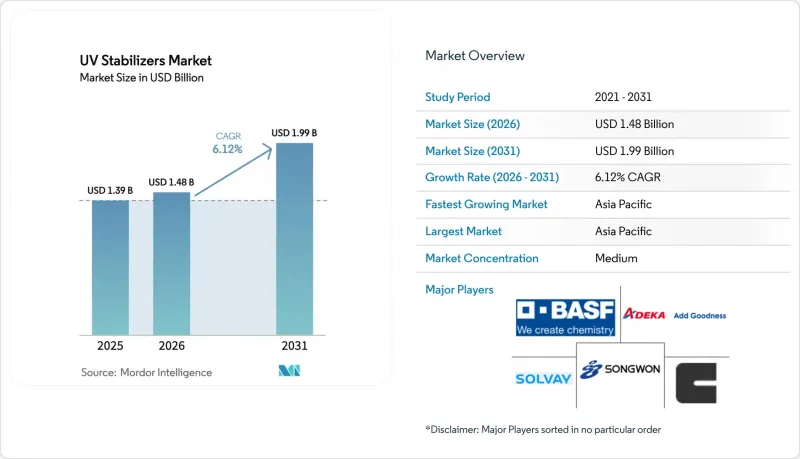
據 Mordor Intelligence 稱,2025 年紫外線穩定劑市值為 13.9 億美元,預計到 2031 年將從 2026 年的 14.8 億美元成長至 19.9 億美元,預測期(2026-2031 年)的複合年成長率為 6.12%。
本報告按類型(HALS、紫外線吸收劑、猝滅劑、抗氧化劑)、終端應用產業(包裝、汽車、農業、建築等)、聚合物類型(聚烯、PVC、聚氨酯、工程塑膠及其他)、形態(液體、粉末、珠粒/顆粒)和地區(亞太地區、北美地區及其他地區)進行細分。市場預測以美元計價。
全球紫外線穩定劑市場趨勢及洞察
紫外線穩定聚烯薄膜在亞洲工業包裝市場迅速普及
在中國和印度,電商中心對能夠承受戶外儲存且不影響拉伸強度的拉伸套膜和收縮包裝膜的需求日益成長。混煉商正在提高配方中高海拔光穩定劑(HALS)的含量,以防止光氧化,並確保印刷圖案在多模態過程中清晰可辨。印度的軟包裝市場正轉向紫外線穩定薄膜。這些薄膜尤其受到農業用品包裝袋的青睞,因為這些包裝袋在季風季節會長時間暴露在陽光下。同時,在中國,加工商正在對含有高濃度HALS的薄膜進行出口預認證。此舉滿足了客戶對回收過程中嚴格純度標準的需求,從而提振了區域需求。東南亞的倉儲公司現在將托盤貨物露天存放。這項變化加速了耐候聚烯薄膜的應用。因此,添加劑的總消耗量顯著增加,同時,薄膜厚度卻呈現下降趨勢。
歐洲向低VOC水性木器塗料轉型
隨著歐盟指令2004/42/EC的實施,VOC(揮發性有機化合物)的允許含量降低,塗料生產商正從溶劑型系統轉向水性塗料,而水性塗料需要耐水解的紫外線吸收劑。由於苯並三唑類化合物會從水性介質中滲出,因此製造商正在轉向使用耐萃取的三嗪類紫外線吸收劑和高分子量HALS(高親水性吸收劑)。德國和北歐國家是最早一批在2025年前完成這些變更的國家,但隨著建築規範日益嚴格,南歐國家也正迎頭趕上。供應商需要對其現有產品線進行改造,檢驗其與新型樹脂平台的兼容性,並將紫外線抑制劑、殺菌劑和流變改性劑整合到單一母粒。雖然配方調整會帶來短期成本,但它創造了以承包添加劑包實現高價銷售的機會,這些添加劑包可確保戶外木質外牆至少五年的顏色穩定性。
原物料價格波動
2024年至2025年間,苯和鄰苯二甲酸酐價格的波動擠壓了沒有長期石化合約的複合材料生產商的利潤空間。亞太地區的現貨買家經歷了最顯著的價格波動,而歐洲生產商則面臨高昂的能源成本,導致芳烴中間體成本上升。因此,中小企業推遲了產能擴張計畫並削減了研發預算,阻礙了先進紫外線穩定劑的商業化。同時,大型垂直一體化企業正透過衍生性商品交易和後向整合風險,但整個產業仍然容易受到地緣政治不穩定和即將訂定的碳定價政策的影響,這些政策可能導致原料成本飆升。
細分市場分析
到2025年,受阻胺類光穩定劑(HALS)將佔據紫外線穩定劑市場65.22%的佔有率,預計到2031年,該細分市場將以6.35%的複合年成長率成長,因為NOR-HALS等級的產品可將戶外塑膠的使用壽命延長10年以上。另一方面,由於紫外線吸收劑在薄膜中的有效性有限,以及揮發性和遷移等問題,其成長速度已放緩。儘管如此,紫外線吸收劑對於透明塗料和聚碳酸酯玻璃仍然至關重要。同時,淬滅劑和抗氧化劑則發揮獨特的作用,並在協同混合物中維持平衡。BASF在2025年推出的「Tinuvin NOR 600」清晰地展現了行業趨勢:混煉商願意為NOR-HALS產品支付溢價,尤其是那些能夠最大限度減少深色汽車零件霧度的產品。
針對特定聚合物的客製化添加劑組合的需求日益成長。例如,聚氨酯分散體擴大採用能夠耐受鹼性環境的輔助鹵化物(HALS)。同樣,3D列印用絲材也正轉向使用與聚醯胺12相容的羥基苯基三嗪類添加劑。在歐洲,REACH法規加強了對鎳基淬滅劑的審查,促使其逐步過渡到有機替代品。此外,整合鹵化物(HALS)、紫外線吸收劑和抗氧化劑的添加劑組合不僅簡化了混配工藝,還減少了組分間的相互作用。這一趨勢將使擁有多元化產品系列的供應商能夠實現高於市場平均的成長。
聚烯主要應用於包裝薄膜、農業覆蓋物和汽車零件等領域,預計2025年將佔市場需求的52.13%。但由於薄膜變薄導致穩定劑用量減少以及單層阻隔材料的普及,其成長速度正在放緩。聚氨酯預計到2031年將維持6.48%的複合年成長率,這主要得益於噴塗泡棉隔熱材料和汽車泡棉板材中對防止泛黃和維持柔軟性的添加劑需求不斷成長。聚氯乙烯(PVC)的成長速度放緩,主要原因是窗框和牆板等替代材料的競爭。相較之下,聚碳酸酯和聚醯胺等工程塑膠的市場正在擴張,這得益於汽車輕量化趨勢和3D列印技術的興起。
聚氨酯的成長主要得益於節能隔熱材料和輕質板材解決方案的強制性應用,這些方案能夠減輕車輛重量。在噴塗泡沫施工過程中,施工人員會選擇以抗紫外線性能著稱的無鹵光穩定劑(HALS),而板材供應商則會選擇與異氰酸酯化學性質相匹配的吸收劑。儘管苯乙烯樹脂和彈性體仍處於小眾市場,但BASF正在採取策略性舉措。該公司計劃於2026年在墨西哥普埃布拉擴建工廠,該工廠將專注於抗氧化劑和紫外線穩定劑的生產,尤其針對聚氨酯和工程塑膠行業的客戶。
區域分析
預計到2025年,亞太地區將佔全球銷售額的54.34%,並在2031年之前以6.61%的複合年成長率持續成長。 2025年,中國軟包裝產業佔據了該地區穩定劑銷售量的大部分。這一成長主要得益於出口商對符合歐洲回收標準的抗紫外線薄膜的需求。同時,2025年,印度對溫室種植的津貼導致對添加HALS的聚乙烯薄膜的需求激增。日本和韓國的成長高於市場平均水平,為汽車和電子產品出口提供重要的工程塑膠零件。為了滿足不斷成長的國內外需求,BASF擴大了其南京工廠的HALS產能。
到2025年,北美將佔據全球市場價值的顯著佔有率,並預計在2031年之前保持穩定成長。這一區域成長主要得益於汽車工業重返美國以及積層製造的蓬勃發展,從而提振了對耐候熱塑性烯烴和紫外線穩定長絲的需求。在加拿大,建設產業正在採用紫外線穩定聚碳酸酯屋頂材料來承受積雪荷載。同時,墨西哥普埃布拉的增產確保了區域內添加劑的穩定供應。歐洲也正處於成長軌道上,其成熟的建築市場與對受監管塗料的強勁需求相平衡。德國、法國、英國和義大利尤其佔了歐洲銷售額的很大一部分,這主要歸功於它們對歐盟指令2004/42/EC的遵守。
南美洲預計將實現成長,主要得益於巴西對熱帶農業的重視以及阿根廷對PVC建築的重視。中東和非洲雖然目前市佔率較小,但正處於快速擴張階段。沙烏地阿拉伯和阿拉伯聯合大公國(阿拉伯聯合大公國)對保護性農業的投資推動了這一成長。此外,南非對汽車出口的正面需求也帶動了對耐紫外線熱塑性烯烴的需求。因此,區域商業機會多種多樣,涵蓋了亞太地區不斷成長的銷售量、北美地區盈利的汽車升級改造,以及中東地區快速發展的溫室產業。
其他好處:
- Excel格式的市場預測(ME)表
- 3個月的分析師支持
目錄
第1章:引言
- 研究假設和市場定義
- 調查範圍
第2章:調查方法
第3章執行摘要
第4章 市場狀況
- 市場概覽
- 市場促進因素
- 亞洲工業包裝領域中抗紫外線聚烯薄膜的快速普及
- 歐洲向低VOC水性木器塗料轉型
- 北美地區對耐候性3D列印塑膠的應用日益廣泛
- 整個中東地區對紫外線穩定溫室薄膜的需求正在激增。
- 汽車應用領域對長壽命外層塑膠的原始設備製造商 (OEM) 要求
- 市場限制因素
- 原物料價格波動
- HALS中間供應鏈中斷
- 阻隔性單層薄膜的廣泛應用導致對穩定劑的需求下降。
- 價值鏈分析
- 波特五力模型
第5章 市場規模與成長預測
- 按類型
- 受阻胺光穩定劑(HALS)
- 紫外線吸收劑
- 解渴
- 抗氧化劑
- 按最終用途行業分類
- 包裝
- 車
- 農業
- 建築/施工
- 黏合劑和密封劑
- 其他終端用戶產業(電氣和電子等)
- 按聚合物類型
- 聚烯(PE、PP)
- PVC
- 聚氨酯
- 工程塑膠(PC、PA、PET)
- 其他材料(苯乙烯樹脂、橡膠和彈性體)
- 按形式
- 液體
- 粉末
- 珠粒/顆粒
- 按地區
- 亞太地區
- 中國
- 印度
- 日本
- 韓國
- 其他亞太國家
- 北美洲
- 美國
- 加拿大
- 墨西哥
- 歐洲
- 德國
- 英國
- 法國
- 義大利
- 其他歐洲國家
- 南美洲
- 巴西
- 阿根廷
- 其他南美國家
- 中東和非洲
- 沙烏地阿拉伯
- 南非
- 其他中東和非洲國家
- 亞太地區
第6章 競爭情勢
- 市場集中度
- 策略趨勢
- 市佔率和排名分析
- 公司簡介
- 3V Sigma SpA
- ADEKA Corporation
- Altana AG
- BASF SE
- Chitec Technology Co., Ltd.
- Clariant
- Eastman Chemical Company
- Everlight Chemical Industrial Co.
- Evonik Industries AG
- Kaneka Corporation
- Lycus Ltd. LLC
- Mayzo Inc.
- Rianlon Corporation
- SABO SpA
- SI Group Inc.
- Solvay
- Songwon
- SUQIAN UNITECH CORP..LTD
- Tianjin Baofeng Chemical Co., Ltd.
- Wanhua
第7章 市場機會與未來展望
According to Mordor Intelligence, the UV stabilizers market size was valued at USD 1.39 billion in 2025 and is estimated to grow from USD 1.48 billion in 2026 to reach USD 1.99 billion by 2031, at a CAGR of 6.12% during the forecast period (2026-2031).
This report is Segmented by Type (HALS, UV Absorbers, Quenchers, and Antioxidants), End-Use Industry (Packaging, Automotive, Agriculture, Building and Construction, and More), Polymer Type (Polyolefins, PVC, Polyurethane, Engineering Plastics, and Others), Form (Liquid, Powder, and Bead/Granule), and Geography (Asia-Pacific, North America, and More). Market Forecasts are Provided in Terms of Value (USD).
Global UV Stabilizers Market Trends and Insights
Rapid Penetration of UV-Stable Polyolefin Films in Asian Industrial Packaging
In China and India, e-commerce hubs are increasingly demanding stretch-hood and shrink-wrap films that can endure outdoor storage without compromising tensile strength. To combat photo-oxidation and ensure printed graphics remain legible during multimodal transport, compounders are increasing HALS loading. India's flexible-packaging market is pivoting towards UV-stable films. These films are particularly sought after for agricultural-input bags that face extended exposure during the monsoon. Meanwhile, in China, converters are pre-qualifying HALS-rich films for export. This move caters to customers who demand stringent recycling-stream purity standards, thereby boosting regional demand. Southeast Asian warehouse operators are now storing palletized goods outdoors. This shift has hastened the adoption of weatherable polyolefin films. Consequently, while there's a notable increase in overall additive consumption, it's happening alongside a trend of film gauge reductions.
Shift Toward Low-VOC, Water-Borne Wood Coatings in Europe
Implementation of EU Directive 2004/42/EC lowered permissible VOC content, steering formulators away from solvent-borne systems toward water-based coatings that require hydrolytically stable UV absorbers. Benzotriazole chemistries leach out of aqueous media, so producers have migrated to triazine UV absorbers and polymeric HALS that resist extraction. Germany and Nordic countries pioneered adoption in 2025, but Southern Europe is closing the gap as building codes tighten. Suppliers must reformulate legacy lines and validate compatibility with new resin platforms, embedding UV protection, biocides, and rheology modifiers into single masterbatches. While reformulation incurs short-term cost, it opens premium pricing opportunities for turnkey additive packages that guarantee color stability on exterior wood facades for at least five years.
Volatility in Feedstock Prices
During 2024-2025, costs for benzene and phthalic anhydride fluctuated, tightening margins for formulators lacking long-term petrochemical contracts. Spot buyers in the Asia-Pacific experienced the most pronounced price swings, while producers in Europe contended with high energy tariffs, driving up costs for aromatic intermediates. As a result, smaller firms are postponing capacity expansions and cutting back on research and development budgets, which is hindering the commercialization of advanced UV stabilizers. While integrated major companies are mitigating risks through derivatives trading and backward integration, the entire sector remains susceptible to geopolitical upheavals and impending carbon-pricing initiatives that threaten to escalate feedstock costs.
Other drivers and restraints analyzed in the detailed report include:
- Growing Adoption of Weather-Resistant 3D-Printed Plastics in North America
- Surge in UV-Stabilized Greenhouse Films Across the Middle East
- Supply-Chain Disruptions in HALS Intermediates
For complete list of drivers and restraints, kindly check the Table Of Contents.
Segment Analysis
Hindered amine light stabilizers controlled 65.22% of the UV stabilizers market share in 2025, and the segment will post a 6.35% CAGR to 2031 as NOR-HALS grades extend exterior plastic life beyond 10 years. UV absorbers face slower growth due to their limited efficacy in thin films, a challenge posed by volatility and migration. Nonetheless, UV absorbers remain crucial for clear coatings and polycarbonate glazing. Meanwhile, quenchers and antioxidants play niche roles, balancing the equation in synergistic blends. BASF's 2025 introduction of Tinuvin NOR 600 underscores the industry's trend: formulators are willing to pay a premium for NOR-HALS, especially those that minimize haze in dark automotive components.
There's a growing demand for packages tailored to specific polymers. For instance, polyurethane dispersions are now opting for secondary HALS that can endure alkaline settings. Similarly, filaments used in 3D printing are turning to hydroxyphenyltriazines, which are compatible with polyamide 12. In Europe, nickel-based quenchers are under heightened scrutiny due to REACH regulations, leading to a gradual pivot towards organic substitutes. Furthermore, integrated additive packages that merge HALS, UV absorbers, and antioxidants not only streamline the formulation process but also mitigate antagonistic interactions. This trend positions suppliers with diverse portfolios for growth that outpaces the market average.
Polyolefins represented 52.13% of 2025 demand, supported by packaging films, agricultural covers, and automotive parts, yet their growth moderates as thinner films and monolayer barriers reduce stabilizer intensity. Polyurethanes will post a 6.48% CAGR through 2031 as spray-foam insulation and automotive seating foams demand additives that prevent yellowing and maintain flexibility. PVC is witnessing slower growth due to competition from alternative materials in window profiles and siding. In contrast, engineering plastics like polycarbonate and polyamide are expanding, driven by trends in automotive lightweighting and the rise of 3D printing.
Gains in polyurethane are fueled by mandates for energy-efficient insulation and lightweight seating solutions, which can reduce a vehicle's mass. During installation, spray-foam installers opt for HALS, known for their UV resistance, while seating suppliers choose absorbers that align with isocyanate chemistries. Although styrenics and elastomers occupy a niche space, BASF is making strategic moves. Their 2026 expansion in Puebla, Mexico, is set to cater specifically to customers in polyurethane and engineering plastics, focusing on antioxidants and UV stabilizers.
Complete Report Scope:
- By Type
- Hindered Amine Light Stabilizers (HALS)
- UV Absorbers
- Quenchers
- Antioxidants
- By End-Use Industry
- Packaging
- Automotive
- Agriculture
- Building and Construction
- Adhesives and Sealants
- Other End-user Industries (Electrical and Electronics, etc.)
- By Polymer Type
- Polyolefins (PE, PP)
- PVC
- Polyurethane
- Engineering Plastics (PC, PA, PET)
- Others (Styrenics and Rubber and Elastomers)
- By Form
- Liquid
- Powder
- Bead/Granule
- By Geography
- Asia-Pacific
- China
- India
- Japan
- South Korea
- Rest of Asia-Pacific
- North America
- United States
- Canada
- Mexico
- Europe
- Germany
- United Kingdom
- France
- Italy
- Rest of Europe
- South America
- Brazil
- Argentina
- Rest of South America
- Middle-East and Africa
- Saudi Arabia
- South Africa
- Rest of Middle-East and Africa
- Asia-Pacific
Geography Analysis
Asia-Pacific held 54.34% of global revenue in 2025 and will expand at a 6.61% CAGR through 2031. In 2025, China's flexible-packaging sector accounted for a significant portion of the regional stabilizer volume. This surge was driven by exporters' demand for UV-resistant films that align with European recycling standards. Meanwhile, in 2025, India subsidized greenhouses, fueling a spike in demand for polyethylene films infused with HALS loading. Japan and South Korea outpaced the market, supplying engineering-plastic components pivotal for automotive and electronics exports. In response to the burgeoning local and export demand, BASF expanded its HALS capacity at the Nanjing plant.
In 2025, North America claimed a notable share of the global market value and is projected to grow steadily through 2031. The region's growth is bolstered by automotive reshoring and a surge in additive manufacturing, driving up demand for weatherable thermoplastic olefins and UV-stabilized filaments. In Canada, the construction sector is turning to UV-stable polycarbonate roofing to withstand snow loads. Simultaneously, Mexico's Puebla expansion is ensuring a steady regional supply of additives. Europe is on a growth trajectory, attributed to mature construction markets balancing out the robust, regulation-driven demand for coatings. Notably, Germany, France, the UK, and Italy collectively account for a significant portion of Europe's revenue, largely due to adherence to Directive 2004/42/EC.
South America is set to rise, thanks to Brazil's tropical agriculture and Argentina's focus on PVC construction. The Middle East and Africa, while currently representing a smaller share, are expanding rapidly. This growth is spurred by Saudi Arabia and the UAE's investments in protected agriculture. Additionally, South Africa's ambitions in automotive exports are driving up the demand for UV-stable thermoplastic olefins. Thus, regional opportunities are diverse, spanning from Asia-Pacific's volume growth and North America's lucrative automotive upgrades to the Middle East's burgeoning greenhouse industry.
- 3V Sigma S.p.A.
- ADEKA Corporation
- Altana AG
- BASF SE
- Chitec Technology Co., Ltd.
- Clariant
- Eastman Chemical Company
- Everlight Chemical Industrial Co.
- Evonik Industries AG
- Kaneka Corporation
- Lycus Ltd. LLC
- Mayzo Inc.
- Rianlon Corporation
- SABO S.p.A.
- SI Group Inc.
- Solvay
- Songwon
- SUQIAN UNITECH CORP..LTD
- Tianjin Baofeng Chemical Co., Ltd.
- Wanhua
Additional Benefits:
- The market estimate (ME) sheet in Excel format
- 3 months of analyst support
TABLE OF CONTENTS
1 Introduction
- 1.1 Study Assumptions and Market Definition
- 1.2 Scope of the Study
2 Research Methodology
3 Executive Summary
4 Market Landscape
- 4.1 Market Overview
- 4.2 Market Drivers
- 4.2.1 Rapid penetration of UV-stable polyolefin films in Asian industrial packaging
- 4.2.2 Shift toward low-VOC, water-borne wood coatings in Europe
- 4.2.3 Growing adoption of weather-resistant 3-D-printed plastics in North America
- 4.2.4 Surge in UV-stabilised greenhouse films across the Middle East
- 4.2.5 OEM mandates for long-life exterior automotive plastics
- 4.3 Market Restraints
- 4.3.1 Volatility in feed-stock prices
- 4.3.2 Supply-chain disruptions in HALS intermediates
- 4.3.3 Uptake of high-barrier monolayer films reducing stabiliser demand
- 4.4 Value Chain Analysis
- 4.5 Porter's Five Forces
- 4.5.1 Bargaining Power of Suppliers
- 4.5.2 Bargaining Power of Consumers
- 4.5.3 Threat of New Entrants
- 4.5.4 Threat of Substitutes
- 4.5.5 Degree of Competition
5 Market Size and Growth Forecasts (Value)
- 5.1 By Type
- 5.1.1 Hindered Amine Light Stabilizers (HALS)
- 5.1.2 UV Absorbers
- 5.1.3 Quenchers
- 5.1.4 Antioxidants
- 5.2 By End-Use Industry
- 5.2.1 Packaging
- 5.2.2 Automotive
- 5.2.3 Agriculture
- 5.2.4 Building and Construction
- 5.2.5 Adhesives and Sealants
- 5.2.6 Other End-user Industries (Electrical and Electronics, etc.)
- 5.3 By Polymer Type
- 5.3.1 Polyolefins (PE, PP)
- 5.3.2 PVC
- 5.3.3 Polyurethane
- 5.3.4 Engineering Plastics (PC, PA, PET)
- 5.3.5 Others (Styrenics and Rubber and Elastomers)
- 5.4 By Form
- 5.4.1 Liquid
- 5.4.2 Powder
- 5.4.3 Bead/Granule
- 5.5 By Geography
- 5.5.1 Asia-Pacific
- 5.5.1.1 China
- 5.5.1.2 India
- 5.5.1.3 Japan
- 5.5.1.4 South Korea
- 5.5.1.5 Rest of Asia-Pacific
- 5.5.2 North America
- 5.5.2.1 United States
- 5.5.2.2 Canada
- 5.5.2.3 Mexico
- 5.5.3 Europe
- 5.5.3.1 Germany
- 5.5.3.2 United Kingdom
- 5.5.3.3 France
- 5.5.3.4 Italy
- 5.5.3.5 Rest of Europe
- 5.5.4 South America
- 5.5.4.1 Brazil
- 5.5.4.2 Argentina
- 5.5.4.3 Rest of South America
- 5.5.5 Middle-East and Africa
- 5.5.5.1 Saudi Arabia
- 5.5.5.2 South Africa
- 5.5.5.3 Rest of Middle-East and Africa
- 5.5.1 Asia-Pacific
6 Competitive Landscape
- 6.1 Market Concentration
- 6.2 Strategic Moves
- 6.3 Market Share(%)/Ranking Analysis
- 6.4 Company Profiles (includes Global-level Overview, Market-level Overview, Core Segments, Financials as available, Strategic Information, Products and Services, Recent Developments)
- 6.4.1 3V Sigma S.p.A.
- 6.4.2 ADEKA Corporation
- 6.4.3 Altana AG
- 6.4.4 BASF SE
- 6.4.5 Chitec Technology Co., Ltd.
- 6.4.6 Clariant
- 6.4.7 Eastman Chemical Company
- 6.4.8 Everlight Chemical Industrial Co.
- 6.4.9 Evonik Industries AG
- 6.4.10 Kaneka Corporation
- 6.4.11 Lycus Ltd. LLC
- 6.4.12 Mayzo Inc.
- 6.4.13 Rianlon Corporation
- 6.4.14 SABO S.p.A.
- 6.4.15 SI Group Inc.
- 6.4.16 Solvay
- 6.4.17 Songwon
- 6.4.18 SUQIAN UNITECH CORP..LTD
- 6.4.19 Tianjin Baofeng Chemical Co., Ltd.
- 6.4.20 Wanhua
7 Market Opportunities and Future Outlook
- 7.1 White-Space and Unmet-Need Assessment

 2026-2030年全球鈣鋅穩定劑市場
 紫外線穩定劑市場-2026-2032年全球市場預測
 2026年全球乳化穩定劑市場報告
 酵素穩定劑市場規模、佔有率和成長分析:按類型、應用、最終用戶、通路和地區分類-2026-2033年產業預測
 紫外線穩定劑市場報告:按類型、最終用戶和地區分類(2026-2034 年)有機穩定劑市場:按類型、應用、終端用戶產業和分銷管道分類-2026-2032年全球市場預測
 氨甲基丙醇市場:依純度、應用、最終用戶和地區分類2026年全球紫外線穩定劑市場報告2026年全球酵素穩定劑市場報告
 紫外線穩定劑市場規模、佔有率和成長分析(按類型、應用、聚合物類型、形態和地區分類)—2026-2033年產業預測