


 |
市場調查報告書
商品編碼
2121982
下一代記憶體:市場佔有率分析、行業趨勢和統計數據以及成長預測(2026-2031 年)Next Generation Memory - Market Share Analysis, Industry Trends & Statistics, Growth Forecasts (2026 - 2031) |
||||||

※ 本網頁內容可能與最新版本有所差異。詳細情況請與我們聯繫。
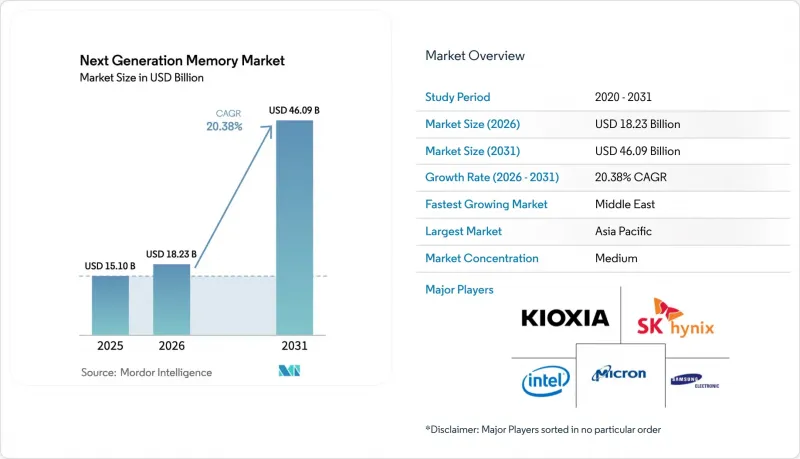
根據 Mordor Intelligence 預測,下一代記憶體市場規模將從 2025 年的 460.9 億美元,2026 年至 2031 年的年複合成長率(CAGR)為 20.38%。
本報告按技術(非揮發性、揮發性)、記憶體介面(DDR/LPDDR、PCIe/NVMe、SATA 等)、終端應用設備(家用電子電器、企業儲存和資料中心、汽車電子和 ADAS、工業IoT、航太和國防、其他)、晶圓尺寸(200mm 以下、300mm、工業物聯網、航空航太和國防、其他)、晶圓尺寸(200mm 以下、300mm、450mm)以及地區細分。市場預測以美元計價。
全球下一代記憶體市場趨勢與洞察
超大規模資料中心中人工智慧主導的HBM需求
隨著人工智慧叢集逐漸接近GDDR6的頻寬極限,超大規模資料中心業者正轉向HBM3E堆疊,其單封裝容量最高可達819 GB/s。 SK海力士已於2024年開始量產12層HBM3E,但主要外包組裝廠商的先進封裝產能已排至2026年中期。 NVIDIA的「Blackwell」系列和AMD的「MI300」系列均整合了8個HBM3E堆疊,使每個加速器的記憶體容量提升至192 GB。與獨立GDDR模組相比,HBM3E可節省高達40%的耗電量,有助於提升資料中心的永續性能力,並進一步加速HBM的普及。因此,下一代記憶體市場的整體複合年成長率將提高6.2個百分點。
汽車L4 ADAS對即時啟動持久記憶體的需求
L4級自動駕駛規格要求系統啟動延遲控制在100毫秒以內,而基於NAND快閃記憶體的啟動路徑無法實現此目標。 STT-MRAM結合了DRAM般的讀取速度和非揮發性,使控制器能夠立即恢復感測器融合。 Everspin計劃到2025年出貨超過100萬個汽車認證的MRAM單元,而意法半導體(STMicroelectronics)已開始為2026款車型量產28nm嵌入式PCM。諸如UNECE WP.29等法規結構強制要求防篡改日誌記錄,進一步強化了其商業價值。這些因素將推動下一代記憶體市場以4.8個百分點的複合年成長率成長。
450 毫米晶圓的滯後限制了 ReRAM 的規模發展。
從300毫米晶圓轉向450毫米晶圓預計將使晶片產量顯著提升2.25倍,從而大幅提高生產效率並降低成本。然而,ASML目前缺乏專為處理這些更大基板而設計的商用EUV平台,這導致在實現這一轉變所需的必要技術基礎設施方面存在顯著差距。嚴重依賴28奈米以下節點的ReRAM供應商無法利用這些成本優勢,這嚴重阻礙了它們與NAND技術實現性能上的匹敵。這種技術限制對成長前景產生了重大影響,尤其是在那些選擇推遲對450毫米晶圓技術投資的地區,進一步阻礙了這些地區的技術進步。
細分市場分析
預計到2025年,揮發性記憶體將佔據下一代記憶體市場52.14%的佔有率,這反映了其作為人工智慧加速器首選儲存堆疊的地位。揮發性記憶體技術的下一代記憶體市場規模依然龐大,三星正在研發頻寬達1.5 TB/s的24層HBM4原型。同時,受汽車和工業領域買家對「即時啟動」功能和抗輻射性能的優先考慮,自旋轉移矩磁阻隨機存取記憶體(MRAM)預計到2031年將以23.03%的年複合成長率(CAGR)。
到2025年,相變記憶體、翻轉磁隨機存取記憶體(MRAM)和電阻式隨機存取記憶體(ReRAM)等非揮發性記憶體將佔據約12%的總合,其中嵌入式ReRAM在支付卡和生物識別模組中的應用日益廣泛。鐵電存取記憶體(FRAM)在超低功耗工業感測器中仍然至關重要,而奈米隨機存取記憶體(NanoRAM)在航太系統中也取得了進展。隨著英特爾傲騰(Optane)將於2024年停產,STT-MRAM供應商正利用這一市場空白,力圖在企業儲存市場佔據更大的佔有率。
預計到2025年,DDR和LPDDR介面將佔據46.51%的市場佔有率,憑藉其向下相容性和廣泛的控制器支持,成為市場主導力量。這些介面能夠與現有系統無縫整合,並具有廣泛的控制器相容性,因此構成了記憶體市場的基礎。下一代記憶體市場,即與Compute Express Link (CXL)相關的市場,預計將以22.16%的複合年成長率強勁成長,這主要得益於CXL 3.0能夠實現4096個設備間的連貫共用。這一成長凸顯了市場對能夠支援高效能運算和資料密集型應用的高階記憶體解決方案日益成長的需求。
儘管 PCIe 和 NVMe 佔據了約三分之一的收入,但隨著新技術的湧現,市場格局正在改變。超大規模負責人正在加速向機架級記憶體架構轉型,以最佳化容量利用率並減少因記憶體利用率不足而造成的效率損失。隨著英特爾 Xeon 6 和 AMD EPYC Genoa 整合原生 CXL 2.0 控制器,預計到 2026 年,該生態系統將日益成熟,從而為未來的應用提供更強大、更具可擴展性的基礎設施。專用於汽車應用的串行鏈路在特定領域仍佔有一席之地,但隨著 JEDEC 推動汽車應用 CXL 擴展的標準化,其市場佔有率正在萎縮。預計這項標準化將刺激汽車產業的創新和應用,進一步改變記憶體市場的競爭格局。
區域分析
預計到2025年,亞太地區將以56.43%的市佔率領先全球市場。韓國斥資26兆韓元(約190億美元)建造先進記憶體生產線,旨在提升產能和技術水平,極大地推動了亞太地區的市場主導。此外,中國長信儲存科技投資500億元人民幣(約70億美元)的擴張計劃,透過提升製造能力和增強在全球市場的競爭力,進一步鞏固了亞太地區的地位。同時,台灣和日本強大的代工生態系統也為亞太地區的領先地位提供了關鍵支持。這些生態系統最佳化了從原型開發到量產的流程,縮短了產品上市時間,並促進了整個供應鏈的創新。
到2025年,北美將佔據下一代記憶體市場約23%的佔有率。這主要得益於大規模人工智慧的普及應用,人工智慧正持續變革產業格局,並催生對先進記憶體解決方案的需求。此外,北美也受惠於《晶片法案》(CHIPS Act)提供的390億美元撥款,這筆資金為加強北美半導體製造和研發能力提供了關鍵支援。這項戰略投資已使北美成為全球記憶體市場的主要參與者,確保了其競爭力和韌性。歐洲佔12%的市場佔有率,並利用了歐盟《晶片法案》中撥出的430億歐元(約470億美元)巨額津貼,用於嵌入式記憶體的研發。特別是,德國和法國合作,共同資助試點生產線,旨在減少對進口的依賴,並建立一個更自給自足的半導體生態系統。這些措施體現了歐洲致力於加強其技術基礎設施並促進記憶體市場創新的決心。
儘管規模較小,但中東預計將以21.65%的複合年成長率成長,成為下一代記憶體市場成長最快的地區。這一顯著成長主要歸功於沙烏地阿拉伯和阿拉伯聯合大公國將設備端推理技術融入其雄心勃勃的智慧城市計畫。這些措施旨在提升城市基礎設施並提高城市營運效率,從而推動對先進記憶體技術的需求。相較之下,南美和非洲則落後於中東,合計總合不足5%。這些地區的成長受到製造業基礎設施不足的限制,限制了其在全球的競爭力。然而,巴西的汽車產業為汽車用MRAM提供了一個充滿潛力的細分市場,因為該國正在不斷提升其在該領域的實力。這一細分市場有望成為該地區記憶體技術領域進一步發展的跳板。
其他好處:
- Excel格式的市場預測(ME)表
- 3個月的分析師支持
目錄
第1章:引言
- 研究假設和市場定義
- 調查範圍
第2章:調查方法
第3章執行摘要
第4章 市場狀況
- 市場概覽
- 市場促進因素
- 超大規模資料中心中人工智慧主導的HBM需求
- 汽車L4 ADAS對即時啟動持久記憶體的需求
- 智慧型手機向LPDDR5X和嵌入式ReRAM過渡
- 國家記憶在地化計劃
- 工業邊緣物聯網需要超低功耗FRAM
- 一個注重資料隱私的持久記憶體內,採用 3D XPoint 技術。
- 市場限制因素
- 450 毫米晶圓供應延遲限制了 ReRAM 的規模化生產。
- 與NAND快閃記憶體相比,MRAM的每位元高成本。
- 與汽車相變材料熱穩定性相關的缺陷
- 28奈米以下STT-MRAM製程的代工集中化
- 產業價值鏈分析
- 監理情勢
- 技術展望
- 波特五力分析
第5章 市場規模與成長預測
- 透過技術
- 非揮發性
- 相變記憶體(PCM)
- 自旋傳輸型磁性隨機存取記憶體(STT-MRAM)
- 切換 MRAM
- 阻變式隨機存取記憶體(ReRAM)
- 3D XPoint/Optene
- 鐵電存取記憶體(FeRAM)
- NanoRAM
- 易揮發的
- 高頻寬體(HBM)
- 混合儲存立方體(HMC)
- 低功耗DDR5/LPDDR5X
- 非揮發性
- 透過記憶體介面
- DDR/LPDDR
- PCIe/NVMe
- SATA
- 其他,內存介面
- 按最終用途和設備分類
- 家用電子產品
- 企業儲存與資料中心
- 汽車電子和ADAS
- 工業IoT和製造業自動化
- 航太/國防
- 醫療保健和醫療設備
- 其他終端設備
- 按晶圓尺寸
- 200毫米或更小
- 300 mm
- 450 mm
- 按地區
- 北美洲
- 美國
- 加拿大
- 墨西哥
- 南美洲
- 巴西
- 阿根廷
- 其他南美國家
- 歐洲
- 德國
- 英國
- 法國
- 義大利
- 西班牙
- 其他歐洲國家
- 亞太地區
- 中國
- 日本
- 韓國
- 印度
- 澳洲
- 紐西蘭
- 其他亞太國家
- 中東和非洲
- 中東
- 阿拉伯聯合大公國
- 沙烏地阿拉伯
- 土耳其
- 其他中東國家
- 非洲
- 南非
- 奈及利亞
- 肯亞
- 其他非洲國家
- 中東
- 北美洲
第6章 競爭情勢
- 市場集中度
- 策略趨勢
- 市佔率分析
- 公司簡介
- Samsung Electronics Co., Ltd.
- SK Hynix Inc.
- Micron Technology, Inc.
- Kioxia Holdings Corporation
- Intel Corporation
- Western Digital Corporation
- Everspin Technologies, Inc.
- Crossbar Inc.
- Avalanche Technology Inc.
- Spin Memory, Inc.
- Nantero Inc.
- Weebit Nano Ltd.
- Renesas Electronics Corporation
- Infineon Technologies AG
- NXP Semiconductors NV
- Changxin Memory Technologies(CXMT)
- Taiwan Semiconductor Manufacturing Co. Ltd.
- GlobalFoundries Inc.
- Winbond Electronics Corporation
- Macronix International Co., Ltd.
- Nanya Technology Corporation
- Advanced Semiconductor Engineering Inc.
- Powerchip Semiconductor Manufacturing Corp.
- Yangtze Memory Technologies Co.
- Microchip Technology Inc.
第7章 市場機會與未來展望
According to Mordor Intelligence, the next-generation memory market size is projected to expand from USD 15.10 billion in 2025 and USD 18.23 billion in 2026 to USD 46.09 billion by 2031, registering a CAGR of 20.38% between 2026 to 2031.
This report is Segmented by Technology (Non-Volatile, and Volatile), Memory Interface (DDR/LPDDR, PCIe/NVMe, SATA, and More), End-Use Device (Consumer Electronics, Enterprise Storage and Data Centers, Automotive Electronics and ADAS, Industrial IoT, Aerospace and Defense, and More), Wafer Size (Up To 200mm, 300mm, and 450mm), and Geography. The Market Forecasts are Provided in Terms of Value (USD).
Global Next Generation Memory Market Trends and Insights
AI-Driven Demand for HBM in Hyperscale Data Centers
Generative-AI clusters are breaching GDDR6 bandwidth ceilings, and hyperscalers have moved to HBM3E stacks that deliver up to 819 GB/s per package. SK Hynix began mass production of 12-layer HBM3E in 2024, yet advanced-packaging capacity at leading outsourced assembly houses remains fully booked through mid-2026. NVIDIA's Blackwell and AMD's MI300 lines each integrate eight HBM3E stacks, lifting per-accelerator memory content to 192 GB. Power savings of up to 40% versus discrete GDDR modules support data-center sustainability pledges, reinforcing HBM adoption momentum. The consequence is a 6.2-point uplift to the overall CAGR of the next generation memory market.
Automotive L4 ADAS Need for Instant-On Persistent Memory
Level 4 autonomy specifications cap system-start latency at 100 ms, a target unreachable with NAND-based boot paths. STT-MRAM delivers DRAM-like read speed with non-volatility, enabling controllers to resume sensor fusion instantly. Everspin shipped more than 1 million automotive-qualified MRAM units in 2025, and STMicroelectronics entered volume production of 28 nm embedded PCM for 2026 vehicles. Regulatory frameworks such as UNECE WP.29 strengthen the business case by requiring tamper-proof logging. These forces add 4.8 points to the CAGR of the next generation memory market.
450 mm Wafer Delay Constraining ReRAM Scale-Up
Transitioning from 300 mm to 450 mm wafers promises a significant 2.25X increase in die output, which could substantially enhance production efficiency and reduce costs. However, ASML currently lacks a commercial EUV platform designed to accommodate these larger substrates, creating a critical gap in the technological infrastructure required for this transition. Vendors of ReRAM, who are heavily reliant on sub-28 nm nodes, are unable to leverage these cost advantages, which significantly hinders their ability to achieve parity with NAND technology. This technological limitation has a notable impact on growth expectations. The effect is particularly pronounced in regions that have chosen to delay their investments in 450 mm wafer technology, further stalling advancements in these areas.
Other drivers and restraints analyzed in the detailed report include:
- Smartphone Migration to LPDDR5X and Embedded ReRAM
- National Memory Localization Programs
- High Per-Bit MRAM Cost Versus NAND
For complete list of drivers and restraints, kindly check the Table Of Contents.
Segment Analysis
Volatile secured 52.14% of the next generation memory market share in 2025, reflecting its role as the preferred stack for AI accelerators. The next-generation memory market size for volatile technologies stays elevated as Samsung prepares a 24-layer HBM4 prototype with 1.5 TB/s bandwidth. Spin-Transfer-Torque MRAM, however, is on track for a 23.03% CAGR through 2031 as automotive and industrial buyers prioritize instant-on and radiation-tolerant features.
Non-volatile alternatives such as phase-change memory, toggle MRAM, and resistive RAM collectively accounted for roughly 12% in 2025, with embedded ReRAM moving into payment cards and biometric modules. Ferroelectric RAM remains essential in ultra-low-power industrial sensors, while NanoRAM is advancing in space-grade systems. Discontinuation of Intel Optane in 2024 created a vacuum that STT-MRAM suppliers are exploiting to capture enterprise storage slots.
In 2025, DDR and LPDDR interfaces commanded a dominant 46.51% share of the revenue, leveraging their backward compatibility and widespread controller support. These interfaces have become a cornerstone in the memory market due to their ability to seamlessly integrate with existing systems and their compatibility with a broad range of controllers. The market for next-generation memory, linked to Compute Express Link, is set to surge at a robust 22.16% CAGR, driven by CXL 3.0's capability to facilitate coherent sharing among 4,096 devices. This growth highlights the increasing demand for advanced memory solutions that can support high-performance computing and data-intensive applications.
While PCIe and NVMe accounted for roughly a third of the revenues, the landscape is shifting as new technologies emerge. Hyperscale buyers are increasingly turning to rack-scale memory fabrics to optimize capacity usage and reduce inefficiencies caused by stranded memory. With Intel's Xeon 6 and AMD's EPYC Genoa integrating native CXL 2.0 controllers, the ecosystem is poised for maturity by 2026, ensuring a more robust and scalable infrastructure for future applications. Although proprietary automotive serial links maintain a specialized foothold, their market share is dwindling as JEDEC moves to standardize CXL extensions for vehicles. This standardization is expected to drive innovation and adoption in the automotive sector, further transforming the competitive dynamics of the memory market.
Complete Report Scope:
- By Technology
- Non-Volatile
- Phase-Change Memory (PCM)
- Spin-Transfer MRAM (STT-MRAM)
- Toggle MRAM
- Resistive RAM (ReRAM)
- 3D XPoint / Optane
- Ferroelectric RAM (FeRAM)
- NanoRAM
- Volatile
- High-Bandwidth Memory (HBM)
- Hybrid Memory Cube (HMC)
- Low-Power DDR5 / LPDDR5X
- Non-Volatile
- By Memory Interface
- DDR / LPDDR
- PCIe / NVMe
- SATA
- Others, Memory Interface
- By End-Use Device
- Consumer Electronics
- Enterprise Storage and Data Centers
- Automotive Electronics and ADAS
- Industrial IoT and Manufacturing Automation
- Aerospace and Defense
- Healthcare and Medical Devices
- Others, End-Use Device
- By Wafer Size
- Up to 200 mm
- 300 mm
- 450 mm
- By Geography
- North America
- United States
- Canada
- Mexico
- South America
- Brazil
- Argentina
- Rest of South America
- Europe
- Germany
- United Kingdom
- France
- Italy
- Spain
- Rest of Europe
- Asia Pacific
- China
- Japan
- South Korea
- India
- Australia
- New Zealand
- Rest of Asia-Pacific
- Middle East and Africa
- Middle East
- United Arab Emirates
- Saudi Arabia
- Turkey
- Rest of Middle East
- Africa
- South Africa
- Nigeria
- Kenya
- Rest of Africa
- Middle East
- North America
Geography Analysis
In 2025, Asia-Pacific dominated the revenue landscape with a commanding 56.43% share. This significant market leadership was bolstered by South Korea's substantial KRW 26 trillion (USD 19 billion) investment in advanced memory lines, aimed at enhancing production capabilities and technological advancements. Additionally, China's CNY 50 billion (USD 7 billion) expansion at Changxin Memory Technologies further strengthened the region's position by increasing its manufacturing capacity and competitiveness in the global market. Meanwhile, Taiwan and Japan's robust foundry ecosystems played a pivotal role in supporting the region's dominance. These ecosystems streamline the journey from prototype development to mass production, enabling faster time-to-market cycles and fostering innovation across the supply chain.
North America secured approximately 23% of the next-generation memory market in 2025, driven by expansive hyperscale AI deployments that continue to transform industries and create demand for advanced memory solutions. The region also benefited significantly from the USD 39 billion CHIPS Act subsidy, which provided critical funding to bolster domestic semiconductor manufacturing and research capabilities. This strategic investment has positioned North America as a key player in the global memory market, ensuring its competitiveness and resilience. Europe, with a 12% market share, leveraged the EU Chips Act's generous grants of EUR 43 billion (USD 47 billion), which were directed towards embedded memory research and development. Notably, Germany and France collaborated to co-fund pilot lines, aiming to reduce their reliance on imports and establish a more self-sufficient semiconductor ecosystem. These efforts reflect Europe's commitment to strengthening its technological infrastructure and fostering innovation in the memory market.
Though modest in size, the Middle East is making waves with a projected 21.65% CAGR, marking it as the fastest-growing region in the next-generation memory market. This impressive growth is largely attributed to Saudi Arabia and the United Arab Emirates integrating on-device inference into their ambitious smart-city initiatives. These initiatives are designed to enhance urban infrastructure and improve the efficiency of city operations, driving demand for advanced memory technologies. In contrast, South America and Africa lag behind with a combined market share of under 5%. Their growth is stunted by a lack of fabrication infrastructure, which limits their ability to compete on a global scale. However, Brazil's automotive sector presents a promising niche opportunity for automotive-grade MRAM, as the country continues to develop its capabilities in this specialized area. This niche market could serve as a stepping stone for further advancements in the region's memory technology landscape.
- Samsung Electronics Co., Ltd.
- SK Hynix Inc.
- Micron Technology, Inc.
- Kioxia Holdings Corporation
- Intel Corporation
- Western Digital Corporation
- Everspin Technologies, Inc.
- Crossbar Inc.
- Avalanche Technology Inc.
- Spin Memory, Inc.
- Nantero Inc.
- Weebit Nano Ltd.
- Renesas Electronics Corporation
- Infineon Technologies AG
- NXP Semiconductors N.V.
- Changxin Memory Technologies (CXMT)
- Taiwan Semiconductor Manufacturing Co. Ltd.
- GlobalFoundries Inc.
- Winbond Electronics Corporation
- Macronix International Co., Ltd.
- Nanya Technology Corporation
- Advanced Semiconductor Engineering Inc.
- Powerchip Semiconductor Manufacturing Corp.
- Yangtze Memory Technologies Co.
- Microchip Technology Inc.
Additional Benefits:
- The market estimate (ME) sheet in Excel format
- 3 months of analyst support
TABLE OF CONTENTS
1 INTRODUCTION
- 1.1 Study Assumptions and Market Definition
- 1.2 Scope of the Study
2 RESEARCH METHODOLOGY
3 EXECUTIVE SUMMARY
4 MARKET LANDSCAPE
- 4.1 Market Overview
- 4.2 Market Drivers
- 4.2.1 AI-Driven Demand for HBM in Hyperscale Data Centers
- 4.2.2 Automotive L4 ADAS Need for Instant-On Persistent Memory
- 4.2.3 Smartphone Migration to LPDDR5X and Embedded ReRAM
- 4.2.4 National Memory Localization Programs
- 4.2.5 Industrial Edge-IoT Requiring Ultra-Low-Power FRAM
- 4.2.6 Data-Privacy-Driven Persistent In-Memory Databases Using 3D XPoint
- 4.3 Market Restraints
- 4.3.1 450 mm Wafer Delay Constraining ReRAM Scale-Up
- 4.3.2 High Per-Bit MRAM Cost Versus NAND
- 4.3.3 Thermal Stability Failures of Automotive-Grade PCM
- 4.3.4 Foundry Concentration for Sub-28 nm STT-MRAM
- 4.4 Industry Value Chain Analysis
- 4.5 Regulatory Landscape
- 4.6 Technological Outlook
- 4.7 Porter's Five Forces Analysis
- 4.7.1 Bargaining Power of Buyers
- 4.7.2 Bargaining Power of Suppliers
- 4.7.3 Threat of New Entrants
- 4.7.4 Threat of Substitutes
- 4.7.5 Competitive Rivalry
5 MARKET SIZE AND GROWTH FORECASTS (VALUE)
- 5.1 By Technology
- 5.1.1 Non-Volatile
- 5.1.1.1 Phase-Change Memory (PCM)
- 5.1.1.2 Spin-Transfer MRAM (STT-MRAM)
- 5.1.1.3 Toggle MRAM
- 5.1.1.4 Resistive RAM (ReRAM)
- 5.1.1.5 3D XPoint / Optane
- 5.1.1.6 Ferroelectric RAM (FeRAM)
- 5.1.1.7 NanoRAM
- 5.1.2 Volatile
- 5.1.2.1 High-Bandwidth Memory (HBM)
- 5.1.2.2 Hybrid Memory Cube (HMC)
- 5.1.2.3 Low-Power DDR5 / LPDDR5X
- 5.1.1 Non-Volatile
- 5.2 By Memory Interface
- 5.2.1 DDR / LPDDR
- 5.2.2 PCIe / NVMe
- 5.2.3 SATA
- 5.2.4 Others, Memory Interface
- 5.3 By End-Use Device
- 5.3.1 Consumer Electronics
- 5.3.2 Enterprise Storage and Data Centers
- 5.3.3 Automotive Electronics and ADAS
- 5.3.4 Industrial IoT and Manufacturing Automation
- 5.3.5 Aerospace and Defense
- 5.3.6 Healthcare and Medical Devices
- 5.3.7 Others, End-Use Device
- 5.4 By Wafer Size
- 5.4.1 Up to 200 mm
- 5.4.2 300 mm
- 5.4.3 450 mm
- 5.5 By Geography
- 5.5.1 North America
- 5.5.1.1 United States
- 5.5.1.2 Canada
- 5.5.1.3 Mexico
- 5.5.2 South America
- 5.5.2.1 Brazil
- 5.5.2.2 Argentina
- 5.5.2.3 Rest of South America
- 5.5.3 Europe
- 5.5.3.1 Germany
- 5.5.3.2 United Kingdom
- 5.5.3.3 France
- 5.5.3.4 Italy
- 5.5.3.5 Spain
- 5.5.3.6 Rest of Europe
- 5.5.4 Asia Pacific
- 5.5.4.1 China
- 5.5.4.2 Japan
- 5.5.4.3 South Korea
- 5.5.4.4 India
- 5.5.4.5 Australia
- 5.5.4.6 New Zealand
- 5.5.4.7 Rest of Asia-Pacific
- 5.5.5 Middle East and Africa
- 5.5.5.1 Middle East
- 5.5.5.1.1 United Arab Emirates
- 5.5.5.1.2 Saudi Arabia
- 5.5.5.1.3 Turkey
- 5.5.5.1.4 Rest of Middle East
- 5.5.5.2 Africa
- 5.5.5.2.1 South Africa
- 5.5.5.2.2 Nigeria
- 5.5.5.2.3 Kenya
- 5.5.5.2.4 Rest of Africa
- 5.5.5.1 Middle East
- 5.5.1 North America
6 COMPETITIVE LANDSCAPE
- 6.1 Market Concentration
- 6.2 Strategic Moves
- 6.3 Market Share Analysis
- 6.4 Company Profiles (includes Global Level Overview, Market Level Overview, Core Segments, Financials as available, Strategic Information, Market Rank/Share, Products and Services, Recent Developments)
- 6.4.1 Samsung Electronics Co., Ltd.
- 6.4.2 SK Hynix Inc.
- 6.4.3 Micron Technology, Inc.
- 6.4.4 Kioxia Holdings Corporation
- 6.4.5 Intel Corporation
- 6.4.6 Western Digital Corporation
- 6.4.7 Everspin Technologies, Inc.
- 6.4.8 Crossbar Inc.
- 6.4.9 Avalanche Technology Inc.
- 6.4.10 Spin Memory, Inc.
- 6.4.11 Nantero Inc.
- 6.4.12 Weebit Nano Ltd.
- 6.4.13 Renesas Electronics Corporation
- 6.4.14 Infineon Technologies AG
- 6.4.15 NXP Semiconductors N.V.
- 6.4.16 Changxin Memory Technologies (CXMT)
- 6.4.17 Taiwan Semiconductor Manufacturing Co. Ltd.
- 6.4.18 GlobalFoundries Inc.
- 6.4.19 Winbond Electronics Corporation
- 6.4.20 Macronix International Co., Ltd.
- 6.4.21 Nanya Technology Corporation
- 6.4.22 Advanced Semiconductor Engineering Inc.
- 6.4.23 Powerchip Semiconductor Manufacturing Corp.
- 6.4.24 Yangtze Memory Technologies Co.
- 6.4.25 Microchip Technology Inc.
7 MARKET OPPORTUNITIES AND FUTURE OUTLOOK
- 7.1 White-Space and Unmet-Need Assessment

 下一代記憶體市場:按技術、晶圓尺寸、應用和終端用戶產業分類-2026-2032年全球市場預測
 2026-2030年全球下一代記憶體市場
 下一代記憶體市場機會、成長要素、產業趨勢分析及 2026-2035 年預測。
 下一代儲存技術市場:按產品類型、介面類型、應用和地區分類
 下一代記憶體市場規模、佔有率、趨勢和預測:按技術、晶圓尺寸、儲存類型、應用和地區分類(2026-2034 年)
 下一代記憶體市場規模、佔有率和成長分析(按技術、晶圓尺寸、應用和地區分類)—2026-2033年產業預測
 2026-2030年全球記憶體IC市場
 下一代儲存技術市場分析及預測(至2035年):按類型、產品類型、技術、應用、組件、形狀、材質、裝置、最終用戶和功能分類
 記憶體IC市場規模、佔有率及成長分析(按類型、終端用戶產業及地區分類)-2026-2033年產業預測
 下一代記憶體市場-2025-2030年預測