


 |
市場調查報告書
商品編碼
2121957
醯胺纖維:市佔率分析、產業趨勢與統計、成長預測(2026-2031)Aramid Fiber - Market Share Analysis, Industry Trends & Statistics, Growth Forecasts (2026 - 2031) |
||||||

※ 本網頁內容可能與最新版本有所差異。詳細情況請與我們聯繫。
據 Mordor Intelligence 稱,醯胺纖維市場預計到 2026 年價值 45.2 億美元,高於 2025 年的 43 億美元,預計到 2031 年將達到 57.8 億美元。
預計從 2026 年到 2031 年,其複合年成長率將達到 5.04%。
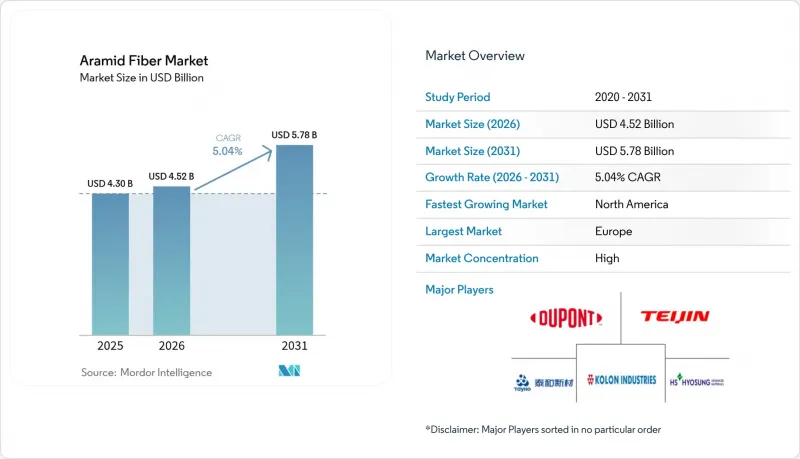
本報告按產品類型(對位芳香聚醯胺、間位芳香聚醯胺)、紡絲製程(濕式紡絲、乾濕兩用紡絲)、應用領域(安防護設備、摩擦制動材料等)、終端用戶行業(安防防護設備、航太等)以及地區(亞太地區、北美地區、歐洲地區等)對市場進行細分。市場預測以美元計價。
全球醯胺纖維市場趨勢與洞察
加強亞洲製造地個人防護設備(PPE)的安全法規
隨著中國、印度和東南亞新興經濟體工業安全法規的日益嚴格,芳香聚醯胺增強手套、頭盔和耐熱工作服的訂單不斷成長。芳香聚醯胺複合材料製成的工業頭盔比ABS材質的頭盔抗衝擊性高出37%,此性能優勢正加速其在工廠中的普及應用。含有對對位芳香聚醯胺的防切割手套可提供5級防護,同時重量減輕30%,進而提升長時間配戴的舒適度。含有間位芳香聚醯胺的阻燃工作服即使在425 度C的高溫下也能保持結構完整性,符合鑄造廠和石化行業更為嚴格的安全標準。因此,向該地區供應產品的製造商正在增加芳香聚醯胺紗線和芳香聚醯胺的採購量,推動了醯胺纖維市場的成長趨勢。
歐盟綠色新政:推廣芳香聚醯胺增強型輕量化電動車輪胎
歐洲汽車製造商正在加速輪胎重新設計項目,以減輕車輛重量,從而延長電動車的續航里程。芳香聚醯胺增強輪胎汽車胎體可減輕高達25%的重量,這項減重直接有助於實現「綠色新政」中交通運輸領域的脫碳目標。每減重1公斤預計可增加0.7公里的續航里程,因此,汽車製造商正擴大採用芳香聚醯胺代替聚酯或鋼絲。橡膠混煉商正在將芳香聚醯胺填充橡膠混合物商業化,這些混合物在保持耐久性的同時,還能降低滾動阻力,這將進一步增加歐洲對醯胺纖維的需求,並很快在北美市場也出現類似需求。
MPD和PPD原物料價格的波動
原油價格的劇烈波動和區域性供應中斷導致MPD和PPD成本曲線上升,擠壓生產商的利潤空間,並威脅長期合約的穩定性。美國商務部已將芳香二胺列為具有地緣政治生產集中度的重要化學原料之一,這加劇了供應不穩定的風險。儘管製造商正透過探索生物基中間體和芳香聚醯胺廢料的閉合迴路回收來應對這一問題,但短期價格波動仍在持續減緩醯胺纖維市場的成長動能。
細分市場分析
受彈道防護、航太和摩擦材料領域需求的推動,對對位芳香聚醯胺預計到2025年將佔據醯胺纖維市場64.35%的主導佔有率。對對位芳香聚醯胺紗線的抗張強度接近3.8 GPa,使其在防彈背心和飛機蜂窩結構等領域保持領先地位。美國國防開支的增加以及對汽車輕質複合材料的重新關注,確保了醯胺纖維市場對對位芳香聚醯胺的穩定需求前景。東麗公司在其韓國工廠增產3000噸等大規模投資,清楚展現了對該類纖維的巨額資本投入。
儘管市場規模相對較小,間位芳香聚醯胺預計將成為成長最快的芳綸纖維,到2031年複合年成長率將達到5.28%。先進的濕式紡絲長絲的拉伸強度現已達到1255兆帕,即使經過長時間的紫外線照射,仍能保持90%以上的強度,使其適用於電力線護套等戶外應用。間位間位芳香聚醯胺被應用於阻燃纖維、絕緣紙和過濾袋中,滿足電子、工業安全和環境保護領域的熱穩定性要求。在亞洲半導體產能擴張和歐盟綠色轉型計畫的推動下,間位芳香聚醯胺醯胺纖維市場預計將穩定成長,形成一個競爭激烈的市場環境,屆時材料性能而非價格將決定客戶的選擇。
預計到2025年,濕式紡絲將佔據醯胺纖維市場59.40%的佔有率,並以5.71%的複合年成長率持續超越整體市場成長率。此製程能夠實現均勻的聚合物凝固,生產出均勻、高密度的纖維,從而具備電工紙和過濾材料所需的高介電穩定性。改進的溶劑回收模組可降低排放和成本,從而促進永續性的終端用戶採用此製程。隨著電氣化的發展和過濾材料需求的成長,濕式紡絲醯胺纖維的市場規模預計將進一步擴大。
在對位芳香聚醯胺的生產中,由於鏈取向賦予其極高的拉伸性能,濕法-乾法紡絲仍然至關重要。聚醯亞胺類似物的實驗室檢驗證實,其拉伸強度可達2.72 GPa,彈性模量超過114 GPa,顯示對對位芳香聚醯胺的性能仍有進一步提升的空間。儘管其整體市場佔有率較小,但該工藝為高階防彈紗線的供應提供了保障,滿足了國防部和高階運動品牌的需求。持續升級生產線,旨在提高加工效率和溶劑回收技術,將確保該製程繼續在市場上佔有一席之地。
區域分析
到2025年,歐洲將佔全球銷售額的34.65%,成為全球市場中心。嚴格的職業安全法規、符合ISO標準的阻燃標準以及歐盟的綠色新政,正推動汽車和工業領域採用高附加價值產品。德國憑藉其出口導向汽車產業,引領著該地區的生產擴張;而法國和荷蘭則專注於先進的過濾技術和航太層壓板。政府對電動車電池工廠的激勵措施,進一步促進了聚合物複合材料的應用。
預計北美地區2026年至2031年的複合年成長率將達到5.21%,位居全球之首。美國聯邦國防預算對對位芳香聚醯胺彈道材料的持續需求支撐了美國醯胺纖維市場的發展,同時,美國國家航空暨太空總署(NASA)和一些私人火箭發射公司也在投資間間位芳香聚醯胺隔熱材料。美國電信公司正在颶風易發地區升級其機載光纖骨幹網,並使用芳香聚醯胺加固材料來減輕風暴造成的損失。加拿大也呈現類似的趨勢,其重點在於公共安全,尤其是在採礦和能源基礎設施領域。
亞太地區是該市場的下一個成長前沿。中國正在擴大國內生產,以減少對進口的依賴,並力爭在2020年代中期實現對對位芳香聚醯胺的自給自足。智慧工廠、電動車電池廠和可再生能源基礎設施的大規模建設,正顯著提升對輕量耐熱材料的需求。在日本和韓國,半導體和5G硬體領域高科技的應用,推動了對芳香聚醯胺所提供的介電穩定性和機械耐久性的需求。印度的「印度製造」國防計畫以及修訂後的職業安全與健康標準,正在增加當地對個人防護設備(PPE)和防彈裝備的需求,進一步深化了該地區的成長。
其他好處:
- Excel格式的市場預測(ME)表
- 3個月的分析師支持
目錄
第1章:引言
- 研究假設和市場定義
- 調查範圍
第2章:調查方法
第3章執行摘要
第4章 市場狀況
- 市場概覽
- 市場促進因素
- 加強亞洲製造地個人防護設備(PPE)安全標準
- 歐盟綠色新政提振了對芳香聚醯胺增強輕質電動車輪胎的需求。
- 5G 的快速普及推動了對芳香聚醯胺增強光纖電纜的需求成長。
- 許多國家增加了國防費用
- 對高超音速和太空防禦領域的投資增加了間位芳香聚醯胺隔熱罩的消耗量。
- 市場限制因素
- MPD和PPD原物料價格的波動
- 專利交叉許可障礙阻礙了新的對位芳香聚醯胺參與企業。
- 高昂的生產成本
- 價值鏈分析
- 波特五力模型
第5章 市場規模與成長預測
- 依產品類型
- 對位芳香聚醯胺
- 間位芳香聚醯胺
- 透過紡絲工藝
- 濕紡
- 乾紡和濕紡
- 透過使用
- 安全和防護設備
- 摩擦材料和煞車材料
- 光纖電纜
- 航太零件
- 汽車複合材料
- 電氣絕緣
- 其他應用(工業過濾、橡膠和輪胎加固)
- 按最終用戶行業分類
- 安全和防護設備
- 航太
- 車
- 電子與通訊
- 其他
- 地區
- 亞太地區
- 中國
- 印度
- 日本
- 韓國
- 其他亞太國家
- 北美洲
- 美國
- 加拿大
- 墨西哥
- 歐洲
- 德國
- 英國
- 法國
- 義大利
- 俄羅斯
- 其他歐洲國家
- 南美洲
- 巴西
- 阿根廷
- 其他南美國家
- 中東和非洲
- 沙烏地阿拉伯
- 南非
- 其他中東和非洲國家
- 亞太地區
第6章 競爭情勢
- 市場集中度
- 策略趨勢
- 市佔率分析
- 公司簡介
- Aramid Hpm, LLC.
- China National Bluestar(Group)Co. Ltd.
- DuPont
- HS HYOSUNG ADVANCED MATERIALS
- Huvis Corp.
- Kolon Industries, Inc.
- Sinochem Internation Corporation
- SINOPEC YIZHENG CHEMICAL FIBRE LIMITED
- SRO Aramid
- Suzhou Zhaoda Specially Fiber Technical Co.,Ltd.
- TAEKWANG INDUSTRIAL CO., LTD.
- Teijin Limited
- Toray Industries Inc.
- TOYOBO MC Corporation
- Wuxi City Shengte Carbon Fiber Products Co.,Ltd
- X-FIPER NEW MATERIAL CO.,LTD
- Yantai Tayho Advanced Materials Co.,Ltd.
第7章 市場機會與未來展望
According to Mordor Intelligence, aramid fiber market size in 2026 is estimated at USD 4.52 billion, growing from 2025 value of USD 4.30 billion with 2031 projections showing USD 5.78 billion, growing at 5.04% CAGR over 2026-2031.
This report Segments the Industry by Product Type (Para-Aramid, Meta-Aramid), Spinning Process (Wet Spinning, Dry Wet Spinning), Application (Security and Protection Equipment, Frictional and Brake Materials, and More), End-User Industry (Safety and Protection Equipment, Aerospace, and More), and Geography (Asia-Pacific, North America, Europe, and More). The Market Forecasts are Provided in Terms of Value (USD).
Global Aramid Fiber Market Trends and Insights
Escalating PPE Safety Mandates Across Asian Manufacturing Hubs
Growing enforcement of industrial-safety rules in China, India, and emerging Southeast Asian economies is lifting orders for aramid-reinforced gloves, helmets, and heat-resistant workwear. Industrial helmets made with aramid composites show 37% higher impact resistance than ABS counterparts, a performance gap that accelerates factory adoption. Cut-resistant gloves incorporating para-aramid deliver Level 5 protection with 30% less weight, improving comfort for continuous wear. Fire-retardant workwear formulated with meta-aramid maintains structural integrity at 425 °C, aligning with stricter foundry and petrochemical safety codes. Manufacturers supplying this region therefore raise allocation for aramid yarns and fabrics, strengthening the growth profile of the aramid fiber market.
EU Green-Deal Push for Lightweight EV Tires Reinforced with Aramid
European automakers accelerate tire redesign programs that shave vehicle mass to extend electric-car range. Aramid-reinforced tire carcasses cut weight by up to 25%, a saving directly linked to the Green Deal's transport decarbonization targets . Every kilogram trimmed offers a 0.7 km range gain, motivating OEMs to substitute polyester or steel cords with aramid. Compounders are commercializing aramid-filled rubber mixes that lower rolling resistance yet keep durability, reinforcing demand for the aramid fiber market in Europe and soon North America.
MPD & PPD Feedstock Price Volatility
Surging crude-oil swings and regional supply disruptions elevate MPD and PPD cost curves, compressing producer margins and unsettling long-term contracts. The U.S. Department of Commerce lists aromatic diamines among chemically critical inputs subject to geopolitically concentrated production, heightening supply-security risks . Manufacturers counter by exploring bio-based intermediates and closed-loop recovery of aramid scrap, yet near-term volatility still shaves growth momentum within the aramid fiber market.
Other drivers and restraints analyzed in the detailed report include:
- 5G Roll-out Surge Elevating Demand for Aramid-Reinforced Optical-Fiber Cables
- Hypersonic & Space Defense Investments Raising Meta-Aramid Thermal-Shield Consumption
- Patent Cross-Licensing Barriers Deterring New Para-Aramid Entrants
For complete list of drivers and restraints, kindly check the Table Of Contents.
Segment Analysis
The para-aramid segment held a commanding 64.35% aramid fiber market share in 2025, supported by ballistic protection, aerospace, and friction-material demand. Para-aramid yarns deliver tensile strength near 3.8 GPa, sustaining their position in body armor and aviation honeycombs. Defense-budget uplifts in the United States and renewed interest in lightweight automotive composites ensure stable volume pipelines for para-aramid within the aramid fiber market. Significant investments, such as a 3,000-ton capacity addition at Toray's South Korea site, underscore the scale of capital allocation toward this fiber class.
Meta-aramid, while smaller in base, stages the fastest trajectory at a 5.28% CAGR through 2031. Advanced wet-spun filaments now reach 1,255 MPa tensile strength and retain over 90% strength after prolonged UV exposure, unlocking outdoor applications like transmission-line covers. Embedded in fire-retardant fabrics, insulation papers, and filtration bags, meta-aramid addresses thermal stability demands in electronics, industrial safety, and environmental protection. The aramid fiber market size for meta-aramid is forecast to expand steadily because of expanding semiconductor capacity across Asia and EU green-transition projects, setting a competitive dynamic where material attributes, not only price, decide customer conversion.
Wet spinning captured 59.40% of aramid fiber market share in 2025 and continues to out-pace the headline market with a 5.71% CAGR. The process offers homogeneous polymer coagulation, producing uniformly dense fibers that achieve high dielectric stability, a prerequisite for electrical papers and filtration media. Upgraded solvent-recycling modules reduce emissions and cost, supporting adoption even among sustainability-minded end-users. The aramid fiber market size for wet-spun output is projected to widen in line with electrification and filter-media demand growth.
Dry-jet wet spinning remains indispensable for para-aramid where chain orientation drives extreme tensile metrics. Lab runs of polyimide analogues display tensile strength up to 2.72 GPa and modulus above 114 GPa, confirming pathway headroom for future para-aramid enhancement. Although overall share is smaller, the process anchors high-end ballistic yarn supply, aligning with the needs of defense ministries and premium sports-equipment brands. Continuous line upgrades aimed at throughput efficiency and solvent-capture technology will safeguard its niche contribution to the market.
Complete Report Scope:
- By Product Type
- Para Aramid
- Meta Aramid
- By Spinning Process
- Wet Spinning
- Dry Jet Wet Spinning
- By Application
- Security and Protection Equipment
- Frictional and Brake Materials
- Optical Fiber Cables
- Aerospace Components
- Automotive Composites
- Electrical Insulation
- Others (industrial filtration, rubber and tire reinforcement)
- By End User Industry
- Safety and Protection Equipment
- Aerospace
- Automotive
- Electronics and Telecommunication
- Other End User Industries
- Geography
- Asia Pacific
- China
- India
- Japan
- South Korea
- Rest of Asia Pacific
- North America
- United States
- Canada
- Mexico
- Europe
- Germany
- United Kingdom
- France
- Italy
- Russia
- Rest of Europe
- South America
- Brazil
- Argentina
- Rest of South America
- Middle East and Africa
- Saudi Arabia
- South Africa
- Rest of Middle East and Africa
- Asia Pacific
Geography Analysis
Europe anchors the global market with 34.65% revenue in 2025. Stringent worker-safety laws, ISO-aligned flame standards, and the European Union's Green Deal propel high-value adoption in automotive and industrial settings. Germany, with its export-oriented automotive base, leads regional volume expansion, while France and the Netherlands specialize in advanced filtration and aerospace laminates. Government incentives for electric-vehicle battery plants further stimulate polymer-composite uptake.
North America posts the fastest CAGR at 5.21% for 2026-2031. The US Aramid Fiber Market benefits from Federal defense appropriations feed continuous demand for para-aramid ballistic materials, whereas NASA and private launch providers channel investments into meta-aramid thermal shields. U.S. telecom carriers renew aerial fiber backbones across hurricane-prone corridors, specifying aramid strength members to mitigate storm damage. Canada follows similar trends with a public-safety focus, particularly in mining and energy infrastructure.
Asia-Pacific represents the next frontier of scale for the market. China escalates domestic output to cut reliance on imports and targets self-sufficiency in para-aramid by mid-decade. Massive construction of smart factories, EV battery plants, and renewable infrastructure multiplies demand for lightweight, heat-resistant materials. Japan and South Korea refine high-tech deployment in semiconductors and 5G hardware, requiring dielectric stability and mechanical resilience that aramid delivers. India's Make-in-India defense program and updated occupational-safety codes build local PPE and armor consumption, adding depth to regional growth.
- Aramid Hpm, LLC.
- China National Bluestar (Group) Co. Ltd.
- DuPont
- HS HYOSUNG ADVANCED MATERIALS
- Huvis Corp.
- Kolon Industries, Inc.
- Sinochem Internation Corporation
- SINOPEC YIZHENG CHEMICAL FIBRE LIMITED
- SRO Aramid
- Suzhou Zhaoda Specially Fiber Technical Co.,Ltd.
- TAEKWANG INDUSTRIAL CO., LTD.
- Teijin Limited
- Toray Industries Inc.
- TOYOBO MC Corporation
- Wuxi City Shengte Carbon Fiber Products Co.,Ltd
- X-FIPER NEW MATERIAL CO.,LTD
- Yantai Tayho Advanced Materials Co.,Ltd.
Additional Benefits:
- The market estimate (ME) sheet in Excel format
- 3 months of analyst support
TABLE OF CONTENTS
1 Introduction
- 1.1 Study Assumptions and Market Definition
- 1.2 Scope of the Study
2 Research Methodology
3 Executive Summary
4 Market Landscape
- 4.1 Market Overview
- 4.2 Market Drivers
- 4.2.1 Escalating PPE Safety Mandates Across Asian Manufacturing Hubs
- 4.2.2 EU Green Deal Push for Lightweight EV Tires Reinforced with Aramid
- 4.2.3 5G Rollout Surge Elevating Demand for Aramid-Reinforced Optical-Fiber Cables
- 4.2.4 Increase in Defense Spending by Many Countries
- 4.2.5 Hypersonic and Space Defense Investments Raising Meta Aramid Thermal Shield Consumption
- 4.3 Market Restraints
- 4.3.1 MPD and PPD Feedstock Price Volatility
- 4.3.2 Patent Cross Licensing Barriers Deterring New Para-Aramid Entrants
- 4.3.3 High Production Costs
- 4.4 Value Chain Analysis
- 4.5 Porter's Five Forces
- 4.5.1 Bargaining Power of Suppliers
- 4.5.2 Bargaining Power of Buyers
- 4.5.3 Threat of New Entrants
- 4.5.4 Threat of Substitutes
- 4.5.5 Industry Rivalry
5 Market Size and Growth Forecasts (Value)
- 5.1 By Product Type
- 5.1.1 Para Aramid
- 5.1.2 Meta Aramid
- 5.2 By Spinning Process
- 5.2.1 Wet Spinning
- 5.2.2 Dry Jet Wet Spinning
- 5.3 By Application
- 5.3.1 Security and Protection Equipment
- 5.3.2 Frictional and Brake Materials
- 5.3.3 Optical Fiber Cables
- 5.3.4 Aerospace Components
- 5.3.5 Automotive Composites
- 5.3.6 Electrical Insulation
- 5.3.7 Others (industrial filtration, rubber and tire reinforcement)
- 5.4 By End User Industry
- 5.4.1 Safety and Protection Equipment
- 5.4.2 Aerospace
- 5.4.3 Automotive
- 5.4.4 Electronics and Telecommunication
- 5.4.5 Other End User Industries
- 5.5 Geography
- 5.5.1 Asia Pacific
- 5.5.1.1 China
- 5.5.1.2 India
- 5.5.1.3 Japan
- 5.5.1.4 South Korea
- 5.5.1.5 Rest of Asia Pacific
- 5.5.2 North America
- 5.5.2.1 United States
- 5.5.2.2 Canada
- 5.5.2.3 Mexico
- 5.5.3 Europe
- 5.5.3.1 Germany
- 5.5.3.2 United Kingdom
- 5.5.3.3 France
- 5.5.3.4 Italy
- 5.5.3.5 Russia
- 5.5.3.6 Rest of Europe
- 5.5.4 South America
- 5.5.4.1 Brazil
- 5.5.4.2 Argentina
- 5.5.4.3 Rest of South America
- 5.5.5 Middle East and Africa
- 5.5.5.1 Saudi Arabia
- 5.5.5.2 South Africa
- 5.5.5.3 Rest of Middle East and Africa
- 5.5.1 Asia Pacific
6 Competitive Landscape
- 6.1 Market Concentration
- 6.2 Strategic Moves
- 6.3 Market Share Analysis
- 6.4 Company Profiles (includes Global Overview, Market Overview, Core Segments, Financials, Strategic Info, Market Rank/Share, Products and Services, Recent Developments)
- 6.4.1 Aramid Hpm, LLC.
- 6.4.2 China National Bluestar (Group) Co. Ltd.
- 6.4.3 DuPont
- 6.4.4 HS HYOSUNG ADVANCED MATERIALS
- 6.4.5 Huvis Corp.
- 6.4.6 Kolon Industries, Inc.
- 6.4.7 Sinochem Internation Corporation
- 6.4.8 SINOPEC YIZHENG CHEMICAL FIBRE LIMITED
- 6.4.9 SRO Aramid
- 6.4.10 Suzhou Zhaoda Specially Fiber Technical Co.,Ltd.
- 6.4.11 TAEKWANG INDUSTRIAL CO., LTD.
- 6.4.12 Teijin Limited
- 6.4.13 Toray Industries Inc.
- 6.4.14 TOYOBO MC Corporation
- 6.4.15 Wuxi City Shengte Carbon Fiber Products Co.,Ltd
- 6.4.16 X-FIPER NEW MATERIAL CO.,LTD
- 6.4.17 Yantai Tayho Advanced Materials Co.,Ltd.
7 Market Opportunities and Future Outlook
- 7.1 White-Space and Unmet-Need Assessment
- 7.2 Market Expansion of Unmanned Aerial Vehicles (UAV)

 間位芳香聚醯胺纖維市場:全球市場預測,2026-2032年醯胺纖維市場:全球市場按產品類型、形態、分銷管道和應用分類的預測,2026-2032年
 芳香聚醯胺材料市場:預測至2034年-按產品類型、形態、製造流程、應用、最終用戶和地區分類的全球分析醯胺纖維市場預測至2034年—按類型、產品形式、製造流程、應用和地區分類的全球分析
 醯胺纖維市場報告:按產品類型、應用、終端用戶產業和地區分類(2026-2034 年)
 醯胺纖維市場:按類型、應用和地區分類
 2026-2030全球醯胺纖維市場
 全球醯胺纖維市場規模、佔有率、趨勢和成長分析報告(2026-2034年)
 2026全球醯胺纖維市場報告
 醯胺纖維市場-全球產業規模、佔有率、趨勢、機會、預測:按類型、應用、區域和競爭格局分類,2021-2031年