


 |
市場調查報告書
商品編碼
2121892
汽車離合器:市場佔有率分析、產業趨勢與統計、成長預測(2026-2031)Automotive Clutch - Market Share Analysis, Industry Trends & Statistics, Growth Forecasts (2026 - 2031) |
||||||

※ 本網頁內容可能與最新版本有所差異。詳細情況請與我們聯繫。
據 Mordor Intelligence 稱,2026 年汽車離合器市值為 153.9 億美元,預計到 2031 年將達到 205.1 億美元。
這相當於在預測期(2026-2031 年)內實現 5.91% 的複合年成長率。
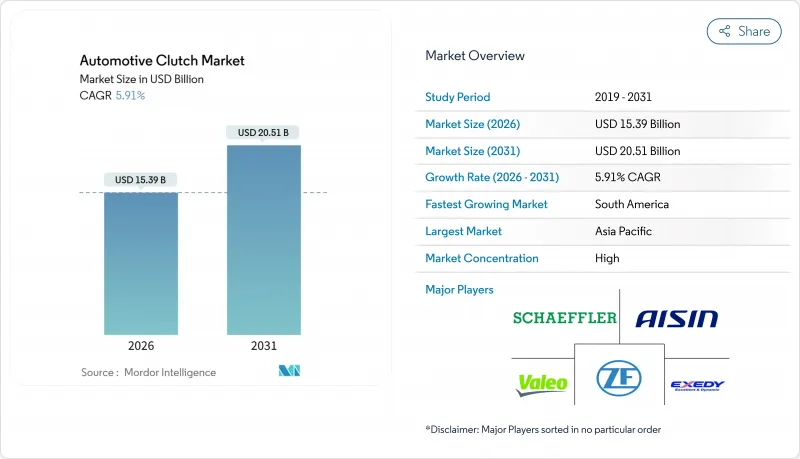
本報告銷售管道變速箱類型(手排、自排、AMT、DCT 及其他)、車輛類型(乘用車、輕型商用車等)、離合器零件(碟式離合器轂、壓板、分離軸承、飛輪、驅動系統)、銷售通路(OEM、售後市場)和地區(北美、南美、歐洲、亞太地區、中東和非洲)進行細分。市場預測以美元計價。
全球汽車離合器市場趨勢與洞察
原始設備製造商迅速轉向雙離合器變速箱和自動變速箱
隨著歐洲和中國汽車製造商傾向於採用濕式離合器設計,雙離合器變速箱的應用日益普及。濕式離合器設計能夠在不增加全混合動力汽車高昂成本的情況下,達到低於95克/公里的二氧化碳排放量。大眾汽車基於MQB平台的車型採用了電液式DQ381變速箱,可將寄生電阻降低12%。同時,中國汽車品牌正在獲得雙離合器變速箱技術的授權,以提升其150-250千瓦插電式混合動力汽車的性能。在印度輕型商用車領域,自動手排變速箱的佔有率正在擴大,伊頓公司的「AutoShift」變速箱可將都市區道路的油耗降低8-10%。這一趨勢導致單片乾式離合器的產量下降,而對多片濕式模組和電子控制機構的需求卻在增加。擁有機電一體化技術專長的供應商能夠獲得更高的報價,從而加劇了高階變速箱市場的競爭。隨著自動擋和雙離合器變速箱車輛數量的增加,變速箱的更換週期將會延長,預計將帶來更穩定的售後市場需求。然而,人們也擔憂維修的複雜性日益增加以及零件價格上漲的問題。
新興經濟體微型車產量增加
在印度、巴西和東協主要市場,受消費者收入成長和當地組裝優惠政策的推動,輕型汽車產量預計將整體擴張。此次產量激增可望支撐基準離合器生產,並抵消成熟市場純電動車(BEV)需求下降的影響。此外,新興市場的工廠建設正促使供應商將沖壓件和摩擦材料工廠整合到同一地點,從而縮短前置作業時間並提高外匯對沖效率。
電動車的日益普及將逐步淘汰傳統離合器。
到2024年,純電動車將佔中國市場佔有率的約25%,這將導致離合器需求減少320萬套;而歐洲21.7%的市場佔有率也將使離合器產量再減少180萬套。光是特斯拉和比亞迪兩家公司就將減少480萬套的需求,迫使福斯汽車於2025年關閉位於卡塞爾的乾式離合器生產線。供應商正將研發重心轉向用於電動動力系統的斷開式離合器和扭力向量離合器,但這些產品的成本比雙離合器變速箱(DCT)模組低40%至60%,這將對供應商的獲利能力造成壓力。
細分市場分析
2025年,手排變速箱在汽車離合器市場仍將佔64.79%的佔有率,因為印度、巴西和東南亞的消費者更重視較低的出廠價格。然而,受歐洲和中國插電式混合動力汽車的推動,這些汽車需要0.2秒以內的換檔速度和無縫的扭矩輸出,預計到2031年,濕式雙離合器變速箱的市場佔有率將以9.37%的複合年成長率成長。
變速器選擇反映了需求曲線的兩極化。在注重成本的新興市場,售價在45至60美元之間的單片乾式離合器在售後市場依然暢銷,即使其他地區電氣化進程不斷推進,其銷量也保持高位。同時,在柴油價格超過每公升1.80美元的歐洲豪華轎車市場,售價2800美元的濕式雙離合器變速箱(DCT)正被廣泛採用,與液力變矩器自動變速箱相比,燃油效率可提升12%。配備沃爾沃「I-Shift」變速箱的卡車降低了駕駛員的踏板疲勞,並使瑞典車隊的駕駛人受傷保險索賠減少了14%。這種需求分化確保了手動離合器的高產量得以維持,同時,技術領導企業也確保了DCT市場在2031年之前擁有豐厚的利潤。
到2025年,乘用車將佔汽車離合器市場的74.23%。然而,中重型商用車預計將維持最高的成長率,到2031年將以8.02%的複合年成長率成長,這主要得益於電子商務物流對提高行駛里程的監管壓力,以及為減少每天高達500公里長途運輸中的疲勞而採用的自動變速箱。福特全順和Stellantis Ducato等廂型車採用了LuK的雙質量飛輪,將保養間隔延長至18萬公里。同時,約翰迪爾正在高功率聯合收割機上測試一種濕式離合器動力換檔變速箱,該變速箱可在田間作業時更換齒輪比。
商用車的電氣化正在改變市場需求格局。純電動貨車無需離合器,而有效距離式混合動力汽車則保留了斷開裝置以隔離發電機。阿蕭克·雷蘭德(Ashok Leyland)的「Boss LX」車型採用採埃孚(ZF)的「Traxxon AMT」自動變速箱,並配備了額定扭矩為1400牛頓·米的雙片離合器,適用於49噸重的車輛。Caterpillar(Caterpillar)推土機也採用濕式多片離合器來散發土方作業過程中產生的180千瓦熱量。這種多樣化的應用場景確保了即使乘用純電動車日益普及,汽車離合器市場仍能保持活力。
區域分析
到2025年,亞太地區仍將佔據汽車離合器市場49.62%的佔有率。在中國,插電式混合動力SUV中濕式雙離合器變速箱(DCT)的日益普及推高了單價。同時,在印度,手排變速箱仍然佔據主導地位,支撐了對具成本效益乾式離合器的強勁需求。在日本,隨著無段變速箱(CVT)的日益普及,離合器產量正在下降。然而,像EXEDY和愛信這樣的公司正在透過擴大出口、利用其具有競爭力的成本結構以及將價格設定在低於歐洲水平的水平來彌補這一損失。在東南亞,隨著泰國批准4.2億美元的外商直接投資(FDI)進入零件產業,各工廠正加緊推動在地化生產。
北美汽車離合器市場主要由商用車和高性能車驅動,因為主流乘用車手排變速箱的普及率已降至2%以下。墨西哥高階轎車的出口支撐著濕式雙離合器變速箱(DCT)的出貨量。在南美,巴西的彈性燃料混合動力汽車(將高扭力乙醇引擎與手排變速箱結合)展現出最高的成長率,預計到2031年年複合成長率(CAGR)將達到6.82%。在中東和非洲地區,受南非優惠政策的推動,投資主要集中在為出口到撒哈拉以南非洲的皮卡組裝離合器。
其他好處:
- Excel格式的市場預測(ME)表
- 3個月的分析師支持
目錄
第1章:引言
- 研究假設和市場定義
- 調查範圍
第2章:調查方法
第3章執行摘要
第4章 市場狀況
- 市場概覽
- 市場促進因素
- 原始設備製造商迅速轉向雙離合器變速箱和自動變速箱
- 新興國家微型車產量增加
- 嚴格的二氧化碳排放目標正在推動對節能型離合器的需求。
- 採用48V電子離合器系統進行輕度混合動力架構
- 輕質複合摩擦材料,符合所有車輛的燃油效率標準。
- 二、三線城市對符合排放氣體法規的改裝計程車的需求日益成長。
- 市場限制因素
- 隨著純電動車的日益普及,傳統離合器正逐漸淘汰。
- CVT動力傳動系統在入門車型中越來越受歡迎。
- 雙品質飛輪的可靠性問題導致保固成本飆升。
- 即將訂定的無銅摩擦材料法規正在對供應鏈造成干擾。
- 價值供應鏈分析
- 監理情勢
- 技術展望
- 波特五力分析
第5章 市場規模與成長預測
- 按變速器類型
- 手排變速箱
- 自動變速器(液力變矩器)
- 自動手排變速箱(AMT)
- 雙離合器變速箱(DCT)
- 其他(電子離合器、CVT離合器組等)
- 車輛類型
- 搭乘用車
- 輕型商用車
- 中型和大型商用車輛
- 非公路用途(用於農業和建築用途)
- 按部件分類的離合器零件
- 離合器圓盤和輪轂
- 壓板和蓋
- 分離軸承/工作缸
- 飛輪(單質量和雙質量)
- 執行系統(液壓、電液、電子)
- 按銷售管道
- 目的地設備製造商 (OEM)
- 售後市場
- 按地區
- 北美洲
- 美國
- 加拿大
- 其他北美國家
- 南美洲
- 巴西
- 阿根廷
- 其他南美國家
- 歐洲
- 德國
- 英國
- 法國
- 義大利
- 西班牙
- 俄羅斯
- 其他歐洲國家
- 亞太地區
- 中國
- 印度
- 日本
- 韓國
- 其他亞太國家
- 中東和非洲
- 沙烏地阿拉伯
- 阿拉伯聯合大公國
- 南非
- 其他中東和非洲國家
- 北美洲
第6章 競爭情勢
- 市場集中度
- 策略趨勢
- 市佔率分析
- 公司簡介
- Schaeffler AG
- Valeo SA
- ZF Friedrichshafen AG
- EXEDY Corporation
- Aisin Corporation
- Eaton Corporation plc
- BorgWarner Inc.
- Magneti Marelli SpA
- Continental AG
- WABCO(ZF CV Systems)
- Setco Automotive Ltd.
- FCC Co., Ltd.
- Zhejiang Tieliu Clutch Co., Ltd.
- Nissin Kogyo Co., Ltd.
- Haldex AB
- Twin Disc Inc.
- Transtar Industries Inc.
- Helix Auto Transmission
第7章 市場機會與未來展望
According to Mordor Intelligence, the automotive clutch market size is valued at USD 15.39 billion in 2026 and is projected to post USD 20.51 billion by 2031, translating into a 5.91% CAGR over the forecast period (2026-2031).
This report is Segmented by Transmission Type (Manual, Automatic, AMT, DCT, Others), Vehicle Type (Passenger Cars, Light Commercial Vehicles, and More), Clutch Component (Disc & Hub, Pressure Plate, Release Bearing, Flywheel, Actuation Systems), Sales Channel (OEM, Aftermarket), and Geography (North America, South America, Europe, Asia-Pacific, MEA). Market Forecasts are Provided in Terms of Value (USD).
Global Automotive Clutch Market Trends and Insights
Rapid OEM Shift Toward Dual-Clutch and Automated Transmissions
Dual-clutch penetration is rising because European and Chinese automakers favor wet-clutch designs that hit sub-95 g/km CO2 targets without full-hybrid premiums. Volkswagen's MQB-based models deploy electro-hydraulic DQ381 units that cut parasitic drag by 12%, while Chinese brands license DCT technology to enhance 150-250 kW plug-in hybrids. Automated manuals gain share in India's light commercial segment, where Eaton's AutoShift trims fuel use 8-10% on urban routes. The trend reduces single-plate dry-clutch volumes but expands demand for multi-plate wet modules and electronic actuation. Suppliers that master mechatronics capture higher unit value, reinforcing competition in premium transmission tiers. A growing base of automated and dual-clutch vehicles promises steadier aftermarket demand because replacement intervals lengthen, but repair complexity and part pricing rise.
Rising Light-Vehicle Production in Emerging Economies
India, Brazil, and key ASEAN markets are collectively forecast to expand light-vehicle production, supported by growing consumer income and favorable local assembly incentives. The output surge anchors baseline clutch volumes, counterbalancing the losses of mature-market BEVs. Emerging factories also push suppliers to co-locate stamping and friction-material plants, improving lead times and currency hedging.
Escalating BEV Penetration Eliminating Conventional Clutches
China's approximately 25% BEV share in 2024 cut 3.2 million clutch units, and Europe's 21.7% share removed 1.8 million more. Tesla and BYD alone displaced 4.8 million assemblies, prompting Volkswagen to idle its Kassel dry-clutch line in 2025. Suppliers are redirecting R&D toward disconnect and torque-vectoring clutches for electrified drivetrains, but unit prices are 40-60% lower than those of DCT modules, thereby compressing revenue.
Other drivers and restraints analyzed in the detailed report include:
- Stringent CO2 Targets Driving Demand for Fuel-Efficient Clutches
- Adoption of 48-V e-Clutch Systems for Mild-Hybrid Architectures
- Rising Popularity of CVT Powertrains in Entry-Level Cars
For complete list of drivers and restraints, kindly check the Table Of Contents.
Segment Analysis
Manual transmission retained a 64.79% share of the automotive clutch market in 2025 as buyers in India, Brazil, and Southeast Asia prized its lower ex-factory cost. Yet, wet dual-clutch systems are expected to expand at a 9.37% CAGR through 2031, driven by European and Chinese plug-in hybrids that require sub-0.2-second shifts and seamless torque overlay.
Transmission preferences illustrate a bifurcated demand curve. Cost-driven emerging markets continue to favor single-plate dry clutches, which cost USD 45-60 in the aftermarket, thereby maintaining elevated volumes even as electrification gains traction elsewhere. Premium European sedans utilize EUR 2,800 wet DCT units to achieve 12% fuel savings compared to torque-converter automatics, amid diesel prices exceeding EUR 1.80 per liter. Volvo's I-Shift-equipped trucks eliminate pedal effort, resulting in a 14% reduction in driver injury claims in Swedish fleets. The divergence preserves high-volume manual production while giving technology leaders a margin-rich DCT runway through 2031.
Passenger cars generated a 74.23% share of the automotive clutch market in 2025. Still, medium and heavy commercial vehicles are forecast to post the fastest growth rate of 8.02% CAGR through 2031, driven by e-commerce logistics that boost mileage and regulators nudging fleets toward automated gearboxes that minimize fatigue on daily hauls of 500 km. Ford Transit and Stellantis Ducato vans utilize LuK dual-mass flywheels, which extend service intervals to 180,000 km. Meanwhile, John Deere tests wet-clutch power-shift transmissions on high-horsepower combines for in-field ratio changes.
Commercial electrification reshapes demand. Battery-electric delivery vans eliminate clutches, whereas range-extender hybrids retain disconnect units to isolate the generators. Ashok Leyland's Boss LX uses ZF's Traxon AMT with a dual-plate clutch rated 1,400 Nm for 49-ton gross weights, and Caterpillar dozers specify wet multi-plate clutches to dissipate 180 kW of heat during earth-moving. This mix sustains the automotive clutch market across diverse use-cases even as passenger-car BEVs proliferate.
Complete Report Scope:
- By Transmission Type
- Manual Transmission
- Automatic Transmission (Torque-Converter)
- Automated Manual Transmission (AMT)
- Dual-Clutch Transmission (DCT)
- Others (e-Clutch, CVT Clutch Packs, etc.)
- By Vehicle Type
- Passenger Cars
- Light Commercial Vehicles
- Medium and Heavy Commercial Vehicles
- Off-Highway (Agricultural and Construction)
- By Clutch Component
- Clutch Disc and Hub
- Pressure Plate and Cover
- Release Bearing/Slave Cylinder
- Flywheel (Single and Dual-Mass)
- Actuation Systems (Hydraulic, Electro-Hydraulic, Electronic)
- By Sales Channel
- Original Equipment Manufacturer (OEM)
- Aftermarket
- By Geography
- North America
- United States
- Canada
- Rest of North America
- South America
- Brazil
- Argentina
- Rest of South America
- Europe
- Germany
- United Kingdom
- France
- Italy
- Spain
- Russia
- Rest of Europe
- Asia-Pacific
- China
- India
- Japan
- South Korea
- Rest of Asia-Pacific
- Middle East and Africa
- Saudi Arabia
- United Arab Emirates
- South Africa
- Rest of Middle East and Africa
- North America
Geography Analysis
Asia-Pacific maintained a 49.62% share of the automotive clutch market in 2025. In China, the growing adoption of wet dual-clutch transmissions (DCTs) in plug-in hybrid SUVs is pushing up unit values. Meanwhile, in India, the dominance of manual transmissions continues to fuel a robust demand for cost-effective dry clutches. Japan sees a decline in volumes as continuously variable transmissions (CVTs) gain prominence. However, companies like EXEDY and Aisin counterbalance this dip by ramping up exports, leveraging their competitive cost structures to undercut European prices. In Southeast Asia, factories are embarking on localized initiatives, bolstered by Thailand's approval of USD 420 million in foreign direct investment (FDI) for components.
The North American automotive clutch market is primarily driven by commercial vehicles and performance cars, as the manual transmission rate in mainstream passenger models has fallen below 2%. Mexico's premium-sedan exports sustain wet DCT volumes, and South America shows the strongest 6.82% CAGR through 2031, as Brazil's flex-fuel hybrids pair higher-torque ethanol engines with manual gearboxes. The Middle East and Africa, with South African incentives, are drawing investment in pickup clutch assembly for sub-Saharan exports.
- Schaeffler AG
- Valeo SA
- ZF Friedrichshafen AG
- EXEDY Corporation
- Aisin Corporation
- Eaton Corporation plc
- BorgWarner Inc.
- Magneti Marelli SpA
- Continental AG
- WABCO (ZF CV Systems)
- Setco Automotive Ltd.
- FCC Co., Ltd.
- Zhejiang Tieliu Clutch Co., Ltd.
- Nissin Kogyo Co., Ltd.
- Haldex AB
- Twin Disc Inc.
- Transtar Industries Inc.
- Helix Auto Transmission
Additional Benefits:
- The market estimate (ME) sheet in Excel format
- 3 months of analyst support
TABLE OF CONTENTS
1 Introduction
- 1.1 Study Assumptions and Market Definition
- 1.2 Scope of the Study
2 Research Methodology
3 Executive Summary
4 Market Landscape
- 4.1 Market Overview
- 4.2 Market Drivers
- 4.2.1 Rapid OEM Shift Toward Dual-Clutch and Automated Transmissions
- 4.2.2 Rising Light-Vehicle Production in Emerging Economies
- 4.2.3 Stringent CO2 Targets Driving Demand for Fuel-Efficient Clutches
- 4.2.4 Adoption of 48-V E-Clutch Systems for Mild-Hybrid Architectures
- 4.2.5 Lightweight Composite Friction Materials to Meet Fleet-Wide MPG Norms
- 4.2.6 Growing Retrofit Demand in Tier-2/3 Cities for Emission-Compliant Taxis
- 4.3 Market Restraints
- 4.3.1 Escalating BEV Penetration Eliminating Conventional Clutches
- 4.3.2 Rising Popularity of CVT Powertrains in Entry-Level Cars
- 4.3.3 Dual-Mass-Flywheel Reliability Issues Causing Warranty Cost Spikes
- 4.3.4 Upcoming Copper-Free Friction-Material Mandates Disrupting Supply Chains
- 4.4 Value/Supply-Chain Analysis
- 4.5 Regulatory Landscape
- 4.6 Technological Outlook
- 4.7 Porter's Five Forces Analysis
- 4.7.1 Threat of New Entrants
- 4.7.2 Bargaining Power of Buyers/Consumers
- 4.7.3 Bargaining Power of Suppliers
- 4.7.4 Threat of Substitute Products
- 4.7.5 Intensity of Competitive Rivalry
5 Market Size and Growth Forecasts (Value (USD))
- 5.1 By Transmission Type
- 5.1.1 Manual Transmission
- 5.1.2 Automatic Transmission (Torque-Converter)
- 5.1.3 Automated Manual Transmission (AMT)
- 5.1.4 Dual-Clutch Transmission (DCT)
- 5.1.5 Others (e-Clutch, CVT Clutch Packs, etc.)
- 5.2 By Vehicle Type
- 5.2.1 Passenger Cars
- 5.2.2 Light Commercial Vehicles
- 5.2.3 Medium and Heavy Commercial Vehicles
- 5.2.4 Off-Highway (Agricultural and Construction)
- 5.3 By Clutch Component
- 5.3.1 Clutch Disc and Hub
- 5.3.2 Pressure Plate and Cover
- 5.3.3 Release Bearing/Slave Cylinder
- 5.3.4 Flywheel (Single and Dual-Mass)
- 5.3.5 Actuation Systems (Hydraulic, Electro-Hydraulic, Electronic)
- 5.4 By Sales Channel
- 5.4.1 Original Equipment Manufacturer (OEM)
- 5.4.2 Aftermarket
- 5.5 By Geography
- 5.5.1 North America
- 5.5.1.1 United States
- 5.5.1.2 Canada
- 5.5.1.3 Rest of North America
- 5.5.2 South America
- 5.5.2.1 Brazil
- 5.5.2.2 Argentina
- 5.5.2.3 Rest of South America
- 5.5.3 Europe
- 5.5.3.1 Germany
- 5.5.3.2 United Kingdom
- 5.5.3.3 France
- 5.5.3.4 Italy
- 5.5.3.5 Spain
- 5.5.3.6 Russia
- 5.5.3.7 Rest of Europe
- 5.5.4 Asia-Pacific
- 5.5.4.1 China
- 5.5.4.2 India
- 5.5.4.3 Japan
- 5.5.4.4 South Korea
- 5.5.4.5 Rest of Asia-Pacific
- 5.5.5 Middle East and Africa
- 5.5.5.1 Saudi Arabia
- 5.5.5.2 United Arab Emirates
- 5.5.5.3 South Africa
- 5.5.5.4 Rest of Middle East and Africa
- 5.5.1 North America
6 Competitive Landscape
- 6.1 Market Concentration
- 6.2 Strategic Moves
- 6.3 Market Share Analysis
- 6.4 Company Profiles (Includes Global level Overview, Market level overview, Core Segments, Financials as available, Strategic Information, Market Rank/Share, Products and Services, and Recent Developments)
- 6.4.1 Schaeffler AG
- 6.4.2 Valeo SA
- 6.4.3 ZF Friedrichshafen AG
- 6.4.4 EXEDY Corporation
- 6.4.5 Aisin Corporation
- 6.4.6 Eaton Corporation plc
- 6.4.7 BorgWarner Inc.
- 6.4.8 Magneti Marelli SpA
- 6.4.9 Continental AG
- 6.4.10 WABCO (ZF CV Systems)
- 6.4.11 Setco Automotive Ltd.
- 6.4.12 FCC Co., Ltd.
- 6.4.13 Zhejiang Tieliu Clutch Co., Ltd.
- 6.4.14 Nissin Kogyo Co., Ltd.
- 6.4.15 Haldex AB
- 6.4.16 Twin Disc Inc.
- 6.4.17 Transtar Industries Inc.
- 6.4.18 Helix Auto Transmission
7 Market Opportunities and Future Outlook
- 7.1 White-space and Unmet-Need Assessment

 2026年全球商用車離合器市場報告
 賽車離合器市場-2026-2032年全球市場預測汽車離合器市場:按類型、組件、離合器圓盤材料、車輛類型和銷售管道分類 - 全球市場預測(2026-2032 年)
 汽車滑動式離合器市場規模、佔有率和成長分析:按車輛類型、材料、技術、銷售管道、最終用戶和地區分類-2026-2033年產業預測
 汽車滑動式離合器市場報告:按類型、車輛類型、應用和地區分類(2026-2034 年)汽車離合器市場規模、佔有率、趨勢和預測:按車輛類型、變速箱類型、離合器類型、離合器圓盤/壓盤尺寸、銷售管道、材質和地區分類,2026-2034年
 離合器摩擦片市場規模、佔有率、成長及全球產業分析:按類型、應用和地區的洞察,2026-2034年的預測2026年全球乘用車軸承和離合器零件售後市場報告2026年全球汽車煞車和離合器市場報告2026年全球汽車軸承和離合器零件售後市場報告