


 |
市場調查報告書
商品編碼
2121888
對二甲苯(PX):市佔率分析、產業趨勢與統計、成長預測(2026-2031)Paraxylene (PX) - Market Share Analysis, Industry Trends & Statistics, Growth Forecasts (2026 - 2031) |
||||||

※ 本網頁內容可能與最新版本有所差異。詳細情況請與我們聯繫。
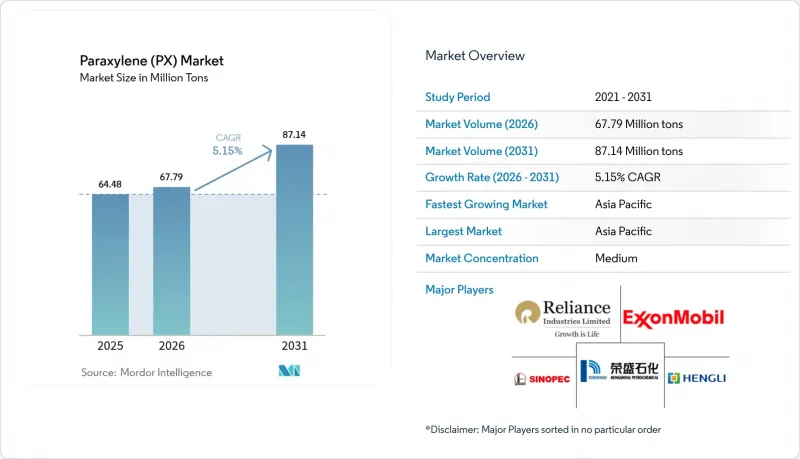
根據 Mordor Intelligence 預測,對二甲苯市場規模預計在 2025 年達到 6,448 萬噸,2026 年達到 6,779 萬噸,到 2031 年達到 8,714 萬噸,2026 年至 2031 年的複合年成長率為 5.15%。
本報告按應用領域(純對苯二甲酸、對苯二甲酸二甲酯及其他應用)、終端用戶產業(紡織品、塑膠及其他)和地區(亞太地區、北美地區、歐洲地區、南美地區以及中東和非洲地區)進行細分。市場預測以噸為單位。
全球對二甲苯 (PX) 市場趨勢及洞察
PET包裝的需求正在飆升。
儘管回收目標日益嚴格,但由於品牌所有者的努力、都市化的加速以及冷鏈物流的快速發展, 寶特瓶的需求仍在上升。歐盟2025/40號法規規定,2030年必須制定再生材料含量標準。然而,2023年,歐洲回收的寶特瓶只有一小部分被回收利用,對原生PTA的依賴仍是造成此現象的原因之一。與此同時,印度、印尼和越南的回收率仍然很低。因此,這些國家的新建PTA工廠仍然專注於使用高品質的PX作為原料。預計未來幾年全球PTA產能將大幅成長,顯示市場對包裝需求充滿信心。預計2023年至2030年,對石化原料的需求將持續成長,凸顯了該產業的韌性。雖然飲料製造商正在探索生物基PX的生產途徑,但商業性供應仍處於試點階段,未來十年原生原料仍將佔據主導地位。
亞洲聚酯纖維的擴張
據預測,到2030年,全球聚酯短纖維消費量預計將大幅成長。這一成長主要受可支配收入增加和快時尚供應鏈快速擴張的推動。 2023年,中國在對二甲苯(PX)自給自足方面取得了顯著成就。然而,恆益和同坤等下游紗線生產商正積極擴大生產規模,以充分利用這些成本優勢。同時,印度雄心勃勃的煉油和石化整合策略預計將在2029-2030會計年度之前大幅提升原油加工能力。此舉不僅將部分石腦油轉向芳烴化合物的生產,也將擴大印度國內對二甲苯的產量。具體而言,石腦油轉向量的增加將導致對二甲苯產能的提升。因此,亞洲煉油廠結構的變化將直接影響上游供應。此外,這種垂直一體化還能起到緩衝現貨價格波動的作用。使用自有產品的 PTA 用戶透過長期合約確保原料供應,從而進一步鞏固了其作為亞洲對二甲苯市場主導中心的地位。
加強對一次性塑膠製品的監管
歐盟已設定目標,到2030年強制要求寶特瓶使用再生材料,並正在推進一項雄心勃勃的計劃,力爭2040年大幅提高這一比例。在美國,加州的SB-54法案也規定了類似的義務。目前,歐洲的機械回收能力尚未達到2030年目標所需的水準。這一差距表明,一旦供應達到目標,原生樹脂的使用量將大幅下降。品牌所有者也在積極響應強制性可回收設計以及PFAS禁令,這可能會減少每個包裝中使用的PET量。儘管實施時間有所不同,但這些全面的政策方向正在抑制已開發市場的成長,生產商正轉向化學回收和生物基對二甲苯作為替代方案。目前,經合組織國家的需求疲軟,主要得益於亞洲和非洲的消費。儘管如此,這些監管趨勢仍然對對二甲苯市場構成挑戰。
細分市場分析
預計到2025年,對二甲苯(PTA)將佔全球對二甲苯(PX)消費量的94.37%,並在2031年之前以5.37%的複合年成長率成長。這種高度集中意味著對二甲苯市場與聚酯市場的趨勢密切相關,生產商的盈利很大程度上取決於紡織和包裝行業的發展。 2021年至2026年,亞洲的PTA產能顯著擴張,其中中國主導了多個計畫。例如,通坤集團在泉州運作了大規模工廠,體現了規模在產業中的重要性。隨著大連恆力等一體化生產企業擴大其下游製程的供應,對二甲苯市場對PTA的需求持續成長。整體交易量的下降進一步加劇了這一趨勢,使得現貨價格更容易受到意外停產的影響。
對苯二甲酸二甲酯 (DMT) 和一些特殊應用的需求佔有率不大,但其成長軌跡與 GDP 趨勢密切相關。對苯二甲酸聚醚 (PTA) 因其成本績效和優異的聚合動力學性能,已成為主流通用樹脂。相較之下,DMT 主要在特種薄膜和特定聚酯領域佔據獨特地位,在這些領域,加工柔軟性比原料成本更為重要。其他應用,包括塑化劑、間苯二甲酸酯和一些次要化學品,對對二甲苯的整體市場影響甚微。監管部門往往優先考慮下游聚合物的永續性,而非對二甲苯 (PX) 和 PTA 的純度。因此,原料合規性主要著重於 ISO 9001 標準和水分含量標準,而環境因素則退居其次。
區域分析
預計到2025年,亞太地區將佔全球對甲苯(PX)出貨量的82.21%,並將在2031年之前以5.49%的複合年成長率持續成長。值得注意的是,中國在2025年下半年新增了二甲苯產能,擴大了國內二甲苯產能。該地區的這一成長勢頭也得到了其他項目的推動,例如計劃於2030年投產的中石化-沙烏地阿美福建聯合裝置項目,以及計劃於2028年提升對甲苯產能的大河煉廠擴建項目。為因應此趨勢,印度也致力於實現對甲苯的自給自足,並計畫在2030年提升其對甲苯產能。同時,韓國和日本的生產商正在縮減產量並維修現有設施,以避免在出口方面面臨競爭。
北美在對二甲苯市場中所佔佔有率不大,這得益於對中國進口對苯二甲酸(PTA)徵收的保護性關稅。北美的大部分對二甲苯產能集中在美國墨西哥灣沿岸地區,其中博蒙特是最大的樞紐。另一方面,歐洲正面臨結構性衰退。隨著煉油廠轉向生質燃料,芳烴化合物的產量正在下降。這種轉變迫使剩餘的PTA工廠依賴進口。在中東,沙烏地阿美公司的賈贊計畫和計畫中的延布擴建計畫正將該地區打造為一個重要的出口樞紐,利用其低成本的原料和接近性亞洲的戰略優勢。然而,南美仍然是一個依賴進口的市場,對二甲苯和PTA均來自美國墨西哥灣沿岸和亞洲,預計這種依賴將在未來十年內持續下去。
其他好處:
- Excel格式的市場預測(ME)表
- 3個月的分析師支持
目錄
第1章:引言
- 研究假設和市場定義
- 調查範圍
第2章:調查方法
第3章執行摘要
第4章 市場狀況
- 市場概覽
- 市場促進因素
- 對PET包裝材料的需求正在激增。
- 亞洲聚酯纖維的擴張
- 高產率CCR/PRT芳香族單元的商業化
- 印度政府主導二甲苯自給自足計劃
- 模擬移動床(SMB)的維修提高了對二甲苯的產率。
- 市場限制因素
- 加強對一次性塑膠製品的監管
- 原油價格波動是原物料價格波動的主要原因
- 中美之間的關稅風險正在擾亂PX和PTA的貿易流量。
- 價值鏈分析
- 波特五力模型
第5章 市場規模及成長預測(數量與價值)
- 透過使用
- 純對苯二甲酸(PTA)
- 對苯二甲酸二甲酯(DMT)
- 其他用途
- 按最終用途行業分類
- 紡織品
- 塑膠
- 其他終端用戶產業
- 按地區
- 亞太地區
- 中國
- 印度
- 日本
- 韓國
- 泰國
- 印尼
- 馬來西亞
- 越南
- 其他亞太國家
- 北美洲
- 美國
- 加拿大
- 墨西哥
- 歐洲
- 德國
- 英國
- 法國
- 義大利
- 西班牙
- 俄羅斯
- 其他歐洲國家
- 南美洲
- 巴西
- 阿根廷
- 哥倫比亞
- 其他南美國家
- 中東和非洲
- 沙烏地阿拉伯
- 阿拉伯聯合大公國
- 卡達
- 奈及利亞
- 埃及
- 南非
- 其他中東和非洲國家
- 亞太地區
第6章 競爭情勢
- 市場集中度
- 策略趨勢
- 市佔率和排名分析
- 公司簡介
- China Petrochemical Corporation
- CNPC
- Eneos Corporation
- Exxon Mobil Corporation
- FCFC
- GS Caltex Corporation
- Hengli Petrochemical Co., Ltd.
- Idemitsu Kosan Co.,Ltd.
- Ineos
- LOTTE CHEMICAL CORPORATION
- PTT Global Chemical Public Company Limited
- Reliance Industries Limited
- Rongsheng Petrochemical Co., Ltd.
- S-oil Corporation
- TotalEnergies
第7章 市場機會與未來展望
According to Mordor Intelligence, the paraxylene market size is projected to be 64.48 million tons in 2025, 67.79 million tons in 2026, and reach 87.14 million tons by 2031, growing at a CAGR of 5.15% from 2026 to 2031.
This report is Segmented by Application (Purified Terephthalic Acid, Dimethyl Terephthalate, and Other Applications), End-Use Industry (Textile, Plastics, and Others), and Geography (Asia-Pacific, North America, Europe, South America, and Middle-East and Africa). Market Forecasts are Provided in Terms of Volume (Tons).
Global Paraxylene (PX) Market Trends and Insights
Surging Demand for PET Packaging
Brand-owner commitments, urban expansion, and a swift rise in cold-chain logistics are driving up the demand for PET bottles, even as recycling targets become more stringent. The European Union's Regulation 2025/40 mandates a recycled-content threshold by 2030. Yet, in 2023, only a portion of PET bottles collected in Europe were recycled, resulting in a reliance on virgin PTA to bridge the gap. Meanwhile, collection rates in India, Indonesia, and Vietnam remain low. Consequently, new PTA plants in these nations continue to be centered around prime PX feed. Global PTA nameplate capacity is set to rise significantly in the coming years, signaling robust confidence in packaging demand. Petrochemical feedstock demand is projected to grow between 2023 and 2030, highlighting the sector's resilience. While beverage producers are exploring bio-PX pathways, their commercial availability is still confined to pilot volumes, ensuring virgin material's dominance for the remainder of the decade.
Polyester-Fiber Expansion in Asia
Forecasts indicate a surge in global polyester staple fiber consumption, projected to rise significantly by 2030. This uptick is largely driven by increasing disposable incomes and the rapid pace of fast-fashion supply chains. In 2023, China achieved a notable milestone, reaching high self-sufficiency in paraxylene (PX). However, downstream yarn producers, Hengyi and Tongkun, are aggressively expanding their operations to capitalize on these cost advantages. Meanwhile, India's ambitious refining-petrochemical integration strategy is set to introduce substantial crude capacity by FY 2029-30. This move not only reroutes naphtha streams into aromatics but also amplifies the nation's domestic PX production. To put this into perspective, every significant diversion of naphtha translates to an augmentation in PX capacity. Thus, adjustments in Asian refinery configurations have a direct ripple effect on upstream supply. Furthermore, this vertical integration acts as a buffer against spot-price fluctuations. Captive PTA users, by securing feed through long-term contracts, further solidify Asia's position as the dominant hub of the Paraxylene market.
Single-Use-Plastic Legislation Tightening
By 2030, the European Union has set a target of mandating recycled content in PET bottles, with an ambitious increase by 2040. In the U.S., California's SB-54 enforces a similar mandate. Europe's mechanical recycling capacity currently falls short of the required levels to meet the 2030 target. This gap suggests a significant reduction in the use of virgin resin, should the supply align with targets. Brand owners are also navigating design-for-recycling mandates and bans on PFAS, potentially leading to a decrease in PET usage per package. While enforcement timelines differ, the overarching policy direction limits growth in developed markets, steering producers towards chemical recycling or bio-PX alternatives. Currently, while demand in OECD economies lags, it's buoyed by consumption in Asia and Africa. Nonetheless, the legislative trend poses a consistent challenge for the Paraxylene market.
Other drivers and restraints analyzed in the detailed report include:
- Commercialization of High-Yield CCR/PRT Aromatics Units
- Government-Backed Paraxylene Self-Sufficiency Programs in India
- Crude-Oil-Led Feedstock Price Volatility
For complete list of drivers and restraints, kindly check the Table Of Contents.
Segment Analysis
PTA consumed 94.37% of global PX volume in 2025 and is forecast to grow at a 5.37% CAGR through 2031. This heavy concentration ties the Paraxylene market closely to polyester dynamics, making producer economics heavily reliant on trends in textiles and packaging. Between 2021 and 2026, Asia bolstered its PTA capacity significantly, with China leading the charge across multiple projects. A testament to the industry's scale requirements, Tongkun unveiled a large-scale plant in Quanzhou. As integrated sites like Hengli Dalian increasingly feed their captive downstream lines, the Paraxylene market's appetite for PTA continues to swell. This trend is further accentuated by a diminishing merchant trade volume, making spot prices more susceptible to any unforeseen outages.
While Dimethyl Terephthalate and select specialty outlets command a modest share of the demand, their growth trajectory closely mirrors that of GDP. PTA's cost-effectiveness and superior polymerization kinetics have made it the dominant choice for commodity resins. In contrast, DMT finds its niche, primarily in specialized films and niche polyesters, where flexibility in processing takes precedence over feedstock pricing. Other applications, including plasticizers, isophthalic acid, and a handful of minor chemicals, exert minimal influence on the broader Paraxylene market. Regulatory oversight tends to emphasize the sustainability of downstream polymers over the purity of PX or PTA. Consequently, compliance for feedstocks leans more towards ISO 9001 standards and moisture specifications, sidelining environmental considerations.
Complete Report Scope:
- By Application
- Purified Terephthalic Acid (PTA)
- Dimethyl Terephthalate (DMT)
- Other Applications
- By End-use Industry
- Textile
- Plastics
- Others End-user Industries
- By Geography
- Asia-Pacific
- China
- India
- Japan
- South Korea
- Thailand
- Indonesia
- Malaysia
- Vietnam
- Rest of Asia-Pacific
- North America
- United States
- Canada
- Mexico
- Europe
- Germany
- United Kingdom
- France
- Italy
- Spain
- Russia
- Rest of Europe
- South America
- Brazil
- Argentina
- Colombia
- Rest of South America
- Middle-East and Africa
- Saudi Arabia
- United Arab Emirates
- Qatar
- Nigeria
- Egypt
- South Africa
- Rest of Middle-East and Africa
- Asia-Pacific
Geography Analysis
Asia-Pacific captured 82.21% of PX volume in 2025 and is set to expand at a 5.49% CAGR through 2031. In a significant move, China introduced new xylene capacity in the latter half of 2025, elevating its national xylene capacity. The region's momentum is further underscored by projects like the Sinopec-Aramco Fujian complex, targeting PX by 2030, and the Tahe refinery's expansion, set to add PX by 2028. Echoing this trend, India aims for self-sufficiency, planning to add PX by 2030. Meanwhile, producers in South Korea and Japan are either downsizing or retrofitting to stay competitive in exports.
While North America holds a modest share of the Paraxylene market, it enjoys protective tariff shields against Chinese PTA imports. The U.S. Gulf Coast, with Beaumont as its largest unit, houses the bulk of this capacity. Europe, however, faces a structural decline: as refineries pivot to biofuels, the output of aromatics diminishes. This shift leaves the remaining PTA plants reliant on imports. In the Middle East, Saudi Aramco's Jazan and the planned Yanbu expansions are capitalizing on low-cost feedstock and their strategic closeness to Asia, positioning the region as a swing exporter. Conversely, South America remains tethered as an import-dependent market, sourcing both PX and PTA from the Gulf Coast and Asia, a reliance that's projected to persist throughout the decade.
- China Petrochemical Corporation
- CNPC
- Eneos Corporation
- Exxon Mobil Corporation
- FCFC
- GS Caltex Corporation
- Hengli Petrochemical Co., Ltd.
- Idemitsu Kosan Co.,Ltd.
- Ineos
- LOTTE CHEMICAL CORPORATION
- PTT Global Chemical Public Company Limited
- Reliance Industries Limited
- Rongsheng Petrochemical Co., Ltd.
- S-oil Corporation
- TotalEnergies
Additional Benefits:
- The market estimate (ME) sheet in Excel format
- 3 months of analyst support
TABLE OF CONTENTS
1 Introduction
- 1.1 Study Assumptions and Market Definition
- 1.2 Scope of the Study
2 Research Methodology
3 Executive Summary
4 Market Landscape
- 4.1 Market Overview
- 4.2 Market Drivers
- 4.2.1 Surging demand for PET packaging
- 4.2.2 Polyester-fiber expansion in Asia
- 4.2.3 Commercialisation of high-yield CCR/PRT aromatics units
- 4.2.4 Government-backed Paraxylene self-sufficiency programs in India
- 4.2.5 Simulated-Moving-Bed (SMB) revamp boosting Paraxylene yield
- 4.3 Market Restraints
- 4.3.1 Single-use-plastic legislation tightening
- 4.3.2 Crude-oil led feedstock price volatility
- 4.3.3 US-China tariff risk disrupting PX/PTA trade flows
- 4.4 Value Chain Analysis
- 4.5 Porter's Five Forces
- 4.5.1 Bargaining Power of Suppliers
- 4.5.2 Bargaining Power of Buyers
- 4.5.3 Threat of New Entrants
- 4.5.4 Threat of Substitutes
- 4.5.5 Competitive Rivalry
5 Market Size and Growth Forecasts (Volume and Value)
- 5.1 By Application
- 5.1.1 Purified Terephthalic Acid (PTA)
- 5.1.2 Dimethyl Terephthalate (DMT)
- 5.1.3 Other Applications
- 5.2 By End-use Industry
- 5.2.1 Textile
- 5.2.2 Plastics
- 5.2.3 Others End-user Industries
- 5.3 By Geography
- 5.3.1 Asia-Pacific
- 5.3.1.1 China
- 5.3.1.2 India
- 5.3.1.3 Japan
- 5.3.1.4 South Korea
- 5.3.1.5 Thailand
- 5.3.1.6 Indonesia
- 5.3.1.7 Malaysia
- 5.3.1.8 Vietnam
- 5.3.1.9 Rest of Asia-Pacific
- 5.3.2 North America
- 5.3.2.1 United States
- 5.3.2.2 Canada
- 5.3.2.3 Mexico
- 5.3.3 Europe
- 5.3.3.1 Germany
- 5.3.3.2 United Kingdom
- 5.3.3.3 France
- 5.3.3.4 Italy
- 5.3.3.5 Spain
- 5.3.3.6 Russia
- 5.3.3.7 Rest of Europe
- 5.3.4 South America
- 5.3.4.1 Brazil
- 5.3.4.2 Argentina
- 5.3.4.3 Colombia
- 5.3.4.4 Rest of South America
- 5.3.5 Middle-East and Africa
- 5.3.5.1 Saudi Arabia
- 5.3.5.2 United Arab Emirates
- 5.3.5.3 Qatar
- 5.3.5.4 Nigeria
- 5.3.5.5 Egypt
- 5.3.5.6 South Africa
- 5.3.5.7 Rest of Middle-East and Africa
- 5.3.1 Asia-Pacific
6 Competitive Landscape
- 6.1 Market Concentration
- 6.2 Strategic Moves
- 6.3 Market Share(%)/Ranking Analysis
- 6.4 Company Profiles (includes Global level Overview, Market level overview, Core Segments, Financials as available, Strategic Information, Products and Services, and Recent Developments)
- 6.4.1 China Petrochemical Corporation
- 6.4.2 CNPC
- 6.4.3 Eneos Corporation
- 6.4.4 Exxon Mobil Corporation
- 6.4.5 FCFC
- 6.4.6 GS Caltex Corporation
- 6.4.7 Hengli Petrochemical Co., Ltd.
- 6.4.8 Idemitsu Kosan Co.,Ltd.
- 6.4.9 Ineos
- 6.4.10 LOTTE CHEMICAL CORPORATION
- 6.4.11 PTT Global Chemical Public Company Limited
- 6.4.12 Reliance Industries Limited
- 6.4.13 Rongsheng Petrochemical Co., Ltd.
- 6.4.14 S-oil Corporation
- 6.4.15 TotalEnergies
7 Market Opportunities and Future Outlook
- 7.1 White-space and Unmet-Need Assessment


