


 |
市場調查報告書
商品編碼
2121882
北美界面活性劑市場:市場佔有率分析、產業趨勢與統計及成長預測(2026-2031 年)North America Surfactants - Market Share Analysis, Industry Trends & Statistics, Growth Forecasts (2026 - 2031) |
||||||

※ 本網頁內容可能與最新版本有所差異。詳細情況請與我們聯繫。
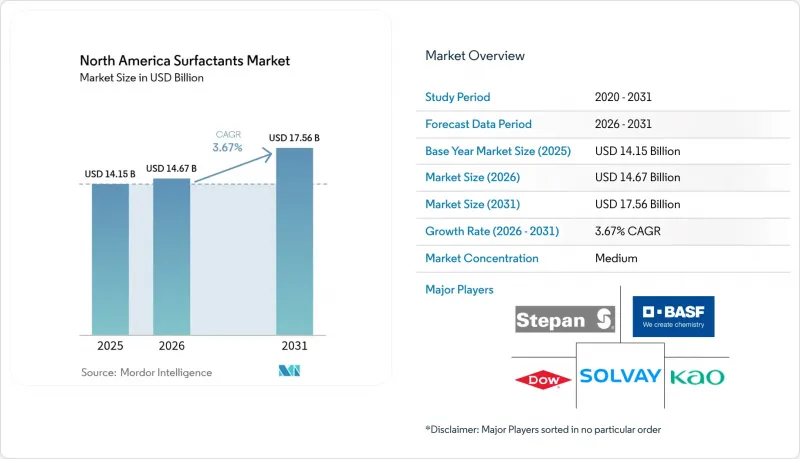
根據 Mordor Intelligence 估計,北美界面活性劑市場在 2026 年的價值為 146.7 億美元,高於 2025 年的 141.5 億美元,預計到 2031 年將達到 175.6 億美元。
預計2026年至2031年複合年成長率為3.67%。
本報告根據「類型」(陰離子界面活性劑、陽離子界面活性劑、非離子界面活性劑、兩性界面活性劑等)、「來源」(合成界面活性劑、生物基界面活性劑)、應用(家用肥皂和清潔劑、個人護理、潤滑劑和燃料添加劑等)和地區(美國、加拿大等)對產業進行分類。
北美表面活性劑市場的趨勢與洞察
家用和個人保健產品配方中向生物基表面活性劑的轉變正在加速。
品牌所有者正將最低生物含量標準納入供應商評估標準,從而縮小石油基體系和可再生體系之間的傳統成本差距。贏創已運作一條生物基琥珀酸生產線,以滿足市場對烷基聚葡萄糖苷的需求。同時,黑田製藥位於阿特拉斯角的工廠已將100%生物基醇醚推向市場,以獲得美國農業部生物優先認證。加州和紐約州對壬基酚聚氧乙烯醚的禁令正在加速這項轉型,配方開發人員正積極應對未來的法規。美國環保署於2024年8月更新了「更安全選擇」計劃,為源自亞麻薺等非食用作物的產品加分,鼓勵減少對棕櫚仁油的依賴。這些措施共同加速了北美界面活性劑市場向可再生原料的轉型,同時又不影響清潔力目標。
後疫情時代工業及機構清潔市場的成長
自疫情爆發以來,醫院、餐廳和辦公大樓的清潔頻率增加已成為標準做法,導致消毒劑和地板清潔劑中表面活性劑的需求持續增加。各州鼓勵減少季銨化合物使用的法規促使買家轉向更容易沖洗且殘留問題更少的陰離子和非離子混合產品。 Pilot Chemical 和 Innospec 透過提供稀釋濃縮液來擴大市場佔有率,這些產品可以減輕運輸重量並符合永續性目標。隨著辦公大樓入住率趨於穩定,清潔預算恢復到疫情前水平,機構需求在 2024 年有所成長。預計到 2027 年,這些變化將推動工業和機構用界面活性劑的成長速度超過家用護理產品的平均水平。
石油基原物料價格波動與供應衝擊
2024年全年,WTI原油價格在每桶70美元至85美元之間波動,導致環氧乙烷現貨價格波動20%至30%,對生產商的利潤率帶來壓力。儘管墨西哥乙烷來源多元化緩解了部分壓力,但由於Braschem Idesa新建的進口碼頭也供應聚合物,因此對錶面活性劑產業的緩解作用有限。依賴進口的加拿大混配商面臨運輸成本和外匯的雙重風險,因為他們必須跨境運輸所有環氧乙烷。此類價格波動阻礙了長期資本項目的推進,並減緩了產能擴張,儘管需求穩步成長。因此,服務於北美界面活性劑市場的區域性契約製造的成本基礎仍然脆弱。
細分市場分析
預計到2025年,非離子界面活性劑的銷售額將佔總銷售量的44.12%。這主要得益於醇醚類界面活性劑在濃縮型清潔劑中的實用性,這類產品需要在低劑量下達到高清潔力。北美非離子界面活性劑市場預計將以3.78%的年均成長率成長,因為機構消毒劑正持續轉向低泡配方,以加速沖洗過程。加州對壬基酚聚氧乙烯醚的禁令迫使供應商轉向脂肪酸酯和烷基聚葡萄糖苷等替代品,這些替代品均符合美國環保署(EPA)「更安全選擇」(Safer Choice)標籤認證要求。陰離子陰離子活性劑仍然是核心產品。 Stepan公司α-烯烴磺酸鹽產量增加25%,增強了人們對洗滌和洗碗領域對磺酸鹽需求的信心,即使生物界面活性劑市場不斷擴大。由於對直鏈烷基苯磺酸鹽的監管審查日益嚴格,對仲烷烴和甲基酯磺酸鹽的需求正在上升,尤其是在根據歐盟清潔劑法規出口到歐洲的產品中。
由於加州提案的消毒劑限制措施將減少特殊陽離子季銨鹽(QACs)的使用,這類產品正面臨不利影響,但其在織物柔軟劑和護髮素中的應用使其保持適度成長。兩性界面活性劑,例如甜菜鹼,因其溫和性和穩定的起泡性,在無硫酸鹽洗髮精中越來越受歡迎。矽基界面活性劑仍處於小眾市場,主要應用於農藥助劑和聚氨酯泡棉,其獨特的鋪展性能使其價格較高。總體而言,非離子介面活性劑的銷售量保持穩定,而陰離子界面活性劑則不斷創新,從而在北美界面活性劑市場形成了涵蓋不同類型產品的廣泛而強勁的需求格局。
其他好處:
- Excel格式的市場預測(ME)表
- 3個月的分析師支持
目錄
第1章:引言
- 研究假設和市場定義
- 調查範圍
第2章:調查方法
第3章執行摘要
第4章 市場狀況
- 市場概覽
- 市場促進因素
- 家用和個人保健產品配方中向生物基表面活性劑的轉變正在加速。
- 新冠疫情后工業和機構清潔以及商用清潔市場的成長
- 美國和加拿大加強對揮發性有機化合物和毒性的監管
- 提高石油採收率(EOR)對高性能界面活性劑的需求日益成長
- 碳捕獲衍生原料的商業化
- 市場限制因素
- 石油基原物料價格波動與供應衝擊
- 對常規 LAS/NPE 等級的水生毒性進行詳細研究
- 特定微生物菌株的區域生產能力限制
- 價值鏈分析
- 波特五力模型
第5章 市場規模與成長預測
- 按類型
- 陰離子活性劑
- 直鏈烷基苯磺酸鹽(LAS 或 LABS)
- 醇磺酸鹽(AES)
- α-烯烴磺酸鹽(AOS)
- 二級烷基磺酸鈉(SAS)
- 甲酯磺酸鹽(MES)
- 磺基琥珀酸酯
- 其他
- 陽離子界面活性劑
- 季銨化合物
- 其他
- 非離子界面活性劑
- 醇乙氧基化物
- 烷基酚聚氧乙烯醚
- 脂肪酸酯
- 其他
- 兩性界面活性劑
- 矽基界面活性劑
- 其他類型
- 陰離子活性劑
- 起源
- 合成界面活性劑
- 生物基界面活性劑
- 化學合成的生物基界面活性劑
- 生物界面活性劑
- 透過使用
- 家用肥皂和清潔劑
- 個人護理
- 潤滑劑和燃油添加劑
- 工業和設施清潔
- 食品加工
- 油田化學品
- 農業化學品
- 紡織加工
- 乳液聚合
- 其他
- 按地區
- 美國
- 加拿大
- 墨西哥
第6章 競爭情勢
- 市場集中度
- 策略趨勢
- 市佔率分析
- 公司簡介
- 3M
- Ashland
- BASF
- CLARIANT
- Croda International Plc
- Dow
- Evonik Industries AG
- GALAXY
- Godrej Industries Limited
- Henkel Corporation
- Innospec
- Kao Corporation
- MITSUI CHEMICALS AMERICA, INC.
- Nouryon
- Procter & Gamble
- Sasol
- Solvay
- Stepan Company
第7章 市場機會與未來展望
According to Mordor Intelligence, the North America surfactants market size in 2026 is estimated at USD 14.67 billion, growing from 2025 value of USD 14.15 billion with 2031 projections showing USD 17.56 billion, growing at 3.67% CAGR over 2026-2031.
This report Segments the Industry Into Type (Anionic Surfactant, Cationic Surfactant, Non-Ionic Surfactant, Amphoteric Surfactant, and More), Origin (Synthetic Surfactant, Bio-Based Surfactant), Application (Household Soap and Detergent, Personal Care, Lubricants and Fuel Additives, and More), and Geography (United States, Canada, and More).
North America Surfactants Market Trends and Insights
Accelerating Shift to Bio-Surfactants in Home and Personal-Care Formulations
Brand owners embed minimum bio-content thresholds in supplier scorecards, shrinking the historic cost gap between petro-derived and renewable systems. Evonik commissioned a bio-succinic-acid line to service alkyl-polyglucoside demand, while Croda's Atlas Point site rolled out 100% bio-based alcohol ethoxylates to secure USDA BioPreferred seals. California and New York bans on nonylphenol ethoxylates advance the transition as formulators pre-empt future restrictions. EPA's August 2024 Safer Choice update allocates extra points for non-food-crop feedstocks such as camelina, guiding purchasing away from palm kernel. Collectively, these measures accelerate the North America Surfactants market's pivot to renewable inputs without compromising detergency targets.
Growth of I&I and Institutional Cleaning Post-COVID
Hospitals, restaurants, and office buildings locked higher cleaning frequencies into standard operating procedures after the pandemic, permanently lifting surfactant demand in sanitizers and floor cleaners. State rules that discourage quaternary ammonium compounds steer buyers toward anionic-nonionic blends that rinse cleanly and pose fewer residue concerns. Pilot Chemical and Innospec win share by offering pre-diluted concentrates that cut shipping weight and satisfy sustainability targets. Office occupancy stabilized in 2024, restoring janitorial budgets to pre-pandemic levels and boosting institutional volumes. Together these shifts lift I&I surfactant growth above household-care averages through 2027.
Petro-Feedstock Price Volatility and Supply Shocks
WTI crude oscillated between USD 70 and USD 85 per barrel through 2024, resulting in 20-30% swings in ethylene oxide spot prices that compressed producer margins. Mexican ethane diversification eases some pressure, yet Braskem Idesa's new import terminal also feeds polymers, limiting relief for surfactants. Import-dependent Canadian formulators face dual freight and currency risk because all ethylene oxide must cross borders. Such volatility discourages long-cycle capital projects, slowing capacity additions despite steady demand growth. The result is a fragile cost base for regional toll manufacturers serving the North America surfactants market.
Other drivers and restraints analyzed in the detailed report include:
- Tightening U.S. and Canadian VOC and Toxicity Regulations
- Rising Demand for High-Performance Surfactants in Enhanced Oil Recovery
- Aquatic-Toxicity Scrutiny of Legacy LAS and NPE Grades
For complete list of drivers and restraints, kindly check the Table Of Contents.
Segment Analysis
Non-ionic surfactants accounted for 44.12% of the 2025 volume, driven by the utility of alcohol-ethoxylates in concentrated pods that require high detergency at low doses. The North American surfactants market size for non-ionics is forecast to rise 3.78% annually as institutional sanitizers continue to shift to low-foam blends that expedite rinse cycles. California's nonylphenol-ethoxylate ban pushes suppliers toward fatty-acid-ester and alkyl-polyglucoside substitutes, both of which qualify for EPA Safer Choice labels. Anionic surfactants remain the workhorse: Stepan's 25% alpha-olefin-sulfonate expansion underscores confidence that sulfonate demand in laundry and dishwashing will hold even as biosurfactants scale. Regulatory scrutiny of linear-alkylbenzene sulfonates boosts secondary-alkane and methyl-ester sulfonates, especially for products exported to Europe under the EU Detergents Regulation.
Specialty cationic quats face headwinds because proposed California disinfectant limits reduce QAC inclusion, yet uses in fabric softeners and hair conditioners preserve modest growth. Amphoterics such as betaines gain popularity in sulfate-free shampoos that require mildness and stable foam. Silicone surfactants remain a niche market, primarily focused on agrochemical adjuvants and polyurethane foams, where their unique spreading properties justify premiums. Overall, non-ionics maintain baseline volume while anionics innovate, ensuring that type-level demand within the North America Surfactants market remains broad and defensible.
Complete Report Scope:
- By Type
- Anionic Surfactant
- Linear Alkylbenzene Sulfolane (LAS or LABS)
- Alcohol Ethoxysulfates (AES)
- Alpha Olefin Sulfonates (AOS)
- Secondary Alkane Sulfonate (SAS)
- Methyl Ester Sulfonates (MES)
- Sulfosuccinates
- Others
- Cationic Surfactant
- Quaternary ammonium compound
- Others
- Non-ionic Surfactant
- Alcohol ethoxylate
- Alkylphenol ethoxylate
- Fatty acid ester
- Others
- Amphoteric Surfactant
- Silicone Surfactant
- Other Types
- Anionic Surfactant
- By Origin
- Synthetic Surfactant
- Bio-based Surfactant
- Chemically-Synthesized Bio-Based Surfactants
- Biosurfactants
- By Application
- Household Soap and Detergent
- Personal Care
- Lubricants and Fuel Additives
- Industry and Institutional Cleaning
- Food Processing
- Oilfield Chemicals
- Agricultural Chemicals
- Textile Processing
- Emulsion Polymerisation
- Others
- By Geography
- United States
- Canada
- Mexico
List of Companies Covered in this Report:
- 3M
- Ashland
- BASF
- CLARIANT
- Croda International Plc
- Dow
- Evonik Industries AG
- GALAXY
- Godrej Industries Limited
- Henkel Corporation
- Innospec
- Kao Corporation
- MITSUI CHEMICALS AMERICA, INC.
- Nouryon
- Procter & Gamble
- Sasol
- Solvay
- Stepan Company
Additional Benefits:
- The market estimate (ME) sheet in Excel format
- 3 months of analyst support
TABLE OF CONTENTS
1 Introduction
- 1.1 Study Assumptions and Market Definition
- 1.2 Scope of the Study
2 Research Methodology
3 Executive Summary
4 Market Landscape
- 4.1 Market Overview
- 4.2 Market Drivers
- 4.2.1 Accelerating shift to bio-surfactants in home and personal-care formulations
- 4.2.2 Growth of IandI and institutional cleaning post-COVID
- 4.2.3 Tightening U.S./Canadian VOC and toxicity regulations
- 4.2.4 Rising demand for high-performance surfactants in enhanced-oil-recovery (EOR)
- 4.2.5 Commercialisation of carbon-capture-derived feedstocks
- 4.3 Market Restraints
- 4.3.1 Petro-feedstock price volatility and supply shocks
- 4.3.2 Aquatic-toxicity scrutiny of legacy LAS/NPE grades
- 4.3.3 Limited regional capacity for specialized microbial strains
- 4.4 Value Chain Analysis
- 4.5 Porter's Five Forces
- 4.5.1 Bargaining Power of Suppliers
- 4.5.2 Bargaining Power of Consumers
- 4.5.3 Threat of New Entrants
- 4.5.4 Threat of Substitute Products and Services
- 4.5.5 Degree of Competition
5 Market Size and Growth Forecasts (Value)
- 5.1 By Type
- 5.1.1 Anionic Surfactant
- 5.1.1.1 Linear Alkylbenzene Sulfolane (LAS or LABS)
- 5.1.1.2 Alcohol Ethoxysulfates (AES)
- 5.1.1.3 Alpha Olefin Sulfonates (AOS)
- 5.1.1.4 Secondary Alkane Sulfonate (SAS)
- 5.1.1.5 Methyl Ester Sulfonates (MES)
- 5.1.1.6 Sulfosuccinates
- 5.1.1.7 Others
- 5.1.2 Cationic Surfactant
- 5.1.2.1 Quaternary ammonium compound
- 5.1.2.2 Others
- 5.1.3 Non-ionic Surfactant
- 5.1.3.1 Alcohol ethoxylate
- 5.1.3.2 Alkylphenol ethoxylate
- 5.1.3.3 Fatty acid ester
- 5.1.3.4 Others
- 5.1.4 Amphoteric Surfactant
- 5.1.5 Silicone Surfactant
- 5.1.6 Other Types
- 5.1.1 Anionic Surfactant
- 5.2 By Origin
- 5.2.1 Synthetic Surfactant
- 5.2.2 Bio-based Surfactant
- 5.2.2.1 Chemically-Synthesized Bio-Based Surfactants
- 5.2.2.2 Biosurfactants
- 5.3 By Application
- 5.3.1 Household Soap and Detergent
- 5.3.2 Personal Care
- 5.3.3 Lubricants and Fuel Additives
- 5.3.4 Industry and Institutional Cleaning
- 5.3.5 Food Processing
- 5.3.6 Oilfield Chemicals
- 5.3.7 Agricultural Chemicals
- 5.3.8 Textile Processing
- 5.3.9 Emulsion Polymerisation
- 5.3.10 Others
- 5.4 By Geography
- 5.4.1 United States
- 5.4.2 Canada
- 5.4.3 Mexico
6 Competitive Landscape
- 6.1 Market Concentration
- 6.2 Strategic Moves
- 6.3 Market Share Analysis
- 6.4 Company Profiles (includes Global level Overview, Market level overview, Core Segments, Financials as available, Strategic Information, Market Rank/Share for key companies, Products and Services, and Recent Developments)
- 6.4.1 3M
- 6.4.2 Ashland
- 6.4.3 BASF
- 6.4.4 CLARIANT
- 6.4.5 Croda International Plc
- 6.4.6 Dow
- 6.4.7 Evonik Industries AG
- 6.4.8 GALAXY
- 6.4.9 Godrej Industries Limited
- 6.4.10 Henkel Corporation
- 6.4.11 Innospec
- 6.4.12 Kao Corporation
- 6.4.13 MITSUI CHEMICALS AMERICA, INC.
- 6.4.14 Nouryon
- 6.4.15 Procter & Gamble
- 6.4.16 Sasol
- 6.4.17 Solvay
- 6.4.18 Stepan Company
7 Market Opportunities and Future Outlook
- 7.1 White-space and Unmet-Need Assessment

 2026年全球特種界面活性劑市場報告2026年全球聚合物界面活性劑市場報告
 全球界面活性劑市場:按類型、基材、應用和地區分類-預測至2031年
 非離子界面活性劑市場規模、佔有率、成長、全球產業分析、區域趨勢及2026年至2034年預測。
 利用界面活性劑提高採收率市場-2026-2032年全球市場預測界面活性劑市場:2026-2032年全球市場預測(依產品、原料、功能、實體形態、等級、應用及通路分類)
 2026 年至 2035 年聚合物界面活性劑市場的商業機會、成長要素、產業趨勢與預測。
 南美洲界面活性劑市場:市場佔有率分析、產業趨勢與統計及成長預測(2026-2031 年)
 肺表面活性劑市場:按類型、藥物類型、適應症、給藥途徑、分銷管道和地區分類全球表面活性劑市場規模、佔有率、趨勢和成長分析報告(2026-2034年)