


 |
市場調查報告書
商品編碼
2121841
菸草包裝:市場佔有率分析、產業趨勢與統計、成長預測(2026-2031)Tobacco Packaging - Market Share Analysis, Industry Trends & Statistics, Growth Forecasts (2026 - 2031) |
||||||

※ 本網頁內容可能與最新版本有所差異。詳細情況請與我們聯繫。
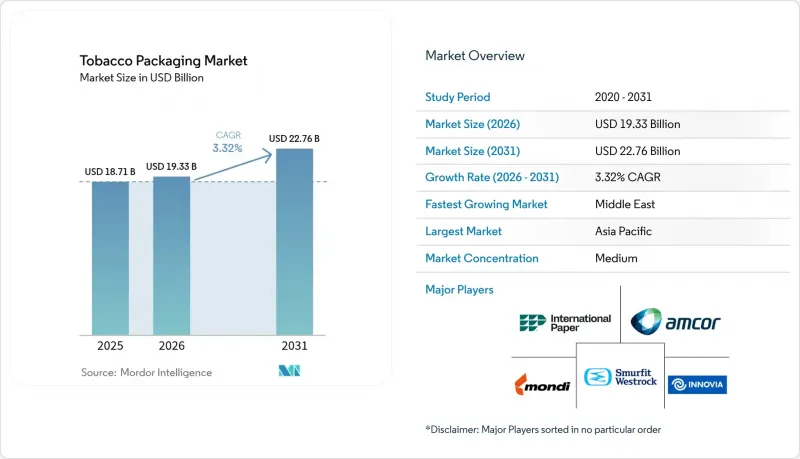
據 Mordor Intelligence 稱,2025 年菸草包裝市場價值為 187.1 億美元,預計到 2031 年將達到 227.6 億美元,而 2026 年為 193.3 億美元,預測期(2026-2031 年)的複合年成長率為 3.32%。
本報告按材質(塑膠、金屬、其他)、包裝類型(初級包裝、二級包裝、其他)、產品形式(紙煙、紙煙鏈蓋的硬包裝香菸、袋裝/小袋、管裝/加熱不燃燒型香菸)、菸草類型(菸絲、無煙煙草、新一代產品、雪茄/小雪茄)和地區進行細分。市場預測以美元計價。
全球菸草包裝市場趨勢與洞察
強制使用簡易包裝,並增加圖示警示標籤的使用。
目前,28個國家已實施統一包裝法,規定包裝表面65%至90%必須印有健康警示圖片,取消了以往因高價而得以保留的壓紋和燙金工藝。沙烏地阿拉伯和阿拉伯聯合大公國計劃在2025年將圖形覆蓋率提高至75%,迫使造紙商使用抗紫外線油墨和更厚的紙板,導致原料成本增加8%。隨著視覺品牌標誌的取消,菸草公司正將預算轉向店內展示和數位平台,但標準化包裝更容易被偽造,從而增加了對隱藏式安全標籤的需求。因此,這些法規在使包裝外觀商品化的同時,也加強了可追溯性要求,使那些將追蹤溯源功能整合到簡潔設計中的供應商受益。無法適應合規要求的加工商則面臨利潤率下降的風險,因為合約將流向技術更先進的競爭對手。
為了永續性和降低成本,過渡到使用紙板。
到2025年,紙張和紙板將佔據56.73%的市場佔有率,這得益於歐洲生產者延伸責任制(EPR)的收費系統,該機制對不可回收塑膠徵收罰款。 2024年與Smurfit Westlock的合併確保了50萬噸可折疊紙盒的專用產能,使單位成本降低了高達9%。隨後,Mondi在2025年開發了一種水性阻隔材料,該材料無需聚乙烯層壓板,並將材料重量減輕了18%。雖然在亞太地區,金屬化薄膜仍用於濕度控制,但越南和印尼等以出口為導向的工廠正在轉向塗佈紙板,以維持其在歐盟市場的佔有率。從長遠來看,即使原料成本總體下降,掌握了不含PFAS的塗層技術並實現了大規模可回收的加工商預計仍將獲得溢價。
消費稅增加導致消費下降
在英國,2025年10%的稅收成長導致普通香菸銷量下降了5.2%。同年,澳洲引進了與指數掛鉤的稅收制度,使每包香菸的銷售稅超過30澳元(20美元),加速了手捲菸袋的普及。加拿大也採取了類似措施,每條香菸的銷售稅增加了4加元,加上各省的額外課稅,導致銷售量下降了4.8%。隨著吸菸者轉向更便宜的替代品或轉向黑市,加工企業面臨著產量下降和單位成本上升的雙重困境,這擠壓了原本設計為年產量數十億支的工廠的利潤空間。許多公司正在將業務多元化,轉向生產用於大麻和藥品包裝的可折疊紙盒,以緩解運轉率的波動。
細分市場分析
到2025年,紙和紙板將佔菸草包裝銷售額的56.73%,佔據菸草包裝市場最大佔有率。加工商偏好這些材料,因為它們可以在折疊紙盒生產線上以每分鐘800包的速度順利加工,並且符合家庭垃圾回收計劃的條件,這有助於品牌所有者避免因生產者延伸責任制(EPR)而受到處罰。金屬和傳統塑膠作為防潮材料仍然發揮著一定的作用,但由於成本和監管方面的不利因素日益增多,它們的總合佔有率仍然低於三分之一。生質塑膠和可堆肥材料雖然目前規模較小,但正以4.33%的複合年成長率成長,因為歐洲進口標準的變化促使菸草公司從雙向拉伸聚丙烯(BOPP)薄膜轉向聚乳酸(PLA)套管和纖維素托盤。
因此,利潤來源正從通用紙板轉向具有不含 PFAS、高光澤或氧氣阻隔性能且不影響可回收性的塗佈紙板。掌握水性塗料和纖維基複合技術的供應商即使在裝飾性印刷受到簡裝包裝法規限制的情況下,也能獲得高價合約。在亞洲潮濕的氣候條件下,金屬化薄膜作為包裝袋重疊材料仍然具有優勢,但由於法國和德國的收費系統,其價格優勢正在減弱。預計到預測期末,主要加工商將提供兩條產品線——用於大規模生產菸草製品的再生紙板和用於加熱菸草棒的專用生質塑膠管——以滿足監管要求並提高利潤率。
到2025年,初級包裝支出將佔總支出的48.26%,主要集中在帶鉸鏈蓋的紙盒和帶有防篡改封條及嬰兒安全蓋的軟包裝上。儘管全球菸草銷售量有所下降,但由於成本、速度和法規遵循等因素,這種包裝形式仍保持強勁勢頭。為了符合簡易包裝法規,二次性包裝套和運輸包裝材料正轉向單色印刷,這降低了單位成本,並迫使加工商透過縮短設定時間和採用數位化工作流程來降低成本。高階硬盒雖然只佔銷售額的6%,但成長率達到4.19%,其盈利也高於其體積所應有的水準。對於雪茄和限量版菸草產品的上市,通常會採用磁性封口、木紋裝飾層板或雷射蝕刻等工藝,這使得其單位成本比標準折疊紙盒高出20倍以上。
需求兩極化迫使加工商實現資產多元化。高速折疊包裝機和自動化取放模組降低了十億件級批量生產的初級包裝成本,而交貨週期短的手工組裝則滿足了需要紋理表面的高級產品線的需求。隨著菸草公司在減少SKU的同時追求季節性連動產品,能夠在不到一小時內完成紙盒到硬盒轉換的模組化設備正成為關鍵的差異化優勢。能夠同時確保大規模生產能力和客製化製程的供應商最具競爭力。
區域分析
預計到2025年,亞太地區將佔全球總銷售額的46.79%,鞏固其在菸草包裝市場中最大區域市場佔有率的地位。中國2.4兆支捲菸和印度1.1兆支的產量支撐了這個規模優勢,但與歐洲相比,亞太地區在簡易包裝法規實施方面進展相對緩慢,導致包裝設計複雜度更高,單包成本也更高。印度將於2025年強制實施序列化,迫使加工商在40多條生產線上安裝目視檢測系統,使每千包的平均加工成本增加了6%。同時,越南和印尼正在採用塗佈紙板以滿足歐洲進口買家的要求,這表明即使在沒有此類法規的地區,外部法規也會影響原料的選擇。因此,區域專業製造商需要在為國內品牌生產低成本紙盒和為出口型製造商提供高規格包裝合約之間尋求平衡。
儘管受銷售稅上調和口味禁令的影響,菸草銷量下降了約4%,但歐洲在2025年仍佔全球銷售額的26%。該地區強勁的業績得益於PFAS法規和生產者延伸責任制,這些法規和製度獎勵能夠提供可回收阻隔塗層紙板的加工商。 Mondi和Smurfit Westrock在該領域處於領先地位,它們採用取得專利的水性塗層,這些塗層通過了可回收性測試,且不影響其防潮性能。北美佔18%的市佔率。雖然美國菸草需求下降,但尼古丁袋包裝的需求激增19%,由於吸塑卡和模製罐需要兒童安全功能,推高了單價。同時擁有瓦楞紙板和硬質塑膠生產能力的加工商正在利用這兩種成長趨勢獲利。
中東和非洲地區在2025年佔全球銷售額的10%,但該地區的複合年成長率(CAGR)最高,達4.39%。在波灣合作理事會(GCC)成員國,75%的包裝現在必須貼上圖形警告標籤,這促使包裝材料轉向更厚的紙板和抗紫外線油墨,導致每包原料成本增加高達12%。同時,撒哈拉以南非洲地區的非法單包貿易正在蠶食12%至18%的潛在需求,儘管人口不斷成長,但銷售量成長卻受到抑制。到2025年底,南美洲佔全球市場佔有率的6%。在巴西,2024年7月頒布的《追蹤溯源法》強制要求在89條生產線上安裝序列化硬體,這整合了國內主要企業的產能,並為歐洲加工商出口符合規定的瓦楞紙箱創造了空間。因此,區域因素正在影響企業的策略。供應商需要將他們在亞洲以成本為導向、大批量生產的業務與歐洲、北美和沿岸地區以合規主導的高階細分市場相結合,以在整個監管週期內穩定其收入。
其他好處
- Excel格式的市場預測(ME)表
- 3個月的分析師支持
目錄
第1章:引言
- 研究假設和市場定義
- 調查範圍
第2章:調查方法
第3章執行摘要
第4章 市場狀況
- 市場概覽
- 市場促進因素
- 強制使用簡易包裝,並增加圖示警示標籤的使用。
- 為了永續性和降低成本,過渡到使用紙板。
- 在產品層面引進防偽技術
- HTP/電子菸自動化包裝格式
- 文化活動限量版
- 生態模組化包裝線實現了 SKU柔軟性。
- 市場限制因素
- 消費稅增加導致消費下降
- 全球推廣簡易包裝導致品牌投資報酬率下降。
- 歐盟和美國加強對 PFAS 和塑膠的禁令。
- 非法單獨銷售產品是規避合法整套銷售的一種方式。
- 產業價值鏈分析
- 監理情勢
- 技術展望
- 宏觀經濟因素對市場的影響
- 波特五力分析
第5章 市場規模與成長預測
- 材料
- 紙張和紙板
- 塑膠
- 金屬
- 玻璃和陶瓷
- 生質塑膠/生物分解性塑膠
- 按包裝類型
- 初級包裝
- 二級包裝
- 散裝/運輸
- 豪華硬盒
- 按產品形式
- 軟包裝紙煙
- 硬包裝紙煙,帶鉸鏈蓋的紙盒
- 小袋
- 管狀熱結燒傷棒
- 依香煙類型
- 吸煙
- 無煙煙草
- 下一代產品
- 雪茄和小雪茄
- 按地區
- 北美洲
- 美國
- 加拿大
- 墨西哥
- 南美洲
- 巴西
- 阿根廷
- 其他南美國家
- 歐洲
- 英國
- 德國
- 法國
- 義大利
- 其他歐洲國家
- 亞太地區
- 中國
- 日本
- 印度
- 韓國
- 其他亞太國家
- 中東和非洲
- 中東
- 阿拉伯聯合大公國
- 沙烏地阿拉伯
- 其他中東國家
- 非洲
- 南非
- 埃及
- 其他非洲地區
- 中東
- 北美洲
第6章 競爭情勢
- 市場集中度
- 策略趨勢
- 市佔率分析
- 公司簡介
- Amcor plc
- Smurfit Westrock plc
- International Paper Company
- Mondi Group
- Innovia Films Ltd.
- Philip Morris International Inc.
- Sonoco Products Company
- Siegwerk Druckfarben AG & Co. KGaA
- Japan Tobacco International
- Treofan Film International
- Stora Enso Oyj
- ITC Limited
- British American Tobacco plc
- Shenzhen Jinjia Group Co. Ltd.
- Huhtamaki Oyj
- Uflex Ltd.
- DS Smith plc
- Jindal Poly Films Ltd.
- Oji Holdings Corp.
- SCHUR Flexibles Holding
第7章 市場機會與未來展望
According to Mordor Intelligence, the tobacco packaging market size was valued at USD 18.71 billion in 2025 and estimated to grow from USD 19.33 billion in 2026 to reach USD 22.76 billion by 2031, at a CAGR of 3.32% during the forecast period (2026-2031).
This report is Segmented by Material (Plastics, Metals, and More), Packaging Type (Primary, Secondary, and More), Product Form (Cigarette Soft Pack, Cigarette Hard Pack/Hinge-lid Carton, Pouch and Sachet, Tube and Heat-Not-Burn Sticks), Tobacco Type (Smoking Tobacco, Smokeless Tobacco, Next-Generation Products, Cigars and Cigarillos), and Geography. The Market Forecasts are Provided in Terms of Value (USD).
Global Tobacco Packaging Market Trends and Insights
Rising Plain-Pack Mandates and Graphic Warnings
Plain-pack laws in 28 nations now force 65% to 90% surface coverage with health images, erasing embossing and foil that once justified premium pricing. Saudi Arabia and the United Arab Emirates introduced 75% graphics in 2025, which pushed converters to adopt UV-resistant inks and thicker paperboard, adding 8% to substrate costs. With visual branding removed, tobacco firms redirect budgets toward point-of-sale displays and digital platforms, but demand for covert security tags rises because standardized packs are easier to counterfeit. The legislation, therefore, simultaneously commoditizes appearance and amplifies traceability requirements, rewarding suppliers that integrate track-and-trace within plain designs. Converters unable to pivot to compliance-driven features risk margin erosion as contracts shift to technically advanced rivals.
Paperboard Shift for Sustainability and Cost
Paper and paperboard held a 56.73% share in 2025, thanks to fee structures under European extended producer responsibility schemes that penalize unrecyclable plastic. Smurfit WestRock's 2024 merger unlocked 500,000 tonnes of dedicated folding-carton capacity, cutting per-unit costs by up to 9%. Mondi followed up in 2025 with a water-based barrier that removed polyethylene lamination and reduced material weight by 18%. While Asia-Pacific still uses metallized films for humidity control, export-oriented plants in Vietnam and Indonesia have shifted to coated paperboard to keep access to the European Union market. Over the long term, converters that master PFAS-free coatings and achieve recyclability at scale will capture price premiums even as overall substrate costs fall.
Escalating Excise Taxes Shrink Consumption
The United Kingdom raised duties by 10% in 2025, driving a 5.2% decline in legal cigarette sales. Australia's indexation pushed the excise component of a pack above AUD 30 (USD 20) the same year, accelerating the switch to roll-your-own pouches. Canada followed with CAD 4-per-carton hikes plus provincial surcharges, contracting volumes by 4.8%. As smokers downtrade or shift to illicit markets, converters face lower run lengths and rising unit costs, eroding margins in plants designed for billion-stick scale. Many are diversifying into cannabis or pharmaceutical folding cartons to cushion utilization swings.
Other drivers and restraints analyzed in the detailed report include:
- Unit-Level Anti-Counterfeit Tech Adoption
- Automation-Ready Pack Formats for HTP and E-cig
- Global Plain-Pack Roll-Out Erodes Branding ROI
For complete list of drivers and restraints, kindly check the Table Of Contents.
Segment Analysis
Paper and paperboard accounted for 56.73% of 2025 revenue, making them the single largest slice of the tobacco packaging market. Converters favor these substrates because they glide through folding-carton lines at 800 packs per minute and qualify for curbside recycling programs that help brand owners avoid extended producer responsibility penalties. Metals and traditional plastics still play niche roles as moisture barriers, yet their combined share remained below one-third due to cost and regulatory headwinds that continue to build. Bioplastics and compostables, although small today, are rising at a 4.33% CAGR as evolving import standards in Europe incentivize tobacco groups to shift from BOPP films toward polylactic acid sleeves and cellulose trays.
Profit pools are therefore shifting from commodity paperboard toward coated grades that deliver PFAS-free, high-gloss, or oxygen-barrier performance without losing recyclability. Suppliers that master water-based coatings or fiber-based laminates can secure premium contracts even when plain-pack rules suppress decorative print. In humid Asian climates, metallized film retains an edge for pouch overwraps, but fee structures in France and Germany are narrowing its price advantage. By the end of the forecast window, leading converters are expected to offer a dual product line, with high-volume recycled paperboard for cigarettes and specialized bioplastic tubes for heated tobacco sticks, positioning themselves for both compliance and margin protection.
Primary packs accounted for 48.26% of spending in 2025, led by hinge-lid cartons and soft packs with tamper-evident seals and child-resistant closures. Cost, speed, and regulatory conformity keep the format resilient even as global cigarette volumes contract. Secondary sleeves and transit shippers have moved toward single-color print to meet plain-pack mandates, compressing their unit value and pushing converters to drive savings through faster make-readies and digital workflows. Luxury rigid boxes, though accounting for only 6% of revenue, are growing at 4.19% and punching above their weight in profitability; cigar and limited-edition cigarette launches use magnetic closures, wood veneers, or laser etching to justify per-unit prices 20-plus times higher than those of a standard folding carton.
The bifurcation in demand compels converters to partition their asset base. High-speed folder-gluers and automated pick-and-place modules keep primary pack costs down at billion-stick scale, while short-run hand-assembly cells cater to premium lines that require tactile finishes. Modular equipment that swaps from cartons to rigid boxes in under an hour is becoming a critical differentiator as tobacco companies trim SKU counts yet still pursue seasonal tie-ins. Providers who can guarantee both mass throughput and bespoke craftsmanship occupy the most defensible competitive tier.
Complete Report Scope:
- By Material
- Paper and Paperboard
- Plastics
- Metals
- Glass and Ceramics
- Bioplastics and Compostables
- By Packaging Type
- Primary
- Secondary
- Bulk / Transit
- High-End Luxury Rigid Boxes
- By Product Form
- Cigarette Soft Pack
- Cigarette Hard Pack / Hinge-lid Carton
- Pouch and Sachet
- Tube and Heat-Not-Burn Sticks
- By Tobacco Type
- Smoking Tobacco
- Smokeless Tobacco
- Next-Generation Products
- Cigars and Cigarillos
- By Geography
- North America
- United States
- Canada
- Mexico
- South America
- Brazil
- Argentina
- Rest of South America
- Europe
- United Kingdom
- Germany
- France
- Italy
- Rest of Europe
- Asia Pacific
- China
- Japan
- India
- South Korea
- Rest of Asia Pacific
- Middle East and Africa
- Middle East
- United Arab Emirates
- Saudi Arabia
- Rest of Middle East
- Africa
- South Africa
- Egypt
- Rest of Africa
- Middle East
- North America
Geography Analysis
Asia-Pacific accounted for 46.79% of 2025 revenue, confirming its position as the largest regional share of the tobacco packaging market. China's 2.4 trillion-stick output and India's 1.1 trillion-unit production underpin this scale advantage, while relatively slow adoption of plain-pack rules keeps design complexity and per-pack value higher than in Europe. India's 2025 serialization mandate pushed converters to install vision inspection on more than 40 lines, nudging average conversion cost per thousand packs up by 6%. In parallel, Vietnam and Indonesia adopted coated paperboard grades to meet the requirements of European import buyers, signaling that external regulation is shaping substrate choice even in non-regulated jurisdictions. Regional specialists, therefore, balance low-cost carton runs for domestic brands with higher-spec contracts for export-oriented manufacturers.
Europe accounted for 26% of 2025 turnover, even though cigarette volumes contracted by about 4% under a mix of excise hikes and flavor bans. The region's revenue resilience stems from PFAS restrictions and extended producer responsibility fees that reward converters who can deliver recyclable, barrier-coated paperboard. Mondi and Smurfit Westrock lead on this front, leveraging patented water-based coatings that pass recyclability tests without compromising moisture protection. North America held an 18% share; U.S. cigarette demand fell, yet nicotine-pouch packaging jumped 19%, lifting unit value as blister cards and molded cans require child-resistant features. Converters with both carton and rigid-plastic capacity are capturing this dual-track growth.
The Middle East and Africa collectively accounted for 10% of 2025 sales, but the region posted the fastest growth rate at 4.39% CAGR. Gulf Cooperation Council states now enforce 75% pictorial warnings, prompting a switch to thicker boards and UV-stable inks that raise per-pack substrate cost by up to 12%. Conversely, illicit single-stick trade in sub-Saharan corridors strips 12% to 18% of addressable demand, limiting volume despite rising population. South America closed 2025 with a 6% share; Brazil's July 2024 track-and-trace law forced 89 lines to install serialization hardware, consolidating capacity among top domestic players and opening space for European converters to export compliant cartons. Geography, therefore, shapes strategy: suppliers must blend high-volume, cost-driven operations in Asia with compliance-led premium niches in Europe, North America, and the Gulf to smooth earnings across regulatory cycles.
- Amcor plc
- Smurfit Westrock plc
- International Paper Company
- Mondi Group
- Innovia Films Ltd.
- Philip Morris International Inc.
- Sonoco Products Company
- Siegwerk Druckfarben AG & Co. KGaA
- Japan Tobacco International
- Treofan Film International
- Stora Enso Oyj
- ITC Limited
- British American Tobacco plc
- Shenzhen Jinjia Group Co. Ltd.
- Huhtamaki Oyj
- Uflex Ltd.
- DS Smith plc
- Jindal Poly Films Ltd.
- Oji Holdings Corp.
- SCHUR Flexibles Holding
Additional Benefits:
- The market estimate (ME) sheet in Excel format
- 3 months of analyst support
TABLE OF CONTENTS
1 INTRODUCTION
- 1.1 Study Assumptions and Market Definition
- 1.2 Scope of the Study
2 RESEARCH METHODOLOGY
3 EXECUTIVE SUMMARY
4 MARKET LANDSCAPE
- 4.1 Market Overview
- 4.2 Market Drivers
- 4.2.1 Rising Plain-Pack Mandates and Graphic Warnings
- 4.2.2 Paperboard Shift for Sustainability and Cost
- 4.2.3 Unit-Level Anti-Counterfeit Tech Adoption
- 4.2.4 Automation-Ready Pack Formats for HTP/E-Cig
- 4.2.5 Cultural-Event Limited-Edition Packs
- 4.2.6 Eco-Modular Pack Lines for SKU Agility
- 4.3 Market Restraints
- 4.3.1 Escalating Excise Taxes Shrink Consumption
- 4.3.2 Global Plain-Pack Roll-Out Erodes Branding ROI
- 4.3.3 PFAS and Plastics Bans Tightening in EU and US
- 4.3.4 Illicit Single-Stick Sales Bypass Legal Packs
- 4.4 Industry Value Chain Analysis
- 4.5 Regulatory Landscape
- 4.6 Technological Outlook
- 4.7 Impact of Macroeconomic Factors on the Market
- 4.8 Porter's Five Forces Analysis
- 4.8.1 Bargaining Power of Suppliers
- 4.8.2 Bargaining Power of Buyers
- 4.8.3 Threat of New Entrants
- 4.8.4 Threat of Substitutes
- 4.8.5 Intensity of Competitive Rivalry
5 MARKET SIZE AND GROWTH FORECASTS (VALUE)
- 5.1 By Material
- 5.1.1 Paper and Paperboard
- 5.1.2 Plastics
- 5.1.3 Metals
- 5.1.4 Glass and Ceramics
- 5.1.5 Bioplastics and Compostables
- 5.2 By Packaging Type
- 5.2.1 Primary
- 5.2.2 Secondary
- 5.2.3 Bulk / Transit
- 5.2.4 High-End Luxury Rigid Boxes
- 5.3 By Product Form
- 5.3.1 Cigarette Soft Pack
- 5.3.2 Cigarette Hard Pack / Hinge-lid Carton
- 5.3.3 Pouch and Sachet
- 5.3.4 Tube and Heat-Not-Burn Sticks
- 5.4 By Tobacco Type
- 5.4.1 Smoking Tobacco
- 5.4.2 Smokeless Tobacco
- 5.4.3 Next-Generation Products
- 5.4.4 Cigars and Cigarillos
- 5.5 By Geography
- 5.5.1 North America
- 5.5.1.1 United States
- 5.5.1.2 Canada
- 5.5.1.3 Mexico
- 5.5.2 South America
- 5.5.2.1 Brazil
- 5.5.2.2 Argentina
- 5.5.2.3 Rest of South America
- 5.5.3 Europe
- 5.5.3.1 United Kingdom
- 5.5.3.2 Germany
- 5.5.3.3 France
- 5.5.3.4 Italy
- 5.5.3.5 Rest of Europe
- 5.5.4 Asia Pacific
- 5.5.4.1 China
- 5.5.4.2 Japan
- 5.5.4.3 India
- 5.5.4.4 South Korea
- 5.5.4.5 Rest of Asia Pacific
- 5.5.5 Middle East and Africa
- 5.5.5.1 Middle East
- 5.5.5.1.1 United Arab Emirates
- 5.5.5.1.2 Saudi Arabia
- 5.5.5.1.3 Rest of Middle East
- 5.5.5.2 Africa
- 5.5.5.2.1 South Africa
- 5.5.5.2.2 Egypt
- 5.5.5.2.3 Rest of Africa
- 5.5.5.1 Middle East
- 5.5.1 North America
6 COMPETITIVE LANDSCAPE
- 6.1 Market Concentration
- 6.2 Strategic Moves
- 6.3 Market Share Analysis
- 6.4 Company Profiles (includes Global Level Overview, Market Level Overview, Core Segments, Financials as available, Strategic Information, Market Rank/Share, Products and Services, Recent Developments)
- 6.4.1 Amcor plc
- 6.4.2 Smurfit Westrock plc
- 6.4.3 International Paper Company
- 6.4.4 Mondi Group
- 6.4.5 Innovia Films Ltd.
- 6.4.6 Philip Morris International Inc.
- 6.4.7 Sonoco Products Company
- 6.4.8 Siegwerk Druckfarben AG & Co. KGaA
- 6.4.9 Japan Tobacco International
- 6.4.10 Treofan Film International
- 6.4.11 Stora Enso Oyj
- 6.4.12 ITC Limited
- 6.4.13 British American Tobacco plc
- 6.4.14 Shenzhen Jinjia Group Co. Ltd.
- 6.4.15 Huhtamaki Oyj
- 6.4.16 Uflex Ltd.
- 6.4.17 DS Smith plc
- 6.4.18 Jindal Poly Films Ltd.
- 6.4.19 Oji Holdings Corp.
- 6.4.20 SCHUR Flexibles Holding
7 MARKET OPPORTUNITIES AND FUTURE OUTLOOK
- 7.1 White-space and Unmet-Need Assessment

 菸草包裝市場分析及預測(至2035年):依類型、產品、技術、組件、應用、材料類型、過程及最終用戶分類
 菸草包裝市場預測至2034年-按包裝類型、材料、產品類型、包裝形式和地區分類的全球分析
 菸草包裝市場分析:按材料類型、包裝類型、最終用途和地區分類(2026-2034 年)
 菸草包裝市場規模、佔有率、成長及全球產業分析:按類型、應用和地區分類,並預測至2026-2034年全球菸草包裝市場規模、佔有率、趨勢和成長分析報告(2026-2034年)菸草包裝市場-2026-2031年預測
 菸草包裝:全球市場佔有率和排名、總收入和需求預測(2025-2031年)
 全球菸草包裝市場:市場規模、佔有率和趨勢分析(按材料、包裝類型、產品和地區)、細分市場預測(2025-2030 年)
 全球菸草包裝市場:2025年
 全球菸草包裝市場:市場規模、佔有率、趨勢、產業分析(依包裝材料、產品、材料類型和地區)、未來預測(2025-2034)