


 |
市場調查報告書
商品編碼
2121838
線纜管理:市場佔有率分析、產業趨勢與統計、成長預測(2026-2031)Cable Management - Market Share Analysis, Industry Trends & Statistics, Growth Forecasts (2026 - 2031) |
||||||

※ 本網頁內容可能與最新版本有所差異。詳細情況請與我們聯繫。
根據 Mordor Intelligence 預測,電纜管理市場規模將從 2025 年的 178.7 億美元成長到 2026 年的 196.5 億美元,然後在 2031 年達到 315.7 億美元,2026 年至 2031 年的複合年成長率為 9.95%。
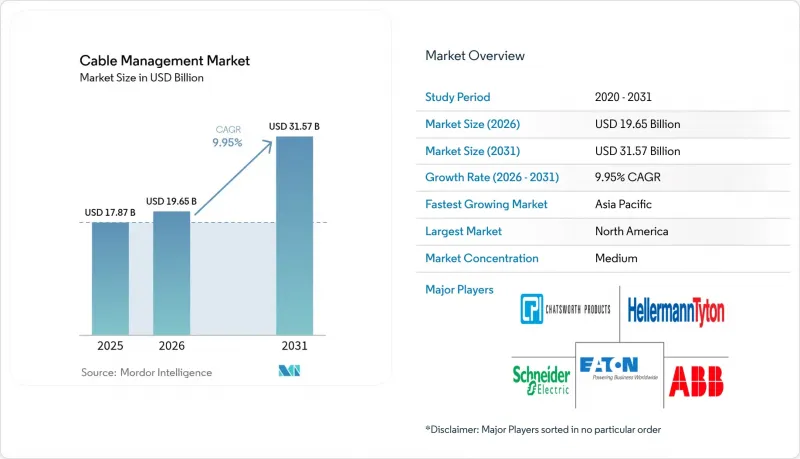
本報告按產品類型(電纜配線架、電纜電氣管槽等)、終端用戶產業(IT及電信、建築、能源及公共產業、製造業、商業、醫療機構)、材質(金屬和非金屬)、安裝方式(架空/天花板、地板下等)和地區進行細分。市場預測以美元(USD)為單位。
全球線纜管理市場趨勢與洞察
超大規模資料中心的激增
超大規模部署的擴張是線纜管理市場最強勁的驅動力。 NVIDIA DGX SuperPOD 的部署要求在有限的安裝空間內,透過特定的線纜佈線方案來容納 400G 和 800G 光纖鏈路以及液冷軟管,這使得每個機架的托盤和連接器數量比企業級設施增加了一倍。 AFL 的垂直線管理器設計可將可用機架空間增加 40%,並減少氣流損失,從而實現每個機架超過 70 kW 的功率密度。預計 GPU叢集每個機架所需的線纜硬體數量將是現有設備的三倍,這迫使專案經理在施工開始前 16 週預訂組件。專用連接器的供應緊張延長了專案前置作業時間,也提升了可減少現場端接的模組化套件的價值。隨著越來越多的營運商要求進行預測性維護以避免停機,將 RFID 標籤和溫度感測器整合到托盤中的供應商正在贏得市場佔有率。
可再生能源建設的擴張
公用事業規模的太陽能和陸上風電場對其電纜管理系統提出了獨特的環境和耐久性要求。美國能源局製定了25年的使用壽命標準,並建議使用抗紫外線聚合物、熱膨脹節和耐腐蝕緊固件。 Panduit提供的電纜束線帶耐熱範圍為-40 度C至+90 度C ,可減少沙漠電站年度維護所需的車輛出勤次數。 CAB Solar的模組化吊架可將安裝工作量減少60%,並幾乎完全消除沙粒進入,從而降低每兆瓦的運作和維護成本。對於風力發電機應用,首選能夠承受塔架持續搖晃和旋轉並保持20年絕緣性能的軟性支架。結合太陽能和儲能的混合電站增加了佈線路徑的複雜性,因為直流陣列、交流電網連接和電池電路必須隔離以滿足安全標準。
鍍鋅鋼板和PVC的價格波動
2025年初,區域供應失衡和能源成本飆升影響了採購預算,導致鍍鋅鋼和PVC現貨價格波動15%。 ADS Sheet Metal預測鋁價將徘徊在每噸2,763美元左右,這進一步增加了成本預測的複雜性。電纜管理設備供應商正透過將報價有效期限縮短至14天並將合約與產品基準掛鉤,將風險轉移給最終用戶。價格波動正在推動對替代品的需求,人們對纖維增強塑膠線槽的興趣迅速成長,儘管其應用需要更長的認證週期。雖然一些EPC承包商正在對原料進行大量避險,但小規模安裝商的盈利正面臨直接影響。
細分市場分析
到2025年,電纜配線架在電纜管理市場中仍將佔據35.12%的佔有率,這反映了其廣泛的應用前景。預計到2031年,電纜連接器和接頭將以10.52%的複合年成長率成長。超大規模資料中心和可再生能源逆變器機架密度的增加,推動了對高電流容量接線端子、應力消除接頭以及用於分離電力和光纖電路的多層橋架的需求。隨著模組化設計縮短安裝時間並降低現場操作風險,連接器電纜管理市場規模預計將進一步擴大。接線盒和載具市場呈現穩定成長態勢,其中動態載具尤其在機器人焊接單元中找到了獨特的市場需求。領先的供應商正透過整合RFID標籤和資產追蹤軟體來實現產品差異化並鞏固服務契約,從而支持結合資本支出(CAPEX)和營運支出(OPEX)的混合收入模式。
太陽能發電廠的維護週期會更換因紫外線劣化的零件,因此,紮線、蓋板和緊固件等配件能夠帶來額外的收入。卡扣式通道蓋板的創新設計縮短了組裝時間,而顏色編碼的卡扣則提高了故障排除效率。適用於 1500V 太陽能組串的高電流接線端子能夠推高平均售價 (ASP),並提升電纜管理市場的利潤率。在銅鋁價格波動的情況下,採用鋁製外殼和鍍銅接點相結合的雙材料接線端子被應用於設計中,既能抑制電流腐蝕,又不會顯著增加成本。
截至2025年,IT和電信業將佔據線材管理市場佔有率的28.24%,但資料中心是成長最快的終端用戶領域,到2031年複合年成長率將達到10.21%。人工智慧(AI)叢集、液冷伺服器和電池備用UPS架構使得每平方英尺的線纜佈線需求加倍。因此,隨著營運商採用更寬的梯架和雙層堆疊式籃框來適應混合銅纜和光纖拓撲結構,資料中心線材管理市場的收入佔有率預計將會擴大。
採用模組化預製方法的建設公司將托盤嵌入牆板內,將機架孔的施工時間從數天縮短至數小時。能源和公共產業行業對金屬托盤的需求持續旺盛,因為離岸風力發電電場和氫氣電解廠需要耐腐蝕解決方案。製造業正在採用靈活的即插即用線束,以適應工業4.0時代生產線的變化,而醫療機構則優先考慮光滑、易於清潔的表面和抗菌塗層。在所有產業中,IT和OT的整合正在推動整合電氣管槽的發展,這些線槽既能促進狀態監控的資料交換,又能保持網路分段。
區域分析
2025年,北美將繼續佔據全球39.02%的電纜管理市場佔有率,這主要得益於維吉尼亞、俄亥俄州和亞伯達資料中心大型園區的建設。聯邦政府對可再生能源發電和輸電的獎勵,以及用於提升電網容錯能力的資金投入,正在推動地下電纜系統的普及。墨西哥的近岸外包熱潮也促進了電纜配線架製造地的擴張,例如Panduit公司投資5,000萬美元興建的工廠,能夠同時滿足資料中心和太陽能發電廠的需求。
預計到2031年,亞太地區將以10.71%的複合年成長率推動成長。中國的智慧工廠計畫和印度的高壓電網升級正在推動大規模競標,而能夠滿足當地認證要求的國內供應商更受青睞。日本和韓國正在為半導體潔淨室創新研發小型化光纖托盤解決方案,而東南亞則吸引外國直接投資建造電池超級工廠,這些工廠對堅固耐用的非金屬導管有特定要求。區域採購規則促進了合資企業的形成,ABB和Niedax在北美建立的托盤合資模式目前正在東協市場複製。
在歐洲,智慧建築標準和可再生能源目標確保了支出水準的維持,各項工作正穩步推進,但複雜的建築產品法規 (CPR) 文件延長了競標前的準備階段。德國汽車生產線的電氣化需要高度柔軟性的拖鍊式輸送機,而英國倫敦周邊的資料中心叢集正在投資緊湊型地板下解決方案。東歐的風電走廊正在成為新的收入來源,但由於價格敏感的規格,鍍鋅梯形托盤比複合材料更受歡迎。
其他好處:
- Excel格式的市場預測(ME)表
- 3個月的分析師支持
目錄
第1章:引言
- 研究假設和市場定義
- 調查範圍
第2章:調查方法
第3章執行摘要
第4章 市場狀況
- 市場概覽
- 市場促進因素
- 加速可再生能源的普及應用
- 超大規模資料中心的激增
- 經合組織成員國強制實施智慧建築
- 工業製程的電氣化
- 模組化異地建造方法
- 部署800V電動車充電基礎設施
- 市場限制因素
- 鍍鋅鋼板和PVC的價格波動
- 阻燃塑膠的認證週期越來越長。
- 無線/PoE解決方案的廣泛應用
- 由於小型化,銅纜的需求減少
- 產業價值鏈分析
- 監理情勢
- 技術展望
- 波特五力分析
第5章 市場規模與成長預測
- 依產品
- 電纜配線架
- 電纜電氣管槽
- 電纜管道
- 電纜連接器和密封接頭
- 電纜營運商
- 電纜地毯
- 接線盒/配電箱
- 領帶、蓋子、緊固件、夾子
- 按最終用戶行業分類
- IT/通訊
- 建造
- 能源公用事業
- 製造業
- 商業的
- 醫療機構
- 材料類型
- 金屬(鐵、鋁)
- 非金屬(PVC、HDPE、FRP)
- 透過部署管道
- 頂棚和天花板
- 地板下
- 壁掛式
- 地下/埋藏
- 按地區
- 北美洲
- 美國
- 加拿大
- 南美洲
- 巴西
- 阿根廷
- 其他南美國家
- 歐洲
- 德國
- 英國
- 法國
- 俄羅斯
- 其他歐洲國家
- 亞太地區
- 中國
- 日本
- 印度
- 韓國
- 其他亞太國家
- 中東和非洲
- 中東
- 沙烏地阿拉伯
- 阿拉伯聯合大公國
- 其他中東國家
- 非洲
- 南非
- 奈及利亞
- 其他非洲國家
- 中東
- 北美洲
第6章 競爭情勢
- 市場集中度
- 策略趨勢
- 市佔率分析
- 公司簡介
- ABB Ltd.
- Schneider Electric SE
- Eaton Corporation plc
- Legrand SA
- Prysmian SpA
- Panduit Corp.
- HellermannTyton Group PLC
- Atkore Inc.
- Hubbell Incorporated
- TE Connectivity Ltd.
- Chatsworth Products, Inc.
- Enduro Composites, Inc.
- Leviton Manufacturing Co., Inc.
- OBO Bettermann Holding GmbH and Co. KG
- Niedax Group
- Oglaend System Group AS
- Thomas and Betts Corporation
- CableOrganizer.com LLC
- Marco Cable Management Ltd.
- Unitrunk Ltd.
- Elastimold(ABB Installation Products Inc.)
- Cembre SpA
第7章 市場機會與未來展望
According to Mordor Intelligence, the cable management market size is expected to grow from USD 17.87 billion in 2025 to USD 19.65 billion in 2026 and is forecast to reach USD 31.57 billion by 2031 at 9.95% CAGR over 2026-2031.
This report is Segmented by Product (Cable Trays, Cable Raceways, and More), End-User Industry (IT and Telecommunications, Construction, Energy and Utilities, Manufacturing, Commercial, and Healthcare Facilities), Material Type (Metallic and Non-Metallic), Installation Channel (Overhead and Ceiling, Under-Floor, and More), and Geography. The Market Forecasts are Provided in Terms of Value (USD).
Global Cable Management Market Trends and Insights
Proliferation of Hyperscale Data Centers
Hyperscale expansion represents the strongest single catalyst for the cable management market. NVIDIA DGX SuperPOD installations now specify cable pathways that house 400 G and 800 G fiber links plus liquid-coolant hoses in confined footprints, doubling the volume of trays and connectors per rack when compared with enterprise facilities. AFL's vertical cable-manager designs raise usable rack space by 40% and cut airflow losses, supporting power densities beyond 70 kW per rack. It is expected that GPU clusters require three times the routing hardware per rack, pressuring project managers to pre-order components 16 weeks ahead of build start dates. Specialized connector supply is tight, lengthening project lead times and amplifying the value of modular kits that reduce field terminations. Vendors incorporating RFID tags and thermal sensors into trays gain share as operators seek predictive maintenance to avoid downtime.
Accelerated Renewable-Energy Build-Outs
Utility-scale solar and onshore wind sites impose unique environmental and longevity requirements on cable management systems. The U.S. Department of Energy outlines 25-year service-life standards that reward UV-stable polymers, thermal-expansion joints, and corrosion-proof fasteners. Panduit delivers cable ties rated from -40 °C to +90 °C, limiting annual maintenance truck rolls across desert plants. CAB Solar's modular hangers reduce install labor by 60% and virtually eliminate sand ingress, lowering O&M cost per megawatt. Wind-turbine applications favor flexible carriers that tolerate continual tower sway and rotation, maintaining insulation integrity for 20 years. Hybrid solar-plus-storage sites add routing complexity because DC arrays, AC grid interconnects, and battery circuits must remain segregated to satisfy safety codes.
Volatile Prices of Galvanized Steel and PVC
Spot prices for galvanized steel and PVC swung 15% in early 2025 as regional supply imbalances and energy-cost spikes hit procurement budgets. ADS Sheet Metal's forecasts show aluminum hovering near USD 2,763 per ton, further complicating cost assumptions. Cable management suppliers shorten quote validity to 14 days and index contracts to commodity benchmarks, shifting risk to end users. Volatility encourages substitution: fiber-reinforced plastic trays see accelerated interest, yet their adoption is tethered to longer qualification cycles. Some EPC contractors lock in bulk raw-material hedges, but smaller installers absorb direct hits to profitability.
Other drivers and restraints analyzed in the detailed report include:
- Smart-Building Mandates in OECD Economies
- Electrification of Industrial Processes
- Lengthy Certification Cycles for Flame-Retardant Plastics
For complete list of drivers and restraints, kindly check the Table Of Contents.
Segment Analysis
Cable trays retained a 35.12% share of the cable management market in 2025, reflecting their broad applicability, while cable connectors and glands are projected to grow at a 10.52% CAGR through 2031. Elevated rack densities in hyperscale data centers and renewable inverters amplify demand for high-ampacity lugs, strain-relief glands, and multi-tier trays that separate power and fiber circuits. The cable management market size for connectors is set to widen as modularity shortens installation windows and limits site labor exposure. Junction boxes and carriers post steady gains, with dynamic-motion carriers finding niche uptake in robotic welding cells. Premium vendors add RFID tagging and asset-tracking software to differentiate offerings and lock in service contracts, supporting hybrid CAPEX-plus-OPEX revenue models.
Ties, covers, and fasteners accumulate incremental revenue thanks to maintenance cycles that replace UV-aged components in solar farms. Innovations in snap-in channel covers reduce assembly time, and color-coded clips boost troubleshooting efficiency. High-current lugs suited for 1,500 V solar strings command ASP premiums, buttressing margins within the cable management market. As copper and aluminum price spreads fluctuate, dual-material lugs enter designs, combining aluminum bodies with copper-plated contacts to manage galvanic corrosion without heavy cost penalties.
IT and telecommunications held 28.24% of the cable management market share in 2025, yet data centers represent the fastest-growing end-user at 10.21% CAGR through 2031. Artificial-intelligence clusters, liquid-cooled servers, and battery-backed UPS architectures multiply pathway requirements per square foot. The cable management market size for data centers is therefore expected to capture a rising revenue slice as operators standardize on wider rung ladders and double-stacked basket trays to accommodate hybrid copper-fiber topologies.
Construction firms adopting modular prefabrication embed trays within wall panels, enabling hours-rather-than-days rack hall builds. Energy and utilities sectors push for corrosion-resistant solutions in offshore wind substations and hydrogen electrolyzer plants, sustaining metallic-tray demand. Manufacturing embraces flexible plug-and-play harnesses to support Industry 4.0 line changes, while healthcare facilities prioritize smooth, wipe-down surfaces and antimicrobial coatings. Across sectors, IT-OT convergence drives integrated raceways that preserve network segmentation yet promote data exchange for condition monitoring.
Complete Report Scope:
- By Product
- Cable Trays
- Cable Raceways
- Cable Conduits
- Cable Connectors and Glands
- Cable Carriers
- Cable Lugs
- Junction / Distribution Boxes
- Ties, Covers, Fasteners, Clips
- By End-user Industry
- IT and Telecommunications
- Construction
- Energy and Utilities
- Manufacturing
- Commercial
- Healthcare Facilities
- By Material Type
- Metallic (Steel, Aluminum)
- Non-metallic (PVC, HDPE, FRP)
- By Installation Channel
- Overhead and Ceiling
- Under-floor
- Wall-mounted
- Underground / Buried
- By Geography
- North America
- United States
- Canada
- South America
- Brazil
- Argentina
- Rest of South America
- Europe
- Germany
- United Kingdom
- France
- Russia
- Rest of Europe
- Asia Pacific
- China
- Japan
- India
- South Korea
- Rest of Asia Pacific
- Middle East and Africa
- Middle East
- Saudi Arabia
- United Arab Emirates
- Rest of Middle East
- Africa
- South Africa
- Nigeria
- Rest of Africa
- Middle East
- North America
Geography Analysis
North America retained 39.02% of the cable management market in 2025, anchored by data-center megacampus construction across Virginia, Ohio, and Alberta. Federal incentives for renewable generation and transmission, together with grid-resilience funds, lift underground-system uptake. Mexico's near-shoring boom stimulates cable-tray manufacturing footprints, evidenced by Panduit's USD 50 million plant that serves both data-center and solar-farm demand.
Asia Pacific leads growth at an 10.71% CAGR through 2031. China's smart-factory programs and India's high-voltage transmission upgrades fuel large tenders favoring domestic suppliers equipped to navigate local certification. Japan and South Korea innovate miniaturized fiber-tray solutions for semiconductor cleanrooms, while Southeast Asia attracts foreign direct investment into battery gigafactories that specify heavy-duty non-metallic conduits. Regional content rules encourage joint ventures, such as ABB-Niedax's North American tray JV blueprint now replicated in ASEAN markets.
Europe progresses steadily as smart-building codes and renewable-energy targets hold spending levels, though complex CPR documentation extends pre-bid phases. Germany's automotive-line electrification demands flexible drag-chain carriers, and the U.K.'s London-edge data-center cluster invests in compact under-floor solutions. Eastern European wind corridors present new revenue pools, albeit with price-sensitive specifications that favor galvanized ladder trays over composites.
- ABB Ltd.
- Schneider Electric SE
- Eaton Corporation plc
- Legrand SA
- Prysmian S.p.A.
- Panduit Corp.
- HellermannTyton Group PLC
- Atkore Inc.
- Hubbell Incorporated
- TE Connectivity Ltd.
- Chatsworth Products, Inc.
- Enduro Composites, Inc.
- Leviton Manufacturing Co., Inc.
- OBO Bettermann Holding GmbH and Co. KG
- Niedax Group
- Oglaend System Group AS
- Thomas and Betts Corporation
- CableOrganizer.com LLC
- Marco Cable Management Ltd.
- Unitrunk Ltd.
- Elastimold (ABB Installation Products Inc.)
- Cembre S.p.A.
Additional Benefits:
- The market estimate (ME) sheet in Excel format
- 3 months of analyst support
TABLE OF CONTENTS
1 INTRODUCTION
- 1.1 Study Assumptions and Market Definition
- 1.2 Scope of the Study
2 RESEARCH METHODOLOGY
3 EXECUTIVE SUMMARY
4 MARKET LANDSCAPE
- 4.1 Market Overview
- 4.2 Market Drivers
- 4.2.1 Accelerated renewable-energy build-outs
- 4.2.2 Proliferation of hyperscale data centers
- 4.2.3 Smart-building mandates in OECD economies
- 4.2.4 Electrification of industrial processes
- 4.2.5 Modular off-site construction methods
- 4.2.6 800 V EV-charging infrastructure rollout
- 4.3 Market Restraints
- 4.3.1 Volatile prices of galvanized steel and PVC
- 4.3.2 Lengthy certification cycles for flame-retardant plastics
- 4.3.3 Growing adoption of wireless/PoE solutions
- 4.3.4 Miniaturization reducing copper cable volumes
- 4.4 Industry Value Chain Analysis
- 4.5 Regulatory Landscape
- 4.6 Technological Outlook
- 4.7 Porter's Five Forces Analysis
- 4.7.1 Bargaining Power of Suppliers
- 4.7.2 Bargaining Power of Buyers
- 4.7.3 Threat of New Entrants
- 4.7.4 Threat of Substitutes
- 4.7.5 Competitive Rivalry
5 MARKET SIZE AND GROWTH FORECASTS (VALUE)
- 5.1 By Product
- 5.1.1 Cable Trays
- 5.1.2 Cable Raceways
- 5.1.3 Cable Conduits
- 5.1.4 Cable Connectors and Glands
- 5.1.5 Cable Carriers
- 5.1.6 Cable Lugs
- 5.1.7 Junction / Distribution Boxes
- 5.1.8 Ties, Covers, Fasteners, Clips
- 5.2 By End-user Industry
- 5.2.1 IT and Telecommunications
- 5.2.2 Construction
- 5.2.3 Energy and Utilities
- 5.2.4 Manufacturing
- 5.2.5 Commercial
- 5.2.6 Healthcare Facilities
- 5.3 By Material Type
- 5.3.1 Metallic (Steel, Aluminum)
- 5.3.2 Non-metallic (PVC, HDPE, FRP)
- 5.4 By Installation Channel
- 5.4.1 Overhead and Ceiling
- 5.4.2 Under-floor
- 5.4.3 Wall-mounted
- 5.4.4 Underground / Buried
- 5.5 By Geography
- 5.5.1 North America
- 5.5.1.1 United States
- 5.5.1.2 Canada
- 5.5.2 South America
- 5.5.2.1 Brazil
- 5.5.2.2 Argentina
- 5.5.2.3 Rest of South America
- 5.5.3 Europe
- 5.5.3.1 Germany
- 5.5.3.2 United Kingdom
- 5.5.3.3 France
- 5.5.3.4 Russia
- 5.5.3.5 Rest of Europe
- 5.5.4 Asia Pacific
- 5.5.4.1 China
- 5.5.4.2 Japan
- 5.5.4.3 India
- 5.5.4.4 South Korea
- 5.5.4.5 Rest of Asia Pacific
- 5.5.5 Middle East and Africa
- 5.5.5.1 Middle East
- 5.5.5.1.1 Saudi Arabia
- 5.5.5.1.2 United Arab Emirates
- 5.5.5.1.3 Rest of Middle East
- 5.5.5.2 Africa
- 5.5.5.2.1 South Africa
- 5.5.5.2.2 Nigeria
- 5.5.5.2.3 Rest of Africa
- 5.5.5.1 Middle East
- 5.5.1 North America
6 COMPETITIVE LANDSCAPE
- 6.1 Market Concentration
- 6.2 Strategic Moves
- 6.3 Market Share Analysis
- 6.4 Company Profiles (includes Global-level Overview, Market-level Overview, Core Segments, Financials, Strategic Information, Market Rank/Share, Products and Services, Recent Developments)
- 6.4.1 ABB Ltd.
- 6.4.2 Schneider Electric SE
- 6.4.3 Eaton Corporation plc
- 6.4.4 Legrand SA
- 6.4.5 Prysmian S.p.A.
- 6.4.6 Panduit Corp.
- 6.4.7 HellermannTyton Group PLC
- 6.4.8 Atkore Inc.
- 6.4.9 Hubbell Incorporated
- 6.4.10 TE Connectivity Ltd.
- 6.4.11 Chatsworth Products, Inc.
- 6.4.12 Enduro Composites, Inc.
- 6.4.13 Leviton Manufacturing Co., Inc.
- 6.4.14 OBO Bettermann Holding GmbH and Co. KG
- 6.4.15 Niedax Group
- 6.4.16 Oglaend System Group AS
- 6.4.17 Thomas and Betts Corporation
- 6.4.18 CableOrganizer.com LLC
- 6.4.19 Marco Cable Management Ltd.
- 6.4.20 Unitrunk Ltd.
- 6.4.21 Elastimold (ABB Installation Products Inc.)
- 6.4.22 Cembre S.p.A.
7 MARKET OPPORTUNITIES AND FUTURE OUTLOOK
- 7.1 White-space and Unmet-Need Assessment

 金屬纜索梯系統市場:全球市場預測,2026-2032年電纜保護器斜面市場:全球市場預測,2026-2032年電纜管理環市場:全球市場預測,2026-2032年
 全球電纜管理配件市場全球電纜管理系統市場梯形電纜配線架市場:全球市場預測,2026-2032年氮化矽熱電偶保護管市場:全球市場預測,2026-2032年聚氨酯電纜保護器市場-2026-2032年全球市場預測建築電纜管理系統市場:按組件、材質、安裝方法、最終用途和分銷管道分類-2026-2032年全球市場預測
 鍍鋅鋼導線管市場機會、成長要素、產業趨勢分析及2026-2035年預測