

 |
市場調查報告書
商品編碼
2121836
金屬加工液:市場佔有率分析、產業趨勢與統計、成長預測(2026-2031)Metal Working Fluids - Market Share Analysis, Industry Trends & Statistics, Growth Forecasts (2026 - 2031) |
||||||

※ 本網頁內容可能與最新版本有所差異。詳細情況請與我們聯繫。
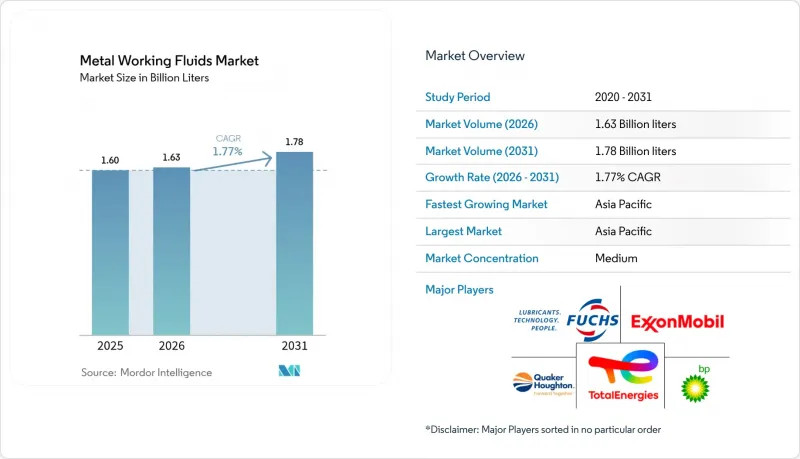
根據 Mordor Intelligence 預測,金屬加工液市場規模預計將從 2025 年的 16 億公升成長到 2026 年的 16.3 億公升,然後從 2026 年到 2031 年以 1.77% 的複合年成長率成長,到 2031 年達到 17.8 億升。
本報告按產品類型(切削液、成型液、保護液、加工液)、最終用戶產業(汽車、重型機械、一般製造業、金屬加工和合約製造、航太和國防、船舶、石油和天然氣、其他)以及地區(亞太地區、北美、歐洲、南美、中東和非洲)進行分類。
全球金屬加工液市場趨勢及洞察。
汽車業對精密加工的需求不斷成長
電動車 (EV) 平台對電池外殼、馬達軸心和結構鋁鑄件的尺寸公差要求極高。上海、柏林和奧斯汀的主要工廠正在採用高壓壓鑄單元,並使用合成或半合成加工液來防止模具焊接並保持表面完整性。隨著原始設備製造商 (OEM) 擴大整合式巨型鑄造生產線的應用,提供具有卓越潤滑性能的無 PFAS 添加劑的配方製造商正在獲得長期供應合約。同時,混合動力汽車汽車動力系統的微型化由於主軸轉速的提高和更嚴格的溫度控管要求而產生了新的需求。因此,儘管內燃機缸體加工的需求趨於平穩,但汽車液壓油的消耗量仍然很高,從而支撐了金屬加工液壓油市場的穩定需求。
全球航太零件生產的快速擴張。
空中巴士和波音預計2025年總合的飛機交付將接近1550架,高於2024年的1263架,這將持續推動對鈦合金和鎳合金加工材料的需求。這些合金需要使用添加了先進極壓(EP)添加劑的高閃點合成切削液,以抑制切屑堆積和刀具磨損。主要的航太製造商要求供應商具備可追溯性並符合REACH法規,但只有少數區域調節商能夠滿足這些要求,這進一步鞏固了現有全球企業的市場佔有率。歐洲未來作戰空中系統(FCAS)和日本戰鬥機現代化計畫等國防項目也在推動需求成長。因此,高價的新型合成切削液正迅速搶佔市場佔有率,超越基礎級乳化液,從而推高了金屬加工液市場的整體價值。
向乾式和近乾式加工製程過渡
微量潤滑 (MQL) 以 50 ml/h 的速率輸送細小的油滴,而傳統的流體潤滑系統則以 50 L/min 的速率輸送。對 7075-T6 鋁合金的實驗表明,MQL 可使刀具壽命延長 20%,並顯著提高表面粗糙度 Ra 值,從而顛覆了 MQL 在輕金屬上性能不佳的普遍認知。一家德國汽車工廠目前已在其曲軸生產線上應用 MQL 技術,冷卻液浪費減少了 88%。隨著硬質合金塗層刀具和自適應控制技術的日益成熟,乾式加工將能夠處理更廣泛的工件,從而降低市場對金屬加工液的需求。
細分市場分析
到2025年,切削液將佔據金屬加工液市場51.48%的佔有率。其持續佔據主導地位歸功於其廣泛的應用範圍,包括車削、鑽孔和研磨等,適用於鋼和鋁的加工。同時,儘管2025年成形液的市場規模較小,但預計到2031年,其複合年成長率將達到2.04%,成為所有產品類型中成長率最高的。這反映了電動車電池機殼和航太拉伸成形領域對成形液的需求不斷成長。在切削液領域,高性能半合成切削液的價值日益凸顯,因為工廠優先考慮延長油槽壽命和減少油霧。防護液和處理液雖然仍屬於小眾市場,但在海軍設備和熱處理爐中卻至關重要,因為這些設備對防腐蝕和硬化完整性要求極高。生物基酯類正進入切削液和成形液市場,它們不僅符合生物分解性目標,還能將摩擦係數降低15%。在避免停機時間比每公升成本更重要的領域,合成化學產品在高價位區間吸引了需求,進一步增強了金屬加工液市場的整體穩健性。
添加劑技術的進步使得配製無硼腐蝕抑制劑和用於高壓滑動(EP)的聚合物基添加劑成為可能,從而使無氯切削液能夠在重載切削應用中佔據一席之地。此外,配方生產商正在添加奈米鑽石顆粒以提高深孔鑽削中的熱傳導效率。適用於沖壓加工和後續機械加工的混合乳液正在提高一級供應商的庫存效率。區域格局的變化也十分顯著,隨著中國和韓國電池工廠擴大生產規模,亞太地區目前在全球成型量中佔了很大比例。
區域分析
自2023年以來,近一半的加工中心集中在亞太地區,支撐了該地區在金屬加工液市場47.70%的佔有率。到2031年,該地區的複合年成長率(CAGR)將達到2.12%,高於全球平均水平,這主要得益於中國電池製造和印度航太業的抵消貿易合約。供應鏈集中在沿海工業區,降低了散裝液體的運輸成本。韓國和新加坡政府對智慧製造的激勵措施,促進了對整合工業IoT物聯網(IIoT)的複合產品的需求成長。日本的精密研磨文化支撐了對超低硫合成油的需求,從而增強了市場中高附加價值產業的發展。
北美佔據了較大的市場佔有率,並受益於國防費用和持續的頁岩氣投資。隨著電動車組裝業務向該地區的中西部轉移,需要建立本地調配廠來減少物流相關的排放。美國職業安全與健康管理局 (OSHA) 對油霧暴露的嚴格規定,使得低揮發性有機化合物 (VOC) 產品需求穩定成長,金屬加工潤滑油市場也轉向半合成油。歐洲面臨最嚴峻的監管挑戰,尤其是全氟烷基和多氟烷基物質 (PFAS) 的禁用。該地區的調配商正在加速開發生物基極壓 (EP) 潤滑油組合,以主動降低合規風險。德國和義大利的工具機製造商正與潤滑油供應商合作,最佳化刀具路徑和冷卻液組合,保持創新。
即使將南美洲、中東和非洲的消費量加起來,它們在全球消費中所佔比例也很小,其中巴西的農業機械產業和沙烏地阿拉伯的造船業是主要的需求中心。政治風險和外匯波動對定價策略構成挑戰,但基礎建設支撐著基本的消費需求。區域性混合生產商正利用靈活的契約製造來對沖不斷上漲的進口運費,並保障金屬加工液壓油市場本地供應的穩定性。
其他好處:
- Excel格式的市場預測(ME)表
- 3個月的分析師支持
目錄
第1章:引言
- 研究假設和市場定義
- 調查範圍
第2章:調查方法
第3章執行摘要
第4章 市場狀況
- 市場概覽
- 市場促進因素
- 汽車精密加工領域需求不斷成長
- 全球航太零件生產的快速擴張。
- 電動汽車電池外殼製造設備升級熱潮
- 利用工業物聯網擴大流體監測的應用範圍
- 石油和天然氣鑽井工具製造的復興
- 市場限制因素
- 向乾式加工和近乾式加工製程的過渡
- 加強對揮發性有機化合物和除生物劑的全球監管
- 第一類/第二類基礎油供應的波動性
- 微生物污染導致的高昂處置成本
- 價值鏈分析
- 監理情勢
- 波特五力模型
第5章 市場規模與成長預測
- 依產品類型
- 液體
- 成型液
- 保護液
- 流體處理
- 按最終用戶行業分類
- 車
- 重型機械
- 一般製造業
- 金屬加工和合約製造公司
- 航太/國防
- 海上
- 石油和天然氣
- 其他
- 按地區
- 亞太地區
- 中國
- 印度
- 日本
- 韓國
- 馬來西亞
- 泰國
- 印尼
- 越南
- 其他亞太國家
- 北美洲
- 美國
- 加拿大
- 墨西哥
- 歐洲
- 德國
- 英國
- 法國
- 義大利
- 西班牙
- 北歐國家
- 俄羅斯
- 其他歐洲國家
- 南美洲
- 巴西
- 阿根廷
- 哥倫比亞
- 其他南美國家
- 中東和非洲
- 沙烏地阿拉伯
- 阿拉伯聯合大公國
- 卡達
- 土耳其
- 奈及利亞
- 埃及
- 南非
- 其他中東和非洲國家
- 亞太地區
第6章 競爭情勢
- 市場集中度
- 策略趨勢
- 市佔率** / 排名分析
- 公司簡介
- Blaser Swisslube
- BP plc
- Carl Bechem Lubricants India Private Limited
- Chevron Corporation
- ENEOS Corporation
- Exxon Mobil Corporation
- FUCHS
- Hindustan Petroleum Corporation Limited
- Idemitsu Kosan Co.,Ltd.
- Indian Oil Corporation Ltd
- Kemipex
- LANXESS
- Master Fluid Solutions
- Motul
- Oelheld GmbH
- PETRONAS Lubricants International
- Quaker Chemical Corporation d/b/a Quaker Houghton
- Saudi Arabian Oil Co.
- Shell plc
- SKF
- TotalEnergies
- YUSHIRO Inc.
第7章 市場機會與未來展望
According to Mordor Intelligence, the metal working fluids market size is expected to grow from 1.60 billion liters in 2025 to 1.63 billion liters in 2026 and is forecast to reach 1.78 billion liters by 2031 at 1.77% CAGR over 2026-2031.
This report is Segmented by Product Type (Removal Fluids, Forming Fluids, Protection Fluids, Treating Fluids), End-User Industry (Automotive, Heavy Machinery, General Manufacturing, Metal Fabrication and Job Shops, Aerospace and Defense, Marine, Oil and Gas, Others), and Geography (Asia-Pacific, North America, Europe, South America, Middle-East and Africa).
Global Metal Working Fluids Market Trends and Insights
Growing Demand from Automotive Precision Machining
Electric-vehicle platforms require tight dimensional tolerances in battery housings, motor shafts, and structural aluminum castings. Leading plants in Shanghai, Berlin, and Austin have installed high-pressure die-casting cells that depend on synthetic or semi-synthetic fluids to prevent die soldering and maintain surface integrity. Formulators able to deliver PFAS-free additives with robust lubricity are winning long-term supply contracts as OEMs ramp integrated gigacasting lines. Parallel demand emerges from drivetrain downsizing in hybrids, where higher spindle speeds intensify thermal management requirements. Automotive fluid consumption, therefore, stays elevated even as internal-combustion engine block machining plateaus, supporting steady volume for the metal working fluids market.
Rapid Expansion of Global Aerospace Component Output
Airbus and Boeing project combined deliveries close to 1,550 aircraft in 2025, versus 1,263 in 2024, driving sustained titanium and nickel-alloy machining. These alloys demand high-flash-point synthetics with advanced extreme-pressure (EP) packages that manage chip adhesion and tool wear. Aerospace primes require supplier traceability and REACH compliance that few regional blenders can meet, reinforcing share for global incumbents. Defense programs like Europe's Future Combat Air System and Japan's fighter replacement add an additional layer of demand. Consequently, premium-priced neo-synthetic fluids climb faster than base-grade emulsions, lifting overall value in the metal working fluids market.
Shift Toward Dry and Near-Dry Machining Processes
Minimum-quantity lubrication (MQL) delivers atomized oil at 50 ml/h, compared with 50 L/min in flood systems. Laboratory trials on 7075-T6 aluminum achieved 20% longer tool life and superior Ra values, debunking myths that MQL underperforms in light metals. Automotive plants in Germany now run MQL on crankshaft lines, cutting coolant disposal volumes by 88%. As carbide-coated tools and adaptive controls mature, dry machining can cover a wider work-piece palette, removing liters from the metal working fluids market.
Other drivers and restraints analyzed in the detailed report include:
- Re-tooling Boom for EV Battery-Housing Fabrication
- Rising Adoption of IIoT-Enabled Fluid Monitoring
- Tightening Global VOC and Biocide Regulations
For complete list of drivers and restraints, kindly check the Table Of Contents.
Segment Analysis
Removal fluids retained 51.48% metal working fluids market share in 2025. Their wide applicability in turning, drilling, and grinding across steel and aluminum explains sustained dominance. Yet forming fluids, with a smaller 2025 base, register a 2.04% CAGR to 2031-the fastest among product types-reflecting growth in EV battery casings and aerospace stretch-forming. Within removal fluids, high-performance semi-synthetics capture incremental value as plants prioritize extended sump life and lower mist. Protection and treating fluids remain niche but indispensable for naval and heat-treat furnaces where corrosion inhibition and quench integrity matter. Bio-derived esters enter both removal and forming categories, offering 15% lower coefficient of friction while meeting biodegradability targets. Synthetic chemistries command premium pricing where downtime avoidance outweighs per-liter cost, reinforcing overall revenue resilience for the metal working fluids market.
Advances in additive technology now blend boron-free corrosion inhibitors with polymeric EP agents, making non-chlorinated fluids competitive in heavy cutting. Formulators also integrate nanodiamond particles to improve heat transfer in deep-hole drilling. Hybrid emulsions suited to both stamping and subsequent machining improve inventory efficiency at tier-one suppliers. Regional shifts are evident: Asia-Pacific consumes majority of global forming volume as Chinese and Korean battery factories scale output.
Complete Report Scope:
- By Product Type
- Removal Fluids
- Forming Fluids
- Protection Fluids
- Treating Fluids
- By End-User Industry
- Automotive
- Heavy Machinery
- General Manufacturing
- Metal Fabrication and Job Shops
- Aerospace and Defense
- Marine
- Oil and Gas
- Others
- By Geography
- Asia-Pacific
- China
- India
- Japan
- South Korea
- Malaysia
- Thailand
- Indonesia
- Vietnam
- Rest of Asia-Pacific
- North America
- United States
- Canada
- Mexico
- Europe
- Germany
- United Kingdom
- France
- Italy
- Spain
- Nordic Countries
- Russia
- Rest of Europe
- South America
- Brazil
- Argentina
- Colombia
- Rest of South America
- Middle-East and Africa
- Saudi Arabia
- United Arab Emirates
- Qatar
- Turkey
- Nigeria
- Egypt
- South Africa
- Rest of Middle-East and Africa
- Asia-Pacific
Geography Analysis
Asia-Pacific hosts nearly half of all machining centers installed since 2023, underpinning its 47.70% share of the metal working fluids market. The region's CAGR of 2.12% through 2031 outpaces the global average, driven by Chinese battery manufacturing and Indian aerospace offsets. Supply chains cluster near coastal industrial zones, lowering transport costs for bulk fluids. Government incentives for smart manufacturing in South Korea and Singapore add upside for IIoT-integrated formulations. Japan's precision-grinding culture sustains demand for ultra-low-sulfur synthetics, reinforcing the premium end of the spectrum.
North America holds a significant share and benefits from defense spending and ongoing shale gas investment. Regional EV assembly shifts to the Midwest require localized blending plants to reduce logistics emissions. Tight OSHA limits on mist exposure create steady pull for low-VOC products, nudging the metal working fluids market toward semi-synthetics. Europe faces the stiffest regulatory headwinds, especially around PFAS bans. Formulators there accelerate development of bio-based EP packages to preempt compliance risks. German and Italian machine-tool builders collaborate with lubricant suppliers to optimize toolpath and coolant packages, sustaining innovation.
South America and Middle East & Africa together comprise smaller share of global liters, with Brazil's agricultural machinery and Saudi fabrication yards as key demand nodes. Political risk and currency volatility challenge pricing strategies, yet infrastructure build-outs anchor baseline consumption. Regional blenders leverage flexible toll-manufacturing to hedge against import freight spikes, protecting local supply resilience in the metal working fluids market.
- Blaser Swisslube
- BP p.l.c.
- Carl Bechem Lubricants India Private Limited
- Chevron Corporation
- ENEOS Corporation
- Exxon Mobil Corporation
- FUCHS
- Hindustan Petroleum Corporation Limited
- Idemitsu Kosan Co.,Ltd.
- Indian Oil Corporation Ltd
- Kemipex
- LANXESS
- Master Fluid Solutions
- Motul
- Oelheld GmbH
- PETRONAS Lubricants International
- Quaker Chemical Corporation d/b/a Quaker Houghton
- Saudi Arabian Oil Co.
- Shell plc
- SKF
- TotalEnergies
- YUSHIRO Inc.
Additional Benefits:
- The market estimate (ME) sheet in Excel format
- 3 months of analyst support
TABLE OF CONTENTS
1 Introduction
- 1.1 Study Assumptions and Market Definition
- 1.2 Scope of the Study
2 Research Methodology
3 Executive Summary
4 Market Landscape
- 4.1 Market Overview
- 4.2 Market Drivers
- 4.2.1 Growing demand from automotive precision machining
- 4.2.2 Rapid expansion of global aerospace component output
- 4.2.3 Re-tooling boom for EV battery-housing fabrication
- 4.2.4 Rising adoption of IIoT-enabled fluid monitoring
- 4.2.5 Resurgence in oil and gas drilling tool manufacture
- 4.3 Market Restraints
- 4.3.1 Shift toward dry and near-dry machining processes
- 4.3.2 Tightening global VOC and biocide regulations
- 4.3.3 Volatility in Group I/II base-oil supply
- 4.3.4 High disposal costs from microbial contamination
- 4.4 Value Chain Analysis
- 4.5 Regulatory Landscape
- 4.6 Porter's Five Forces
- 4.6.1 Bargaining Power of Suppliers
- 4.6.2 Bargaining Power of Buyers
- 4.6.3 Threat of New Entrants
- 4.6.4 Threat of Substitutes
- 4.6.5 Degree of Competition
5 Market Size and Growth Forecasts (Volume)
- 5.1 By Product Type
- 5.1.1 Removal Fluids
- 5.1.2 Forming Fluids
- 5.1.3 Protection Fluids
- 5.1.4 Treating Fluids
- 5.2 By End-User Industry
- 5.2.1 Automotive
- 5.2.2 Heavy Machinery
- 5.2.3 General Manufacturing
- 5.2.4 Metal Fabrication and Job Shops
- 5.2.5 Aerospace and Defense
- 5.2.6 Marine
- 5.2.7 Oil and Gas
- 5.2.8 Others
- 5.3 By Geography
- 5.3.1 Asia-Pacific
- 5.3.1.1 China
- 5.3.1.2 India
- 5.3.1.3 Japan
- 5.3.1.4 South Korea
- 5.3.1.5 Malaysia
- 5.3.1.6 Thailand
- 5.3.1.7 Indonesia
- 5.3.1.8 Vietnam
- 5.3.1.9 Rest of Asia-Pacific
- 5.3.2 North America
- 5.3.2.1 United States
- 5.3.2.2 Canada
- 5.3.2.3 Mexico
- 5.3.3 Europe
- 5.3.3.1 Germany
- 5.3.3.2 United Kingdom
- 5.3.3.3 France
- 5.3.3.4 Italy
- 5.3.3.5 Spain
- 5.3.3.6 Nordic Countries
- 5.3.3.7 Russia
- 5.3.3.8 Rest of Europe
- 5.3.4 South America
- 5.3.4.1 Brazil
- 5.3.4.2 Argentina
- 5.3.4.3 Colombia
- 5.3.4.4 Rest of South America
- 5.3.5 Middle-East and Africa
- 5.3.5.1 Saudi Arabia
- 5.3.5.2 United Arab Emirates
- 5.3.5.3 Qatar
- 5.3.5.4 Turkey
- 5.3.5.5 Nigeria
- 5.3.5.6 Egypt
- 5.3.5.7 South Africa
- 5.3.5.8 Rest of Middle-East and Africa
- 5.3.1 Asia-Pacific
6 Competitive Landscape
- 6.1 Market Concentration
- 6.2 Strategic Moves
- 6.3 Market Share**/Ranking Analysis
- 6.4 Company Profiles (includes Global level Overview, Market level overview, Core Segments, Financials as available, Strategic Information, Market Rank/Share, Products and Services, Recent Developments)
- 6.4.1 Blaser Swisslube
- 6.4.2 BP p.l.c.
- 6.4.3 Carl Bechem Lubricants India Private Limited
- 6.4.4 Chevron Corporation
- 6.4.5 ENEOS Corporation
- 6.4.6 Exxon Mobil Corporation
- 6.4.7 FUCHS
- 6.4.8 Hindustan Petroleum Corporation Limited
- 6.4.9 Idemitsu Kosan Co.,Ltd.
- 6.4.10 Indian Oil Corporation Ltd
- 6.4.11 Kemipex
- 6.4.12 LANXESS
- 6.4.13 Master Fluid Solutions
- 6.4.14 Motul
- 6.4.15 Oelheld GmbH
- 6.4.16 PETRONAS Lubricants International
- 6.4.17 Quaker Chemical Corporation d/b/a Quaker Houghton
- 6.4.18 Saudi Arabian Oil Co.
- 6.4.19 Shell plc
- 6.4.20 SKF
- 6.4.21 TotalEnergies
- 6.4.22 YUSHIRO Inc.
7 Market Opportunities and Future Outlook
- 7.1 White-space and Unmet-Need Assessment

 2026-2030年全球冶金設備市場
 金屬加工機械配件市場-全球市場預測(2026-2032年)
 金屬加工液市場規模、佔有率和成長分析:按產品類型、化學成分、供應形式、最終用途產業和地區分類-2026-2033年產業預測
 全球沖壓金屬市場:機會與策略展望(至2035年)
 日本冶金設備市場規模、佔有率、趨勢及預測(按類型、設備、應用和地區分類),2026-2034年
 金屬加工設備市場 - 全球產業規模、佔有率、趨勢、機會、預測(按類型、產能、最終用途、地區和競爭格局分類),2021-2031年水性金屬加工液市場按產品類型、金屬類型、應用、最終用戶和銷售管道分類 - 全球預測(2026-2032 年)水溶性金屬加工液市場按產品類型、產品形態、最終用途產業、應用和分銷管道分類,全球預測(2026-2032年)油基金屬加工介質市場按產品類型、金屬類型、黏度等級、供應類型、應用和最終用途產業分類-2026-2032年全球預測油基金屬加工液市場按油類型、黏度等級、添加劑類型、工具機類型、應用、終端用戶產業和分銷管道分類-2026-2032年全球預測