


 |
市場調查報告書
商品編碼
2121825
蛋品加工機械:市場佔有率分析、產業趨勢與統計、成長預測(2026-2031)Egg Processing Machinery - Market Share Analysis, Industry Trends & Statistics, Growth Forecasts (2026 - 2031) |
||||||

※ 本網頁內容可能與最新版本有所差異。詳細情況請與我們聯繫。
根據 Mordor Intelligence 預測,雞蛋加工機械市場規模將從 2025 年的 332.6 億美元成長到 2026 年的 346.4 億美元,然後在 2031 年達到 424.6 億美元,2026 年至 2031 年的複合年成長率為 4.17%。
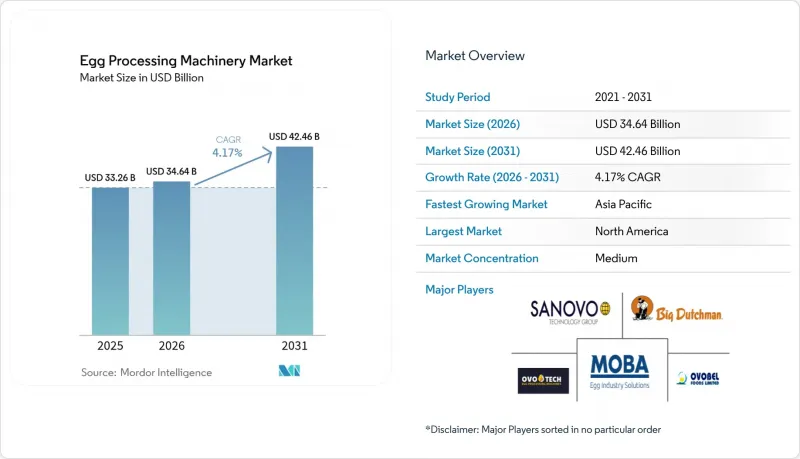
本報告按機器類型(雞蛋破碎機、蛋黃分離機等)、最終產品(液態蛋等)、自動化程度(手動/小規模系統等)、最終用戶(蛋製品生產商、烘焙/糖果加工商等)和地區(北美、歐洲、亞太地區等)對行業進行細分。市場預測以美元計價。
全球蛋品加工機械市場趨勢與洞察
對加工蛋製品和便利商店蛋製品的需求不斷成長
消費者偏好轉向即食產品和保存期限長的蛋白質來源,推動了對傳統液態蛋應用之外的先進加工技術的持續需求。 Cal-Maine公司於2025年以2.58億美元收購Echo Lake Foods,凸顯了高價值蛋製品的戰略重要性。這些產品利潤豐厚,但需要精密專業的加工設備。隨著製造商尋求能夠生產創新產品的系統,例如蛋餅、已烹調煎蛋捲和強化蛋白質的簡便食品,這一趨勢正在加速加工設備的更新換代。這些產品需要精確的溫度控制和嚴格的污染預防措施,因此先進的設備至關重要。均質機和噴霧乾燥機尤其受益於此轉變,因為這些技術對於實現簡便食品食品所需的質地調整和延長保存期限至關重要。為了保持競爭力,設備製造商現在需要設計一個能夠在單一生產線上處理多種產品形式的系統。這些要求增加了生產系統的複雜性和資本密集度,與傳統的單一產品設備相比,對生產標準提出了更高的要求。不斷變化的市場動態凸顯了加工技術創新和適應性的必要性,以滿足消費者對多樣化、高品質簡便食品日益成長的需求。
人們越來越關注食品安全和衛生標準
監管執法正從定期檢查轉向持續監控,這對機器設計規範和操作規程產生了重大影響。美國食品藥物管理局 (FDA) 修訂的《雞蛋食品藥物管理局計劃標準》(ERPS) 為州與聯邦之間的合作建立了一個強力的框架,從而導致檢查頻率更高、數據報告要求更嚴格。這種轉變推動了配備內建監控系統、自動化清潔技術和即時數據採集功能的先進機械的普及,從而在確保合規性的同時,最大限度地減少人工干預。此外,美國農業部 (USDA) 開發的射頻 (RF) 滅菌技術僅需 24 分鐘即可實現 99.999% 的沙門氏菌去除率,比傳統的 57 分鐘製程快得多。這顯示監管要求正在加速技術進步。能夠無縫整合這些創新安全技術並保持營運效率的供應商將處於競爭優勢地位。在監管合規成本對盈利影響日益顯著的市場中,這些技術進步對於維持市場領先地位和滿足不斷變化的安全標準至關重要。
加工機械的大量初始資本投入
機械設備資金籌措方面的技術進步正日益惠及大規模加工企業,而小規模企業在現代化改造方面卻面臨諸多挑戰。在資金籌措管道仍然有限的新興市場,這些挑戰尤其突出。全自動雞蛋加工生產線需要超過1000萬美元的巨額資本投資才能全面部署,凸顯了小規模企業面臨的融資障礙。為了解決這些限制因素,印度政府已根據生產連結獎勵計畫計畫(PLIS)撥款1.44億美元,用於支持食品加工產業在2025年前的發展,這表明需要政策主導的干預措施。資金籌措缺口也為設備即服務(EaaS)模式和模組化系統等替代解決方案創造了機遇,這些方案可以實現分階段部署。然而,這些方法往往無法達到完全整合機械設備的營運效率。因此,資金緊張的加工企業往往會推遲設備升級,從而面臨更高的風險,例如不合規和競爭劣勢。隨著時間的推移,這些風險可能會加劇,最終導致市場佔有率下降和市場細分。
細分市場分析
到2025年,雞蛋破碎機將佔據29.45%的顯著市場佔有率,鞏固其作為下游加工基石的地位。這一主導地位源於其將帶殼雞蛋轉化為液態雞蛋這一關鍵功能,這是後續增值加工的重要步驟。因此,雞蛋破碎機已成為工業基礎設施中不可或缺的一部分。由於機器磨損和嚴格的衛生設計規範,該領域對新舊機器的需求穩定成長。製造商正積極開發先進的雞蛋破碎系統,這些系統整合了自動蛋殼分離和品質檢測功能。這些創新技術不僅最大限度地降低了污染風險,還提高了生產效率並確保了性能穩定性。即使在其他機械領域技術不斷進步的情況下,雞蛋破碎機仍能保持市場領先地位,凸顯了該產業對機械加工解決方案的依賴。
均質機是成長最快的機械設備類別,預計到2031年複合年成長率將達到6.18%。這一成長主要得益於液態蛋應用中對產品品質均勻性和延長保存期限的需求不斷成長。 Moba的空化均質技術是該領域值得關注的創新,它能夠實現更溫和的均質過程。與傳統的高壓系統相比,該技術透過延長滅菌器的運作和降低營運成本,顯著提高了效率。該領域的快速成長反映了業界對均質品質在決定最終產品性能方面所起關鍵作用的認可,尤其是在烘焙和食品服務領域。現代均質機與滅菌系統無縫整合,在最佳化熱處理的同時,確保產品品質。這種技術整合提高了整體加工效率,使均質機成為現代蛋品生產線中不可或缺的組件。在這些生產線中,維持產品品質和營運效率是獲得競爭優勢的關鍵。
預計到2025年,液態蛋將佔45.98%的市場佔有率,2031年複合年成長率(CAGR)預計為6.92%。這一成長凸顯了液態蛋在餐飲服務業、烘焙和工業應用領域的廣泛用途,在這些領域,穩定的品質和便利的操作至關重要。液態蛋能夠滿足眾多終端用戶的需求,並能為加工商帶來更高的營運效率,例如與蛋殼相比,其儲存、運輸和庫存管理更加簡便,因此推動了市場成長。諸如「人工水奈米結構(EWNS)」等技術進步,在蛋殼滅菌過程中可實現97.6%的大腸桿菌去活化率,進一步提升了液態蛋的安全性和品質,同時保持了其天然的保護特性。此外,先進的加工系統整合了即時品質監控和自動污染檢測功能,以確保產品規格的一致性。這個市場主導地位反映了食品業對標準化原料日益成長的需求,這些原料能夠實現可預測和高效的生產流程。
此外,液態蛋正憑藉其加工優勢,拓展至簡便食品、蛋白質補充劑和功能性食品配料等新領域。美國農業部 (USDA) 開發的高頻滅菌技術,只需 24 分鐘即可將沙門氏菌減少 99.999%,而傳統滅菌工藝則需要 57 分鐘,這透過提高安全性並縮短加工時間,為液態蛋的應用開闢了新的可能性。為該領域提供支援的設備製造商正經歷持續的需求成長,同時也面臨越來越大的壓力,需要開發能夠滿足特殊配方和長期儲存要求的系統。在持續的技術創新和新應用領域的多元化發展推動下,液態蛋正處於強勁的成長軌道,預計市場規模將繼續擴大。
區域分析
到2025年,北美將佔據30.88%的市場。這得歸功於先進的食品加工基礎設施和嚴格的法規結構,這些因素推動了機械設備的持續現代化。該地區受益於自動化技術的廣泛應用以及消費者對簡便食品的強烈偏好。然而,由於市場趨於成熟,其成長潛力與新興地區相比受到限制。供應鏈中斷帶來機會的一個顯著例子是美國決定在2025年從土耳其進口4.2億枚雞蛋,以應對高致病性禽流感(HPAI)疫情造成的雞蛋短缺。據美國雞蛋委員會稱,儘管美國每年生產超過75億枚雞蛋,但土耳其仍然是美國唯一的雞蛋進口國。這種情況凸顯了對能夠處理來自不同來源、品質標準各異的原料的高度適應性加工系統的需求日益成長。
亞太地區被定位為成長最快的地區,預計到2031年複合年成長率將達到7.22%。這一成長主要得益於快速的都市化、蛋白質消費量的成長以及政府主導的旨在實現食品加工業現代化的各項舉措。印度的食品加工業在2000年4月至2024年3月期間吸引了125.8億美元的外國直接投資(FDI),這充分展現了該地區的投資吸引力和成長潛力。在中國,農產品貿易趨勢,例如2025年初拒絕進口154種美國食品,凸顯了中國對強大的國內加工能力和嚴格的品管系統的迫切需求。該地區的擴張為能夠調整技術以滿足當地偏好、監管要求和成本效益需求的機械供應商帶來了巨大的機會。
在歐洲,受嚴格的監管合規和永續性要求的推動,市場需求仍然強勁。相較之下,南美、中東和非洲地區雖然湧現出新的機遇,但基礎設施不足和資金籌措制約了成長。這些區域差異反映了經濟發展階段和食品加工業成熟度的差異。這也為機械供應商提供了機遇,他們可以實施針對特定區域的策略,並提供量身定做的資金籌措方案,以滿足當地市場的需求。
其他好處
- Excel格式的市場預測(ME)表
- 3個月的分析師支持
目錄
第1章:引言
- 研究假設和市場定義
- 調查範圍
第2章:調查方法
第3章執行摘要
第4章 市場狀況
- 市場概覽
- 市場促進因素
- 對加工蛋製品和便利商店蛋製品的需求不斷成長
- 人們越來越關注食品安全和衛生標準
- 引入自動化和智慧處理技術
- 高蛋白飲食和功能性食品越來越受歡迎。
- 雞蛋收集機的技術進步
- 用於放養雞蛋生產的模組化農場消毒系統的出現。
- 市場限制因素
- 加工機械的大量初始資本投入
- 中小企業採用率有限
- 蛋品加工廢棄物引發的環境問題
- 與植物來源雞蛋替代品的競爭
- 供應鏈分析
- 監理情勢
- 波特五力分析
第5章 市場規模與成長預測
- 按機器類型
- 破蛋機
- 蛋黃分離器
- 消毒器
- 均質機
- 噴霧乾燥器
- 離心分離器和過濾器
- 其他類型的機器(煮沸線、冷卻線和去皮線)
- 最終產品
- 液態蛋
- 蛋粉
- 冷凍雞蛋
- 按自動化級別
- 手動/小規模系統
- 半自動
- 全自動
- 最終用戶
- 蛋製品生產商
- 麵包和糖果製造商
- 營養補充品和蛋白質原料生產商
- 其他
- 按地區
- 北美洲
- 美國
- 加拿大
- 墨西哥
- 其他北美國家
- 南美洲
- 巴西
- 阿根廷
- 哥倫比亞
- 智利
- 秘魯
- 其他南美國家
- 歐洲
- 德國
- 英國
- 義大利
- 法國
- 荷蘭
- 波蘭
- 比利時
- 瑞典
- 其他歐洲國家
- 亞太地區
- 中國
- 印度
- 日本
- 澳洲
- 印尼
- 韓國
- 泰國
- 新加坡
- 其他亞太國家
- 中東和非洲
- 南非
- 沙烏地阿拉伯
- 阿拉伯聯合大公國
- 奈及利亞
- 埃及
- 摩洛哥
- 土耳其
- 其他中東和非洲國家
- 北美洲
第6章 競爭情勢
- 市場集中度
- 策略趨勢
- 市場定位分析
- 公司簡介
- Sanovo Technology Group
- Moba Group
- Ovobel Foods Limited
- OVO-TECH Sp. z oo
- Big Dutchman AG
- Dion Ltd
- OVOCONCEPT
- Ecat-iD Technology
- Palamatic Process SAS
- Egg Machines Inc.
- HCS Enterprises
- Paul Mueller Company
- NABEL Co.,Ltd.
- National Poultry Equipment
- Kyowa machinery
- Damtech
- Vencomatic Group
- OVORIDER DWC-LLC-DMCC
- Zhengzhou Wenming Machinery Co,. Ltd
- Hightop
第7章 市場機會與未來展望
According to Mordor Intelligence, the egg processing equipment market size is expected to grow from USD 33.26 billion in 2025 to USD 34.64 billion in 2026 and is forecast to reach USD 42.46 billion by 2031 at 4.17% CAGR over 2026-2031.
This report Segments the Industry by Machine Type (Egg Breakers, Egg Separators, and More); End Product (Liquid Eggs, and More); Automation Level (Manual/Small-Scale Systems, and More); End User (Egg Product Manufacturers, Bakery and Confectionery Processors, and More); and Geography (North America, Europe, Asia-Pacific, and More). The Market Forecasts are Provided in Terms of Value (USD).
Global Egg Processing Machinery Market Trends and Insights
Rising demand for processed and convenience egg products
Shifting consumer preferences toward ready-to-eat and shelf-stable protein sources are driving sustained demand for advanced processing technologies that surpass traditional liquid egg applications. The acquisition of Echo Lake Foods by Cal-Maine for USD 258 million in 2025 highlights the strategic importance of value-added egg products, which offer higher profit margins but require advanced and specialized processing equipment. This trend is accelerating the replacement cycles for processing equipment, as manufacturers seek systems capable of producing innovative products such as egg bites, pre-cooked omelets, and protein-enriched convenience foods. These products demand precise temperature control and robust contamination prevention measures, making advanced equipment essential. The homogenizer and spray dryer segments are particularly benefiting from this shift, as these technologies are critical for achieving the texture modifications and extended shelf life required by convenience food applications. To remain competitive, equipment manufacturers must now design systems that can handle multiple product formats on a single production line. This requirement is increasing both the complexity and capital intensity of production systems, setting a higher standard compared to traditional single-product equipment. The evolving market dynamics underscore the need for innovation and adaptability in processing technologies to meet the growing demand for diverse, high-quality convenience food products.
Increasing focus on food safety and hygiene standards
Regulatory enforcement is evolving from periodic inspections to continuous monitoring, creating a profound impact on equipment design specifications and operational protocols. The FDA's updated Egg Regulatory Program Standards (ERPS) establish robust frameworks for state-federal collaboration, leading to more frequent inspections and stricter data reporting mandates. This shift is driving the adoption of advanced equipment featuring embedded monitoring systems, automated cleaning technologies, and real-time data capture capabilities, which ensure compliance with minimal manual intervention. Additionally, the USDA's development of Radio Frequency (RF) pasteurization technology, which achieves a 99.999% reduction in Salmonella in just 24 minutes-significantly faster than the traditional 57-minute process-demonstrates how regulatory requirements are accelerating technological advancements. Suppliers that can seamlessly integrate these innovative safety technologies while maintaining operational efficiency are positioned to gain a competitive edge. In markets where regulatory compliance costs increasingly influence profitability, such advancements are becoming critical for sustaining market leadership and meeting evolving safety standards.
High initial capital investment in processing equipment
Technological advancements in equipment financing are increasingly benefiting large processors, while smaller operations face growing challenges to modernization. These challenges are particularly pronounced in emerging markets, where access to financing remains constrained. Fully automated egg processing lines, which require significant capital investment exceeding USD 10 million for comprehensive installations, highlight the financial barriers smaller players encounter. To address such constraints, the Indian government has allocated USD 144 million in 2025 under its Production Linked Incentive Scheme for food processing, signaling the need for policy-driven interventions. The financing gap has also opened opportunities for alternative solutions, such as equipment-as-a-service models and modular systems, which enable incremental deployment. However, these approaches often fall short in delivering the operational efficiency of fully integrated installations. Consequently, processors with limited capital frequently delay equipment upgrades, exposing themselves to heightened risks of regulatory non-compliance and competitive disadvantages. Over time, these vulnerabilities can escalate, leading to potential market share erosion and further segmentation within the market.
Other drivers and restraints analyzed in the detailed report include:
- Adoption of automation and smart processing technologies
- Rising popularity of protein-rich diets and functional foods
- Limited adoption in small- and medium-sized enterprises
For complete list of drivers and restraints, kindly check the Table Of Contents.
Segment Analysis
In 2025, egg breakers captured a significant 29.45% share of the market, solidifying their role as the cornerstone of downstream processing operations. This dominance stems from the essential function of converting shell eggs into liquid form, a critical step before any value-added processing can take place. As a result, egg breakers are fundamental to the industry's infrastructure. The segment benefits from steady replacement demand, driven by equipment wear and compliance with stringent sanitary design regulations. Manufacturers have responded by developing advanced breaking systems that incorporate automated shell separation and quality inspection features. These innovations not only minimize contamination risks but also enhance yield efficiency, ensuring consistent performance. The sustained market leadership of egg breakers highlights the industry's reliance on mechanical processing solutions, even as other equipment categories experience technological advancements.
Homogenizers are positioned as the fastest-growing machine category, with a projected CAGR of 6.18% through 2031. This growth is propelled by increasing demand for uniform product consistency and extended shelf life in liquid egg applications. A notable example of innovation in this segment is Moba's cavitation homogenizing technology, which enables gentler homogenization processes. This technology extends pasteurizer run times and reduces operational costs compared to traditional high-pressure systems, offering significant efficiency gains. The rapid growth of this segment reflects the industry's recognition of the critical role homogenization quality plays in determining the performance of final products, particularly in bakery and food service applications. Modern homogenizers now integrate seamlessly with pasteurization systems, optimizing thermal treatments while preserving product integrity. This technological convergence enhances overall processing efficiency and positions homogenizers as indispensable components in contemporary egg processing lines, where maintaining product quality and operational efficiency is key to achieving a competitive advantage.
In 2025, liquid eggs captured a significant 45.98% share of the market, with a projected CAGR of 6.92% through 2031. This growth highlights their versatility across food services, bakeries, and industrial applications, where consistent quality and ease of handling are critical. The segment's dominance is driven by its ability to meet the needs of multiple end-user categories while offering processors operational efficiencies, such as simplified storage, transportation, and inventory management compared to shell eggs. Technological advancements, such as engineered water nanostructures (EWNS) achieving a 97.6% E. coli inactivation rate for eggshell decontamination, have further enhanced the safety and quality of liquid eggs while preserving their natural protective properties. Additionally, advanced processing systems now integrate real-time quality monitoring and automated contamination detection, ensuring consistent product specifications. This market leadership reflects the food industry's growing preference for standardized ingredients that enable predictable and efficient manufacturing processes.
Liquid eggs are also expanding into emerging applications, including convenience foods, protein supplements, and functional food ingredients, leveraging their processing advantages. The USDA's development of Radio Frequency pasteurization technology, which reduces Salmonella by 99.999% in just 24 minutes compared to the traditional 57-minute process, has opened new opportunities for liquid egg applications by improving safety and reducing processing time. Equipment manufacturers supporting this segment are experiencing sustained demand growth but face increasing pressure to develop systems capable of handling specialized formulations and meeting extended shelf-life requirements. With a strong growth trajectory, liquid eggs are expected to continue their market expansion, driven by ongoing technological innovations and diversification into new applications.
Complete Report Scope:
- By Machine Type
- Egg Breakers
- Egg Separators
- Pasteurizers
- Homogenizers
- Spray Dryers
- Centrifuges and Filters
- Other Machine Type (Boiling/Cooling/Peeling Lines)
- By End Product
- Liquid Eggs
- Powdered Eggs
- Frozen Eggs
- By Automation Level
- Manual/Small-Scale Systems
- Semi-Automated
- Fully Automated
- By End User
- Egg Product Manufacturers
- Bakery and Confectionery Processors
- Nutraceutical and Protein Ingredient Firms
- Other End Users
- By Geography
- North America
- United States
- Canada
- Mexico
- Rest of North America
- South America
- Brazil
- Argentina
- Colombia
- Chile
- Peru
- Rest of South America
- Europe
- Germany
- United Kingdom
- Italy
- France
- Netherlands
- Poland
- Belgium
- Sweden
- Rest of Europe
- Asia-Pacific
- China
- India
- Japan
- Australia
- Indonesia
- South Korea
- Thailand
- Singapore
- Rest of Asia-Pacific
- Middle East and Africa
- South Africa
- Saudi Arabia
- United Arab Emirates
- Nigeria
- Egypt
- Morocco
- Turkey
- Rest of Middle East and Africa
- North America
Geography Analysis
In 2025, North America holds a 30.88% market share, supported by its advanced food processing infrastructure and stringent regulatory frameworks that drive continuous equipment modernization. The region benefits from widespread automation adoption and a strong preference for convenience foods. However, market maturity limits its growth potential compared to emerging regions. A notable example of supply chain disruptions creating opportunities is the U.S. decision to import 420 million eggs from Turkey in 2025 to address shortages caused by HPAI outbreaks. Turkey remains the only country from which the U.S. imports eggs, despite the U.S. producing over 7.5 billion eggs annually, as per the American Egg Board. This scenario highlights the increasing demand for adaptable processing systems capable of handling inputs from diverse sources with varying quality standards.
Asia-Pacific is positioned as the fastest-growing region, with a projected CAGR of 7.22% through 2031. This growth is driven by rapid urbanization, increasing protein consumption, and government-led initiatives aimed at modernizing food processing industries. India's food processing sector, which attracted USD 12.58 billion in FDI between April 2000 and March 2024, exemplifies the region's investment appeal and growth potential In China, agricultural trade dynamics, such as the rejection of 154 U.S. food shipments in early 2025, underscore the critical need for robust domestic processing capabilities and stringent quality control systems. The region's expansion creates significant opportunities for equipment suppliers who can adapt technologies to meet local preferences, regulatory requirements, and cost-efficiency demands.
Europe continues to exhibit steady demand, driven by strict regulatory compliance and sustainability mandates. In contrast, South America and the Middle East & Africa present emerging opportunities, albeit with growth constrained by infrastructure deficits and limited capital availability. These geographic disparities reflect varying stages of economic development and food processing industry maturity. They also highlight opportunities for equipment suppliers to implement region-specific strategies and offer financing solutions tailored to local market needs.
- Sanovo Technology Group
- Moba Group
- Ovobel Foods Limited
- OVO-TECH Sp. z o.o.
- Big Dutchman AG
- Dion Ltd
- OVOCONCEPT
- Ecat-iD Technology
- Palamatic Process SAS
- Egg Machines Inc.
- HCS Enterprises
- Paul Mueller Company
- NABEL Co.,Ltd.
- National Poultry Equipment
- Kyowa machinery
- Damtech
- Vencomatic Group
- OVORIDER DWC-LLC-DMCC
- Zhengzhou Wenming Machinery Co,. Ltd
- Hightop
Additional Benefits:
- The market estimate (ME) sheet in Excel format
- 3 months of analyst support
TABLE OF CONTENTS
1 INTRODUCTION
- 1.1 Study Assumptions and Market Definition
- 1.2 Scope of the Study
2 RESEARCH METHODOLOGY
3 EXECUTIVE SUMMARY
4 MARKET LANDSCAPE
- 4.1 Market Overview
- 4.2 Market Drivers
- 4.2.1 Rising demand for processed and convenience egg products
- 4.2.2 Increasing focus on food safety and hygiene standards
- 4.2.3 Adoption of automation and smart processing technologies
- 4.2.4 Rising popularity of protein-rich diets and functional foods
- 4.2.5 Technological advancements in egg processing machinery
- 4.2.6 Emergence of on-farm modular pasteurization systems for cage-free egg production
- 4.3 Market Restraints
- 4.3.1 High initial capital investment in processing equipment
- 4.3.2 Limited adoption in small- and medium-sized enterprises
- 4.3.3 Environmental concerns over egg processing waste
- 4.3.4 Competition from plant-based egg substitutes
- 4.4 Supply Chain Analysis
- 4.5 Regulatory Landscape
- 4.6 Porter's Five Forces Analysis
- 4.6.1 Threat of New Entrants
- 4.6.2 Bargaining Power of Buyers
- 4.6.3 Bargaining Power of Suppliers
- 4.6.4 Threat of Substitute Products
- 4.6.5 Intensity of Competitive Rivalry
5 MARKET SIZE AND GROWTH FORECASTS (VALUE)
- 5.1 By Machine Type
- 5.1.1 Egg Breakers
- 5.1.2 Egg Separators
- 5.1.3 Pasteurizers
- 5.1.4 Homogenizers
- 5.1.5 Spray Dryers
- 5.1.6 Centrifuges and Filters
- 5.1.7 Other Machine Type (Boiling/Cooling/Peeling Lines)
- 5.2 By End Product
- 5.2.1 Liquid Eggs
- 5.2.2 Powdered Eggs
- 5.2.3 Frozen Eggs
- 5.3 By Automation Level
- 5.3.1 Manual/Small-Scale Systems
- 5.3.2 Semi-Automated
- 5.3.3 Fully Automated
- 5.4 By End User
- 5.4.1 Egg Product Manufacturers
- 5.4.2 Bakery and Confectionery Processors
- 5.4.3 Nutraceutical and Protein Ingredient Firms
- 5.4.4 Other End Users
- 5.5 By Geography
- 5.5.1 North America
- 5.5.1.1 United States
- 5.5.1.2 Canada
- 5.5.1.3 Mexico
- 5.5.1.4 Rest of North America
- 5.5.2 South America
- 5.5.2.1 Brazil
- 5.5.2.2 Argentina
- 5.5.2.3 Colombia
- 5.5.2.4 Chile
- 5.5.2.5 Peru
- 5.5.2.6 Rest of South America
- 5.5.3 Europe
- 5.5.3.1 Germany
- 5.5.3.2 United Kingdom
- 5.5.3.3 Italy
- 5.5.3.4 France
- 5.5.3.5 Netherlands
- 5.5.3.6 Poland
- 5.5.3.7 Belgium
- 5.5.3.8 Sweden
- 5.5.3.9 Rest of Europe
- 5.5.4 Asia-Pacific
- 5.5.4.1 China
- 5.5.4.2 India
- 5.5.4.3 Japan
- 5.5.4.4 Australia
- 5.5.4.5 Indonesia
- 5.5.4.6 South Korea
- 5.5.4.7 Thailand
- 5.5.4.8 Singapore
- 5.5.4.9 Rest of Asia-Pacific
- 5.5.5 Middle East and Africa
- 5.5.5.1 South Africa
- 5.5.5.2 Saudi Arabia
- 5.5.5.3 United Arab Emirates
- 5.5.5.4 Nigeria
- 5.5.5.5 Egypt
- 5.5.5.6 Morocco
- 5.5.5.7 Turkey
- 5.5.5.8 Rest of Middle East and Africa
- 5.5.1 North America
6 COMPETITIVE LANDSCAPE
- 6.1 Market Concentration
- 6.2 Strategic Moves
- 6.3 Market Positioning Analysis
- 6.4 Company Profiles (Includes Global-level Overview, Market-level Overview, Core Segments, Financials, Strategic Info, Market Rank/Share, Products and Services, Recent Developments)
- 6.4.1 Sanovo Technology Group
- 6.4.2 Moba Group
- 6.4.3 Ovobel Foods Limited
- 6.4.4 OVO-TECH Sp. z o.o.
- 6.4.5 Big Dutchman AG
- 6.4.6 Dion Ltd
- 6.4.7 OVOCONCEPT
- 6.4.8 Ecat-iD Technology
- 6.4.9 Palamatic Process SAS
- 6.4.10 Egg Machines Inc.
- 6.4.11 HCS Enterprises
- 6.4.12 Paul Mueller Company
- 6.4.13 NABEL Co.,Ltd.
- 6.4.14 National Poultry Equipment
- 6.4.15 Kyowa machinery
- 6.4.16 Damtech
- 6.4.17 Vencomatic Group
- 6.4.18 OVORIDER DWC-LLC-DMCC
- 6.4.19 Zhengzhou Wenming Machinery Co,. Ltd
- 6.4.20 Hightop
7 MARKET OPPORTUNITIES AND FUTURE OUTLOOK

 全球雞蛋加工機械市場(2026-2030 年)
 碾米機械:市場佔有率分析、產業趨勢與統計、成長預測(2026-2031)蔬果加工設備:市場佔有率分析、產業趨勢與統計、成長預測(2026-2031)
 蔬果加工設備市場報告:趨勢、預測及競爭分析(至2035年)蛋品加工機械市場報告:趨勢、預測與競爭分析(至2035年)
 工業蒸汽去皮機市場-2026-2032年全球市場預測工業食品研磨機市場-全球市場預測(2026-2032年)熱食加工設備市場-全球市場預測(2026-2032年)食品加工與包裝設備市場-2026-2032年全球市場預測食品飲料加工設備市場:2026-2032年全球市場預測(依設備類型、運作模式、技術、自動化程度及最終用途分類)