


 |
市場調查報告書
商品編碼
2121816
力感測器:市場佔有率分析、產業趨勢與統計、成長預測(2026-2031)Force Sensors - Market Share Analysis, Industry Trends & Statistics, Growth Forecasts (2026 - 2031) |
||||||

※ 本網頁內容可能與最新版本有所差異。詳細情況請與我們聯繫。
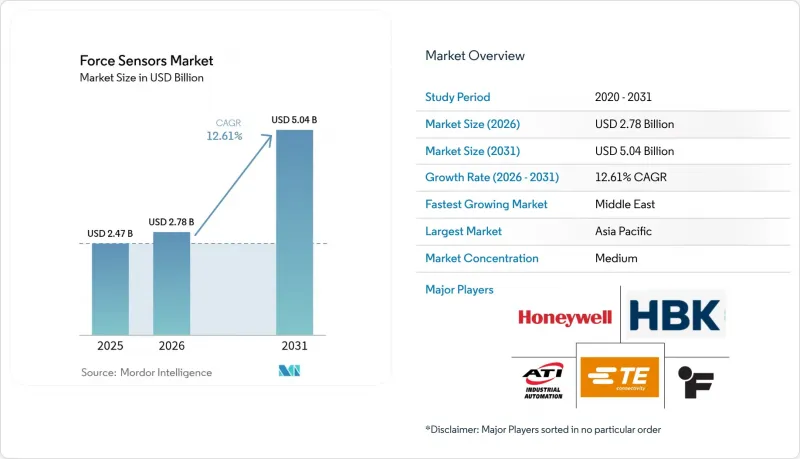
據 Mordor Intelligence 稱,2025 年力感測器市場價值為 24.7 億美元,預計到 2031 年將達到 50.4 億美元,而 2026 年為 27.8 億美元,預測期(2026-2031 年)的複合年成長率為 12.61%。
本報告按類型(張力感測器、壓力感測器、其他)、技術(應變式力感測器、荷重元式力感測器、其他)、終端用戶產業(醫療保健、工業製造、其他)、力測量範圍(微載≤10N、低載荷10N–1kN、其他)、應用(南美製程監控、檢測與測量、機器人自動化、結構監控載重10N–1kN、其他)、應用(南美洲製程監控、檢測與測量、機器人結構、結構監控載重10N–1kN、其他)、應用(南美洲製程監控、檢測與測量、機器人結構、結構監控載重10N–1kN、其他)、應用(南美洲製程監控、檢測與測量市場預測以美元計價。
全球力感測器市場趨勢及洞察
消費性電子領域的創新
智慧型手機和穿戴式裝置如今在顯示器和鉸鏈下方整合了微力感測器層,取代了機械按鈕,並實現了情境感應式手勢控制。在折疊式設備中,鉸鏈上的感測器陣列會將折疊式角度和結構應力報告給設計團隊,從而提高品質保證分析的準確性。遊戲機採用壓電觸發器,使用戶能夠根據遊戲操作體驗不同的阻力。健身追蹤器測量手腕和胸部的地面反作用力,將實驗室層級的步態分析功能帶入消費級設備。這些需求要求供應商採用卷對捲製程印刷厚度小於1毫米的電容式陣列,這需要投資建造精密雷射圖形化生產線。
車輛電氣化和ADAS整合方面的進展
在電動車電池生產線上,每個工作站都安裝了力道感測器,以防止電池變形,從而避免縮短電池循環壽命。在自動導引車(AGV)中,搬運托盤時施加的力被限制在5牛頓以內,以防止機殼出現微小裂縫。轉向柱和煞車踏板中的荷重元感測器分析駕駛員的意圖,從而實現駕駛員與高級駕駛輔助系統(ADAS)之間更平穩的操作切換,這些操作均受到安全機構的監控。在高速碰撞檢查室中,碰撞動力學以10kHz的頻率記錄,並使用亞毫秒數據透過有限元素分析進行檢驗。座椅佔用偵測墊可區分兒童安全座椅和行李,以最佳化安全氣囊的展開力。同時,在電池溫度控管板中,採用壓縮監控來確保整個電池陣列的均勻冷卻。
主要原物料價格波動
用於壓電感測器的鋯鈦酸鉛陶瓷在2024年經歷了18%的價格波動,原因是稀土元素氧化物出口配額的實施;而由於印尼的供應瓶頸,鎳鉻合金的價格波動了14%。汽車和航太領域的固定價格合約迫使供應商要么承受利潤率的劇烈變化,要么在周期中期重新談判,導致新認證的延遲。沒有避險計畫的中小型製造商受到的衝擊最大,它們面臨研發資金因季度虧損而受到威脅的風險。歐盟推動無鉛陶瓷的舉措加劇了不確定性,因為它要求使用壓電係數更低的替代材料,這導致感測器面積增大,與消費者追求小型化的目標相衝突。
細分市場分析
預計到2025年,拉伸和壓縮感測器類別的銷售額將佔總銷售額的44.78%,年複合成長率(CAGR)為6.62%,主要得益於製造商將液壓支架升級為數位式稱重荷重元,從而鞏固其在力感測器市場的主導地位。雙模技術的通用性縮短了維護訓練週期,減少了庫存,推動了其在防撞護欄、結構監測和通用檢測設備等領域的應用。供應商正在部署模組化平台,只需更換安裝套件而非整個組件,從而降低了整體擁有成本(TCO)。
校準服務現已涵蓋高達 500kN 的雙向標準,這反映了市場對拉伸和壓縮方向單感測器檢驗的需求。此外,數位孿生技術的普及也增加了對雙向載重高精度數據的需求,從而推動了具備機載診斷功能的智慧雙模單元出貨量的增加。簡化的庫存管理對於產品頻繁更換的契約製造製造商尤其有利。
預計到2025年,應變式感測器將佔總銷售額的39.92%。這得益於數十年來技術的不斷改進,使得低容量型號的成本降至50美元以下,使其成為力感測器市場的中堅力量。壓電感測器憑藉其10kHz的頻寬,能夠捕捉航太領域和碰撞測試實驗室所需的毫秒級衝擊事件,因此成長最為迅速,複合年成長率高達7.71%。電容式陣列則應用於超薄觸控介面,而混合封裝技術則將靜態預載和高頻資料整合到單一裝置中。
應變式稱重荷重元製造商正在整合 EtherCAT 和 Wi-Fi 模組,將被動元件轉變為智慧節點,以便在漂移超過可接受限值之前向用戶發出警告。壓電供應商正在擴建其無塵室,用於生產半導體處理中所需的 Microforce 晶片,因為亞牛頓級解析度和污染控制至關重要。混合式設計方案旨在透過將靜態和動態感測整合到單一外殼中,實現渦輪葉片監測。
區域分析
到2025年,亞太地區銷售額佔比將達到35.22%,這主要得益於中國電子產品生產、日本精密機械出口以及韓國電池生產線的蓬勃發展。中國部署的機器人數量已達27.6萬台,其中24%的交付配備了力感測器,這反映了中國對軟性自動化領域的投資。日本供應商正利用其在汽車應變計方面的專業技術,為折疊式智慧型手機和穿戴式健康設備生產超薄應變計陣列。在韓國電池工廠,微力感測器陣列應用於鋰離子電池的插入過程的每個階段,以保護電池。在印度,與生產連結獎勵計畫正在推動用於壓機監控和壓片機的感測器訂單成長。
中東地區正以7.29%的複合年成長率快速成長,沙烏地阿拉伯的工業多元化和阿拉伯聯合大公國的航太中心都已開始採用高容量荷重元進行品質保證。沙烏地阿拉伯已撥款64億美元用於汽車和國防項目,這些項目都需要用於結構檢測的感測器;而阿布達比航太中心則需要機翼載荷和引擎推力測試設備。土耳其的出口工廠正在將荷重元應用於煞車檢驗,以滿足歐盟標準;非洲也已開始部署稱重感測器,尤其是在南非的採礦業和肯亞的農業領域。
北美佔28.85%的市場佔有率,主要由航太、汽車和醫療設備產業推動,這些產業需要可追溯至國家標準化機構。美國食品藥物管理局(FDA)的510(k)計畫有利於擁有認證測試實驗室的供應商。歐洲佔23.76%的市場佔有率,其中電動車充電連接器具備位移偵測功能(符合修訂後的機械指令要求),是推動市場成長的主要因素。德國弗勞恩霍夫實驗室展示了一種自校準協作機器人感測器,可在12個月內將漂移誤差降低40%,這表明該感測器在免維護運行方面的研究進展迅速。隨著精密農業在巴西和阿根廷的興起,南美製造商正逐步將荷重元整合到播種機和收割機中。
其他好處
- Excel格式的市場預測(ME)表
- 3個月的分析師支持
目錄
第1章:引言
- 研究假設和市場定義
- 調查範圍
第2章:調查方法
第3章執行摘要
第4章 市場狀況
- 市場概覽
- 市場促進因素
- 消費性電子領域的創新
- 車輛電氣化和ADAS整合方面的進展
- 工業機器人和自動化擴展
- 智慧醫療設備和穿戴式裝置的廣泛應用。
- 用於人形機器人的六軸高力感測器的出現。
- 開發用於工業物聯網邊緣節點的自主型無線力感測器
- 市場限制因素
- 主要原物料價格波動
- 惡劣環境下的校準和長期漂移挑戰
- 知識產權限制阻礙了開放原始碼感測器模組的廣泛應用。
- 小型化多材料感測器的回收管道有限
- 宏觀經濟因素對市場的影響
- 產業價值鏈分析
- 監理情勢
- 技術展望
- 波特五力分析
第5章 市場規模與成長預測
- 按類型
- 張力感測器
- 壓縮力感測器
- 拉力和壓力感測器
- 透過技術
- 應變式力道感測器
- 荷重元式力感測器
- 壓電電力感測器
- 電容式力道感測器
- 按最終用戶行業分類
- 衛生保健
- 工業製造
- 車
- 航太/國防
- 家用電子產品
- 其他
- 力測量範圍
- 微量負載(10N 或更小)感測器
- 低負載(10N 至 1kN)感測器
- 中等負載(1kN 至 100kN)感測器
- 高負載(100kN 或以上)感測器
- 透過使用
- 流程監控
- 檢驗和測量
- 機器人自動化
- 結構完整性監測
- 按地區
- 北美洲
- 美國
- 加拿大
- 墨西哥
- 南美洲
- 巴西
- 阿根廷
- 其他南美國家
- 歐洲
- 英國
- 德國
- 法國
- 西班牙
- 義大利
- 其他歐洲國家
- 亞太地區
- 中國
- 印度
- 日本
- 澳洲
- 韓國
- 其他亞太國家
- 中東和非洲
- 中東
- 沙烏地阿拉伯
- 阿拉伯聯合大公國
- 土耳其
- 其他中東國家
- 非洲
- 南非
- 肯亞
- 其他非洲地區
- 中東
- 北美洲
第6章 競爭情勢
- 市場集中度
- 策略趨勢
- 市佔率分析
- 公司簡介
- TE Connectivity Ltd.
- Honeywell International Inc.
- Hottinger Bruel and Kjaer GmbH
- Futek Advanced Sensor Technology Inc.
- ATI Industrial Automation Inc.
- Kistler Holding AG
- Sensata Technologies Inc.
- Vishay Precision Group Inc.
- Flintec Group AB
- Alps Alpine Co. Ltd.
- Synaptics Incorporated
- Interlink Electronics Inc.
- Pressure Profile Systems Inc.
- Uneo Incorporated
- Tekscan Inc.
- Kavlico Corporation
- Tecsis GmbH
- Shenzhen New Degree Technology Co. Ltd.
- Sensel Inc.
- Tangio Printed Electronics
- NextInput Inc.
第7章 市場機會與未來展望
According to Mordor Intelligence, the force sensors market size was valued at USD 2.47 billion in 2025 and estimated to grow from USD 2.78 billion in 2026 to reach USD 5.04 billion by 2031, at a CAGR of 12.61% during the forecast period (2026-2031).
This report is Segmented by Type (Tension, Compression, and More), Technology (Strain Gauge, Load Cell, and More), End-User (Healthcare, Manufacturing, and More), Force Range (Micro <=10 N, Low 10 N-1 KN, and More), Application (Monitoring, Testing, Robotics, Structural Health), and Geography (North America, South America, Europe, and More). The Market Forecasts are Provided in Terms of Value (USD).
Global Force Sensors Market Trends and Insights
Innovation in Consumer Electronics
Smartphones and wearables now hide micro-force layers beneath displays and hinges, replacing mechanical buttons and enabling contextual gestures. Foldable handsets employ hinge-mounted arrays that report fold angle and structural stress to design teams, improving warranty analytics. Gaming consoles integrate piezoelectric triggers so users feel variable resistance aligned with game actions. Fitness trackers measure ground reaction forces from wrist or chest, bringing laboratory-grade gait analytics to consumer devices. These requirements are pushing suppliers to roll-to-roll print capacitive arrays under one millimeter thick, demanding investments in precision laser patterning lines.
Growing Automotive Electrification and ADAS Integration
Electric-vehicle battery lines mount force sensors at every workstation to avoid cell deformation that can shorten cycle life. Automated guided vehicles now keep tray-handling forces under 5 N to prevent micro-cracks in casings. Steering-column and brake-pedal load cells interpret driver intent, enabling smoother handoffs between humans and advanced driver-assistance systems monitored by safety agencies. High-speed crash labs record impact dynamics at 10 kHz, feeding sub-millisecond data into finite-element validation. Seat-occupancy mats distinguish child seats from cargo, optimizing airbag deployment force. Meanwhile, battery thermal plates rely on compressive monitoring to ensure uniform cooling across cell arrays.
Volatility in Key Raw Material Prices
Lead zirconate titanate ceramics used in piezoelectric sensors swung 18% in 2024 after export quotas on rare-earth oxides, while nickel-chromium alloy moved 14% amid Indonesian bottlenecks. Fixed-price automotive and aerospace contracts left suppliers absorbing margin shocks or forcing mid-cycle renegotiations that delayed new qualifications. Smaller producers without hedging programs were hit hardest, risking quarterly losses that jeopardized R&D funding. The EU drive toward lead-free ceramics adds uncertainty by requiring alternative materials that deliver lower piezo coefficients, forcing larger sensor footprints that clash with consumer miniaturization goals.
Other drivers and restraints analyzed in the detailed report include:
- Expansion of Industrial Robotics and Automation
- Development of Self-Powered Wireless Force Sensors for IIoT Edge Nodes
- Calibration and Long-Term Drift Challenges in Harsh Environments
For complete list of drivers and restraints, kindly check the Table Of Contents.
Segment Analysis
The tension-and-compression category held 44.78% revenue in 2025 and will grow at 6.62% CAGR as manufacturers retrofit hydraulic stands with digital load cells, confirming its commanding slice of the force sensors market size. Dual-mode versatility shortens maintenance training and reduces inventory, driving adoption in crash barriers, structural monitoring, and universal testing machines. Suppliers are rolling out modular platforms that swap mounting kits instead of entire elements, lowering total cost of ownership.
Calibration services now include bidirectional standards up to 500 kN, reflecting demand for single-sensor validation across tension and compression. Digital twins also raise the need for high-fidelity data under both load directions, boosting shipments of smart dual-mode units with on-board diagnostics. Inventory simplification is especially valuable for contract manufacturers with frequent product changeovers.
Strain-gauge sensors controlled 39.92% revenue in 2025 because decades of refinement drove cost below USD 50 for low-capacity models, yielding a durable pillar of the force sensors market. Piezoelectric designs rise fastest at 7.71% CAGR thanks to 10 kHz bandwidth that captures millisecond impact events demanded by aerospace and crash labs. Capacitive arrays serve ultra-thin touch interfaces, while hybrid packages combine static preload and high-frequency data in a single device.
Makers of strain-gauge load cells are embedding EtherCAT and Wi-Fi modules to transform passive elements into smart nodes that alert users before drift exceeds limits. Piezo vendors expand cleanrooms for micro-force chips used in semiconductor handling where sub-newton resolution and contamination control are critical. Hybrid concepts target turbine-blade monitoring by merging static and dynamic sensing within one housing.
Complete Report Scope:
- By Type
- Tension Force Sensors
- Compression Force Sensors
- Tension And Compression Force Sensors
- By Technology
- Strain Gauge Force Sensors
- Load Cell Force Sensors
- Piezoelectric Force Sensors
- Capacitive Force Sensors
- By End-User Industry
- Healthcare
- Industrial Manufacturing
- Automotive
- Aerospace And Defense
- Consumer Electronics
- Other End-User Industries
- By Force Range
- Micro-Force (<=10 N) Sensors
- Low-Force (10 N-1 kN) Sensors
- Medium-Force (1 kN-100 kN) Sensors
- High-Force (>=100 kN) Sensors
- By Application
- Process Monitoring
- Test And Measurement
- Robotics And Automation
- Structural Health Monitoring
- By Geography
- North America
- United States
- Canada
- Mexico
- South America
- Brazil
- Argentina
- Rest of South America
- Europe
- United Kingdom
- Germany
- France
- Spain
- Italy
- Rest of Europe
- Asia Pacific
- China
- India
- Japan
- Australia
- South Korea
- Rest of Asia Pacific
- Middle East and Africa
- Middle East
- Saudi Arabia
- United Arab Emirates
- Turkey
- Rest of Middle East
- Africa
- South Africa
- Kenya
- Rest of Africa
- Middle East
- North America
Geography Analysis
Asia Pacific generated 35.22% revenue in 2025, supported by China's electronics output, Japan's precision machinery exports, and South Korea's battery fabrication lines. Chinese robot installations hit 276,000 units with force options on 24% of deliveries, reflecting local investment in flexible automation. Japanese suppliers repurpose automotive strain-gauge know-how to craft ultrathin arrays for foldable phones and wearable health devices. South Korean battery plants integrate micro-force arrays at every insertion step to protect lithium-ion cells. India's production-linked incentives spur orders for press monitoring and tablet compression sensors.
The Middle East advances at 7.29% CAGR as Saudi industrial diversification and UAE aerospace hubs adopt high-capacity load cells for quality assurance. Saudi Arabia earmarked USD 6.4 billion for vehicle and defense projects that rely on structural testing sensors, while Abu Dhabi's aerospace center needs wing-load and engine-thrust rigs. Turkey's export plants embed load cells in brake validation to meet EU norms, and early African deployments appear in South African mines and Kenyan agriculture.
North America holds 28.85% share, anchored by aerospace, automotive, and medical device sectors that require traceability to national standards bodies. The FDA's 510(k) regime favors suppliers with accredited labs. Europe represents 23.76%, buoyed by EV charging connectors that include misalignment detection per revised Machinery Directive requirements. Germany's Fraunhofer Institute demonstrated self-calibrating cobot sensors that cut drift error 40% within 12 months, indicating research momentum toward maintenance-free operation. South American makers slowly integrate load cells into planters and harvesters as precision agriculture gains ground in Brazil and Argentina.
- TE Connectivity Ltd.
- Honeywell International Inc.
- Hottinger Bruel and Kjaer GmbH
- Futek Advanced Sensor Technology Inc.
- ATI Industrial Automation Inc.
- Kistler Holding AG
- Sensata Technologies Inc.
- Vishay Precision Group Inc.
- Flintec Group AB
- Alps Alpine Co. Ltd.
- Synaptics Incorporated
- Interlink Electronics Inc.
- Pressure Profile Systems Inc.
- Uneo Incorporated
- Tekscan Inc.
- Kavlico Corporation
- Tecsis GmbH
- Shenzhen New Degree Technology Co. Ltd.
- Sensel Inc.
- Tangio Printed Electronics
- NextInput Inc.
Additional Benefits:
- The market estimate (ME) sheet in Excel format
- 3 months of analyst support
TABLE OF CONTENTS
1 INTRODUCTION
- 1.1 Study Assumptions and Market Definition
- 1.2 Scope of the Study
2 RESEARCH METHODOLOGY
3 EXECUTIVE SUMMARY
4 MARKET LANDSCAPE
- 4.1 Market Overview
- 4.2 Market Drivers
- 4.2.1 Innovation And Development In The Consumer Electronics Sector
- 4.2.2 Growing Automotive Electrification And ADAS Integration
- 4.2.3 Expansion Of Industrial Robotics And Automation
- 4.2.4 Rising Adoption Of Smart Medical Devices And Wearables
- 4.2.5 Emergence Of High-Force Six-Axis Sensors For Humanoid Robots
- 4.2.6 Development Of Self-Powered Wireless Force Sensors For IIoT Edge Nodes
- 4.3 Market Restraints
- 4.3.1 Volatility In Key Raw Material Prices
- 4.3.2 Calibration And Long-Term Drift Challenges In Harsh Environments
- 4.3.3 Intellectual Property Constraints Hindering Open-Source Sensor Modules
- 4.3.4 Limited Recycling Pathways For Miniaturized Multi-Material Sensors
- 4.4 Impact of Macroeconomic Factors on the Market
- 4.5 Industry Value Chain Analysis
- 4.6 Regulatory Landscape
- 4.7 Technological Outlook
- 4.8 Porter's Five Forces Analysis
- 4.8.1 Threat of New Entrants
- 4.8.2 Bargaining Power of Buyers
- 4.8.3 Bargaining Power of Suppliers
- 4.8.4 Threat of Substitute Products
- 4.8.5 Intensity of Competitive Rivalry
5 MARKET SIZE AND GROWTH FORECASTS (VALUE)
- 5.1 By Type
- 5.1.1 Tension Force Sensors
- 5.1.2 Compression Force Sensors
- 5.1.3 Tension And Compression Force Sensors
- 5.2 By Technology
- 5.2.1 Strain Gauge Force Sensors
- 5.2.2 Load Cell Force Sensors
- 5.2.3 Piezoelectric Force Sensors
- 5.2.4 Capacitive Force Sensors
- 5.3 By End-User Industry
- 5.3.1 Healthcare
- 5.3.2 Industrial Manufacturing
- 5.3.3 Automotive
- 5.3.4 Aerospace And Defense
- 5.3.5 Consumer Electronics
- 5.3.6 Other End-User Industries
- 5.4 By Force Range
- 5.4.1 Micro-Force (<=10 N) Sensors
- 5.4.2 Low-Force (10 N-1 kN) Sensors
- 5.4.3 Medium-Force (1 kN-100 kN) Sensors
- 5.4.4 High-Force (>=100 kN) Sensors
- 5.5 By Application
- 5.5.1 Process Monitoring
- 5.5.2 Test And Measurement
- 5.5.3 Robotics And Automation
- 5.5.4 Structural Health Monitoring
- 5.6 By Geography
- 5.6.1 North America
- 5.6.1.1 United States
- 5.6.1.2 Canada
- 5.6.1.3 Mexico
- 5.6.2 South America
- 5.6.2.1 Brazil
- 5.6.2.2 Argentina
- 5.6.2.3 Rest of South America
- 5.6.3 Europe
- 5.6.3.1 United Kingdom
- 5.6.3.2 Germany
- 5.6.3.3 France
- 5.6.3.4 Spain
- 5.6.3.5 Italy
- 5.6.3.6 Rest of Europe
- 5.6.4 Asia Pacific
- 5.6.4.1 China
- 5.6.4.2 India
- 5.6.4.3 Japan
- 5.6.4.4 Australia
- 5.6.4.5 South Korea
- 5.6.4.6 Rest of Asia Pacific
- 5.6.5 Middle East and Africa
- 5.6.5.1 Middle East
- 5.6.5.1.1 Saudi Arabia
- 5.6.5.1.2 United Arab Emirates
- 5.6.5.1.3 Turkey
- 5.6.5.1.4 Rest of Middle East
- 5.6.5.2 Africa
- 5.6.5.2.1 South Africa
- 5.6.5.2.2 Kenya
- 5.6.5.2.3 Rest of Africa
- 5.6.5.1 Middle East
- 5.6.1 North America
6 COMPETITIVE LANDSCAPE
- 6.1 Market Concentration
- 6.2 Strategic Moves
- 6.3 Market Share Analysis
- 6.4 Company Profiles (includes Global Level Overview, Market Level Overview, Core Segments, Financials as available, Strategic Information, Market Rank/Share for key companies, Products and Services, and Recent Developments)
- 6.4.1 TE Connectivity Ltd.
- 6.4.2 Honeywell International Inc.
- 6.4.3 Hottinger Bruel and Kjaer GmbH
- 6.4.4 Futek Advanced Sensor Technology Inc.
- 6.4.5 ATI Industrial Automation Inc.
- 6.4.6 Kistler Holding AG
- 6.4.7 Sensata Technologies Inc.
- 6.4.8 Vishay Precision Group Inc.
- 6.4.9 Flintec Group AB
- 6.4.10 Alps Alpine Co. Ltd.
- 6.4.11 Synaptics Incorporated
- 6.4.12 Interlink Electronics Inc.
- 6.4.13 Pressure Profile Systems Inc.
- 6.4.14 Uneo Incorporated
- 6.4.15 Tekscan Inc.
- 6.4.16 Kavlico Corporation
- 6.4.17 Tecsis GmbH
- 6.4.18 Shenzhen New Degree Technology Co. Ltd.
- 6.4.19 Sensel Inc.
- 6.4.20 Tangio Printed Electronics
- 6.4.21 NextInput Inc.
7 MARKET OPPORTUNITIES AND FUTURE OUTLOOK
- 7.1 White-Space and Unmet-Need Assessment

 片材壓力感測器市場:全球市場預測,2026-2032年荷重元變送器市場:全球市場預測,2026-2032年
 機械定量感測器市場分析及預測(至2035年):按類型、產品類型、技術、組件、應用、材料類型、裝置、最終用戶、功能和安裝類型分類力感測器市場:2026-2032年全球市場預測(按感測器類型、測量範圍、安裝方式、應用和銷售管道)
 力感測器市場:策略洞察與預測(2026-2031年)
 力感測器市場報告:按感測技術、力類型、工作原理、最終用途和地區分類,2026-2034 年
 力感測器市場:按技術、應用、最終用途、汽車應用和地區分類全球力感測器市場規模、佔有率、趨勢和成長分析報告(2026-2034年)力感測器市場分析及預測(至2035年):按類型、產品、技術、組件、應用、材料類型、最終用戶、功能及安裝配置分類高精度MEMS航太應用市場分析及預測(至2035年):依類型、產品類型、服務、技術、組件、應用、材料類型、裝置、製程及最終用戶分類