


 |
市場調查報告書
商品編碼
2121809
氯化鈉:市場佔有率分析、產業趨勢與統計、成長預測(2026-2031)Sodium Chloride - Market Share Analysis, Industry Trends & Statistics, Growth Forecasts (2026 - 2031) |
||||||

※ 本網頁內容可能與最新版本有所差異。詳細情況請與我們聯繫。
據 Mordor Intelligence 稱,2025 年氯化鈉市場價值為 2.4076 億噸,預計到 2031 年將達到 3.256 億噸,而 2026 年為 2.5318 億噸,預測期(2026-2031 年)的複合年成長率為 5.16%。
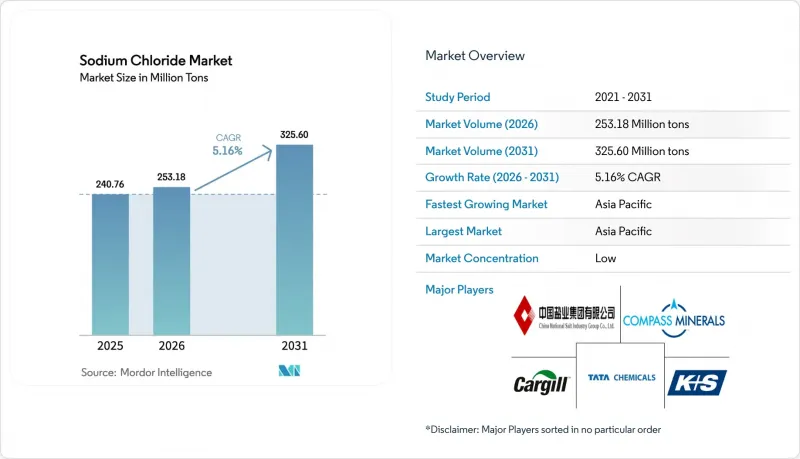
本報告按等級(岩鹽、日曬鹽、真空鹽)、應用領域(化學品製造、除冰劑、水處理、食品加工、農業、製藥及其他應用)和地區(亞太地區、北美地區、歐洲地區、南美地區以及中東和非洲地區)進行細分。市場預測以噸為單位。
全球氯化鈉市場趨勢及洞察
加工食品和飲料生產商的需求正在激增。
自願減鈉目標與包裝食品市場快速成長之間的矛盾,導致食鹽消費量激增。隨著印度和東南亞都市化進程的推進以及冷鏈覆蓋範圍的擴大,美國食品藥品監督管理局(FDA)第一階段每日3000毫克的限量標準和第二階段2300毫克的目標值尚未能有效遏制食鹽生產商的採購量。預計到2025年,印度加工食品產業將成長11%,這主要得益於即食型、保存期限長的食品,這些食品使用氯化鈉來抑制微生物生長。儘管歐洲的包裝正面標籤提高了透明度,但歐盟委員會2025年的一項審計顯示,合規率僅為58%,顯示產品配方修訂進度落後。預計到2025年,包括含電解質的運動飲料在內的飲料品類將年增14%,這得益於新的自願購買管道的出現。
透析液和靜脈輸液對藥用級氯化鈉的需求增加。
美國和澳洲監管機構在2024年記錄的供不應求凸顯了生產系統的集中化問題,目前全球僅有不到12家真空鹽生產廠。每位每週接受三次治療的患者每年大約消耗312公斤超高純度鹽,而美國和歐洲藥典標準要求純度達到99.9%或更高,並對重金屬和內毒素含量有嚴格的限制。透過引入機械蒸氣再壓縮蒸發器,將每噸鹽的能耗降低至15-25千瓦時,製造商既可以滿足這些標準,又能保持獲利能力。
推廣使用環保有機融雪劑(醋酸鹽、甲酸鹽)
斯堪的納維亞半島的機場和市政當局正逐步淘汰岩鹽,轉而使用無腐蝕性的替代品。至2024年,醋酸鉀和甲酸鈉將占美國機場除冰劑使用量的80%。北歐白天鵝生態標章將氯含量限制在每公斤100毫克以內,將促使每年有18萬噸除冰劑被醋酸鹽混合物所取代。雖然醋酸鹽的成本是岩鹽的3到5倍,但由於橋樑腐蝕的減少,其生命週期成本也隨之降低,因此總擁有成本的差異正在縮小。
細分市場分析
真空鹽的複合年成長率 (CAGR) 為 6.98%。這項需求主要由 MVR(質量體積回收)蒸發器推動,該蒸發器僅需傳統多級蒸發器三分之一的能耗即可達到 99.9% 以上的純度。岩鹽將繼續佔據主導地位,到 2025 年將佔氯化鈉市場佔有率的 42.30%。這是因為在大規模融雪合約中,低成本比極高的純度更為重要。在沿海蒸發池中生產的日曬鹽可滿足對純度要求適中的應用需求,例如紡織品染色和水軟化處理,這些應用允許存在微量的硫酸鈣殘留。
儘管岩鹽具有成本優勢(真空鹽價格為120-180美元,而礦山離岸價僅40-60美元),製藥公司和電池正極材料製造商仍需支付更高的價格,才能將雜質含量控制在10ppm以下。塔塔化工位於古吉拉突邦的年產150萬噸的工廠為當地的透析液製造商供貨,而嘉吉公司位於大鹽湖的工廠則為美國西部的食品加工商供貨。山東和江蘇兩省的太陽能鹽生產商目前正被迫在更嚴格的排放法規下處理高鹽母液,並轉向採用太陽能蒸發結晶設備,以回收溴化鎂這種產品特有的成分。雖然由於能源價格差異,真空鹽在歐洲的應用有限,但德國韋爾拉礦維修為蒸氣循環(MVR)系統後,硫酸鹽含量已降至0.2%,使其能夠競標先前無法企及的製藥合約競標。
區域分析
預計到2025年,亞太地區將佔全球產量的46.20%,年複合成長率達6.44%,主要得益於中國鈉離子電池正極材料的產能以及印度(主要產自古吉拉突邦)3,000萬噸的食鹽產量。在日本,人口老化推動了對醫藥級化學品需求的成長。同時,在韓國,膜電解式氯鹼生產線正在供應半導體級化學品。涵蓋越南和印尼的東協石化走廊的工業需求正在擴大,而新加坡的圖阿斯海水淡化廠(日處理量13.7萬立方公尺)將於2024年運作,這將增加海水處理量。
在北美,市場呈現成熟成長態勢。嚴冬期間,高速公路除冰鹽的消耗量高達2,000萬噸,但由於市政預算限制和庫存消耗, 指南針 Minerals公司2024年的除冰鹽銷量下降了6%。加州的軟水法規提高了住宅用水的需求。同時,墨西哥蒙特雷周邊地區的氯鹼產能正在擴張,以滿足近岸電子工廠的需求,預計將使2025年的原料需求增加超過80萬噸。
儘管北歐「天鵝」採購禁令限制了道路用鹽的使用,但歐洲市場仍在成長。 K+S公司斥資2,500萬歐元對其離子交換設備進行了升級,降低了硫酸鹽濃度,使其得以進入製藥業的細分市場。歐盟水框架指令強制要求實施零液體排放(ZLD),雖然這會增加生產成本,但卻能確保符合法規要求。在南美洲,紙漿和造紙業以及鋰鹵水加工商的需求正在上升。同時,中東地區越來越依賴海水淡化、氯鹼法和聚光太陽能發電(CSP)儲能。卡達已運作一座年產100萬噸的真空鹽廠,旨在2025年滿足整個沿岸地區的製藥和食品需求。
其他好處:
- Excel格式的市場預測(ME)表
- 3個月的分析師支持
目錄
第1章:引言
- 研究假設和市場定義
- 調查範圍
第2章:調查方法
第3章執行摘要
第4章 市場狀況
- 市場概覽
- 市場促進因素
- 加工食品和飲料生產商的需求激增。
- 透析和靜脈輸液中對藥用級氯化鈉的需求增加。
- 鈉基電池使用範圍的擴大
- 硬水地區的地方政府強制推行軟水措施。
- 聚光型太陽熱能發電發電廠中的熔鹽儲熱系統
- 市場限制因素
- 推廣使用環保有機融雪劑(醋酸鹽、甲酸鹽)
- 公共衛生部門致力於減少膳食鈉的攝取量
- 高鹽污水的處理有嚴格的規定。
- 價值鏈分析
- 波特五力模型
第5章 市場規模與成長預測
- 按年級
- 岩鹽
- 日曬鹽
- 真空包裝鹽
- 透過使用
- 化學產品的生產
- 除冰
- 水處理
- 食品加工
- 農業
- 製藥
- 其他用途(石油和天然氣、染色和紡織等)
- 按地區
- 亞太地區
- 中國
- 印度
- 日本
- 韓國
- 東南亞國協
- 其他亞太國家
- 北美洲
- 美國
- 加拿大
- 墨西哥
- 歐洲
- 德國
- 英國
- 法國
- 義大利
- 西班牙
- 北歐國家
- 其他歐洲國家
- 南美洲
- 巴西
- 阿根廷
- 其他南美國家
- 中東和非洲
- 沙烏地阿拉伯
- 南非
- 卡達
- 奈及利亞
- 阿拉伯聯合大公國
- 其他中東和非洲國家
- 亞太地區
第6章 競爭情勢
- 市場集中度
- 策略趨勢
- 市佔率和排名分析
- 公司簡介
- Cargill Inc.
- China National Salt Industry Corporation
- CK Life Sciences Int'l.,(Holdings)Inc.
- Compass Minerals
- Donald Brown Group(PureSalt)
- EUsalt c/o KELLEN
- GHCL Limited
- ICL
- K+S Aktiengesellschaft
- Morton Salt, Inc.
- Nouryon
- Rio Tinto
- Salins Group
- Sudwestdeutsche Salzwerke AG
- Swiss Salt Works AG
- Tata Chemicals
- Wacker Chemie AG
第7章 市場機會與未來展望
According to Mordor Intelligence, the sodium chloride market size was valued at 240.76 Million tons in 2025 and is estimated to grow from 253.18 Million tons in 2026 to reach 325.60 Million tons by 2031, at a CAGR of 5.16% during the forecast period (2026-2031).
This report is Segmented by Grade (Rock Salt, Solar Salt, and Vacuum Salt), Application (Chemical Production, De-Icing, Water Treatment, Food Processing, Agriculture, Pharmaceuticals, and Other Applications), and Geography (Asia-Pacific, North America, Europe, South America, and Middle East and Africa). The Market Forecasts are Provided in Terms of Volume (Tons).
Global Sodium Chloride Market Trends and Insights
Surging Demand from Packaged-Food and Beverage Processors
The tension between voluntary sodium-reduction targets and rapid packaged-food growth is sustaining bulk consumption. The FDA's Phase I limit of 3,000 milligrams and Phase II goal of 2,300 milligrams per day have not yet suppressed the absolute tonnage of salt bought by manufacturers as urbanization in India and Southeast Asia broadens cold-chain access. India's processed-food industry expanded 11% in 2025, with shelf-stable ready-to-eat meals using sodium chloride for microbial control. Europe's front-of-pack labeling improves transparency, but a 2025 European Commission audit showed only 58% compliance, keeping reformulation behind schedule. Beverage categories such as electrolyte sports drinks grew 14% year over year in 2025, adding another discretionary channel.
Rising Pharmaceutical-Grade NaCl Uptake for Dialysis and IV Fluids
Regulatory shortages logged by U.S. and Australian agencies in 2024 exposed concentrated production footprints that rely on fewer than a dozen vacuum-salt plants worldwide. Each patient on thrice-weekly regimens consumes roughly 312 kilograms of ultra-pure salt annually, and specifications under the U.S. Pharmacopeia and European Pharmacopoeia require more than 99.9% purity plus tight heavy-metal and endotoxin limits. Adoption of mechanical-vapor-recompression evaporators, which slash energy input to 15-25 kilowatt-hours per ton, helps producers meet these standards while defending margins.
Proliferation of Eco-Friendly Organic De-Icers (Acetates, Formates)
Airports and Nordic municipalities are shifting from rock salt to corrosion-free alternatives. Potassium acetate and sodium formate covered 80% of U.S. airfield de-icing tonnage in 2024. The Nordic Swan Ecolabel caps chlorine at 100 mg per kg, diverting 180,000 tons annually into acetate blends. Though acetates cost three to five times more than rock salt, lifecycle savings from reduced bridge corrosion are narrowing total ownership gaps.
Other drivers and restraints analyzed in the detailed report include:
- Increasing Usage of Sodium-Based Batteries
- Municipal Water-Softening Mandates in Hard-Water Regions
- Public-Health Push to Curb Dietary Sodium Intake
For complete list of drivers and restraints, kindly check the Table Of Contents.
Segment Analysis
Vacuum salt is rising at a 6.98% CAGR. Demand stems from MVR evaporators that deliver more than 99.9% purity using one-third the energy of older multi-effect units. Rock salt retained dominance with a 42.30% sodium chloride market share in 2025 because bulk de-icing contracts require low cost more than extreme purity. Solar salt from coastal evaporation ponds meets mid-purity needs in textile dyeing and water softening where minor calcium sulfate residues are tolerated.
Despite rock salt's cost edge-USD 40-60 free-on-board mine versus USD 120-180 for vacuum salt-pharmaceutical and battery cathode makers pay premiums for impurity thresholds below 10 ppm. Tata Chemicals' 1.5 million-ton plant in Gujarat supplies regional dialysate producers, while Cargill's Great Salt Lake operation feeds western U.S. food processors. Solar-salt producers in Shandong and Jiangsu must now manage hypersaline mother liquor under stricter discharge rules, nudging them toward solar-evaporation crystallizers that reclaim magnesium bromide byproducts. Energy-price disparities cap vacuum-salt rollouts in Europe, but MVR retrofits in Germany's Werra mine cut sulfate to 0.2%, enabling bids for pharma contracts previously unreachable.
Complete Report Scope:
- By Grade
- Rock Salt
- Solar Salt
- Vacuum Salt
- By Application
- Chemical Production
- De-icing
- Water Treatment
- Food Processing
- Agriculture
- Pharmaceuticals
- Other Applications (Oil and Gas, Dyeing and Textile, etc.)
- By Geography
- Asia-Pacifc
- China
- India
- Japan
- South Korea
- ASEAN Countries
- Rest of Asia-Pacific
- North America
- United States
- Canada
- Mexico
- Europe
- Germany
- United Kingdom
- France
- Italy
- Spain
- NORDIC Countries
- Rest of Europe
- South America
- Brazil
- Argentina
- Rest of South America
- Middle East and Africa
- Saudi Arabia
- South Africa
- Qatar
- Nigeria
- United Arab Emirates
- Rest of Middle East and Africa
- Asia-Pacifc
Geography Analysis
Asia-Pacific commanded 46.20% of global volume in 2025 and will advance at a 6.44% CAGR, underpinned by Chinese sodium-ion battery cathode capacity and India's 30 million-ton salt output centered in Gujarat. Japan's aging population intensifies pharmaceutical-grade demand, while South Korea's membrane-cell chlor-alkali lines supply semiconductor-grade chemicals. ASEAN petrochemical corridors in Vietnam and Indonesia expand industrial uptake, and Singapore's Tuas desalination plant, commissioned in 2024 at 137,000 m3 per day, raises brine-management volumes.
North America exhibits mature growth. Highways consumed up to 20 million tons of de-icing salt during harsh winters, but municipal budget limits and inventory drawdowns trimmed Compass Minerals' 2024 salt revenue by 6%. California water-softening ordinances add residential-level volume, while Mexico's chlor-alkali capacity around Monterrey expanded to serve near-shoring electronics plants, boosting feedstock demand by over 800,000 tons in 2025.
Europe grows as Nordic Swan procurement bans limit road-salt use. K+S's EUR 25 million ion-exchange upgrade lowered sulfate levels to penetrate pharmaceutical niches. The EU Water Framework Directive forces zero-liquid-discharge adoption, raising production costs but enabling compliance. In South America, pulp-and-paper and lithium brine processors lift needs, while the Middle East leans on desalination, chlor-alkali, and CSP storage. Qatar opened a 1 million-ton vacuum-salt plant in 2025 to backfill pharmaceutical and food demand across the Gulf.
- Cargill Inc.
- China National Salt Industry Corporation
- CK Life Sciences Int'l., (Holdings) Inc.
- Compass Minerals
- Donald Brown Group (PureSalt)
- EUsalt c/o KELLEN
- GHCL Limited
- ICL
- K+S Aktiengesellschaft
- Morton Salt, Inc.
- Nouryon
- Rio Tinto
- Salins Group
- Sudwestdeutsche Salzwerke AG
- Swiss Salt Works AG
- Tata Chemicals
- Wacker Chemie AG
Additional Benefits:
- The market estimate (ME) sheet in Excel format
- 3 months of analyst support
TABLE OF CONTENTS
1 Introduction
- 1.1 Study Assumptions and Market Definition
- 1.2 Scope of the Study
2 Research Methodology
3 Executive Summary
4 Market Landscape
- 4.1 Market Overview
- 4.2 Market Drivers
- 4.2.1 Surging Demand from Packaged-Food and Beverage Processors
- 4.2.2 Rising Pharmaceutical-Grade NaCl Uptake for Dialysis and IV Fluids
- 4.2.3 Increasing Usage of Sodium-Based Batteries
- 4.2.4 Municipal Water-Softening Mandates in Hard-Water Regions
- 4.2.5 Molten-Salt Thermal Storage in Concentrated-Solar-Power Plants
- 4.3 Market Restraints
- 4.3.1 Proliferation of Eco-Friendly Organic De-Icers (Acetates, Formates)
- 4.3.2 Public-Health Push to Curb Dietary Sodium Intake
- 4.3.3 Stringent Regulation on Hypersaline Effluent Disposal
- 4.4 Value Chain Analysis
- 4.5 Porter's Five Forces
- 4.5.1 Bargaining Power of Suppliers
- 4.5.2 Bargaining Power of Buyers
- 4.5.3 Threat of New Entrants
- 4.5.4 Threat of Substitutes
- 4.5.5 Degree of Competition
5 Market Size and Growth Forecasts (Volume)
- 5.1 By Grade
- 5.1.1 Rock Salt
- 5.1.2 Solar Salt
- 5.1.3 Vacuum Salt
- 5.2 By Application
- 5.2.1 Chemical Production
- 5.2.2 De-icing
- 5.2.3 Water Treatment
- 5.2.4 Food Processing
- 5.2.5 Agriculture
- 5.2.6 Pharmaceuticals
- 5.2.7 Other Applications (Oil and Gas, Dyeing and Textile, etc.)
- 5.3 By Geography
- 5.3.1 Asia-Pacifc
- 5.3.1.1 China
- 5.3.1.2 India
- 5.3.1.3 Japan
- 5.3.1.4 South Korea
- 5.3.1.5 ASEAN Countries
- 5.3.1.6 Rest of Asia-Pacific
- 5.3.2 North America
- 5.3.2.1 United States
- 5.3.2.2 Canada
- 5.3.2.3 Mexico
- 5.3.3 Europe
- 5.3.3.1 Germany
- 5.3.3.2 United Kingdom
- 5.3.3.3 France
- 5.3.3.4 Italy
- 5.3.3.5 Spain
- 5.3.3.6 NORDIC Countries
- 5.3.3.7 Rest of Europe
- 5.3.4 South America
- 5.3.4.1 Brazil
- 5.3.4.2 Argentina
- 5.3.4.3 Rest of South America
- 5.3.5 Middle East and Africa
- 5.3.5.1 Saudi Arabia
- 5.3.5.2 South Africa
- 5.3.5.3 Qatar
- 5.3.5.4 Nigeria
- 5.3.5.5 United Arab Emirates
- 5.3.5.6 Rest of Middle East and Africa
- 5.3.1 Asia-Pacifc
6 Competitive Landscape
- 6.1 Market Concentration
- 6.2 Strategic Moves
- 6.3 Market Share(%)/Ranking Analysis
- 6.4 Company Profiles (includes Global-level Overview, Market-level Overview, Core Segments, Financials as available, Strategic Information, Market Rank/Share, Products and Services, Recent Developments)
- 6.4.1 Cargill Inc.
- 6.4.2 China National Salt Industry Corporation
- 6.4.3 CK Life Sciences Int'l., (Holdings) Inc.
- 6.4.4 Compass Minerals
- 6.4.5 Donald Brown Group (PureSalt)
- 6.4.6 EUsalt c/o KELLEN
- 6.4.7 GHCL Limited
- 6.4.8 ICL
- 6.4.9 K+S Aktiengesellschaft
- 6.4.10 Morton Salt, Inc.
- 6.4.11 Nouryon
- 6.4.12 Rio Tinto
- 6.4.13 Salins Group
- 6.4.14 Sudwestdeutsche Salzwerke AG
- 6.4.15 Swiss Salt Works AG
- 6.4.16 Tata Chemicals
- 6.4.17 Wacker Chemie AG
7 Market Opportunities and Future Outlook
- 7.1 White-space and Unmet-Need Assessment
- 7.2 Use as Osmotic Stressor in Micro-algae Cultivation for Biofuels

 氯化鈉市場規模、佔有率、成長率、全球產業分析、區域趨勢及2026年至2034年預測
 氯化鈉市場:依形態、純度、原料、包裝、最終用戶、應用及通路分類-2026-2032年全球市場預測2026-2034年全球氯化鈉市場規模、佔有率、趨勢和成長分析報告
 氯酸鈉市場報告:按形態、應用和地區分類(2026-2034 年)2026-2034年全球亞硫酸鈉市場規模、佔有率、趨勢和成長分析報告
 2026年全球氯化鈉市場報告氯化鈉注射液市場按產品類型、包裝類型、給藥途徑、應用、最終用途和分銷管道分類,全球預測(2026-2032年)
 氯化鈉市場規模、佔有率及成長分析(按類型、等級、應用及地區分類)-2026-2033年產業預測
 氯酸鈉市場規模、佔有率及成長分析(按類型、應用、最終用戶和地區分類)-2026-2033年產業預測
 全球藥用級氯化鈉市場按等級、應用和地區分類-預測至2030年