


 |
市場調查報告書
商品編碼
2121804
工業包裝:市場佔有率分析、產業趨勢與統計、成長預測(2026-2031)Industrial Packaging - Market Share Analysis, Industry Trends & Statistics, Growth Forecasts (2026 - 2031) |
||||||

※ 本網頁內容可能與最新版本有所差異。詳細情況請與我們聯繫。
根據 Mordor Intelligence 預測,工業包裝市場規模預計將在 2025 年達到 709.9 億美元,2026 年達到 743.5 億美元,到 2031 年達到 975.3 億美元,2026 年至 2031 年的複合年成長率為 5.58%。
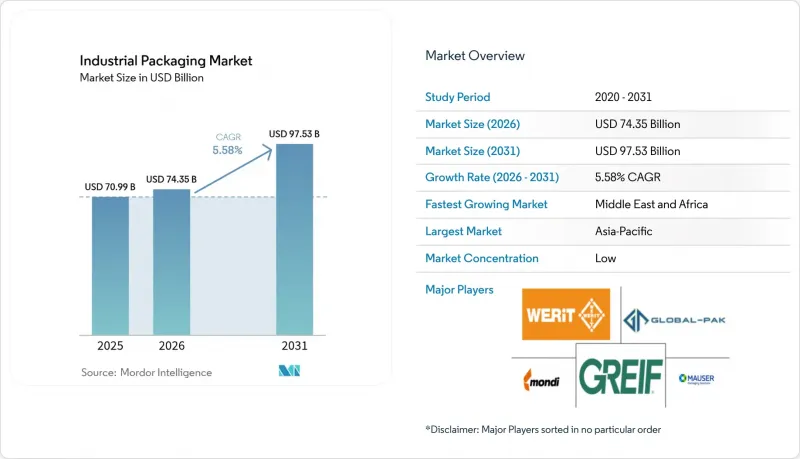
本報告按產品類型(IBC、桶、袋、桶、瓦楞紙箱等)、材料類型(塑膠、金屬、紙/紡織品等)、包裝容量(50公升以下、51-500公升、501-1000公升及以上)、包裝形式(硬質和軟質)、終端用戶行業(化學、製藥及其他)和地區進行細分。市場預測以美元計價。
全球工業包裝市場趨勢與洞察
永續和可回收材料的興起
監管機構強制要求最低再生材料含量和完全可回收性,迫使加工商放棄使用原生樹脂。 Mondi公司計劃於2025年推出的紙基IBC內襯,無需聚乙烯內袋,同時保持低於5克/平方米·天的水蒸氣透過率,展現了纖維基材料在食品級應用中的有效性。 Mauser Packaging Solutions公司目前運作一條解聚生產線,可將受污染的高密度聚乙烯(HDPE)桶轉化為與原生樹脂性能相當的顆粒,從而實現危險品容器的回收利用。高階品牌為確保碳中和記錄,願意為生物聚合物支付40-60%的溢價。同時,黏合劑供應商正在轉向支援單一流回收的水性和熱熔膠系統。回收導向的設計軟體可在開發階段模擬產品報廢場景,進而減少實體原型製作,加速合規進程。
電子商務和跨境貿易流量的擴張
預計到2025年,跨境電商市場規模將超過1.2兆美元,這將推動對符合ISO 668標準的瓦楞紙箱和折疊式IBC(中型散裝容器)的需求,從而最大限度地提高貨櫃的利用率。東南亞和中東的第三方物流供應商正在規範包裝尺寸,以避免15%至25%的附加費。亞馬遜的「零挫」服務概念正擴展到化學產品的分銷領域,促使鋼桶重新設計,以減少二次包裝並減輕8%至12%的包裝重量。直接面對消費者的營養補充品品牌選擇使用20至50公升的桶裝容器來分批出貨,避免庫存積壓。區域貿易協定正在消除關稅壁壘,從而增加了對符合多種運輸標準的聯合國認證IBC的需求。
樹脂和鋼材價格波動劇烈
2024年至2025年間,高密度聚乙烯(HDPE)現貨價格在每噸1100美元至1450美元之間波動,而熱軋鋼卷則在每噸650美元至950美元之間劇烈波動,這給加工商的利潤率帶來了壓力。在Greif公司,內部混煉目前可滿足40%的聚丙烯需求,進而達到緩衝價格上漲的作用。缺乏對沖手段的小規模企業在轉嫁價格上漲方面面臨著60至90天的延遲,這加劇了它們的現金流緊張,並加速了它們退出通用塑膠桶市場的進程。客戶越來越傾向於選擇提供與指數掛鉤、季度調整幅度設有上限的合約的供應商,他們願意接受略高的基準價格以換取價格的可預測性。價格的高波動性也促使加工商與石化整合商簽訂多年期樹脂供應合約。
細分市場分析
預計IBC(中型散裝容器)將以6.11%的複合年成長率成長,優於整體工業包裝市場,因為一次性內襯無需清洗,可保持無菌狀態,並符合聯合國性能測試標準。預計到2025年,桶裝容器將佔工業包裝市場佔有率的35.53%,但由於人工搬運和手動傾斜過程中1-2%的洩漏,其成長速度將放緩。碳纖維複合材料IBC可減輕40-50%的重量,並降低氫氣運輸成本0.15-0.20美元/噸公里。採用伽瑪射線滅菌內襯的軟性IBC可將生物製藥批次切換時間從8小時縮短至30分鐘,資產運轉率提高四分之一。一家汽車潤滑油供應商透過將200公升桶換成1000公升可堆疊IBC,節省了35%的倉庫空間,並將每台設備的堆高機搬運時間從4分鐘縮短至90秒。
針對特定應用領域,專用容器形式仍佔據主導地位。在粉末狀化學品和建築添加劑領域,袋裝產品佔據主導地位,因為25-50公斤的包裝符合勞動標準。桶裝產品用於黏合劑和客製化塗料,而瓦楞紙「袋中袋」混合容器則用於運輸濃縮液液,這種容器結合了纖維的可回收性和聚乙烯的阻隔性。半剛性IBC(中型散裝容器)具有折疊式側壁,空載時體積可減少60-70%,而裝滿後仍可堆疊至三層高。聯合國跌落和靜水壓測試標準仍然建議對危險品使用剛性包裝,但更厚的多層薄膜正在以更靈活的設計填補監管合規方面的空白。
在零售商回收計畫和市政上門回收方案的支持下,紡織品包裝預計將以6.75%的複合年成長率成長,這些措施促進了消費者的參與。到2025年,由於高密度聚乙烯(HDPE,價格為1.20-1.40美元/公斤)具有良好的耐化學性,塑膠將佔工業包裝市場規模的46.44%,但0.10-0.25美元/公斤的生產者責任延伸(EPR)費用正在削弱其主導地位。 Mondi公司的牛皮紙IBC內襯袋無需使用塑膠薄膜即可通過防潮測試,從而消除了紡織品回收中的分類障礙。甘蔗衍生聚乙烯可將生產階段的碳足跡減少60-70%,因此,高階個人保健產品的填充用產品可以溢價30-40%。金屬容器在易燃或易穿孔貨物的運輸領域仍佔有一席之地,但隨著再生鋼含量超過80%以及電弧爐技術的應用,其內部碳含量已減半。鋁纖維混合型IBC(中型散裝容器)在其使用壽命結束後可進行機械分離,從而提高了其可回收性。
黏合劑的創新正在加速這一轉變。水性黏合劑系統能夠實現紙漿生產過程中的清潔分層,避免了曾經困擾再生纖維的黏性污染。隨著客戶對原料來源和加工條件的可追溯性要求日益提高,通過 ISO 9001 認證的供應鏈如今在醫藥和食品級訂單佔據主導地位。 Mauser 的化學回收產品能夠生產高純度再生 HDPE 桶,從而拓展了危險品應用領域的循環生產能力。那些已經整合回收流程的成熟市場參與者正在獲得品牌所有者的支持,而那些落後者則面臨著支付高昂環境調整費用的風險。
區域分析
至2025年,亞太地區將佔工業包裝市場40.45%的佔有率。這主要得益於中國化學品產量超過15億噸以及印度農藥出口額達80億美元。在中國沿海的大型港口,例如蓮光港,目前更傾向於使用可繞過公路瓶頸的鐵路運輸相容型IBC(中型散裝容器)。同時,在印度的農藥產區,危險殺蟲劑的包裝正逐漸轉向使用聯合國認證的高密度聚乙烯(HDPE)桶。在日本,由於勞動力老化,協作機器人(cobot)的應用正在加速,其托盤堆疊速度可達每小時50桶,人事費用降低了60-70%。在韓國,「氫能經濟藍圖」刺激了對複合材料IBC的需求,因為甲基環己烷需要從進口碼頭運送到內陸供應基地。東南亞的物流公司嚴格遵守ISO標準盤尺寸,縮短港口停留時間並降低泊位費。
儘管北美地區的貨運量保持穩定,但該地區正受益於半導體製造廠和電動車組裝廠的近岸外包。用於盛裝超高純度化學品的IBC(中型散裝容器)中採用了無氟層壓薄膜,以防止晶片製造廠受到污染。在墨西哥的加工出口區,可重複使用的塑膠週轉箱(可跨境運輸30-40次後才丟棄)正在被使用,從而減少了廢棄物。在加拿大油砂作業中,正在採購能夠承受低至-40 度C低溫的碳鋼桶來盛裝鑽井添加劑。美國加州等州對再生材料含量的法規迫使加工商改用r-HDPE(再生高密度聚乙烯)桶。同時,美國東岸港口正在投資興建桶清洗設施,以支持化學品出口的暢通。
中東和非洲地區正處於最快的成長軌道上,預計年複合成長率將達到7.14%。沙烏地阿拉伯斥資200億美元打造的「2030願景」石化工廠擴建計劃,正推動著對用於運輸腐蝕性中間體的複合材料IBC貨櫃的需求。阿拉伯聯合大公國的自由區正作為貨櫃轉運樞紐,連接亞洲製造商和非洲礦業公司,刺激了對儲槽清洗和鋼桶再處理設施的投資。南非礦業正從木箱轉向符合聯合國標準的帶有RFID標籤的鋼桶,從而提高了可追溯性。奈及利亞的食用油生產商正用國產瓦楞紙和纖維基散裝包裝取代進口鋼桶,從而將外匯留在國內。沙烏地阿拉伯的氫氣試點計畫與NEOM計畫相關,正在催生氨和液態有機氫運輸容器的早期採用者,預示著該地區對複合材料IBC貨櫃的需求將持續成長。
其他好處:
- Excel格式的市場預測(ME)表
- 3個月的分析師支持
目錄
第1章:引言
- 研究假設和市場定義
- 調查範圍
第2章:調查方法
第3章執行摘要
第4章 市場狀況
- 市場概覽
- 市場促進因素
- 永續和可回收材料的興起
- 電子商務的擴張和跨境貿易的流動
- 食品和藥品散裝物流的成長
- 現場引入包裝自動化
- 氫氣供應鏈對複合材料中型散裝容器的需求
- 可重複使用包裝池經營模式的興起
- 市場限制因素
- 樹脂和鋼材價格波動
- 全球環境法規日益加強
- 禁止在阻隔塗料中使用全氟烷基和多氟烷基物質(PFAS)和微塑膠
- 近岸外包減少了長途運輸所需的包裝量。
- 產業價值鏈分析
- 監理情勢
- 技術展望
- 波特五力分析
- 宏觀經濟因素對市場的影響
第5章 市場規模與成長預測
- 依產品類型
- 中型散貨箱(IBC)
- 鼓
- 薩克斯風
- 油漆罐
- 瓦楞紙箱
- 其他產品類型
- 材料類型
- 塑膠
- 金屬
- 紙張和纖維基
- 其他材料類型
- 按包裝容量
- 50公升或以下
- 51~500 L
- 501~1,000 L
- 1,001~2,000 L
- 2000公升或更多
- 按包裝類型
- 硬包裝
- 軟包裝
- 按最終用戶行業分類
- 化學品和製藥
- 食品/飲料
- 車
- 石油、天然氣和石化產品
- 建築/施工
- 其他終端用戶產業
- 按地區
- 北美洲
- 美國
- 加拿大
- 墨西哥
- 南美洲
- 巴西
- 阿根廷
- 其他南美國家
- 歐洲
- 德國
- 英國
- 法國
- 西班牙
- 義大利
- 其他歐洲國家
- 亞太地區
- 中國
- 日本
- 印度
- 澳洲
- 韓國
- 其他亞太國家
- 中東和非洲
- 中東
- 沙烏地阿拉伯
- 阿拉伯聯合大公國
- 土耳其
- 其他中東國家
- 非洲
- 南非
- 肯亞
- 其他非洲國家
- 中東
- 北美洲
第6章 競爭情勢
- 市場集中度
- 策略趨勢
- 市佔率分析
- 公司簡介
- Greif, Inc.
- Mauser Packaging Solutions Holding Company
- Mondi plc
- Smurfit WestRock
- Amcor plc
- International Paper Company
- Packaging Corporation of America
- Schutz GmbH & Co. KGaA
- WERIT Kunststoffwerke W. Schneider GmbH & Co. KG
- Tank Holding Corp.
- Visy Industries Holdings Pty Ltd
- Pact Group Holdings Ltd
- Brambles Limited(CHEP)
- Global-Pak, Inc.
- Nefab AB
- Snyder Industries, LLC
- Myers Container, LLC
- Pyramid Technoplast Ltd
第7章 市場機會與未來展望
According to Mordor Intelligence, the industrial packaging market size is projected to be USD 70.99 billion in 2025, USD 74.35 billion in 2026, and reach USD 97.53 billion by 2031, growing at a CAGR of 5.58% from 2026 to 2031.
This report is Segmented by Product Type (IBCs, Drums, Sacks, Pails, Corrugated Boxes, and More), Material Type (Plastics, Metal, Paper and Fiber-Based, and More), Packaging Capacity (<=50L, 51-500L, 501-1, 000L, and More), Packaging Format (Rigid, and Flexible), End-User Industry (Chemicals and Pharmaceuticals, and More), and Geography. The Market Forecasts are Provided in Terms of Value (USD).
Global Industrial Packaging Market Trends and Insights
Emergence of Sustainable and Recyclable Materials
Regulators are mandating minimum recycled-content thresholds and full recyclability, compelling converters to shift away from virgin resin. Mondi's 2025 paper-based IBC liner eliminates the polyethylene inner bag yet achieves moisture-vapor transmission below 5 g/m2-day, validating fiber substrates for food-grade use. Mauser Packaging Solutions now runs depolymerization lines that convert contaminated HDPE drums into virgin-equivalent pellets, enabling circular use in hazardous-goods containers. Premium brands absorb 40-60% cost premiums on bio-polymers to secure carbon-neutral credentials, while adhesive suppliers switch to water-based and hot-melt systems that remain compatible with single-stream recycling. Design-for-recycling software simulates end-of-life scenarios during development, cutting physical prototyping and speeding compliance.
Expansion of E-Commerce and Cross-Border Trade Flows
Cross-border e-commerce surpassed USD 1.2 trillion in 2025, lifting demand for ISO 668-compliant corrugated boxes and collapsible IBCs that maximize container utilization. Third-party logistics providers in Southeast Asia and the Middle East standardize packaging dimensions to avoid freight surcharges of 15-25%. Amazon's frustration-free guidelines ripple into chemical distribution, prompting steel-drum redesigns that strip secondary overwraps and cut package weight 8-12%. Direct-to-consumer nutraceutical brands choose 20-50 liter drums so they can ship split orders without bloating inventory. Regional trade pacts remove tariff friction, amplifying demand for UN-certified IBCs that satisfy multiple transport codes.
Volatile Resin and Steel Prices
HDPE spot prices oscillated between USD 1,100 and USD 1,450 t in 2024-2025, while hot-rolled coil swung from USD 650 to USD 950 t, crushing converter margins. Greif's in-house compounding now covers 40% of polypropylene needs, buffering against price spikes. Small players lacking hedges face 60-90-day pass-through lags that strain cash flow, accelerating exits from commodity drum markets. Customers increasingly favor suppliers offering index-linked contracts that cap quarterly adjustments, accepting slightly higher base prices in exchange for predictability. Volatility also nudges converters toward multi-year resin agreements with integrated petrochemical partners.
Other drivers and restraints analyzed in the detailed report include:
- Growth in Food-Grade and Pharma Bulk Logistics
- On-Site Packaging Automation Adoption
- Tightening Global Environmental Regulations
For complete list of drivers and restraints, kindly check the Table Of Contents.
Segment Analysis
IBCs are forecast to grow at a 6.11% CAGR, outstripping the wider industrial packaging market, because single-use liners erase cleaning cycles and preserve sterility while meeting UN performance tests. Drums held 35.53% of the industrial packaging market share in 2025 but face slower growth due to labor-intensive handling and 1-2% spillage during manual tipping. Carbon-fiber composite IBCs slice weight 40-50%, lowering transport costs by USD 0.15-0.20/t-km for hydrogen carriers. Flexible IBCs with gamma-sterile liners cut biopharma batch changeover from eight hours to half an hour, lifting asset utilization by a quarter. Automotive lubricant suppliers upgrading from 200-liter drums to 1,000-liter stackable IBCs reclaim 35% warehouse space and reduce forklift time per unit from four minutes to ninety seconds.
Niche formats persist in specialized roles. Sacks dominate powdered chemicals and construction additives, where 25-50 kg packages align with labor codes. Pails address adhesives and bespoke coatings, and corrugated bag-in-box hybrids merge fiber recyclability with polyethylene barriers for liquid concentrates. Semi-rigid IBCs with collapsible sidewalls reduce empty volume 60-70% yet stack three-high filled. UN drop- and hydro-pressure criteria still favor rigid packages in hazardous goods, but thicker multilayer films are closing the compliance gap for flexible designs.
Fiber-based packs are set to rise at a 6.75% CAGR, supported by retailer take-back schemes and municipal curbside collection that simplify consumer participation. Plastics retained 46.44% of the industrial packaging market size in 2025 thanks to HDPE's chemical resistance at USD 1.20-1.40/kg, but extended producer responsibility fees of USD 0.10-0.25/kg erode that edge. Mondi's kraft IBC liners pass moisture-barrier tests without plastic films, removing sorting hurdles in fiber recovery. Sugarcane-based polyethylene slashes cradle-to-gate carbon 60-70%, justifying 30-40% premiums in premium personal-care refills. Metal containers keep niches in flammable or puncture-risk cargo, but recycled steel content above 80% and electric-arc furnaces cut embodied carbon by half. Hybrid aluminum-in-fiber IBCs allow mechanical separation at end-of-life, boosting recycling.
Adhesive innovation accelerates the shift. Water-based systems detach cleanly in pulpers, avoiding stickie contamination that once plagued recovered fiber. ISO 9001 certified supply chains now dominate pharmaceutical and food-grade orders, as customers require traceable sourcing and processing conditions. Mauser's chemical-recycling outputs enable high-purity r-HDPE drums, widening circular capacity for hazardous-goods applications. Market incumbents that integrate recycling streams gain brand-owner loyalty, while laggards risk paying escalating eco-modulation fees.
Complete Report Scope:
- By Product Type
- Intermediate Bulk Containers (IBCs)
- Drums
- Sacks
- Pails
- Corrugated Boxes
- Other Product Types
- By Material Type
- Plastics
- Metal
- Paper and Fiber-Based
- Other Material Types
- By Packaging Capacity
- <= 50 L
- 51 - 500 L
- 501 - 1,000 L
- 1,001 - 2,000 L
- > 2,000 L
- By Packaging Format
- Rigid Packaging
- Flexible Packaging
- By End-User Industry
- Chemicals and Pharmaceuticals
- Food and Beverage
- Automotive
- Oil, Gas and Petrochemicals
- Building and Construction
- Other End-User Industries
- By Geography
- North America
- United States
- Canada
- Mexico
- South America
- Brazil
- Argentina
- Rest of South America
- Europe
- Germany
- United Kingdom
- France
- Spain
- Italy
- Rest of Europe
- Asia-Pacific
- China
- Japan
- India
- Australia
- South Korea
- Rest of Asia-Pacific
- Middle East and Africa
- Middle East
- Saudi Arabia
- United Arab Emirates
- Turkey
- Rest of Middle East
- Africa
- South Africa
- Kenya
- Rest of Africa
- Middle East
- North America
Geography Analysis
Asia-Pacific captured 40.45% of the industrial packaging market in 2025, propelled by China's chemical output above 1.5 billion t and India's agrochemical exports topping USD 8 billion. Chinese coastal megasites such as Lianyungang now favor rail-compatible IBCs that bypass road bottlenecks, while India's agrochemical belt upgrades to UN-approved HDPE drums for hazardous insecticides. Japan's aging workforce accelerates cobot adoption, with palletizing speeds reaching 50 drums an hour and cutting labor costs 60-70%. South Korea's Hydrogen Economy Roadmap stimulates composite IBC demand as methylcyclohexane flows from import terminals to inland dispensers. Southeast Asian logistics firms enforce ISO pallet footprints to shorten port dwell times and slice demurrage bills.
North America shows steady volume but benefits from near-shoring of semiconductor fabs and electric-vehicle assembly. Ultrapure chemical IBCs integrate fluorine-free laminate films to avoid chip-fab contamination. Mexico's maquiladora clusters rely on reusable plastic totes that cross borders 30-40 times before retirement, shrinking corrugated waste. Canadian oil-sands operations purchase carbon-steel drums rated for -40 °C service to handle drilling additives. U.S. states like California apply recycled-content rules that push converters toward r-HDPE drums, while East Coast ports invest in drum-washing capacity to support chemical export flows.
The Middle East and Africa offer the fastest trajectory, with a 7.14% CAGR outlook. Saudi Arabia's USD 20 billion Vision 2030 petrochemical build-out drives demand for composite IBCs rated for corrosive intermediates. UAE free zones serve as container trans-shipment hubs bridging Asian manufacturers and African miners, spurring investments in tank-cleaning and drum-reconditioning yards. South Africa's mining sector swaps wooden crates for RFID-tagged UN steel drums, improving traceability. Nigeria's consumer-oil producers substitute imported drums with domestic corrugated and fiber-based bulk packs, retaining forex. Hydrogen pilots tied to Saudi Arabia's NEOM plan create early adopters for ammonia and liquid organic hydrogen carriers, foreshadowing regional capacity for composite IBCs.
- Greif, Inc.
- Mauser Packaging Solutions Holding Company
- Mondi plc
- Smurfit WestRock
- Amcor plc
- International Paper Company
- Packaging Corporation of America
- Schutz GmbH & Co. KGaA
- WERIT Kunststoffwerke W. Schneider GmbH & Co. KG
- Tank Holding Corp.
- Visy Industries Holdings Pty Ltd
- Pact Group Holdings Ltd
- Brambles Limited (CHEP)
- Global-Pak, Inc.
- Nefab AB
- Snyder Industries, LLC
- Myers Container, LLC
- Pyramid Technoplast Ltd
Additional Benefits:
- The market estimate (ME) sheet in Excel format
- 3 months of analyst support
TABLE OF CONTENTS
1 INTRODUCTION
- 1.1 Study Assumptions and Market Definition
- 1.2 Scope of the Study
2 RESEARCH METHODOLOGY
3 EXECUTIVE SUMMARY
4 MARKET LANDSCAPE
- 4.1 Market Overview
- 4.2 Market Drivers
- 4.2.1 Emergence of Sustainable and Recyclable Materials
- 4.2.2 Expansion of E-Commerce and Cross-Border Trade Flows
- 4.2.3 Growth in Food-Grade and Pharma Bulk Logistics
- 4.2.4 On-Site Packaging Automation Adoption
- 4.2.5 Hydrogen-Supply Chain Demand for Composite IBCs
- 4.2.6 Rise of Reusable Packaging Pool Business Models
- 4.3 Market Restraints
- 4.3.1 Volatile Resin and Steel Prices
- 4.3.2 Tightening Global Environmental Regulations
- 4.3.3 PFAS and Micro-Plastic Bans on Barrier Coatings
- 4.3.4 Near-Shoring Lowering Long-Haul Packaging Volumes
- 4.4 Industry Value Chain Analysis
- 4.5 Regulatory Landscape
- 4.6 Technological Outlook
- 4.7 Porter's Five Forces Analysis
- 4.7.1 Bargaining Power of Suppliers
- 4.7.2 Bargaining Power of Buyers
- 4.7.3 Threat of New Entrants
- 4.7.4 Threat of Substitutes
- 4.7.5 Intensity of Competitive Rivalry
- 4.8 Impact of Macroeconomic Factors on the Market
5 MARKET SIZE AND GROWTH FORECASTS (VALUE)
- 5.1 By Product Type
- 5.1.1 Intermediate Bulk Containers (IBCs)
- 5.1.2 Drums
- 5.1.3 Sacks
- 5.1.4 Pails
- 5.1.5 Corrugated Boxes
- 5.1.6 Other Product Types
- 5.2 By Material Type
- 5.2.1 Plastics
- 5.2.2 Metal
- 5.2.3 Paper and Fiber-Based
- 5.2.4 Other Material Types
- 5.3 By Packaging Capacity
- 5.3.1 <= 50 L
- 5.3.2 51 - 500 L
- 5.3.3 501 - 1,000 L
- 5.3.4 1,001 - 2,000 L
- 5.3.5 > 2,000 L
- 5.4 By Packaging Format
- 5.4.1 Rigid Packaging
- 5.4.2 Flexible Packaging
- 5.5 By End-User Industry
- 5.5.1 Chemicals and Pharmaceuticals
- 5.5.2 Food and Beverage
- 5.5.3 Automotive
- 5.5.4 Oil, Gas and Petrochemicals
- 5.5.5 Building and Construction
- 5.5.6 Other End-User Industries
- 5.6 By Geography
- 5.6.1 North America
- 5.6.1.1 United States
- 5.6.1.2 Canada
- 5.6.1.3 Mexico
- 5.6.2 South America
- 5.6.2.1 Brazil
- 5.6.2.2 Argentina
- 5.6.2.3 Rest of South America
- 5.6.3 Europe
- 5.6.3.1 Germany
- 5.6.3.2 United Kingdom
- 5.6.3.3 France
- 5.6.3.4 Spain
- 5.6.3.5 Italy
- 5.6.3.6 Rest of Europe
- 5.6.4 Asia-Pacific
- 5.6.4.1 China
- 5.6.4.2 Japan
- 5.6.4.3 India
- 5.6.4.4 Australia
- 5.6.4.5 South Korea
- 5.6.4.6 Rest of Asia-Pacific
- 5.6.5 Middle East and Africa
- 5.6.5.1 Middle East
- 5.6.5.1.1 Saudi Arabia
- 5.6.5.1.2 United Arab Emirates
- 5.6.5.1.3 Turkey
- 5.6.5.1.4 Rest of Middle East
- 5.6.5.2 Africa
- 5.6.5.2.1 South Africa
- 5.6.5.2.2 Kenya
- 5.6.5.2.3 Rest of Africa
- 5.6.5.1 Middle East
- 5.6.1 North America
6 COMPETITIVE LANDSCAPE
- 6.1 Market Concentration
- 6.2 Strategic Moves
- 6.3 Market Share Analysis
- 6.4 Company Profiles (Includes Global Level Overview, Market Level Overview, Core Segments, Financials as Available, Strategic Information, Market Rank/Share, Products and Services, and Recent Developments)
- 6.4.1 Greif, Inc.
- 6.4.2 Mauser Packaging Solutions Holding Company
- 6.4.3 Mondi plc
- 6.4.4 Smurfit WestRock
- 6.4.5 Amcor plc
- 6.4.6 International Paper Company
- 6.4.7 Packaging Corporation of America
- 6.4.8 Schutz GmbH & Co. KGaA
- 6.4.9 WERIT Kunststoffwerke W. Schneider GmbH & Co. KG
- 6.4.10 Tank Holding Corp.
- 6.4.11 Visy Industries Holdings Pty Ltd
- 6.4.12 Pact Group Holdings Ltd
- 6.4.13 Brambles Limited (CHEP)
- 6.4.14 Global-Pak, Inc.
- 6.4.15 Nefab AB
- 6.4.16 Snyder Industries, LLC
- 6.4.17 Myers Container, LLC
- 6.4.19 Pyramid Technoplast Ltd
7 MARKET OPPORTUNITIES AND FUTURE OUTLOOK
- 7.1 White-Space and Unmet-Need Assessment

 工業包裝市場:依材料、包裝類型、技術、應用、最終用途產業和分銷管道分類-2026-2032年全球市場預測
 工業包裝市場預測至2034年-按包裝類型、材料、產品形式、功能、最終用途產業和地區分類的全球分析
 工業包裝市場規模、佔有率和成長分析:按產品類型、材料類型、最終用途產業、應用和地區分類-2026-2033年產業預測
 工業包裝市場報告:按產品、材料、應用和地區分類(2026-2034 年)
 工業包裝市場:依產品類型、材料類型、類別、應用和地區分類
 工業包裝市場規模、佔有率、成長及全球產業分析:按類型、應用和地區分類,並預測至2026-2034年工業真菌包裝市場預測至2034年:按產品、基材來源、製造流程、最終用戶、分銷管道和地區分類的全球分析
 工業包裝市場分析及預測(至2035年):依類型、產品類型、服務、技術、材料類型、應用、製程、最終用戶、功能分類
 2026年全球工業包裝市場報告
 工業包裝市場規模、佔有率和趨勢分析報告:按材料、產品、最終用途、地區和細分市場預測(2026-2033 年)