


 |
市場調查報告書
商品編碼
2121794
肥料添加劑:市場佔有率分析、產業趨勢與統計、成長預測(2026-2031)Fertilizer Additives - Market Share Analysis, Industry Trends & Statistics, Growth Forecasts (2026 - 2031) |
||||||

※ 本網頁內容可能與最新版本有所差異。詳細情況請與我們聯繫。
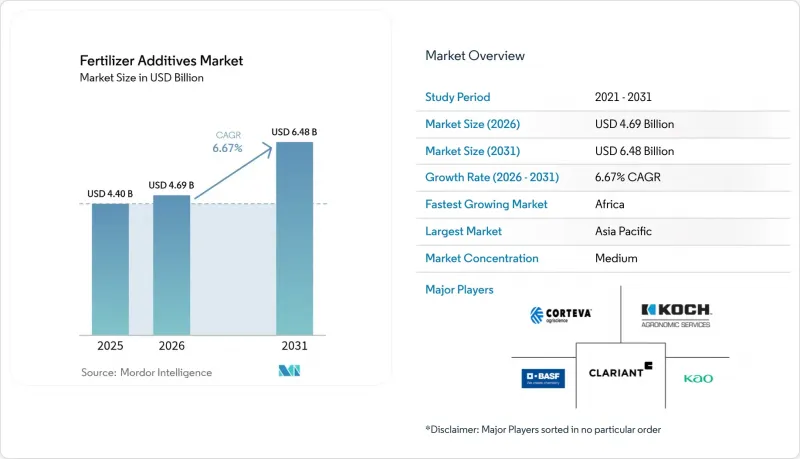
據 Mordor Intelligence 稱,2026 年肥料添加劑市值估計為 46.9 億美元,高於 2025 年的 44 億美元,預計到 2031 年將達到 64.8 億美元。
預計 2026 年至 2031 年的複合年成長率為 6.67%。
本報告按功能(抑制劑、敷料、造粒助劑等)、形態(固體、液體、微膠囊)、應用(尿素、硝酸銨、磷酸二銨等)、作物(穀物、油籽等)和地區(北美、歐洲、亞太等)進行細分。本報告基於市場規模(美元)提供市場預測。
全球肥料添加劑市場趨勢與洞察
高度集約農業區化肥用量增加
糧食需求的激增推動了集約化農業已高度普及地區化肥用量的增加。根據經合組織-糧農組織《展望》報告,預計到2032年,全球糧食產量將達到31億噸,其中大部分來自亞洲和非洲。化學肥料有助於減少濕潤灌溉系統中養分流失的增加,目前已有超過500萬英畝的農地(worldfertilizer.com)使用改良配方,以減少施肥過程中養分的揮發。採用滴灌和中心支軸式噴灌系統的農戶養分利用率接近90%,促使人們進一步採用防結塊劑和包膜劑,以保持肥料混合物在高濕度條件下的流動性。用於保障糧食安全的資金流入,為化肥供應商創造了可預測的長期需求曲線。
對高效肥料(EEF)的需求
價值198億美元的增值肥料市場將生物促效劑、抑制劑和緩釋包衣整合到單一顆粒肥料中,並根據施用時間和作物生長階段進行客製化。尿素酶抑制劑(例如NBPT)與杜羅米德穩定劑合併使用時,可減少54%的氨損失,幫助種植者無需額外犁地即可收穫高蛋白穀物。預計到2026年,美國生物促效劑的銷售額將成長兩倍,達到12億美元,生物來源成分將擴大融入傳統的養分管理方案中。採用聚合物包衣的緩釋產品進一步最佳化了活性成分的釋放時間,引領肥料添加劑市場朝向更智慧的多層薄膜發展,從而實現供需同步。
農業投入成本不斷上漲
截至2025年初,化肥價格上漲了11%,但糧食價格低迷正在擠壓農民的利潤空間。 UAN28價格為每噸354美元,DAP價格為每噸765美元,MAP價格為每噸810美元,對於融資緊張的農民來說,銷售這些高價添加劑變得越來越困難。荷蘭合作銀行的交付指數顯示,化肥需求有下降風險,尤其是在氮肥和磷肥方面,因為這兩種肥料在農民支出中佔很大比例。非洲和南亞的小規模農戶面臨最艱難的權衡,他們常常推遲購買能夠提高生產效率的肥料,即使投資回報已經得到證實。
細分市場分析
2025年,抗結塊劑佔據了肥料添加劑市場最大的佔有率,銷售額達36.45%。這一主導地位歸功於這些材料在潮濕的運輸季節和長期倉儲中保持顆粒流動性方面發揮的關鍵作用。與早期的生物蠟相比,採用低脂胺混合物和界面活性劑的系統能夠形成更薄、更柔韌的薄膜,從而承受鐵路車輛內的壓縮,性能更優。同時,塗層產品以9.32%的複合年成長率引領成長,主要得益於能夠控制養分釋放45至90天的聚合物和生物聚合物薄膜。這兩大類別表明,養分釋放的可靠性和時間性共同影響著消費者的購買決策。
第二大類別也在不斷發展。抑制劑正在響應減少一氧化二氮排放的法規要求,而造粒助劑在對粒徑精度要求嚴格的精密噴霧器中越來越受歡迎。新興的混合產品將防結塊、抑制劑和包膜功能整合到單一添加劑中,從而降低了添加劑的比例並簡化了供應鏈。防腐蝕解決方案正在進入液態肥料領域,而除塵劑在工人接觸標準日益嚴格的地區也越來越受歡迎。肥料添加劑市場持續朝向多功能化學品發展,這類化學品只需一次施用即可解決多種問題。
顆粒狀營養混合物是市場的主要驅動力,佔銷售額的 67.10%,並為滑石粉基調理劑、蠟和脂肪胺粉末提供了穩定的現金流。散貨碼頭和駁船運營商依靠固態團聚劑來保持貨物的流動性。液體產品雖然規模較小,但成長迅速,複合年成長率達到 7.98%,這反映了肥料灌溉種植面積的擴大和無人機噴灑技術的日益普及。液體分散劑在儲槽中快速溶解,可以根據產量圖以可變速率進行線上註入。
微膠囊技術介於這兩種極端情況之間。它既能保護活性成分,又能延緩其釋放,而且由於其外殼由聚乳酸或澱粉等可生物分解材料製成,因此能夠應對即將訂定的微塑膠法規。米利肯公司進軍微膠囊領域,清楚地表明了資本正向下一代遞送途徑轉移。在肥料添加劑市場,劑型正在整合。一些供應商現在提供包含液體種子處理劑和用於追肥的乾包衣劑的套裝,從而確保整個生長季養分管理的一致性。
區域分析
預計到2025年,亞太地區將繼續保持其最大銷售市場的地位,市佔率將達到38.40%。這主要得益於中國和印度小規模農戶的總合,兩國共服務約30億人口。中國對磷酸鹽出口的臨時限制,透過重新分配供應至國內通路並減少對進口的依賴,正使國內添加劑產品線受益。在「數位農業計畫」的推動下,印度的特種化學品銷售額預計到2025年將達到500億美元。該計劃為土壤檢查室和農場感測器提供資金。在肥料添加劑市場,儘管貨運市場波動,但國內製造商正利用一體化供應鏈來降低運輸成本。
非洲的成長率最高,達到10.02%,主要得益於政府和私人資本對新建生產設施的投資。預計到本十年末,營養素消費量將從760萬噸激增至1360萬噸,其中奈及利亞年產150萬噸的工廠和Indorama公司280萬噸的擴建項目將引領這一成長。光是西非地區,到2030年其消費量就可能超過460萬噸。儘管「最後一公里」的挑戰依然存在,例如包裝產品的成本和農村資金籌措不平衡等問題,但添加劑供應商認為,透過將流動性調節劑的供應與農民培訓相結合,可以提高其市場接受度。
北美和歐洲的化肥市場正經歷成熟而又充滿創新性的成長,年複合成長率分別為5.05%和4.38%。精密農業是推動需求成長的主要動力,英國28%的農場正在調整施肥計劃,採用豆科作物輪作以固氮並減少合成肥料的使用。歐盟將於2026年推出的碳邊境調節機制(CBAM)將要求化肥進口商揭露其產品的碳含量,這將使本地生產的低排放量複合肥料更具優勢。在北美和歐洲,生物來源肥料的市場佔有率都在不斷擴大,但由於化學包膜肥料即使在寒冷氣候和種植期有限的情況下也表現出可靠的性能,因此其市場地位仍然穩固。
其他好處:
- Excel格式的市場預測(ME)表
- 3個月的分析師支持
目錄
第1章:引言
- 研究假設和市場定義
- 調查範圍
第2章:調查方法
第3章執行摘要
第4章 市場狀況
- 市場概覽
- 市場促進因素
- 集約農業區化肥用量增加
- 對高效肥料(EEF)的需求
- 提高營養物質利用效率的監管措施
- 精密農業的引進使得少量施肥成為可能。
- 低溫低碳氨的物流對防止結塊產生了新的需求。
- 對土壤微生物群落溫和的生物聚合物塗層
- 市場限制因素
- 農業投入品價格上漲
- 加強對食品添加物的環境監管
- 特種界面活性劑用石化原料價格波動
- 生物來源替代品的迅速崛起
- 監理情勢
- 技術展望
- 波特五力分析
第5章 市場規模與成長預測
- 按功能
- 抑制劑
- 塗層劑
- 造粒助劑
- 抗結塊劑
- 除塵劑
- 腐蝕抑制劑
- 消泡劑
- 其他特色功能
- 按形式
- 固體的
- 液體
- 微膠囊化
- 透過使用
- 尿素
- 硝酸銨
- 磷酸二銨(DAP)
- 磷酸一銨(MAP)
- 硫酸銨
- 三重過磷酸鈣(TSP)
- 鉀混合物
- 其他特殊肥料
- 按作物
- 穀類和穀類食品
- 油籽
- 水果和蔬菜
- 草坪和觀賞植物
- 其他
- 按地區
- 北美洲
- 美國
- 加拿大
- 墨西哥
- 其他北美國家
- 歐洲
- 德國
- 法國
- 英國
- 西班牙
- 義大利
- 俄羅斯
- 其他歐洲國家
- 亞太地區
- 中國
- 印度
- 日本
- 澳洲
- 韓國
- 其他亞太國家
- 中東
- 沙烏地阿拉伯
- 阿拉伯聯合大公國
- 其他中東國家
- 非洲
- 南非
- 埃及
- 其他非洲國家
- 北美洲
第6章 競爭情勢
- 市場集中度
- 策略趨勢
- 市佔率分析
- 公司簡介
- BASF SE
- Corteva Agriscience
- Clariant International Ltd
- KAO Corporation
- Koch Agronomic Services
- Arkema(ArrMaz)
- Dorf Ketal Company LLC
- Michelman Inc.
- Novochem Group
- Lanxess AG
- Croda International Public Limited Company(Cargill, Incorporated)
- Hubei Forbon Technology Co., Ltd.
- Jiangsu Kolod Food Ingredients Co., Ltd.
- TIMAC AGRO INDIA PRIVATE LIMITED
- Nutrien Ltd.
- CF Industries
- The Mosaic Company
- Yara International
- ADM
- ICL Group
第7章 市場機會與未來展望
According to Mordor Intelligence, the fertilizer additives market size in 2026 is estimated at USD 4.69 billion, growing from 2025 value of USD 4.40 billion with 2031 projections showing USD 6.48 billion, growing at 6.67% CAGR over 2026-2031.
This report is Segmented by Function (Inhibitors, Coating Agents, Granulation Aids, and More), Form (Solid, Liquid, and Micro-Encapsulated), Application (Urea, Ammonium Nitrate, Diammonium Phosphate (DAP), and More), Crop (Cereals and Grains, Oilseeds, and More) and Geography (North America, Europe, Asia-Pacific, and More). The Report Offers Market Forecasts in Terms of Value (USD).
Global Fertilizer Additives Market Trends and Insights
Rising Fertilizer Consumption in High-Intensity Farming Regions
Surging cereal demand lifts additive volumes in zones that already farm at maximum intensity. The OECD-FAO Outlook sees global cereals hitting 3.1 billion tons by 2032, most of it from Asia and Africa. Additives arrest nutrient losses that climb in humid, irrigated systems, and more than 5 million acres now run on enhanced formulations that cut volatilization during fertigation worldfertilizer.com. Growers using drip and pivot systems achieve nutrient-use efficiency near 90%, propelling further uptake of anti-caking and coating chemistries that keep blends free-flowing under high humidity. Capital inflows toward food security create predictable long-term demand curves for additive suppliers.
Demand for Enhanced-Efficiency Fertilizers (EEF)
Value-added fertilizers worth USD 19.8 billion merge biostimulants, inhibitors, and controlled-release coatings into single granules tailored for timing and crop phase. Urease inhibitors such as NBPT lower ammonia losses by 54% when matched with Duromide stabilizer, helping growers derive higher protein grain without extra passes. U.S. biostimulant sales will triple to USD 1.2 billion by 2026, embedding biologicals into conventional nutrient programs. Polymer-coated controlled-release variants further tighten delivery windows, nudging the fertilizer additives market toward smarter, multi-layer films that synchronize supply and root demand.
Rising Cost of Crop Inputs
Fertilizer prices rose 11% in early 2025, squeezing farm margins as grain prices lag. Delivered UAN28 reached USD 354 per ton, DAP USD 765, and MAP USD 810, making premium additives a harder sell for cash-strapped growers. Rabobank's affordability index signals demand destruction risk, especially in nitrogen and phosphate categories that already command the bulk of farm spend. Smallholders in Africa and South Asia face the harshest trade-offs, often deferring enhanced-efficiency purchases despite proven payback.
Other drivers and restraints analyzed in the detailed report include:
- Regulatory Push for Nutrient-Use Efficiency
- Cryogenic Low-Carbon Ammonia Logistics Creating New Anti-Caking Needs
- Tightening Environmental Regulations on Additives
For complete list of drivers and restraints, kindly check the Table Of Contents.
Segment Analysis
Anti-caking products generated the largest slice of the fertilizer additives market in 2025, at 36.45% of revenue. This dominance stems from the material's vital role in preserving particle flow during humid shipping seasons and long warehouse layovers. Fatty amine blends and reduced-surfactant systems now outperform early bio-waxes by creating thinner, more flexible films that withstand compression in rail cars. Coating agents, however, wear the growth crown with a 9.32% CAGR, propelled by polymer and biopolymer films that meter release over 45- to 90-day spans. These twin leaders show how reliability and nutrient timing together move purchasing decisions.
Second-tier categories also evolve. Inhibitors answer regulatory calls to curb nitrous oxide, and granulation aids win converts in precision applicators that demand tight particle tolerances. Emerging hybrid products fuse anti-caking, inhibitor, and coating functions into single additives that cut inclusion rates and simplify supply chains. Corrosion prevention solutions enter liquid fertilizer service while dedusting agents gain momentum where worker exposure standards tighten. The fertilizer additives market continues to gravitate toward multi-purpose chemistries able to solve several pain points with one dose.
Granular nutrient blends keep solids on top, translating to 67.10% of revenues and steady cash flows for talc-based conditioners, waxes, and fatty amine powders. Bulk terminals and barge operators rely on solid anti-caking to keep piles free-flowing. Liquids, though smaller, are the climbers, logging an 7.98% CAGR that mirrors rising fertigation acres and drone spray adoption. Liquid dispersions dissolve quickly in nurse tanks, enabling inline injection at variable rates that match yield maps.
Micro-encapsulated formats sit between the two poles. They protect active ingredients, delay the release, and satisfy looming microplastic rules with compostable shells made from polylactic acid or starch. Milliken's push into microcapsules illustrates capital migration toward next-generation delivery routes. In the fertilizer additives market, form factors are converging; some suppliers now offer kits that include both liquid seed dressing and companion dry coating for top-dress passes, ensuring consistent nutrient control across the season.
Complete Report Scope:
- By Function
- Inhibitors
- Coating Agents
- Granulation Aids
- Anti-Caking Agents
- Dedusting Agents
- Corrosion Inhibitors
- Anti-Foaming Agents
- Other Niche Functions
- By Form
- Solid
- Liquid
- Micro-encapsulated
- By Application
- Urea
- Ammonium Nitrate
- Diammonium Phosphate (DAP)
- Mono-Ammonium Phosphate (MAP)
- Ammonium Sulfate
- Triple Superphosphate (TSP)
- Potash Blends
- Other Specialty Fertilizers
- By Crop
- Cereals and Grains
- Oilseeds
- Fruits and Vegetables
- Turf and Ornamentals
- Others
- By Geography
- North America
- United States
- Canada
- Mexico
- Rest of North America
- Europe
- Germany
- France
- United Kingdom
- Spain
- Italy
- Russia
- Rest of Europe
- Asia-Pacific
- China
- India
- Japan
- Australia
- South Korea
- Rest of Asia-Pacific
- Middle East
- Saudi Arabia
- United Arab Emirates
- Rest of Middle East
- Africa
- South Africa
- Egypt
- Rest of Africa
- North America
Geography Analysis
Asia-Pacific retained the sales crown at 38.40% in 2025 thanks to dense small-plot farms in China and India that collectively serve nearly 3 billion people. Domestic additive lines benefit from China's temporary phosphate export limits, which reshuffle supply into local channels and dampen import reliance. India's chemicals sector is on track to touch USD 50 billion in specialty revenues by 2025, aided by the Digital Agriculture Mission that funds soil labs and on-farm sensors. Within the fertilizer additives market size, domestic producers leverage integrated supply chains to keep delivered costs low despite volatile freight markets.
Africa showcases the fastest 10.02% CAGR as governments and private capital pour funds into new production hubs. Consumption will jump from 7.6 million to 13.6 million tons of nutrients by decade's end, led by Nigeria's 1.5 million ton plant and Indorama's 2.8 million ton expansion. West Africa alone could exceed 4.6 million tons by 2030. Adoption still faces last-mile hurdles such as bagged product costs and rural financing gaps, but additive suppliers see room to package flow conditioners with farmer training to lift acceptance.
North America and Europe register mature yet innovative growth at 5.05% and 4.38% CAGR. Precision agriculture underpins most incremental demand; 28% of U.K. farms adjust fertilizer plans using legume rotations to fix nitrogen and curb synthetic application. The EU Carbon Border Adjustment Mechanism, coming in 2026, will require fertilizer importers to disclose embedded carbon, advantaging local low-emission formulations. Across both continents, biological alternatives gain a share, yet chemical coatings persist because their performance data remain robust under colder climates and tight planting windows.
- BASF SE
- Corteva Agriscience
- Clariant International Ltd
- KAO Corporation
- Koch Agronomic Services
- Arkema (ArrMaz)
- Dorf Ketal Company LLC
- Michelman Inc.
- Novochem Group
- Lanxess AG
- Croda International Public Limited Company (Cargill, Incorporated)
- Hubei Forbon Technology Co., Ltd.
- Jiangsu Kolod Food Ingredients Co., Ltd.
- TIMAC AGRO INDIA PRIVATE LIMITED
- Nutrien Ltd.
- CF Industries
- The Mosaic Company
- Yara International
- ADM
- ICL Group
Additional Benefits:
- The market estimate (ME) sheet in Excel format
- 3 months of analyst support
TABLE OF CONTENTS
1 Introduction
- 1.1 Study Assumptions and Market Definition
- 1.2 Scope of the Study
2 Research Methodology
3 Executive Summary
4 Market Landscape
- 4.1 Market Overview
- 4.2 Market Drivers
- 4.2.1 Rising fertilizer consumption in high-intensity farming regions
- 4.2.2 Demand for enhanced-efficiency fertilizers (EEF)
- 4.2.3 Regulatory push for nutrient-use efficiency
- 4.2.4 Precision-agriculture adoption enabling micro-dosing
- 4.2.5 Cryogenic low-carbon ammonia logistics creating new anti-caking needs
- 4.2.6 Soil-microbiome friendly biopolymer coatings
- 4.3 Market Restraints
- 4.3.1 Rising cost of crop inputs
- 4.3.2 Tightening environmental regulations on additives
- 4.3.3 Petrochemical feedstock volatility for specialty surfactants
- 4.3.4 Rapid emergence of biological substitutes
- 4.4 Regulatory Landscape
- 4.5 Technological Outlook
- 4.6 Porter's Five Forces Analysis
- 4.6.1 Bargaining Power of Suppliers
- 4.6.2 Bargaining Power of Buyers
- 4.6.3 Threat of New Entrants
- 4.6.4 Threat of Substitute Products
- 4.6.5 Intensity of Competitive Rivalry
5 Market Size and Growth Forecasts (Value, USD)
- 5.1 By Function
- 5.1.1 Inhibitors
- 5.1.2 Coating Agents
- 5.1.3 Granulation Aids
- 5.1.4 Anti-Caking Agents
- 5.1.5 Dedusting Agents
- 5.1.6 Corrosion Inhibitors
- 5.1.7 Anti-Foaming Agents
- 5.1.8 Other Niche Functions
- 5.2 By Form
- 5.2.1 Solid
- 5.2.2 Liquid
- 5.2.3 Micro-encapsulated
- 5.3 By Application
- 5.3.1 Urea
- 5.3.2 Ammonium Nitrate
- 5.3.3 Diammonium Phosphate (DAP)
- 5.3.4 Mono-Ammonium Phosphate (MAP)
- 5.3.5 Ammonium Sulfate
- 5.3.6 Triple Superphosphate (TSP)
- 5.3.7 Potash Blends
- 5.3.8 Other Specialty Fertilizers
- 5.4 By Crop
- 5.4.1 Cereals and Grains
- 5.4.2 Oilseeds
- 5.4.3 Fruits and Vegetables
- 5.4.4 Turf and Ornamentals
- 5.4.5 Others
- 5.5 By Geography
- 5.5.1 North America
- 5.5.1.1 United States
- 5.5.1.2 Canada
- 5.5.1.3 Mexico
- 5.5.1.4 Rest of North America
- 5.5.2 Europe
- 5.5.2.1 Germany
- 5.5.2.2 France
- 5.5.2.3 United Kingdom
- 5.5.2.4 Spain
- 5.5.2.5 Italy
- 5.5.2.6 Russia
- 5.5.2.7 Rest of Europe
- 5.5.3 Asia-Pacific
- 5.5.3.1 China
- 5.5.3.2 India
- 5.5.3.3 Japan
- 5.5.3.4 Australia
- 5.5.3.5 South Korea
- 5.5.3.6 Rest of Asia-Pacific
- 5.5.4 Middle East
- 5.5.4.1 Saudi Arabia
- 5.5.4.2 United Arab Emirates
- 5.5.4.3 Rest of Middle East
- 5.5.5 Africa
- 5.5.5.1 South Africa
- 5.5.5.2 Egypt
- 5.5.5.3 Rest of Africa
- 5.5.1 North America
6 Competitive Landscape
- 6.1 Market Concentration
- 6.2 Strategic Moves
- 6.3 Market Share Analysis
- 6.4 Company Profiles (includes Global level Overview, Market level overview, Core Segments, Financials as available, Strategic Information, Market Rank/Share for key companies, Products and Services, and Recent Developments)
- 6.4.1 BASF SE
- 6.4.2 Corteva Agriscience
- 6.4.3 Clariant International Ltd
- 6.4.4 KAO Corporation
- 6.4.5 Koch Agronomic Services
- 6.4.6 Arkema (ArrMaz)
- 6.4.7 Dorf Ketal Company LLC
- 6.4.8 Michelman Inc.
- 6.4.9 Novochem Group
- 6.4.10 Lanxess AG
- 6.4.11 Croda International Public Limited Company (Cargill, Incorporated)
- 6.4.12 Hubei Forbon Technology Co., Ltd.
- 6.4.13 Jiangsu Kolod Food Ingredients Co., Ltd.
- 6.4.14 TIMAC AGRO INDIA PRIVATE LIMITED
- 6.4.15 Nutrien Ltd.
- 6.4.16 CF Industries
- 6.4.17 The Mosaic Company
- 6.4.18 Yara International
- 6.4.19 ADM
- 6.4.20 ICL Group
7 Market Opportunities and Future Outlook

 肥料添加劑市場規模、佔有率、趨勢和預測:按功能、形式、應用和地區分類,2026-2034年
 肥料添加劑市場:全球市場按產品類型、形態、作物類型、技術和應用進行預測 - 2026-2032年
 全球肥料添加劑市場規模、佔有率、趨勢和成長分析報告(2026-2034年)
 2026年全球水耕肥料添加劑市場報告2026年全球肥料添加劑市場報告
 肥料添加劑市場-全球產業規模、佔有率、趨勢、機會及預測(按功能、形式、應用、地區和競爭格局分類,2021-2031年)
 肥料添加劑市場規模、佔有率和成長分析(按形態、功能、最終產品和地區分類)-2026-2033年產業預測
 化肥抗結塊劑-全球市佔率及排名、總收入及需求預測(2025-2031年)
 全球技術級硝酸銨及炸藥市場:依產品類型、應用、終端用戶產業及地區劃分(2035-2035)液體尿素硝酸銨市場-全球產業規模、佔有率、趨勢、機會和預測,按銷售管道、應用、應用模式、地區和競爭細分,2020-2030 年