


 |
市場調查報告書
商品編碼
2121772
氣霧劑塗料:市場佔有率分析、產業趨勢與統計、成長預測(2026-2031)Aerosol Paints - Market Share Analysis, Industry Trends & Statistics, Growth Forecasts (2026 - 2031) |
||||||

※ 本網頁內容可能與最新版本有所差異。詳細情況請與我們聯繫。
根據 Mordor Intelligence 預測,氣霧劑塗料市場預計將從 2025 年的 11.8 億美元成長到 2026 年的 12.4 億美元,到 2031 年達到 16 億美元,2026 年至 2031 年的複合成長率年預計為 5.32%。
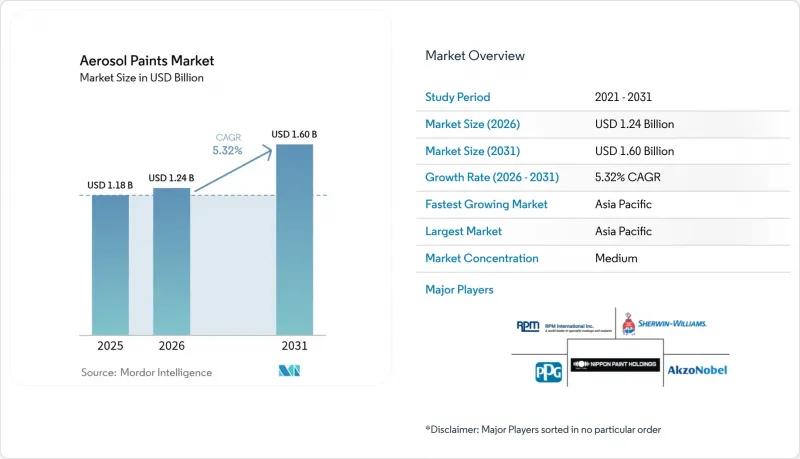
本報告按樹脂(丙烯酸樹脂、環氧樹脂、聚氨酯樹脂、醇酸樹脂及其他樹脂)、技術(溶劑型和水性樹脂)、終端用戶行業(汽車、建築、木材和包裝、運輸、DIY及其他終端用戶行業)和地區(亞太地區、北美地區、歐洲等)進行細分。市場預測以美元計價。
全球氣霧劑塗料市場趨勢與洞察
住宅和商業建築活動增加
在中國、印度和沙烏地阿拉伯,住宅建設法規對延誤工期規定了罰款,因此,完工速度成為選擇塗料的首要標準,甚至比占地面積的擴大更為重要。氣霧塗料可透過減少修整和打孔所需的人工時間,有助於緩解技術純熟勞工短缺和工資上漲帶來的壓力。在沙烏地阿拉伯的「新未來城」(Neom)計畫中,模組化施工方法得到了強調,這與單層氣霧底漆完美契合。在北美,設計建造合約中內部完成裝修工作的趨勢日益成長,總承包商也擴大採用氣霧塗料來避免與分包商的工期衝突。這些趨勢共同推動了氣霧塗料在新建築中的普及。
DIY家居裝修和室內設計專案的興起。
PPG 的「Glidden Max Flex」系列產品,憑藉其5分鐘快速乾燥和不滴落的配方,清晰地展現了千禧世代和Z世代住宅對DIY項目(例如特色牆和家具翻新)日益成長的興趣。這些住宅現在通常每個項目購買2-4罐氣霧劑,而不是像以前那樣購買加侖裝的專業級液體塗料。此外,2024會計年度的線上銷售額成長,凸顯了直銷通路在提升整體需求方面的強大作用。快速乾燥的特性不僅加快了施工速度,還最大限度地減少了遮蔽和清潔工作,即使氣霧劑塗料的每平方英尺成本更高,也更容易被消費者接受。
對揮發性有機化合物含量有嚴格的規定
2024年,美國環保署(EPA)將霧面漆的二氧化碳含量限制在50克/公升。這意味著,除非使用昂貴的豁免溶劑來取代二甲苯或甲苯,否則傳統的醇酸樹脂氣霧劑將會逐步淘汰。加州計劃在2025年對消費氣霧劑產品實施更為嚴格的二氧化碳含量限制,為25克/公升,預計這將進一步加劇成本壓力,尤其是對DIY愛好者常用的快乾清漆而言。同時,德國的「TA Luft」法規強制要求進行第三方檢測和年度排放報告,這增加了中型企業的成本。因此,受監管原料的成本飆升,擠壓了缺乏規模優勢、無法分攤研發和審核成本的區域品牌的利潤空間。
細分市場分析
2025年,丙烯酸樹脂將佔氣霧劑塗料銷售額的32.89%,成為樹脂類型中市佔率最大的產品,預計到2031年將以5.59%的複合年成長率成長。這些樹脂的化學結構能夠無縫整合溶劑型和水性體系,只需20分鐘即可達到觸乾。這種快速固化和紫外線防護的組合滿足了汽車噴漆和家具週期計的需求。宣偉公司的「K2」雙組分丙烯酸瓷漆具有卓越的覆蓋性和耐久性,通過了嚴格的鹽霧測試,並符合ISO C5腐蝕標準,因此在潮濕的沿海市場尤其受歡迎。
環氧樹脂雖然銷售量,但在維護、維修和營運 (MRO) 領域卻佔據了獨特的地位。在這個領域,即使是對處理不當的鋼基材,環氧樹脂也能提供必要的強力黏合。隨著基礎設施預算越來越側重於維修,環氧樹脂的應用預計將會激增。同時,聚氨酯已成為一種特殊塗料,尤其適用於需要耐化學腐蝕的局部修補。宣偉公司的「Acrolon 680」就是一個很好的例子,它具有極強的耐腐蝕性,能夠承受10%硫酸溶液的浸泡。在永續性方面,基於再生PET的醇酸樹脂的創新展現出成為環保途徑的潛力,但目前其高昂的價格對其廣泛應用構成了挑戰。
區域分析
預計到2025年,亞太地區將佔全球銷售量的45.47%,並在2031年之前維持5.72%的複合年成長率。中國已大規模供應城市住宅,而印度的「PMAY-Urban 2.0」計畫則迅速推進了經濟適用住宅項目,確保在18個月內竣工。在印度的二線城市,氣霧底漆透過大幅減少技術純熟勞工在創客空間的應用也不斷擴展。此外,東南亞國協的需求日益多元化,同時也應對區域性揮發性有機化合物(VOC)法規的複雜性,這給進入該市場的跨國公司帶來了挑戰。
預計到2025年,北美將佔據氣霧劑塗料銷售額的很大一部分。在北美,推動氣霧劑塗料市場成長的並非新建工程,而是住宅翻新、電子商務的蓬勃發展以及持續的基礎設施維護。家得寶(Home Depot)報告稱,其線上氣霧劑塗料銷量有所成長,並指出項目套裝的銷售有助於消費者做出購買決策。面臨基礎設施短缺的加拿大省份正在轉向使用奈米陶瓷氣霧劑塗料,這種塗料能夠顯著延長塗層的使用壽命並大幅降低生命週期成本。此外,墨西哥汽車出口的成長也推動了重新噴漆需求的激增,尤其是在美墨邊境地區。
到2025年,歐洲將佔據全球市場的重要佔有率。該地區正努力應對嚴格的揮發性有機化合物(VOC)法規和消防安全標準。例如,德國的「TA Luft」法規和英國脫歐後的新標準推高了合規成本,同時有利於那些擁有充足監管預算的公司。在義大利,一項文化遺產修復基金強制要求在室內裝修中使用低VOC氣霧劑塗料,以最大限度地減少施工造成的干擾。同時,在東歐,交通基礎設施的現代化正在推動對速乾型標線塗料的需求成長。
即使將南美洲和中東/非洲地區合併計算,它們在全球整體消費中所佔的佔有率也不大。受海洋設施維護預算的驅動,巴西石油公司(Petrobras)正擴大採用單層氣霧劑系統,該系統可以顯著減少繩索作業所需的天數。同樣,沙烏地阿拉伯雄心勃勃的Neom計畫也在模組化單元中使用氣霧劑底漆來加快施工進度。此外,南非向可再生能源的轉型也推動了對具有卓越紫外線穩定性的面漆的需求。這些面漆即使在強紫外線照射下也不會泛白,供應商正在添加高品質的紫外線吸收劑以滿足嚴格的規格要求。
其他好處:
- Excel格式的市場預測(ME)表
- 3個月的分析師支持
目錄
第1章:引言
- 研究假設和市場定義
- 調查範圍
第2章:調查方法
第3章執行摘要
第4章 市場狀況
- 市場概覽
- 市場促進因素
- 住宅和商業建築活動活性化
- DIY家居裝修和室內裝修的興起。
- 汽車改裝最後加工文化的擴張
- 在城市微型製造和創客空間中採用噴塗工藝
- 用於老化基礎設施的奈米陶瓷金屬直接噴塗
- 市場限制因素
- 對揮發性有機化合物(VOC)含量有嚴格的規定
- 根據《基加利修正案》分階段減少氫氟碳化合物推進劑的使用
- 消防法中關於加壓塗料儲存的規定
- 價值鏈分析
- 波特五力模型
第5章 市場規模與成長預測
- 依樹脂類型
- 丙烯酸纖維
- 環氧樹脂
- 聚氨酯
- 阿爾基多
- 其他樹脂
- 透過技術
- 溶劑型
- 水溶液
- 按最終用戶行業分類
- 車
- 建築學
- 木材/包裝
- 運輸
- DIY(Do-It-Yourself)
- 其他終端用戶產業
- 按地區
- 亞太地區
- 中國
- 印度
- 日本
- 韓國
- 其他亞太國家
- 北美洲
- 美國
- 加拿大
- 墨西哥
- 歐洲
- 德國
- 英國
- 義大利
- 法國
- 其他歐洲國家
- 南美洲
- 巴西
- 阿根廷
- 其他南美國家
- 中東和非洲
- 沙烏地阿拉伯
- 南非
- 其他中東和非洲國家
- 亞太地區
第6章 競爭情勢
- 市場集中度
- 策略趨勢
- 市佔率和排名分析
- 公司簡介
- Aeroaids Corporation
- Akzo Nobel NV
- BASF
- Kobra Paint
- Masco Corporation
- Nippon Paint Holdings Co., Ltd.
- PPG Industries Inc.
- RPM International Inc.
- RusTA
- The Sherwin-Williams Company
第7章 市場機會與未來展望
According to Mordor Intelligence, the aerosol paints market size is expected to increase from USD 1.18 billion in 2025 to USD 1.24 billion in 2026 and reach USD 1.60 billion by 2031, growing at a CAGR of 5.32% over 2026-2031.
This report is Segmented by Resin (Acrylic, Epoxy, Polyurethane, Alkyd, and Other Resins), Technology (Solvent-Borne and Water-Borne), End-User Industry (Automotive, Architectural, Wood and Packaging, Transportation, Do-It-Yourself, and Other End-User Industries), and Geography (Asia-Pacific, North America, Europe, and More). The Market Forecasts are Provided in Terms of Value (USD).
Global Aerosol Paints Market Trends and Insights
Rising Residential and Commercial Construction Activities
In China, India, and Saudi Arabia, where housing mandates impose penalty clauses for delays, completion speed has become the primary criterion for paint selection, surpassing square-footage expansion. By reducing labor hours on trim and punch-list work, aerosol coatings help alleviate the pressures of skilled-worker shortages and rising wages. The Neom program in Saudi Arabia emphasizes modular building methods, which align seamlessly with single-coat aerosol primers. In North America, design-build contracts are increasingly internalizing finishing tasks, leading general contractors to favor aerosol paints to sidestep scheduling conflicts with subcontractors. Collectively, these trends are boosting the penetration of aerosol paints in new-build activities.
Increasing DIY Refurbishment and Decor Projects
PPG's Glidden Max Flex range, with a five-minute dry time and a no-drip formulation, underscores the growing preference among Millennials and Gen-Z homeowners for DIY projects, like accent walls and furniture up-cycling. Instead of purchasing contractor-sized liquid gallons, these homeowners now typically buy two to four aerosol cans per project. Furthermore, online sales saw an uptick in fiscal 2024, highlighting the strength of direct-to-consumer channels in bolstering overall demand. The fast-dry feature not only expedites the process but also minimizes the need for masking and cleanup, making the higher per-square-foot cost of aerosols more palatable.
Stringent VOC-Content Regulations
In 2024, the U.S. EPA set a flat-finish limit of 50 g/L, effectively phasing out legacy alkyd aerosols unless costly exempt solvents are used in place of xylene and toluene. California is set to impose a stricter 25 g/L cap on consumer aerosols in 2025, intensifying cost pressures, particularly for fast-dry lacquers favored by DIY enthusiasts. Meanwhile, Germany's TA Luft mandates third-party testing and annual emissions reporting, incurring an added cost for medium-sized companies. As a result, compliant raw material costs have surged, tightening margins for regional brands that lack the scale to distribute research and development and audit expenses.
Other drivers and restraints analyzed in the detailed report include:
- Growing Automotive Customization and Refinishing Culture
- Urban Micro-Manufacturing and Maker-Space Adoption of Spray Finishes
- Phase-Down of HFC Propellants under Kigali Amendment
For complete list of drivers and restraints, kindly check the Table Of Contents.
Segment Analysis
Acrylics accounted for 32.89% of 2025 revenue, the largest aerosol paints market share among resins, and are forecast to grow at a 5.59% CAGR through 2031. These resins, with a chemical backbone that seamlessly integrates solvent-borne and water-borne systems, offer tack-free surfaces in just 20 minutes. This rapid curing, combined with UV protection, caters to the needs of vehicle refinishers and furniture upcyclers. Sherwin-Williams' K2 two-component acrylic enamel boasts impressive coverage and excels in durability, passing rigorous salt-spray tests and meeting ISO C5 corrosion standards, making it particularly attractive to markets in humid coastal regions.
Epoxies, though lesser in volume, carve out a niche in maintenance-repair-operations. Here, they provide the robust adhesion needed for marginally prepared steel. As infrastructure budgets increasingly favor refurbishment, the adoption of epoxies is set to surge. Meanwhile, polyurethanes have carved a niche as specialty coatings, especially for chemical-resistant touch-ups. This is underscored by Sherwin-Williams' Acrolon 680, which boasts resilience against a 10% sulfuric acid immersion. On the sustainability front, innovations in recycled PET-based alkyds highlight potential eco-friendly pathways, though their price premiums currently hinder widespread adoption.
Complete Report Scope:
- By Resin
- Acrylic
- Epoxy
- Polyurethane
- Alkyd
- Other Resins
- By Technology
- Solvent-borne
- Water-borne
- By End-User Industry
- Automotive
- Architectural
- Wood and Packaging
- Transportation
- Do-It-Yourself (DIY)
- Other End-user Industries
- By Geography
- Asia-Pacific
- China
- India
- Japan
- South Korea
- Rest of Asia-Pacific
- North America
- United States
- Canada
- Mexico
- Europe
- Germany
- United Kingdom
- Italy
- France
- Rest of Europe
- South America
- Brazil
- Argentina
- Rest of South America
- Middle-East and Africa
- Saudi Arabia
- South Africa
- Rest of Middle-East and Africa
- Asia-Pacific
Geography Analysis
Asia-Pacific held 45.47% of global volume in 2025, and sustained a 5.72% CAGR through 2031. China rolled out significant urban housing units, while India's PMAY-Urban 2.0 fast-tracked affordable housing projects, ensuring completion within 18 months. In tier-2 cities of India, aerosol primers are proving their worth by slashing skilled labor hours, a timely advantage given the rising wage trends. Meanwhile, Japan and South Korea are increasingly adopting maker-space applications. At the same time, ASEAN nations are diversifying their demand, navigating the complexities of fragmented local VOC regulations that pose challenges for multinational entries.
North America accounted for a significant portion of the 2025 revenue pie. Here, the aerosol paints market is buoyed not by new constructions but by residential refurbishments, a surge in e-commerce, and ongoing infrastructure maintenance. Home Depot reported an uptick in online aerosol sales, crediting bundled project kits for easing customer decisions. With an infrastructure shortfall, Canadian provinces are turning to nano-ceramic aerosols, which notably extend coating lifespans, thereby slashing life-cycle costs. Additionally, Mexico's vehicle exports have spurred a surge in refinishing demand, especially along the U.S. border.
Europe secured a substantial share of the global volume in 2025. The region grapples with stringent VOC and fire-code regulations. For instance, Germany's TA Luft and the UK's post-Brexit standards, which, while inflating compliance costs, also favor players with robust regulatory budgets. Italy, with its heritage-restoration fund, mandates low-VOC aerosols for interior work to minimize disruptions. Concurrently, Eastern Europe's transport upgrades are driving demand for fast-cure marking paints.
South America and the Middle East-Africa regions together represent a modest portion of global consumption. Petrobras, with an offshore maintenance budget, is leaning towards single-coat aerosol systems, which significantly reduce the need for rope-access days. In a similar vein, Saudi Arabia's ambitious Neom project is utilizing aerosol primers for its modular units to expedite processes. Furthermore, South Africa's push towards renewable energy is fueling a demand for UV-stable topcoats. These topcoats are engineered to withstand intense radiation without chalking, with suppliers incorporating premium UV absorbers to meet the heightened specifications.
- Aeroaids Corporation
- Akzo Nobel N.V.
- BASF
- Kobra Paint
- Masco Corporation
- Nippon Paint Holdings Co., Ltd.
- PPG Industries Inc.
- RPM International Inc.
- RusTA
- The Sherwin-Williams Company
Additional Benefits:
- The market estimate (ME) sheet in Excel format
- 3 months of analyst support
TABLE OF CONTENTS
1 Introduction
- 1.1 Study Assumptions and Market Definition
- 1.2 Scope of the Study
2 Research Methodology
3 Executive Summary
4 Market Landscape
- 4.1 Market Overview
- 4.2 Market Drivers
- 4.2.1 Rising Residential and Commercial Construction Activities
- 4.2.2 Increasing DIY Refurbishment and Decor Projects
- 4.2.3 Growing Automotive Customisation and Refinishing Culture
- 4.2.4 Urban Micro-Manufacturing and Maker-Space Adoption of Spray Finishes
- 4.2.5 Nano-Ceramic Direct-to-Metal Sprays for Ageing Infrastructure
- 4.3 Market Restraints
- 4.3.1 Stringent VOC-Content Regulations
- 4.3.2 Phase-Down of HFC Propellants under Kigali Amendment
- 4.3.3 Fire-Code Restrictions on Pressurised Paint Storage
- 4.4 Value Chain Analysis
- 4.5 Porter's Five Forces
- 4.5.1 Bargaining Power of Suppliers
- 4.5.2 Bargaining Power of Buyers
- 4.5.3 Threat of New Entrants
- 4.5.4 Threat of Substitutes
- 4.5.5 Degree of Competition
5 Market Size and Growth Forecasts (Value)
- 5.1 By Resin
- 5.1.1 Acrylic
- 5.1.2 Epoxy
- 5.1.3 Polyurethane
- 5.1.4 Alkyd
- 5.1.5 Other Resins
- 5.2 By Technology
- 5.2.1 Solvent-borne
- 5.2.2 Water-borne
- 5.3 By End-User Industry
- 5.3.1 Automotive
- 5.3.2 Architectural
- 5.3.3 Wood and Packaging
- 5.3.4 Transportation
- 5.3.5 Do-It-Yourself (DIY)
- 5.3.6 Other End-user Industries
- 5.4 By Geography
- 5.4.1 Asia-Pacific
- 5.4.1.1 China
- 5.4.1.2 India
- 5.4.1.3 Japan
- 5.4.1.4 South Korea
- 5.4.1.5 Rest of Asia-Pacific
- 5.4.2 North America
- 5.4.2.1 United States
- 5.4.2.2 Canada
- 5.4.2.3 Mexico
- 5.4.3 Europe
- 5.4.3.1 Germany
- 5.4.3.2 United Kingdom
- 5.4.3.3 Italy
- 5.4.3.4 France
- 5.4.3.5 Rest of Europe
- 5.4.4 South America
- 5.4.4.1 Brazil
- 5.4.4.2 Argentina
- 5.4.4.3 Rest of South America
- 5.4.5 Middle-East and Africa
- 5.4.5.1 Saudi Arabia
- 5.4.5.2 South Africa
- 5.4.5.3 Rest of Middle-East and Africa
- 5.4.1 Asia-Pacific
6 Competitive Landscape
- 6.1 Market Concentration
- 6.2 Strategic Moves
- 6.3 Market Share (%)/Ranking Analysis
- 6.4 Company Profiles (includes Global level Overview, Market level overview, Core Segments, Financials as available, Strategic Information, Products and Services, and Recent Developments)
- 6.4.1 Aeroaids Corporation
- 6.4.2 Akzo Nobel N.V.
- 6.4.3 BASF
- 6.4.4 Kobra Paint
- 6.4.5 Masco Corporation
- 6.4.6 Nippon Paint Holdings Co., Ltd.
- 6.4.7 PPG Industries Inc.
- 6.4.8 RPM International Inc.
- 6.4.9 RusTA
- 6.4.10 The Sherwin-Williams Company
7 Market Opportunities and Future Outlook
- 7.1 White-space and Unmet-Need Assessment


