


 |
市場調查報告書
商品編碼
2121727
Eubiotics:市場佔有率分析、產業趨勢和統計數據、成長預測(2026-2031)Eubiotics - Market Share Analysis, Industry Trends & Statistics, Growth Forecasts (2026 - 2031) |
||||||

※ 本網頁內容可能與最新版本有所差異。詳細情況請與我們聯繫。
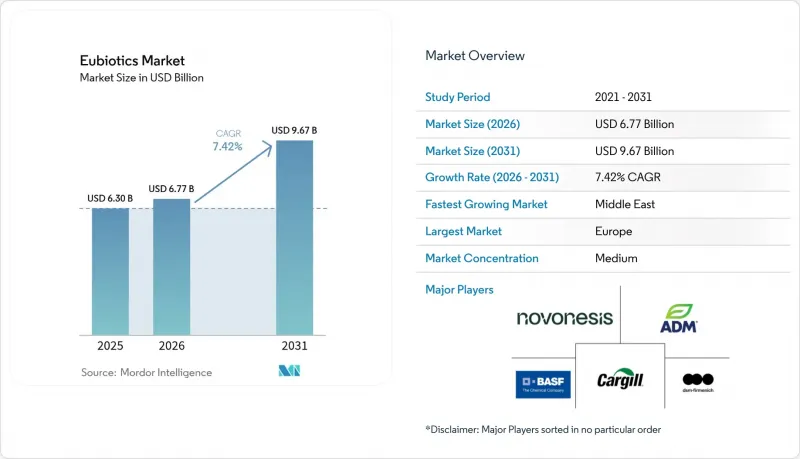
據 Mordor Intelligence 稱,2025 年Eubiotics市場價值為 63 億美元,預計到 2031 年將達到 96.7 億美元,而 2026 年為 67.7 億美元,預測期(2026-2031 年)複合年成長率為 7.42%。
本報告按類型(益生元、益生菌、有機酸、精油)、動物類型(反芻動物、家禽、豬、水產養殖、其他)、形態(乾粉、液體)、功能(增強免疫功能、其他)和地區(北美、歐洲、亞太、南美、中東和非洲)進行細分。市場預測以美元計價。
全球Eubiotics市場趨勢與洞察
對抗生素生長促進劑的監管限制
在主要畜牧產區,抗生素生長促進劑的正式淘汰正在加速向Eubiotics的不可逆轉的過渡。歐盟第1831/2003號法規建立了一套嚴格的安全文件流程,目前已被許多其他司法管轄區採用。因此,更清晰、更標準化的核准流程得以建立,有利於能夠提供可靠臨床資料包的供應商。美國FDA的《創新飼料法案》(Innovative FEED Act)也引入了類似的簡化措施,使跨國製造商能夠協調文件提交、縮短產品上市時間,並開發符合通用安全標準的統一配方。
消費者對不含抗生素的畜產品的需求日益成長
對不含抗生素的肉類和乳製品的需求已從利基市場轉向主流市場。大型超級市場超市正在強制供應商停止使用抗生素,這促使生產商儘管添加劑成本較高,但仍傾向採用Eubiotics。高階產品的商店價格足以抵消這些成本,從而形成了令人信服的經濟理由,尤其是在歐洲都市區、北美和發達的亞洲國家,這些地區的消費者將合理使用抗生素與健康和食品安全聯繫起來。
高成本和複雜的法規核准流程
高成本和複雜的法規核准流程會延緩產品上市,並增加小規模供應商的進入門檻。向歐洲食品安全局 (EFSA) 提交完整的安全文件可能需要花費數百萬歐元,耗時 3-4 年,佔用原本可用於研發的資金。英國脫歐後,監管差異意味著企業現在必須分別向歐盟和英國提交申請,導致文件和實驗室測試重複。雖然這種負擔使擁有專門監管合規團隊的跨國公司獲得了競爭優勢,但它也會阻礙對缺乏快速核准途徑的新型作用機制的投資。
細分市場分析
預計到2025年,益生菌將佔41.10%的銷售佔有率,成為Eubiotics市場中最大的佔有率。這一主導地位得益於廣泛的臨床檢驗、在各種氣候條件下可靠的性能以及加快核准的監管先例。該領域的芽孢桿菌孢子能夠耐受製粒溫度,確保其順利通過前胃到達髂骨,並在那裡發揮其競爭性排斥作用。益生菌與果寡糖(FOS)益生元結合的合益素配方已證實可使飼料轉換率提高3-4%,展現互補的作用機制。
預計到2031年,精油的複合年成長率將達到9.64%,成為成長最快的產品。消費者對植物來源抗菌劑的偏好以及這些化合物對腸道菌叢的多重作用正在推動其應用。百里酚、香芹酚和肉桂醛的微膠囊化技術能夠穩定揮發性化合物,即使添加量低至100 ppm,也能對致病菌產生可測量的抑製作用。有機酸和益生元在酸化和基材供應方面發揮重要作用,而多模態混合物則旨在實現協同效應。配方科學的全面進步正在鞏固Eubiotics市場作為腸道健康創新核心平台的地位。
到2025年,家禽將佔銷售額的34.10%,反映了數十年來肉雞和蛋雞無抗生素養殖計畫的成功。平均飼料配比為每噸飼料500克,透過提高動物生命週期內的累積飼料轉換率,實現了卓越的成本效益。水產養殖領域的預計複合年成長率為8.44%,相對成長將轉向海水和淡水魚類。對蝦、吳郭魚和雜交石斑魚的研究表明,透過自動投餵器在水中精確投餵穩定的益生菌,可將病原體數量減少30%以上。
在養豬業中,斷奶後會引入多種益生菌來抑制產腸毒素的大腸桿菌。由於瘤胃的複雜動態,益生菌在反芻動物中的應用較為緩慢,但利用丙酸桿菌調節揮發性脂肪酸比例以減少甲烷排放的方法正日益受到關注。伴侶動物配方領域則屬於高階市場,寵物食品負責人利用「人性化」趨勢來支撐更高的定價。總體而言,針對不同動物類型的最佳化正在擴大Eubiotics市場規模,同時也使專業供應商能夠透過其專有產品確保利潤率。
區域分析
預計到2025年,歐洲將佔34.40%的市場佔有率,這主要得益於嚴格的飼料添加劑法規、生產者的高度認知以及完善的分銷體系。產品開發商受益於與發酵原料、獸醫大學和受託研究機構的接近性,這些優勢加速了專有菌株的篩檢。歐盟的有機農業行動計畫正在逐步提升對經認證的Eubiotics的需求,這些益生菌可作為有機牲畜飼料的補充,同時解決維生素和胺基酸缺乏的問題。英國脫歐帶來的監管差異雖然增加了雙重註冊的成本,但也帶來了一些獨特的機遇,例如在英國的指導方針下可以享受快速核准服務。
中東地區以7.78%的複合年成長率領跑,主要得益於沙烏地阿拉伯「2030願景」下水產養殖領域的大型企劃。海灣合作理事會(GCC)成員國正投資建造沙漠氣候水產飼料設施,將單細胞蛋白質和Eubiotics結合,以解決國內蛋白質短缺問題。政府的飼料補貼計畫鼓勵當地生產者採用永續的腸道健康解決方案,最大限度地減少抗生素殘留,並符合清真和綠色標籤標準。
在亞太地區,不同區域的趨勢各不相同。在日本和韓國等已開發市場,高附加價值配方和可追溯性備受重視;而在中國和印度,由於其市場規模,成本效益更高的配方才是重點。在中國,法規核准流程仍然緩慢,但山東和福建等省份的本地生產群集正在縮短供應鏈。南美洲的生產商正利用豐富的植物原料在國內開發精油混合物,在以出口為導向的牛肉和家禽產業中獲得成本優勢。
其他好處
- Excel格式的市場預測(ME)表
- 3個月的分析師支持
目錄
第1章:引言
- 研究假設和市場定義
- 調查範圍
第2章:調查方法
第3章執行摘要
第4章 市場狀況
- 市場概覽
- 市場促進因素
- 對抗生素生長促進劑的監管限制
- 消費者對不含抗生素的畜產品的需求日益成長
- 全球水產養殖生產擴張
- 精準營養和輸送系統的技術進步
- 人們越來越意識到腸道健康對畜牧生產力的重要性
- 人們越來越關注永續發展措施和循環經濟。
- 市場限制因素
- 高成本和複雜的法規核准流程
- 供應鏈波動和原物料採購帶來的挑戰。
- 新興市場缺乏意識與技術專長
- 效果結果缺乏一致性和標準化不足
- 監理情勢
- 技術展望
- 波特五力模型
第5章 市場規模與成長預測
- 按類型
- 益生菌
- 乳酸菌
- 雙歧桿菌
- 其他益生菌(枯草桿菌、布氏酵母菌等)
- 益生元
- 菊糖
- 果寡糖
- 半乳寡糖
- 其他益生元(甘露聚醣、BETA-聚葡萄糖等)
- 有機酸
- 精油(植物來源成分)
- 益生菌
- 依動物類型
- 反芻動物
- 家禽
- 豬
- 水產養殖
- 其他動物類型(伴侶動物、馬等)
- 按形式
- 乾粉(粉末、顆粒)
- 液體(溶液、懸浮液、乳液)
- 按功能(主要用途)
- 維持健康的腸道環境並提升運動表現
- 增強免疫系統
- 病原體控制和疾病緩解
- 提高飼料轉換率
- 按地區
- 北美洲
- 美國
- 加拿大
- 墨西哥
- 其他北美國家
- 歐洲
- 德國
- 英國
- 法國
- 西班牙
- 義大利
- 俄羅斯
- 其他歐洲國家
- 亞太地區
- 中國
- 日本
- 印度
- 澳洲
- 其他亞太國家
- 南美洲
- 巴西
- 阿根廷
- 其他南美國家
- 中東
- 沙烏地阿拉伯
- 土耳其
- 其他中東國家
- 非洲
- 南非
- 其他非洲地區
- 北美洲
第6章 競爭情勢
- 市場集中度
- 策略趨勢
- 市佔率分析
- 公司簡介
- BASF SE
- dsm-firmenich
- Cargill, Incorporated
- Novonesis
- ADM
- Kemin Industries, Inc.
- Lallemand Inc.
- Evonik Industries AG
- Alltech
- Adisseo
- Huvepharma
- Phibro Animal Health Corporation
- Novus International, Inc.
- Marubeni Corporation(Orffa)
- VetAgro SpA
第7章 市場機會與未來展望
According to Mordor Intelligence, the eubiotics market size was valued at USD 6.30 billion in 2025 and estimated to grow from USD 6.77 billion in 2026 to reach USD 9.67 billion by 2031, at a CAGR of 7.42% during the forecast period (2026-2031).
This report is Segmented by Type (Prebiotics, Probiotics, Organic Acids, and Essential Oils), Animal Type (Ruminants, Poultry, Swine, Aquaculture, and More), Form (Dry and Liquid), Function (Immunity Enhancement and More), and Geography (North America, Europe, Asia-Pacific, South America, Middle East, and Africa). The Market Forecasts are Provided in Terms of Value (USD).
Global Eubiotics Market Trends and Insights
Regulatory restrictions on antibiotic growth promoters
The formal phase-out of antibiotic growth promoters across major livestock regions has set an irreversible shift toward eubiotics. Regulation (EC) No 1831/2003 created a rigorous safety dossier process that many other jurisdictions now mirror, resulting in a clearer, more standardized approval path that rewards suppliers with robust clinical data packages. As the U.S. FDA's Innovative FEED Act introduces similar streamlining, multinational producers can coordinate dossier submissions, shorten time-to-market, and deploy harmonized formulations that meet common safety thresholds.
Rising consumer demand for antibiotic-free animal products
Demand for antibiotic-free meat and dairy has moved from niche to mainstream. Large grocery chains impose supplier policies that eliminate antibiotic use, pushing producers toward eubiotics despite higher additive costs. Premium shelf prices offset these costs and create a compelling economic case, particularly in urban Europe, North America, and advanced Asian economies where consumers link antibiotic stewardship to health and food safety.
High costs and complex regulatory approval processes
High costs and complex regulatory approval processes slow product launches and raise entry barriers for smaller suppliers. Submitting a full EFSA safety dossier can cost several million EUR and extend timelines to 3-4 years, tying up capital that could otherwise fund Research and Development. Diverging post-Brexit rules mean companies must now prepare separate submissions for the EU and the UK, duplicating documentation and laboratory studies. These burdens tilt competitive advantage toward multinationals with dedicated regulatory teams and can discourage investment in novel mechanisms of action that lack a clear pathway to fast approval.
Other drivers and restraints analyzed in the detailed report include:
- Expansion of aquaculture production globally
- Technological advances in precision nutrition and delivery systems
- Supply-chain volatility and raw-material sourcing challenges
For complete list of drivers and restraints, kindly check the Table Of Contents.
Segment Analysis
Probiotics held a 41.10% 2025 revenue share, underpinning the largest slice of the eubiotics market. Their dominance stems from extensive clinical validation, reliable performance across climates, and accommodating regulatory precedents that expedite approvals. The segment's Bacillus spores tolerate pelleting temperatures, ensuring delivery past the proventriculus and into the ileum, where competitive exclusion exerts its effect. Synbiotic formulations that blend probiotics with fructooligosaccharide prebiotics show feed-conversion improvements of 3-4%, validating complementary mechanisms.
Essential oils record the fastest 9.64% CAGR to 2031. Consumer preference for plant-based antimicrobials and the compounds' multilayered actions on gut microbes drive uptake. Micro-encapsulation of thymol, carvacrol, and cinnamaldehyde stabilizes volatile compounds, and inclusion rates as low as 100 ppm deliver measurable pathogen suppression. Organic acids and prebiotics retain niche roles in acidification and substrate provisioning, while multi-modal blends aim to capture synergistic benefits. Collective progress in formulation science cements the eubiotics market as the central platform for gut-health innovation.
Poultry contributed 34.10% of 2025 revenue, reflecting decades of antibiotic-alternative programs in broilers and layers. Inclusion rates average 500 g per metric ton of feed, and cumulative lifetime feed-conversion gains deliver strong cost-benefit ratios. Aquaculture's 8.44% forecast CAGR shifts relative growth toward marine and freshwater species. Shrimp, tilapia, and hybrid grouper trials indicate pathogen load reductions exceeding 30% when precise water-stable probiotics are dosed through automated feeders.
Swine operations integrate multi-strain probiotics post-weaning to curb enterotoxigenic Escherichia coli. Ruminant adoption lags due to complex rumen dynamics, yet propionibacterium blends that modulate volatile fatty acid ratios gain traction as methane-reduction tools. Companion-animal formulations segment adds a premium layer where pet-food marketers leverage the humanization trend to justify higher price points. Collectively, animal-specific optimization widens the eubiotics market size while allowing specialty suppliers to capture margin through proprietary strains.
Complete Report Scope:
- By Type
- Probiotics
- Lactobacilli
- Bifidobacteria
- Other Probiotics (Bacillus subtilis, Saccharomyces boulardii, etc.)
- Prebiotics
- Inulin
- Fructo-oligosaccharides
- Galacto-oligosaccharides
- Other Prebiotics (Mannan-oligosaccharides, beta-Glucans, etc.)
- Organic Acids
- Essential Oils (Phytogenics)
- Probiotics
- By Animal Type
- Ruminant
- Poultry
- Swine
- Aquaculture
- Other Animal Types (Companion Animals, Equines, etc.)
- By Form
- Dry (powder, granule)
- Liquid (solution, suspension, emulsion)
- By Function (Primary Objective)
- Gut-health and performance enhancement
- Immunity enhancement
- Pathogen control / disease mitigation
- Feed-efficiency improvement
- By Geography
- North America
- United States
- Canada
- Mexico
- Rest of North America
- Europe
- Germany
- United Kingdom
- France
- Spain
- Italy
- Russia
- Rest of Europe
- Asia-Pacific
- China
- Japan
- India
- Australia
- Rest of Asia-Pacific
- South America
- Brazil
- Argentina
- Rest of South America
- Middle East
- Saudi Arabia
- Turkey
- Rest of Middle East
- Africa
- South Africa
- Rest of Africa
- North America
Geography Analysis
Europe's 34.40% revenue share in 2025 stems from stringent feed-additive rules, high producer awareness, and established distribution infrastructure. Product developers benefit from proximity to fermentation inputs, veterinary universities, and contract research labs that speed proprietary-strain screening. The EU Organic Action Plan triggers incremental demand for certified eubiotics that complement organic livestock diets while addressing vitamin and amino-acid gaps. Regulatory divergence following Brexit introduces dual-registration costs but also niche opportunities for fast-track approvals under UK guidelines.
The Middle East delivers the fastest 7.78% CAGR, anchored by aquaculture megaprojects under Saudi Vision 2030. Gulf Cooperation Council countries invest in desert-climate aquafeed facilities that marry single-cell protein and eubiotics to close domestic protein gaps. Government feed-subsidy schemes reward local producers that integrate sustainable gut health solutions to minimize antibiotic residues and align with halal and green-label standards.
Asia-Pacific shows heterogeneous patterns. Advanced markets like Japan and South Korea emphasize value-added formulations and traceability, while China and India focus on cost-effective blends due to scale. Regulatory clearance remains slower in China, yet local production clusters in Shandong and Fujian provinces shorten supply chains. South American producers leverage abundant botanical raw materials to develop essential oil blends domestically, providing cost advantages in export-oriented beef and poultry sectors.
- BASF SE
- dsm-firmenich
- Cargill, Incorporated
- Novonesis
- ADM
- Kemin Industries, Inc.
- Lallemand Inc.
- Evonik Industries AG
- Alltech
- Adisseo
- Huvepharma
- Phibro Animal Health Corporation
- Novus International, Inc.
- Marubeni Corporation (Orffa)
- VetAgro S.p.A.
Additional Benefits:
- The market estimate (ME) sheet in Excel format
- 3 months of analyst support
TABLE OF CONTENTS
1 Introduction
- 1.1 Study Assumptions and Market Definition
- 1.2 Scope of the Study
2 Research Methodology
3 Executive Summary
4 Market Landscape
- 4.1 Market Overview
- 4.2 Market Drivers
- 4.2.1 Regulatory restrictions on antibiotic growth promoters
- 4.2.2 Rising consumer demand for antibiotic-free animal products
- 4.2.3 Expansion of aquaculture production globally
- 4.2.4 Technological advances in precision nutrition and delivery systems
- 4.2.5 Growing awareness of gut-health importance in animal performance
- 4.2.6 Increasing focus on sustainable and circular-economy practices
- 4.3 Market Restraints
- 4.3.1 High costs and complex regulatory approval processes
- 4.3.2 Supply-chain volatility and raw-material sourcing challenges
- 4.3.3 Limited awareness and technical expertise in developing markets
- 4.3.4 Inconsistent efficacy results and lack of standardization
- 4.4 Regulatory Landscape
- 4.5 Technological Outlook
- 4.6 Porter's Five Forces
- 4.6.1 Bargaining Power of Suppliers
- 4.6.2 Bargaining Power of Buyers
- 4.6.3 Threat of New Entrants
- 4.6.4 Threat of Substitute Products
- 4.6.5 Intensity of Competitive Rivalry
5 Market Size and Growth Forecasts (Value, USD)
- 5.1 By Type
- 5.1.1 Probiotics
- 5.1.1.1 Lactobacilli
- 5.1.1.2 Bifidobacteria
- 5.1.1.3 Other Probiotics (Bacillus subtilis, Saccharomyces boulardii, etc.)
- 5.1.2 Prebiotics
- 5.1.2.1 Inulin
- 5.1.2.2 Fructo-oligosaccharides
- 5.1.2.3 Galacto-oligosaccharides
- 5.1.2.4 Other Prebiotics (Mannan-oligosaccharides, beta-Glucans, etc.)
- 5.1.3 Organic Acids
- 5.1.4 Essential Oils (Phytogenics)
- 5.1.1 Probiotics
- 5.2 By Animal Type
- 5.2.1 Ruminant
- 5.2.2 Poultry
- 5.2.3 Swine
- 5.2.4 Aquaculture
- 5.2.5 Other Animal Types (Companion Animals, Equines, etc.)
- 5.3 By Form
- 5.3.1 Dry (powder, granule)
- 5.3.2 Liquid (solution, suspension, emulsion)
- 5.4 By Function (Primary Objective)
- 5.4.1 Gut-health and performance enhancement
- 5.4.2 Immunity enhancement
- 5.4.3 Pathogen control / disease mitigation
- 5.4.4 Feed-efficiency improvement
- 5.5 By Geography
- 5.5.1 North America
- 5.5.1.1 United States
- 5.5.1.2 Canada
- 5.5.1.3 Mexico
- 5.5.1.4 Rest of North America
- 5.5.2 Europe
- 5.5.2.1 Germany
- 5.5.2.2 United Kingdom
- 5.5.2.3 France
- 5.5.2.4 Spain
- 5.5.2.5 Italy
- 5.5.2.6 Russia
- 5.5.2.7 Rest of Europe
- 5.5.3 Asia-Pacific
- 5.5.3.1 China
- 5.5.3.2 Japan
- 5.5.3.3 India
- 5.5.3.4 Australia
- 5.5.3.5 Rest of Asia-Pacific
- 5.5.4 South America
- 5.5.4.1 Brazil
- 5.5.4.2 Argentina
- 5.5.4.3 Rest of South America
- 5.5.5 Middle East
- 5.5.5.1 Saudi Arabia
- 5.5.5.2 Turkey
- 5.5.5.3 Rest of Middle East
- 5.5.6 Africa
- 5.5.6.1 South Africa
- 5.5.6.2 Rest of Africa
- 5.5.1 North America
6 Competitive Landscape
- 6.1 Market Concentration
- 6.2 Strategic Moves
- 6.3 Market Share Analysis
- 6.4 Company Profiles (includes Global level Overview, Market level Overview, Core Segments, Financials as available, Strategic Information, Market Rank/Share, Products and Services, Recent Developments)
- 6.4.1 BASF SE
- 6.4.2 dsm-firmenich
- 6.4.3 Cargill, Incorporated
- 6.4.4 Novonesis
- 6.4.5 ADM
- 6.4.6 Kemin Industries, Inc.
- 6.4.7 Lallemand Inc.
- 6.4.8 Evonik Industries AG
- 6.4.9 Alltech
- 6.4.10 Adisseo
- 6.4.11 Huvepharma
- 6.4.12 Phibro Animal Health Corporation
- 6.4.13 Novus International, Inc.
- 6.4.14 Marubeni Corporation (Orffa)
- 6.4.15 VetAgro S.p.A.


