


 |
市場調查報告書
商品編碼
2121723
相變材料:市場佔有率分析、產業趨勢與統計、成長預測(2026-2031)Phase Change Materials - Market Share Analysis, Industry Trends & Statistics, Growth Forecasts (2026 - 2031) |
||||||

※ 本網頁內容可能與最新版本有所差異。詳細情況請與我們聯繫。
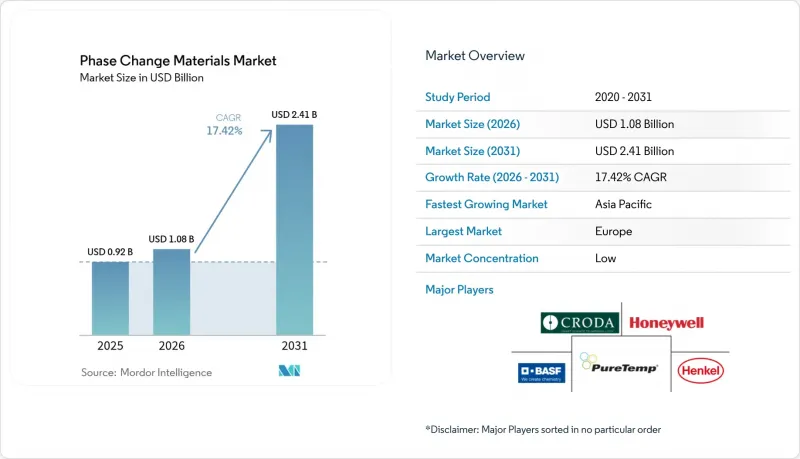
據 Mordor Intelligence 稱,相變材料的市場規模預計在 2026 年達到 10.8 億美元,高於 2025 年的 9.2 億美元,預計到 2031 年將達到 24.1 億美元。
預計 2026 年至 2031 年的複合年成長率為 17.42%。
本報告按產品類型(有機、無機、生物基)、化學成分(石蠟、非石蠟烴、其他)、封裝技術(大分子膠囊化、其他)、終端用戶產業(建築和施工、包裝、紡織、電子、其他)和地區(亞太地區、北美、歐洲、南美、中東和非洲)對產業進行分類。
全球相變材料(PCM)市場趨勢與洞察
歐洲和北美強制實施建築節能標準,正在加速相變材料的採用。
基於性能的合規要求現已允許建築師以潛熱儲存層取代剛性隔熱材料,從而將輕質牆體的峰值冷卻負荷降低 35% 至 45%。明尼蘇達州的現場測量報告顯示,室內尖峰溫度降低了 5.49 度C,負載向非尖峰時段轉移了 77.8%,為監管機構提供了暖通空調成本降低的實際數據。隨著歐盟 2027 年維修目標合規要求的日益嚴格,預計人們對相變材料(PCM)浸漬石膏板和混凝土砌塊的關注度將有所提高,從而推動相變材料市場整體採購量的成長。
冷鏈物流基礎設施快速發展
疫苗、先進生技藥品和培養肉通常需要溫度控制在±0.5 度C以內,且持續時間不超過三天。相變材料無需外部電源即可將溫度維持時間延長至72小時,從而減少機場和海關延誤期間對柴油發電機的依賴。與主動冷卻相比,甘油-水-氯化鈉混合物可減少30-40%的碳排放,並將藥品保存期限延長15-25%,推動相變材料市場達到兩位數的需求成長。
相變材料的危險性
由於石蠟的燃點約為170 度C,因此必須使用溴化阻燃劑,這會增加成本,並可能使其受到健康標籤法規的約束。無機候選物質,例如硝酸鋰(LiNO3),有毒性風險。近期開發的固體-固體材料(PCM)無需使用鹵素即可防止洩漏並達到UL94 V-0阻燃標準。為了更廣泛地應用這些封裝技術,關鍵在於擴大其應用規模並使其與全球化學品安全標準相協調。
細分市場分析
有機石蠟仍是相變材料市場的主要收入來源,預計到2025年將佔全球銷售額的43.62%。其市場主導地位反映了成熟的供應鏈、廣泛的溫度範圍以及與建築板材中使用的大分子膠囊化板材的兼容性。然而,隨著相關人員尋求在整個生命週期中減少排放,相變生物來源市場正迅速轉向生物基油脂和脂肪酸混合物。這個新興細分市場在LEED認證積分和市政綠色採購義務的推動下,預計到2031年將以18.90%的複合年成長率成長,超過所有其他細分市場。
由於其穩定的結晶特性以及熔點易於在0–90 度C範圍內調節,預計到2025年,石蠟基配方將佔相變材料市場銷售額的41.02%。然而,鹽水水合物有望超越石蠟,到2031年將以17.76%的複合年成長率成長。鹽水水合物具有高體積比熱容(高達350 kJ/L)以及由於添加碳基添加劑而提高的導熱性,能夠減少部件的尺寸和重量。由此帶來的密度優勢在安裝空間有限的應用中尤其吸引人,例如電動車電池套管和緊湊型資料中心機櫃。
區域分析
預計到2025年,歐洲將佔全球銷售額的32.40%。歐盟《建築能源性能指令》對此提供了支持,該指令強制要求新建築和大型維修計畫均需達到接近淨零能耗的目標。德國和北歐國家的早期應用表明,將相變材料(PCM)融入外牆隔熱系統可降低20%至35%的暖通空調(HVAC)能耗。碳排放交易和綠色債券合格相關法規的明確化,正推動資金持續流入富含相變建材,進一步鞏固歐洲在相變材料市場的主導地位。
亞太地區是成長最快的地區,預計到 2031 年將以每年 18.55% 的速度成長。中國大力推廣熱泵,透過降低尖峰時段電力需求,與相變材料儲熱技術相輔相成,這種協同效應正在「熱泵的未來」藍圖的推動下發展。
在北美,更嚴格的能源標準修訂以及電動車 (EV) 行業的快速成長正在推動市場發展。受現場儲能稅額扣抵的吸引,美國資料中心營運商正在試點使用基於相變材料 (PCM) 的熱緩衝器來吸收伺服器的熱量激增,並延緩冷卻器的啟動。
其他好處
- Excel格式的市場預測(ME)表
- 3個月的分析師支持
目錄
第1章:引言
- 研究假設和市場定義
- 調查範圍
第2章:調查方法
第3章執行摘要
第4章 市場狀況
- 市場概覽
- 市場促進因素
- 歐洲和北美強制實施建築節能標準,正在加速相變材料的採用。
- 冷鏈物流基礎設施快速發展
- 隨著車輛電氣化的發展,需要採用氯化鈉相變材料(PCM)的高性能溫度控管電池組。
- 透過政府對淨零排放建築的獎勵,促進生物基相變材料的應用。
- 全球節能和永續發展的趨勢正在擴大。
- 市場限制因素
- 相變材料的危險性
- 高純度鹽水供應鏈的波動
- 缺乏意識和理解
- 價值鏈分析
- 波特五力模型
- 原料分析
- 專利分析
第5章 市場規模與成長預測
- 依產品類型
- 有機的
- 無機物
- 生物基
- 按化學成分
- 石蠟
- 非烷烴
- 鹹水
- 共晶體
- 透過封裝技術
- 大分子膠囊化
- 微膠囊化
- 分子封裝
- 按最終用戶行業分類
- 建築/施工
- 包裝
- 紡織品
- 電子設備
- 運輸
- 其他產業(醫療保健、國防)
- 按地區
- 亞太地區
- 中國
- 印度
- 日本
- 韓國
- 其他亞太國家
- 北美洲
- 美國
- 加拿大
- 墨西哥
- 歐洲
- 德國
- 英國
- 法國
- 義大利
- 其他歐洲國家
- 南美洲
- 巴西
- 阿根廷
- 其他南美國家
- 中東和非洲
- 沙烏地阿拉伯
- 南非
- 其他中東和非洲國家
- 亞太地區
第6章 競爭情勢
- 市場集中度
- 策略性舉措(併購、合資、合作、資金籌措)
- 市佔率和排名分析
- 公司簡介
- BASF
- Appvion, LLC.
- Climator
- Croda International Plc
- Cryopak
- DuPont
- Henkel AG & Co. KGaA
- Honeywell International Inc.
- Laird Technologies, Inc.
- Microtek
- National Gypsum Services Company
- Outlast Technologies GmbH
- Parker Hannifin Corp
- Phase Change Solutions
- Pluss Advanced Technologies
- PureTemp LLC
- Rubitherm Technologies GmbH
- Shenzhen Aochuan Technology Co.,Ltd.
- Shin-Etsu Chemical Co., Ltd.
- Sonoco Products Company
第7章 市場機會與未來展望
According to Mordor Intelligence, phase change materials market size in 2026 is estimated at USD 1.08 billion, growing from 2025 value of USD 0.92 billion with 2031 projections showing USD 2.41 billion, growing at 17.42% CAGR over 2026-2031.
This report Segments the Industry by Product Type (Organic, Inorganic, and Bio-Based), Chemical Composition (Paraffin, Non-Paraffin Hydrocarbons, and More), Encapsulation Technology (Macro-Encapsulation, and More), End-User Industry (Building and Construction, Packaging, Textiles, Electronics, and More), and Geography (Asia-Pacific, North America, Europe, South America, and Middle-East and Africa).
Global Phase Change Materials Market Trends and Insights
Mandatory Building-Energy Codes Accelerating PCM Integration
Performance-based compliance criteria now allow architects to substitute rigid insulation with latent-heat storage layers, unlocking a 35-45% reduction in peak cooling loads within lightweight walls. Measured field results in Minnesota reported a 5.49 °C drop in peak indoor temperature plus a 77.8% load shift toward off-peak hours, providing regulators with real-world evidence of HVAC savings. Rising compliance thresholds for 2027 EU renovation targets are expected to place additional emphasis on PCM-infused gypsum boards and concrete blocks, thereby lifting procurement volumes across the Phase Change Material market.
Rapid Deployment of Cold-Chain Logistics Infrastructure
Vaccines, advanced biologics, and precision meats require temperature bands that often tolerate a +-0.5 °C deviation for less than three days. PCMs extend that holdover to 72 hours without external power, cutting diesel-generator reliance during airport or customs delays. Glycerol-water-NaCl blends slash carbon footprints 30-40% versus active cooling and lift pharmaceutical shelf life by 15-25%, feeding double-digit demand across the Phase Change Material market.
Hazardous Nature of Phase Change Materials
Paraffin waxes ignite at roughly 170 °C and require brominated flame retardants that add cost and can trigger health-labeling restrictions. Inorganic candidates such as LiNO3 present toxicity risks. Recent in-situ polymerized solid-solid PCMs eliminate leakage, passing UL94 V-0 flammability without halogens. Broader adoption hinges on scaling these encapsulation advances and harmonizing global chemical safety standards.
Other drivers and restraints analyzed in the detailed report include:
- Electrification of Vehicles Necessitating Advanced Thermal Battery Packs
- Government Incentives for Net-Zero Buildings Propelling Bio-Based PCM Adoption
- Supply-Chain Volatility of High-Purity Salt Hydrates
For complete list of drivers and restraints, kindly check the Table Of Contents.
Segment Analysis
Organic paraffin waxes remain the revenue anchor for the Phase Change Material market, accounting for 43.62% of global sales in 2025. Their dominance reflects mature supply chains, broad temperature coverage, and compatibility with macro-encapsulation slabs used in building panels. Yet the Phase Change Material market is witnessing a sharp pivot toward bio-derived oils, tallow, and fatty-acid blends as stakeholders chase lower life-cycle emissions. The emergent sub-segment is forecast to outpace all others at 18.90% CAGR to 2031, buoyed by LEED credits and municipal green-procurement mandates that explicitly endorse biogenic materials.
Paraffin-based formulations captured 41.02% of the Phase Change Material market revenue in 2025 due to their stable crystallization and ease of tailoring melting points across the 0-90 °C spectrum. Even so, salt hydrates are on course to disrupt that hierarchy, expanding at an 17.76% CAGR through 2031. High volumetric heat capacity (up to 350 kJ/L) and thermal conductivity improvements via carbon additives are allowing salt hydrates to shrink component size and weight. The resulting density advantage is especially attractive for electric-vehicle battery sleeves and compact data-center racks, where available footprint is constrained.
Complete Report Scope:
- By Product Type
- Organic
- Inorganic
- Bio-based
- By Chemical Composition
- Paraffin
- Non-Paraffin Hydrocarbons
- Salt Hydrates
- Eutectics
- By Encapsulation Technology
- Macro-encapsulation
- Micro-encapsulation
- Molecular Encapsulation
- By End-user Industry
- Building and Construction
- Packaging
- Textiles
- Electronics
- Transportation
- Other Industries (Healthcare, Defense)
- By Geography
- Asia-Pacific
- China
- India
- Japan
- South Korea
- Rest of Asia-Pacific
- North America
- United States
- Canada
- Mexico
- Europe
- Germany
- United Kingdom
- France
- Italy
- Rest of Europe
- South America
- Brazil
- Argentina
- Rest of South America
- Middle-East and Africa
- Saudi Arabia
- South Africa
- Rest of Middle-East and Africa
- Asia-Pacific
Geography Analysis
Europe held 32.40% of global sales in 2025, underpinned by the EU's Energy Performance of Buildings Directive, which compels both new construction and deep-renovation projects to hit quasi-net-zero targets. Early adopters in Germany and the Nordics have shown 20-35% HVAC energy savings after embedding PCMs into external wall insulation systems. Regulatory clarity around carbon trading and green-bond eligibility continues to draw capital toward PCM-rich building materials, consolidating Europe's leadership position in the Phase Change Material market.
Asia-Pacific is the fastest-growing region, anticipated to expand 18.55% annually through 2031. China's aggressive heat-pump rollout complements PCM thermal storage by shaving peak electricity demand, a synergy encouraged under the "Future of Heat Pumps" roadmap.
North America combines stringent energy-code updates with an exploding electric-vehicle sector. Data-center operators in the United States, drawn by tax credits for on-site energy storage, pilot PCM-based thermal buffers to absorb server heat spikes and postpone chiller start-up.
- BASF
- Appvion, LLC.
- Climator
- Croda International Plc
- Cryopak
- DuPont
- Henkel AG & Co. KGaA
- Honeywell International Inc.
- Laird Technologies, Inc.
- Microtek
- National Gypsum Services Company
- Outlast Technologies GmbH
- Parker Hannifin Corp
- Phase Change Solutions
- Pluss Advanced Technologies
- PureTemp LLC
- Rubitherm Technologies GmbH
- Shenzhen Aochuan Technology Co.,Ltd.
- Shin-Etsu Chemical Co., Ltd.
- Sonoco Products Company
Additional Benefits:
- The market estimate (ME) sheet in Excel format
- 3 months of analyst support
TABLE OF CONTENTS
1 Introduction
- 1.1 Study Assumptions and Market Definition
- 1.2 Scope of the Study
2 Research Methodology
3 Executive Summary
4 Market Landscape
- 4.1 Market Overview
- 4.2 Market Drivers
- 4.2.1 Mandatory Building-Energy Codes in Europe and North America Accelerating PCM Integration
- 4.2.2 Rapid Deployment of Cold-Chain Logistics Infrastructure
- 4.2.3 Electrification of Vehicles Necessitating Advanced Thermal Battery Packs Using Salt-Hydrate PCMs
- 4.2.4 Government Incentives for Net-Zero Buildings Propelling Bio-based PCM Adoption
- 4.2.5 Expanding Global Trend Towards Energy Conservation and Sustainable Development
- 4.3 Market Restraints
- 4.3.1 Hazardous Nature of Phase Change Materials
- 4.3.2 Supply-Chain Volatility of High-Purity Salt Hydrates
- 4.3.3 Limited Awareness and Understanding
- 4.4 Value Chain Analysis
- 4.5 Porter's Five Forces
- 4.5.1 Bargaining Power of Suppliers
- 4.5.2 Bargaining Power of Buyers
- 4.5.3 Threat of New Entrants
- 4.5.4 Threat of Substitutes
- 4.5.5 Degree of Competition
- 4.6 Raw-Material Analysis
- 4.7 Patent Analysis
5 Market Size and Growth Forecasts (Value)
- 5.1 By Product Type
- 5.1.1 Organic
- 5.1.2 Inorganic
- 5.1.3 Bio-based
- 5.2 By Chemical Composition
- 5.2.1 Paraffin
- 5.2.2 Non-Paraffin Hydrocarbons
- 5.2.3 Salt Hydrates
- 5.2.4 Eutectics
- 5.3 By Encapsulation Technology
- 5.3.1 Macro-encapsulation
- 5.3.2 Micro-encapsulation
- 5.3.3 Molecular Encapsulation
- 5.4 By End-user Industry
- 5.4.1 Building and Construction
- 5.4.2 Packaging
- 5.4.3 Textiles
- 5.4.4 Electronics
- 5.4.5 Transportation
- 5.4.6 Other Industries (Healthcare, Defense)
- 5.5 By Geography
- 5.5.1 Asia-Pacific
- 5.5.1.1 China
- 5.5.1.2 India
- 5.5.1.3 Japan
- 5.5.1.4 South Korea
- 5.5.1.5 Rest of Asia-Pacific
- 5.5.2 North America
- 5.5.2.1 United States
- 5.5.2.2 Canada
- 5.5.2.3 Mexico
- 5.5.3 Europe
- 5.5.3.1 Germany
- 5.5.3.2 United Kingdom
- 5.5.3.3 France
- 5.5.3.4 Italy
- 5.5.3.5 Rest of Europe
- 5.5.4 South America
- 5.5.4.1 Brazil
- 5.5.4.2 Argentina
- 5.5.4.3 Rest of South America
- 5.5.5 Middle-East and Africa
- 5.5.5.1 Saudi Arabia
- 5.5.5.2 South Africa
- 5.5.5.3 Rest of Middle-East and Africa
- 5.5.1 Asia-Pacific
6 Competitive Landscape
- 6.1 Market Concentration
- 6.2 Strategic Moves (Mergers and Acquistions, JV, Collaboration, Funding)
- 6.3 Market Share(%)/Ranking Analysis
- 6.4 Company Profiles {(includes Global level Overview, Market level overview, Core Segments, Financials as available, Strategic Information, Market Rank/Share, Products and Services, and Recent Developments)}
- 6.4.1 BASF
- 6.4.2 Appvion, LLC.
- 6.4.3 Climator
- 6.4.4 Croda International Plc
- 6.4.5 Cryopak
- 6.4.6 DuPont
- 6.4.7 Henkel AG & Co. KGaA
- 6.4.8 Honeywell International Inc.
- 6.4.9 Laird Technologies, Inc.
- 6.4.10 Microtek
- 6.4.11 National Gypsum Services Company
- 6.4.12 Outlast Technologies GmbH
- 6.4.13 Parker Hannifin Corp
- 6.4.14 Phase Change Solutions
- 6.4.15 Pluss Advanced Technologies
- 6.4.16 PureTemp LLC
- 6.4.17 Rubitherm Technologies GmbH
- 6.4.18 Shenzhen Aochuan Technology Co.,Ltd.
- 6.4.19 Shin-Etsu Chemical Co., Ltd.
- 6.4.20 Sonoco Products Company
7 Market Opportunities and Future Outlook
- 7.1 White-space and Unmet-Need Assessment
- 7.2 Development of Phase Change Thermal Interface Material

 全球相變材料市場規模、佔有率、趨勢和成長分析報告(2026-2034年)
 相變材料市場報告:趨勢、預測與競爭分析(至2035年)
 相變材料市場-2026-2032年全球市場預測
 相變材料市場預測至2034年-按產品類型、形態、溫度範圍、應用、最終用戶和地區分類的全球分析相變材料(PCM)儲能市場預測-按材料類型、應用、最終用戶和地區分類的全球分析——2034年有機相變材料市場:按類型、形態、應用、終端用戶產業和分銷管道分類-2026-2032年全球預測無機相變材料市場:按類型、形態、分銷管道、應用和最終用途行業分類-全球預測,2026-2032年
 生物基相變材料市場規模、佔有率和成長分析:按產品類型、應用、最終用戶和地區分類-2026-2033年產業預測
 2026年全球相變材料市場報告
 相變材料市場-全球產業規模、佔有率、趨勢、機會、預測:按產品、應用、地區和競爭對手分類,2021-2031年