


 |
市場調查報告書
商品編碼
2121679
電磁閥:市場佔有率分析、產業趨勢與統計、成長預測(2026-2031)Solenoid Valves - Market Share Analysis, Industry Trends & Statistics, Growth Forecasts (2026 - 2031) |
||||||

※ 本網頁內容可能與最新版本有所差異。詳細情況請與我們聯繫。
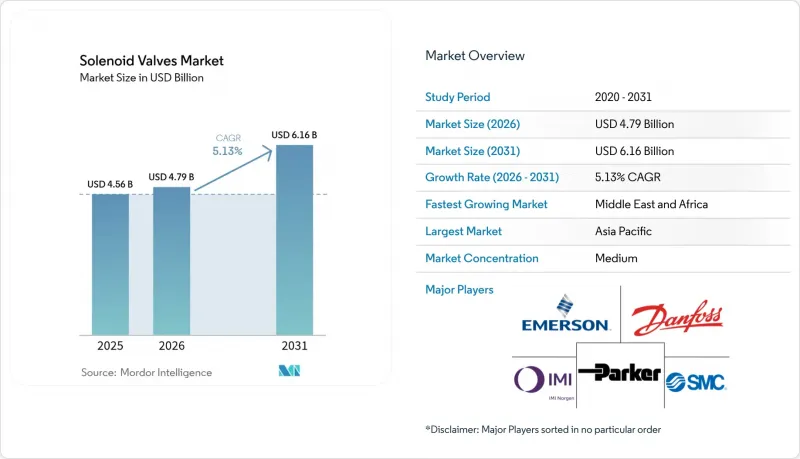
根據 Mordor Intelligence 預測,電磁閥市場規模將從 2025 年的 45.6 億美元成長到 2026 年的 47.9 億美元,然後在 2031 年達到 61.6 億美元,2026 年至 2031 年的複合年成長率為 5.13%。
本報告按運行原理(直動式、先導式)、連接埠配置(雙向、三向、四向)、材質(黃銅、鋼、鋁、塑膠)、尺寸(微型、超微型、迷你型、小型、大型)、最終用戶(食品、汽車、化學、石油天然氣、醫療等)和地區進行細分。市場預測以美元(USD)計價。
全球電磁閥市場趨勢及洞察
歐盟和海灣合作理事會工業污水再利用計畫的擴展
歐盟關於循環經濟的指令以及波灣合作理事會(GCC)強制性的水資源短缺措施正在加速對先進處理設施的投資,這些設施需要自動化學藥劑注入、反沖洗控制和級間切換。電磁閥能夠實現手動裝置無法實現的精確無洩漏操作,尤其是在處理配方隨進水水質波動而變化的情況下。中東地區部署零液體排放裝置的石油生產商傾向於選擇具有數位位置回饋的不銹鋼或雙相鋼閥體,以滿足環境審計要求。
緊湊型電動車溫度控管迴路對微型電磁閥的需求激增。
下一代電動車採用多迴路電路,依靠高速、高能源效率的微型電磁閥為電池冷卻、電力電子冷卻器和車載空調(HVAC)供電。三華汽車等供應商正在將冷媒型電磁閥商業化,這些電磁閥能夠在電池組有限的空間內運行,並能承受數百萬次的循環。輕量化的PEEK閥體和低功耗線圈延長了續航里程,使這一領域成為電磁閥市場的主要成長引擎。
在超過 120 度C 的應用中,高開關循環疲勞
在蒸氣管道和高溫反應器中,電磁線圈會經歷加速的介電擊穿。雖然目前已有高品質的耐熱銅線圈和全氟橡膠密封件,但它們會推高元件成本,阻礙其在價格敏感型專案中的應用。而對於維修週期較長的公共產業而言,改用高密度線圈風險較高,也抑制了電磁閥市場的成長。
細分市場分析
到2025年,直動式電磁閥將主導電磁閥市場,佔41.60%的市佔率。預計到2026年,其銷售額將達到19.9億美元。直動式電磁閥結構簡單、壓力損失小、循環速度快,使其適用於公共產業供水管路和OEM機械設備。同時,以6.65%的複合年成長率快速成長的先導式電磁閥,正擴大應用於井口、動力鍋爐和大型化學反應器等需要超過25毫米端口直徑和超過100巴壓力的場合。艾默生的頁岩氣解決方案正是這一轉變的典型例證,它將微電磁先導裝置與活塞隔膜結合,每小時可輸送數千標準立方公尺的氣體。先導式電磁閥的低湧入電流和靜音關閉特性,正是那些正在轉型為預測性維護平台的產業所需要的。
這一趨勢正在改變供應鏈的需求。線圈必須能夠承受上游壓力波動,隔膜需要耐磨彈性體,而閥體通常整合螺桿式感測器,以便向PLC提供資料。亞洲製造商目前正在廣泛複製傳統先導式閥門的形狀,加劇了價格競爭,但新興經濟體供應量的增加也推動了電磁閥市場的成長。
雙向截止閥仍是核心產品,預計到2025年將佔電磁閥銷售額的54.30%,約佔電磁閥市場24.8億美元的佔有率。它們在灌溉、壓縮空氣和基本製程截止應用中佔據主導地位。然而,隨著食品、飲料和生技產業的使用者對快速切換產品型號的需求日益成長,三通分流閥的設計正以每年6.18%的速度成長。這些閥門無需手動更換閥芯即可在生產、CIP清洗和滅菌流程之間切換,並符合衛生標準。一些製藥撬裝設備現在將20多個三通閥整合到一個數位歧管中,從而減少了30%的面積,並顯著縮短了安裝時間。
製造商正透過採用無腔內部結構和經FDA認證的密封件來解決這個問題,從而消除污染物可能積聚的死角。控制軟體將每個連接埠對應到一個PLC標籤,從而實現基於配方的流路配置。這種多端口技術的創新也正在擴展到半導體濕式製程台,在這些製程台上,化學品需要在毫秒內流經多個清洗槽和蝕刻槽,這進一步推動了三通閥在電磁閥市場的應用。
區域分析
亞太地區預計到2025年將佔全球銷售額的33.70%,該地區正充分利用中國龐大的電子產品生產能力、日本的精密機器人技術以及印度不斷成長的藥品出口。政府支持國內半導體製造廠和電池工廠的政策正在推動歧管的應用,而日本和韓國的氫氣試點走廊則需要能夠承受700巴氣體環境的高可靠性閥門。此外,中國沿海省份日益嚴格的水資源再利用政策也催生了地方政府的新需求。
中東和非洲地區預計將以7.10%的複合年成長率成長,受益於沙烏地阿拉伯「2030願景」下的多元化計畫以及阿拉伯聯合大公國的大型石化計畫。阿曼和沙烏地阿拉伯的NEOM氫氣和氨出口計畫需要用於低溫和高壓環境的專用先導式閥門。非洲的成長由多元化的需求驅動,儘管成長率較為溫和,主要來自南非礦山廢水處理和埃及食品加工業的擴張。
在北美,頁岩氣、液化天然氣和製藥業的售後市場銷售依然強勁。科羅拉多和德克薩斯州零排放井口閥的快速部署表明,監管主導的資本投資正在升級現有設備。在加拿大,二氧化碳捕集示範工廠需要耐腐蝕電磁閥來處理混合二氧化碳流。歐洲作為一個成熟且創新主導的地區,正將重點轉向綠色氫能和數位化製造。雖然這種轉型減緩了表面成長,但它確保了支援IO-Link的智慧閥的價值,並在電磁閥市場確立了高階價格區間。
其他好處:
- Excel格式的市場預測(ME)表
- 3個月的分析師支持
目錄
第1章:引言
- 研究假設和市場定義
- 調查範圍
第2章:調查方法
第3章執行摘要
第4章 市場狀況
- 市場概覽
- 市場促進因素
- 歐盟和海灣合作理事會工業污水再利用計畫的擴展
- 緊湊型電動車的溫度控管迴路需求激增,需要微型螺線管。
- 東協地區現有飲料生產線衛生設計的快速維修
- 美國和阿根廷頁岩盆地的自動化天然氣井
- 歐洲和日本氫電解設備安裝規模擴大
- 「製藥4.0」對智慧、IO-Link相容閥門的需求日益成長
- 市場限制因素
- 在超過 120°C 的應用中,高開關循環疲勞
- 特殊合金(例如雙相不銹鋼)的價格波動
- 拉丁美洲現場改造試運行技術純熟勞工短缺
- 醫療OEM市場中,壓電微閥的競爭日益激烈。
- 價值供應鏈分析
- 監管和技術展望
- 波特五力分析
- 價格分析(如適用)
- 行業標準和法規
- 技術概述
- 電磁閥的發展演變及其在電動車和自動駕駛汽車領域的新應用。
- 關鍵設計與技術考量
第5章 市場規模與成長預測
- 運行原理
- 直接作用型
- 先導操作
- 埠/流配置
- 雙向
- 三向
- 4 種或更多方法
- 閥體材質
- 黃銅
- 不銹鋼
- 鋁
- 工程塑膠和複合材料
- 尺寸
- 微型(小於5毫米)
- 超小型(5-10毫米)
- 微縮模型(10-25毫米)
- 小光圈(25-50毫米)
- 大直徑隔膜(超過 50 毫米)
- 按最終用戶行業分類
- 食品/飲料
- 過濾系統
- 灌裝/稱重線
- 車
- 氣壓懸吊
- 燃油噴射和排放氣體
- 安全保障系統
- 變速箱和傳動系統
- 其他(暖通空調、門)
- 化工/石油化工
- 儲存方向控制
- 關閉閥
- 發電
- 蒸氣控制和給水器
- 電梯和水泵
- Deluge Systems
- 石油和天然氣
- 挖掘
- 礦業
- 下游供應
- 醫療和藥品
- 其他垂直市場(農業技術、航太、紡織等)
- 食品/飲料
- 按地區
- 北美洲
- 美國
- 加拿大
- 墨西哥
- 歐洲
- 英國
- 德國
- 法國
- 義大利
- 其他歐洲國家
- 亞太地區
- 中國
- 日本
- 印度
- 韓國
- 其他亞太國家
- 中東
- 以色列
- 沙烏地阿拉伯
- 阿拉伯聯合大公國
- 土耳其
- 其他中東國家
- 非洲
- 南非
- 埃及
- 其他非洲國家
- 南美洲
- 巴西
- 阿根廷
- 其他南美國家
- 北美洲
第6章 競爭情勢
- 市場集中度
- 策略措施(併購、合資、智慧財產權)
- 市佔率分析
- 公司簡介
- Emerson Electric Co.(ASCO)
- Danfoss A/S
- Parker-Hannifin Corp.
- SMC Corp.
- IMI plc
- Burkert GmbH and Co. KG
- Curtiss-Wright Corp.
- AirTAC International Group
- Kendrion NV
- The Lee Co.
- CEME SpA
- PeterPaul Electronics Co.
- CKD Corp.
- Anshan Solenoid Valve Co.
- KANKEO SANGYO Co.
- Rotex Automation
- Festo SE and Co. KG
- ODE Srl
- GEMU Group
- Genebre SA
第7章 市場機會與未來展望
According to Mordor Intelligence, the solenoid valves market size is expected to grow from USD 4.56 billion in 2025 to USD 4.79 billion in 2026 and is forecast to reach USD 6.16 billion by 2031 at 5.13% CAGR over 2026-2031.
This report is Segmented by Operating Principle (Direct-Acting, Pilot-Operated), Port Configuration (Two-Way, Three-Way, and Four-Way), Material (Brass, Steel, Aluminum, and Plastics), Size (Micro, Sub, Mini, Small, and Large), End-User (Food, Automotive, Chemical, Oil and Gas, Healthcare, and More), and Geography. The Market Forecasts are Provided in Terms of Value (USD).
Global Solenoid Valves Market Trends and Insights
Expansion of Industrial Waste-water Re-use Schemes in EU & GCC
Circular-economy directives in the European Union and water-scarcity mandates in the Gulf Cooperation Council are accelerating investments in advanced treatment plants that need automated chemical dosing, back-flush control, and stage switching. Solenoid valves enable precise, low-leak actuation that manual devices cannot match, especially when treatment recipes shift with feed-water variability. Oil producers adopting zero-liquid-discharge plants in the Middle East prefer stainless-steel or duplex bodies coupled with digital position feedback to meet environmental audits.
Surge in Compact EV Thermal-Management Loops Requiring Micro-Solenoids
Battery cooling, power-electronics chillers, and cabin HVAC in next-generation EVs integrate multi-loop circuits that depend on fast, energy-efficient micro-solenoids. Suppliers such as Sanhua Automotive have commercialized refrigerant versions able to cycle millions of times while operating inside constrained battery packs. Lightweight PEEK bodies and low-power coils extend driving range, making the segment a core growth engine for the solenoid valves market.
High Switching-Cycle Fatigue in >120 °C Applications
Steam lines and high-temperature reactors expose solenoid coils to accelerated insulation breakdown. Premium high-temp copper windings and perfluoro-elastomer seals are available but raise bill-of-material cost, curbing adoption in price-sensitive projects. Utilities facing extended maintenance intervals perceive risk in swapping to higher-density windings, moderating growth for the solenoid valves market.
Other drivers and restraints analyzed in the detailed report include:
- Rapid Retrofit of Legacy Beverage Lines in ASEAN for Hygienic Design
- Gas Well-Head Automation in Shale Basins of US & Argentina
- Price Volatility of Specialty Alloys (e.g., Duplex Stainless)
For complete list of drivers and restraints, kindly check the Table Of Contents.
Segment Analysis
Direct-acting valves led the solenoid valves market with 41.60% share in 2025, translating to an estimated USD 1.99 billion of 2026 revenue. Their simple architecture, minimal pressure drop, and fast cycling suit utilities water lines and OEM machinery. Yet pilot-operated mechanisms, advancing at 6.65% CAGR, increasingly service wellheads, power boilers, and large chemical reactors that require ports above 25 mm and pressures exceeding 100 bar. Emerson's shale-gas solution highlights the shift, pairing a minute electromagnetic pilot with a piston diaphragm able to pass thousands of standard cubic meters per hour. Industries upgrading to predictive maintenance platforms value the lower inrush current and quieter closing profile typical of pilot-operated units.
The move alters supply-chain needs: coils must tolerate fluctuating upstream pressures, diaphragms demand abrasion-resistant elastomers, and housings often integrate threaded sensors that feed PLCs. Asian fabricators now replicate classic pilot-operated geometries at scale, intensifying price pressure but also expanding availability across emerging economies, thereby broadening the solenoid valves market.
Two-way shut-off valves remain the workhorse, holding 54.30% revenue in 2025, roughly USD 2.48 billion of solenoid valves market size. They dominate irrigation, compressed-air, and basic process isolation. However, as food, beverage, and biotech adopters demand rapid SKU changeovers, three-way diverter designs grow 6.18% annually. These valves alternate between production, CIP, and sterilization streams without manual spool changes, aligning with hygienic directives. Certain pharmaceutical skids now bundle twenty or more three-way units on a single digital manifold, trimming footprint by 30% and slashing install time.
Manufacturers respond with cavity-free internals and FDA-approved seals that eliminate dead legs where contaminants accumulate. Control software maps each port to PLC tags, enabling recipe-driven flow paths. Multi-port innovations bleed into semiconductor wet benches, where chemistries must route through multiple rinse and etch tanks in milliseconds, reinforcing three-way adoption across the solenoid valves market.
Complete Report Scope:
- By Operating Principle
- Direct-Acting
- Pilot-Operated
- By Port/Flow Configuration
- Two-Way
- Three-Way
- Four-Way and Above
- By Valve Body Material
- Brass
- Stainless Steel
- Aluminum
- Engineering Plastics and Composites
- By Size
- Micro-Miniature (less than 5 mm)
- Sub-Miniature (5-10 mm)
- Miniature (10-25 mm)
- Small Diaphragm (25-50 mm)
- Large Diaphragm (greater than 50 mm)
- By End-user Industry
- Food and Beverage
- Filtration Systems
- Filling / Dosing Lines
- Automotive
- Air-Suspension
- Fuel Injection and Emission
- Safety and Security Systems
- Transmission and Driveline
- Others (HVAC, Doors)
- Chemical and Petrochemical
- Direction Control for Storage
- Isolation Valves
- Power Generation
- Steam Control and Feeders
- Lifts and Pumping
- Deluge Systems
- Oil and Gas
- Drilling
- Extraction
- Downstream Supply
- Healthcare and Pharmaceutical
- Other Verticals (Agri-Tech, Aerospace, Textile, etc.)
- Food and Beverage
- By Geography
- North America
- United States
- Canada
- Mexico
- Europe
- United Kingdom
- Germany
- France
- Italy
- Rest of Europe
- Asia-Pacific
- China
- Japan
- India
- South Korea
- Rest of Asia-Pacific
- Middle East
- Israel
- Saudi Arabia
- United Arab Emirates
- Turkey
- Rest of Middle East
- Africa
- South Africa
- Egypt
- Rest of Africa
- South America
- Brazil
- Argentina
- Rest of South America
- North America
Geography Analysis
Asia-Pacific, home to 33.70% of 2025 revenue, leverages China's vast electronics output, Japan's precision robotics, and India's expanding pharma exports. Governments supporting domestic semiconductor fabs and battery plants fuel manifold adoption, while hydrogen pilot corridors in Japan and Korea demand high-integrity valves able to tolerate 700 bar gaseous service. Additionally, rising water-reuse mandates in coastal Chinese provinces add fresh municipal demand.
The Middle East and Africa, posting a projected 7.10% CAGR, benefits from Vision 2030 diversification projects in Saudi Arabia and petrochemical mega-sites in the UAE. Hydrogen-ammonia export plans from Oman and Saudi NEOM require specialized pilot-operated valves compatible with cryogenic and high-pressure duty. African growth centers on South African mining dewatering and Egyptian food-processing expansion, driving moderate yet diverse uptake.
North America contributes steady aftermarket turnover in shale gas, LNG, and pharma. The rapid rollout of zero-emissions wellhead valves across Colorado and Texas showcases regulatory-driven capex that refreshes installed bases. In Canada, carbon-capture demonstration plants call for corrosion-proof solenoids handling CO2 mixed streams. Europe, a mature yet innovation-led region, pivots to green hydrogen and digitalized manufacturing. That pivot secures value for smart IO-Link-ready valves despite slower headline growth, anchoring premium price bands within the solenoid valves market.
- Emerson Electric Co. (ASCO)
- Danfoss A/S
- Parker-Hannifin Corp.
- SMC Corp.
- IMI plc
- Burkert GmbH and Co. KG
- Curtiss-Wright Corp.
- AirTAC International Group
- Kendrion N.V.
- The Lee Co.
- CEME S.p.A
- PeterPaul Electronics Co.
- CKD Corp.
- Anshan Solenoid Valve Co.
- KANKEO SANGYO Co.
- Rotex Automation
- Festo SE and Co. KG
- ODE S.r.l.
- GEMU Group
- Genebre S.A.
Additional Benefits:
- The market estimate (ME) sheet in Excel format
- 3 months of analyst support
TABLE OF CONTENTS
1 INTRODUCTION
- 1.1 Study Assumptions and Market Definition
- 1.2 Scope of the Study
2 RESEARCH METHODOLOGY
3 EXECUTIVE SUMMARY
4 MARKET LANDSCAPE
- 4.1 Market Overview
- 4.2 Market Drivers
- 4.2.1 Expansion of Industrial Waste-water Re-use Schemes in EU and GCC
- 4.2.2 Surge in Compact EV Thermal-Management Loops Requiring Micro-Solenoids
- 4.2.3 Rapid Retrofit of Legacy Beverage Lines in ASEAN for Hygienic Design
- 4.2.4 Gas Well-Head Automation in Shale Basins of US and Argentina
- 4.2.5 Hydrogen Electrolyzer Build-Out in Europe and Japan
- 4.2.6 Growing Preference for Smart, IO-Link-Enabled Valves in Pharma 4.0
- 4.3 Market Restraints
- 4.3.1 High Switching-Cycle Fatigue in greater than 120 degree C Applications
- 4.3.2 Price Volatility of Specialty Alloys (e.g., Duplex SS)
- 4.3.3 Skilled Labor Shortage for Field Retro-Commissioning in LATAM
- 4.3.4 Rising Competition from Piezo-Electric Micro-Valves in Medical OEMs
- 4.4 Value / Supply-Chain Analysis
- 4.5 Regulatory and Technological Outlook
- 4.6 Porter's Five Forces Analysis
- 4.6.1 Threat of New Entrants
- 4.6.2 Bargaining Power of Buyers
- 4.6.3 Bargaining Power of Suppliers
- 4.6.4 Threat of Substitutes
- 4.6.5 Intensity of Competitive Rivalry
- 4.7 Pricing Analysis (if applicable)
- 4.8 Industry Standards and Regulations
- 4.9 Technology Snapshot
- 4.9.1 Evolution of Solenoid Valves and Emerging EV / AV Uses
- 4.9.2 Major Design and Technical Considerations
5 MARKET SIZE AND GROWTH FORECASTS (VALUE)
- 5.1 By Operating Principle
- 5.1.1 Direct-Acting
- 5.1.2 Pilot-Operated
- 5.2 By Port/Flow Configuration
- 5.2.1 Two-Way
- 5.2.2 Three-Way
- 5.2.3 Four-Way and Above
- 5.3 By Valve Body Material
- 5.3.1 Brass
- 5.3.2 Stainless Steel
- 5.3.3 Aluminum
- 5.3.4 Engineering Plastics and Composites
- 5.4 By Size
- 5.4.1 Micro-Miniature (less than 5 mm)
- 5.4.2 Sub-Miniature (5-10 mm)
- 5.4.3 Miniature (10-25 mm)
- 5.4.4 Small Diaphragm (25-50 mm)
- 5.4.5 Large Diaphragm (greater than 50 mm)
- 5.5 By End-user Industry
- 5.5.1 Food and Beverage
- 5.5.1.1 Filtration Systems
- 5.5.1.2 Filling / Dosing Lines
- 5.5.2 Automotive
- 5.5.2.1 Air-Suspension
- 5.5.2.2 Fuel Injection and Emission
- 5.5.2.3 Safety and Security Systems
- 5.5.2.4 Transmission and Driveline
- 5.5.2.5 Others (HVAC, Doors)
- 5.5.3 Chemical and Petrochemical
- 5.5.3.1 Direction Control for Storage
- 5.5.3.2 Isolation Valves
- 5.5.4 Power Generation
- 5.5.4.1 Steam Control and Feeders
- 5.5.4.2 Lifts and Pumping
- 5.5.4.3 Deluge Systems
- 5.5.5 Oil and Gas
- 5.5.5.1 Drilling
- 5.5.5.2 Extraction
- 5.5.5.3 Downstream Supply
- 5.5.6 Healthcare and Pharmaceutical
- 5.5.7 Other Verticals (Agri-Tech, Aerospace, Textile, etc.)
- 5.5.1 Food and Beverage
- 5.6 By Geography
- 5.6.1 North America
- 5.6.1.1 United States
- 5.6.1.2 Canada
- 5.6.1.3 Mexico
- 5.6.2 Europe
- 5.6.2.1 United Kingdom
- 5.6.2.2 Germany
- 5.6.2.3 France
- 5.6.2.4 Italy
- 5.6.2.5 Rest of Europe
- 5.6.3 Asia-Pacific
- 5.6.3.1 China
- 5.6.3.2 Japan
- 5.6.3.3 India
- 5.6.3.4 South Korea
- 5.6.3.5 Rest of Asia-Pacific
- 5.6.4 Middle East
- 5.6.4.1 Israel
- 5.6.4.2 Saudi Arabia
- 5.6.4.3 United Arab Emirates
- 5.6.4.4 Turkey
- 5.6.4.5 Rest of Middle East
- 5.6.5 Africa
- 5.6.5.1 South Africa
- 5.6.5.2 Egypt
- 5.6.5.3 Rest of Africa
- 5.6.6 South America
- 5.6.6.1 Brazil
- 5.6.6.2 Argentina
- 5.6.6.3 Rest of South America
- 5.6.1 North America
6 COMPETITIVE LANDSCAPE
- 6.1 Market Concentration
- 6.2 Strategic Moves (M&A, JV, IP)
- 6.3 Market Share Analysis
- 6.4 Company Profiles (includes Global level Overview, Market level overview, Core Segments, Financials as available, Strategic Information, Market Rank/Share for key companies, Products and Services, and Recent Developments)
- 6.4.1 Emerson Electric Co. (ASCO)
- 6.4.2 Danfoss A/S
- 6.4.3 Parker-Hannifin Corp.
- 6.4.4 SMC Corp.
- 6.4.5 IMI plc
- 6.4.6 Burkert GmbH and Co. KG
- 6.4.7 Curtiss-Wright Corp.
- 6.4.8 AirTAC International Group
- 6.4.9 Kendrion N.V.
- 6.4.10 The Lee Co.
- 6.4.11 CEME S.p.A
- 6.4.12 PeterPaul Electronics Co.
- 6.4.13 CKD Corp.
- 6.4.14 Anshan Solenoid Valve Co.
- 6.4.15 KANKEO SANGYO Co.
- 6.4.16 Rotex Automation
- 6.4.17 Festo SE and Co. KG
- 6.4.18 ODE S.r.l.
- 6.4.19 GEMU Group
- 6.4.20 Genebre S.A.
7 MARKET OPPORTUNITIES AND FUTURE OUTLOOK
- 7.1 White-space and Unmet-need Assessment

 微流體電磁閥市場:全球市場預測,2026-2032年常閉式電磁閥市場:全球市場預測,2026-2032年
 全球電磁閥市場:市場規模、佔有率、趨勢和成長分析(2026-2034)
 2026年全球二通電磁閥市場報告
 「2026年全球氫氣壓力電磁閥市場研究報告」隔膜式流量調節器市場:2026-2032年全球市場預測(依產品類型、隔膜材質、隔膜厚度、銷售管道、應用及最終用途產業分類)電磁閥市場:依產品類型、材料、閥門類型、工作原理、密封材料、電壓等級、外形規格、介質類型、最終用戶產業、通路分類-全球預測,2026-2032年高溫蒸氣電磁閥市場依閥型、材質、壓力範圍、工作電壓、連接方式及最終用途產業分類,全球預測(2026-2032年)
 電磁閥市場規模、佔有率及成長分析(依閥類型、驅動介質、應用領域、驅動方式及地區分類)-2026-2033年產業預測全球電磁閥低功耗智慧晶片市場(按閥類型、流體介質、驅動方式、連接通訊協定、終端用戶產業和銷售管道)預測(2026-2032年)