


 |
市場調查報告書
商品編碼
2121661
PMMA微球:市佔率分析、產業趨勢與統計、成長預測(2026-2031年)PMMA Microspheres - Market Share Analysis, Industry Trends & Statistics, Growth Forecasts (2026 - 2031) |
||||||

※ 本網頁內容可能與最新版本有所差異。詳細情況請與我們聯繫。
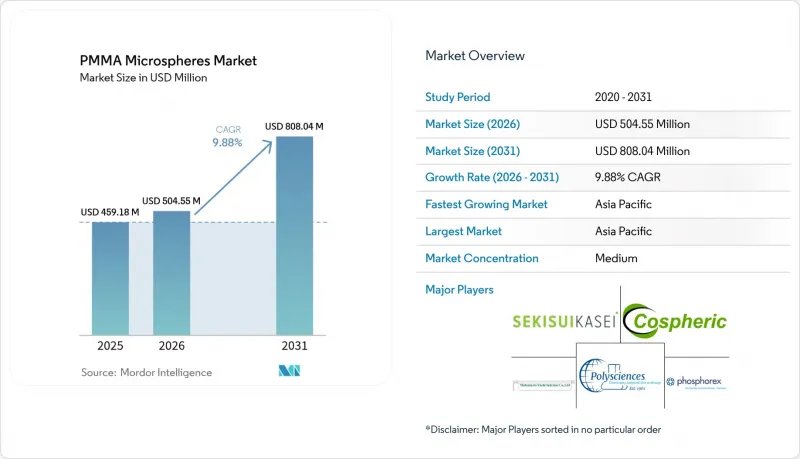
根據 Mordor Intelligence 預測,PMMA 微球市場規模將從 2025 年的 4.5918 億美元成長到 2026 年的 5.0455 億美元,到 2031 年將達到 8.0804 億美元,2026 年至 2031 年的複合年成長率為 9.88%。
本報告按應用領域(光擴散劑、消光劑、化妝品添加劑等)、終端用戶產業(生命科學與醫療、個人護理與化妝品、電子等)、粒徑(0-30微米、30-100微米、大於100微米)以及地區(亞太地區、北美地區、歐洲地區、南美地區、中東和非洲地區)進行細分。市場預測以美元計價。
全球PMMA微球市場趨勢及洞察
在微創美容療程中,對PMMA皮膚填充劑的需求正在擴大。
Bellafill是唯一獲得FDA核准的永久性注射填充劑,含有20%的PMMA微球,可有效減少皺紋,效果永續長達15年。在4725例臀部填充手術中,其肉芽腫發生率僅0.011%,凸顯了其長期安全性。直徑30-50微米的微球可促進膠原蛋白內源性生成,同時抵抗吞噬作用,提供持久的組織支撐。其在大容量體型雕塑的應用,使其患者群從臉部美學擴展到更廣泛的領域,推動了PMMA微球市場的發展。診所也因其減少了重複治療次數而青睞有加,從而為醫用級供應商創造了穩定的需求。
在藥物傳遞和栓塞治療領域的應用不斷擴展。
與聚苯乙烯相比,PMMA微球的特異性蛋白質結合較少,從而提高了緩釋系統的生物相容性。表面羧基增強了藥物結合,1.19 g/cc的密度有利於離心分離。目前,連續生產孔徑為50 nm的單分散多孔顆粒已成為製造抗癌藥物洗脫微球的可能。由於成本降低和批次間一致性提高,這種連續生產方法正引起越來越多的商業性關注。
監管機構會對永久性皮膚填充劑的安全性進行嚴格審查。
目前僅有一種基於聚甲基膠原蛋白甲酯(PMMA)的填充劑獲得美國食品藥物管理局(FDA)的批准,凸顯了其嚴格的證據要件。不利事件與注射深度相關,黏膜下注射會增加結節形成的風險,因此要求從業人員接受強制性訓練。對牛膠原蛋白類產品進行強制性皮膚測試會增加成本。新興市場日益嚴格的監管可能會延長核准流程,儘管其臨床效果持久,但這可能限制其廣泛應用。
細分市場分析
至2025年,化妝品添加劑應用將佔PMMA微球市場佔有率的34.78%。 PMMA微球因其絲滑的質地、柔焦效果和活性成分的控釋特性而備受青睞。在高階護膚、彩妝和防曬油產品中,為了滿足安全審核要求,仍指定使用低MMA殘留的醫用級微球。然而,由於歐盟微塑膠法規的實施,大規模生產的乳液正轉向使用生物基填料,而對PMMA的需求也轉向了免沖洗精華液和針對性抗衰老產品系列。陶瓷聚合物的應用正以11.55%的複合年成長率成長。這是因為在積層製造的氧化鋁和氧化鋯部件中需要犧牲性PMMA模板來形成均勻的孔隙網路,而這對於提高抗熱衝擊性至關重要。用於顯示薄膜的光擴散器和用於工業塗料的消光添加劑保持著中等個位數的成長,分別用於提高能源效率和實現低光澤表面效果。在改性塑膠添加劑和油漆油墨添加劑領域,PMMA 微球的需求穩定,因為它們可以提高衝擊強度和流變控制。
區域分析
預計到2025年,亞太地區將在PMMA微球市場佔據領先地位,市佔率將達到39.05%。中國顯示面板製造商、日本精細化工企業和韓國消費性電子品牌是強勁需求的基石。儘管由於產能整合(包括住友化學在新加坡的業務重組),區域供應正轉向特種級產品,但預計到2031年,銷售量仍將維持10.44%的複合年成長率。政府對半導體和醫療設備供應鏈的支持措施將進一步擴大下游產業的消費。
在北美,FDA嚴格的標準正在推動符合ISO 13485標準的注射填充劑和診斷設備用微球的國內生產。 Bellafill品牌已為醫療需求奠定了堅實的基礎,而總部位於威斯康辛州的Nouryon公司正在擴大其用於包裝和建築添加劑的特種微球的生產。針對藥物輸送新創公司的研發稅額扣抵和創業投資投資,即使學名藥的生產轉移到海外,也有助於維持創新主導的需求。
歐洲對聚合物微粒的監管最為嚴格,但德國和荷蘭的先進製造地正在為高利潤塗料、汽車光學元件和人體醫療設備供應聚甲基丙烯酸甲酯(PMMA)微球。生產商正根據歐盟的循環經濟目標,投資於生物基或化學回收材料,以維持穩健但盈利的成長。南美、中東和非洲仍然是新興的機會地區,不斷擴大的醫療保健基礎設施和日益普及的基礎設施塗料推動了需求,但對進口的依賴和監管差異限制了其快速成長。
其他好處:
- Excel格式的市場預測(ME)表
- 3個月的分析師支持
目錄
第1章:引言
- 研究假設和市場定義
- 調查範圍
第2章:調查方法
第3章執行摘要
第4章 市場狀況
- 市場概覽
- 市場促進因素
- 微創整形外科領域對PMMA為基礎的皮膚填充劑的需求不斷成長。
- 在藥物傳遞治療和栓塞治療方面的應用已擴展。
- 在LED/LCD和塗料領域中,可用作光擴散劑和消光劑。
- 增加個人保健產品中的添加量,以改善產品質地。
- 需要PMMA校準珠的微流體診斷裝置
- 市場限制因素
- 監管機構會對永久性皮膚填充劑的安全性進行嚴格審查。
- MMA單體價格的波動正在影響生產成本。
- 全球單分散、高精度等級產品的產能有限。
- 價值鏈分析
- 波特五力模型
第5章 市場規模與成長預測
- 透過使用
- 光擴散劑
- 墊料代理
- 化妝品添加物
- 陶瓷發泡
- 改性塑膠添加劑
- 油漆和油墨添加劑
- 其他用途
- 按最終用戶行業分類
- 生命科學與醫學
- 個人護理化妝品
- 電子設備
- 油漆和塗料
- 塑膠
- 陶瓷和複合材料
- 其他終端用戶產業
- 按粒徑
- 0~30µm
- 30~100µm
- 100微米或以上
- 按地區
- 亞太地區
- 中國
- 日本
- 印度
- 韓國
- 其他亞太國家
- 北美洲
- 美國
- 加拿大
- 墨西哥
- 歐洲
- 德國
- 英國
- 法國
- 義大利
- 其他歐洲國家
- 南美洲
- 巴西
- 阿根廷
- 其他南美國家
- 中東和非洲
- 沙烏地阿拉伯
- 南非
- 其他中東和非洲國家
- 亞太地區
第6章 競爭情勢
- 市場集中度
- 策略趨勢
- 市佔率和排名分析
- 公司簡介
- Bangs Laboratories, Inc.
- CD Bioparticles
- Cospheric LLC
- EPRUI Biotech Co.,Ltd.
- Goodfellow Cambridge Ltd.
- Heyo Enterprises Co., Ltd.
- Kayaku AM.
- Matsumoto Yushi-Seiyaku Co.,Ltd
- microParticles GmbH
- Phosphorex
- Polysciences
- Sekisui Kasei Co., Ltd.
- Sumitomo Chemical Co., Ltd.
- Sunjin Beauty Science
第7章 市場機會與未來展望
According to Mordor Intelligence, the PMMA microspheres market size is expected to grow from USD 459.18 million in 2025 to USD 504.55 million in 2026 and is forecast to reach USD 808.04 million by 2031 at 9.88% CAGR over 2026-2031.
This report is Segmented by Application (Light Diffusing Agent, Matting Agent, Cosmetic Additive, and More), End-User Industry (Lifesciences & Medical, Personal Care & Cosmetics, Electronics, and More), Particle Size (0-30 Mm, 30-100 Mm, Greater Than 100 Mm), and Geography (Asia-Pacific, North America, Europe, South America, Middle East & Africa). The Market Forecasts are Provided in Terms of Value (USD).
Global PMMA Microspheres Market Trends and Insights
Growing Demand for PMMA Dermal Fillers in Minimally-Invasive Aesthetics
Bellafill, the only FDA-approved permanent injectable containing 20% PMMA microspheres, delivers wrinkle correction that persists for up to 15 years. A low 0.011% granuloma incidence reported across 4,725 gluteal-augmentation procedures underscores long-term safety. Microspheres in the 30-50 µm range resist phagocytosis yet foster collagen ingrowth, providing durable tissue support. Large-volume body-contouring usage is expanding the PMMA microspheres market by broadening the patient base beyond facial aesthetics. Clinics value reduced retreatment frequency, creating steady pull-through for medical-grade suppliers.
Expanding Use in Drug-Delivery & Embolization Therapies
PMMA microspheres offer lower nonspecific protein binding than polystyrene, improving biocompatibility in controlled-release systems. Surface carboxyl functionality enhances drug conjugation, while the density of 1.19 g/cc eases centrifugation handling. Continuous production of monodisperse porous particles with 50 nm pores now supports oncology drug-eluting beads. Commercial interest is rising as continuous manufacturing cuts costs and tightens batch consistency.
Regulatory Scrutiny Over Permanent Dermal-Filler Safety
Only one PMMA-based filler has FDA clearance, underscoring rigorous evidence requirements. Adverse events correlate with injection depth; submucosal placement increases nodule formation, prompting practitioner training mandates. Mandatory skin tests for bovine collagen carriers add cost. Emerging markets are tightening regulations, potentially lengthening approval timelines, and limiting broad uptake despite clinical durability advantages.
Other drivers and restraints analyzed in the detailed report include:
- Rising Utilisation in Personal-Care Formulations for Texture Enhancement
- Microfluidic Diagnostic Devices Requiring PMMA Calibration Beads
- MMA Monomer Price Volatility Impacting Production Costs
For complete list of drivers and restraints, kindly check the Table Of Contents.
Segment Analysis
Cosmetic Additive applications held 34.78% of PMMA microspheres market share in 2025, valued for imparting silky texture, soft-focus optics, and controlled release of actives. Premium skincare, color cosmetics, and suncare continue to specify medical-grade, low-residual MMA beads to satisfy safety audits. EU microplastic rules, however, are shifting large-volume mass-market lotions toward bio-based fillers, redirecting PMMA demand into leave-on serums and targeted anti-aging lines. Ceramic Porogen uses are accelerating at an 11.55% CAGR, as additive-manufactured alumina and zirconia components require sacrificial PMMA templates to engineer uniform pore networks critical for thermal-shock resistance. Light-diffusing agents in display films and matting additives in industrial coatings sustain mid-single-digit growth by delivering energy efficiency and low-gloss finishes, respectively. Modified Plastic Additive and Paints & Inks Additive segments absorb steady volumes where PMMA microspheres improve impact strength and rheology control.
Complete Report Scope:
- By Application
- Light Diffusing Agent
- Matting Agent
- Cosmetic Additive
- Ceramic Porogen
- Modified Plastic Additive
- Paints and Inks Additive
- Other Applications
- By End-user Industry
- Lifesciences and Medical
- Personal Care and Cosmetics
- Electronics
- Paints and Coatings
- Plastics
- Ceramics and Composites
- Other End-user Industries
- By Particle Size
- 0 - 30 µm
- 30 - 100 µm
- Greater than 100 µm
- By Geography
- Asia-Pacific
- China
- Japan
- India
- South Korea
- Rest of Asia-Pacific
- North America
- United States
- Canada
- Mexico
- Europe
- Germany
- United Kingdom
- France
- Italy
- Rest of Europe
- South America
- Brazil
- Argentina
- Rest of South America
- Middle East and Africa
- Saudi Arabia
- South Africa
- Rest of Middle East and Africa
- Asia-Pacific
Geography Analysis
Asia-Pacific led with 39.05% of PMMA microspheres market share in 2025. China's display-panel makers, Japanese fine-chemicals specialists, and South Korean consumer-electronics brands provide a robust demand backbone. Capacity consolidation, including Sumitomo Chemical's Singapore restructuring, nudges regional supply toward specialty grades yet maintains volume growth through 2031 at a 10.44% CAGR. Government incentives for semiconductor and medical-device supply chains further broaden downstream consumption.
North America benefits from stringent FDA standards, which favor domestic output of ISO-13485-compliant beads for injectable fillers and diagnostics. The Bellafill franchise anchors steady medical demand, while Wisconsin-based Nouryon has scaled specialty microsphere output for packaging and construction additives. R&D tax credits and venture capital funding in drug-delivery start-ups sustain innovation-driven consumption even as commodity volumes migrate offshore.
Europe faces the most restrictive polymer-micro-particle regulation, yet advanced-manufacturing bases in Germany and the Netherlands channel PMMA microspheres into high-margin coatings, automotive optics, and implantable medical devices. Producers are investing in bio-based or chemically recycled feedstocks that align with EU circular-economy goals, sustaining modest but profitable growth. South America and the Middle East & Africa remain emerging opportunity zones where growing healthcare infrastructure and infrastructure coatings uptake create incremental demand, though import dependence and regulatory variability temper rapid expansion.
- Bangs Laboratories, Inc.
- CD Bioparticles
- Cospheric LLC
- EPRUI Biotech Co.,Ltd.
- Goodfellow Cambridge Ltd.
- Heyo Enterprises Co., Ltd.
- Kayaku AM.
- Matsumoto Yushi-Seiyaku Co.,Ltd
- microParticles GmbH
- Phosphorex
- Polysciences
- Sekisui Kasei Co., Ltd.
- Sumitomo Chemical Co., Ltd.
- Sunjin Beauty Science
Additional Benefits:
- The market estimate (ME) sheet in Excel format
- 3 months of analyst support
TABLE OF CONTENTS
1 Introduction
- 1.1 Study Assumptions and Market Definition
- 1.2 Scope of the Study
2 Research Methodology
3 Executive Summary
4 Market Landscape
- 4.1 Market Overview
- 4.2 Market Drivers
- 4.2.1 Growing demand for PMMA dermal fillers in minimally-invasive aesthetics
- 4.2.2 Expanding use in drug-delivery and embolization therapies
- 4.2.3 Adoption as light-diffusing and matting agents in LED/LCD, coatings
- 4.2.4 Rising utilisation in personal-care formulations for texture enhancement
- 4.2.5 Microfluidic diagnostic devices requiring PMMA calibration beads
- 4.3 Market Restraints
- 4.3.1 Regulatory scrutiny over permanent dermal-filler safety
- 4.3.2 MMA monomer price volatility impacting production costs
- 4.3.3 Limited global capacity for monodisperse high-precision grades
- 4.4 Value Chain Analysis
- 4.5 Porter's Five Forces
- 4.5.1 Bargaining Power of Suppliers
- 4.5.2 Bargaining Power of Buyers
- 4.5.3 Threat of New Entrants
- 4.5.4 Threat of Substitutes
- 4.5.5 Degree of Competition
5 Market Size and Growth Forecasts (Value)
- 5.1 By Application
- 5.1.1 Light Diffusing Agent
- 5.1.2 Matting Agent
- 5.1.3 Cosmetic Additive
- 5.1.4 Ceramic Porogen
- 5.1.5 Modified Plastic Additive
- 5.1.6 Paints and Inks Additive
- 5.1.7 Other Applications
- 5.2 By End-user Industry
- 5.2.1 Lifesciences and Medical
- 5.2.2 Personal Care and Cosmetics
- 5.2.3 Electronics
- 5.2.4 Paints and Coatings
- 5.2.5 Plastics
- 5.2.6 Ceramics and Composites
- 5.2.7 Other End-user Industries
- 5.3 By Particle Size
- 5.3.1 0 - 30 µm
- 5.3.2 30 - 100 µm
- 5.3.3 Greater than 100 µm
- 5.4 By Geography
- 5.4.1 Asia-Pacific
- 5.4.1.1 China
- 5.4.1.2 Japan
- 5.4.1.3 India
- 5.4.1.4 South Korea
- 5.4.1.5 Rest of Asia-Pacific
- 5.4.2 North America
- 5.4.2.1 United States
- 5.4.2.2 Canada
- 5.4.2.3 Mexico
- 5.4.3 Europe
- 5.4.3.1 Germany
- 5.4.3.2 United Kingdom
- 5.4.3.3 France
- 5.4.3.4 Italy
- 5.4.3.5 Rest of Europe
- 5.4.4 South America
- 5.4.4.1 Brazil
- 5.4.4.2 Argentina
- 5.4.4.3 Rest of South America
- 5.4.5 Middle East and Africa
- 5.4.5.1 Saudi Arabia
- 5.4.5.2 South Africa
- 5.4.5.3 Rest of Middle East and Africa
- 5.4.1 Asia-Pacific
6 Competitive Landscape
- 6.1 Market Concentration
- 6.2 Strategic Moves
- 6.3 Market Share(%)/Ranking Analysis
- 6.4 Company Profiles (includes Global level Overview, Market level overview, Core Segments, Financials as available, Strategic Information, Market Rank/Share for key companies, Products and Services, and Recent Developments)
- 6.4.1 Bangs Laboratories, Inc.
- 6.4.2 CD Bioparticles
- 6.4.3 Cospheric LLC
- 6.4.4 EPRUI Biotech Co.,Ltd.
- 6.4.5 Goodfellow Cambridge Ltd.
- 6.4.6 Heyo Enterprises Co., Ltd.
- 6.4.7 Kayaku AM.
- 6.4.8 Matsumoto Yushi-Seiyaku Co.,Ltd
- 6.4.9 microParticles GmbH
- 6.4.10 Phosphorex
- 6.4.11 Polysciences
- 6.4.12 Sekisui Kasei Co., Ltd.
- 6.4.13 Sumitomo Chemical Co., Ltd.
- 6.4.14 Sunjin Beauty Science
7 Market Opportunities and Future Outlook
- 7.1 White-space and Unmet-need Assessment


