


 |
市場調查報告書
商品編碼
2121646
農業界面活性劑:市場佔有率分析、產業趨勢與統計、成長預測(2026-2031)Agricultural Surfactants - Market Share Analysis, Industry Trends & Statistics, Growth Forecasts (2026 - 2031) |
||||||

※ 本網頁內容可能與最新版本有所差異。詳細情況請與我們聯繫。
根據 Mordor Intelligence 預測,農業界面活性劑市場規模將從 2025 年的 22.6 億美元成長到 2026 年的 24 億美元,到 2031 年將達到 33.5 億美元,2026 年至 2031 年的複合年成長率為 6.90%。
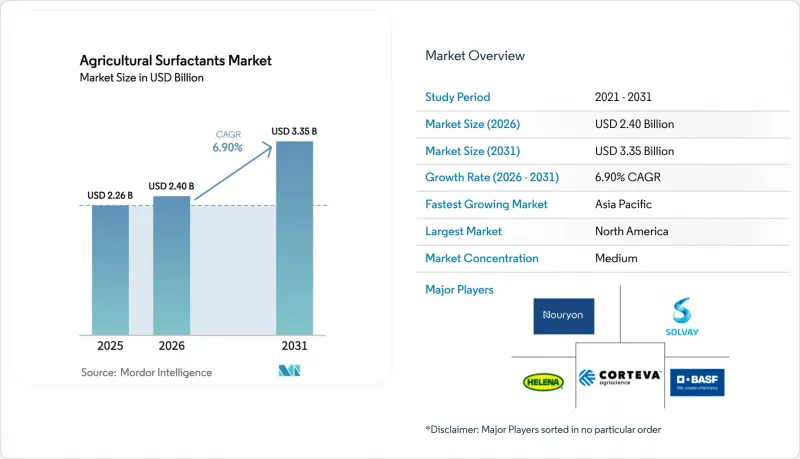
本報告按產品類型(例如,陰離子)、應用領域(例如,殺蟲劑)、基礎材料(例如,合成和生物基)、作物應用(例如,作物基)、劑型(液體和粉末/顆粒)、功能(例如,潤濕劑)以及地區(北美、歐洲、亞太地區及其他地區)進行細分。市場預測以美元計價。
全球農業界面活性劑市場趨勢及洞察
農藥需求的成長正在提高作物產量。
氣候變遷和害蟲抗藥性的出現使得每個生長季節需要多次施藥,導致每公頃表面活性劑用量增加。在巴西,2024年8月批准了100種新的農作物保護產品,預計將提振對大豆和玉米添加劑的需求。在印度,2024年農藥銷售量顯著成長,但由於硬水滲透性問題,界面活性劑的成長速度超過了活性成分。在中國,由於水稻和小麥種植勞動力短缺,預計2025年除草劑銷量將有所成長,同時對需要助劑以增強葉片附著力的化學除草劑的需求也在不斷成長。隨著對錶面張力低於30達因/公分的萌後除草劑的需求激增,小規模農戶更傾向於使用非離子型和油性化學品。
精密農業的引入導致表面活性劑的使用量增加。
目前,變數噴藥機可根據作物冠層密度、土壤濕度和風速調整添加劑的施用量。 2024年,北美農場對變數噴藥機的應用增加。同年11月,科迪華公司發布了一種演算法,該演算法可推薦針對不同作物最佳化的界面活性劑混合物,從而減少20%的總噴灑量並延長設備運作。歐洲的漂移控制法規正在加速對噴嘴技術和添加劑配方的投資,以將液滴尺寸控制在狹窄的範圍內。在澳洲的糧食產區,將GPS噴桿與線上界面活性劑輸液設備結合,使每個種植季節的添加劑浪費減少了15%。
生物基原料生產成本高
發酵法製取的脂醇類比石油基原料貴40%。印尼收緊出口限制後,棕櫚油價格在2025年初上漲了22%,推高了非離子原料的成本。 2024年至2025年間環氧乙烷價格30%至35%的波動,使沒有長期合約的小規模製劑生產商處於不利地位,削弱了它們與大型一體化企業的競爭力。棕櫚油和大豆油價格的飆升波及整個價值鏈,導致生物基界面活性劑中間體的合約價格在一個季度內上漲了兩位數。非垂直一體化的製劑生產商別無選擇,只能自行承擔這些價格波動,或將其轉嫁給生產商,但後一種策略會削弱對價格敏感的農產品的需求。
細分市場分析
到2025年,非離子化合物將佔據41%的市場。這主要歸功於其廣泛的兼容性和對硬水的耐受性。由於種子萌發後除草劑需要更深的角質層滲透,油基替代品的市場正以13.2%的複合年成長率成長。壬基酚聚氧乙烯醚類化合物因監管限制而逐步淘汰,由此產生了1.8億至2.2億美元的替代需求。生物基非離子界面活性劑,例如BASF的Sokalan CP 301,正在推動向可再生原料的轉型。
農業界面活性劑市場受益於合成產品的穩健性,即使在早春寒流中也能保持性能穩定;而混合型界面活性劑則兼顧了成本和永續性。兩性界面活性劑和陽離子界面活性劑產品目前仍處於小眾市場,但隨著水生雜草控制項目和pH緩衝劑罐混劑的應用,其市場佔有率持續成長。分散劑領域不斷湧現創新,例如科萊恩的可濕性粉劑“Dispasogen TP 100 T”,凸顯了這一成熟領域持續創新的勢頭。同時,亞什蘭的超潤濕劑「EasyWet 300 n」將於2024年9月上市,其目標應用是低表面張力的精準噴灑。
到2025年,除草劑的使用量將佔界面活性劑消耗量的46%,反映出Glyphosate、草銨膦和麥草畏在農作物種植中的主導地位。殺菌劑助劑的複合年成長率(CAGR)為12.4%,這主要受高價值作物生長後期病害壓力增加以及生物殺菌劑應用日益廣泛(生物殺菌劑需要非離子型、低毒助劑來維持微生物活性)的推動。殺蟲劑助劑在亞太地區的棉花和水稻種植中需求不斷成長,這主要是由於需要透過綜合蟲害管理(IPM)來提高噴灑覆蓋率。
BASF於2024年10月與AgroSpheres就生物殺蟲劑傳遞平台達成合作,凸顯了界面活性劑相容性在生物作物保護領域的戰略重要性。預計2030年,全球生物作物保護市場規模將達120億美元。與三唑類和甲氧基丙烯酸酯類酯類殺菌劑的相容性是產品設計的關鍵因素,Nouriyon公司的Adsee Flex 960就是一個例子。無人機噴霧器的普及推動了對內吸性除草劑需求的成長,並強化了對滲透促進劑的需求。此外,便利的桶混方式也促進了兼具潤濕、滲透和抑制漂移功能的多用途製劑的研發。
區域分析
到2025年,北美將以38%的市佔率引領市場。在大規模行栽作物種植中,根據作物冠層圖調整肥料用量的精準噴霧器正在推廣應用,可減少高達30%的用水量。美國環保署(EPA)的《農藥登記改進法案》正在推動傳統界面活性劑的重新配方。在墨西哥農業領域,界面活性劑在酪梨和漿果生產中的應用日益廣泛,而這些出口市場要求產品必須符合嚴格的殘留基準值,且不含任何殘留物。
亞太地區成長最快,複合年成長率達11.5%。由於印度水質硬度高以及中國勞動力短缺,對添加劑的需求不斷成長,而無人機噴灑計畫已使負載容量減少了75%。在中國,隨著2024年航空噴灑法規核准程序的簡化,用於無人機噴灑的超高濃度配方正迅速普及。在熱帶地區,由於濕度會導致植物毒性,奈米乳液的應用較為滯後,而適用於水稻和大豆的濕度響應型混合物的開發正在加速進行。
在歐洲,REACH法規和碳排放稅的指南下,可生物分解材料的使用正在取得進展。德國、法國和英國在農藥漂移控制技術方面處於主導地位。在南美洲,隨著巴西增加作物保護劑的註冊數量,並在其不斷擴大的大豆面積中推廣使用內吸性除草劑,市場正在成長。非洲和中東的成長則得益於農業集約化和精準灌溉。
其他好處:
- Excel格式的市場預測(ME)表
- 3個月的分析師支持
目錄
第1章:引言
- 研究假設和市場定義
- 調查範圍
第2章:調查方法
第3章執行摘要
第4章 市場狀況
- 市場概覽
- 市場促進因素
- 為提高作物產量,對殺蟲劑的需求不斷增加。
- 精密農業的引入導致表面活性劑的使用量增加。
- 人們對永續表面活性劑和生物基界面活性劑的興趣日益濃厚。
- 奈米表面活性劑的創新使其能夠實現超低劑量
- 生物作物保護的適用性要求
- 用於無人機噴灑的超高濃度配方
- 市場限制因素
- 生物基原料生產成本高
- 對化學殘留物實施嚴格監管
- 特殊乙氧基化物原料的供應波動
- 人們對奈米製劑在潮濕熱帶地區可能產生的植物毒性表示擔憂
- 監理情勢
- 技術展望
- 波特五力分析
第5章 市場規模與成長預測
- 依產品類型
- 陰離子類型
- 非離子型
- 陽離子
- 雌雄同體
- 油性界面活性劑
- 透過使用
- 除草劑
- 殺蟲劑
- 消毒劑
- 其他用途
- 按基礎材料
- 合成
- 生物基
- 透過應用於農作物
- 按作物
- 穀物和穀類
- 油籽
- 水果和蔬菜
- 非作物系統
- 草坪和觀賞草
- 其他作物用途
- 按作物
- 按形式
- 液體
- 粉末/顆粒狀
- 按功能
- 保濕劑
- 分散劑
- 滲透劑/輔助劑
- 按地區
- 北美洲
- 美國
- 加拿大
- 墨西哥
- 其他北美國家
- 歐洲
- 德國
- 英國
- 法國
- 西班牙
- 義大利
- 俄羅斯
- 其他歐洲國家
- 亞太地區
- 中國
- 印度
- 日本
- 澳洲
- 其他亞太國家
- 南美洲
- 巴西
- 阿根廷
- 其他南美國家
- 中東
- 沙烏地阿拉伯
- 阿拉伯聯合大公國
- 土耳其
- 其他中東國家
- 非洲
- 南非
- 奈及利亞
- 其他非洲國家
- 北美洲
第6章 競爭情勢
- 市場集中度
- 策略趨勢
- 市佔率分析
- 公司簡介
- Corteva Agriscience
- BASF SE
- RAG-Stiftung
- Croda International Plc
- Solvay SA
- Nouryon
- Clariant International Ltd.
- Wilbur-Ellis Company LLC
- Nufarm
- Kao Corporation
- Lamberti SpA
- Brandt, Inc.
- GarrCo Products, Inc.
- Bionema
- Innospec Inc.
- Stepan Company
- Loveland Products, Inc.(Nutrien)
- Norac Concepts Inc.
- Marubeni Corporation
第7章 市場機會與未來展望
According to Mordor Intelligence, the agricultural surfactants market size is anticipated to grow from USD 2.26 billion in 2025 to USD 2.40 billion in 2026 and is forecast to reach USD 3.35 billion by 2031 at a 6.90% CAGR over 2026-2031.
This report is Segmented by Product Type (Anionic, and More ), by Application (Insecticide, and More), by Substrate (Synthetic, and Bio-Based), by Crop Application (Crop-Based, and More), by Form (Liquid, and Powder/Granular), by Function (Wetting Agent, and More), and by Geography (North America, Europe, Asia-Pacific, and More). The Market Forecasts are Provided in Terms of Value (USD).
Global Agricultural Surfactants Market Trends and Insights
Rising Demand for Agrochemicals to Boost Crop Yield
Climate swings and pest resistance necessitate multiple spray passes each season, resulting in increased surfactant kilograms per hectare. Brazil cleared 100 new crop-protection products in August 2024, which is anticipated to lift demand for soybean and corn adjuvants. India's pesticide sales increased significantly in 2024, with surfactants outpacing actives due to challenges in penetrating hard water. China experienced growth in herbicide sales in 2025, amid labor shortages in rice and wheat, which led to increased demand for chemical weed control that relies on adjuvants for leaf adhesion. The spike in post-emergence herbicides that need surface tension below 30 dynes/cm favors nonionic and oil-based chemistries on smallholder farms.
Precision-Farming Adoption Increasing Surfactant Usage
Variable-rate sprayers now modulate adjuvant dose by canopy density, soil moisture, and wind speed. North American farm penetration increased in 2024, and algorithms showcased by Corteva in November 2024 recommend bespoke surfactant blends, trimming total spray volume by 20% and extending equipment uptime. Europe's drift-reduction rules accelerate investment in nozzle technology and adjuvant formulations that hold droplet size within tight bands. Australia's grain belt links GPS booms with inline surfactant injectors, cutting adjuvant waste by 15% per season.
High Production Cost of Bio-Based Raw Materials
Fermentation-derived fatty alcohols raise costs by up to 40% versus petroleum feedstocks. Palm oil rose 22% in early 2025 after Indonesia tightened exports, inflating nonionic input costs. Ethylene oxide volatility of 30-35% from 2024-2025 hampered small formulators that lack long contracts, undermining competitiveness against integrated majors. Price spikes in palm and soybean oil cascade through the value chain, lifting contract prices for bio-surfactant intermediates by double digits within a single quarter. Formulators without vertical integration must absorb this volatility or pass it to growers, a strategy that erodes demand in price-sensitive row crops.
Other drivers and restraints analyzed in the detailed report include:
- Growing Focus on Sustainable and Bio-Based Surfactants
- Nano-Surfactant Innovations Enabling Ultra-Low Doses
- Stringent Regulations on Chemical Residues
For complete list of drivers and restraints, kindly check the Table Of Contents.
Segment Analysis
Nonionic chemistries controlled 41% share in 2025, favored for broad compatibility and hard-water tolerance. Oil-based alternatives rise at 13.2% CAGR as post-emergence herbicides need deeper cuticle penetration. Regulatory phase-outs of nonylphenol ethoxylates open a USD 180-220 million replacement pool. Bio-based nonionics, such as BASF's Sokalan CP 301, anchor the pivot toward renewable content.
The agricultural surfactants market benefits from synthetic robustness in early-season cold spells, while hybrid blends balance cost and sustainability. Amphoteric and cationic options stay niche yet grow with aquatic weed programs and pH-buffered tank mixes. Innovation continues in dispersants such as Clariant's Dispersogen TP 100 T for wettable powders, underscoring ongoing innovation in this mature segment, while Ashland's easy-wet 300 n super wetting agent, commercialized in September 2024, targets low-surface-tension applications in precision spraying.
Herbicide applications commanded 46% of surfactant consumption in 2025, reflecting the dominance of glyphosate, glufosinate, and dicamba programs in row-crop agriculture. Fungicide-friendly adjuvants grow at 12.4% CAGR driven by late-season disease pressure in high-value crops and the proliferation of biological fungicides that demand non-ionic, low-toxicity adjuvants to preserve microbial viability. Insecticide adjuvants rise in Asia-Pacific cotton and rice, where integrated pest management boosts coverage needs.
BASF's October 2024 partnership with AgroSpheres on bioinsecticide delivery platforms illustrates the strategic importance of surfactant compatibility in biological crop protection, a segment forecast to reach USD 12 billion globally by 2030. Compatibility with triazole and strobilurin fungicides steers product design, as evidenced by Nouryon's Adsee Flex 960. Drone sprayers elevate systemic herbicide needs, reinforcing demand for penetrant agents. Tank-mix simplicity also drives multipurpose formulations that combine wetting, penetration, and drift control.
Complete Report Scope:
- By Product Type
- Anionic
- Nonionic
- Cationic
- Amphoteric
- Oil-based Surfactants
- By Application
- Herbicide
- Insecticide
- Fungicide
- Other Applications
- By Substrate
- Synthetic
- Bio-based
- By Crop Application
- Crop-based
- Grains and Cereals
- Oilseeds
- Fruits and Vegetables
- Non-crop-based
- Turf and Ornamental Grass
- Other Crop Applications
- Crop-based
- By Form
- Liquid
- Powder/Granular
- By Function
- Wetting Agent
- Dispersant
- Penetrant/Adjuvant
- By Geography
- North America
- United States
- Canada
- Mexico
- Rest of North America
- Europe
- Germany
- United Kingdom
- France
- Spain
- Italy
- Russia
- Rest of Europe
- Asia-Pacific
- China
- India
- Japan
- Australia
- Rest of Asia-Pacific
- South America
- Brazil
- Argentina
- Rest of South America
- Middle East
- Saudi Arabia
- United Arab Emirates
- Turkey
- Rest of Middle East
- Africa
- South Africa
- Nigeria
- Rest of Africa
- North America
Geography Analysis
North America dominated with 38% share in 2025. Large row-crop operations embrace precision sprayers that align adjuvant dose with canopy maps, reducing water use by up to 30%. Regulatory influence from the EPA's Pesticide Registration Improvement Act is forcing reformulation of legacy surfactants. Mexico's agricultural sector is expanding surfactant usage in avocado and berry production, where export markets demand residue-free produce that meets stringent maximum residue limits.
Asia-Pacific represents the fastest expansion at 11.5% CAGR. India's hard-water conditions and China's labor shortages elevate adjuvant requirements, and drone programs compress payload volume by 75%. Ultra-high-concentration formulations for drone spraying are advancing rapidly in China, where regulatory approvals for aerial application were streamlined in 2024. Humidity-driven phytotoxicity in tropical zones slows nano-emulsion rollouts but accelerates development of moisture-responsive blends suited for rice and soybean.
Europe advances, guided by REACH and carbon taxes that reward biodegradable inputs. Germany, France, and the United Kingdom lead investments in drift-control technology. South America is growing as Brazil adds crop-protection registrations and pushes systemic herbicide penetration in its expanded soybean acreage. Africa and the Middle East's growth is supported by intensification and precision irrigation.
- Corteva Agriscience
- BASF SE
- RAG-Stiftung
- Croda International Plc
- Solvay SA
- Nouryon
- Clariant International Ltd.
- Wilbur-Ellis Company LLC
- Nufarm
- Kao Corporation
- Lamberti S.p.A.
- Brandt, Inc.
- GarrCo Products, Inc.
- Bionema
- Innospec Inc.
- Stepan Company
- Loveland Products, Inc. (Nutrien)
- Norac Concepts Inc.
- Marubeni Corporation
Additional Benefits:
- The market estimate (ME) sheet in Excel format
- 3 months of analyst support
TABLE OF CONTENTS
1 Introduction
- 1.1 Study Assumptions and Market Definition
- 1.2 Scope of the Study
2 Research Methodology
3 Executive Summary
4 Market Landscape
- 4.1 Market Overview
- 4.2 Market Drivers
- 4.2.1 Rising demand for agrochemicals to boost crop yield
- 4.2.2 Precision-farming adoption increasing surfactant usage
- 4.2.3 Growing focus on sustainable and bio-based surfactants
- 4.2.4 Nano-surfactant innovations enabling ultra-low doses
- 4.2.5 Biological crop-protection compatibility requirements
- 4.2.6 Ultra-high-concentration formulations for drone spraying
- 4.3 Market Restraints
- 4.3.1 High production cost of bio-based raw materials
- 4.3.2 Stringent regulations on chemical residues
- 4.3.3 Feed-stock supply volatility for specialty ethoxylates
- 4.3.4 Phytotoxicity concerns with nano-formulations in humid tropics
- 4.4 Regulatory Landscape
- 4.5 Technological Outlook
- 4.6 Porter's Five Forces Analysis
- 4.6.1 Bargaining Power of Suppliers
- 4.6.2 Bargaining Power of Buyers
- 4.6.3 Threat of New Entrants
- 4.6.4 Threat of Substitutes
- 4.6.5 Intensity of Competitive Rivalry
5 Market Size And Growth Forecasts (Value)
- 5.1 By Product Type
- 5.1.1 Anionic
- 5.1.2 Nonionic
- 5.1.3 Cationic
- 5.1.4 Amphoteric
- 5.1.5 Oil-based Surfactants
- 5.2 By Application
- 5.2.1 Herbicide
- 5.2.2 Insecticide
- 5.2.3 Fungicide
- 5.2.4 Other Applications
- 5.3 By Substrate
- 5.3.1 Synthetic
- 5.3.2 Bio-based
- 5.4 By Crop Application
- 5.4.1 Crop-based
- 5.4.1.1 Grains and Cereals
- 5.4.1.2 Oilseeds
- 5.4.1.3 Fruits and Vegetables
- 5.4.2 Non-crop-based
- 5.4.2.1 Turf and Ornamental Grass
- 5.4.2.2 Other Crop Applications
- 5.4.1 Crop-based
- 5.5 By Form
- 5.5.1 Liquid
- 5.5.2 Powder/Granular
- 5.6 By Function
- 5.6.1 Wetting Agent
- 5.6.2 Dispersant
- 5.6.3 Penetrant/Adjuvant
- 5.7 By Geography
- 5.7.1 North America
- 5.7.1.1 United States
- 5.7.1.2 Canada
- 5.7.1.3 Mexico
- 5.7.1.4 Rest of North America
- 5.7.2 Europe
- 5.7.2.1 Germany
- 5.7.2.2 United Kingdom
- 5.7.2.3 France
- 5.7.2.4 Spain
- 5.7.2.5 Italy
- 5.7.2.6 Russia
- 5.7.2.7 Rest of Europe
- 5.7.3 Asia-Pacific
- 5.7.3.1 China
- 5.7.3.2 India
- 5.7.3.3 Japan
- 5.7.3.4 Australia
- 5.7.3.5 Rest of Asia-Pacific
- 5.7.4 South America
- 5.7.4.1 Brazil
- 5.7.4.2 Argentina
- 5.7.4.3 Rest of South America
- 5.7.5 Middle East
- 5.7.5.1 Saudi Arabia
- 5.7.5.2 United Arab Emirates
- 5.7.5.3 Turkey
- 5.7.5.4 Rest of Middle East
- 5.7.6 Africa
- 5.7.6.1 South Africa
- 5.7.6.2 Nigeria
- 5.7.6.3 Rest of Africa
- 5.7.1 North America
6 Competitive Landscape
- 6.1 Market Concentration
- 6.2 Strategic Moves
- 6.3 Market Share Analysis
- 6.4 Company Profiles (includes Global Level Overview, Market Level overview, Core Segments, Financials as Available, Strategic Information, Market Rank/Share for key companies, Products and Services, and Recent Developments)
- 6.4.1 Corteva Agriscience
- 6.4.2 BASF SE
- 6.4.3 RAG-Stiftung
- 6.4.4 Croda International Plc
- 6.4.5 Solvay SA
- 6.4.6 Nouryon
- 6.4.7 Clariant International Ltd.
- 6.4.8 Wilbur-Ellis Company LLC
- 6.4.9 Nufarm
- 6.4.10 Kao Corporation
- 6.4.11 Lamberti S.p.A.
- 6.4.12 Brandt, Inc.
- 6.4.13 GarrCo Products, Inc.
- 6.4.14 Bionema
- 6.4.15 Innospec Inc.
- 6.4.16 Stepan Company
- 6.4.17 Loveland Products, Inc. (Nutrien)
- 6.4.18 Norac Concepts Inc.
- 6.4.19 Marubeni Corporation
7 Market Opportunities and Future Outlook

 農業界面活性劑市場:按類型、形態、原料、作物類型和應用分類-2026-2032年全球市場預測
 農業界面活性劑市場分析及預測(至2035年):類型、產品類型、服務、應用、形式、技術、最終用戶、功能、解決方案
 2026-2034年全球農業界面活性劑市場規模、佔有率、趨勢和成長分析報告
 2026年全球農業界面活性劑市場報告
 農業表面活性劑市場規模、佔有率和成長分析(按產品類型、基材類型、作物類型、應用和地區分類)—產業預測,2026-2033年
 農業表面活性劑市場規模、佔有率、趨勢分析報告:按類型、基礎、作物類型、應用、地區、細分市場預測,2025-2030