


 |
市場調查報告書
商品編碼
2121624
乙醇胺:市佔率分析、產業趨勢與統計、成長預測(2026-2031)Ethanolamines - Market Share Analysis, Industry Trends & Statistics, Growth Forecasts (2026 - 2031) |
||||||

※ 本網頁內容可能與最新版本有所差異。詳細情況請與我們聯繫。
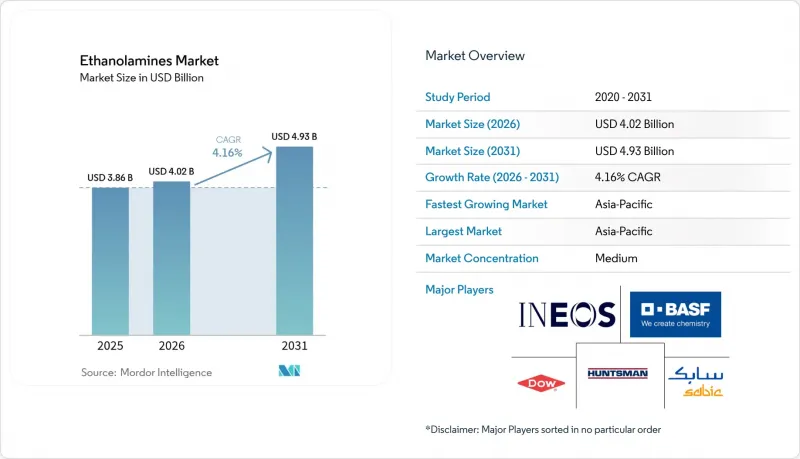
據 Mordor Intelligence 稱,乙醇胺市場預計到 2026 年價值 40.2 億美元,高於 2025 年的 38.6 億美元,預計到 2031 年將達到 49.3 億美元。
預計從 2026 年到 2031 年,其複合年成長率將達到 4.16%。
本報告按產品類型(單乙醇胺、二乙醇胺等)、工藝(環氧乙烷工藝和生質乙醇工藝)、應用(氣體處理、除草劑等)、終端用戶行業(石油天然氣、農業等)以及地區(亞太地區、北美地區、歐洲地區、南美地區、中東和非洲地區)進行細分。市場預測以美元計價。
全球乙醇胺市場趨勢與洞察
新興國家的快速工業化
中國、印度、印尼和越南固定資產投資的激增刺激了乙醇胺在天然氣脫硫、水泥添加劑和製程化學品領域的新消費。中國針對先進電池原料的一攬子政策直接推動了電解精煉計畫對單乙醇胺的需求。印度不斷擴大的生質乙醇產能增強了未來可再生乙醇胺工廠的原料供應,降低了進口依賴,同時支持了出口導向特種化學品叢集的發展。東南亞建築計畫的擴張推動了對三乙醇胺作為水泥助磨劑的需求,同時該地區的電力公司正在採用胺基二氧化碳捕集技術來實現燃煤和燃氣電廠的脫碳。都市化提高了人均清潔劑和個人保健產品的購買量,從而形成了對界面活性劑級乙醇胺的結構性需求。這些趨勢共同表明,乙醇胺市場在中長期內將實現顯著成長。
為因應作物抗除草劑需求,Glyphosate產量激增
在雜草抗藥性問題日益激烈的爭論中,巴西、阿根廷和美國種植抗除草劑大豆和玉米的面積持續擴大,而依賴乙醇胺中和工藝的Glyphosate合成量仍然居高不下。跨國製藥公司正將生產轉移到成本更具競爭力的亞洲地區,這在不改變全球整體消費量的情況下,為乙醇胺市場創造了新的需求來源。在開發中國家,農業機械化推動了Glyphosate使用量的增加,因為省力的除草劑仍然比人工除草更便宜。將Glyphosate與其他活性成分結合使用的新型「雙效」方案,通常會增加每公頃的胺類總需求量。儘管歐盟監管機構正在推動減少合成化學品的使用,但這些法規通常會導致製造地轉移到監管較少的地區,而不是限制絕對產量。因此,Glyphosate帶來的短期成長動能仍然是乙醇胺市場成長的正面因素。
環氧乙烷原料價格波動劇烈
環氧乙烷現貨價格對石腦油和天然氣價格的波動仍然高度敏感,價格的急劇上漲給各個乙醇胺生產商帶來了壓力。 2025年初,由於烯烴利潤率下降導致營運虧損,多家韓國裂解裝置停產,加劇了全部區域環氧乙烷供應的緊張。BASF和陶氏等綜合性巨頭正透過將環氧乙烷的產能重新分配到利潤率最高的衍生性商品上,來增強其應對價格波動的能力,這凸顯了其結構性優勢,並助長了市場集中度。蘇伊士運河和巴拿馬運河的貨運中斷進一步增加了原物料套利交易的不確定性。中小規模的混煉企業正透過減產和轉嫁附加費來應對,但價格衝擊若持續,可能會導致對價格敏感的應用領域(例如通用清潔劑)的需求下降。因此,預計在原料市場趨勢恢復正常之前,乙醇胺市場將面臨短期下行壓力。
細分市場分析
2025年,單乙醇胺的銷售額佔總銷售額的44.62%,這主要得益於穩定的天然氣脫硫業務、二氧化碳捕集先導計畫的運作以及在清潔劑行業的廣泛應用。預計到2031年,該細分市場將以6.32%的複合年成長率成長,進一步鞏固其在乙醇胺市場的核心地位。由於其高反應活性,單乙醇胺使配方設計人員能夠將產品pH值調整到較寬的範圍內,從而保持其跨行業的重要性。同時,二乙醇胺在金屬加工液和除草劑中和領域保持著穩固的市場地位,並且由於其腐蝕防護性能的提升,其產品價值也在不斷提高。三乙醇胺作為水泥助磨劑的應用日益廣泛,可使水泥的抗壓強度提高高達5兆帕,從而縮短大型基礎設施項目的維護時間。
三大主要等級產品的多元化配置,能夠幫助供應商抵禦特定下游產業需求波動的影響。煉油廠和鋼鐵廠碳捕集設施的維修可能會帶動單乙醇胺訂單的激增,而個人保健產品的優質化支撐了三乙醇胺的強勁利潤率。這些趨勢共同作用,為乙醇胺市場的產品層面創造了健康的平衡。
到2025年,傳統的環氧乙烷製程將佔全球產量的91.75%,這反映了數十年的最佳化和沈沒資本的優勢。然而,在可再生原料含量要求和企業淨零排放目標的推動下,生質乙醇路線預計將以7.12%的複合年成長率成長。泰國和巴西的早期商業化工廠表明,利用農業廢棄物生產的生物乙烯可以無縫整合到現有的胺化製程中,從而降低下游製程改造的門檻。歐洲的碳邊境調節(CBA)機制透過對碳排放定價來縮小成本差距,引導未來的支出流向低碳路線。
提高製程密度的努力,例如連續反應系統、膜分離和催化重排等,確保了傳統技術在成本方面保持競爭力。然而,願意為經認證的低碳分子支付溢價的品牌所有者的存在,為生物基供應商提供了極具吸引力的立足點。由此產生的雙軌限制框架,既確保了充足的供應,也同時促進了乙醇胺市場的技術創新。
區域分析
得益於一體化石化聯合企業、高素質勞動力和不斷擴張的下游製造中心,亞太地區預計到2025年將主導市場,佔全球銷售額的46.35%。中國煉油企業正持續推動單乙醇胺生產線的瓶頸建設,以滿足國內清潔劑和電子化學品客戶的需求。同時,印度生質乙醇產業的蓬勃發展正使印度成為未來再生乙醇胺的出口中心。東南亞農業化學品生產商(主要集中在泰國和越南)的持續成長,也進一步推動了該地區對可再生乙醇胺的需求,因為該地區在作物保護方面的支出不斷增加。
在北美,以德克薩斯州和路易斯安那州的氧化物衍生物產業叢集為中心,維持強大的生產基地。英力士斥資7億美元收購利安德巴塞爾的工廠,確保了與獲得其氣體純化技術許可的公司簽訂長期供應合約所需的原料。亨斯邁位於伍德蘭茲的E-GRADE擴建項目瞄準了半導體精煉這個細分市場,為該地區提供了一種對沖大宗商品利潤週期波動的增值方案。
歐洲嚴格的碳政策正推動投資流向低排放設施,BASF在安特衛普擴建14萬噸的工廠便是例證。紐瑞安位於斯滕松德的工廠獲得了ISCC PLUS認證,可以使用可追溯的可再生原料,從而刺激個人護理行業的需求。碳邊境調節定價機制預計將提高高排放乙醇胺的進口溢價,間接使認證的歐洲產品獲得優勢。這些區域趨勢共同作用,維持著一個平衡的全球網路,從而支持乙醇胺市場的穩定分銷。
其他好處:
- Excel格式的市場預測(ME)表
- 3個月的分析師支持
目錄
第1章:引言
- 研究假設和市場定義
- 調查範圍
第2章:調查方法
第3章執行摘要
第4章 市場狀況
- 市場概覽
- 市場促進因素
- 新興國家的快速工業化
- 為因應作物抗除草劑需求,Glyphosate產量激增
- 電動汽車製造業對水基金屬加工液的需求不斷成長
- 在農藥產業的應用擴展
- 生物基界面活性劑配方在個人護理領域的成長
- 市場限制因素
- 環氧乙烷原料價格波動
- 雜草抗藥性的增強預計將削弱對Glyphosate的需求。
- 更環保的生物溶劑的出現給乙醇胺帶來了挑戰。
- 價值鏈分析
- 波特五力模型
第5章 市場規模與成長預測
- 依產品類型
- 單乙醇胺(MEA)
- 二乙醇胺(DEA)
- 三乙醇胺(TEA)
- 透過技術
- 環氧乙烷工藝
- 生質乙醇生產路線
- 透過使用
- 氣體處理
- 除草劑(Glyphosate)
- 界面活性劑和清潔劑
- 水泥和混凝土添加劑
- 個人護理配方
- 金屬加工用潤滑液
- 其他用途
- 按最終用戶行業分類
- 石油和天然氣
- 農業
- 建造
- 個人護理
- 紡織品
- 冶金/金屬加工
- 其他終端用戶產業
- 按地區
- 亞太地區
- 中國
- 印度
- 日本
- 韓國
- 其他亞太國家
- 北美洲
- 美國
- 加拿大
- 墨西哥
- 歐洲
- 德國
- 英國
- 法國
- 義大利
- 其他歐洲國家
- 南美洲
- 巴西
- 阿根廷
- 其他南美國家
- 中東和非洲
- 沙烏地阿拉伯
- 南非
- 其他中東和非洲國家
- 亞太地區
第6章 競爭情勢
- 市場集中度
- 策略趨勢
- 市佔率和排名分析
- 公司簡介
- Amines & Plasticizers ltd.
- BASF
- Dow
- Huntsman Corporation
- INEOS
- NIPPON SHOKUBAI CO., LTD.
- Nouryon
- OUCC
- SABIC
- Sintez OKA Group
- Thai Ethanolamines Co.
- Tosoh Corp.
第7章 市場機會與未來展望
According to Mordor Intelligence, ethanolamines market size in 2026 is estimated at USD 4.02 billion, growing from 2025 value of USD 3.86 billion with 2031 projections showing USD 4.93 billion, growing at 4.16% CAGR over 2026-2031.
This report is Segmented by Product Type (Monoethanolamine, Diethanolamine, and More), Technology (Ethylene Oxide Route and Bio-Ethanol Route), Application (Gas Treatment, Herbicides, and More), End-User Industry (Oil and Gas, Agriculture, and More), and Geography (Asia-Pacific, North America, Europe, South America, Middle East and Africa). The Market Forecasts are Provided in Terms of Value (USD).
Global Ethanolamines Market Trends and Insights
Rapid industrialisation in emerging economies
Surging fixed-asset investment across China, India, Indonesia and Vietnam stimulates fresh consumption of ethanolamines for gas sweetening, cement additives and process chemicals. Chinese policy packages that target advanced battery raw materials directly raise monoethanolamine offtake for electrolyte purification projects. India's widening bio-ethanol capacity reinforces future feedstock availability for renewable ethanolamines plants, lowering import dependence while supporting export-oriented specialty chemicals clusters. Expanding construction programs in Southeast Asia lift triethanolamine demand for cement grinding aids, while regional utilities deploy amine-based CO2 capture to decarbonize coal and gas-fired plants. Urbanisation unlocks higher per-capita purchases of detergents and personal-care items, embedding a structural pull for surfactant-grade ethanolamines. Collectively, these trends embed a broad-based, medium-term uplift in the ethanolamines market.
Surging glyphosate production for herbicide-tolerant crops
Even as weed-resistance debates intensify, acreage sown with herbicide-tolerant soybean and maize varieties keeps expanding in Brazil, Argentina and the United States, sustaining large synthesis volumes for glyphosate that rely on ethanolamines neutralisation steps. Multinational formulators are relocating production to cost-competitive Asian hubs, giving the ethanolamines market fresh demand corridors without altering global consumption totals. In developing economies, farm-mechanisation campaigns elevate glyphosate usage because labour-saving herbicides remain cheaper than manual weeding. New double-knock programs that mix glyphosate with complementary actives often boost total amine requirements per hectare. Although regulators in the European Union push for reduced synthetic loads, these restrictions typically shift manufacturing to friendlier jurisdictions rather than curbing absolute tonnage. Consequently, near-term momentum from glyphosate maintains a positive swing factor for ethanolamines market growth.
Volatile ethylene oxide feedstock prices
Spot ethylene-oxide quotes remain highly sensitive to naphtha and natural-gas swings, squeezing standalone ethanolamines producers during sudden upcycles. Several South Korean crackers idled in early 2025 because negative olefin margins rendered operations uneconomic, tightening ethylene-oxide supply in the wider Asia-Pacific basin. Integrated majors such as BASF and Dow weather volatility better by reallocating oxide streams to the highest-margin derivatives, underscoring structural advantages that reinforce market concentration. Freight disruptions through the Suez and Panama canals add further unpredictability to feedstock arbitrage flows. Smaller formulators respond by trimming run rates or passing through surcharges, yet prolonged price shocks risk demand destruction in price-sensitive applications like commodity detergents. Net impact is a near-term drag on the ethanolamines market until feedstock trends normalise.
Other drivers and restraints analyzed in the detailed report include:
- Rising demand for water-based metal-working fluids in EV manufacturing
- Increasing utilization in the agrochemical industry
- Increasing weed resistance to weaken glyphosate demand
For complete list of drivers and restraints, kindly check the Table Of Contents.
Segment Analysis
Monoethanolamine held 44.62% of 2025 revenues, supported by steady gas-sweetening runs, burgeoning carbon-capture pilots and broad detergent usage. The segment is forecast to post a 6.32% CAGR to 2031, reinforcing its anchor role in the ethanolamines market. Monoethanolamine's high reactivity allows formulators to tailor a wide pH spectrum, sustaining cross-industry relevance. Meanwhile, diethanolamine retains a solid niche in metal-working fluids and herbicide neutralisation, with coproduct value uplift from improved corrosion-inhibition performance. Triethanolamine advances in cement grinding aids, delivering up to 5 MPa compressive-strength gains that shorten curing times on major infrastructure projects.
Diversification across three primary grades protects suppliers from demand swings in any one downstream sector. Carbon-capture retrofits in refineries and steel mills could sharply raise monoethanolamine call-offs, whereas personal-care premiumisation supports triethanolamine margin resilience. Together, these dynamics keep the ethanolamines market well balanced at the product level.
The legacy ethylene-oxide process represented 91.75% of global throughput in 2025, reflecting decades of optimisation and sunk-capital advantages. Even so, the bio-ethanol pathway is predicted to accelerate at a 7.12% CAGR, propelled by renewable-content mandates and corporate net-zero targets. Early commercial plants in Thailand and Brazil demonstrate that agricultural-residue-derived bio-ethylene can integrate seamlessly into existing amination trains, reducing downstream qualification hurdles. Carbon-border-adjustment schemes in Europe tighten the cost gap by pricing embedded emissions, tilting future expenditures toward low-carbon routes.
Process intensification efforts-continuous reaction systems, membrane-based separations and catalysed rearrangements-keep legacy technology competitive on cash cost. Still, brand owners willing to pay premiums for certified-low-carbon molecules grant bio-based suppliers an attractive foothold. The resulting dual-pathway framework ensures ample supply while catalysing technology upgrades across the wider ethanolamines market.
Complete Report Scope:
- By Product Type
- Monoethanolamine (MEA)
- Diethanolamine (DEA)
- Triethanolamine (TEA)
- By Technology
- Ethylene Oxide Route
- Bio-ethanol Route
- By Application
- Gas Treatment
- Herbicides (Glyphosate)
- Surfactants & Detergents
- Cement & Concrete Additives
- Personal-care Formulations
- Metal-working Fluids
- Other Applications
- By End-user Industry
- Oil and Gas
- Agriculture
- Construction
- Personal Care
- Textile
- Metallurgy and Metalworking
- Other End-user Industries
- By Geography
- Asia-Pacifc
- China
- India
- Japan
- South Korea
- Rest of Asia-Pacific
- North America
- United States
- Canada
- Mexico
- Europe
- Germany
- United Kingdom
- France
- Italy
- Rest of Europe
- South America
- Brazil
- Argentina
- Rest of South America
- Middle East and Africa
- Saudi Arabia
- South Africa
- Rest of Middle East and Africa
- Asia-Pacifc
Geography Analysis
Asia-Pacific dominated with a 46.35% revenue share in 2025, buoyed by integrated petrochemical complexes, competitive labour and expanding downstream manufacturing hubs. Chinese refiners continually debottleneck mono-ethanolamine lines to serve domestic detergent and electronic-chemicals customers, while India's bio-ethanol surge positions the subcontinent as a future export base for renewable ethanolamines. Southeast Asia's agrochemical formulators, concentrated in Thailand and Vietnam, offer further pull as regional crop-protection spending climbs.
North America retains a robust production backbone anchored by Texas and Louisiana oxide-derivative clusters. INEOS's USD 700 million purchase of LyondellBasell's facility secures feedstock for long-term supply contracts with gas-sweetening licensors. Huntsman's E-GRADE expansion in The Woodlands targets semiconductor-purification niches, giving the region a value-added hedge against commodity margin cycles.
Europe's stringent carbon agenda steers investment toward low-emission units, exemplified by BASF's 140,000-ton upgrade in Antwerp. Nouryon's ISCC PLUS accreditation at Stenungsund spurs personal-care demand by enabling traceable renewable content. Carbon-border-adjustment pricing is expected to elevate import premiums on high-emission ethanolamines, indirectly favouring certified European output. Collectively, these regional dynamics sustain a balanced global network that underpins steady flows in the ethanolamines market.
- Amines & Plasticizers ltd.
- BASF
- Dow
- Huntsman Corporation
- INEOS
- NIPPON SHOKUBAI CO., LTD.
- Nouryon
- OUCC
- SABIC
- Sintez OKA Group
- Thai Ethanolamines Co.
- Tosoh Corp.
Additional Benefits:
- The market estimate (ME) sheet in Excel format
- 3 months of analyst support
TABLE OF CONTENTS
1 Introduction
- 1.1 Study Assumptions & Market Definition
- 1.2 Scope of the Study
2 Research Methodology
3 Executive Summary
4 Market Landscape
- 4.1 Market Overview
- 4.2 Market Drivers
- 4.2.1 Rapid industrialisation in emerging economies
- 4.2.2 Surging glyphosate production for herbicide-tolerant crops
- 4.2.3 Rising demand for water-based metal-working fluids in EV manufacturing
- 4.2.4 Increasing utilization in the agrochemical industry
- 4.2.5 Growth in bio-based surfactant formulation in personal-care
- 4.3 Market Restraints
- 4.3.1 Volatile ethylene oxide feedstock prices
- 4.3.2 Increasing Weed Resistance to Weaken the Demand for Glyphosate
- 4.3.3 Emergence of greener bio-solvents challenging ethanolamines
- 4.4 Value Chain Analysis
- 4.5 Porter's Five Forces
- 4.5.1 Bargaining Power of Suppliers
- 4.5.2 Bargaining Power of Consumers
- 4.5.3 Threat of New Entrants
- 4.5.4 Threat of Substitute Products
- 4.5.5 Degree of Competition
5 Market Size & Growth Forecasts (Value)
- 5.1 By Product Type
- 5.1.1 Monoethanolamine (MEA)
- 5.1.2 Diethanolamine (DEA)
- 5.1.3 Triethanolamine (TEA)
- 5.2 By Technology
- 5.2.1 Ethylene Oxide Route
- 5.2.2 Bio-ethanol Route
- 5.3 By Application
- 5.3.1 Gas Treatment
- 5.3.2 Herbicides (Glyphosate)
- 5.3.3 Surfactants & Detergents
- 5.3.4 Cement & Concrete Additives
- 5.3.5 Personal-care Formulations
- 5.3.6 Metal-working Fluids
- 5.3.7 Other Applications
- 5.4 By End-user Industry
- 5.4.1 Oil and Gas
- 5.4.2 Agriculture
- 5.4.3 Construction
- 5.4.4 Personal Care
- 5.4.5 Textile
- 5.4.6 Metallurgy and Metalworking
- 5.4.7 Other End-user Industries
- 5.5 By Geography
- 5.5.1 Asia-Pacifc
- 5.5.1.1 China
- 5.5.1.2 India
- 5.5.1.3 Japan
- 5.5.1.4 South Korea
- 5.5.1.5 Rest of Asia-Pacific
- 5.5.2 North America
- 5.5.2.1 United States
- 5.5.2.2 Canada
- 5.5.2.3 Mexico
- 5.5.3 Europe
- 5.5.3.1 Germany
- 5.5.3.2 United Kingdom
- 5.5.3.3 France
- 5.5.3.4 Italy
- 5.5.3.5 Rest of Europe
- 5.5.4 South America
- 5.5.4.1 Brazil
- 5.5.4.2 Argentina
- 5.5.4.3 Rest of South America
- 5.5.5 Middle East and Africa
- 5.5.5.1 Saudi Arabia
- 5.5.5.2 South Africa
- 5.5.5.3 Rest of Middle East and Africa
- 5.5.1 Asia-Pacifc
6 Competitive Landscape
- 6.1 Market Concentration
- 6.2 Strategic Moves
- 6.3 Market Share(%)/Ranking Analysis
- 6.4 Company Profiles (includes Global level Overview, Market level overview, Core Segments, Financials as available, Strategic Information, Market Rank/Share for key companies, Products & Services, and Recent Developments)
- 6.4.1 Amines & Plasticizers ltd.
- 6.4.2 BASF
- 6.4.3 Dow
- 6.4.4 Huntsman Corporation
- 6.4.5 INEOS
- 6.4.6 NIPPON SHOKUBAI CO., LTD.
- 6.4.7 Nouryon
- 6.4.8 OUCC
- 6.4.9 SABIC
- 6.4.10 Sintez OKA Group
- 6.4.11 Thai Ethanolamines Co.
- 6.4.12 Tosoh Corp.
7 Market Opportunities & Future Outlook
- 7.1 White-space & Unmet-need Assessment

 乙醇胺市場:全球市場預測,2026-2032年
 單乙醇胺市場:依產品類型、應用、終端用戶產業及地區分類乙醇胺市場:按產品類型、應用和地區分類
 2026-2034年全球乙醇胺市場規模、佔有率、趨勢和成長分析報告
 2026年全球單乙醇胺市場報告
 乙醇胺市場機會、成長要素、產業趨勢分析及2026年至2035年預測
 單乙醇胺市場規模、佔有率和成長分析(按類型、應用、通路、形態、等級和地區分類)-2026-2033年產業預測三乙醇胺 (TEA) 市場規模、佔有率、成長、全球產業分析:按類型、應用和地區劃分的見解、預測(2026-2034 年)
 乙醇胺市場規模、佔有率和成長分析(按類型、應用、最終用途產業和地區分類)-2026-2033年產業預測
 氨基乙基乙醇胺市場規模、佔有率和成長分析(按等級、應用、形態、銷售管道和地區分類)-2026-2033年產業預測