


 |
市場調查報告書
商品編碼
2121623
汽車燃油供應系統:市場佔有率分析、產業趨勢與統計、成長預測(2026-2031)Automotive Fuel Delivery System - Market Share Analysis, Industry Trends & Statistics, Growth Forecasts (2026 - 2031) |
||||||

※ 本網頁內容可能與最新版本有所差異。詳細情況請與我們聯繫。
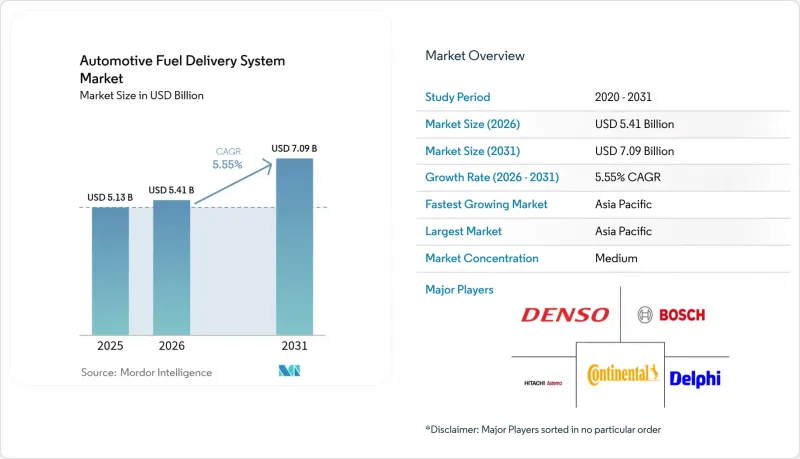
據 Mordor Intelligence 稱,2025 年汽車燃油供應系統市值為 51.3 億美元,預計到 2031 年將達到 70.9 億美元,而 2026 年為 54.1 億美元,預測期(2026-2031 年)的複合年成長率為 5.55%。
本報告按零件(燃油泵、燃油噴射器等)、車輛類型(乘用車、商用車)、燃料類型(汽油、柴油等)、供油方式(歧管噴射、汽油缸內直噴等)、配銷通路(原廠配套 (OEM) 和售後市場 (替換。市場預測以美元 (USD) 為單位。
全球汽車燃油供應系統市場趨勢及洞察
嚴格的排放氣體法規正在推動先進燃料供應模組的普及。
從2026年11月起,歐盟7排放標準將提高所有輕型車輛引擎的顆粒物和氮氧化物閾值;而美國環保署第三階段排放標準旨在到2027年將重型卡車的氮氧化物排放量大幅降低至35毫克/馬力·小時。因此,汽車製造商正在其全球平台上統一採用高壓燃油泵和汽油顆粒過濾器。 16萬公里的更高耐久性要求迫使供應商開發長壽命噴油器和耐腐蝕油軌,這些因素將為支撐汽車燃油供應系統市場直至2030年奠定基礎。
全球汽車產量和車輛更換量增加
2025年,微型車產量復甦,歐洲平均車輛擁有週期超過12年,縮短了更換週期,進一步提振了汽車燃油供應系統零件市場的需求。汽車製造商正在印度、印尼和墨西哥等地建立本地化工廠,從而創造了對一級供應商的區域採購需求。車輛營運商正在升級硬體以滿足燃油效率標準,即使電動車日益普及,內燃機的重要性仍將持續存在。
電動車的快速成長導致內燃機(ICE)的市佔率下降。
中國和加州正加速推進2035年強制零排放目標。隨著電動車的蓬勃發展,預計未來十年內與內燃機相關的利潤來源將下降50%。儘管電池驅動的汽車不需要燃油泵或噴油器,但從長遠來看,這會帶來一些不利因素,而且區域差異也意味著汽車燃油供應系統市場在重型車輛、農村地區和開發中國家仍然佔據著重要地位。
細分市場分析
到2025年,燃油泵將佔汽車燃油供應系統市場銷售額的37.22%,在所有引擎尺寸中都至關重要,並構成汽車燃油供應系統市場的基礎。其多功能性確保了即使在電氣化進程中,銷售量也能保持穩定。成長最快的細分市場-噴油器,在2200 psi GDI(缸內直噴)引擎壓力需求的推動下,到2031年將以7.06%的複合年成長率成長,而乙醇混合燃料的「智慧」噴嘴設計和不銹鋼導軌的普及也推動了這一成長。目前,組件升級主要集中在車載診斷系統、遠端壓力感測和空中韌體更新等方面,以減少意外停機時間。生質燃料的成長增加了對耐腐蝕管道和過濾器的需求,而蒸氣回收閥和油箱安裝感測器則進一步提升了電子領域的價值。這些變化共同確保了汽車燃油供應系統市場的組件規模保持上升趨勢,儘管電動車未來可能會搶佔部分市場佔有率。
到2025年,乘用車將佔汽車燃油輸送系統市場銷售量的63.62%。掀背車和轎車需要經濟高效的無回油泵,而扭力負荷較大的SUV則採用高壓油軌。在預計年複合成長率為6.15%的輕型商用車領域,耐用性優先於效率,鋼編織軟管和可更換過濾器仍被廣泛使用。這一趨勢正在擴大商用車平台在汽車燃油輸送系統市場中的佔有率。由於日行駛里程的增加和車隊遠端資訊處理技術的日益普及,售後改裝業務也不斷成長。同時,儘管中型和重型卡車的產量較低,但它們仍然使用高流量柴油噴射油軌,這使得市場規模保持穩定,直到電池能量密度足以滿足長途運輸的需求。因此,汽車燃油輸送系統市場在不同的使用週期中保持多樣性。
區域分析
預計到2025年,亞太地區將佔全球汽車燃油供應系統市場收入的38.12%,並預計在2031年以6.82%的複合年成長率超越其他所有地區。這主要得益於中國龐大的產能、印度不斷擴展的高速公路網路以及東協的本地組裝叢集。中國汽車製造商正在泰國和印尼生產燃油系統子系統,以規避關稅並縮短物流鏈,從而增強整個東南亞地區的汽車燃油供應系統市場。此外,一家日本半導體合資企業正在確保高壓幫浦微控制器的供應,從而降低區域供應風險。
在環保署 (EPA) 制定的到 2027 年將氮氧化物 (NOx) 排放量降至 0.035 克/馬力小時以下的法規的推動下,北美仍然保持著技術領先地位。諸如美國農業部 (USDA) 2600 萬美元的 E15 基礎設施計劃等投資正在推動生質燃料的普及,從而創造了對乙醇兼容型鋼軌和密封件的利基需求,並擴大了汽車燃料供應系統市場。在墨西哥,美墨加協定 (USMCA) 帶來的有利人事費用和貿易優惠正促使一級供應商在拉莫斯阿里斯佩和阿瓜斯卡連特斯提高產能。
歐洲面臨雙重壓力:一方面是歐7排放法規,另一方面是加速推動碳中和進程。汽車製造商正在為2026年之前改進顆粒物過濾器和蒸氣控制系統,這將增加每輛車的零件成本,但同時也維持了供應商的訂單儲備。東歐工廠的生產線組裝成本較低,即使西歐工廠轉向電氣模組,它們仍然保持競爭力。此外,從西班牙到德國的氫能走廊試點計畫也讓汽車燃料供應系統市場在燃料電池應用領域搶佔了先機。
其他好處:
- Excel格式的市場預測(ME)表
- 3個月的分析師支持
目錄
第1章:引言
- 研究假設和市場定義
- 調查範圍
第2章:調查方法
第3章執行摘要
第4章 市場狀況
- 市場概覽
- 市場促進因素
- 嚴格的排放氣體法規正在推動先進燃料供應模組的普及。
- 全球汽車產量和車輛更換量增加
- 乘用車對汽油缸內直噴引擎的需求日益成長。
- 新興市場輕型商用車銷售成長
- 將智慧診斷功能整合到電動燃油泵中
- 合成燃料和生質燃料混合物的快速成長對耐腐蝕管道提出了更高的要求。
- 市場限制因素
- 電動車的快速普及導致內燃機汽車的市場佔有率下降。
- 燃油系統部件原物料價格波動
- 對蒸發排放的更嚴格規定導致系統成本增加。
- 半導體供不應求正在擾亂電子泵浦控制設備的供應。
- 價值供應鏈分析
- 監理情勢
- 技術展望
- 波特五力分析
第5章 市場規模與成長預測
- 按組件
- 燃油幫浦
- 燃油噴射器
- 燃油軌道
- 燃油壓力穩壓器
- 燃油濾清器
- 燃油管路和軟管
- 其他
- 車輛類型
- 搭乘用車
- 掀背車
- 轎車
- 跑車和小轎車
- SUV 與跨界車
- 商用車輛
- 輕型商用車(LCV)
- 中型和重型商用車輛(MCV 和 HCV)
- 搭乘用車
- 按燃料類型
- 汽油
- 柴油引擎
- 靈活燃料(E10-E85)
- 壓縮天然氣和液化石油氣
- 生質燃料和合成燃料
- 氫
- 透過供應方式
- 連接埠噴射
- 汽油缸內直噴
- 無回油燃油系統
- 共軌柴油噴射
- 透過分銷管道
- OEM(工廠安裝)
- 售後市場(替換件)
- 按地區
- 北美洲
- 美國
- 加拿大
- 其他北美國家
- 南美洲
- 巴西
- 阿根廷
- 智利
- 其他南美國家
- 歐洲
- 德國
- 英國
- 法國
- 義大利
- 西班牙
- 俄羅斯
- 其他歐洲國家
- 亞太地區
- 中國
- 日本
- 印度
- 韓國
- 澳洲和紐西蘭
- 其他亞太國家
- 中東和非洲
- 沙烏地阿拉伯
- UAE
- 土耳其
- 南非
- 奈及利亞
- 埃及
- 其他中東和非洲國家
- 北美洲
第6章 競爭情勢
- 市場集中度
- 策略趨勢
- 市佔率分析
- 公司簡介
- Robert Bosch GmbH
- Continental AG
- DENSO Corporation
- Delphi Technologies(BorgWarner)
- Magna International Inc.
- TI Fluid Systems plc(TI Automotive)
- Toyoda Gosei Co., Ltd.
- Ucal Fuel Systems Ltd.
- Marelli Holdings Co., Ltd.
- Hitachi Astemo Ltd.
- Stanadyne LLC
- Carter Fuel Systems LLC
- Aisin Corporation
- Valeo SA
- MS Motorservice International GmbH(Pierburg)
- Walbro LLC
- Johnson Electric Holdings Ltd.
- Woodward, Inc.
第7章 市場機會與未來展望
According to Mordor Intelligence, the automotive fuel delivery system market size was valued at USD 5.13 billion in 2025 and estimated to grow from USD 5.41 billion in 2026 to reach USD 7.09 billion by 2031, at a CAGR of 5.55% during the forecast period (2026-2031).
This report is Segmented by Component (Fuel Pump, Fuel Injector, and More), Vehicle Type (Passenger Cars, and Commercial Vehicles), Fuel Type (Gasoline, Diesel, and More), Delivery Method (Port Fuel Injection, Gasoline Direct Injection, and More), Distribution Channel (OEM (Factory-Fitted) and Aftermarket (Replacement)), and Geography. The Market Forecasts are Provided in Terms of Value (USD).
Global Automotive Fuel Delivery System Market Trends and Insights
Stringent Emission Norms Driving Advanced Fuel-Delivery Modules
Euro 7 tightens particulate and NOx thresholds for all light-duty engines from November 2026, while EPA Phase 3 slashes NOx to 35 mg/hp-hr for heavy trucks in 2027 . Automakers are therefore standardizing high-pressure pumps and gasoline particulate filters across global platforms. Durability requirements rise to 160,000 km, pushing suppliers to develop long-life injectors and corrosion-proof rails, factors that underpin the automotive fuel delivery system market through 2030.
Rising Global Vehicle Production and Parc Rejuvenation
Light-vehicle output rebounded in 2025, and replacement cycles shortened as average fleet age passed 12 years in Europe, reinforcing component demand for the automotive fuel delivery system market. Vehicle-makers localize plants in India, Indonesia, and Mexico, creating regional sourcing pull for tier-1 suppliers. Fleet operators refresh hardware to meet fuel-economy benchmarks, prolonging ICE relevance despite EV penetration.
Rapid Growth of Electric Vehicles Reducing ICE Share
China and California are accelerating toward full zero-emission mandates by 2035. EV momentum is cutting ICE-linked profit pools by an anticipated 50% this decade. Fuel pumps and injectors are absent from battery platforms, creating long-run headwinds, yet regional differences keep the automotive fuel delivery system market relevant in heavy-duty, rural, and developing-country segments.
Other drivers and restraints analyzed in the detailed report include:
- Growing Demand for Gasoline Direct-Injection Engines in Passenger Cars
- Increasing Sales of Light Commercial Vehicles
- Volatility in Raw-Material Prices for Fuel-System Components
For complete list of drivers and restraints, kindly check the Table Of Contents.
Segment Analysis
Fuel pumps generated 37.22% revenue of the automotive fuel delivery system market in 2025 and remain indispensable across all engine sizes, anchoring the automotive fuel delivery system market. Their ubiquity provides steady volumes even as electrification advances. Accelerating fastest, injectors will rise at 7.06% CAGR to 2031 on the back of 2,200 psi GDI requirements, pushing "smart" tip designs and stainless-steel rails for ethanol blends.Component upgrades now emphasize on-board diagnostics, remote pressure sensing, and over-the-air firmware that cuts unplanned downtime. Biofuel growth lifts demand for corrosion-resistant lines and filters, while vapor-recovery valves and tank-mounted sensors add incremental electronics value. Together, these shifts keep the automotive fuel delivery system market size for components on an upward curve despite future EV displacement threats.
Passenger cars delivered 63.62% of the automotive fuel delivery system market revenue in 2025. Hatchbacks and sedans require cost-efficient returnless pumps, whereas SUVs integrate higher-pressure rails because of increased torque loads. Light commercial vehicles, forecast at 6.15% CAGR, prefer robustness over efficiency, sustaining steel-braid hoses and replaceable filters, a pattern that enlarges the automotive fuel delivery system market share commanded by commercial platforms.Longer daily mileage and fleet telematics open retrofitting business, while medium and heavy trucks, though smaller in volume, retain high-flow diesel injection rails that stabilize volumes until battery densities permit long-haul substitution. As such, the automotive fuel delivery system market remains diversified across duty cycles.
Complete Report Scope:
- By Component
- Fuel Pump
- Fuel Injector
- Fuel Rail
- Fuel Pressure Regulator
- Fuel Filter
- Fuel Line and Hoses
- Others
- By Vehicle Type
- Passenger Cars
- Hatchback
- Sedan
- Sports Car and Coupe
- SUV and Crossover
- Commercial Vehicles
- Light Commercial Vehicles (LCV)
- Medium and Heavy Commercial Vehicles (MCV and HCV)
- Passenger Cars
- By Fuel Type
- Gasoline
- Diesel
- Flex Fuel (E10-E85)
- CNG and LPG
- Biofuel and Synthetic Fuel
- Hydrogen
- By Delivery Method
- Port Fuel Injection
- Gasoline Direct Injection
- Returnless Fuel Systems
- Common-Rail Diesel Injection
- By Distribution Channel
- OEM (Factory-fitted)
- Aftermarket (Replacement)
- By Geography
- North America
- United States
- Canada
- Rest of North America
- South America
- Brazil
- Argentina
- Chile
- Rest of South America
- Europe
- Germany
- United Kingdom
- France
- Italy
- Spain
- Russia
- Rest of Europe
- Asia Pacific
- China
- Japan
- India
- South Korea
- Australia and New Zealand
- Rest of APAC
- Middle East and Africa
- Saudi Arabia
- UAE
- Turkey
- South Africa
- Nigeria
- Egypt
- Rest of Middle East and Africa
- North America
Geography Analysis
Asia Pacific captured 38.12% of the automotive fuel delivery system market's 2025 turnover and will outpace all other regions with a 6.82% CAGR to 2031, owing to China's outsized production, India's highway expansion, and ASEAN's localized assembly clusters. Chinese OEMs are building fuel-system subsystems in Thailand and Indonesia to bypass tariffs and shorten logistics chains, strengthening the automotive fuel delivery system market across Southeast Asia. Semiconductor joint ventures in Japan also secure microcontroller flow for high-pressure pumps, buffering regional supply risk.
North America remains technology-rich, driven by EPA regulations that mandate 0.035 g/b-hp-hr NOx by 2027. Investments such as the USDA's USD 26 million E15 infrastructure program expand biofuel uptake, creating niche demand for ethanol-ready rails and seals that enlarge the automotive fuel delivery system market. Mexico's attractively priced labor and USMCA trade benefits encourage tier-1s to add capacity in Ramos Arizpe and Aguascalientes.
Europe faces the twin pressures of Euro 7 and accelerated carbon-neutrality pledges. OEMs are retrofitting particulate filters and vapor-containment hardware ahead of 2026, raising per-vehicle bill-of-materials but sustaining supplier order books. Eastern European plants offer lower costs for line assemblies, ensuring competitiveness even as Western European factories pivot to electric modules. Hydrogen corridor pilots from Spain to Germany are also giving the automotive fuel delivery system market an early foothold in fuel-cell applications.
- Robert Bosch GmbH
- Continental AG
- DENSO Corporation
- Delphi Technologies (BorgWarner)
- Magna International Inc.
- TI Fluid Systems plc (TI Automotive)
- Toyoda Gosei Co., Ltd.
- Ucal Fuel Systems Ltd.
- Marelli Holdings Co., Ltd.
- Hitachi Astemo Ltd.
- Stanadyne LLC
- Carter Fuel Systems LLC
- Aisin Corporation
- Valeo SA
- MS Motorservice International GmbH (Pierburg)
- Walbro LLC
- Johnson Electric Holdings Ltd.
- Woodward, Inc.
Additional Benefits:
- The market estimate (ME) sheet in Excel format
- 3 months of analyst support
TABLE OF CONTENTS
1 Introduction
- 1.1 Study Assumptions & Market Definition
- 1.2 Scope of the Study
2 Research Methodology
3 Executive Summary
4 Market Landscape
- 4.1 Market Overview
- 4.2 Market Drivers
- 4.2.1 Stringent emission norms driving adoption of advanced fuel-delivery modules
- 4.2.2 Rising global vehicle production and parc rejuvenation
- 4.2.3 Growing demand for gasoline direct-injection engines in passenger cars
- 4.2.4 Increasing sales of light commercial vehicles in emerging markets
- 4.2.5 Integration of smart diagnostics within electric fuel pumps
- 4.2.6 Surge in synthetic/bio-fuel blends requiring corrosion-resistant lines
- 4.3 Market Restraints
- 4.3.1 Rapid growth of electric vehicles reducing ICE share
- 4.3.2 Volatility in raw-material prices for fuel-system components
- 4.3.3 Tightening evaporative-emission norms raising system cost
- 4.3.4 Semiconductor shortages disrupting electronic pump controllers
- 4.4 Value/Supply-Chain Analysis
- 4.5 Regulatory Landscape
- 4.6 Technological Outlook
- 4.7 Porter's Five Forces Analysis
- 4.7.1 Threat of New Entrants
- 4.7.2 Bargaining Power of Buyers/Consumers
- 4.7.3 Bargaining Power of Suppliers
- 4.7.4 Threat of Substitute Products
- 4.7.5 Intensity of Competitive Rivalry
5 Market Size & Growth Forecasts (Value, USD)
- 5.1 By Component
- 5.1.1 Fuel Pump
- 5.1.2 Fuel Injector
- 5.1.3 Fuel Rail
- 5.1.4 Fuel Pressure Regulator
- 5.1.5 Fuel Filter
- 5.1.6 Fuel Line and Hoses
- 5.1.7 Others
- 5.2 By Vehicle Type
- 5.2.1 Passenger Cars
- 5.2.1.1 Hatchback
- 5.2.1.2 Sedan
- 5.2.1.3 Sports Car and Coupe
- 5.2.1.4 SUV and Crossover
- 5.2.2 Commercial Vehicles
- 5.2.2.1 Light Commercial Vehicles (LCV)
- 5.2.2.2 Medium and Heavy Commercial Vehicles (MCV and HCV)
- 5.2.1 Passenger Cars
- 5.3 By Fuel Type
- 5.3.1 Gasoline
- 5.3.2 Diesel
- 5.3.3 Flex Fuel (E10-E85)
- 5.3.4 CNG and LPG
- 5.3.5 Biofuel and Synthetic Fuel
- 5.3.6 Hydrogen
- 5.4 By Delivery Method
- 5.4.1 Port Fuel Injection
- 5.4.2 Gasoline Direct Injection
- 5.4.3 Returnless Fuel Systems
- 5.4.4 Common-Rail Diesel Injection
- 5.5 By Distribution Channel
- 5.5.1 OEM (Factory-fitted)
- 5.5.2 Aftermarket (Replacement)
- 5.6 By Geography
- 5.6.1 North America
- 5.6.1.1 United States
- 5.6.1.2 Canada
- 5.6.1.3 Rest of North America
- 5.6.2 South America
- 5.6.2.1 Brazil
- 5.6.2.2 Argentina
- 5.6.2.3 Chile
- 5.6.2.4 Rest of South America
- 5.6.3 Europe
- 5.6.3.1 Germany
- 5.6.3.2 United Kingdom
- 5.6.3.3 France
- 5.6.3.4 Italy
- 5.6.3.5 Spain
- 5.6.3.6 Russia
- 5.6.3.7 Rest of Europe
- 5.6.4 Asia Pacific
- 5.6.4.1 China
- 5.6.4.2 Japan
- 5.6.4.3 India
- 5.6.4.4 South Korea
- 5.6.4.5 Australia and New Zealand
- 5.6.4.6 Rest of APAC
- 5.6.5 Middle East and Africa
- 5.6.5.1 Saudi Arabia
- 5.6.5.2 UAE
- 5.6.5.3 Turkey
- 5.6.5.4 South Africa
- 5.6.5.5 Nigeria
- 5.6.5.6 Egypt
- 5.6.5.7 Rest of Middle East and Africa
- 5.6.1 North America
6 Competitive Landscape
- 6.1 Market Concentration
- 6.2 Strategic Moves
- 6.3 Market Share Analysis
- 6.4 Company Profiles (includes Global Level Overview, Market Level Overview, Core Segments, Financials as Available, Strategic Information, Market Rank/Share for Key Companies, Products and Services, SWOT Analysis, and Recent Developments)
- 6.4.1 Robert Bosch GmbH
- 6.4.2 Continental AG
- 6.4.3 DENSO Corporation
- 6.4.4 Delphi Technologies (BorgWarner)
- 6.4.5 Magna International Inc.
- 6.4.6 TI Fluid Systems plc (TI Automotive)
- 6.4.7 Toyoda Gosei Co., Ltd.
- 6.4.8 Ucal Fuel Systems Ltd.
- 6.4.9 Marelli Holdings Co., Ltd.
- 6.4.10 Hitachi Astemo Ltd.
- 6.4.11 Stanadyne LLC
- 6.4.12 Carter Fuel Systems LLC
- 6.4.13 Aisin Corporation
- 6.4.14 Valeo SA
- 6.4.15 MS Motorservice International GmbH (Pierburg)
- 6.4.16 Walbro LLC
- 6.4.17 Johnson Electric Holdings Ltd.
- 6.4.18 Woodward, Inc.
7 Market Opportunities & Future Outlook
- 7.1 White-space & Unmet-Need Assessment


