


 |
市場調查報告書
商品編碼
2121621
汽車開關:市場佔有率分析、產業趨勢與統計、成長預測(2026-2031)Automotive Switch - Market Share Analysis, Industry Trends & Statistics, Growth Forecasts (2026 - 2031) |
||||||

※ 本網頁內容可能與最新版本有所差異。詳細情況請與我們聯繫。
據 Mordor Intelligence 稱,2025 年汽車開關市值為 440.8 億美元,預計到 2031 年將達到 600.9 億美元,而 2026 年為 464.2 億美元,預測期(2026-2031 年)的複合年成長率為 5.31%。
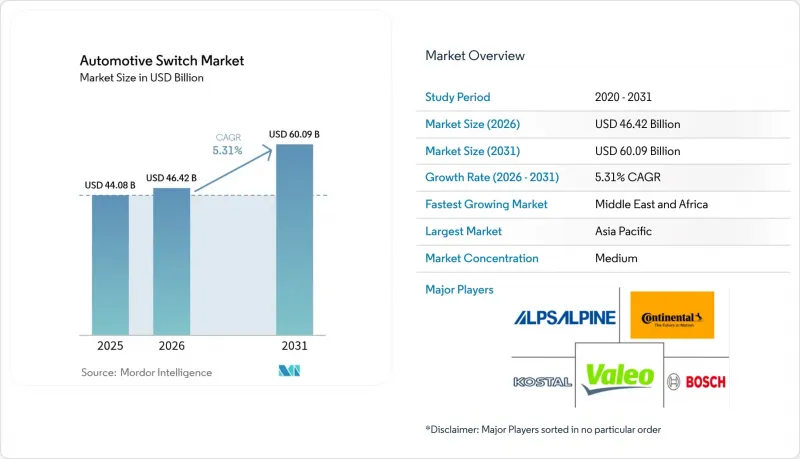
本報告按開關類型(機械開關、觸控開關等)、應用領域(指示系統開關、暖通空調控制開關等)、車輛類型(乘用車、輕型商用車等)、銷售管道(OEM 和售後市場)以及地區(北美、南美等)進行細分。市場預測以價值(美元)和數量(單位)表示。
全球汽車開關市場趨勢及洞察
車輛電氣化進展
電動動力傳動系統的引進帶來了獨特的控制需求。電池管理、能量回收煞車和熱最佳化需要特殊設計的開關,這些開關既要能承受更高的電壓,又要保持靈敏的觸覺反應。 Panasonic汽車的集中式ECU架構展示了一旦消除內燃機相關硬體,電子元件的數量將如何大幅增加。預計到2024年,巴西插電式汽車的銷量將成長90%,達到177,360輛,凸顯了需求模式的快速變化。中國計劃在2026年推出100%國產晶片的汽車,將進一步重塑零件採購管道。所有這些因素共同推動汽車開關市場在產量和開關功能多樣性方面不斷擴張。
先進資訊娛樂和ADAS功能的成長
基於高通驍龍平台的雲端連線駕駛座需要一個多功能控制器,能夠與外部感測器、語音助理和後端進行空中下載 (OTA) 更新。大陸集團的可程式設計觸覺旋鈕只需一個旋鈕即可模擬多種點擊觸感,滿足下一代儀錶板的空間和造型要求。安全關鍵型高階駕駛輔助系統 (ADAS) 需要通過 ISO 26262 認證的開關,以確保車道維持輔助等功能的冗餘運作。 ADAS 售後市場規模已接近 10 億美元,正在擴大舊款車型對新安全功能的潛在需求。
銅和稀土元素原物料價格波動
自2024年2月以來,銅價已上漲近20%,預計到2025年將超過每噸15,000美元。這推高了所有使用高純度觸點的機械開關的零件成本。同時,中國對稀土出口的限制已迫使包括鈴木和福特在內的汽車製造商暫時停產。為了確保汽車開關市場的利潤,開關製造商正在對沖原料成本、重新設計觸點佈局並評估低密度合金。
細分市場分析
到了2025年,機械式設計將佔銷售額的93.35%,這證明它們即使在極端溫度、灰塵和振動環境下也能保持可靠性。按鈕回應使用者常用的操作,搖桿單元控制二進位功能,撥片則管理安裝在方向盤上的指令。儘管顯示器越來越普及,但安全標準仍要求保留觸覺輔助控制,因此汽車開關機械產品的市場預計將穩定成長。
儘管觸控開關目前的銷量並不高,但隨著豪華車和大眾高階車型轉向採用平面背光面板,預計到2031年,其年複合成長率將達到8.03%。大陸集團的靜電回授旋鈕無需齒輪即可模擬機械點擊感,而Snaptron的可焊接觸覺圓頂則可使年產能增加一倍。這些技術的融合正在模糊傳統開關和現代開關之間的界線。混合模組在薄塑膠蓋下整合電容式感測器,同時仍能產生點擊感,這不僅為汽車製造商提供了設計上的靈活性,也保持了汽車開關市場所期望的傳統手感。
到2025年,指示燈控制佔總銷售額的24.80%。這是因為所有地區都強制要求方向燈、危險警示燈和警示燈等功能必須具備強大的號誌控制能力。即使在完全數位化的駕駛座中,用於指示燈的汽車開關市場仍然強勁。這是因為即使螢幕故障,外部照明控制也必須可靠運作。
得益於電動車中安裝的距離感應熱邏輯技術,HVAC(暖通空調)介面的複合年成長率(CAGR)高達5.53%。東洋理化(Toyo Rika)的套模噴塗(IMP)工藝已被豐田海獅(Hiace)採用,在顯著降低生產能耗的同時,實現了耐刮擦的面板。空調控制無法完全被觸控螢幕取代。由於使用者需要即時操控除霧、除霜等功能,汽車開關市場仍保持需求。
區域分析
亞太地區目前是全球最大的汽車開關市場,預計到2025年將佔全球銷售量的49.40%。憑藉中國、日本、韓國和印度等國成熟的供應鏈叢集,以及對電動車的慷慨獎勵,隨著全球汽車製造商擴大在地化生產,亞太地區持續保持領先地位。泰國首個電動皮卡計畫和印尼富含鎳的電池走廊進一步鞏固了亞太地區的領先地位。
中東和非洲地區雖然規模較小,但成長最快,到2031年複合年成長率將達7.43%。沙烏地阿拉伯正在推動一項價值29億美元的汽車項目,其中包括Ceer公司投資13億美元的電動車綜合設施,並計劃在2025年安裝5萬個公共充電樁,這將加速海灣國家對Switch充電樁的需求。杜拜的目標是到2030年引進4.2萬輛電動車,這將進一步拉大成長差距。
北美和歐洲透過將豪華品牌與高性能ADAS和資訊娛樂系統相結合,繼續保持強勁的市場地位。在南美,巴西憑藉價值300億雷亞爾(約60億美元)的Stellantis計畫穩步鞏固其市場地位,該計畫已在該地區建立了製造基地。能夠在組裝廠附近設立生產基地的供應商,在應對不斷變化的貿易和合規壓力方面,仍然處於最有利的地位。
其他好處:
- Excel格式的市場預測(ME)表
- 3個月的分析師支持
目錄
第1章:引言
- 研究假設和市場定義
- 調查範圍
第2章:調查方法
第3章執行摘要
第4章 市場狀況
- 市場概覽
- 市場促進因素
- 車輛電氣化進程
- 擴展高級資訊娛樂和ADAS功能
- 新興國家汽車產量增加
- 高階室內設計對照明和電容式開關的需求
- 採用觸覺/壓力觸摸開關技術
- 功能安全中冗餘開關設計的必要性(ISO 26262)
- 市場限制因素
- 銅和稀土元素原物料價格波動
- 向基於顯示器的觸控介面過渡
- 觸覺穹頂子組件供應瓶頸
- 更嚴格的電磁相容性法規增加了檢驗成本。
- 價值供應鏈分析
- 技術展望
- 監理情勢
- 波特五力模型
第5章 市場規模與成長預測
- 按開關類型
- 機械開關
- 旋鈕
- 按鈕
- 置物櫃
- 撥動開關/撥片
- 觸控式開關
- 電容式觸控板
- 具有觸覺回饋的表面
- 多功能/複合模組
- 機械開關
- 透過使用
- 指示器系統開關
- 暖通空調控制
- 電動車窗和車門鎖開關
- 方向盤控制開關
- 座椅和車內舒適性開關
- 照明和雨刷開關
- 引擎管理系統(EMS)開關
- 車輛類型
- 搭乘用車
- 輕型商用車
- 中型和重型商用車輛
- 按銷售管道
- OEM
- 售後市場
- 按地區
- 北美洲
- 美國
- 加拿大
- 其他北美國家
- 南美洲
- 巴西
- 阿根廷
- 其他南美國家
- 歐洲
- 德國
- 英國
- 法國
- 義大利
- 西班牙
- 俄羅斯
- 其他歐洲國家
- 亞太地區
- 中國
- 日本
- 印度
- 韓國
- 其他亞太國家
- 中東和非洲
- 沙烏地阿拉伯
- 阿拉伯聯合大公國
- 埃及
- 土耳其
- 南非
- 其他中東和非洲國家
- 北美洲
第6章 競爭情勢
- 市場集中度
- 策略趨勢
- 市佔率分析
- 公司簡介
- Alps Alpine Co. Ltd
- Robert Bosch GmbH
- Continental AG
- HELLA GmbH & Co KGaA
- Omron Corporation
- Panasonic Holdings Corp
- Tokai Rika Co. Ltd
- Minda Corporation Ltd
- ZF Friedrichshafen AG
- Leopold Kostal GmbH & Co. KG
- Valeo SA
- Toyodenso Co Ltd
- TE Connectivity Ltd
- LS Automotive
- Denso Corporation
- Nidec Mobility
- Joyson Electronics
第7章 市場機會與未來展望
According to Mordor Intelligence, the automotive switch market size was valued at USD 44.08 billion in 2025 and estimated to grow from USD 46.42 billion in 2026 to reach USD 60.09 billion by 2031, at a CAGR of 5.31% during the forecast period (2026-2031).
This report is Segmented by Switch Type (Mechanical Switches, Touch-Based Switches, and More), Application (Indicator System Switches, HVAC Controls, and More), Vehicle Type (Passenger Cars, Light Commercial Vehicles, and More), Sales Channel (OEM and Aftermarket), and Geography (North America, South America, and More). The Market Forecasts are Provided in Terms of Value (USD) and Volume (Units).
Global Automotive Switch Market Trends and Insights
Rise in Vehicle Electrification
Electric powertrains introduce unique control needs-battery management, regenerative braking, and thermal optimization all require purpose-built switches that tolerate higher voltage while preserving tactile response. Panasonic Automotive's centralized ECU architecture shows how electronics content balloons once combustion hardware is removed. Brazil's plug-in sales jumped 90% in 2024 to 177,360 units, underscoring how quickly demand patterns shift. China's plan to launch cars using 100% domestically sourced chips by 2026 will further reshape component procurement paths . These forces collectively lift the automotive switch market by broadening both unit volumes and the variety of switch functions.
Growth of Advanced Infotainment & ADAS Features
Cloud-linked cockpits built on Qualcomm's Snapdragon platforms require multifunction controllers able to talk to exterior sensors, voice assistants, and over-the-air update back-ends. Continental's programmable haptic knob enables a single dial to mimic many different detents, satisfying space and styling goals in next-generation dashboards . Safety-critical ADAS layers demand switches certified to ISO 26262, ensuring redundant actuation for features such as lane-keeping. The retrofit ADAS aftermarket, approaching USD 1 billion, expands addressable demand among older vehicles seeking new safety functions.
Volatile Prices of Copper & Rare-Earth Inputs
Copper prices climbed nearly 20% after February 2024 and are on track to top USD 15,000 per ton in 2025, inflating the bill-of-materials for every mechanical switch that uses high-purity contacts. Parallel restrictions on Chinese rare-earth exports have already forced short production pauses at OEMs, including Suzuki and Ford. Switch makers are hedging material costs, redesigning contact layouts, and evaluating lower-mass alloys to protect margins inside the automotive switch market.
Other drivers and restraints analyzed in the detailed report include:
- Rising Vehicle Output in Emerging Economies
- Premium-Interior Demand for Illuminated & Capacitive Switches
- Shift Toward Display-Based Touch Interfaces
For complete list of drivers and restraints, kindly check the Table Of Contents.
Segment Analysis
Mechanical designs retained 93.35% of 2025 revenue, proving their reliability in temperature, dust, and vibration extremes. Buttons handle high-frequency user tasks, rocker units govern binary functions, and paddles manage steering-mounted commands. The automotive switch market size for mechanical variants is projected to expand steadily even as displays grow, because safety codes continue to demand tactile backup controls.
Touch-based switches hold modest volume today but carry an 8.03% CAGR to 2031 as luxury and mass-premium trims migrate to flush lit panels. Continental's electrostatic feedback knob reproduces mechanical detents without gears, and Snaptron's solderable tactile domes can double annual output capacity. This convergence blurs the line: hybrid modules bundle capacitive sensing beneath a thin plastic cap yet still generate a click, giving OEMs styling freedom while maintaining the legacy feel expected in the automotive switch market.
Indicator controls owned 24.80% of 2025 revenue because every jurisdiction mandates robust signaling for turn, hazard, and warning functions. The automotive switch market size for indicator applications remains secure even in fully digital cockpits, as external lighting commands must work when screens fail.
HVAC interfaces earn the fastest 5.53% CAGR thanks to range-sensitive thermal logic in electric cars. Tokai Rika's in-mold-painting process, already used on Toyota's Hiace, slashes energy use during manufacturing while delivering scratch-resistant fascias. Climate controls cannot disappear into touchscreens entirely; users need immediate tactile access to demist or defrost, sustaining demand across the automotive switch market.
Complete Report Scope:
- By Switch Type
- Mechanical Switches
- Knob
- Button
- Rocker
- Toggle/Paddle
- Touch-based Switches
- Capacitive Touchpad
- Haptic-feedback Surface
- Multifunction / Combination Modules
- Mechanical Switches
- By Application
- Indicator System Switches
- HVAC Controls
- Power Window and Door-Lock Switches
- Steering-Wheel Control Switches
- Seat and Interior Comfort Switches
- Lighting and Wiper Switches
- Engine-Management (EMS) Switches
- By Vehicle Type
- Passenger Cars
- Light Commercial Vehicles
- Medium and Heavy Commercial Vehicles
- By Sales Channel
- OEM
- Aftermarket
- By Geography
- North America
- United States
- Canada
- Rest of North America
- South America
- Brazil
- Argentina
- Rest of South America
- Europe
- Germany
- United Kingdom
- France
- Italy
- Spain
- Russia
- Rest of Europe
- Asia Pacific
- China
- Japan
- India
- South Korea
- Rest of Asia Pacific
- Middle East and Africa
- Saudi Arabia
- United Arab Emirates
- Egypt
- Turkey
- South Africa
- Rest of Middle East and Africa
- North America
Geography Analysis
Asia Pacific spearheads the automotive switch market with 49.40% revenue in 2025, making it the largest market today. Entrenched supply clusters in China, Japan, South Korea, and India, plus robust EV incentives, keep the region in front as global OEMs scale local production. Thailand's first electric pickup program and Indonesia's nickel-rich battery corridor reinforce APAC's leadership.
The Middle East & Africa, while smaller, posts the fastest 7.43% CAGR through 2031. Saudi Arabia's USD 2.9 billion pipeline of automotive projects, including Ceer's USD 1.3 billion EV complex, alongside 50,000 public chargers planned by 2025, accelerates switch demand across Gulf economies. Dubai's target of 42,000 EVs by 2030 further widens the growth gap.
North America and Europe retain strong positions by marrying premium nameplates with high-content ADAS and infotainment systems. South America gains steady ground as Brazil's R$30 billion (USD 6.0 billion) Stellantis program secures regional manufacturing. Suppliers able to locate production close to final assembly sites remain best placed to navigate evolving trade and compliance pressures.
- Alps Alpine Co. Ltd
- Robert Bosch GmbH
- Continental AG
- HELLA GmbH & Co KGaA
- Omron Corporation
- Panasonic Holdings Corp
- Tokai Rika Co. Ltd
- Minda Corporation Ltd
- ZF Friedrichshafen AG
- Leopold Kostal GmbH & Co. KG
- Valeo SA
- Toyodenso Co Ltd
- TE Connectivity Ltd
- LS Automotive
- Denso Corporation
- Nidec Mobility
- Joyson Electronics
Additional Benefits:
- The market estimate (ME) sheet in Excel format
- 3 months of analyst support
TABLE OF CONTENTS
1 Introduction
- 1.1 Study Assumptions & Market Definition
- 1.2 Scope of the Study
2 Research Methodology
3 Executive Summary
4 Market Landscape
- 4.1 Market Overview
- 4.2 Market Drivers
- 4.2.1 Rise in vehicle electrification
- 4.2.2 Growth of advanced infotainment & ADAS features
- 4.2.3 Rising vehicle output in emerging economies
- 4.2.4 Premium-interior demand for illuminated & capacitive switches
- 4.2.5 Adoption of haptic/force-touch switch technology
- 4.2.6 Functional-safety (ISO 26262) need for redundant switch designs
- 4.3 Market Restraints
- 4.3.1 Volatile prices of copper & rare-earth inputs
- 4.3.2 Shift toward display-based touch interfaces
- 4.3.3 Supply bottlenecks in tactile-dome sub-components
- 4.3.4 Tighter EMC limits raising validation costs
- 4.4 Value/Supply-Chain Analysis
- 4.5 Technological Outlook
- 4.6 Regulatory Landscape
- 4.7 Porter's Five Forces
- 4.7.1 Threat of New Entrants
- 4.7.2 Bargaining Power of Buyers
- 4.7.3 Bargaining Power of Suppliers
- 4.7.4 Threat of Substitutes
- 4.7.5 Competitive Rivalry
5 Market Size & Growth Forecasts (Value (USD) and Volume (Units))
- 5.1 By Switch Type
- 5.1.1 Mechanical Switches
- 5.1.1.1 Knob
- 5.1.1.2 Button
- 5.1.1.3 Rocker
- 5.1.1.4 Toggle/Paddle
- 5.1.2 Touch-based Switches
- 5.1.2.1 Capacitive Touchpad
- 5.1.2.2 Haptic-feedback Surface
- 5.1.3 Multifunction / Combination Modules
- 5.1.1 Mechanical Switches
- 5.2 By Application
- 5.2.1 Indicator System Switches
- 5.2.2 HVAC Controls
- 5.2.3 Power Window and Door-Lock Switches
- 5.2.4 Steering-Wheel Control Switches
- 5.2.5 Seat and Interior Comfort Switches
- 5.2.6 Lighting and Wiper Switches
- 5.2.7 Engine-Management (EMS) Switches
- 5.3 By Vehicle Type
- 5.3.1 Passenger Cars
- 5.3.2 Light Commercial Vehicles
- 5.3.3 Medium and Heavy Commercial Vehicles
- 5.4 By Sales Channel
- 5.4.1 OEM
- 5.4.2 Aftermarket
- 5.5 By Geography
- 5.5.1 North America
- 5.5.1.1 United States
- 5.5.1.2 Canada
- 5.5.1.3 Rest of North America
- 5.5.2 South America
- 5.5.2.1 Brazil
- 5.5.2.2 Argentina
- 5.5.2.3 Rest of South America
- 5.5.3 Europe
- 5.5.3.1 Germany
- 5.5.3.2 United Kingdom
- 5.5.3.3 France
- 5.5.3.4 Italy
- 5.5.3.5 Spain
- 5.5.3.6 Russia
- 5.5.3.7 Rest of Europe
- 5.5.4 Asia Pacific
- 5.5.4.1 China
- 5.5.4.2 Japan
- 5.5.4.3 India
- 5.5.4.4 South Korea
- 5.5.4.5 Rest of Asia Pacific
- 5.5.5 Middle East and Africa
- 5.5.5.1 Saudi Arabia
- 5.5.5.2 United Arab Emirates
- 5.5.5.3 Egypt
- 5.5.5.4 Turkey
- 5.5.5.5 South Africa
- 5.5.5.6 Rest of Middle East and Africa
- 5.5.1 North America
6 Competitive Landscape
- 6.1 Market Concentration
- 6.2 Strategic Moves
- 6.3 Market Share Analysis
- 6.4 Company Profiles (includes Global Level Overview, Market Level Overview, Core Segments, Financials as Available, Strategic Information, Market Rank/Share for Key Companies, Products and Services, SWOT Analysis, and Recent Developments)
- 6.4.1 Alps Alpine Co. Ltd
- 6.4.2 Robert Bosch GmbH
- 6.4.3 Continental AG
- 6.4.4 HELLA GmbH & Co KGaA
- 6.4.5 Omron Corporation
- 6.4.6 Panasonic Holdings Corp
- 6.4.7 Tokai Rika Co. Ltd
- 6.4.8 Minda Corporation Ltd
- 6.4.9 ZF Friedrichshafen AG
- 6.4.10 Leopold Kostal GmbH & Co. KG
- 6.4.11 Valeo SA
- 6.4.12 Toyodenso Co Ltd
- 6.4.13 TE Connectivity Ltd
- 6.4.14 LS Automotive
- 6.4.15 Denso Corporation
- 6.4.16 Nidec Mobility
- 6.4.17 Joyson Electronics
7 Market Opportunities & Future Outlook
- 7.1 White-space & Unmet-need Assessment

 汽車開關市場-2026-2032年全球市場預測
 汽車開關市場機會、成長要素、產業趨勢分析及2026-2035年預測
 汽車開關市場分析及預測(至2035年):類型、產品、技術、組件、應用、材質、最終用戶、模組、功能、安裝類型
 汽車開關市場規模、佔有率和成長分析:按開關類型、應用、車輛類型、銷售管道、技術、最終用戶和地區分類-2026-2033年產業預測汽車內裝開關市場:依技術、開關類型、車輛類型、驅動方式和應用分類-2026-2032年全球市場預測
 2026-2034年全球汽車開關市場規模、佔有率、趨勢和成長分析報告汽車開關市場規模、佔有率、成長及全球產業分析:按類型、應用和地區分類,並提供2026-2034年的洞察和預測
 日本汽車開關市場規模、佔有率、趨勢及預測(按類型、設計、車輛類型、銷售管道和地區分類),2026-2034年汽車開關市場報告:按類型、設計、車輛類型、銷售管道和地區分類(2026-2034 年)
 2026年全球汽車開關市場報告