


 |
市場調查報告書
商品編碼
2121620
石油和天然氣安全:市場佔有率分析、行業趨勢和統計數據、成長預測(2026-2031 年)Oil And Gas Security - Market Share Analysis, Industry Trends & Statistics, Growth Forecasts (2026 - 2031) |
||||||

※ 本網頁內容可能與最新版本有所差異。詳細情況請與我們聯繫。
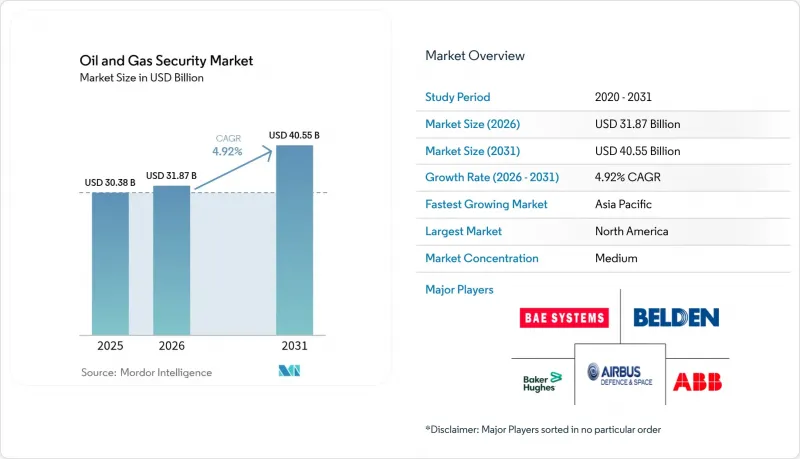
根據 Mordor Intelligence 預測,石油和天然氣安全市場規模將從 2025 年的 303.8 億美元成長到 2026 年的 318.7 億美元,然後在 2031 年達到 405.5 億美元,2026 年至 2031 年的複合年成長率為 4.92%。
本報告按安全類型(網路和網路安全、監控、篩檢和偵測等)、元件(硬體、軟體平台和服務)、營運階段(上游、中游和下游)、部署模式(本地部署、雲端部署和混合/邊緣雲端)、應用程式(探勘和生產現場、海上平台和FPSO等)以及地區進行分類。
全球油氣安全市場的趨勢與洞察
隨著營運技術(OT)和資訊科技(IT)的融合,網路風險日益增加。
隨著曾經與企業網路隔離的營運資產如今接入雲端和企業系統,攻擊面正不斷擴大。這種整合引發的事件使得攻擊者能夠將入侵路徑從IT系統轉移到安全至關重要的OT系統,從而增加了造成物理中斷的可能性。美國政府機構的報告顯示,即使是技術水平較低的攻擊團夥也成功攻擊了工業控制系統,暴露了網路分段漏洞和多因素身份驗證不足的問題。因此,網路分區、零信任策略和即時異常檢測正從最佳實踐轉變為基本要求。隨著企業在不中斷生產的情況下進行現代化改造,複雜性日益增加,分階段部署和平行架構勢在必行。加強管治以協調IT安全、工程和生產團隊,將是預測期內支出的關鍵內容。
TSA 和 IEC 針對管道的強制性網路安全法規
美國運輸安全管理局(TSA) 修訂後的指令要求管道運營商檢驗控制措施、消除漏洞並在指定的時限內報告違規行為。同時,IEC 62443 正成為控制系統的全球標準,日本 CERT 等區域組織提供實施指南。歐洲的 NIS2 指示進一步規定了相關義務,要求在 24 小時內揭露事故。違規行為可能面臨罰款和停產處罰,這使得安全措施從可選項轉變為營運必要。隨著營運商對承包合規方案的需求日益成長,同時具備管治和技術實施專業知識的供應商也變得越來越重要。
傳統SCADA系統升級成本超支
許多平台仍然依賴已有20年歷史的監控系統,這些系統並非為網路環境而設計。企業通常低估了網路分段、多因素身份驗證和加密遙測所需的投入和停機成本。當部署過程中出現相容性問題時,升級成本往往會超出初始預算的兩到三倍。資產生命週期延長使得資金分配更加困難,迫使企業在短期生產力下降和長期韌性之間尋求平衡。學術研究表明,部門間溝通不良會導致實施進一步延誤和成本膨脹。
細分市場分析
到2025年,監控平台將佔總收入的30.10%,這印證了市場長期以來對周界防禦和情境察覺的重視。儘管包括影像分析、無人機和門禁控制在內的油氣安全市場規模依然龐大,但隨著預算重新分配給數位防禦,其年成長率正在放緩。網路和網路安全解決方案正以7.85%的複合年成長率成長,這反映了管道強制性法規的訂定以及針對油田資產的勒索軟體攻擊的增加。諸如Colonial Pipeline遭受攻擊之類的事件表明,停產可能源於筆記型電腦而非圍欄入侵,這推動了對入侵偵測和安全遠端存取閘道器的投資。
在預測期內,融合攝影機影像和網路遙測資料的整合指揮中心預計將超越單一用途的部署方式。這種融合透過將實體徽章與網路登入資訊關聯起來,減少了誤報。能夠跨攝影機、防火牆和控制器標記事件並將其顯示在統一螢幕上的供應商,預計將在石油和天然氣安全市場獲得越來越大的佔有率。因此,儘管監控仍然至關重要,但它正擴大被整合到更廣泛的網實整合實體平台中。雖然單一設備的銷售量預計將保持平穩,但軟體分析的收入預計將會成長。
即使到了2025年,硬體仍將佔據油氣安全市場52.10%的佔有率,其中包括用於危險區域的加固防火牆、本質安全型攝影機和抗震伺服器。然而,隨著營運商將全天候監控和事件回應外包以彌補技能缺口,託管服務業預計將以9.05%的複合年成長率成長。受對高級分析、威脅情報源以及針對每個新站點的定期紅隊評估的需求驅動,與服務合約相關的油氣安全市場正在擴張。
服務成長與監管審計密切相關,後者要求進行獨立檢驗和文件記錄。缺乏足夠內部能力的公司依賴專門從事營運技術 (OT) 資產的資安管理服務提供者 (MSSP),這些服務提供者將資產發現、漏洞管理和合規性報告納入多年期合約。硬體供應商則透過基於結果的模式來應對,將設備和服務打包,從而平衡收入並加深客戶鎖定。
區域分析
預計2025年,北美將維持35.90%的油氣安全市佔率。這部分歸功於美國運輸安全局(TSA)的強制性指令以及從科洛尼爾管道勒索軟體事件中吸取的教訓。加拿大的威脅評估發現,有國家支持的駭客組織以生產基地和中游樞紐為目標,促使加拿大進行公私合營培訓,並津貼用於營運技術(OT)分段。聯邦審計發現墨西哥灣和北坡的近海資產有防火牆過時和人機介面(HMI)未修補等問題,因此亟需進行網路安全升級。
在亞太地區,年複合成長率(CAGR),達到8.75%,這主要得益於其在邊境地區擴建幹線管道和儲罐,以及營運技術(OT)安全和北京強制推行的主權雲。在日本,已頒布經濟安全法規,將石油和天然氣列為關鍵社會基礎設施,要求業者向監管機構提交安全計畫。印度正在擴建煉油廠加工能力和LNG接收站,並利用位於班加羅爾和海得拉巴的本地安全營運中心提供的管理服務。鑑於南海地區緊張局勢加劇,澳洲和韓國正在將營運技術安全條款納入新的LNG出口計畫。歐洲的現代化工作以NIS2框架為中心,該框架要求關鍵能源營業單位進行全天候事件報告和年度審計。德國、法國和荷蘭的LNG進口設施擴建規模和複雜性不斷增加,因此需要對從海上到接收站的通訊鏈路進行加密。在中東和非洲,隨著區域網路論壇上報告的攻擊數量激增206%,投資正在加速成長。拉丁美洲仍在發展中,但隨著巴西、阿根廷和圭亞那擴大生產規模並力求符合IEC 62443標準,投資也逐漸增加。
其他好處:
- Excel格式的市場預測(ME)表
- 3個月的分析師支持
目錄
第1章:引言
- 研究假設和市場定義
- 調查範圍
第2章:調查方法
第3章執行摘要
第4章 市場狀況
- 市場概覽
- 市場促進因素
- 隨著營運技術(OT)和資訊科技(IT)的融合,網路風險日益增加。
- TSA 和 IEC 針對管道的網路安全強制性規則
- 實施人工智慧驅動的預測性安全分析
- 能源價格波動推高了保險需求。
- 需要從邊緣到核心安全保障的自主離岸資產
- 市場限制因素
- 傳統SCADA系統升級成本超支
- 偏遠盆地OT安保人員短缺
- 圍繞雲端資料主權的衝突
- 基於環境、社會和治理因素的資產剝離正在抑制長期資本投資。
- 產業價值鏈分析
- 監理情勢
- 技術展望
- 產業吸引力—五力分析
- 新進入者的威脅
- 買方的議價能力
- 供應商的議價能力
- 替代品的威脅
- 競爭公司之間的競爭
- 宏觀經濟因素對市場的影響
第5章 市場規模與成長預測
- 按安全類型
- 網路與網路安全
- 監視
- 篩檢和檢測
- 指揮與控制
- 實體存取控制
- 其他類型
- 按組件
- 硬體
- 軟體平台
- 服務(託管服務和專業服務)
- 按操作階段
- 上游領域(探勘和生產)
- 中游領域(管道和儲存)
- 下游產業(煉油/分銷)
- 部署模式
- 現場
- 雲
- 混合/邊緣雲端
- 透過使用
- 探勘和生產場地
- 海上平台和FPSO
- 管道監測
- 煉油廠和石化廠
- 液化天然氣和天然氣處理
- 零售和配送終端
- 按地區
- 北美洲
- 美國
- 加拿大
- 墨西哥
- 南美洲
- 巴西
- 阿根廷
- 智利
- 其他南美國家
- 歐洲
- 德國
- 英國
- 法國
- 義大利
- 西班牙
- 俄羅斯
- 其他歐洲國家
- 亞太地區
- 中國
- 印度
- 日本
- 韓國
- 馬來西亞
- 新加坡
- 澳洲
- 其他亞太國家
- 中東和非洲
- 中東
- 阿拉伯聯合大公國
- 沙烏地阿拉伯
- 土耳其
- 其他中東國家
- 非洲
- 南非
- 奈及利亞
- 埃及
- 其他非洲國家
- 中東
- 北美洲
第6章 競爭情勢
- 市場集中度
- 策略趨勢
- 市佔率分析
- 公司簡介
- ABB Ltd.
- Airbus Defence and Space
- BAE Systems plc
- Baker Hughes Cyber-Security Services
- Belden Inc.
- Check Point Software Technologies Ltd.
- Cisco Systems Inc.
- Claroty Ltd.
- Dragos Inc.
- Fortinet Inc.
- Honeywell International Inc.
- Huawei Technologies Co. Ltd.
- Johnson Controls International plc
- Kaspersky Lab JSC
- Microsoft Corp.
- Nozomi Networks Inc.
- Palo Alto Networks Inc.
- Parsons Corp.
- Rockwell Automation Inc.
- Schneider Electric SE
- Siemens AG
- Tenable OT Security
- Thales Group
- Trend Micro Inc.
- Waterfall Security Solutions Ltd.
第7章 市場機會與未來趨勢
- 評估閒置頻段和未滿足的需求
According to Mordor Intelligence, the oil and gas security market size is expected to grow from USD 30.38 billion in 2025 to USD 31.87 billion in 2026 and is forecast to reach USD 40.55 billion by 2031 at 4.92% CAGR over 2026-2031.
This report is Segmented by Security Type (Network and Cyber Security, Surveillance, Screening and Detection, and More), Component (Hardware, Software Platforms, and Services), Operation Stage (Upstream, Midstream, and Downstream), Deployment Mode (On-Premise, Cloud, and Hybrid/Edge-Cloud), Application (Exploration and Production Sites, Offshore Platforms and FPSOs, and More), and Geography.
Global Oil And Gas Security Market Trends and Insights
Growing OT-IT Convergence Elevating Cyber-Risk
Operational assets, once isolated from corporate networks, now connect to cloud and enterprise systems, broadening attack surfaces. Incidents prompted by this linkage allow adversaries to pivot from IT into safety-critical OT, increasing the likelihood of physical disruption. United States agencies report that even low-skill groups successfully target industrial control systems, exposing weak segmentation and minimal multifactor authentication. Network zoning, zero-trust policies, and real-time anomaly detection are therefore moving from best practice to baseline expectation. Complexity grows as firms modernize without halting production, forcing staged rollouts and parallel architectures. Improved governance that aligns IT security, engineering, and production teams forms a critical piece of spend over the forecast horizon.
Mandatory TSA and IEC Cyber Rules for Pipelines
Revised Transportation Security Administration directives compel pipeline operators to verify controls, close gaps, and report breaches in set time windows. IEC 62443 is simultaneously emerging as the global control-system benchmark, with regional groups such as Japan's CERT delivering implementation guidance. Europe's NIS2 directive layers additional duties by mandating incident disclosure within 24 hours. Monetary penalties and potential shutdown orders for non-compliance raise security from discretionary spending to operational necessity. Vendors versed in both governance and technical deployment are in demand as operators seek turnkey compliance programs.
Legacy SCADA Upgrades Cost Overruns
Many platforms still rely on 20-year-old supervisory control systems never architected for network exposure. Firms routinely underestimate the engineering and downtime expense needed for segmentation, multifactor authentication, and encrypted telemetry. Upgrades often cost two to three times the original budget when compatibility hurdles surface mid-deployment. Extended asset lifecycles make capital allocation difficult, forcing operators to weigh short-term productivity loss against long-term resilience. Academic studies find that ineffective cross-department communication further delays execution and inflates cost.
Other drivers and restraints analyzed in the detailed report include:
- AI-Driven Predictive Security Analytics Adoption
- Energy-Price Volatility Boosting Insurance Requirements
- Shortage of OT-Security Talent in Remote Basins
For complete list of drivers and restraints, kindly check the Table Of Contents.
Segment Analysis
Surveillance platforms commanded 30.10% revenue share in 2025, confirming the market's long-standing focus on perimeter and situational awareness. The oil and gas security market size tied to video analytics, drones, and access control remains significant, but annual growth moderates as budgets reallocate toward digital defenses. Network and cybersecurity solutions, advancing at an 7.85% CAGR, reflect mandatory pipeline rules and the rise in ransomware aimed at field assets. Incidents such as the Colonial Pipeline attack emphasized that an operational halt can stem from a laptop rather than a fence breach, nudging capital toward intrusion detection and secure remote-access gateways.
In the forecast window, integrated command centers that fuse camera feeds with cyber telemetry are expected to outpace single-purpose deployments. This convergence reduces false positives by correlating physical badges with network logins. Vendors able to cross-tag events from cameras, firewalls, and controllers into a unified screen are likely to capture an expanding slice of the oil and gas security market. Consequently, surveillance remains vital but increasingly embedded within broader cyber-physical platforms, moderating standalone unit sales while lifting software analytics revenue.
Hardware still comprised 52.10% of the oil and gas security market share in 2025, spanning firewalls ruggedized for hazardous zones, intrinsically safe cameras, and vibration-resistant servers. However, the managed-services segment posts a 9.05% CAGR as operators contract 24 X 7 monitoring and incident response to offset skill gaps. The oil and gas security market size attached to service retainers is increasing because each new site demands advanced analytics, threat intelligence feeds, and periodic red-team assessments.
Service growth is also tied to regulatory audits, which require independent validation and documentation. Firms lacking internal capacity rely on MSSPs that specialise in OT assets; these providers bundle asset discovery, vulnerability management, and compliance reporting into multi-year agreements. Hardware vendors are reacting through outcome-based models that package equipment and services, thereby smoothing revenue and deepening customer lock-in.
Complete Report Scope:
- By Security Type
- Network and Cyber Security
- Surveillance
- Screening and Detection
- Command and Control
- Physical Access Control
- Other Types
- By Component
- Hardware
- Software Platforms
- Services (Managed and Professional)
- By Operation Stage
- Upstream (Exploration and Production)
- Midstream (Pipelines and Storage)
- Downstream (Refining and Distribution)
- By Deployment Mode
- On-premise
- Cloud
- Hybrid/Edge-Cloud
- By Application
- Exploration and Production Sites
- Offshore Platforms and FPSOs
- Pipeline Monitoring
- Refineries and Petrochem Plants
- LNG and Gas Processing
- Retail and Distribution Terminals
- By Geography
- North America
- United States
- Canada
- Mexico
- South America
- Brazil
- Argentina
- Chile
- Rest of South America
- Europe
- Germany
- United Kingdom
- France
- Italy
- Spain
- Russia
- Rest of Europe
- Asia-Pacific
- China
- India
- Japan
- South Korea
- Malaysia
- Singapore
- Australia
- Rest of Asia-Pacific
- Middle East and Africa
- Middle East
- United Arab Emirates
- Saudi Arabia
- Turkey
- Rest of Middle East
- Africa
- South Africa
- Nigeria
- Egypt
- Rest of Africa
- Middle East
- North America
Geography Analysis
North America maintained a 35.90% stake in the oil and gas security market in 2025, supported by mandatory TSA directives and the lingering lessons of the Colonial Pipeline ransomware event. Canada's threat assessments cite state-sponsored actors targeting production and midstream hubs, prompting coordinated public-private drills and grants for OT segmentation. Offshore assets in the Gulf of Mexico and the North Slope face calls for urgent cyber upgrades following federal audits that flagged outdated firewalls and unpatched HMIs.
Asia-Pacific records the fastest CAGR at 8.75% through 2031 as China extends trunk pipelines and storage capacity into border regions, blending OT security with sovereign cloud mandates from Beijing. Japan legislated economic-security rules that classify oil and gas as critical social infrastructure, compelling operators to file security plans with regulators. India expands refinery capacity and LNG terminals, sourcing managed services from local security operations centers in Bengaluru and Hyderabad. Australia and South Korea embed OT security clauses into new LNG export projects after noting rising regional tension in the South China Sea. Europe's modernization drive centers on the NIS2 framework that mandates 24-hour incident reporting and annual audits for essential energy entities. LNG import build-outs across Germany, France, and the Netherlands add scale and complexity, necessitating encrypted maritime-to-terminal links. The Middle East and Africa experience stepped-up funding after a 206% rise in documented attacks, showcased at regional cyber forums. Latin America remains nascent but sees incremental investment as Brazil, Argentina, and Guyana grow production and seek alignment with IEC 62443.
- ABB Ltd.
- Airbus Defence and Space
- BAE Systems plc
- Baker Hughes Cyber-Security Services
- Belden Inc.
- Check Point Software Technologies Ltd.
- Cisco Systems Inc.
- Claroty Ltd.
- Dragos Inc.
- Fortinet Inc.
- Honeywell International Inc.
- Huawei Technologies Co. Ltd.
- Johnson Controls International plc
- Kaspersky Lab JSC
- Microsoft Corp.
- Nozomi Networks Inc.
- Palo Alto Networks Inc.
- Parsons Corp.
- Rockwell Automation Inc.
- Schneider Electric SE
- Siemens AG
- Tenable OT Security
- Thales Group
- Trend Micro Inc.
- Waterfall Security Solutions Ltd.
Additional Benefits:
- The market estimate (ME) sheet in Excel format
- 3 months of analyst support
TABLE OF CONTENTS
1 INTRODUCTION
- 1.1 Study Assumptions and Market Definition
- 1.2 Scope of the Study
2 RESEARCH METHODOLOGY
3 EXECUTIVE SUMMARY
4 MARKET LANDSCAPE
- 4.1 Market Overview
- 4.2 Market Drivers
- 4.2.1 Growing OT and IT convergence elevating cyber-risk
- 4.2.2 Mandatory TSA and IEC cyber rules for pipelines
- 4.2.3 AI-driven predictive security analytics adoption
- 4.2.4 Energy-price volatility boosting insurance requirements
- 4.2.5 Autonomous offshore assets needing edge-to-core security
- 4.3 Market Restraints
- 4.3.1 Legacy SCADA upgrades cost overruns
- 4.3.2 Shortage of OT-security talent in remote basins
- 4.3.3 Cloud-based data-sovereignty conflicts
- 4.3.4 ESG divestments curbing long-term capex
- 4.4 Industry Value Chain Analysis
- 4.5 Regulatory Landscape
- 4.6 Technological Outlook
- 4.7 Industry Attractiveness - Porter's Five Forces Analysis
- 4.7.1 Threat of New Entrants
- 4.7.2 Bargaining Power of Buyers
- 4.7.3 Bargaining Power of Suppliers
- 4.7.4 Threat of Substitutes
- 4.7.5 Intensity of Competitive Rivalry
- 4.8 Impact of Macroeconomic Factors on the Market
5 MARKET SIZE AND GROWTH FORECASTS (VALUES)
- 5.1 By Security Type
- 5.1.1 Network and Cyber Security
- 5.1.2 Surveillance
- 5.1.3 Screening and Detection
- 5.1.4 Command and Control
- 5.1.5 Physical Access Control
- 5.1.6 Other Types
- 5.2 By Component
- 5.2.1 Hardware
- 5.2.2 Software Platforms
- 5.2.3 Services (Managed and Professional)
- 5.3 By Operation Stage
- 5.3.1 Upstream (Exploration and Production)
- 5.3.2 Midstream (Pipelines and Storage)
- 5.3.3 Downstream (Refining and Distribution)
- 5.4 By Deployment Mode
- 5.4.1 On-premise
- 5.4.2 Cloud
- 5.4.3 Hybrid/Edge-Cloud
- 5.5 By Application
- 5.5.1 Exploration and Production Sites
- 5.5.2 Offshore Platforms and FPSOs
- 5.5.3 Pipeline Monitoring
- 5.5.4 Refineries and Petrochem Plants
- 5.5.5 LNG and Gas Processing
- 5.5.6 Retail and Distribution Terminals
- 5.6 By Geography
- 5.6.1 North America
- 5.6.1.1 United States
- 5.6.1.2 Canada
- 5.6.1.3 Mexico
- 5.6.2 South America
- 5.6.2.1 Brazil
- 5.6.2.2 Argentina
- 5.6.2.3 Chile
- 5.6.2.4 Rest of South America
- 5.6.3 Europe
- 5.6.3.1 Germany
- 5.6.3.2 United Kingdom
- 5.6.3.3 France
- 5.6.3.4 Italy
- 5.6.3.5 Spain
- 5.6.3.6 Russia
- 5.6.3.7 Rest of Europe
- 5.6.4 Asia-Pacific
- 5.6.4.1 China
- 5.6.4.2 India
- 5.6.4.3 Japan
- 5.6.4.4 South Korea
- 5.6.4.5 Malaysia
- 5.6.4.6 Singapore
- 5.6.4.7 Australia
- 5.6.4.8 Rest of Asia-Pacific
- 5.6.5 Middle East and Africa
- 5.6.5.1 Middle East
- 5.6.5.1.1 United Arab Emirates
- 5.6.5.1.2 Saudi Arabia
- 5.6.5.1.3 Turkey
- 5.6.5.1.4 Rest of Middle East
- 5.6.5.2 Africa
- 5.6.5.2.1 South Africa
- 5.6.5.2.2 Nigeria
- 5.6.5.2.3 Egypt
- 5.6.5.2.4 Rest of Africa
- 5.6.5.1 Middle East
- 5.6.1 North America
6 COMPETITIVE LANDSCAPE
- 6.1 Market Concentration
- 6.2 Strategic Moves
- 6.3 Market Share Analysis
- 6.4 Company Profiles (includes Global level Overview, Market level overview, Core Segments, Financials as available, Strategic Information, Market Rank/Share for key companies, Products and Services, and Recent Developments)
- 6.4.1 ABB Ltd.
- 6.4.2 Airbus Defence and Space
- 6.4.3 BAE Systems plc
- 6.4.4 Baker Hughes Cyber-Security Services
- 6.4.5 Belden Inc.
- 6.4.6 Check Point Software Technologies Ltd.
- 6.4.7 Cisco Systems Inc.
- 6.4.8 Claroty Ltd.
- 6.4.9 Dragos Inc.
- 6.4.10 Fortinet Inc.
- 6.4.11 Honeywell International Inc.
- 6.4.12 Huawei Technologies Co. Ltd.
- 6.4.13 Johnson Controls International plc
- 6.4.14 Kaspersky Lab JSC
- 6.4.15 Microsoft Corp.
- 6.4.16 Nozomi Networks Inc.
- 6.4.17 Palo Alto Networks Inc.
- 6.4.18 Parsons Corp.
- 6.4.19 Rockwell Automation Inc.
- 6.4.20 Schneider Electric SE
- 6.4.21 Siemens AG
- 6.4.22 Tenable OT Security
- 6.4.23 Thales Group
- 6.4.24 Trend Micro Inc.
- 6.4.25 Waterfall Security Solutions Ltd.
7 MARKET OPPORTUNITIES AND FUTURE TRENDS
- 7.1 White-Space and Unmet-Need Assessment

 石油與天然氣安全市場:2026-2032年全球市場預測(依安全類型、組件、價值鏈階段、營運環境和部署模式分類)
 石油和天然氣安全市場分析及至2035年的預測:類型、產品類型、服務、技術、組件、應用、部署狀態、最終用戶、解決方案
 石油和天然氣安全市場規模、佔有率、趨勢和預測:按組件、安全類型、應用和地區分類,2026-2034 年
 石油和天然氣安全市場規模、佔有率和成長分析:按組件、營運階段、安全類型、威脅類型、技術、應用、最終用戶、地區和產業預測,2026-2033年
 石油和天然氣網路安全市場規模、佔有率和成長分析(按安全類型、組件、部署方法、應用和地區分類)- 產業預測(2026-2033 年)可再生能源 SCADA 市場(按組件、部署、通訊技術、應用和最終用戶分類)—2025-2030 年全球預測
 全球石油與天然氣網路安全市場
 全球可再生能源 SCADA 市場(按組件、行業類型、活動類型和地區分類)- 2030 年預測
 石油和天然氣安全市場報告:2030 年趨勢、預測和競爭分析