


 |
市場調查報告書
商品編碼
2121597
遙控潛水器(ROV):市場佔有率分析、行業趨勢和統計數據以及成長預測(2026-2031 年)Remotely Operated Vehicles (ROV) - Market Share Analysis, Industry Trends & Statistics, Growth Forecasts (2026 - 2031) |
||||||

※ 本網頁內容可能與最新版本有所差異。詳細情況請與我們聯繫。
根據 Mordor Intelligence 估計,2026 年遙控車輛 (ROV) 的市場規模為 37.2 億美元,預計到 2031 年將達到 60.5 億美元,在預測期(2026-2031 年)內以 10.21% 的複合年成長率成長。
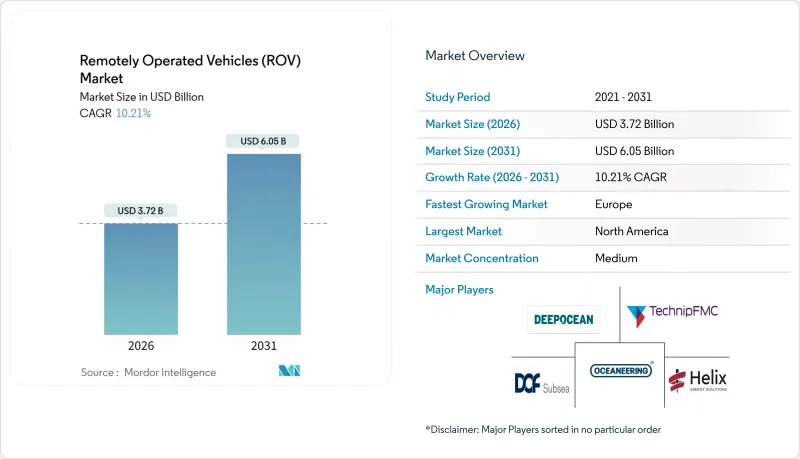
本報告按車輛類別(作業類和觀測類)、耐水深度(淺海、中海和深海)、推進系統(電動、液壓和混合動力)、應用(鑽井和開發、檢查、維修和維護等)、最終用戶應用(石油和天然氣、海上風電等)以及地區(北美、歐洲、亞太地區等)進行分類。
全球遙控潛水器(ROV)市場趨勢與洞察
海上油氣探勘資本投資的復甦
在經歷了2020年至2023年的低迷期後,全球上游產業預算已恢復正常。雪佛龍公司計劃在2025年向上游領域投入145億美元,其中大部分將用於墨西哥灣。殼牌公司的「鯨魚」計畫於2024年底在2500公尺深處實現了初步產油,這一過程需要持續的ROV(遙控潛水器)作業支援。惠譽評等預測,到2027年,上游產業的年度支出將超過5,000億美元,其中深海領域將佔22%。國際能源總署(IEA)預測,2025年至2030年間,海上石油日產量將增加180萬桶,幾乎全部來自深海資產。這些措施將擴大全球ROV市場,因為只有重型ROV才能在1500公尺以上的深海進行液壓作業。
離岸風力發電和海底電纜的擴建
預計到2030年,歐洲離岸風力發電將達到120吉瓦,需要鋪設3萬公里長的電纜,這些電纜需要每年進行檢查。奧爾斯特德公司的Hornsea 3計畫將在696平方公里的海域安裝231風力發電機,並將使用淺水遙控潛水器(ROV)進行船舶系纜勘測。挪威國家石油公司(Equinor)的Highwind Tampen浮式離岸浮體式電計畫引進了多波束ROV進行繫泊纜繩檢查。預計到2025年,中國的離岸風電裝置容量將超過40吉瓦,並計劃在2030年達到100吉瓦,這將促使電池動力裝置的持續採購。凱爾特海的租賃海域將新增4.5吉瓦的裝置容量,合約規定每年進行沖刷評估,以確保未來幾十年持續的電力需求。
海洋探勘與生產(E&P):暫停令與環保運動
美國聯邦政府於2025年宣布禁止發放新的石油和天然氣租賃許可證,這意味著1,200萬英畝的土地將無法進行短期探勘。加州將鑽探禁令延長至2030年,凍結了聖塔芭芭拉海峽對遙控潛水器(ROV)的需求。挪威延後了巴倫支海的油氣開發許可證發放,直至2027年完成影響評估。歐盟的可再生能源戰略關閉了北海18%的油氣開發活動。同時,環保組織向國際海底管理局施壓,要求將商業鑽探許可證的發放延至2028年。
細分市場分析
到2025年,作業級ROV系統將佔據ROV市場佔有率的71.6%,預計到2031年將以11.7%的複合年成長率成長。作業級ROV的市場規模預計在預測期內將增加19億美元,這反映了它們在需要200公斤機械臂力作業中的主導地位。 Saab Seaeye於2024年推出了「Leopard」型號,該型號結合了電力驅動和液壓升降系統,可將燃油消耗降低18%。觀測型ROV對於淺水檢測仍然至關重要,但其日租金較低。 Forum公司的「Sub-Atlantic Mohawk Lite」面向中等規模的作業,其工具滑橇可在兩小時內完成重新配置。這種兩極化確保了ROV市場內部的平行成長軌跡。這是因為離岸風力發電更傾向於緊湊型電動ROV,而石油和天然氣產業則需要與重型設備相當的高容量ROV。
目前,作業級創新主要集中在光纖遙測技術上,該技術可實現即時 4K影像,消除了以往任務結束後需要下載資料才能獲得的資料缺口。 Oceania 公司的 Millennium Plus 設備在墨西哥灣的測試中展示了無縫的多波束視訊串流。小型觀測型 ROV 船隊則更重視移動性和電池續航力,VideoRay 公司的 Pro 5 就是一個很好的例子,它配備了續航時間長達 10 小時的鋰離子電池。混合架構正逐漸成為一種折衷方案,使營運商能夠在滿足環境準則的前提下,又不犧牲有效載荷。
到2025年,深度超過1000公尺的深海專案將佔銷售額的56.3%,但作業深度不超過300公尺的淺海ROV正以13.1%的複合年成長率推動全球ROV市場成長。隨著渦輪機基礎檢查的日益普及,預計到2031年,全球淺海作業ROV市場規模將成長一倍以上。 Austoed公司的Hornsea 3專案需要在40至60公尺深水域安裝的231台渦輪機進行年度檢查。 Videoray公司的Pro 5和Deep Trekker公司的Revolution正瞄準這個市場,它們能夠在5分鐘內完成電池更換。
水深300至1000公尺的中層水域涵蓋了成熟的北海油田和較深的沿海風電場。歐盟指令要求對水深小於200公尺的水域進行年度電纜檢查,從而每年產生4.5億美元的穩定淺水收入。這些合規義務確保了營運商在全球水下機器人(ROV)市場中擁有長期穩定的業務前景。
區域分析
2025年,北美地區將佔雪佛龍公司總收入的37.1%,這主要得益於墨西哥灣一項競標了3.82億美元的租賃競標。雪佛龍的上游預算顯示其對深水開發的持續投入,在加拿大紐芬蘭省獲得批准後,新的鑽井計畫將持續到2027年。墨西哥國家石油公司(Pemex)於2024年恢復了佩爾迪多油田的探勘,提振了中期需求。然而,政策阻力依然存在,聯邦政府暫停租賃以及加州的禁令限制了沿海地區的成長。
歐洲是成長最快的地區,複合年成長率達16.5%,離岸風力發電維護(IRM)市場。丹麥能源網公司已簽署一份契約,將於2024年鋪設1,200公里的輸電電纜。德國的目標是到2030年達到30吉瓦的風電裝置容量。
亞太地區、中東和拉丁美洲是具有高成長潛力的地區。中國計劃在2025年實現離岸風力發電裝置容量超過40吉瓦。印度石油天然氣公司(ONGC)已獲得克里希納-戈達瓦里盆地深海區塊的開採合約。沙烏地阿美、巴西石油和阿布達比國家石油公司(ADNOC)計畫在2028年每年安裝超過60套海底採油樹,並維持高運轉率運作。隨著馬來西亞和印尼擴大天然氣出口,東協地區的管道檢測作業也增加。
其他好處:
- Excel格式的市場預測(ME)表
- 3個月的分析師支持
目錄
第1章:引言
- 研究假設和市場定義
- 調查範圍
第2章:調查方法
第3章執行摘要
第4章 市場狀況
- 市場概覽
- 市場促進因素
- 海上油氣探勘領域的資本投資曾處於上升趨勢,目前正處於復甦階段。
- 擴建離岸風力發電及鋪設海底電纜
- 對用於老舊水下基礎設施的基礎設施拆除設備 (IRM) 的需求日益成長
- 國營石油公司深海石油投資激增
- 可實現水下對接的永久性ROV系統。
- 水下礦物開採試驗計畫
- 市場限制因素
- 暫時中止海上探勘與生產(E&P)與環境保護活動
- 營運型水下機器人船隊的高額資本支出(Capex)和營運成本(OpEx)。
- 關於自主水下作業的監管灰色地帶
- 光纖供應連系管的頻寬限制
- 供應鏈分析
- 監理情勢
- 技術展望
- 波特五力模型
第5章 市場規模與成長預測
- 按車輛類別
- 工作車輛
- 輕體力勞動班
- 中型工作等級
- 重體力勞動等級
- 天文台課程
- 工作車輛
- 防水性能隨深度變化
- 淺海(水深300公尺以下)
- 中層水域(300-1000公尺)
- 深海(超過1000公尺)
- 透過推進系統
- 電的
- 油壓
- 混合
- 透過使用
- 挖掘與開發
- 施工/安裝
- 檢查、維修和維護 (IRM)
- 退休
- 環境監測
- 透過最終用戶應用程式
- 石油和天然氣
- 離岸風力發電
- 國防與安全
- 研究與學術
- 水產養殖和海洋基礎設施
- 按地區
- 北美洲
- 美國
- 加拿大
- 墨西哥
- 歐洲
- 英國
- 挪威
- 丹麥
- 德國
- 法國
- 俄羅斯
- 其他歐洲國家
- 亞太地區
- 中國
- 印度
- 日本
- 韓國
- 東南亞國協
- 其他亞太國家
- 南美洲
- 巴西
- 阿根廷
- 哥倫比亞
- 其他南美國家
- 中東和非洲
- 沙烏地阿拉伯
- 阿拉伯聯合大公國
- 卡達
- 南非
- 埃及
- 奈及利亞
- 其他中東和非洲國家
- 北美洲
第6章 競爭情勢
- 市場集中度
- 策略趨勢(併購、聯盟、購電協議)
- 市場佔有率分析(主要公司的市場排名和佔有率)
- 公司簡介
- Oceaneering International Inc.
- TechnipFMC plc
- Subsea 7 SA
- Fugro NV
- DOF Subsea AS
- DeepOcean AS
- Helix Energy Solutions Group Inc.
- Bourbon Corp. SA
- Saipem SpA
- Forum Energy Technologies Inc.
- Saab Seaeye Ltd.
- ROVOP Ltd.
- Delta SubSea LLC
- IKM Subsea AS
- Kongsberg Maritime
- ECA Group
- Deep Trekker Inc.
- VideoRay LLC
- Blue Robotics Inc.
- Seatronics(Ashtead Group)
第7章 市場機會與未來展望
According to Mordor Intelligence, the remotely operated vehicles market size is estimated at USD 3.72 billion in 2026, and is expected to reach USD 6.05 billion by 2031, at a CAGR of 10.21% during the forecast period (2026-2031).
This report is Segmented by Vehicle Class (Work-Class and Observatory-Class), Depth Rating (Shallow, Mid-Water, and Deep-Water), Propulsion System (Electric, Hydraulic, and Hybrid), Activity (Drilling and Development, Inspection, Repair and Maintenance, and More), End-User Application (Oil and Gas, Offshore Wind, and More), and Geography (North America, Europe, Asia-Pacific, and More).
Global Remotely Operated Vehicles (ROV) Market Trends and Insights
Increasing Offshore Oil & Gas Exploration Capex Rebound
Global upstream budgets have normalized after the 2020-2023 downturn, with Chevron allocating USD 14.5 billion to upstream in 2025, much of it in the Gulf of Mexico. Shell's Whale project reached first oil in late 2024 at 2,500 meters and required continuous work-class support. Fitch Ratings expects annual upstream spending to top USD 500 billion through 2027, with deep-water claiming 22% of that outlay. The International Energy Agency projects offshore production to rise by 1.8 million barrels per day between 2025 and 2030, almost entirely from deep-water assets. These commitments enlarge the Global ROV market because only heavy work-class units can handle hydraulic manipulation at depths beyond 1,500 meters.
Expansion of Offshore Wind Farms and Subsea Cabling
Europe is on track for 120 gigawatts of offshore wind by 2030, requiring 35,000 kilometers of cables that must be inspected annually. Orsted's Hornsea 3 will install 231 turbines across 696 square kilometers and deploy shallow-water vehicles for foundation surveys. Equinor's Hywind Tampen floating project introduced mooring-line inspections that depend on multi-beam-equipped ROVs. China surpassed 40 gigawatts in 2025 and targets 100 gigawatts by 2030, generating sustained procurement of battery-electric units. The Celtic Sea leasing round added 4.5 gigawatts with contracts mandating yearly scour assessments, guaranteeing decades of recurring demand.
Offshore E&P Moratoriums & Environmental Activism
The U.S. federal pause on new leases announced in 2025 removed 12 million acres from near-term exploration. California extended its drilling moratorium to 2030, freezing ROV demand in the Santa Barbara Channel. Norway deferred Barents licensing until impact studies finish in 2027. The EU's Renewable Energy Strategy closed 18% of the North Sea to hydrocarbon activity. Meanwhile, environmental groups pressured the International Seabed Authority to postpone commercial mining licenses until 2028.
Other drivers and restraints analyzed in the detailed report include:
- Rising IRM Demand for Ageing Subsea Infrastructure
- Deep-Water Capex Surge by NOCs
- High Capex & OPEX of Work-Class ROV Fleets
For complete list of drivers and restraints, kindly check the Table Of Contents.
Segment Analysis
Work-class systems held 71.6% of the ROV market share in 2025 and will climb at an 11.7% CAGR to 2031. The ROV market size for work-class units is projected to expand by USD 1.9 billion over the forecast, reflecting monopoly on tasks that demand 200-kilogram manipulator force. Saab Seaeye launched the Leopard in 2024, pairing electric transit with hydraulic lift to cut fuel use 18%. Observatory-class vehicles remain essential for shallow inspections but command lower day rates. Forum's Sub-Atlantic Mohawk Lite targets mid-tier tasks with a tool skid that reconfigures in under two hours. This bifurcation ensures parallel growth paths inside the ROV market as offshore wind favors compact electric units while oil and gas relies on heavy work-class capacity.
Work-class innovations now center on fiber-optic telemetry that enables real-time 4K video, closing a data gap that historically forced post-mission downloads. Oceaneering's Millennium Plus demonstrated seamless multi-beam streaming in Gulf of Mexico trials. Smaller observatory fleets focus on agility and battery endurance, typified by VideoRay's Pro 5 with a 10-hour lithium-ion package. Hybrid architecture is emerging as a compromise, letting operators satisfy environmental guidelines without sacrificing payload.
Deep-water projects above 1,000 meters controlled 56.3% of revenue in 2025, yet shallow-water fleets up to 300 meters are pacing the Global ROV market at a 13.1% CAGR. The Global ROV market size for shallow-water operations is projected to more than double by 2031 as turbine-foundation inspections proliferate. Orsted's Hornsea 3 requires annual verification across 231 turbines located at 40-60 meters. VideoRay's Pro 5 and Deep Trekker's Revolution target this domain with battery swaps under five minutes.
Mid-water zones covering 300-1,000 meters serve mature North Sea fields and deeper coastal wind sites. EU directives mandate yearly cable checks in waters shallower than 200 meters, creating a captive shallow-water revenue stream of USD 450 million annually. These compliance obligations ensure long-run visibility for operators pursuing recurrent contracts inside the Global ROV market.
Complete Report Scope:
- By Vehicle Class
- Work-class
- Light Work-class
- Medium Work-class
- Heavy Work-class
- Observatory-class
- Work-class
- By Depth Rating
- Shallow (Up to 300 m)
- Mid-water (300 to 1,000 m)
- Deep-water (Above 1,000 m)
- By Propulsion System
- Electric
- Hydraulic
- Hybrid
- By Activity
- Drilling and Development
- Construction and Installation
- Inspection, Repair and Maintenance (IRM)
- Decommissioning
- Environmental Monitoring
- By End-user Application
- Oil and Gas
- Offshore Wind
- Defense and Security
- Research and Academia
- Aquaculture and Marine Infrastructure
- By Geography
- North America
- United States
- Canada
- Mexico
- Europe
- United Kingdom
- Norway
- Denmark
- Germany
- France
- Russia
- Rest of Europe
- Asia-Pacific
- China
- India
- Japan
- South Korea
- ASEAN Countries
- Rest of Asia-Pacific
- South America
- Brazil
- Argentina
- Colombia
- Rest of South America
- Middle East and Africa
- Saudi Arabia
- United Arab Emirates
- Qatar
- South Africa
- Egypt
- Nigeria
- Rest of Middle East and Africa
- North America
Geography Analysis
North America generated 37.1% of 2025 revenue, anchored by Gulf of Mexico lease rounds that drew USD 382 million in bids. Chevron's upstream budget signals a durable deep-water appetite, and Canada's approvals in Newfoundland add new drilling campaigns through 2027. Pemex revived Perdido exploration in 2024, enhancing medium-term demand. Policy headwinds persist as the federal leasing pause and California moratorium constrain near-shore growth.
Europe is the fastest-advancing region with a 16.5% CAGR, scaling the Global ROV market through offshore wind build-out and decommissioning. The Crown Estate's Celtic Sea leases add 4.5 gigawatts with compulsory yearly inspections. Norway's annual integrity rules create a USD 800 million captive IRM market. Denmark's Energinet let contracts for 1,200 kilometers of export cables in 2024. Germany targets 30 gigawatts of wind by 2030.
Asia-Pacific, the Middle East, and Latin America represent high-growth corridors. China already crossed 40 gigawatts of offshore wind in 2025. India's ONGC awarded contracts for deep-water KG-Basin blocks. Saudi Aramco, Petrobras, and ADNOC together plan more than 60 subsea trees per year through 2028, sustaining heavy work-class utilization. ASEAN pipeline inspection work is rising as Malaysia and Indonesia expand gas exports.
- Oceaneering International Inc.
- TechnipFMC plc
- Subsea 7 S.A.
- Fugro N.V.
- DOF Subsea AS
- DeepOcean AS
- Helix Energy Solutions Group Inc.
- Bourbon Corp. SA
- Saipem SpA
- Forum Energy Technologies Inc.
- Saab Seaeye Ltd.
- ROVOP Ltd.
- Delta SubSea LLC
- IKM Subsea AS
- Kongsberg Maritime
- ECA Group
- Deep Trekker Inc.
- VideoRay LLC
- Blue Robotics Inc.
- Seatronics (Ashtead Group)
Additional Benefits:
- The market estimate (ME) sheet in Excel format
- 3 months of analyst support
TABLE OF CONTENTS
1 Introduction
- 1.1 Study Assumptions & Market Definition
- 1.2 Scope of the Study
2 Research Methodology
3 Executive Summary
4 Market Landscape
- 4.1 Market Overview
- 4.2 Market Drivers
- 4.2.1 Increasing offshore oil & gas exploration capex rebound
- 4.2.2 Expansion of offshore wind farms and subsea cabling
- 4.2.3 Rising IRM demand for ageing subsea infrastructure
- 4.2.4 Deep-water capex surge by NOCs
- 4.2.5 Resident ROV systems enabled by subsea docking
- 4.2.6 Seabed mineral-mining pilot programs
- 4.3 Market Restraints
- 4.3.1 Offshore E&P moratoriums & environmental activism
- 4.3.2 High capex & OPEX of work-class ROV fleets
- 4.3.3 Regulatory grey zones for autonomous subsea ops
- 4.3.4 Fiber-optic umbilical bandwidth constraints
- 4.4 Supply-Chain Analysis
- 4.5 Regulatory Landscape
- 4.6 Technological Outlook
- 4.7 Porter's Five Forces
- 4.7.1 Bargaining Power of Suppliers
- 4.7.2 Bargaining Power of Buyers
- 4.7.3 Threat of New Entrants
- 4.7.4 Threat of Substitutes
- 4.7.5 Intensity of Rivalry
5 Market Size & Growth Forecasts
- 5.1 By Vehicle Class
- 5.1.1 Work-class
- 5.1.1.1 Light Work-class
- 5.1.1.2 Medium Work-class
- 5.1.1.3 Heavy Work-class
- 5.1.2 Observatory-class
- 5.1.1 Work-class
- 5.2 By Depth Rating
- 5.2.1 Shallow (Up to 300 m)
- 5.2.2 Mid-water (300 to 1,000 m)
- 5.2.3 Deep-water (Above 1,000 m)
- 5.3 By Propulsion System
- 5.3.1 Electric
- 5.3.2 Hydraulic
- 5.3.3 Hybrid
- 5.4 By Activity
- 5.4.1 Drilling and Development
- 5.4.2 Construction and Installation
- 5.4.3 Inspection, Repair and Maintenance (IRM)
- 5.4.4 Decommissioning
- 5.4.5 Environmental Monitoring
- 5.5 By End-user Application
- 5.5.1 Oil and Gas
- 5.5.2 Offshore Wind
- 5.5.3 Defense and Security
- 5.5.4 Research and Academia
- 5.5.5 Aquaculture and Marine Infrastructure
- 5.6 By Geography
- 5.6.1 North America
- 5.6.1.1 United States
- 5.6.1.2 Canada
- 5.6.1.3 Mexico
- 5.6.2 Europe
- 5.6.2.1 United Kingdom
- 5.6.2.2 Norway
- 5.6.2.3 Denmark
- 5.6.2.4 Germany
- 5.6.2.5 France
- 5.6.2.6 Russia
- 5.6.2.7 Rest of Europe
- 5.6.3 Asia-Pacific
- 5.6.3.1 China
- 5.6.3.2 India
- 5.6.3.3 Japan
- 5.6.3.4 South Korea
- 5.6.3.5 ASEAN Countries
- 5.6.3.6 Rest of Asia-Pacific
- 5.6.4 South America
- 5.6.4.1 Brazil
- 5.6.4.2 Argentina
- 5.6.4.3 Colombia
- 5.6.4.4 Rest of South America
- 5.6.5 Middle East and Africa
- 5.6.5.1 Saudi Arabia
- 5.6.5.2 United Arab Emirates
- 5.6.5.3 Qatar
- 5.6.5.4 South Africa
- 5.6.5.5 Egypt
- 5.6.5.6 Nigeria
- 5.6.5.7 Rest of Middle East and Africa
- 5.6.1 North America
6 Competitive Landscape
- 6.1 Market Concentration
- 6.2 Strategic Moves (M&A, Partnerships, PPAs)
- 6.3 Market Share Analysis (Market Rank/Share for key companies)
- 6.4 Company Profiles (includes Global level Overview, Market level overview, Core Segments, Financials as available, Strategic Information, Products & Services, and Recent Developments)
- 6.4.1 Oceaneering International Inc.
- 6.4.2 TechnipFMC plc
- 6.4.3 Subsea 7 S.A.
- 6.4.4 Fugro N.V.
- 6.4.5 DOF Subsea AS
- 6.4.6 DeepOcean AS
- 6.4.7 Helix Energy Solutions Group Inc.
- 6.4.8 Bourbon Corp. SA
- 6.4.9 Saipem SpA
- 6.4.10 Forum Energy Technologies Inc.
- 6.4.11 Saab Seaeye Ltd.
- 6.4.12 ROVOP Ltd.
- 6.4.13 Delta SubSea LLC
- 6.4.14 IKM Subsea AS
- 6.4.15 Kongsberg Maritime
- 6.4.16 ECA Group
- 6.4.17 Deep Trekker Inc.
- 6.4.18 VideoRay LLC
- 6.4.19 Blue Robotics Inc.
- 6.4.20 Seatronics (Ashtead Group)
7 Market Opportunities & Future Outlook
- 7.1 White-space & Unmet-Need Assessment

 全球無人水下航行器(UUV)市場(至 2031 年):依 AUV/ROV、應用、推進方法、系統、速度、形狀和地區分類。
 遠程操作車輛市場規模、佔有率和成長分析:按潛水器類型、應用、組件、潛水深度、最終用戶、操作類型和地區分類-2026-2033年產業預測
 全球智慧無人水下導航系統市場:機會與策略展望(至2035年)
 全球無人水下航行器市場規模、佔有率、趨勢和成長分析報告(2026-2034)2026年全球軍用無人水下載具市場報告
 無人水下航行器市場:按平台、推進系統、有效載荷、應用和最終用途分類-2026-2032年全球預測無人水下航行器市場規模、佔有率、成長及全球產業分析:按無人水下航行器類型、子系統、作業範圍類型、應用、最終用戶和地區分類的洞察與預測(2026-2034 年)
 無人水下航行器市場:依類型、應用、系統和產品類型劃分 - 全球預測至 2036 年
 全球無人水下航行器市場:預測(至2034年)-按類型、推進系統、產品類型、有效載荷、應用、最終用戶和地區進行分析2026年全球小型ROV市場報告