


 |
市場調查報告書
商品編碼
2121595
己二酸:市場佔有率分析、產業趨勢與統計、成長預測(2026-2031)Adipic Acid - Market Share Analysis, Industry Trends & Statistics, Growth Forecasts (2026 - 2031) |
||||||

※ 本網頁內容可能與最新版本有所差異。詳細情況請與我們聯繫。
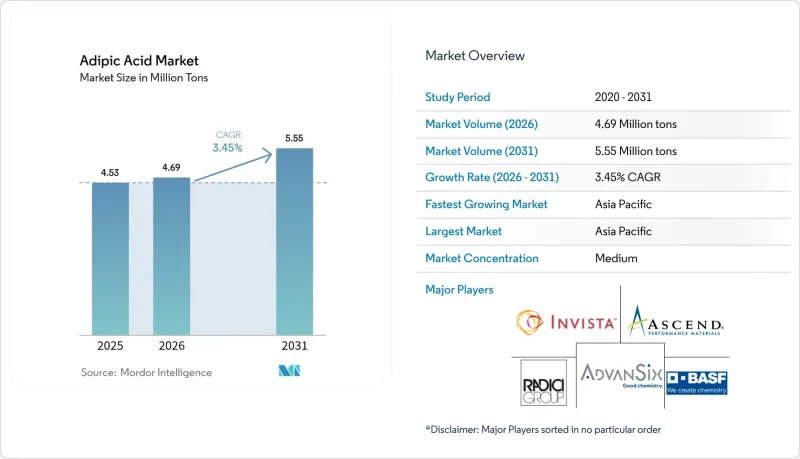
根據 Mordor Intelligence 預測,己二酸市場規模將從 2025 年的 453 萬噸成長到 2026 年的 469 萬噸,然後在 2031 年達到 555 萬噸,2026 年至 2031 年的複合年成長率為 3.45%。
本報告依原料(環己醇、環己酮)、製造流程(硝酸氧化法、生物發酵法)、最終產品(尼龍 66 纖維、尼龍 66 工程樹脂等)、應用(塑化劑、不飽和聚酯樹脂等)、終端用戶產業(汽車、電氣和電子設備等)以及地區(亞太地區、北美、歐洲聚酯樹脂等)進行分類。
全球己二酸市場趨勢及洞察
電動車輕量化零件對尼龍 66 的需求正在激增。
電動車製造商擴大採用尼龍66來減輕車身重量並延長續航里程,這導致己二腈基中間體的消耗量增加。英威達(INVISTA)計劃將其上海尼龍66的產量加倍,達到40萬噸,這將使生產基地更靠近己二腈原料產地,從而降低物流成本並縮短供應鏈。BASF(BASF)位於法國的年產26萬噸的己二胺生產廠正在提高關鍵單體的區域自給率。尼龍66對於電池溫度控管和結構模組至關重要,因為它具有同等重量金屬無法實現的耐熱性。近期中國一家己二腈生產廠的意外停產凸顯了供應的脆弱性,並促使生產商整合上游工程以降低風險。
電動汽車電池機殼從金屬到塑膠的過渡
汽車製造商正從金屬電池蓋轉向聚合物解決方案,以減輕重量並提高設計柔軟性。由己二酸製成的聚氨酯泡棉可為機殼提供隔熱和散熱功能,而科思創獲得ISCC+認證的原料則象徵著汽車產業向永續性的轉型。 2023年,美國汽車製造商消耗了價值1.42億英鎊的聚氨酯塗料,這一規模顯示己二酸供應商短期內可獲得可觀的利潤。塑膠的使用使得電池組能夠製造複雜形狀,從而簡化其結構。高性能聚合物的高價可以抵消原料成本的上漲,促進產能提升,並有助於穩定己二酸市場。
環己酮原料價格波動
環己酮約佔生產成本的三分之二,這意味著價格波動會迅速擠壓利潤空間。上游產業缺乏多元化意味著意外停產和地緣政治衝擊會對整個價值鏈產生連鎖反應。物流和能源成本的上漲進一步削弱了生產的整體經濟效益,使得簽訂長期合約變得困難。垂直整合和生物芳香化合物等替代原料正被視為應對策略。然而,鑑於原物料價格波動難以預測,籌集上游收購所需的資金仍面臨挑戰。
細分市場分析
預計到2025年,環己酮將佔據己二酸市場54.62%的佔有率,鞏固其在硝酸氧化製程的主導地位。己二酸市場依賴環己酮,約佔全球產量的一半,凸顯了穩定供應鏈的重要性。同時,隨著生產商採用更環保的氧化催化劑,顯著降低氮氧化物排放,環己酮的複合年成長率(CAGR)達到4.78%。以過氧化氫為催化劑的設計實現了92.3%的轉化率和29.4%的己二酸選擇性,效率大幅提升。高效法拉第效率的電催化反應能夠以93%的效率同時生成氫氣,這不僅開啟了新的收入來源,也符合脫碳目標。
生物芳烴概念有效利用木質素,可完全消除生產過程中原油衍生的中間體。一種基因改造的惡臭假單胞菌菌株可利用木質素片段生產2.5 g/L的己二酸,為未來將其整合到生物煉製產品中鋪平了道路。生命週期評估表明,與石油化工路線相比,該方法可減少58%的二氧化碳排放和23%的能源需求,使其成為在不斷變化的碳定價體系下實現合規的有效途徑。儘管目前產量仍然小規模,但成功的商業化可望重塑己二酸市場原料的經濟格局。
截至2025年,由於技術成熟和成本下降,硝酸氧化法佔了己二酸市場90.98%的佔有率。雖然該製程生產的己二酸市場受益於規模經濟,但其一氧化二氮(N₂O)排放仍受到嚴格監管。德克薩斯州的法規將NOx排放量限制在每噸2.5磅以內,凸顯了該地區合規的難度。
儘管生物發酵目前的複合年成長率僅4.82%,但以葡萄糖和木糖為原料的商業試驗正在增加。將碳成本內部化將使其更接近經濟平衡,尤其是在可再生能源過剩的地區。與玉米乙醇工廠毗鄰可以確保原料和公用設施的供應,進一步降低變動成本。競爭力的關鍵在於發酵製程能否達到足夠的規模,將固定成本降低到現有資產水準以下。
區域分析
預計到2025年,亞太地區將佔全球產量的46.88%,年複合成長率將達到4.98%,成為成長最快的地區。這主要得益於中國產能的擴張以及印度將石化投資集中於其古吉拉突邦工業走廊。催化裂解設備的快速部署正逐步縮小中西方生產商之間的碳排放差距。北美仍是食品級和高純度己二酸的主要生產地。 Ascend Performance Materials和AdvanceSix經營著一條完全一體化的供應鏈,受益於頁岩氣的經濟效益以及美國嚴格的排放法規,這些法規更青睞那些擁有良好合規記錄的生產商。位於中西部的發酵先導工廠以玉米為原料,並利用風電走廊的再生能源。在歐洲,強調循環經濟的政策正在推動資本流入將下游樹脂工廠與上游單體生產相結合的綜合資產,從而最大限度地減少與物流相關的排放。BASF在法國對己二胺的投資是將永續性融入供應鏈結構的樞紐模式的典型範例。在南美洲、中東和非洲,隨著基礎建設的推進,人們對己二酸的興趣日益濃厚,但政治和經濟的不穩定性可能會成為阻礙,延緩大規模投資的進行。總而言之,這些發展凸顯了己二酸市場複雜且區域差異顯著的現狀,而這種現狀仍持續影響著全球己二酸市場的供應模式。
其他好處:
- Excel格式的市場預測(ME)表
- 3個月的分析師支持
目錄
第1章:引言
- 研究假設和市場定義
- 調查範圍
第2章:調查方法
第3章執行摘要
第4章 市場狀況
- 市場概覽
- 市場促進因素
- 電動車輕量化零件對尼龍 66 的需求激增。
- 電動汽車電池機殼從金屬到塑膠的過渡
- 節能建築發泡材的成長
- 擴大纖維長絲生產能力
- 用於可堆肥薄膜的生物基己二酸現已上市。
- 市場限制因素
- 環己酮原料價格波動
- 生物發酵途徑規模化面臨的挑戰
- 硝酸供應鏈面臨的地緣政治風險
- 價值鏈分析
- 波特五力模型
第5章 市場規模與成長預測
- 按成分
- 環己醇
- 環己酮
- 透過生產過程
- 硝酸氧化法
- 生物發酵
- 最終產品
- 尼龍66纖維
- 尼龍66工程樹脂
- 聚氨酯
- 己二酸酯
- 其他最終產品
- 透過使用
- 塑化劑
- 不飽和聚酯樹脂
- 濕紙巾用樹脂
- 塗層
- 合成潤滑油
- 食品添加物
- 其他用途
- 按最終用戶行業分類
- 車
- 電氣和電子設備
- 紡織品
- 食品/飲料
- 個人護理
- 製藥
- 其他終端用戶產業
- 按地區
- 亞太地區
- 中國
- 印度
- 日本
- 韓國
- 其他亞太國家
- 北美洲
- 美國
- 加拿大
- 墨西哥
- 歐洲
- 德國
- 英國
- 義大利
- 法國
- 其他歐洲國家
- 南美洲
- 巴西
- 阿根廷
- 其他南美國家
- 中東和非洲
- 沙烏地阿拉伯
- 南非
- 其他中東和非洲國家
- 亞太地區
第6章 競爭情勢
- 市場集中度
- 策略趨勢
- 市佔率分析
- 公司簡介
- AdvanSix Inc.
- Asahi Kasei Corp.
- Ascend Performance Materials
- BASF SE
- CJ CheilJedang
- Domo Chemicals
- Huafeng Group
- INVISTA
- Lanxess AG
- Radici Partecipazioni SpA
- Shandong Hualu-Hengsheng Chemical
- Shenma Industrial
- Solvay SA
- Sumitomo Chemical Co., Ltd.
- Tangshan Zhonghao Chemical
- TORAY INDUSTRIES, INC.
第7章 市場機會與未來展望
According to Mordor Intelligence, the adipic acid market size is expected to grow from 4.53 million tons in 2025 to 4.69 million tons in 2026 and is forecast to reach 5.55 million tons by 2031 at 3.45% CAGR over 2026-2031.
This report is Segmented by Raw Material (Cyclohexanol, Cyclohexanone), Production Process (Nitric-Acid Oxidation, Bio-Fermentation), End Product (Nylon 66 Fibers, Nylon 66 Engineering Resins, and More), Application (Plasticizers, Unsaturated Polyester Resins, and More), End-User Industry (Automotive, Electrical and Electronics, and More), and Geography (Asia-Pacific, North America, Europe, and More).
Global Adipic Acid Market Trends and Insights
Surging Demand for Nylon 66 in E-Mobility Lightweight Parts
Electric vehicle manufacturers are embracing nylon 66 to reduce vehicle mass and extend driving range, which elevates consumption of adipic acid-based intermediates. INVISTA's project to double Shanghai nylon 66 output to 400,000 tons places production close to adiponitrile feedstock, lowering logistics costs and shortening supply chains. BASF's 260,000-ton hexamethylenediamine unit in France expands regional self-sufficiency for critical monomers. Battery thermal-management and structural modules rely on nylon 66 for heat resistance that metals cannot offer at comparable weight. Recent unplanned outages at adiponitrile plants in China highlighted supply vulnerability and prompted producers to integrate upstream operations for risk mitigation.
Shift from Metal to Plastics in EV Battery Casings
Automakers are converting metal battery covers to polymer solutions that combine weight savings with enhanced design flexibility. Polyurethane foams derived from adipic acid now insulate casings while dissipating heat, and Covestro's ISCC+ certified raw materials illustrate the industry's sustainability pivot. United States automotive producers consumed 142 million lb of polyurethane coatings in 2023, a scale that underscores the near-term revenue upside for adipic acid suppliers. Complex geometries are achievable through plastics, enabling streamlined battery pack architectures. Premium pricing for high-performance polymers offsets higher raw-material costs and encourages capacity additions that stabilize the adipic acid market.
Volatility in Cyclohexanone Feedstock Prices
Cyclohexanone accounts for roughly two-thirds of conversion costs; hence, price swings rapidly compress margins. Limited upstream diversification means unplanned outages or geopolitical shocks ripple through the value chain. Rising logistics and energy costs further destabilize total production economics, complicating long-term contracts. Vertical integration or alternative feedstocks such as bio-aromatics are gaining attention as resilience strategies. However, securing capital for upstream acquisitions is challenging when feedstock cycles remain unpredictable.
Other drivers and restraints analyzed in the detailed report include:
- Growth of Energy-Efficient Construction Foams
- Expansion of Textile Filament Capacity
- Scale-Up Challenges for Bio-Fermentation Pathways
For complete list of drivers and restraints, kindly check the Table Of Contents.
Segment Analysis
Cyclohexanone controlled 54.62% adipic acid market share in 2025, confirming its entrenched role in nitric-acid oxidation. The adipic acid market size tied to cyclohexanone represents roughly half of global output, reinforcing the importance of stable supply chains. Cyclohexanol, however, is rising at 4.78% CAGR as producers deploy greener oxidation catalysts that slash nitrous oxide emissions. Catalyst designs featuring hydrogen peroxide achieve 92.3% conversion and 29.4% selectivity to adipic acid, reflecting substantial efficiency gains. Faradaic-efficient electrocatalysis that co-generates hydrogen gas at 93% efficiency presents an additional revenue stream and aligns with decarbonization targets.
Bio-aromatic concepts that valorize lignin can remove crude-derived intermediates from the chain altogether. Engineered Pseudomonas putida strains deliver 2.5 g/L adipic acid from lignin fragments and point toward future integration of biorefinery side-streams. Lifecycle assessments suggest a 58% CO2 reduction and 23% lower energy demand versus petrochemical routes, positioning such pathways as compliance tools under evolving carbon-pricing regimes. Although volumes remain small, successful commercialization could redraw raw-material economics within the adipic acid market.
Nitric-acid oxidation constituted 90.98% of the adipic acid market in 2025 due to mature technology and sunk capital. The adipic acid market size linked to this process benefits from economies of scale but endures scrutiny over nitrous oxide emissions. Texas regulations limit NOx to 2.5 lb per ton, illustrating regional compliance burdens.
Bio-fermentation, despite holding only 4.82% CAGR momentum, is gathering commercial trials that run on glucose and xylose. When carbon costs are internalized, economic parity edges closer, particularly in regions with renewable-energy surpluses. Co-location with corn-ethanol plants can secure feedstock and utilities, further compressing variable cost. The competitive narrative hinges on whether fermentation can achieve the scale needed to drop fixed costs below incumbent asset levels.
Complete Report Scope:
- By Raw Material
- Cyclohexanol
- Cyclohexanone
- By Production Process
- Nitric-acid Oxidation
- Bio-fermentation
- By End Product
- Nylon 66 Fibers
- Nylon 66 Engineering Resins
- Polyurethanes
- Adipate Esters
- Other End Products
- By Application
- Plasticizers
- Unsaturated Polyester Resins
- Wet Paper Resins
- Coatings
- Synthetic Lubricants
- Food Additives
- Other Applications
- By End-user Industry
- Automotive
- Electrical and Electronics
- Textiles
- Food and Beverage
- Personal Care
- Pharmaceuticals
- Other End User Industries
- By Geography
- Asia-Pacific
- China
- India
- Japan
- South Korea
- Rest of Asia-Pacific
- North America
- United States
- Canada
- Mexico
- Europe
- Germany
- United Kingdom
- Italy
- France
- Rest of Europe
- South America
- Brazil
- Argentina
- Rest of South America
- Middle East and Africa
- Saudi Arabia
- South Africa
- Rest of Middle East and Africa
- Asia-Pacific
Geography Analysis
Asia-Pacific held 46.88% of global volume in 2025 and drives the fastest 4.98% CAGR as China scales capacity and India channels petrochemical investment into Gujarat corridors. Rapid adoption of catalytic destruction units has started to narrow the carbon gap between Chinese and Western producers. North America remains a stronghold for food-grade and high-purity grades of adipic acid. Ascend Performance Materials and AdvanSix operate fully integrated chains that benefit from shale-gas economics and strict U.S. emission controls, which favor producers with demonstrated compliance records. Fermentation pilots clustered in the Midwest leverage corn feedstock and renewable electricity from wind corridors. Europe's policy focus on circularity is driving capital toward integrated assets that couple downstream resin plants with upstream monomers to minimize logistics emissions. BASF's French hexamethylenediamine investment exemplifies a hub model that embeds sustainability into supply architecture. South America and the Middle East & Africa show emerging interest through infrastructure build-outs, yet political and economic volatility create hurdles that could delay large-scale investments. Together these dynamics illustrate a regionally stratified complexion that continues to shape global supply patterns in the adipic acid market.
- AdvanSix Inc.
- Asahi Kasei Corp.
- Ascend Performance Materials
- BASF SE
- CJ CheilJedang
- Domo Chemicals
- Huafeng Group
- INVISTA
- Lanxess AG
- Radici Partecipazioni SpA
- Shandong Hualu-Hengsheng Chemical
- Shenma Industrial
- Solvay SA
- Sumitomo Chemical Co., Ltd.
- Tangshan Zhonghao Chemical
- TORAY INDUSTRIES, INC.
Additional Benefits:
- The market estimate (ME) sheet in Excel format
- 3 months of analyst support
TABLE OF CONTENTS
1 Introduction
- 1.1 Study Assumptions and Market Definition
- 1.2 Scope of the Study
2 Research Methodology
3 Executive Summary
4 Market Landscape
- 4.1 Market Overview
- 4.2 Market Drivers
- 4.2.1 Surging demand for Nylon 66 in e-mobility lightweight parts
- 4.2.2 Shift from metal to plastics in EV battery casings
- 4.2.3 Growth of energy-efficient construction foams
- 4.2.4 Expansion of textile filament capacity
- 4.2.5 Emergence of bio-based adipic acid for compostable films
- 4.3 Market Restraints
- 4.3.1 Volatility in cyclohexanone feedstock prices
- 4.3.2 Scale-up challenges for bio-fermentation pathways
- 4.3.3 Geopolitical risk to nitric-acid supply chains
- 4.4 Value Chain Analysis
- 4.5 Porter's Five Forces
- 4.5.1 Bargaining Power of Suppliers
- 4.5.2 Bargaining Power of Buyers
- 4.5.3 Threat of New Entrants
- 4.5.4 Threat of Substitutes
- 4.5.5 Degree of Competition
5 Market Size and Growth Forecasts (Value and Volume)
- 5.1 By Raw Material
- 5.1.1 Cyclohexanol
- 5.1.2 Cyclohexanone
- 5.2 By Production Process
- 5.2.1 Nitric-acid Oxidation
- 5.2.2 Bio-fermentation
- 5.3 By End Product
- 5.3.1 Nylon 66 Fibers
- 5.3.2 Nylon 66 Engineering Resins
- 5.3.3 Polyurethanes
- 5.3.4 Adipate Esters
- 5.3.5 Other End Products
- 5.4 By Application
- 5.4.1 Plasticizers
- 5.4.2 Unsaturated Polyester Resins
- 5.4.3 Wet Paper Resins
- 5.4.4 Coatings
- 5.4.5 Synthetic Lubricants
- 5.4.6 Food Additives
- 5.4.7 Other Applications
- 5.5 By End-user Industry
- 5.5.1 Automotive
- 5.5.2 Electrical and Electronics
- 5.5.3 Textiles
- 5.5.4 Food and Beverage
- 5.5.5 Personal Care
- 5.5.6 Pharmaceuticals
- 5.5.7 Other End User Industries
- 5.6 By Geography
- 5.6.1 Asia-Pacific
- 5.6.1.1 China
- 5.6.1.2 India
- 5.6.1.3 Japan
- 5.6.1.4 South Korea
- 5.6.1.5 Rest of Asia-Pacific
- 5.6.2 North America
- 5.6.2.1 United States
- 5.6.2.2 Canada
- 5.6.2.3 Mexico
- 5.6.3 Europe
- 5.6.3.1 Germany
- 5.6.3.2 United Kingdom
- 5.6.3.3 Italy
- 5.6.3.4 France
- 5.6.3.5 Rest of Europe
- 5.6.4 South America
- 5.6.4.1 Brazil
- 5.6.4.2 Argentina
- 5.6.4.3 Rest of South America
- 5.6.5 Middle East and Africa
- 5.6.5.1 Saudi Arabia
- 5.6.5.2 South Africa
- 5.6.5.3 Rest of Middle East and Africa
- 5.6.1 Asia-Pacific
6 Competitive Landscape
- 6.1 Market Concentration
- 6.2 Strategic Moves
- 6.3 Market Share Analysis
- 6.4 Company Profiles (includes Global level Overview, Market level overview, Core Segments, Financials as available, Strategic Information, Market Rank/Share for key companies, Products and Services, and Recent Developments)
- 6.4.1 AdvanSix Inc.
- 6.4.2 Asahi Kasei Corp.
- 6.4.3 Ascend Performance Materials
- 6.4.4 BASF SE
- 6.4.5 CJ CheilJedang
- 6.4.6 Domo Chemicals
- 6.4.7 Huafeng Group
- 6.4.8 INVISTA
- 6.4.9 Lanxess AG
- 6.4.10 Radici Partecipazioni SpA
- 6.4.11 Shandong Hualu-Hengsheng Chemical
- 6.4.12 Shenma Industrial
- 6.4.13 Solvay SA
- 6.4.14 Sumitomo Chemical Co., Ltd.
- 6.4.15 Tangshan Zhonghao Chemical
- 6.4.16 TORAY INDUSTRIES, INC.
7 Market Opportunities and Future Outlook
- 7.1 White-space and Unmet-need Assessment

 己二酸市場:全球市場預測(2026-2032)
 合成和生物衍生己二酸市場:按應用和地區分類
 己二酸市場規模、佔有率和趨勢分析報告:按應用、地區和細分市場預測(2026-2033 年)己二酸市場:按應用、終端用戶產業和地區分類生物基己二酸市場:依製程、原料、等級、應用、終端用戶產業及通路分類-2026-2032年全球市場預測
 己二酸市場規模、佔有率、趨勢和預測:最終產品、應用、最終用戶和地區分類,2026-2034年
 2026年全球己二酸市場報告
 全球己二酸市場:市場規模、佔有率、成長率、產業分析、依類型、應用和地區劃分的分析、未來預測(2026-2034)
 生物基己二酸市場報告:趨勢、預測與競爭分析(至2031年)
 2030 年己二酸市場預測:按來源、劑型、製造方法、分銷管道、應用、最終用戶和地區進行的全球分析