


 |
市場調查報告書
商品編碼
2121587
電池回收:市場佔有率分析、產業趨勢與統計、成長預測(2026-2031)Battery Recycling - Market Share Analysis, Industry Trends & Statistics, Growth Forecasts (2026 - 2031) |
||||||

※ 本網頁內容可能與最新版本有所差異。詳細情況請與我們聯繫。
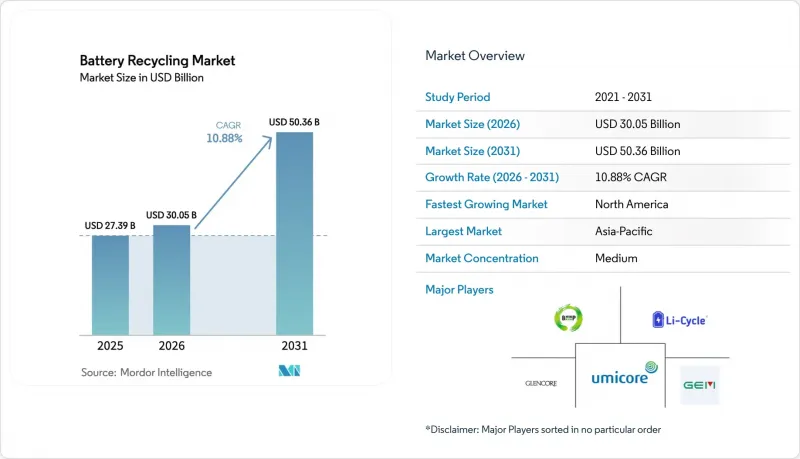
根據 Mordor Intelligence 預測,電池回收市場規模將從 2025 年的 273.9 億美元成長到 2026 年的 300.5 億美元,到 2031 年將達到 503.6 億美元,2026 年至 2031 年的複合年成長率為 10.88%。
本報告按電池化學成分(鉛酸電池、鋰離子電池等)、廢料來源(汽車等)、回收技術(濕冶金、乾冶金等)、工藝階段(材料精煉和回收等)、回收材料的用途(陰極活性材料等)、最終用戶行業(汽車等)和地區(亞太地區等)進行分類。
全球電池回收市場趨勢及洞察
電動車普及率的快速成長
2024年,全球電池式電動車和插電式混合動力汽車的銷量超過1,400萬輛,其鋰離子電池容量約為1.1太瓦時(TWh)。這些電池將在2032年後達到使用壽命終點,形成可預測的原料供應高峰。特斯拉在其內華達州工廠回收了廢棄電池組中92%的關鍵礦物,證明了大規模回收的技術可行性。預計到2030年,中國將產生1,200萬噸廢棄鋰離子電池,是目前全球回收能力的三倍。在歐洲,更嚴格的車輛平均二氧化碳排放量法規正在加速電動車的普及,導致第一代電池組更早進入拆解網路。從銷售到報廢的生命週期縮短,壓縮了回收商擴大處理能力和與正極材料製造商簽訂收購合約的緩衝期。
全球對廢棄電池的監管法規日趨嚴格。
歐盟電池法規規定,到2031年,新型電動車電池必須使用16%的再生鈷、6%的再生鋰和6%的再生鎳,並計畫在2036年實施更為嚴格的標準。中國2024年實施的生產者延伸責任制(EPR)法規要求汽車製造商投資建造回收網路,並實現85%的鋰離子電池回收率,違規者將面臨最高50萬元人民幣的罰款。美國環保署(EPA)提案在2025年實施一項監管框架,對沒有認證回收管道的電池單元徵收生產者費用。印度提出的EPR法規目標是2028年達到70%的回收率,但缺乏明確的執行細則。這些政策雖然緩解了回收商的收入波動,但也導致了不同司法管轄區供應鏈的零碎化。
回收工廠的高資本投資(Capex)/營運成本(Opex)
一座年處理量為2萬噸的濕式冶煉廠需要1.8億至2.5億美元的投資,其中反應器和溶劑萃取線佔安裝成本的60%。營運成本根據酸消耗量和污水處理成本的不同,每噸原料的成本在1800至2400美元之間。 Li-Cycle公司位於羅徹斯特的樞紐預算已從4.85億美元飆升至2024年中期的9.6億美元,增加了成本超支的風險。新興市場的中小企業面臨著18%至22%的借貸成本,進一步擴大了基礎設施缺口。
細分市場分析
預計到2025年,鉛酸電池仍將佔電池銷售額的70.9%,因為已開發市場近99%的廢電池都得到了回收,並透過現有的冶煉廠進行處理。鋰離子電池23.9%的複合年成長率預示著電池回收市場的發展方向。根據國際能源總署(IEA)的數據,到2030年,每年將產生180萬噸鋰離子電池廢料,針對特定電池回收的市場規模預計將迅速擴大。現有鉛酸電池回收商正在對其熱處理生產線進行現代化改造,而新參與企業則在資金籌措濕式提煉設施,以抓住高鋰含量廢棄電池數量預期成長的機會。 Redwood Materials公司在2024年處理了1.8萬噸鋰離子電池廢料,印證了其強勁的業務發展勢頭。
因此,電池回收市場呈現兩極化。鉛酸電池提供穩定但成長緩慢的現金流,而鋰離子電池則具有高成長潛力,且技術密集。競爭優勢在於,在2028年後的過渡期之前,確保取得電動車衍生原料,並實現90%以上的金屬回收率,以滿足汽車製造商的規格要求。
到2025年,汽車電池將佔總處理量的58.5%,這反映了鉛酸電池的大規模淘汰以及電動車(例如2013年至2016年間生產的日產聆風的電池組)提前報廢的影響。隨著設備生命週期的縮短,消費性電子廢棄物正以20.5%的複合年成長率成長,但由於回收率不足40%,政策主導的回收計畫仍有進一步改進的空間。製造廢棄物可提供高純度原料,寧德時代寧德園區的存貨周轉在45天以內,與舊產品相比,可改善營運資金流動。
消費性電子產品的快速成長促使電池回收市場原料來源更加多元化,降低了對汽車產業的依賴。此外,高品質的製造廢料可以彌補低品質家用電池的不足,從而提高混合利潤率。
區域分析
到2025年,亞太地區將佔全球銷售額的52.4%,這主要得益於中國垂直整合的生態系統。在中國,叢集回收商和超級工廠透過水處理流程實現了88%至92%的金屬回收率。 「國家電池護照」計畫於2024年推出,該計畫將對每個電池單元進行標記,以確保可追溯性,並減少15%至18%的污染。在日本,豐田住友集團位於小名濱的冶煉廠處理了6.8萬噸鎳氫(NiMH)和鋰離子電池廢料,並回收了稀土元素。在韓國,一項收費資助的生產者責任再利用(EPR)計畫使鋰離子電池的回收率在2025年底達到了72%。印度的處理量為4.2萬噸,但非正規拆解公司仍攫取了其中60%的處理量。
北美是成長最快的地區,複合年成長率高達21.3%。第45X條規定,回收材料可享有每千瓦時10美元的生產稅額扣抵;第30D條規定,到2026年,電池價值的50%必須來自北美或自由貿易協定(FTA)國家。 Redwood Materials公司正投資35億美元建造一座年產能100吉瓦時的正負極電池製造地,其中30%的材料為回收材料。 Li-Cycle公司位於羅徹斯特的樞紐已獲得美國能源局(DOE)4.75億美元的貸款擔保,計劃於2026年下半年開始運作。加拿大已撥款15億加元用於回收基礎設施建設,嘉能可和Electra公司正在魁北克省和安大略省擴大其濕式冶煉業務。
受Northvolt強勁訂單的推動,歐洲市場佔有率也在快速擴張。 Northvolt的「Revolt」工廠鋰、鎳、鈷的回收率已達95%,年處理能力為8000噸,併計劃到2030年將年處理能力提升至12.5萬噸。德國已向Düsenfeld和Accurec提供2億歐元,用於建造年處理能力5萬噸的液壓冶金加工廠。法國威立雅-索爾維合資企業計劃在ACC超級工廠的同一廠址建造一座年處理能力1.5萬噸的工廠。南美洲和中東及非洲地區的市佔率目前僅限於巴西的鋰離子電池網路和南非的Eco-Bat冶煉廠。隨著電動車普及率的提高,人們期待著大規模離子電池計畫的出現。
其他好處:
- Excel格式的市場預測(ME)表
- 3個月的分析師支持
目錄
第1章:引言
- 市場分析與定義的前提條件
- 分析範圍
第2章 分析方法
第3章執行摘要
第4章 市場狀況
- 市場概覽
- 市場促進因素
- 電動車電池的處置速度正在加快。
- 全球EPR和歐盟電池法規的要求更加嚴格。
- 原物料價格上漲正在推動閉合迴路供應鏈的發展。
- 新一代水力發電和直接循環利用技術取得突破性成果
- 由原始設備製造商設計的可回收電池組可降低拆卸成本。
- 高流動性「黑市」現貨市場的興起
- 市場限制因素
- 金屬價格波動和高昂的逆向物流成本
- 遵守高壓電流收集安全和危險材料法規。
- 區域產能過剩正在造成原料短缺的風險。
- LFP化學體系固有的低價值
- 供應鏈分析
- 監理情勢
- 技術展望
- 波特五力分析
第5章:預測市場規模與成長率
- 電池化學成分
- 鉛酸
- 鋰離子電池(NMC、LFP、NCA、LMO)
- 鎳基
- 其他化學成分(鋅空氣、鈉離子等)
- 按廢料來源
- 汽車電池
- 家用電器電池
- 工業和儲能電池
- 生產廢料
- 透過回收技術
- 濕式冶金
- 火法冶金(火法冶金)
- 直接/機械
- 混合和新興技術(生物/電化學)
- 依工藝階段
- 收集和物流
- 拆卸/卸載
- 機械破碎與分類
- 黑彌撒生產
- 材料精煉與回收
- 透過應用回收材料
- 陰極活化材料
- 陽極/石墨
- 電池級鋰化合物
- 鈷鎳鹽
- 錳
- 其他(銅、鋁)
- 按最終用戶行業分類
- 車
- 船
- 電力和儲能
- 家用電子電器
- 其他
- 按地區
- 北美洲
- 美國
- 加拿大
- 墨西哥
- 歐洲
- 德國
- 英國
- 義大利
- 法國
- 西班牙
- 北歐國家
- 俄羅斯
- 其他歐洲國家
- 亞太地區
- 中國
- 印度
- 日本
- 韓國
- 東南亞國協
- 澳洲和紐西蘭
- 其他亞太國家
- 南美洲
- 巴西
- 阿根廷
- 哥倫比亞
- 其他南美國家
- 中東和非洲
- 沙烏地阿拉伯
- 阿拉伯聯合大公國
- 南非
- 埃及
- 其他中東和非洲國家
- 北美洲
第6章 競爭情勢
- 市場集中度
- 策略趨勢(併購、聯盟、購電協議)
- 市場佔有率分析(主要公司的市場排名和市場佔有率)
- 公司簡介
- Umicore SA
- Glencore PLC
- Brunp Recycling(CATL)
- GEM Co., Ltd.
- Li-Cycle Holdings Corp.
- Redwood Materials Inc.
- Ascend Elements(Battery Resources)
- Ecobat
- American Battery Technology Co.(ABTC)
- RecycLiCo Battery Materials
- Retriev Technologies Inc.
- Cirba Solutions
- Duesenfeld GmbH
- TES-AMM Pte Ltd.
- Recupyl SAS
- Raw Materials Company Inc.
- Glencore-Li-Cycle Portovesme JV
- Ganfeng Lithium Co., Ltd.
- Eramet-Suez JV(Recyclage Batteries)
- InoBat-Minerals JV
第7章 市場機會與未來展望
According to Mordor Intelligence, the battery recycling market size is expected to grow from USD 27.39 billion in 2025 to USD 30.05 billion in 2026 and is forecast to reach USD 50.36 billion by 2031 at 10.88% CAGR over 2026-2031.
This report is Segmented by Battery Chemistry (Lead-Acid, Lithium-Ion, and More), Source of Scrap (Automotive, and More), Recycling Technology (Hydrometallurgical, Pyrometallurgical, and More), Process Stage (Material Refining and Recovery, and More), Application of Recovered Materials (Cathode Active Materials, and More), End-User Industry (Automotive, and More) and Geography (Asia-Pacifica, and More).
Global Battery Recycling Market Trends and Insights
EV penetration surge
Global battery-electric and plug-in hybrid sales passed 14 million units in 2024, embedding roughly 1.1 TWh of lithium-ion capacity that will reach end-of-life after 2032, creating a predictable feedstock wave. Tesla recovered 92% of critical minerals from retired packs at its Nevada facility, proving technical feasibility at scale. China projects 12 million t of retired lithium-ion cells by 2030, triple the current global recycling capacity. Europe's tightening fleet-average CO2 limits accelerate EV adoption and bring first-generation packs into dismantling networks earlier. The lag between sales and retirements compresses the window for recyclers to build capacity and secure offtake agreements with cathode makers.
Global End-of-Life Battery Regulations Tighten
The EU Battery Regulation requires 16% recycled cobalt, 6% recycled lithium, and 6% recycled nickel in new EV batteries by 2031, with steeper thresholds by 2036. China's 2024 extended-producer-responsibility rules oblige automakers to finance collection networks and reach 85% lithium-ion recovery, alongside penalties up to CNY 500,000 per violation. The U.S. Environmental Protection Agency proposed a stewardship framework in 2025 that would impose producer fees on cells lacking certified recycling pathways. India's draft EPR rules target 70% collection by 2028 but lack enforcement clarity. These policies reduce revenue volatility for recyclers but fragment supply chains across jurisdictions.
High Capex / Opex of Recycling Plants
A 20,000 t y hydrometallurgical facility requires USD 180-250 million, with reactors and solvent-extraction trains comprising 60% of the installed cost. Operating expenses range USD 1,800-2,400 t input, driven by acid consumption and wastewater treatment. Li-Cycle's Rochester Hub budget ballooned from USD 485 million to USD 960 million by mid-2024, exposing cost-overrun risk. Smaller firms in emerging markets face debt costs of 18-22%, widening the infrastructure gap.
Other drivers and restraints analyzed in the detailed report include:
- Critical-Metal Price Inflation
- OEM ESG & Circular-Economy Mandates
- Patchy Collection Logistics in Emerging Markets
For complete list of drivers and restraints, kindly check the Table Of Contents.
Segment Analysis
Lead-acid retained 70.9% of 2025 revenue as nearly 99% of spent units are collected in developed markets and recycled through established smelters. Lithium-ion's 23.9% CAGR signals where the battery recycling market is pivoting; International Energy Agency data show 1.8 million t of lithium-ion scrap annually by 2030, creating an addressable battery recycling market size surge. Incumbent lead-acid recyclers are modernizing pyro lines, while new entrants finance hydrometallurgical hubs to capture upcoming lithium-rich flows. Redwood Materials processed 18,000 t of lithium-ion scrap in 2024, confirming commercial momentum.
The battery recycling market is therefore split: lead-acid offers stable, low-growth cash flows; lithium-ion offers high-growth, technology-intensive upside. Competitive advantage will hinge on securing EV-derived feedstock ahead of the post-2028 inflection and on achieving metal-recovery rates above 90% to satisfy automaker specifications.
Automotive batteries supplied 58.5% of 2025 throughput, reflecting large lead-acid replacement volumes and early EV retirements such as 2013-16 Nissan Leaf packs. Consumer electronics scrap is expanding 20.5% CAGR as device lifecycles shorten; however, sub-40% collection rates reveal upside for policy-driven capture programs. Manufacturing scrap delivers high-purity feedstock and turns inventory within 45 days at CATL's Ningde campus, improving working capital compared with post-consumer flows.
Rapid consumer electronics growth ensures the battery recycling market continues diversifying feedstock, reducing reliance on automotive volumes, and improving blended margins as clean manufacturing scrap offsets lower-grade household batteries.
Complete Report Scope:
- By Battery Chemistry
- Lead-acid
- Lithium-ion (NMC, LFP, NCA, LMO)
- Nickel-based
- Other chemistries (Zn-air, Sodium-ion etc.)
- By Source of Scrap
- Automotive Batteries
- Consumer Electronics Batteries
- Industrial and ESS Batteries
- Manufacturing Scrap
- By Recycling Technology
- Hydrometallurgical
- Pyrometallurgical
- Direct/Mechanical
- Hybrid and Emerging (Bio/ Electro-chemical)
- By Process Stage
- Collection and Logistics
- Dismantling and Discharge
- Mechanical Shredding/Sorting
- Black-Mass Production
- Material Refining and Recovery
- By Application of Recovered Materials
- Cathode Active Materials
- Anode/Graphite
- Battery-grade Lithium Compounds
- Cobalt and Nickel Salts
- Manganese
- Others (Cu, Al)
- By End-user Industry
- Automotive
- Marine
- Power and Energy Storage
- Consumer Electronics
- Others
- By Geography
- North America
- United States
- Canada
- Mexico
- Europe
- Germany
- United Kingdom
- Italy
- France
- Spain
- NORDIC Countries
- Russia
- Rest of Europe
- Asia-Pacific
- China
- India
- Japan
- South Korea
- ASEAN Countries
- Australia and New Zealand
- Rest of Asia-Pacific
- South America
- Brazil
- Argentina
- Colombia
- Rest of South America
- Middle East and Africa
- Saudi Arabia
- United Arab Emirates
- South Africa
- Egypt
- Rest of Middle East and Africa
- North America
Geography Analysis
Asia-Pacific captured 52.4% of 2025 revenue, led by China's vertically integrated ecosystem where recycler-gigafactory clusters reach 88-92% metal-recovery through hydro routes. The national battery passport, launched in 2024, tags every cell for traceability, cutting contamination by 15-18%. Japan processed 68,000 t of NiMH and lithium-ion scrap, recovering rare-earth elements at Toyota-Sumitomo's Onahama smelter. South Korea's fee-backed EPR scheme lifted lithium-ion recovery to 72% by end-2025. India has 42,000 t capacity, but informal dismantlers still siphon 60% of volumes.
North America is the fastest-growing region at 21.3% CAGR. Section 45X provides a USD 10 kWh production credit for recycled material, and Section 30D requires 50% battery value from North America or FTA partners by 2026. Redwood Materials is investing USD 3.5 billion in a 100 GWh cathode-anode campus, with 30% recycled feedstock. Li-Cycle's Rochester Hub secured a USD 475 million DOE loan guarantee, targeting late-2026 commissioning. Canada earmarked CAD 1.5 billion for recycling infrastructure, with Glencore and Electra expanding hydrometallurgy in Quebec and Ontario.
Europe's share is also increasing at a high rate, driven by rNorthvolt'stent strong mandates. Northvolt's Revolt facility achieved 95% lithium, nickel, and cobalt recovery at 8,000 t throughput and targets 125,000 t/y by 2030. Germany granted EUR 200 million to Duesenfeld and Accurec for 50,000 tFrance'sd hydro capacity. France's Veolia-Solvay JV will build a 15,000 t plant in ACC 'sirk, co-located with ACC's gigafactory. South America and MEA combined for share, limited to Brazil's network and South Africa's Eco-Bat smelter; large-scale lithium-ion projects await higher EV penetration.
- Umicore SA
- Glencore PLC
- Brunp Recycling (CATL)
- GEM Co., Ltd.
- Li-Cycle Holdings Corp.
- Redwood Materials Inc.
- Ascend Elements (Battery Resources)
- Ecobat
- American Battery Technology Co. (ABTC)
- RecycLiCo Battery Materials
- Retriev Technologies Inc.
- Cirba Solutions
- Duesenfeld GmbH
- TES-AMM Pte Ltd.
- Recupyl SAS
- Raw Materials Company Inc.
- Glencore-Li-Cycle Portovesme JV
- Ganfeng Lithium Co., Ltd.
- Eramet-Suez JV (Recyclage Batteries)
- InoBat-Minerals JV
Additional Benefits:
- The market estimate (ME) sheet in Excel format
- 3 months of analyst support
TABLE OF CONTENTS
1 Introduction
- 1.1 Study Assumptions & Market Definition
- 1.2 Scope of the Study
2 Research Methodology
3 Executive Summary
4 Market Landscape
- 4.1 Market Overview
- 4.2 Market Drivers
- 4.2.1 Accelerating wave of EV battery retirements
- 4.2.2 Tightening global EPR & EU Battery Regulation mandates
- 4.2.3 Raw-material price inflation spurring closed-loop supply chains
- 4.2.4 Step-change yields from next-gen hydro & direct recycling
- 4.2.5 OEM design-for-recycling battery packs reducing dismantling cost
- 4.2.6 Emergence of liquid "black-mass" spot markets
- 4.3 Market Restraints
- 4.3.1 Volatile metal prices & high reverse-logistics costs
- 4.3.2 Safety & haz-mat compliance in high-voltage collection
- 4.3.3 Regional over-capacity creating feedstock scarcity risk
- 4.3.4 Low intrinsic value of LFP chemistries
- 4.4 Supply-Chain Analysis
- 4.5 Regulatory Landscape
- 4.6 Technological Outlook
- 4.7 Porter's Five Forces
- 4.7.1 Bargaining Power of Suppliers
- 4.7.2 Bargaining Power of Buyers
- 4.7.3 Threat of New Entrants
- 4.7.4 Threat of Substitutes
- 4.7.5 Intensity of Competitive Rivalry
5 Market Size & Growth Forecasts
- 5.1 By Battery Chemistry
- 5.1.1 Lead-acid
- 5.1.2 Lithium-ion (NMC, LFP, NCA, LMO)
- 5.1.3 Nickel-based
- 5.1.4 Other chemistries (Zn-air, Sodium-ion etc.)
- 5.2 By Source of Scrap
- 5.2.1 Automotive Batteries
- 5.2.2 Consumer Electronics Batteries
- 5.2.3 Industrial and ESS Batteries
- 5.2.4 Manufacturing Scrap
- 5.3 By Recycling Technology
- 5.3.1 Hydrometallurgical
- 5.3.2 Pyrometallurgical
- 5.3.3 Direct/Mechanical
- 5.3.4 Hybrid and Emerging (Bio/ Electro-chemical)
- 5.4 By Process Stage
- 5.4.1 Collection and Logistics
- 5.4.2 Dismantling and Discharge
- 5.4.3 Mechanical Shredding/Sorting
- 5.4.4 Black-Mass Production
- 5.4.5 Material Refining and Recovery
- 5.5 By Application of Recovered Materials
- 5.5.1 Cathode Active Materials
- 5.5.2 Anode/Graphite
- 5.5.3 Battery-grade Lithium Compounds
- 5.5.4 Cobalt and Nickel Salts
- 5.5.5 Manganese
- 5.5.6 Others (Cu, Al)
- 5.6 By End-user Industry
- 5.6.1 Automotive
- 5.6.2 Marine
- 5.6.3 Power and Energy Storage
- 5.6.4 Consumer Electronics
- 5.6.5 Others
- 5.7 By Geography
- 5.7.1 North America
- 5.7.1.1 United States
- 5.7.1.2 Canada
- 5.7.1.3 Mexico
- 5.7.2 Europe
- 5.7.2.1 Germany
- 5.7.2.2 United Kingdom
- 5.7.2.3 Italy
- 5.7.2.4 France
- 5.7.2.5 Spain
- 5.7.2.6 NORDIC Countries
- 5.7.2.7 Russia
- 5.7.2.8 Rest of Europe
- 5.7.3 Asia-Pacific
- 5.7.3.1 China
- 5.7.3.2 India
- 5.7.3.3 Japan
- 5.7.3.4 South Korea
- 5.7.3.5 ASEAN Countries
- 5.7.3.6 Australia and New Zealand
- 5.7.3.7 Rest of Asia-Pacific
- 5.7.4 South America
- 5.7.4.1 Brazil
- 5.7.4.2 Argentina
- 5.7.4.3 Colombia
- 5.7.4.4 Rest of South America
- 5.7.5 Middle East and Africa
- 5.7.5.1 Saudi Arabia
- 5.7.5.2 United Arab Emirates
- 5.7.5.3 South Africa
- 5.7.5.4 Egypt
- 5.7.5.5 Rest of Middle East and Africa
- 5.7.1 North America
6 Competitive Landscape
- 6.1 Market Concentration
- 6.2 Strategic Moves (M&A, Partnerships, PPAs)
- 6.3 Market Share Analysis (Market Rank/Share for key companies)
- 6.4 Company Profiles (includes Global level Overview, Market level overview, Core Segments, Financials as available, Strategic Information, Products & Services, and Recent Developments)
- 6.4.1 Umicore SA
- 6.4.2 Glencore PLC
- 6.4.3 Brunp Recycling (CATL)
- 6.4.4 GEM Co., Ltd.
- 6.4.5 Li-Cycle Holdings Corp.
- 6.4.6 Redwood Materials Inc.
- 6.4.7 Ascend Elements (Battery Resources)
- 6.4.8 Ecobat
- 6.4.9 American Battery Technology Co. (ABTC)
- 6.4.10 RecycLiCo Battery Materials
- 6.4.11 Retriev Technologies Inc.
- 6.4.12 Cirba Solutions
- 6.4.13 Duesenfeld GmbH
- 6.4.14 TES-AMM Pte Ltd.
- 6.4.15 Recupyl SAS
- 6.4.16 Raw Materials Company Inc.
- 6.4.17 Glencore-Li-Cycle Portovesme JV
- 6.4.18 Ganfeng Lithium Co., Ltd.
- 6.4.19 Eramet-Suez JV (Recyclage Batteries)
- 6.4.20 InoBat-Minerals JV
7 Market Opportunities & Future Outlook
- 7.1 White-space & Unmet-Need Assessment

 2026年全球電動車電池再利用市場報告
 電池回收市場預測至2034年-全球電池化學成分、回收製程、回收材料、回收來源、最終用戶及地區分析電池回收和材料再生市場預測至2034年-全球分析:按電池化學成分、回收流程、回收材料、廢棄電池來源、最終用戶和地區分類
 電池回收市場:2026-2032年全球市場預測(按電池類型、服務類型、來源、處理技術和最終用戶分類)城市採礦市場對電池材料的預測(至2034年)-全球分析(按回收材料來源、目標電池化學成分、回收製程、萃取材料、應用、最終用戶和地區分類)
 電池回收市場:按化學成分、應用和地區分類手錶電池回收市場:按手錶類型、電池尺寸、分銷管道和最終用戶分類 - 全球預測 2026-2032 年氧化銀電池回收市場:依電池類型、製程、純度等級、容量範圍、最終用途及通路分類-2026-2032年全球預測
 突破性創新趨勢揭示電池回收的經濟價值
 一次電池回收市場規模、佔有率和成長分析:按類型、應用和地區分類-2026-2033年產業預測