


 |
市場調查報告書
商品編碼
2121544
奈米塗料和油漆:市場佔有率分析、行業趨勢和統計數據、成長預測(2026-2031 年)Nano Paints And Coatings - Market Share Analysis, Industry Trends & Statistics, Growth Forecasts (2026 - 2031) |
||||||

※ 本網頁內容可能與最新版本有所差異。詳細情況請與我們聯繫。
據 Mordor Intelligence 稱,奈米塗層市場預計將從 2025 年的 128.7 億美元成長到 2026 年的 134.3 億美元,預計到 2031 年將達到 166.4 億美元,2026 年至 2031 年的複合年成長率為 4.38%。
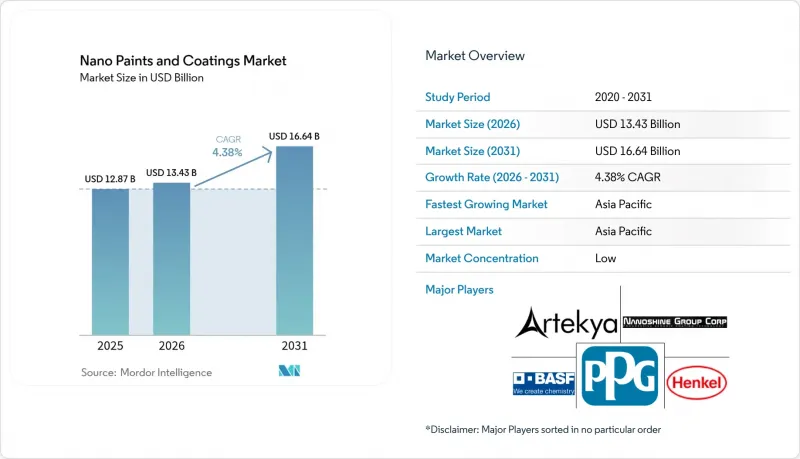
本報告按樹脂類型(石墨烯、奈米碳管、奈米二氧化鈦等)、製造方法(電灑/靜電紡絲、化學沉澱等)、終端用戶產業(航太/國防、汽車、生物醫學等)和地區(亞太、北美、歐洲、南美、中東和非洲)進行細分。市場預測以美元計價。
全球奈米塗層與塗料市場趨勢及洞察
提高航太和國防領域的耐腐蝕性和減輕重量。
根據美國國防部(五角大廈)估計,軍用裝備的腐蝕成本每年高達230億美元,加速了兼具輕量化和卓越防護性能的奈米塗層的應用。實地數據顯示,奈米塗層因其除冰性能,縮短了海軍飛機的維護週期,並提高了飛機在惡劣氣候條件下的作戰準備。美國海軍小型企業創新研究(SBIR)計畫下的計畫正從基礎研究階段過渡到艦隊實地測試階段,這表明嚴格的認證標準既限制了新進入者,也確保了對認證供應商的持續需求。隨著國防籌資策略重視降低總擁有成本(TCO)的平台,能夠解決重量、耐久性和環境暴露挑戰的單次應用組合藥物正被擴大指定使用。
電動車對隔熱、防火和安全塗料的需求不斷成長
隨著電氣化進程的快速推進,電池系統需要更高的能量密度和更嚴格的安全標準。特殊的奈米層能夠快速散熱並形成阻燃屏障,從而保護電芯及其相鄰組件。 Resonac公司面向電動車電池組的隔熱產品正積極推動商業化開發。碳和石墨烯分散體在不影響介電強度的前提下提供良好的導熱性能,並符合原始設備製造商(OEM)的安全規範。同時,諸如現代汽車的奈米冷卻膜等提升乘客舒適性的解決方案(此冷卻膜可將車廂溫度降低10 度C)也正在對輔助應用領域產生連鎖反應。包含熱失控控制措施的法律規範正在加速電池的大規模生產部署,尤其是在電池產能最高的亞太地區。
奈米材料的高製造成本
專用CVD反應器、低產量的批量生產以及嚴格的純度要求導致單位成本居高不下。儘管技術性能優勢顯著,但所需的大量資本投入阻礙了其在價格敏感型應用領域(例如消費家具)的普及。創業投資持續注入,Forge Nano公司4000萬美元的資金籌措也印證了私營部門的支持,但許多規模化生產項目仍處於試點階段,這意味著成本下降將是漸進的,而非快速的。製造商正在探索線上測量、前驅體回收和混合濕化學製程以降低成本,但損益平衡點仍取決於高階應用領域。
細分市場分析
2025年,奈米二氧化鈦(TiO2)在奈米塗料市場佔據38.62%的佔有率。其穩定的生產流程、光催化自清潔性能和具成本效益正推動其在建築外牆、汽車裝飾和室內防霧霾面板等領域廣泛應用。韓國一條利用奈米二氧化鈦顆粒生產超大透明螢幕的試驗生產線,其價格僅為OLED玻璃的十分之一,凸顯了該材料的可擴展性。石墨烯雖然目前仍處於小規模應用階段,但隨著電池散熱器和電磁屏蔽需求的成長,預計2031年其複合年成長率將達到4.93%。奈米碳管在航太和高階消費性電子領域仍是一種小眾選擇,這些領域需要結構剛性、導電性和輕質特性。奈米二氧化矽(SiO2)作為一種水泥添加劑,在延長基礎設施使用壽命方面正日益受到重視,而奈米氧化鋅(ZnO)則正在成為醫療設備和智慧型手機的紫外線阻隔塗層。未來的成長將取決於將多種奈米粒子結合起來的混合配方,以確保協同效應。
儘管使用二氧化鈦樹脂的奈米塗料和油漆的市場規模預計將穩步成長,但由於供應鏈的擴張和反應器產能的提高,石墨烯的市場佔有率預計將成長得更快。為了配合這一趨勢,使用生物基前驅物和無溶劑分散體等環保合成路線,以減少碳足跡,也正在同步推廣中。
區域分析
預計到2025年,亞太地區將佔全球銷售額的45.05%,維持領先地位,預計複合年成長率(CAGR)為4.65%。中國的電子供應鏈、日本的材料科學叢集以及韓國的顯示器製造工廠為該地區的發展奠定了穩定的基礎。 「中國製造2025」策略和日本的「登月計畫」等政策獎勵正在加速奈米技術產能的提升,並縮短前置作業時間。本土CVD反應器供應商正協助將技術推廣到大型企業以外的地區,使中型塗料製造商能夠獲得奈米產品認證。
北美的需求趨勢主要集中在航太、國防和醫療設備領域。美國空軍維護司令部和主要航太發射公司將奈米塗層視為降低維護成本的戰略手段。在墨西哥,快速發展的電動車組裝生態系統正在進口奈米隔熱膜和電池塗層系統,並將其無縫整合到區域供應鏈中。在歐洲,生態設計和工人安全至關重要,這推動了符合REACH法規和綠建築認證的奈米配方水性塗料的應用。德國一級汽車供應商和法國航太原始設備製造商已與奈米塗層專家簽署了多年框架協議。
在南美洲,巴西交通走廊的基礎設施維修和阿根廷的頁岩氣開發案正在加速奈米塗層技術的應用。在鹽霧、高濕度和強紫外線輻射等惡劣環境下,對高性能塗料的需求日益成長,當地主要塗料製造商正與日本和德國的奈米材料製造商合作,以實現配方在地化。在中東能源產業,奈米塗層正被用於地下泵浦和出口管道,以對抗酸性腐蝕。同時,供水網路對非洲的經濟成長至關重要,在管道內部應用奈米密封劑可以降低高溫環境下的洩漏率。
其他好處:
- Excel格式的市場預測(ME)表
- 3個月的分析師支持
目錄
第1章:引言
- 市場分析與定義的前提條件
- 分析範圍
第2章 分析方法
第3章執行摘要
第4章 市場狀況
- 市場概覽
- 市場促進因素
- 航太和國防領域朝向耐腐蝕性和輕量化發展
- 電動車對耐熱、防火和安全塗料的需求不斷成長。
- 對高性能塗料的需求日益成長
- 基礎設施領域的需求增加
- 電子和消費品產業的使用量增加
- 市場限制因素
- 奈米材料的高製造成本
- 關於奈米毒性監管的不確定性
- 石墨烯CVD反應器供應瓶頸
- 價值鏈
- 波特五力分析
第5章:預測市場規模與成長率
- 依樹脂類型
- 石墨烯
- 奈米碳管
- 奈米二氧化鈦(TiO2)
- 奈米二氧化矽(SiO2)
- 奈米氧化鋅
- 奈米銀
- 透過方法
- 電灑和靜電紡絲
- 化學沉澱(CVD)
- 物理氣相澱積(PVD)
- 原子層沉積(ALD)
- 氣霧塗層
- 自組織
- 溶膠-凝膠法
- 按最終用戶行業分類
- 航太/國防
- 車
- 電子與光學
- 生物醫學
- 食品/包裝
- 造船
- 石油和天然氣
- 其他終端用戶產業(能源電力、建築基礎設施等)
- 按地區
- 亞太地區
- 中國
- 印度
- 日本
- 韓國
- 東南亞國協
- 其他亞太國家
- 北美洲
- 美國
- 加拿大
- 墨西哥
- 歐洲
- 德國
- 英國
- 法國
- 義大利
- 其他歐洲國家
- 南美洲
- 巴西
- 阿根廷
- 其他南美國家
- 中東和非洲
- 沙烏地阿拉伯
- 南非
- 其他中東和非洲國家
- 亞太地區
第6章 競爭情勢
- 市場集中度
- 策略趨勢
- 市佔率和排名分析
- 公司簡介
- Aculon
- Artekya Teknoloji
- BASF
- Europlasma NV
- Graphene NanoChem
- GVD Corporation
- Henkel AG and Co. KGaA
- I-CanNano
- Nanofilm
- Nanoshine Group Corp
- Pearl Global Ltd.
- Pellucere
- PPG Industries, Inc.
- SIA Naco Technologies
- Starshield Technologies Pvt Ltd
- Tesla NanoCoatings Inc.
第7章 市場機會與未來展望
According to Mordor Intelligence, nano paints & coatings market size in 2026 is estimated at USD 13.43 billion, growing from 2025 value of USD 12.87 billion with 2031 projections showing USD 16.64 billion, growing at 4.38% CAGR over 2026-2031.
This report is Segmented by Resin Type (Graphene, Carbon Nanotubes, Nano-TiO2, and More), Method (Electrospray and Electrospinning, Chemical Vapor Deposition, and More), End-User Industry (Aerospace and Defense, Automotive, Biomedical, and More), and Geography (Asia-Pacific, North America, Europe, South America, Middle East and Africa). The Market Forecasts are Provided in Terms of Value (USD).
Global Nano Paints And Coatings Market Trends and Insights
Aerospace and defense corrosion-light-weight push
Pentagon estimates that corrosion costs USD 23 billion each year across military equipment, intensifying the adoption of nano coatings that combine structural lightness with superior protection. Field data show nano-engineered layers lowering maintenance cycles on naval airframes, while icephobic properties enhance aircraft readiness in extreme climates. Programs under the U.S. Navy SBIR banner are moving from bench research to fleet trials, illustrating that rigorous certification barriers simultaneously limit new entrants and guarantee durable demand for validated suppliers. As defense procurement strategies favor platforms with reduced total ownership cost, single-application nano formulations that solve weight, durability, and environmental exposure challenges are increasingly specified.
Increase in demand for EV thermal-fire-safety coating
Rapid electrification pushes battery systems toward higher energy density and stricter safety standards. Specialized nano layers dissipate heat swiftly and form fire-retardant barriers, protecting cells and adjacent components. Resonac's thermal insulation product for EV packs highlights active commercial development. Carbon and graphene dispersions deliver thermal conductivity without sacrificing dielectric strength, matching OEM safety protocols. In parallel, passenger-comfort solutions such as Hyundai's nano cooling film that cuts cabin temperature by 10 °C demonstrate spill-over into ancillary applications. Regulatory frameworks that incorporate thermal runaway containment accelerate volume adoption, especially in Asia-Pacific, where battery production capacity is highest.
High production cost of nanomaterials
Specialized CVD reactors, low-yield batch processes, and stringent purity requirements keep unit costs elevated. Capital requirements delay adoption in price-sensitive uses such as consumer furniture, despite technical performance benefits. Venture capital continues to inject funds-Forge Nano's USD 40 million raise underscored private backing-but many scale-up programs remain in pilot phase, pointing to gradual cost attrition rather than abrupt drops. Producers pursue inline metrology, precursor recycling, and hybrid wet-chemistry steps to cut expenses, yet breakeven economics still hinge on premium applications.
Other drivers and restraints analyzed in the detailed report include:
- Growing requirement for high performance coatings
- Increasing demand from infrastructure sector
- Nano-toxicity regulatory uncertainty
For complete list of drivers and restraints, kindly check the Table Of Contents.
Segment Analysis
Nano-TiO2 kept its 38.62% hold on the nano paints & coatings market in 2025. Stable manufacturing, photocatalytic self-cleaning performance, and cost efficiency drive its acceptance on facades, automotive trims, and indoor anti-smog panels. Korean pilot lines producing ultra-large transparent screens using TiO2 nanoparticles at one-tenth the price of OLED glass underscore this material's scalability. Graphene, although capped at a modest base, posts a 4.93% CAGR through 2031 as demand from battery heat spreaders and electromagnetic shielding intensifies. Carbon nanotubes remain a niche choice for aerospace and high-end consumer electronics where structural stiffness, conductivity, and weight savings converge. Nano-SiO2 extends its presence in cement additions that lengthen infrastructure life, and nano-ZnO secures UV-blocking coatings for medical devices and smartphones. Future growth leans on hybrid recipes pairing multiple nanoparticles to secure synergistic properties.
The nano paints & coatings market size for titanium dioxide resin applications is projected to widen steadily, while graphene's share expands faster under supply chain releases and reactor capacity additions. Complementing that trajectory is a parallel push for green synthesis routes that use bio-derived precursors or solvent-free dispersion to cut carbon footprint.
Complete Report Scope:
- By Resin Type
- Graphene
- Carbon Nanotubes
- Nano-TiO2 (Titanium Dioxide)
- Nano-SiO2 (Silicon Dioxide)
- Nano-ZnO
- Nano Silver
- By Method
- Electrospray and Electrospinning
- Chemical Vapor Deposition (CVD)
- Physical Vapor Deposition (PVD)
- Atomic Layer Deposition (ALD)
- Aerosol Coating
- Self-Assembly
- Sol-Gel
- By End-User Industry
- Aerospace and Defense
- Automotive
- Electronics and Optics
- Biomedical
- Food and Packaging
- Marine
- Oil and Gas
- Other End-user Industries (Energy and Power, Construction and Infrastructure, etc.)
- By Geography
- Asia-Pacific
- China
- India
- Japan
- South Korea
- ASEAN Countries
- Rest of Asia-Pacific
- North America
- United States
- Canada
- Mexico
- Europe
- Germany
- United Kingdom
- France
- Italy
- Rest of Europe
- South America
- Brazil
- Argentina
- Rest of South America
- Middle East and Africa
- Saudi Arabia
- South Africa
- Rest of Middle East and Africa
- Asia-Pacific
Geography Analysis
Asia-Pacific anchored 45.05% of global revenue in 2025, keeping the lead with a 4.65% CAGR outlook. China's electronics supply chains, Japan's materials science clusters, and South Korea's display fabs guarantee a stable baseline. Policy incentives, such as China's Made-in-China 2025 priorities and Japan's Moonshot R&D goals, accelerate nano production capability, shortening lead times. Local CVD reactor suppliers help diffuse technology beyond top-tier conglomerates, enabling mid-size coating shops to certify nano offerings.
North America's demand profile centers on aerospace, defense, and medical devices. U.S. Air Force sustainment commands and space launch primes view nano-layering as strategic maintenance cost reducers. Mexico's ascending EV assembly ecosystem imports nano thermal films and battery coating systems, integrating seamlessly with regional supply. Europe champions eco-design and worker safety, thus driving the adoption of nano-formulated water-borne coatings that satisfy REACH and green building labels. Germany's automotive Tier-1 suppliers and France's aerospace OEMs lock up multi-year framework agreements with nano-coating specialists.
South America injects momentum from infrastructure rehabilitation commitments in Brazil's transport corridors and Argentina's shale play servicing. Exposure to salt spray, high humidity, and UV intensity places a premium on high-performance coatings, and local paint majors partner with Japanese and German nanomaterial producers to localize blends. The Middle East's energy sector trials nano layers on downhole pumps and export pipelines to combat sour corrosion, while Africa's growth story lies in water networks, where internally applied nano sealants cut leak rates under high ambient heat.
- Aculon
- Artekya Teknoloji
- BASF
- Europlasma NV
- Graphene NanoChem
- GVD Corporation
- Henkel AG and Co. KGaA
- I-CanNano
- Nanofilm
- Nanoshine Group Corp
- Pearl Global Ltd.
- Pellucere
- PPG Industries, Inc.
- SIA Naco Technologies
- Starshield Technologies Pvt Ltd
- Tesla NanoCoatings Inc.
Additional Benefits:
- The market estimate (ME) sheet in Excel format
- 3 months of analyst support
TABLE OF CONTENTS
1 Introduction
- 1.1 Study Assumptions and Market Definition
- 1.2 Scope of the Study
2 Research Methodology
3 Executive Summary
4 Market Landscape
- 4.1 Market Overview
- 4.2 Market Drivers
- 4.2.1 Aerospace and defense corrosion-light-weight push
- 4.2.2 Increase in demand for EV thermal-fire-safety coating
- 4.2.3 Growing requirement for high performance coatings
- 4.2.4 Inceasing demand from infrastructure sector
- 4.2.5 Rise in utilization from electronics and consumer goods
- 4.3 Market Restraints
- 4.3.1 High production cost of nanomaterials
- 4.3.2 Nano-toxicity regulatory uncertainty
- 4.3.3 Graphene CVD reactor supply bottlenecks
- 4.4 Value Chain Analysis
- 4.5 Porter's Five Forces
- 4.5.1 Bargaining Power of Suppliers
- 4.5.2 Bargaining Power of Consumers
- 4.5.3 Threat of New Entrants
- 4.5.4 Threat of Substitute Products and Services
- 4.5.5 Degree of Competition
5 Market Size and Growth Forecasts (Value)
- 5.1 By Resin Type
- 5.1.1 Graphene
- 5.1.2 Carbon Nanotubes
- 5.1.3 Nano-TiO2 (Titanium Dioxide)
- 5.1.4 Nano-SiO2 (Silicon Dioxide)
- 5.1.5 Nano-ZnO
- 5.1.6 Nano Silver
- 5.2 By Method
- 5.2.1 Electrospray and Electrospinning
- 5.2.2 Chemical Vapor Deposition (CVD)
- 5.2.3 Physical Vapor Deposition (PVD)
- 5.2.4 Atomic Layer Deposition (ALD)
- 5.2.5 Aerosol Coating
- 5.2.6 Self-Assembly
- 5.2.7 Sol-Gel
- 5.3 By End-User Industry
- 5.3.1 Aerospace and Defense
- 5.3.2 Automotive
- 5.3.3 Electronics and Optics
- 5.3.4 Biomedical
- 5.3.5 Food and Packaging
- 5.3.6 Marine
- 5.3.7 Oil and Gas
- 5.3.8 Other End-user Industries (Energy and Power, Construction and Infrastructure, etc.)
- 5.4 By Geography
- 5.4.1 Asia-Pacific
- 5.4.1.1 China
- 5.4.1.2 India
- 5.4.1.3 Japan
- 5.4.1.4 South Korea
- 5.4.1.5 ASEAN Countries
- 5.4.1.6 Rest of Asia-Pacific
- 5.4.2 North America
- 5.4.2.1 United States
- 5.4.2.2 Canada
- 5.4.2.3 Mexico
- 5.4.3 Europe
- 5.4.3.1 Germany
- 5.4.3.2 United Kingdom
- 5.4.3.3 France
- 5.4.3.4 Italy
- 5.4.3.5 Rest of Europe
- 5.4.4 South America
- 5.4.4.1 Brazil
- 5.4.4.2 Argentina
- 5.4.4.3 Rest of South America
- 5.4.5 Middle East and Africa
- 5.4.5.1 Saudi Arabia
- 5.4.5.2 South Africa
- 5.4.5.3 Rest of Middle East and Africa
- 5.4.1 Asia-Pacific
6 Competitive Landscape
- 6.1 Market Concentration
- 6.2 Strategic Moves
- 6.3 Market Share(%)/Ranking Analysis
- 6.4 Company Profiles (includes Global level Overview, Market level overview, Core Segments, Financials as available, Strategic Information, Market Rank/Share, Products and Services, Recent Developments)
- 6.4.1 Aculon
- 6.4.2 Artekya Teknoloji
- 6.4.3 BASF
- 6.4.4 Europlasma NV
- 6.4.5 Graphene NanoChem
- 6.4.6 GVD Corporation
- 6.4.7 Henkel AG and Co. KGaA
- 6.4.8 I-CanNano
- 6.4.9 Nanofilm
- 6.4.10 Nanoshine Group Corp
- 6.4.11 Pearl Global Ltd.
- 6.4.12 Pellucere
- 6.4.13 PPG Industries, Inc.
- 6.4.14 SIA Naco Technologies
- 6.4.15 Starshield Technologies Pvt Ltd
- 6.4.16 Tesla NanoCoatings Inc.
7 Market Opportunities and Future Outlook
- 7.1 White-space and Unmet-Need Assessment

 奈米技術防水市場規模、佔有率和趨勢分析報告:按產品、應用、最終用途、地區和細分市場分類的預測(2026-2033 年)
 全球奈米塗層市場規模、佔有率、趨勢和成長分析報告(2026-2034)
 奈米塗層市場報告:趨勢、預測和競爭分析(至2035年)
 奈米塗層市場:按類型、材料、應用和最終用途產業分類-2026-2032年全球市場預測
 真菌微生物材料市場預測至2034年—按產品類型、作物類型、製劑形式、應用方法、應用領域、最終用戶和地區分類的全球分析
 抗菌奈米塗層市場規模、佔有率和成長分析:按材料類型、基材適用性、最終用途產業和地區分類-2026-2033年產業預測全球奈米塗層市場(2026-2036 年)
 奈米塗層市場報告:按產品類型、最終用戶和地區分類(2026-2034 年)
 奈米塗層市場:按產品類型、應用和地區分類抗菌奈米塗層市場:2026-2032年全球市場預測(按應用、類型、最終用戶、形態和技術分類)