


 |
市場調查報告書
商品編碼
2121539
導航系統:市場佔有率分析、產業趨勢與統計、成長預測(2026-2031)Navigation System - Market Share Analysis, Industry Trends & Statistics, Growth Forecasts (2026 - 2031) |
||||||

※ 本網頁內容可能與最新版本有所差異。詳細情況請與我們聯繫。
根據 Mordor Intelligence 估計,導航系統市場在 2026 年的價值為 535.5 億美元,預計在預測期(2026-2031 年)內將以 9.84% 的複合年成長率成長,到 2031 年達到 856.1 億美元。
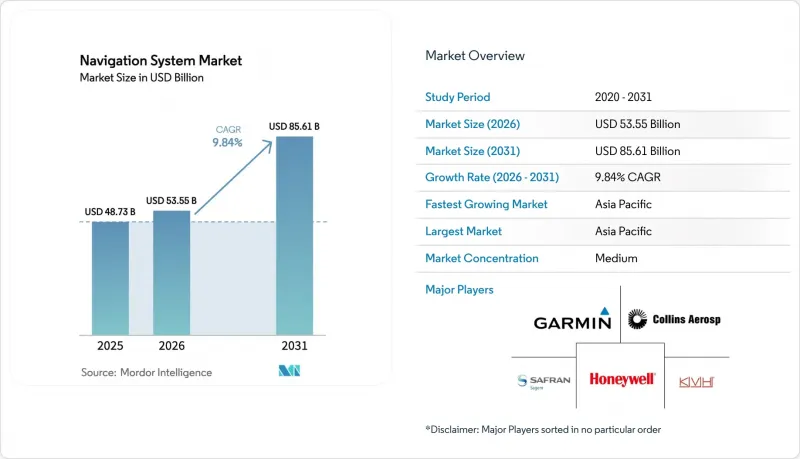
本報告按應用領域(汽車、航空航太、船舶、國防、工業)、導航技術(衛星導航系統、慣性導航系統、手術導航系統、混合感測器融合系統)、組件(硬體、軟體、服務)、平台(陸地、航空航太、海洋、太空船)和地區進行細分。市場預測以美元計價。
全球導航系統市場趨勢與洞察
乘用車和商用車原廠安裝的導航系統迅速增加。
汽車製造商如今正將定位硬體整合到組裝過程中,從而降低零件成本,並將買家連接到自己的地圖生態系統。 2024年10月,大眾汽車旗下CARIAD部門與Tom合作,計劃到2028年為1500萬輛汽車配備「IndiGO.NDS」系統。這將實現無需前往經銷商即可進行的無線地圖更新。 BMW將於2025年發布的「作業系統9」整合了HERE高清即時地圖和即時疊加功能,實現了200毫秒的路線重新計算——這一延遲遠超市面上任何售後設備。在商業領域,歐盟的「移動出行一期」(Mobility Package I)將於2025年2月全面實施,屆時將強制要求總重超過3.5噸的跨境卡車安裝支援GNSS的行車記錄器。這將建立定期更換週期,並促進車道級定位,作為引入進階駕駛輔助功能的初步步驟。
具備GNSS功能的家用電器快速普及
2025年出貨的智慧型手機中,68%將配備可同時處理L1和L5訊號的雙頻接收器。這一比例較2023年的41%有所提升,這主要得益於高通驍龍X80數據機,該數據機融合了GPS、伽利略、北斗和NavIC的輸入訊號,即使在都市區「峽谷效應」下也能實現亞米級的定位精度。蘋果的U2超寬頻(UWB)晶片結合了GNSS和UWB技術,可在室內零售商店和醫療機構等場所實現厘米級的P2P定位,這項功能目前已在整個安卓生態系統中得到推廣。穿戴式裝置將佔消費級GNSS模組的22%,而像DHL這樣的物流公司在2024年於歐洲部署了120萬個追蹤器,從而使客戶位置查詢量減少了40%。出貨量的增加使得模組價格低於 2 美元,從而使得低成本的電動滑板車和租賃自行車能夠整合基於位置的防盜功能和基於使用量的收費。
高度精密系統的初始投資成本高
公分級接收器的售價在 5,000 美元到 15,000 美元之間,這對成本敏感型用戶來說是一筆不小的開支。 Trimble 的 R12i 售價 12,800 美元,每年還需要 1,200 美元到 2,400 美元的校準服務費,這限制了它的普及,使其僅適用於測量員和資金雄厚的農場。 John Deere 的 StarFire 7000 售價 9,500 美元,年費 1,800 美元,對於耕地面積不到 50 公頃的小規模農戶來說難以負擔。 Septentrio 的 Mosaic-X5 模組批量購買價格為 800 美元,降低了初始成本,但仍需要付費校準數據才能達到亞分米級的精度。
細分市場分析
隨著即時動態定位(RTK)和高精度定位技術與機器視覺和機器人技術的融合,工業和測繪解決方案預計將以12.60%的複合年成長率成長,成為所有應用領域中成長最快的領域。 Trimble於2024年收購Bilberry,為其全球導航衛星系統(GNSS)工具集新增了人工智慧驅動的雜草偵測功能,使點噴試驗中的除草劑用量減少了70%。此外,Trimble於2025年3月與Agri-Trak建立的合作關係,使一般農民也能使用變數播種技術。建設產業也呈現類似的趨勢。據Caterpillar公司稱,2024年北美地區出貨的推土機中有38%在出廠時就配備了3D坡度控制系統,每個項目可節省18,000美元的返工成本。
汽車應用佔據了大部分銷售額,預計到2025年,該公司將佔據導航系統市場38%的佔有率,但隨著汽車製造商轉向獨立的軟體平台,成長速度正在放緩。車輛相關法規,例如歐盟的行車記錄器法規,正在穩步推動系統更新換代,但速度有所放緩。航空、航運和國防等細分市場由於對完整性、冗餘性和防欺騙性的嚴格要求,因此價格更高。
混合和感測器融合架構預計到2031年將以14.40%的複合年成長率成長。 2024年11月在英國進行的一次飛行測試表明,量子慣性技術在商業航空領域具有巨大潛力,該技術利用冷原子乾涉測量技術,在無需衛星輔助的情況下,實現了90分鐘10米的精度。 DARPA的微型PNT原型將晶片級原子鐘和MEMS陀螺儀整合到10立方公分的封裝中,在步兵導航中實現了小於1公尺的漂移。
即使到了2025年,接收器仍將佔據導航系統市場49%的佔有率,這主要歸功於它們與家用電子電器的整合。慣性導航系統(INS)僅用於GNSS訊號無法覆蓋的潛水艇、水雷和室內機器人,但高性能INS的高成本限制了其更廣泛的應用。光學和電磁手術平台完全在GNSS訊號覆蓋範圍之外運行,但卻受益於混合感測器技術的廣泛進步。
區域分析
預計到2025年,亞太地區將佔全球銷售額的38%,並在2031年之前以10.50%的複合年成長率成長。 2025年1月,中國強制所有新智慧型手機相容北斗系統,將使國內用戶群每年新增3億台設備。印度的NavIC衛星星座計畫在2025年中期將其覆蓋範圍擴展至全部區域,從而降低海上對GPS的依賴,並推動對雙衛星群接收器的需求。日本的準天頂衛星系統計畫在2024年部署七顆衛星,使自動駕駛車輛無需高清地圖即可進行測試。據報道,韓國2025年出貨的新農業機械中有42%配備了RTK接收器。泰國計劃在2024年部署12個SBAS參考站,使18個機場能夠進行RNP進場,並將季風季節的航班延誤減少14%。
北美和歐洲合計佔年銷售額的47%。美國聯邦航空管理局(FAA)的規定將在2025年至2027年間推動6,800項航空電子設備維修,而歐盟的行車記錄器法規則為420萬輛卡車設定了固定的升級週期。在美國中西部,精密農業在2024年乾旱之後,透過實施基於即時動態定位(RTK)技術的可變施肥系統,實現了灌溉用水量減少22%。國防現代化進程依然強勁,北約將於2025年4月採納多源定位、導航和授時(PNT)要求。
儘管中東和非洲在規模上落後於其他地區,但它們正經歷兩位數的成長,尤其是在政府主導的智慧城市和物流項目正在實施的地區。阿拉伯聯合大公國的「獵鷹之眼」(Falcon Eye)網路預計到2025年中期將涵蓋87%的都市區,從而實現即時緊急服務和交通協調。這些措施正在推動混合導航技術在傳統航空和海事領域之外得到應用。
其他好處:
- Excel格式的市場預測(ME)表
- 3個月的分析師支持
目錄
第1章:引言
- 市場分析與定義的前提條件
- 分析範圍
第2章 分析方法
第3章執行摘要
第4章 市場狀況
- 市場概覽
- 市場促進因素
- 乘用車和商用車原廠安裝的導航系統迅速增加。
- 具備GNSS功能的家用電器快速普及
- 航空業對符合PBN(基於性能的導航)的要求
- 需要可靠的PNT解決方案的國防現代化項目
- 量子和光學陀螺儀技術的出現,為GPS無法覆蓋的環境提供了解決方案。
- 人工智慧驅動的感測器融合軟體提高了即時精度。
- 市場限制因素
- 高度精密系統的高昂資本成本
- 易受干擾和欺騙攻擊
- 較短的產品生命週期和汽車設計週期
- 缺乏開發先進導航演算法的熟練人員
- 產業價值鏈與供應鏈分析
- 宏觀經濟因素對市場的影響
- 監理情勢
- 技術展望
- 波特五力分析
第5章:預測市場規模與成長率
- 透過使用
- 車
- 航空
- 船
- 國防與安全
- 工業與測量
- 導航技術
- 全球導航衛星系統(GNSS)
- 慣性導航系統
- 手術導航系統
- 混合感測器融合系統
- 按組件
- 硬體(接收器、慣性測量單元、天線)
- 軟體和地圖服務
- 服務(安裝、訓練、維護)
- 按平台
- 陸地車輛
- 空中平台
- 海上和水下平台
- 太空船和運載火箭
- 地區
- 北美洲
- 美國
- 加拿大
- 墨西哥
- 南美洲
- 巴西
- 阿根廷
- 其他南美國家
- 歐洲
- 英國
- 德國
- 法國
- 義大利
- 西班牙
- 俄羅斯
- 比荷盧經濟聯盟
- 北歐的
- 其他歐洲國家
- 亞太地區
- 中國
- 印度
- 日本
- 韓國
- ASEAN
- 大洋洲
- 其他亞太國家
- 中東
- 土耳其
- 以色列
- GCC
- 其他中東國家
- 非洲
- 北非
- 南非
- 其他非洲國家
- 北美洲
第6章 競爭情勢
- 市場集中度
- 策略趨勢
- 市佔率分析
- 公司簡介
- Honeywell International Inc.
- Garmin Ltd
- Collins Aerospace(RTX)
- Safran Electronics & Defense
- Trimble Inc.
- Thales Group
- TomTom NV
- Northrop Grumman Corporation
- L3Harris Technologies Inc.
- KVH Industries Inc.
- SBG Systems
- Advanced Navigation Pty Ltd
- Raytheon Company
- Bosch Mobility Solutions
- Denso Corporation
- HERE Technologies
- Apple Inc.(Maps)
- Google LLC(Maps & Waze)
- Medtronic plc(Surgical)
- Stryker Corporation(Surgical)
- Brainlab AG
第7章 市場機會與未來展望
According to Mordor Intelligence, the navigation system market size is estimated at USD 53.55 billion in 2026, and is expected to reach USD 85.61 billion by 2031, at a CAGR of 9.84% during the forecast period (2026-2031).
This report is Segmented by Application (Automotive, Aviation, Maritime, Defense, Industrial), Navigation Technology (Satellite Navigation Systems, Inertial Navigation Systems, Surgical Navigation Systems, Hybrid and Sensor-Fusion Systems), Component (Hardware, Software, Services), Platform (Land, Airborne, Maritime, Spacecraft), and Geography. The Market Forecasts are Provided in Terms of Value (USD).
Global Navigation System Market Trends and Insights
Surge in Factory-Fitted Navigation in Passenger and Commercial Vehicles
Automakers now embed positioning hardware at the assembly stage, reducing bill-of-materials cost and tying buyers into proprietary map ecosystems. Volkswagen's CARIAD unit partnered with TomTom in October 2024 to deliver the IndiGO.NDS stack across 15 million vehicles by 2028, enabling over-the-air map updates that eliminate the need for dealership visits. BMW's Operating System 9, released in 2025, merges HERE HD Live Map with real-time overlays to deliver 200-millisecond route recalculations, a latency that aftermarket devices cannot match. On the commercial side, the European Union's Mobility Package I, fully effective as of February 2025, requires cross-border trucks weighing more than 3.5 tonnes to carry GNSS-enabled tachographs, creating a captive replacement cycle and promoting lane-level positioning as a precursor to premium driver-assistance features.
Rapid Expansion of GNSS-Enabled Consumer Electronics
Dual-frequency receivers processed both L1 and L5 signals in 68% of smartphones shipped during 2025, up from 41% in 2023, thanks to Qualcomm's Snapdragon X80 modem that fuses GPS, Galileo, BeiDou, and NavIC inputs for sub-meter accuracy in urban canyons. Apple's U2 ultra-wideband chip combines GNSS with UWB to deliver centimeter-level peer-to-peer localization for indoor retail and healthcare navigation, a capability now replicating across Android ecosystems. Wearables account for 22% of consumer GNSS modules, while logistics operators such as DHL deployed 1.2 million trackers across Europe in 2024, resulting in a 40% reduction in customer location queries. Higher shipment volumes drove module prices below USD 2, allowing low-cost e-scooters and rental bikes to integrate positioning for anti-theft and usage-based billing.
High Capital Cost of High-Precision Systems
Centimeter-level receivers list between USD 5,000 and USD 15,000, a hurdle for cost-sensitive users. Trimble's R12i sells for USD 12,800 and requires an additional USD 1,200-2,400 per year for correction services, limiting its adoption to surveyors and well-capitalized farms. John Deere's StarFire 7000 costs USD 9,500, with an annual subscription of USD 1,800, pricing out smallholders cultivating under 50 hectares. Septentrio's Mosaic-X5 module, priced at USD 800 in high volume, lowers entry costs but still needs paid corrections to reach sub-decimeter precision.
Other drivers and restraints analyzed in the detailed report include:
- Aviation Demand for Performance-Based Navigation Compliance
- Defense Modernization Programs Requiring Assured-PNT Solutions
- Vulnerability to Jamming and Spoofing Attacks
For complete list of drivers and restraints, kindly check the Table Of Contents.
Segment Analysis
Industrial and surveying solutions are projected to rise at a 12.60% CAGR, the fastest among all applications, as RTK and precise point positioning converge with machine vision and robotics. Trimble's 2024 Bilberry acquisition added AI weed-detection to its GNSS toolset, reducing herbicide use by 70% in spot-spraying trials, while the March 2025 Agri-Trak deal extended variable-rate seeding to mainstream farmers. Construction adopts similar patterns; Caterpillar stated that 38% of North American dozers shipped in 2024 carried factory-installed 3D grade control, trimming rework by USD 18,000 per project.
Automotive uses dominated revenue, with a 38% market share in navigation systems in 2025; however, growth is moderating as carmakers pivot toward decoupled software platforms. Fleet regulations such as the EU tachograph rule push steady, but slower, replacement cycles. Aviation, maritime, and defense niches command premium pricing due to strict integrity, redundancy, and anti-spoofing needs.
Hybrid and sensor-fusion architectures are set to expand at a 14.40% CAGR through 2031. The United Kingdom's November 2024 flight test utilized cold-atom interferometry to achieve 10-meter accuracy for 90 minutes without the aid of satellites, thereby confirming the quantum inertial potential in commercial aviation. DARPA's Micro-PNT prototypes integrate chip-scale atomic clocks and MEMS gyros in a 10-cm3 package, achieving sub-meter drift for infantry navigation.
Satellite receivers still hold a 49% share of the navigation systems market in 2025, largely due to their integration with consumer electronics. Inertial-only units are used in submarines, mines, and indoor robots where GNSS is unavailable, but the high cost of high-performance INS limits their wider use. Optical and electromagnetic surgical platforms operate entirely outside GNSS, yet they benefit from broader hybrid sensor advances.
Complete Report Scope:
- By Application
- Automotive
- Aviation
- Maritime
- Defense and Security
- Industrial and Surveying
- By Navigation Technology
- Satellite Navigation Systems (GNSS)
- Inertial Navigation Systems
- Surgical Navigation Systems
- Hybrid and Sensor-Fusion Systems
- By Component
- Hardware (Receivers, IMUs, Antennas)
- Software and Mapping Services
- Services (Installation, Training, Maintenance)
- By Platform
- Land Vehicles
- Airborne Platforms
- Maritime and Sub-Sea Platforms
- Spacecraft and Launch Vehicles
- Geography
- North America
- United States
- Canada
- Mexico
- South America
- Brazil
- Argentina
- Rest of South America
- Europe
- United Kingdom
- Germany
- France
- Italy
- Spain
- Russia
- Benelux
- Nordics
- Rest of Europe
- Asia Pacific
- China
- India
- Japan
- South Korea
- ASEAN
- Oceania
- Rest of Asia Pacific
- Middle East
- Turkey
- Israel
- GCC
- Rest of Middle East
- Africa
- North Africa
- South Africa
- Rest of Africa
- North America
Geography Analysis
Asia Pacific seized 38% of 2025 revenue and is forecast to grow at a 10.50% CAGR through 2031. China's January 2025 mandate that all new smartphones support BeiDou instantly converted 300 million devices per year into a domestic user base. India's NavIC constellation expanded coverage across the Indian Ocean Region in mid-2025, cutting maritime reliance on GPS and driving dual-constellation receiver demand. Japan's Quasi-Zenith System reached seven satellites in 2024, enabling autonomous vehicle trials operating without detailed HD maps. South Korea reported that 42% of new farm machinery shipped in 2025 was equipped with RTK receivers. Thailand deployed 12 SBAS reference stations in 2024, enabling RNP approaches at 18 airports and reducing monsoon-season delays by 14%.
North America and Europe combined for 47% of annual revenue. FAA mandates are driving 6,800 avionics retrofits between 2025 and 2027, while EU tachograph rules created a captive cycle for 4.2 million trucks. Precision agriculture in the U.S. Midwest conserved 22% irrigation water after the 2024 droughts through RTK-guided variable-rate systems. Defense modernizations remain robust, with NATO adopting a multi-source PNT requirement in April 2025.
The Middle East and Africa trail in volume but post double-digit growth, particularly in areas with sovereign smart-city and logistics projects. The UAE's Falcon Eye network had covered 87% of urban areas by mid-2025, enabling the coordination of emergency services and traffic in real-time. These initiatives encourage the adoption of hybrid navigation beyond traditional aviation and maritime domains.
- Honeywell International Inc.
- Garmin Ltd
- Collins Aerospace (RTX)
- Safran Electronics & Defense
- Trimble Inc.
- Thales Group
- TomTom N.V.
- Northrop Grumman Corporation
- L3Harris Technologies Inc.
- KVH Industries Inc.
- SBG Systems
- Advanced Navigation Pty Ltd
- Raytheon Company
- Bosch Mobility Solutions
- Denso Corporation
- HERE Technologies
- Apple Inc. (Maps)
- Google LLC (Maps & Waze)
- Medtronic plc (Surgical)
- Stryker Corporation (Surgical)
- Brainlab AG
Additional Benefits:
- The market estimate (ME) sheet in Excel format
- 3 months of analyst support
TABLE OF CONTENTS
1 INTRODUCTION
- 1.1 Study Assumptions and Market Definition
- 1.2 Scope of the Study
2 RESEARCH METHODOLOGY
3 EXECUTIVE SUMMARY
4 MARKET LANDSCAPE
- 4.1 Market Overview
- 4.2 Market Drivers
- 4.2.1 Surge in Factory-Fitted Navigation in Passenger and Commercial Vehicles
- 4.2.2 Rapid Expansion of GNSS-Enabled Consumer Electronics
- 4.2.3 Aviation Demand for Performance-Based Navigation (PBN) Compliance
- 4.2.4 Defense Modernization Programs Requiring Assured-PNT Solutions
- 4.2.5 Emergence of Quantum and Optical Gyro Technologies for GPS-Denied Environments
- 4.2.6 AI-Driven Sensor-Fusion Software Enhancing Real-Time Accuracy
- 4.3 Market Restraints
- 4.3.1 High Capital Cost of High-Precision Systems
- 4.3.2 Vulnerability to Jamming and Spoofing Attacks
- 4.3.3 Short Product Life-Cycles Versus Automotive Design Cycles
- 4.3.4 Talent Shortage in Advanced Navigation Algorithm Development
- 4.4 Industry Value / Supply-Chain Analysis
- 4.5 Impact of Macroeconomic Factors on the Market
- 4.6 Regulatory Landscape
- 4.7 Technological Outlook
- 4.8 Porter's Five Forces Analysis
- 4.8.1 Threat of New Entrants
- 4.8.2 Bargaining Power of Suppliers
- 4.8.3 Bargaining Power of Buyers
- 4.8.4 Threat of Substitutes
- 4.8.5 Intensity of Competitive Rivalry
5 MARKET SIZE AND GROWTH FORECASTS (VALUE)
- 5.1 By Application
- 5.1.1 Automotive
- 5.1.2 Aviation
- 5.1.3 Maritime
- 5.1.4 Defense and Security
- 5.1.5 Industrial and Surveying
- 5.2 By Navigation Technology
- 5.2.1 Satellite Navigation Systems (GNSS)
- 5.2.2 Inertial Navigation Systems
- 5.2.3 Surgical Navigation Systems
- 5.2.4 Hybrid and Sensor-Fusion Systems
- 5.3 By Component
- 5.3.1 Hardware (Receivers, IMUs, Antennas)
- 5.3.2 Software and Mapping Services
- 5.3.3 Services (Installation, Training, Maintenance)
- 5.4 By Platform
- 5.4.1 Land Vehicles
- 5.4.2 Airborne Platforms
- 5.4.3 Maritime and Sub-Sea Platforms
- 5.4.4 Spacecraft and Launch Vehicles
- 5.5 Geography
- 5.5.1 North America
- 5.5.1.1 United States
- 5.5.1.2 Canada
- 5.5.1.3 Mexico
- 5.5.2 South America
- 5.5.2.1 Brazil
- 5.5.2.2 Argentina
- 5.5.2.3 Rest of South America
- 5.5.3 Europe
- 5.5.3.1 United Kingdom
- 5.5.3.2 Germany
- 5.5.3.3 France
- 5.5.3.4 Italy
- 5.5.3.5 Spain
- 5.5.3.6 Russia
- 5.5.3.7 Benelux
- 5.5.3.8 Nordics
- 5.5.3.9 Rest of Europe
- 5.5.4 Asia Pacific
- 5.5.4.1 China
- 5.5.4.2 India
- 5.5.4.3 Japan
- 5.5.4.4 South Korea
- 5.5.4.5 ASEAN
- 5.5.4.6 Oceania
- 5.5.4.7 Rest of Asia Pacific
- 5.5.5 Middle East
- 5.5.5.1 Turkey
- 5.5.5.2 Israel
- 5.5.5.3 GCC
- 5.5.5.4 Rest of Middle East
- 5.5.6 Africa
- 5.5.6.1 North Africa
- 5.5.6.2 South Africa
- 5.5.6.3 Rest of Africa
- 5.5.1 North America
6 COMPETITIVE LANDSCAPE
- 6.1 Market Concentration
- 6.2 Strategic Moves
- 6.3 Market Share Analysis
- 6.4 Company Profiles (includes Global Level Overview, Market Level Overview, Core Segments, Financials as available, Strategic Information, Market Rank/Share for key companies, Products and Services, and Recent Developments)
- 6.4.1 Honeywell International Inc.
- 6.4.2 Garmin Ltd
- 6.4.3 Collins Aerospace (RTX)
- 6.4.4 Safran Electronics & Defense
- 6.4.5 Trimble Inc.
- 6.4.6 Thales Group
- 6.4.7 TomTom N.V.
- 6.4.8 Northrop Grumman Corporation
- 6.4.9 L3Harris Technologies Inc.
- 6.4.10 KVH Industries Inc.
- 6.4.11 SBG Systems
- 6.4.12 Advanced Navigation Pty Ltd
- 6.4.13 Raytheon Company
- 6.4.14 Bosch Mobility Solutions
- 6.4.15 Denso Corporation
- 6.4.16 HERE Technologies
- 6.4.17 Apple Inc. (Maps)
- 6.4.18 Google LLC (Maps & Waze)
- 6.4.19 Medtronic plc (Surgical)
- 6.4.20 Stryker Corporation (Surgical)
- 6.4.21 Brainlab AG
7 MARKET OPPORTUNITIES and FUTURE OUTLOOK
- 7.1 White-Space and Unmet-Need Assessment

 2026-2034年全球助航設備(AtoN)管理與監控系統市場規模、佔有率、趨勢與成長分析報告
 中繼指南針市場分析及至2035年預測:類型、產品類型、技術、組件、應用、最終用戶、功能、安裝配置、設備月球導航系統市場分析與預測(至2035年):按類型、產品、服務、技術、組件、應用、部署方式、最終用戶和功能分類
 2026年全球量子感測器導航市場報告2026年全球個人導航設備市場報告2026年全球導航系統市場報告
 導航輔助系統市場按產品類型、技術、模式、安裝方式和最終用戶分類-2026年至2032年全球預測
 離子推進器市場預測至2032年:按類型、功率、推進劑類型、太空船類型、應用、最終用戶和地區分類的全球分析全球神經多樣性友善旅行和導航輔助設備市場:預測至 2032 年—按產品類型、出行方式、技術、年齡層、分銷管道、最終用戶和地區進行分析
 SIaaS(Space Insight as a Service)市場報告:趨勢、預測和競爭分析(至2031年)