


 |
市場調查報告書
商品編碼
2121536
包裝塗料:市場佔有率分析、產業趨勢與統計、成長預測(2026-2031)Packaging Coatings - Market Share Analysis, Industry Trends & Statistics, Growth Forecasts (2026 - 2031) |
||||||

※ 本網頁內容可能與最新版本有所差異。詳細情況請與我們聯繫。
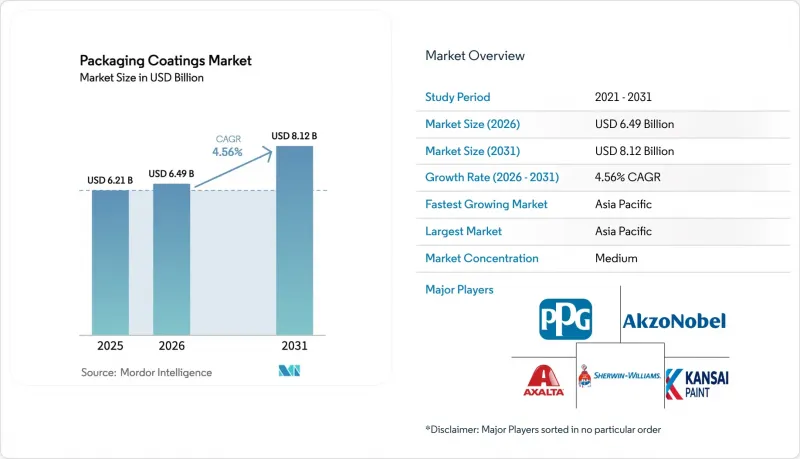
根據 Mordor Intelligence 預測,包裝塗料市場規模將從 2025 年的 62.1 億美元成長到 2026 年的 64.9 億美元,然後在 2031 年達到 81.2 億美元,2026 年至 2031 年的複合年成長率為 4.56%。
本報告按樹脂(環氧樹脂、丙烯酸樹脂等)、塗層技術(水性塗料等)、包裝類型(硬質、軟質)、應用領域(食品罐、飲料罐等)、終端用戶行業(食品飲料等)以及地區(亞太地區、北美地區、歐洲地區、南美地區、中東和非洲地區)進行細分。市場預測以美元計價。
全球包裝塗料市場趨勢與洞察
關於不含雙酚A的罐頭內塗層的法規
歐盟第2024/3190號法規自2025年1月20日起禁止在食品接觸塗層中使用雙酚A(BPA),飲料罐的過渡期為2026年7月,其他金屬容器的過渡期為2028年1月。罐體製造商正在用丙烯酸、聚酯和聚烯材料取代傳統的環氧酚內襯,這些材料在提供同等阻隔性能的同時,不含雙酚成分。阿克蘇諾貝爾公司於2024年1月投資3,200萬歐元,擴大其無雙酚產品的產能,顯示現有企業不僅將合規視為成本負擔,更將其視為競爭優勢。在美國,各州的法規以及可口可樂和百事可樂等公司自願逐步淘汰雙酚A的舉措,正使北美地區的實踐與歐盟標準接軌。 12至18個月的縮短過渡期為能夠提供快速產品認證和線上技術服務的供應商帶來了優勢。
精釀飲料的蓬勃發展帶動了對紫外線固化清漆的需求。
獨立啤酒廠和高階即飲雞尾酒生產商更青睞鋁罐,因為鋁罐可回收利用,且能在整個表面展示圖案,這催生了對紫外線固化型戶外清漆的需求。這種清漆可在不到一秒的時間內固化,無需加熱烘乾。庫爾斯啤酒公司的研究表明,從熱固化改為紫外線固化,每十億個罐子可節省14,000 MMBtu的能源。 PPG公司於2024年7月推出的「DuraNEXT」產品組合,將先前用於木材和線圈塗布的電子束和紫外線化學技術拓展至金屬包裝領域,提供可在室溫下固化的無溶劑底塗層。這種縮短的過渡時間非常適合小批量生產且SKU數量眾多的精釀啤酒製造商。同時,波爾公司的「卓越圖形中心」正在檢驗用於品牌差異化的紫外線清漆設計。
環氧樹脂價格波動
2025年1月,美國環氧樹脂現貨價格上漲2.18%。同時,歐盟對中國進口環氧樹脂徵收最高可達40.8%的反傾銷稅,導致價格上漲。如果樹脂價格在年中飆升,與製造商簽訂年度供應合約的廠商將面臨風險,利潤率將受到擠壓。不含雙酚A的丙烯酸樹脂和聚酯樹脂可以減少對環氧樹脂的依賴,但這些化學物質的原料價格也有波動。大型供應商透過垂直整合和簽訂多年期原物料採購合約來規避風險,但中小企業卻難以獲得資金籌措。
細分市場分析
到2025年,環氧樹脂將佔據包裝塗料市場51.67%的佔有率,預計到2031年將以4.81%的複合年成長率成長。其強勁的市場地位歸功於其對鋁和鋼無與倫比的黏合力,以及數十年來累積的過渡數據,這些數據降低了召回風險。供應商正在改進配方,採用不含雙酚S和不含雙酚S的骨架設計,以符合歐盟法規,同時又不犧牲性能。以PPG的「INNOVEL PRO」為代表的丙烯酸樹脂,憑藉其低遷移率和鉑金級材料安全認證,正在擴大其在飲料罐市場的佔有率。聚酯樹脂因其熱穩定性和低萃取率,在高溫蒸餾食品和醫療保健包裝領域越來越受歡迎,而聚氨酯樹脂則在需要高柔軟性的折疊式領域發揮獨特的作用。
隨著禁令範圍的擴大,丙烯酸樹脂和聚酯樹脂將逐漸蠶食環氧樹脂的市場佔有率,但由於其成本績效,環氧樹脂在工業和塗料罐應用領域仍將保持重要地位。市場參與企業預計其樹脂產品組合將按應用領域更加細分。具體而言,環氧樹脂將用於高腐蝕性環境,丙烯酸樹脂將用於軟性飲料和啤酒罐,聚酯樹脂將用於醫療罐,聚氨酯樹脂將用於個人護理氣霧劑。
由於過去20年VOC法規的實施,預計到2025年,水性塗料將佔據包裝塗料市場43.44%的佔有率。這類分散型塗料在150–200 度C下固化,利用界面活性劑穩定的聚合物顆粒,這些顆粒會在水分蒸發時聚集。溶劑型塗料則主要用於快速蒸發需求較高的特定氣霧劑應用。粉末塗料,例如PPG的“Hoba”系列單體氣霧劑,可以將VOC含量降至零,但需要較高的固化溫度,因此其應用僅限於瓶蓋和厚壁罐。
紫外光固化和電子束固化平台是成長最快的領域,年複合成長率高達5.11%,主要得益於罐頭製造商對節能和快速週轉的追求。不到一秒的固化過程無需使用烘箱,從而減少了面積和碳排放。這些技術在精釀飲料、個人護理氣霧劑和數位印刷罐頭等領域應用最為廣泛,因為在這些領域,最大限度地減少熱暴露至關重要。
區域分析
預計到2025年,亞太地區將佔全球市場佔有率的43.75%,並在2031年之前以4.79%的複合年成長率持續成長。在中國,更嚴格的VOC(揮發性有機化合物)法規正在加速向粉末塗料和水性塗料生產線的轉型;越南和印度位置大型製罐廠,為該地區的供應提供支持。日本已成為循環經濟的示範基地,其回收率高達73.9%,並與其他國家合作開發100%再生材料製成的罐體。東南亞市場,包括印尼、泰國和馬來西亞,正受益於可支配收入的成長和跨國飲料公司的擴張。
北美市場需求主要得益於蓬勃發展的精釀飲品產業生態系統以及比聯邦標準更嚴格的州級揮發性有機化合物(VOC)法規。對紫外線固化生產線和技術服務中心的投資推動了產品快速週轉。根據美墨加協定(USMCA),墨西哥的成本優勢促進了塗料生產,不僅滿足了國內市場需求,也拓展了對美國的出口管道。
歐洲市場佔有率的成長主要得益於歐盟第2024/3190號法規,該法規禁止使用雙酚A(BPA),並加速了聚酯和丙烯酸樹脂的普及。阿克蘇諾貝爾投資3,200萬歐元擴大無雙酚塗料產能,正是供應商積極因應市場變化的有力例證。英國的可回收性評估系統促使品牌商選擇支持閉合迴路金屬回收的塗料,進一步重塑了區域產品格局。
其他好處:
- Excel格式的市場預測(ME)表
- 3個月的分析師支持
目錄
第1章:引言
- 研究假設和市場定義
- 調查範圍
第2章:調查方法
第3章執行摘要
第4章 市場狀況
- 市場概覽
- 市場促進因素
- 北美和歐洲關於不含雙酚A的罐頭內塗層的法規
- 精釀飲料的蓬勃發展帶動了對紫外線固化清漆的需求。
- 線上食品配送物流正在推動對耐刮瓶蓋/瓶蓋塗層的需求。
- 可重複填充金屬包裝的興起
- 直接成型噴墨列印技術的日益普及推動了對低溫固化技術的需求。
- 市場限制因素
- 環氧樹脂價格波動
- 回收率低阻礙了生物屏障的廣泛應用。
- 遵守VOC排放法規的成本
- 價值鏈分析
- 波特五力模型
第5章 市場規模與成長預測
- 依樹脂類型
- 環氧樹脂
- 丙烯酸樹脂
- 聚氨酯
- 聚烯
- 聚酯纖維
- 其他樹脂
- 透過塗層技術
- 水溶液
- 溶劑型
- 粉末
- 紫外線固化型
- 按包裝類型
- 硬質容器(罐、蓋、密封件)
- 軟性包裝(袋、薄膜、小包裝)
- 透過使用
- 食品罐頭
- 飲料罐
- 氣霧劑和管狀物
- 帽子和帽子
- 工業和特殊包裝
- 按最終用戶行業分類
- 食品/飲料
- 個人護理化妝品
- 醫療和藥品
- 工業產品
- 按地區
- 亞太地區
- 中國
- 印度
- 日本
- 韓國
- 印尼
- 馬來西亞
- 泰國
- 越南
- 其他亞太國家
- 北美洲
- 美國
- 加拿大
- 墨西哥
- 歐洲
- 德國
- 英國
- 法國
- 義大利
- 西班牙
- 北歐的
- 土耳其
- 俄羅斯
- 其他歐洲國家
- 南美洲
- 巴西
- 阿根廷
- 哥倫比亞
- 其他南美國家
- 中東和非洲
- 卡達
- 阿拉伯聯合大公國
- 奈及利亞
- 埃及
- 南非
- 其他中東和非洲國家
- 亞太地區
第6章 競爭情勢
- 市場集中度
- 策略趨勢
- 市佔率和排名分析
- 公司簡介
- Akzo Nobel NV
- ALTANA
- artience Co., Ltd.
- Axalta Coating Systems LLC
- BASF
- DIC Corporation
- Dow
- HB Fuller Company
- Hempel A/S
- Henkel AG & Co. KGaA
- Jamestown Coating Technologies
- Jotun
- KANGNAM JEVISCO CO., LTD.
- Kansai Paint Co., Ltd.
- Michelman, Inc.
- PPG Industries Inc.
- RPM International Inc.
- Siegwerk Druckfarben AG & Co. KGaA
- Silgan Holdings Inc.
- The Sherwin-Williams Company
第7章 市場機會與未來展望
According to Mordor Intelligence, the packaging coatings market size is expected to grow from USD 6.21 billion in 2025 to USD 6.49 billion in 2026 and is forecast to reach USD 8.12 billion by 2031 at a 4.56% CAGR over 2026-2031.
This report is Segmented by Resin (Epoxies, Acrylics, and More), Coating Technology (Water-Based, and More), Packaging Type (Rigid and Flexible), Application (Food Cans, Beverage Cans, and More), End-User Industry (Food and Beverage, and More), and Geography (Asia-Pacific, North America, Europe, South America, and Middle East and Africa). The Market Forecasts are Provided in Terms of Value (USD).
Global Packaging Coatings Market Trends and Insights
BPA-Free Can-Lining Mandates
The European Union's Regulation 2024/3190 prohibits BPA in food-contact coatings from January 20, 2025, setting transitional deadlines that end in July 2026 for beverage cans and January 2028 for other metal formats . Canmakers are replacing legacy epoxy-phenolic liners with acrylic, polyester, and polyolefin chemistries that match barrier performance without bisphenol building blocks. AkzoNobel invested EUR 32 million in January 2024 to scale bisphenol-free capacity, illustrating how incumbents treat compliance as a competitive lever rather than a cost burden. In the United States, state-level restrictions and voluntary brand-owner phase-outs by Coca-Cola and PepsiCo are harmonizing North American practices with EU norms. Compressed reformulation windows of 12-18 months reward suppliers that provide rapid product qualification and online technical service.
Craft Beverage Boom Spurring UV-Curable Varnish Demand
Independent breweries and premium ready-to-drink cocktails favor aluminum cans for recyclability and full-surface graphics, creating demand for UV-curable exterior varnishes that harden in under one second and do not require thermal ovens. A Coors Brewing study logged energy savings of 14,000 MMBtu per billion cans when switching from thermal to UV curing. PPG's DuraNEXT portfolio, launched in July 2024, extends electron-beam and UV chemistries from wood and coil coatings into metal packaging, offering solvent-free basecoats that cure at ambient temperature. Faster changeovers suit craft producers that run short batches and multiple SKUs, while Ball Corporation's Graphics Centers of Excellence validate UV varnish designs for brand differentiation.
Epoxy Resin Price Volatility
US spot epoxy prices climbed 2.18% in January 2025, while EU quotes rose after anti-dumping duties of up to 40.8% on Chinese imports. Annual supply contracts leave canmakers exposed when resin costs spike mid-year, compressing margins. Although BPA-free acrylics and polyesters lessen epoxy exposure, those chemistries face their own feedstock swings. Large suppliers hedge by vertically integrating or signing multi-year feedstock deals, but smaller firms struggle to finance such strategies.
Other drivers and restraints analyzed in the detailed report include:
- E-Grocery Logistics Fueling Scuff-Resistant Cap/Closure Coats
- Rise of Refill-Ready Metal Packaging
- Weak Recycling Streams Limiting Bio-Barrier Uptake
For complete list of drivers and restraints, kindly check the Table Of Contents.
Segment Analysis
Epoxies held 51.67% of the packaging coatings market size in 2025 and are forecast to post a 4.81% CAGR through 2031. Their entrenched status stems from unmatched adhesion to aluminum and steel, plus decades of migration data that lower recall risk. Suppliers are reformulating around bisphenol-S or non-bisphenol backbones to comply with EU rules without sacrificing performance. Acrylics, led by PPG's INNOVEL PRO, are gaining beverage-can share through lower migration and platinum-level material-health certifications. Polyesters are gaining traction in retort food and healthcare packaging thanks to thermal stability and low extractables, while polyurethanes fill niche roles in collapsible tubes that demand high flexibility.
Acrylics and polyesters will chip away at epoxies as bans widen, yet cost-performance trade-offs keep epoxies relevant in industrial and paint-can applications. Market participants expect resin portfolios to fragment along application lines: epoxies for high-corrosion environments, acrylics for soft-drink and beer cans, polyesters for medical cans, and polyurethanes for personal-care aerosols.
Water-based chemistries captured 43.44% share of the packaging coatings market size in 2025, owing to two decades of VOC curbs. These dispersions cure at 150-200°C, leveraging surfactant-stabilized polymer particles that coalesce as water evaporates. Solvent-based systems retreat to niche aerosol uses where rapid flash-off is essential. Powder coatings, exemplified by PPG's Hoba line for monobloc aerosols, deliver zero VOCs but require high cure temperatures, limiting use to caps and thicker-gauge cans.
UV-curable and electron-beam platforms represent the fastest-growing slice, advancing at 5.11% CAGR as canmakers chase energy savings and faster changeovers. Their sub-second cure eliminates ovens, trimming floor space, and carbon output. Adoption is strongest in craft beverages, personal-care aerosols, and digitally printed cans, where thermal exposure must be minimized.
Complete Report Scope:
- By Resin
- Epoxies
- Acrylics
- Polyurethane
- Polyolefins
- Polyester
- Other Resins
- By Coating Technology
- Water-based
- Solvent-based
- Powder
- UV curable
- By Packaging Type
- Rigid (Cans, Caps and Closures)
- Flexible (Pouches, Films, Sachets)
- By Application
- Food Cans
- Beverage Cans
- Aerosol and Tubes
- Caps and Closures
- Industrial and Specialty Packaging
- By End-User Industry
- Food and Beverage
- Personal Care and Cosmetics
- Healthcare and Pharmaceutical
- Industrial Goods
- By Geography
- Asia-Pacific
- China
- India
- Japan
- South Korea
- Indonesia
- Malaysia
- Thailand
- Vietnam
- Rest of Asia-Pacific
- North America
- United States
- Canada
- Mexico
- Europe
- Germany
- United Kingdom
- France
- Italy
- Spain
- Nordics
- Turkey
- Russia
- Rest of Europe
- South America
- Brazil
- Argentina
- Colombia
- Rest of South America
- Middle East and Africa
- Qatar
- United Arab Emirates
- Nigeria
- Egypt
- South Africa
- Rest of Middle East and Africa
- Asia-Pacific
Geography Analysis
Asia-Pacific accounted for 43.75% of the market in 2025 and is projected to advance at a 4.79% CAGR to 2031. China's tightening VOC rules are escalating the shift to powder and water-based lines, while Vietnam and India host mega-scale can plants that anchor regional supply. Japan's recycle rate of 73.9% and collaborations on 100% recycled-content cans position the nation as a circular-economy test bed. Southeast Asian markets including Indonesia, Thailand, and Malaysia benefit from rising disposable incomes and multinational beverage expansions.
North America's demand is propelled by a flourishing craft beverage ecosystem and statewide VOC norms stricter than federal thresholds. Investments in UV-curable lines and technical service hubs support rapid SKU turnover. Mexico's cost advantages under USMCA are spurring coatings production for both domestic and US export channels.
Europe's share is driven by Regulation 2024/3190, which bans BPA and accelerates polyester and acrylic adoption. AkzoNobel's EUR 32 million bisphenol-free capacity expansion exemplifies supplier readiness. The U.K.'s recyclability scoring system pressures brands to select coatings compatible with closed-loop metal recovery, further reshaping the regional product mix.
- Akzo Nobel N.V.
- ALTANA
- artience Co., Ltd.
- Axalta Coating Systems LLC
- BASF
- DIC Corporation
- Dow
- H.B. Fuller Company
- Hempel A/S
- Henkel AG & Co. KGaA
- Jamestown Coating Technologies
- Jotun
- KANGNAM JEVISCO CO., LTD.
- Kansai Paint Co., Ltd.
- Michelman, Inc.
- PPG Industries Inc.
- RPM International Inc.
- Siegwerk Druckfarben AG & Co. KGaA
- Silgan Holdings Inc.
- The Sherwin-Williams Company
Additional Benefits:
- The market estimate (ME) sheet in Excel format
- 3 months of analyst support
TABLE OF CONTENTS
1 Introduction
- 1.1 Study Assumptions & Market Definition
- 1.2 Scope of the Study
2 Research Methodology
3 Executive Summary
4 Market Landscape
- 4.1 Market Overview
- 4.2 Market Drivers
- 4.2.1 BPA-free can-lining mandates in North America and Europe
- 4.2.2 Craft beverage boom spurring UV-curable varnish demand
- 4.2.3 E-grocery logistics fuelling scuff-resistant cap/closure coats
- 4.2.4 Rise of refill-ready metal packaging
- 4.2.5 Direct-to-shape inkjet print adoption raising low-temp cure needs
- 4.3 Market Restraints
- 4.3.1 Epoxy resin price volatility
- 4.3.2 Weak recycling streams limiting bio-barrier uptake
- 4.3.3 VOC-emission compliance costs
- 4.4 Value Chain Analysis
- 4.5 Porter's Five Forces
- 4.5.1 Bargaining Power of Suppliers
- 4.5.2 Bargaining Power of Buyers
- 4.5.3 Threat of New Entrants
- 4.5.4 Threat of Substitutes
- 4.5.5 Competitive Rivalry
5 Market Size and Growth Forecasts (Value)
- 5.1 By Resin
- 5.1.1 Epoxies
- 5.1.2 Acrylics
- 5.1.3 Polyurethane
- 5.1.4 Polyolefins
- 5.1.5 Polyester
- 5.1.6 Other Resins
- 5.2 By Coating Technology
- 5.2.1 Water-based
- 5.2.2 Solvent-based
- 5.2.3 Powder
- 5.2.4 UV curable
- 5.3 By Packaging Type
- 5.3.1 Rigid (Cans, Caps and Closures)
- 5.3.2 Flexible (Pouches, Films, Sachets)
- 5.4 By Application
- 5.4.1 Food Cans
- 5.4.2 Beverage Cans
- 5.4.3 Aerosol and Tubes
- 5.4.4 Caps and Closures
- 5.4.5 Industrial and Specialty Packaging
- 5.5 By End-User Industry
- 5.5.1 Food and Beverage
- 5.5.2 Personal Care and Cosmetics
- 5.5.3 Healthcare and Pharmaceutical
- 5.5.4 Industrial Goods
- 5.6 By Geography
- 5.6.1 Asia-Pacific
- 5.6.1.1 China
- 5.6.1.2 India
- 5.6.1.3 Japan
- 5.6.1.4 South Korea
- 5.6.1.5 Indonesia
- 5.6.1.6 Malaysia
- 5.6.1.7 Thailand
- 5.6.1.8 Vietnam
- 5.6.1.9 Rest of Asia-Pacific
- 5.6.2 North America
- 5.6.2.1 United States
- 5.6.2.2 Canada
- 5.6.2.3 Mexico
- 5.6.3 Europe
- 5.6.3.1 Germany
- 5.6.3.2 United Kingdom
- 5.6.3.3 France
- 5.6.3.4 Italy
- 5.6.3.5 Spain
- 5.6.3.6 Nordics
- 5.6.3.7 Turkey
- 5.6.3.8 Russia
- 5.6.3.9 Rest of Europe
- 5.6.4 South America
- 5.6.4.1 Brazil
- 5.6.4.2 Argentina
- 5.6.4.3 Colombia
- 5.6.4.4 Rest of South America
- 5.6.5 Middle East and Africa
- 5.6.5.1 Qatar
- 5.6.5.2 United Arab Emirates
- 5.6.5.3 Nigeria
- 5.6.5.4 Egypt
- 5.6.5.5 South Africa
- 5.6.5.6 Rest of Middle East and Africa
- 5.6.1 Asia-Pacific
6 Competitive Landscape
- 6.1 Market Concentration
- 6.2 Strategic Moves
- 6.3 Market Share(%)/Ranking Analysis
- 6.4 Company Profiles {(includes Global level Overview, Market level overview, Core Segments, Financials as available, Strategic Information, Market Rank/Share for key companies, Products and Services, and Recent Developments)}
- 6.4.1 Akzo Nobel N.V.
- 6.4.2 ALTANA
- 6.4.3 artience Co., Ltd.
- 6.4.4 Axalta Coating Systems LLC
- 6.4.5 BASF
- 6.4.6 DIC Corporation
- 6.4.7 Dow
- 6.4.8 H.B. Fuller Company
- 6.4.9 Hempel A/S
- 6.4.10 Henkel AG & Co. KGaA
- 6.4.11 Jamestown Coating Technologies
- 6.4.12 Jotun
- 6.4.13 KANGNAM JEVISCO CO., LTD.
- 6.4.14 Kansai Paint Co., Ltd.
- 6.4.15 Michelman, Inc.
- 6.4.16 PPG Industries Inc.
- 6.4.17 RPM International Inc.
- 6.4.18 Siegwerk Druckfarben AG & Co. KGaA
- 6.4.19 Silgan Holdings Inc.
- 6.4.20 The Sherwin-Williams Company
7 Market Opportunities and Future Outlook
- 7.1 White-space and Unmet-Need Assessment
- 7.2 Growing Inclination for Eco-Friendly Packaging Coatings

 包裝用塑膠塗佈機市場規模、佔有率及成長分析:按機器類型、塗料、應用、最終用戶和地區分類-產業預測,2026-2033年
 包裝塗料市場報告:趨勢、預測和競爭分析(至2035年)
 包裝塗料市場:按類型、樹脂、基材類型、應用和最終用途產業分類-2026-2032年全球市場預測
 全球包裝塗料市場(2026-2036年):市場展望與策略預測
 全球永續耐腐蝕樹脂市場預測(至2034年):依樹脂類型、技術、應用和地區分類
 包裝塗料市場報告:按基材、樹脂、配方、應用和地區分類(2026-2034 年)
 包裝塗料市場:預測至2031年全球包裝塗料市場規模、佔有率、趨勢和成長分析報告(2026-2034)
 2026年全球包裝塗料市場報告
 包裝塗料市場規模、佔有率和成長分析(按技術、樹脂類型、應用、終端用戶產業和地區分類)-產業預測,2026-2033年