


 |
市場調查報告書
商品編碼
2121530
汽車降雨感應器:市場佔有率分析、產業趨勢與統計、成長預測(2026-2031)Automotive Rain Sensor - Market Share Analysis, Industry Trends & Statistics, Growth Forecasts (2026 - 2031) |
||||||

※ 本網頁內容可能與最新版本有所差異。詳細情況請與我們聯繫。
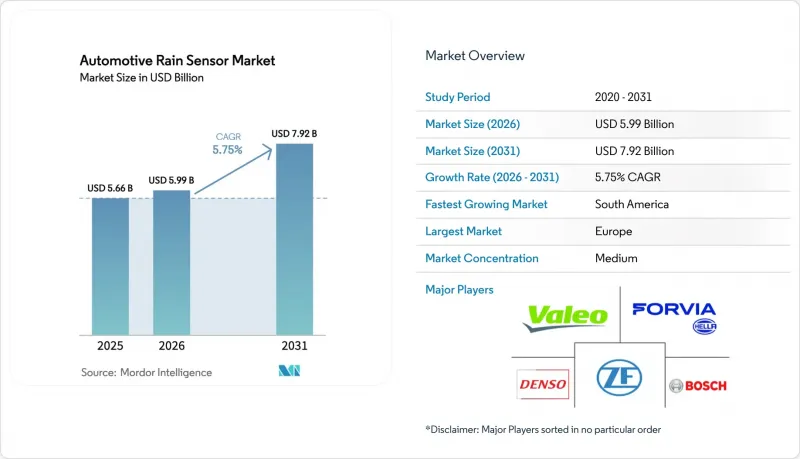
根據 Mordor Intelligence 預測,汽車降雨感應器市場將從 2025 年的 56.6 億美元成長到 2026 年的 59.9 億美元,然後在 2031 年達到 79.2 億美元,2026 年至 2031 年的複合年成長率為 5.75%。
本報告按車輛類型(乘用車[掀背車、轎車等]、商用車[輕型商用車(LCV)等])、技術(光學[CCD/CMOS等])、銷售管道(OEM安裝、售後改裝)、應用(ADAS感測器融合模組等)和地區進行細分。市場預測以價值(美元)和銷售量(輛)表示。
全球汽車降雨感應器市場趨勢及洞察
隨著ADAS的廣泛應用,多功能環境感知將變得至關重要。
在L2+和L3級感知系統中,需要精確獲取雨滴、光線和霧氣數據,以保持相機鏡頭和雷射雷達窗口的清晰,這使得感測器的角色從單純的舒適性增強功能轉變為支撐安全性的核心要素。歐洲的OEM廠商正在將光學降雨感應器和濕度/光線感測器整合到單一PCB板上,以減輕線束重量並整合診斷功能。中國汽車製造商正在採用這種架構以滿足即將實施的NCAP能見度評估標準,而北美卡車製造商則將雨量偵測功能整合到前視攝影機叢集中,以延長自動緊急煞車系統的運作。高解析度CCD陣列提高了水滴分類的準確性,透過將這些資料輸入融合軟體,可以在單一控制迴路中調整雨刷速度、主動式轉向頭燈和除霧器的控制邏輯。因此,採購團隊現在不僅根據雨刷響應延遲來評估性能,還根據雷達和攝影機聯合使用得出的指標來評估性能,這使得採用多感測器對於一級供應商的收入至關重要。
電氣化和車載高壓架構正在加速其普及應用。
E平台可在400V和800V電壓下運行,為訊號處理ASIC和雷射微調VCSEL發射器提供穩定的功率裕度,使其在高濕度瞬態條件下性能優於12V同類產品。集中式運算域透過安全的CAN-FD連結將原始水滴向量傳送至區域控制器,機器學習模型在此最佳化刮水時機,從而延長擋風玻璃雨刷壽命並降低HVAC系統負荷。透過OTA韌體更新,OEM廠商可以迭代最佳化偵測閾值,實現與預測性維護警報相關的按使用計量收費模式。因此,電池式電動車品牌不再僅僅將降雨感應器視為被動式玻璃配件,而是將其視為能源管理資產,從而將擋風玻璃除霧次數減少高達6%。
入門A/B級車的價格敏感度較高
在印度、部分東協國家和拉丁美洲等對成本高度敏感的平台上,整個儀錶板電子組件的預算不足75美元,幾乎沒有餘力安裝一個價值25-30美元的雨滴檢測模組。印度的國內採購規則提高了非本地生產的PCBA進口關稅,擠壓了一級供應商的盈利,並減緩了技術的普及速度。在整合MEMS的價格降至15美元以下之前,OEM廠商仍會在長度小於4公尺的車輛上使用手動可變間歇式雨刷。與本地玻璃貼合合作夥伴建立合作關係的供應商可以降低運費附加費,但目前小批量訂單阻礙了此類資本投資。
細分市場分析
預計到2025年,乘用車降雨感應器市場將佔據70.88%的市場佔有率,並將在2031年之前維持6.30%的強勁複合年成長率。雖然轎車各配置車型的雨量搭載率穩定,但掀背車車型的雨量感知器普及率仍僅限於高配車型。自動雨刷正日益成為輕型商用車的標準配置,以減少駕駛人分心和保險索賠,但由於售後安裝的複雜性,其在中型卡車中的普及率仍然較低。從需求趨勢來看,SUV構成比每增加10個百分點,系統平均物料清單(BOM)的上限就會增加4美元,這有助於一級供應商維持利潤率。在預測期內,由於 SUV 的擋風玻璃面積較大,電容陣列中的水滴雜訊將會增加,因此預計 OEM 將繼續採用即使在大雨中也能保持 ±2 ml 靈敏度精度的光學架構。
與快速更新換代的輕型商用車相比,乘用車的車型更新周期更為穩定,儘管銷售成長速度較慢。考慮實施遠端資訊處理技術的車隊營運商報告稱,啟用預測性雨刷控制後,擋風玻璃維修索賠減少了7%,這印證了該技術的商業可行性。總體而言,SUV的普及導致汽車降雨感應器市場持續向功能豐富的套裝產品傾斜,從而彌補了量產掀背車較低的利潤率。
光學CCD/CMOS元件憑藉其卓越的信噪比,在2025年佔據了81.10%的市場佔有率。排名前五的光學控制器ASIC晶片已達到B版或更高版本,且成本曲線趨於平緩,MEMS參與企業在性價比方面仍有發展空間。電容式/MEMS裝置預計將以8.25%的複合年成長率成長,因為它們避免了玻璃鍵合的公差問題,使其成為採用具有先進紫外線防護功能的夾層擋風玻璃的車輛的理想選擇。紅外線反射式混合感測器已在需要-25 度C以下除冰性能的細分市場中找到了自己的位置,但其單位成本較高。
根據戰略藍圖,MEMS供應商正在將環境光感測器和紅外線接近感測器整合到通用晶片空間中,從而將PCB尺寸縮小35%。同時,領先的光學元件製造商透過整合AI邊緣推理核心來保持其規格優勢,以確保產量並實現自校準水滴檢測。未來前景的特徵是共存而非替代。光學元件將繼續在高階和嚴苛環境領域保持其利基市場地位,而MEMS將推動其廣泛應用。
區域分析
歐洲37.55%的市佔率反映了聯合國歐洲經濟委員會(UNECE)嚴格的能見度標準以及2025年新車撞擊測試(NCAP)評級。此評級對整合雨量、光線和濕度感測器的技術給予兩分安全加分,使得感測器安裝成為B級及以上掀背車的標配。此外,歐洲大陸成熟的高階車型陣容也使得高利潤的光學陣列得以主導市場。南美洲是成長最快的細分市場,年複合成長率(CAGR)高達9.85%,主要得益於巴西聖保羅一家高產量的OEM工廠。消費者從入門級車型轉換緊湊型SUV,為自動雨刷的材料清單(BOM)騰出了空間;同時,聯邦政府鼓勵本地生產電子元件的獎勵也推動了馬瑙斯附近感測器外殼成型業務的推出。
在亞太地區,趨勢更為微妙。中國的新車評估計畫將於2027年開始對自動視覺管理功能進行評分,預計將確保年產量已達2,500萬輛的製造地的穩定出貨量。在印度和部分東協國家,進口電子元件的課稅推高了成本,構成了一定的障礙。儘管如此,電動車的推廣再次凸顯了降雨感應器的重要性。出口到泰國和印尼的售價低於1.5萬美元的中國製造微型電動車配備了基本的電容式感測器,以便適合右舵駕駛的規範。因此,亞太地區仍是最大的成長源,但也是競爭最分散的地區。雖然北美地區的電動車普及率穩定上升而非爆發式成長,但較高的平均交易價格使得在主流皮卡和SUV中安裝複雜的感測器融合套件成為可能。空中下載 (OTA) 更新的文化為預測性擋風玻璃維護的訂閱模式創造了肥沃的土壤,產生了持續的收入,從而緩解了硬體的商品化。
其他好處:
- Excel格式的市場預測(ME)表
- 3個月的分析師支持
目錄
第1章:引言
- 市場分析與定義的前提條件
- 分析範圍
第2章 分析方法
第3章執行摘要
第4章 市場狀況
- 市場概覽
- 市場促進因素
- 隨著 ADAS(進階駕駛輔助系統)的普及,多功能環境感知(雨、光、霧)變得至關重要。
- 車輛電氣化程度的提高和車輛電壓技術的進步正在加速固態光學降雨感應器的應用。
- 監理機構推動自動雨刷系統
- 消費者對中型車舒適性和便利性功能的需求日益成長。
- 為擋風玻璃整合抬頭顯示器(HUD) 模組需要清潔度偵測功能(這一點尚未廣泛報導)。
- 汽車的空中升級正在透過基於訂閱的雨刷自動化開闢新的收入來源(這是一個尚未充分報告的領域)。
- 市場限制因素
- 入門級 A/B 級車輛對價格的高度敏感限制了印度和東協地區感測器的搭載率。
- 汽車光電二極體和垂直腔面發射雷射供不應求
- 擋風玻璃設計的變化會使光學耦合變得複雜,並增加檢驗成本(未充分報告)。
- 相機專用 ADAS 堆疊(未充分報告)的衝突,這些堆疊支援軟體定義的降雨檢測。
- 價值鍊和供應鏈分析
- 監理情勢
- 技術展望
- 波特五力分析
第5章:預測市場規模與成長率
- 按車輛類型
- 搭乘用車
- 掀背車
- 轎車
- SUV/跨界車
- 商用車輛
- 輕型商用車(LCV)
- 中型和大型商用車輛
- 搭乘用車
- 透過技術
- 光學元件(CCD/CMOS)
- 紅外線反射型
- 基於電容/MEMS的
- 按銷售管道
- OEM設備
- 改裝
- 透過使用
- 自動雨刷控制
- 雨量、光照和濕度的綜合檢測
- ADAS感測器融合模組
- 按地區
- 北美洲
- 美國
- 加拿大
- 其他北美國家
- 南美洲
- 巴西
- 阿根廷
- 其他南美國家
- 歐洲
- 德國
- 英國
- 法國
- 西班牙
- 義大利
- 俄羅斯
- 其他歐洲國家
- 亞太地區
- 中國
- 日本
- 印度
- 韓國
- 其他亞太國家
- 中東和非洲
- 土耳其
- 沙烏地阿拉伯
- 阿拉伯聯合大公國
- 南非
- 其他中東和非洲國家
- 北美洲
第6章 競爭情勢
- 市場集中度
- 策略趨勢
- 市佔率分析
- 公司簡介
- HELLA GmbH & Co. KGaA
- Valeo SA
- DENSO Corporation
- ZF Friedrichshafen AG
- Robert Bosch GmbH
- STMicroelectronics NV
- Analog Devices Inc.
- ams-OSRAM AG
- onsemi
- Hamamatsu Photonics KK
- Sensata Technologies Inc.
- Melexis NV
- Texas Instruments Inc.
- Panasonic Holdings Corp.
第7章 市場機會與未來展望
According to Mordor Intelligence, the automotive rain sensor market size is expected to grow from USD 5.66 billion in 2025 to USD 5.99 billion in 2026 and is forecast to reach USD 7.92 billion by 2031 at 5.75% CAGR over 2026-2031.
This report is Segmented by Vehicle Type (Passenger Cars [Hatchback, Sedan, and More] and Commercial Vehicles (Light Commercial Vehicle (LCV) and More)), Technology (Optical (CCD/CMOS) and More), Sales Channel (OEM-Installed and Aftermarket Retrofit), Application (ADAS Sensor Fusion Modules, and More), and Geography. The Market Forecasts are Provided in Terms of Value (USD) and Volume (Units).
Global Automotive Rain Sensor Market Trends and Insights
Rising ADAS Penetration Mandates Multi-Function Environmental Sensing
Level 2+ and Level 3 perception stacks require precise raindrop, light, and fog data to keep camera lenses and LiDAR windows clear, recasting the sensor from a comfort extra into a core safety enabler. European OEM programs pair optical rain sensors with humidity and light channels on a single PCB for reduced harness weight and unified diagnostics. Chinese brands replicate the architecture to meet forthcoming NCAP visibility scoring, while North American truck makers embed rain detection in forward-vision clusters to extend automatic emergency braking uptime. High-resolution CCD arrays improve droplet classification, feeding fusion software that modulates wiper speed, adaptive headlights, and defogger logic in one control loop. Consequently, procurement teams now benchmark performance against radar-camera synergy metrics rather than wiper latency alone, making multi-sensor wins pivotal to Tier 1 revenue pipelines.
Electrification & Higher Onboard Voltage Architectures Accelerate Adoption
E-platforms working at 400 V and 800 V offer stable power headroom for signal-processing ASICs and laser-trimmed VCSEL emitters that outperform 12 V counterparts under high-humidity transients. Centralized compute domains pull raw droplet vectors over secure CAN-FD links into zone controllers where machine-learning models refine wipe timing, extending blade life, and trimming HVAC load. Over-the-air firmware releases let OEMs iteratively sharpen detection thresholds, opening pay-per-use revenue tiers tied to predictive maintenance alerts. Battery-electric brands, therefore, market rain sensors as energy-management assets, reducing window-defog cycles by up to 6%, rather than passive glass accessories.
High Price Sensitivity in Entry-Level A/B-Segment Cars
Cost-led platforms in India, parts of ASEAN, and Latin America allocate less than USD 75 for the entire instrument-panel electronics stack, leaving marginal headroom for a USD 25-30 rain-sensing module. Domestic content rules in India amplify import tariffs on unlocalized PCBAs, compressing Tier 1 profitability and slowing take rates. OEMs resort to manual-variable-intermittent wipers in sub-4-m vehicles until integrated MEMS pricing drops below USD 15. Suppliers that secure local glass-bonding partnerships can shave freight surcharges, but low-volume orders currently deter such CAPEX outlays.
Other drivers and restraints analyzed in the detailed report include:
- Regulatory Push for Automatic Wiper Systems
- Rising Consumer Demand for Comfort & Convenience Features
- Shortage of Automotive-Grade Photodiodes & VCSELs
For complete list of drivers and restraints, kindly check the Table Of Contents.
Segment Analysis
The automotive rain sensor market size for passenger cars captured 70.88% share in 2025, and is expected to lead at a robust 6.30% CAGR through 2031. Sedan programs maintain consistent attach rates across trim lines, yet hatchbacks remain price-gated to upper variants. Fleets of light commercial vans now specify automatic wiping to minimize driver distraction and insurance claims, though medium trucks lag because of retrofit complexities. Demand alignment shows that every 10-point uptick in SUV mix raises system-average BOM ceiling by USD 4, supporting margin retention for Tier 1s. Over the forecast period, SUVs' larger windshield area drives higher droplet-noise in capacitive arrays, sustaining OEM preference for optical architectures that maintain +-2 ml sensitivity accuracy in heavy downpours.
Passenger-car refresh cycles grant slower but steadier volume accrual compared with high-churn small commercial fleets. Fleet operators investigating telematics report 7% lower windshield repair claims once predictive wipe analytics are activated, strengthening business cases. Overall, SUV proliferation ensures the automotive rain sensor market remains skewed toward feature-rich packages, balancing the lower margins of high-volume hatchbacks.
Optical CCD/CMOS devices controlled 81.10% of 2025 revenue owing to proven signal-to-noise fidelity. With the top five optical controller ASICs already at silicon-revision B or later, cost curves flatten, giving MEMS entrants a price-to-performance opening. Capacitive / MEMS-based devices will clock an 8.25% CAGR as they sidestep glass-coupling tolerances, ideal for vehicles using advanced UV-blocking laminated windshields. Infrared-reflective hybrids capture niche programs needing anti-icing credibility below -25 °C, albeit at higher per-unit cost.
Strategy roadmaps show MEMS suppliers bundling ambient-light sensors and IR proximity in shared die space, trimming PCB footprint by 35%. Conversely, optical incumbents shield volumes by embedding AI-edge inference cores, enabling self-calibrating droplet recognition that sustains specification leadership. Coexistence rather than displacement defines the horizon: optical retains premium and severe-duty niches; MEMS drives democratization.
Complete Report Scope:
- By Vehicle Type
- Passenger Cars
- Hatchback
- Sedan
- SUVs and crossovers
- Commercial Vehicles
- Light Commercial Vehicle (LCV)
- Medium and Heavy Commercial Vehicle
- Passenger Cars
- By Technology
- Optical (CCD/CMOS)
- Infra-red Reflective
- Capacitive / MEMS-based
- By Sales Channel
- OEM-Installed
- Aftermarket Retrofit
- By Application
- Automatic Wiper Control
- Integrated Rain-Light-Humidity Sensing
- ADAS Sensor Fusion Modules
- By Geography
- North America
- United States
- Canada
- Rest of North America
- South America
- Brazil
- Argentina
- Rest of South America
- Europe
- Germany
- United Kingdom
- France
- Spain
- Italy
- Russia
- Rest of Europe
- Asia-Pacific
- China
- Japan
- India
- South Korea
- Rest of Asia-Pacific
- Middle East and Africa
- Turkey
- Saudi Arabia
- United Arab Emirates
- South Africa
- Rest of Middle East and Africa
- North America
Geography Analysis
Europe's 37.55% share reflects strict UNECE visibility norms and 2025 NCAP scoring that awards two safety points for rain-light-humidity fusion, cementing sensor fitment as an entitlement across B-segment hatchbacks upward. The continent's established premium mix also ensures high-margin optical arrays dominate. South America, led by Brazil's volume OEM hubs in Sao Paulo, is the fastest climber with a 9.85% CAGR. Consumer upgrades from entry to compact SUVs introduce room in the BOM for automated wiping, while federal incentives to localize electronic content spur sensor-housing molding ventures near Manaus.
Asia-Pacific delivers nuanced dynamics. China's New Car Evaluation Program will credit automated visibility management starting in 2027, anchoring stable shipments within a manufacturing base already scaling 25 million vehicles yearly. Hindrances lie in India and parts of ASEAN, where taxation on imported electronics inflates cost. Nonetheless, EV push grants rain sensors renewed relevance: Chinese-built sub-USD 15,000 micro-EVs that export to Thailand and Indonesia include basic capacitive sensors to ease right-hand-drive adaptation. Hence, Asia-Pacific remains both the largest growth reservoir and the most fragmented battlefield. North America's uptake is steady rather than spectacular, yet high average transaction prices allow complex sensor-fusion packages on mainstream pickups and SUVs. Over-the-air update culture seeds subscription models for predictive windshield maintenance, producing recurring revenues that temper hardware commoditization.
- HELLA GmbH & Co. KGaA
- Valeo SA
- DENSO Corporation
- ZF Friedrichshafen AG
- Robert Bosch GmbH
- STMicroelectronics N.V.
- Analog Devices Inc.
- ams-OSRAM AG
- onsemi
- Hamamatsu Photonics K.K.
- Sensata Technologies Inc.
- Melexis NV
- Texas Instruments Inc.
- Panasonic Holdings Corp.
Additional Benefits:
- The market estimate (ME) sheet in Excel format
- 3 months of analyst support
TABLE OF CONTENTS
1 Introduction
- 1.1 Study Assumptions & Market Definition
- 1.2 Scope of the Study
2 Research Methodology
3 Executive Summary
4 Market Landscape
- 4.1 Market Overview
- 4.2 Market Drivers
- 4.2.1 Rising ADAS penetration mandates multi-function environmental sensing (rain, light, fog)
- 4.2.2 Electrification & higher onboard voltage architectures accelerate adoption of solid-state optical rain sensors
- 4.2.3 Regulatory push for automatic wiper systems
- 4.2.4 Rising consumer demand for comfort & convenience features across mid-segment vehicles
- 4.2.5 Integration of windshield head-up-display (HUD) modules requires cleanliness sensing (under-reported)
- 4.2.6 Automotive over-the-air updates unlock new revenue via subscription-based wiper automation (under-reported)
- 4.3 Market Restraints
- 4.3.1 High price sensitivity in entry-level A/B-segment cars limits sensor attach-rates in India & ASEAN
- 4.3.2 Shortage of automotive-grade photodiodes & VCSELs
- 4.3.3 Windshield design heterogeneity complicates optical coupling & raises validation cost (under-reported)
- 4.3.4 Competition from camera-only ADAS stacks promising software-defined rain detection (under-reported)
- 4.4 Value/Supply-Chain Analysis
- 4.5 Regulatory Landscape
- 4.6 Technological Outlook
- 4.7 Porter's Five Forces
- 4.7.1 Threat of New Entrants
- 4.7.2 Bargaining Power of Buyers/Consumers
- 4.7.3 Bargaining Power of Suppliers
- 4.7.4 Threat of Substitute Products
- 4.7.5 Intensity of Competitive Rivalry
5 Market Size & Growth Forecasts
- 5.1 By Vehicle Type
- 5.1.1 Passenger Cars
- 5.1.1.1 Hatchback
- 5.1.1.2 Sedan
- 5.1.1.3 SUVs and crossovers
- 5.1.2 Commercial Vehicles
- 5.1.2.1 Light Commercial Vehicle (LCV)
- 5.1.2.2 Medium and Heavy Commercial Vehicle
- 5.1.1 Passenger Cars
- 5.2 By Technology
- 5.2.1 Optical (CCD/CMOS)
- 5.2.2 Infra-red Reflective
- 5.2.3 Capacitive / MEMS-based
- 5.3 By Sales Channel
- 5.3.1 OEM-Installed
- 5.3.2 Aftermarket Retrofit
- 5.4 By Application
- 5.4.1 Automatic Wiper Control
- 5.4.2 Integrated Rain-Light-Humidity Sensing
- 5.4.3 ADAS Sensor Fusion Modules
- 5.5 By Geography
- 5.5.1 North America
- 5.5.1.1 United States
- 5.5.1.2 Canada
- 5.5.1.3 Rest of North America
- 5.5.2 South America
- 5.5.2.1 Brazil
- 5.5.2.2 Argentina
- 5.5.2.3 Rest of South America
- 5.5.3 Europe
- 5.5.3.1 Germany
- 5.5.3.2 United Kingdom
- 5.5.3.3 France
- 5.5.3.4 Spain
- 5.5.3.5 Italy
- 5.5.3.6 Russia
- 5.5.3.7 Rest of Europe
- 5.5.4 Asia-Pacific
- 5.5.4.1 China
- 5.5.4.2 Japan
- 5.5.4.3 India
- 5.5.4.4 South Korea
- 5.5.4.5 Rest of Asia-Pacific
- 5.5.5 Middle East and Africa
- 5.5.5.1 Turkey
- 5.5.5.2 Saudi Arabia
- 5.5.5.3 United Arab Emirates
- 5.5.5.4 South Africa
- 5.5.5.5 Rest of Middle East and Africa
- 5.5.1 North America
6 Competitive Landscape
- 6.1 Market Concentration
- 6.2 Strategic Moves
- 6.3 Market Share Analysis
- 6.4 Company Profiles (includes Global level Overview, Market level overview, Core Segments, Financials as available, Strategic Information, Market Rank/Share for key companies, Products & Services, and Recent Developments)
- 6.4.1 HELLA GmbH & Co. KGaA
- 6.4.2 Valeo SA
- 6.4.3 DENSO Corporation
- 6.4.4 ZF Friedrichshafen AG
- 6.4.5 Robert Bosch GmbH
- 6.4.6 STMicroelectronics N.V.
- 6.4.7 Analog Devices Inc.
- 6.4.8 ams-OSRAM AG
- 6.4.9 onsemi
- 6.4.10 Hamamatsu Photonics K.K.
- 6.4.11 Sensata Technologies Inc.
- 6.4.12 Melexis NV
- 6.4.13 Texas Instruments Inc.
- 6.4.14 Panasonic Holdings Corp.
7 Market Opportunities & Future Outlook
- 7.1 Demand surge for combined rain-fog-light sensor modules to support L3 autonomy
- 7.2 Growth of subscription-based "feature-on-demand" wiper services post-2026
- 7.3 Localisation of sensor assembly in India, Brazil & Indonesia to bypass import duties
- 7.4 Development of hydrophobic nano-coated windshields reducing sensor calibration cycles

 汽車降雨感應器全球市場規模、佔有率、趨勢和成長分析報告(2026-2034)
 汽車降雨感應器市場:2026-2032年全球市場預測(按感測器類型、車輛類型、材料、技術、應用和銷售管道)
 汽車雨量感測器市場分析及預測(至2035年):類型、產品、技術、組件、應用、功能、安裝方式、設備、解決方案
 汽車降雨感應器市場-全球產業規模、佔有率、趨勢、機會和預測:按車輛類型、銷售管道、地區和競爭格局分類,2021-2031年
 汽車降雨感應器市場規模、佔有率和成長分析(按靈敏度、工作模式、銷售管道、車輛類型和地區分類)-2026-2033年產業預測
 2032年汽車降雨感應器市場預測:按車型、銷售管道、技術、應用和地區分類的全球分析汽車降雨感應器市場 - 預測至 2025-2030 年
 汽車雨量感知器市場,按車型、銷售管道和地區分類 - 2024-2032年行業分析、市場規模、市場佔有率和預測
 全球汽車降雨感應器市場(2024-2028)