


 |
市場調查報告書
商品編碼
2121516
熱交換器:市場佔有率分析、產業趨勢與統計、成長預測(2026-2031)Heat Exchanger - Market Share Analysis, Industry Trends & Statistics, Growth Forecasts (2026 - 2031) |
||||||

※ 本網頁內容可能與最新版本有所差異。詳細情況請與我們聯繫。
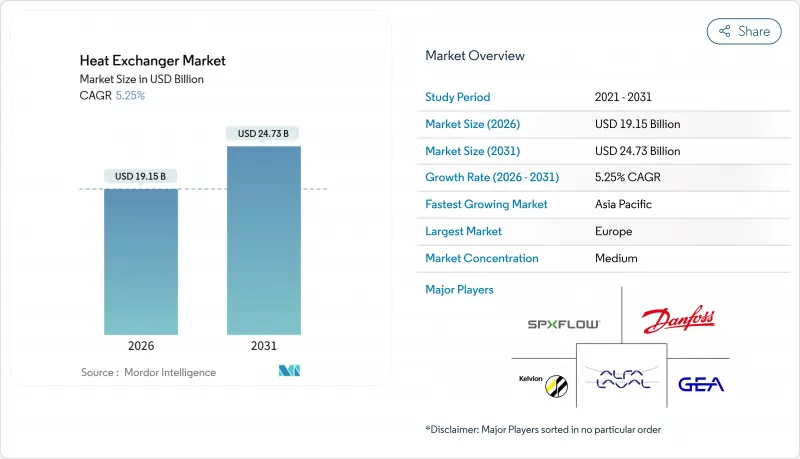
根據 Mordor Intelligence 估計,到 2026 年,熱交換器市值將達到 191.5 億美元,預計在預測期(2026-2031 年)內將以 5.25% 的複合年成長率成長,到 2031 年將達到 247.3 億美元。
本報告按類型(殼管式、板框式、空冷式等)、材質(不銹鋼、碳鋼等)、流路配置(逆流式、並流式、橫流式、混合/多路徑)、終端用戶行業(石油和天然氣、發電、水和用水和污水處理等)以及地區(北美、歐洲、亞太地區、南美等)進行分類。
全球熱交換器市場趨勢及洞察
液化天然氣計畫的激增推高了對低溫熱交換器的需求。
全球液化天然氣投資,包括卡達北方氣田擴建工程、美國的金山口和普拉克明斯計畫以及德克薩斯州的里奧格蘭德計畫等,已累積訂單超過15億美元。這些設備必須符合API 660和ASME第二部分標準,能夠承受低至-160 度C的環境溫度,並且需要在16個月或更短的工期內交付。
海灣合作理事會的擴張和東南亞區域冷卻的發展正在推動板式熱交換器的銷售。
到2025年,Empower公司位於杜拜的冷凍網路處理能力將超過24.1萬冷噸,其位於新加坡濱海灣的設施處理能力將達到20.3萬冷噸。這兩個設施均採用墊片式板式熱交換器,使每冷噸的電力消耗量低於0.6千瓦。目前,對於溶解性固態含量高的地熱迴路,指定使用鈦板,可將板的使用壽命延長至25年。
鎳和鈦的價格波動推高了對耐腐蝕部件的需求。
2024年,鎳價年波動幅度達30%,海綿鈦價格也經歷了15%至20%的波動。這導致304不鏽鋼板材成本上漲12%至18%,特種合金的交貨週期延長至36週。在EPC合約下,成本上漲的轉嫁門檻從5%降至3%,給供應商的利潤率帶來了壓力。
細分市場分析
隨著沙漠地區的煉油廠和液化天然氣工廠為避免用水量超標而紛紛搬遷,空冷式熱交換器市場預計將以6.6%的複合年成長率成長,比整體熱交換器市場增速高出1個百分點。到2025年,管殼式熱交換器仍將維持35.4%的市場佔有率,因為ASME認證在高壓石化應用中仍然至關重要。板框式熱交換器在區域冷卻領域市佔率不斷成長,而印刷電路板式熱交換器的市佔率雖然不足2%,但在運作超過200巴的氫氣站中卻佔據主導地位。
用於資料中心的後門式和微通道盤管,以及用於中東裂解裝置的預製翅片管模組,訂單量保持強勁。受EPC(工程、採購和施工)公司對「即插即用」撬裝設備的青睞(可減少30%的現場工作量),預計到2031年,空冷式熱交換器市場規模將達到97億美元。
由於氫氣壓縮機、海上酸性氣體處理設施和海水淡化廠對具有優異抗點蝕性能的2級鈦合金和鎳合金的需求,特種合金市場預計將以7.0%的複合年成長率成長。到2025年,不銹鋼仍將維持30.5%的市場佔有率,這主要得益於符合食品飲料衛生標準和適中氯化物要求的雙相不銹鋼。碳鋼組件仍用於低腐蝕性應用,但隨著脫碳導致工作溫度超過400 度C,其市佔率正在下降。
在中東海水淡化計畫中,使用壽命為 30 年的鈦合金管束是首選,到 2031 年,特種合金在熱交換器市場的佔有率可能會增加到 18%。在歐洲生物精煉中,當原料的酸度 pH 值超過 2 時,會指定使用鎳基哈氏合金和因科鎳合金,這導致其價格比不銹鋼裝置高出 3-4 倍。
區域分析
受中國年產4000萬噸煉油廠項目、印度HPCL Ballmer煉油廠維修以及東南亞國協石化產業投資的推動,亞太地區預計在2026年至2031年間將維持6.5%的複合年成長率。到2031年,亞太地區熱交換器市場規模預計將達到102億美元,因為當地的EPC公司正在強制採用空冷模組,以避免冷卻塔水塔用水量超標的罰款。
在歐洲,嚴格的能源效率指令以及斯堪地那維亞區域冷卻的興起,使得不銹鋼和特種合金冷凍設備在2025年仍能維持33.0%的市場佔有率。諸如BASF維希港計畫等維修項目,正在採用冷凝水餘熱回收裝置,降低15%的燃料消耗。綠色交易的目標也進一步推動了對不銹鋼和特殊合金冷凍設備的需求。
北美市場約佔總銷售額的22%,其中維吉尼亞和亞利桑那州的LNG接收站、小型模組化反應器(SMR)先導計畫以及資料中心集群訂單。在中東和非洲,空冷式熱交換器廣泛應用於天然氣處理和海水淡化;而在南美洲,公司正致力於對巴西和阿根廷的煉油廠進行現代化改造,以滿足低碳燃料法規的要求。
其他好處:
- Excel格式的市場預測(ME)表
- 3個月的分析師支持
目錄
第1章:引言
- 研究假設和市場定義
- 調查範圍
第2章:調查方法
第3章執行摘要
第4章 市場狀況
- 市場概覽
- 市場促進因素
- 液化天然氣計畫的激增推高了對低溫熱交換器的需求。
- 海灣合作理事會的擴張和東南亞地區冷卻的普及正在推動平板框架的銷售。
- 氫氣先導工廠採用印刷電路型熱交換器,可承受 200 巴的工作條件。
- 歐盟強制維修工業鍋爐的政策正在推動管束的維修。
- 引入 SMR(小型模組化爐)需要緊湊、符合安全等級標準的熱交換器。
- 資料中心液冷技術的日益普及正在加速微通道技術的推廣。
- 市場限制因素
- 鎳和鈦的價格波動推高了耐腐蝕部件的價格。
- 生物製程結垢問題限制了生物煉製技術的應用。
- 前置作業時間為 12 週的 EPC(工程、訂單和施工)的需求抑制了依訂單生產的設計。
- 電廠中的直接空氣冷卻正在蠶食空氣冷卻式熱交換器的市場。
- 供應鏈分析
- 監理展望
- 技術展望
- 波特五力模型
第5章 市場規模與成長預測
- 按類型
- 殼管式
- 板框式(墊片式、硬焊式、焊接式)
- 空冷式(翅片管式、板翅式、微通道式)
- 再生式(旋轉式和板式)
- 印刷基板
- 其他(雙管、螺旋、同軸)
- 透過建築材料
- 不銹鋼
- 碳鋼
- 非鐵金屬(銅、鋁)
- 特殊合金(鈦、鎳、哈氏合金)
- 聚合物和複合材料(聚四氟乙烯、石墨、陶瓷)
- 按流程配置
- 逆流式
- 平行線
- 交叉流
- 混合/多路徑
- 按最終用途行業分類
- 石油和天然氣
- 化工/石油化工
- 發電(包括核能)
- 食品/飲料
- 紙漿和造紙
- 供水和廢水處理
- 其他行業(汽車和運輸、冶金、採礦、暖通空調、製藥和生物技術)
- 按地區
- 北美洲
- 美國
- 加拿大
- 墨西哥
- 歐洲
- 英國
- 德國
- 法國
- 義大利
- 西班牙
- 北歐國家
- 俄羅斯
- 其他歐洲國家
- 亞太地區
- 中國
- 印度
- 日本
- 韓國
- 東南亞國協
- 澳洲
- 其他亞太國家
- 南美洲
- 巴西
- 阿根廷
- 智利
- 哥倫比亞
- 其他南美國家
- 中東和非洲
- 沙烏地阿拉伯
- 阿拉伯聯合大公國
- 南非
- 埃及
- 其他中東和非洲國家
- 北美洲
第6章 競爭情勢
- 市場集中度
- 策略趨勢(併購、聯盟、購電協議)
- 市場佔有率分析(主要公司的市場排名和佔有率)
- 公司簡介
- Alfa Laval AB
- Kelvion Holding GmbH
- Danfoss A/S
- SPX Flow Inc.
- GEA Group AG
- Hisaka Works Ltd.
- Xylem Inc.
- Thermax Ltd.
- Mersen SA
- API Heat Transfer Inc.
- GE Vernova Inc.
- Barriquand Technologies Thermiques SAS
- Koch Heat Transfer Company LP
- SWEP International AB
- Heatric
- Kobelco Steel Ltd.
- Accessen Group
- Funke WarmeaustauscherGmbH
- Tranter Inc.
- HRS Heat Exchangers Ltd.
- Hamon Thermal Europe SA
- Graham Corporation
- United Heat Transfer Ltd.
- KRN Heat Exchanger & Refrigeration Ltd.
第7章 市場機會與未來展望
According to Mordor Intelligence, the heat exchanger market size is estimated at USD 19.15 billion in 2026, and is expected to reach USD 24.73 billion by 2031, at a CAGR of 5.25% during the forecast period (2026-2031).
This report is Segmented by Type (Shell and Tube, Plate and Frame, Air-Cooled, and More), Material of Construction (Stainless Steel, Carbon Steel, and More), Flow Arrangement (Counter-Current, Parallel, Cross-Flow, and Hybrid/Multi-Pass), End-User Industry (Oil and Gas, Power Generation, Water and Waste-Water Treatment, and More), and Geography (North America, Europe, Asia-Pacific, South America, and More).
Global Heat Exchanger Market Trends and Insights
Surge in LNG Liquefaction Projects Boosting Demand for Cryogenic Exchangers
Global LNG investments, North Field expansion in Qatar, Golden Pass and Plaquemines in the U.S., and Rio Grande in Texas, are driving a backlog worth more than USD 1.5 billion for spiral-wound and plate-fin cryogenic units. Equipment must meet API 660 and ASME Division 2 standards, handle minus-160 °C service, and ship within 16-month construction windows.
District-Cooling Expansion in GCC & Southeast Asia Driving Plate-Frame Sales
Empower's Dubai network exceeded 241,000 refrigeration tons in 2025, while Marina Bay Singapore reached 203,000 refrigeration tons, both relying on gasketed-plate exchangers to trim electrical consumption below 0.6 kW per refrigeration ton. Titanium plates are now specified in geothermal loops with high dissolved solids, extending plate life to 25 years.
Nickel and Titanium Price Volatility Inflating Corrosion-Resistant Units
Nickel traded with 30% intra-year swings in 2024, while titanium sponge experienced 15-20% shifts, lifting stainless-steel 304 plate costs 12-18% and extending exotic-alloy delivery to 36 weeks. EPC contracts lowered escalation pass-through thresholds from 5% to 3%, squeezing vendor margins.
Other drivers and restraints analyzed in the detailed report include:
- Hydrogen Pilot Plants Adopting Printed-Circuit Exchangers for 200-Bar Service
- Mandatory EU Industrial Boiler Upgrades Spurring Retrofit Tube Bundles
- Bio-Process Fouling Issues Limiting Adoption in Biorefineries
For complete list of drivers and restraints, kindly check the Table Of Contents.
Segment Analysis
Air-cooled units are projected to rise at a 6.6% CAGR, a full percentage point above the overall heat exchanger market growth, as desert refineries and LNG trains avoid water usage penalties. Shell-and-tube designs retained a 35.4% share in 2025 because ASME certifications remain indispensable for high-pressure petrochemical service. Plate-and-frame variants are climbing in district cooling, while printed-circuit equipment, though under 2% share, dominates hydrogen stations that operate above 200 bar.
Rear-door and micro-channel coils for data centers, together with prefabricated finned-tube modules for Middle East crackers, sustain robust ordering cycles. The heat exchanger market size for air-cooled units is anticipated to reach USD 9.7 billion by 2031, thanks to EPC preference for plug-and-play skids that shorten site work by 30%.
Exotic alloys will expand at a 7.0% CAGR as hydrogen compressors, offshore sour-gas facilities, and desalination plants require titanium Grade 2 or nickel alloys with high pitting resistance. Stainless steel still held a 30.5% share in 2025, sustained by food and beverage hygiene standards and duplex grades that handle moderate chlorides. Carbon-steel assemblies persist in low-corrosion duties but lose ground as decarbonization raises operating temperatures beyond 400 °C.
The heat exchanger market share of exotic alloys could climb to 18% by 2031 because Middle East desalination projects prefer titanium bundles with 30-year lifetimes. Nickel-based Hastelloy and Inconel are specified in European bio-refineries where feedstock acidities exceed pH 2, driving a premium of 3-4X over stainless units.
Complete Report Scope:
- By Type
- Shell and Tube
- Plate and Frame (Gasketed Plate, Brazed Plate, Welded Plate)
- Air-Cooled (Fin and Tube, Plate-Fin, Micro-Channel)
- Regenerative (Rotary and Plate)
- Printed Circuit
- Others (Double-Pipe, Spiral, Coaxial)
- By Material of Construction
- Stainless Steel
- Carbon Steel
- Non-Ferrous (Copper, Aluminium)
- Exotic Alloys (Titanium, Nickel, Hastelloy)
- Polymers and Composites (PTFE, Graphite, Ceramic)
- By Flow Arrangement
- Counter-Current
- Parallel
- Cross-Flow
- Hybrid/Multi-Pass
- By End-Use Industry
- Oil and Gas
- Chemical and Petrochemical
- Power Generation (incl. Nuclear)
- Food and Beverage
- Pulp and Paper
- Water and Waste-water Treatment
- Other Industries (Automotive and Transportation, Metallurgy, Mining, HVACR, Pharmaceutical and Biotechnology)
- By Geography
- North America
- United States
- Canada
- Mexico
- Europe
- United Kingdom
- Germany
- France
- Italy
- Spain
- Nordic Countries
- Russia
- Rest of Europe
- Asia-Pacific
- China
- India
- Japan
- South Korea
- ASEAN Countries
- Australia
- Rest of Asia-Pacific
- South America
- Brazil
- Argentina
- Chile
- Colombia
- Rest of South America
- Middle East and Africa
- Saudi Arabia
- United Arab Emirates
- South Africa
- Egypt
- Rest of Middle East and Africa
- North America
Geography Analysis
Asia-Pacific is set to post a 6.5% CAGR from 2026 to 2031, driven by Chinese 40 million tpa refinery projects, Indian HPCL Barmer upgrades, and ASEAN petrochemical investments. The heat exchanger market size for Asia-Pacific could reach USD 10.2 billion by 2031 as local EPC firms mandate air-cooled modules that avoid cooling-tower water penalties.
Europe maintained a 33.0% share in 2025 because of stringent energy-efficiency directives and district-cooling growth in Scandinavia. Retrofit programs, such as BASF Ludwigshafen, deploy condensing heat-recovery bundles that cut fuel 15%. EU Green Deal targets further bolster demand for stainless and exotic-alloy units.
North America contributes about 22% of revenue, with LNG terminals, SMR pilots, and data-center corridors in Virginia and Arizona pushing order books. The Middle East and Africa rely on air-cooled exchangers for gas processing and desalination, while South America focuses on refinery modernization in Brazil and Argentina to meet low-carbon fuel rules.
- Alfa Laval AB
- Kelvion Holding GmbH
- Danfoss A/S
- SPX Flow Inc.
- GEA Group AG
- Hisaka Works Ltd.
- Xylem Inc.
- Thermax Ltd.
- Mersen SA
- API Heat Transfer Inc.
- GE Vernova Inc.
- Barriquand Technologies Thermiques SAS
- Koch Heat Transfer Company LP
- SWEP International AB
- Heatric
- Kobelco Steel Ltd.
- Accessen Group
- Funke WarmeaustauscherGmbH
- Tranter Inc.
- HRS Heat Exchangers Ltd.
- Hamon Thermal Europe SA
- Graham Corporation
- United Heat Transfer Ltd.
- KRN Heat Exchanger & Refrigeration Ltd.
Additional Benefits:
- The market estimate (ME) sheet in Excel format
- 3 months of analyst support
TABLE OF CONTENTS
1 Introduction
- 1.1 Study Assumptions & Market Definition
- 1.2 Scope of the Study
2 Research Methodology
3 Executive Summary
4 Market Landscape
- 4.1 Market Overview
- 4.2 Market Drivers
- 4.2.1 Surge in LNG liquefaction projects boosting demand for cryogenic exchangers
- 4.2.2 District-cooling expansion in GCC & SE-Asia driving plate-frame sales
- 4.2.3 Hydrogen pilot plants adopting printed-circuit exchangers for 200-bar service
- 4.2.4 Mandatory EU industrial boiler upgrades spurring retrofit tube bundles
- 4.2.5 SMR (small modular reactor) roll-out needing compact safety-class exchangers
- 4.2.6 Data-centre liquid cooling uptake accelerating micro-channel adoption
- 4.3 Market Restraints
- 4.3.1 Nickel & titanium price volatility inflating corrosion-resistant units
- 4.3.2 Bio-process fouling issues limiting adoption in biorefineries
- 4.3.3 EPC demand for 12-week lead-times curbing engineered-to-order designs
- 4.3.4 Direct air-cooling in power plants cannibalising air-cooled exchangers
- 4.4 Supply-Chain Analysis
- 4.5 Regulatory Outlook
- 4.6 Technological Outlook
- 4.7 Porter's Five Forces
- 4.7.1 Bargaining Power of Suppliers
- 4.7.2 Bargaining Power of Buyers
- 4.7.3 Threat of New Entrants
- 4.7.4 Threat of Substitutes
- 4.7.5 Intensity of Competitive Rivalry
5 Market Size & Growth Forecasts
- 5.1 By Type
- 5.1.1 Shell and Tube
- 5.1.2 Plate and Frame (Gasketed Plate, Brazed Plate, Welded Plate)
- 5.1.3 Air-Cooled (Fin and Tube, Plate-Fin, Micro-Channel)
- 5.1.4 Regenerative (Rotary and Plate)
- 5.1.5 Printed Circuit
- 5.1.6 Others (Double-Pipe, Spiral, Coaxial)
- 5.2 By Material of Construction
- 5.2.1 Stainless Steel
- 5.2.2 Carbon Steel
- 5.2.3 Non-Ferrous (Copper, Aluminium)
- 5.2.4 Exotic Alloys (Titanium, Nickel, Hastelloy)
- 5.2.5 Polymers and Composites (PTFE, Graphite, Ceramic)
- 5.3 By Flow Arrangement
- 5.3.1 Counter-Current
- 5.3.2 Parallel
- 5.3.3 Cross-Flow
- 5.3.4 Hybrid/Multi-Pass
- 5.4 By End-Use Industry
- 5.4.1 Oil and Gas
- 5.4.2 Chemical and Petrochemical
- 5.4.3 Power Generation (incl. Nuclear)
- 5.4.4 Food and Beverage
- 5.4.5 Pulp and Paper
- 5.4.6 Water and Waste-water Treatment
- 5.4.7 Other Industries (Automotive and Transportation, Metallurgy, Mining, HVACR, Pharmaceutical and Biotechnology)
- 5.5 By Geography
- 5.5.1 North America
- 5.5.1.1 United States
- 5.5.1.2 Canada
- 5.5.1.3 Mexico
- 5.5.2 Europe
- 5.5.2.1 United Kingdom
- 5.5.2.2 Germany
- 5.5.2.3 France
- 5.5.2.4 Italy
- 5.5.2.5 Spain
- 5.5.2.6 Nordic Countries
- 5.5.2.7 Russia
- 5.5.2.8 Rest of Europe
- 5.5.3 Asia-Pacific
- 5.5.3.1 China
- 5.5.3.2 India
- 5.5.3.3 Japan
- 5.5.3.4 South Korea
- 5.5.3.5 ASEAN Countries
- 5.5.3.6 Australia
- 5.5.3.7 Rest of Asia-Pacific
- 5.5.4 South America
- 5.5.4.1 Brazil
- 5.5.4.2 Argentina
- 5.5.4.3 Chile
- 5.5.4.4 Colombia
- 5.5.4.5 Rest of South America
- 5.5.5 Middle East and Africa
- 5.5.5.1 Saudi Arabia
- 5.5.5.2 United Arab Emirates
- 5.5.5.3 South Africa
- 5.5.5.4 Egypt
- 5.5.5.5 Rest of Middle East and Africa
- 5.5.1 North America
6 Competitive Landscape
- 6.1 Market Concentration
- 6.2 Strategic Moves (M&A, Partnerships, PPAs)
- 6.3 Market Share Analysis (Market Rank/Share for key companies)
- 6.4 Company Profiles (includes Global level Overview, Market level overview, Core Segments, Financials as available, Strategic Information, Products & Services, Recent Developments)
- 6.4.1 Alfa Laval AB
- 6.4.2 Kelvion Holding GmbH
- 6.4.3 Danfoss A/S
- 6.4.4 SPX Flow Inc.
- 6.4.5 GEA Group AG
- 6.4.6 Hisaka Works Ltd.
- 6.4.7 Xylem Inc.
- 6.4.8 Thermax Ltd.
- 6.4.9 Mersen SA
- 6.4.10 API Heat Transfer Inc.
- 6.4.11 GE Vernova Inc.
- 6.4.12 Barriquand Technologies Thermiques SAS
- 6.4.13 Koch Heat Transfer Company LP
- 6.4.14 SWEP International AB
- 6.4.15 Heatric
- 6.4.16 Kobelco Steel Ltd.
- 6.4.17 Accessen Group
- 6.4.18 Funke WarmeaustauscherGmbH
- 6.4.19 Tranter Inc.
- 6.4.20 HRS Heat Exchangers Ltd.
- 6.4.21 Hamon Thermal Europe SA
- 6.4.22 Graham Corporation
- 6.4.23 United Heat Transfer Ltd.
- 6.4.24 KRN Heat Exchanger & Refrigeration Ltd.
7 Market Opportunities & Future Outlook
- 7.1 White-space & Unmet-Need Assessment

 2026-2030年全球熱交換器市場
 熱交換器市場:2026-2032年全球市場預測(依產品類型、結構材料、流動佈局、熱交換機制、相態、壓力等級、最終用途、熱負荷、安裝類型和銷售管道)
 板式熱交換器市場:按產品類型、應用和地區分類
 熱交換器市場規模、佔有率和成長分析:按產品類型、材質、應用和地區分類-2026-2033年產業預測
 熱交換器市場規模、佔有率、趨勢和預測:按產品、材質、終端用戶產業和地區分類,2026-2034年
 氫燃料加註站用熱交換器:全球市場佔有率和排名、總收入和需求預測(2026-2032年)地熱熱交換器市場:類型、技術、安裝配置、應用和最終用途—2026-2032年全球市場預測
 2026年板翅式盤管全球市場報告熱交換器市場:按原料、應用和地區分類2026年全球地熱供暖和製冷市場報告