


 |
市場調查報告書
商品編碼
2121513
鈦合金:市場佔有率分析、產業趨勢與統計、成長預測(2026-2031)Titanium Alloy - Market Share Analysis, Industry Trends & Statistics, Growth Forecasts (2026 - 2031) |
||||||

※ 本網頁內容可能與最新版本有所差異。詳細情況請與我們聯繫。
預計鈦合金市場將從 2025 年的 158.23 千噸成長到 2026 年的 166.44 千噸,然後從 2026 年到 2031 年以 5.19% 的複合年成長率成長,到 2031 年達到 214.35 千噸成長率。
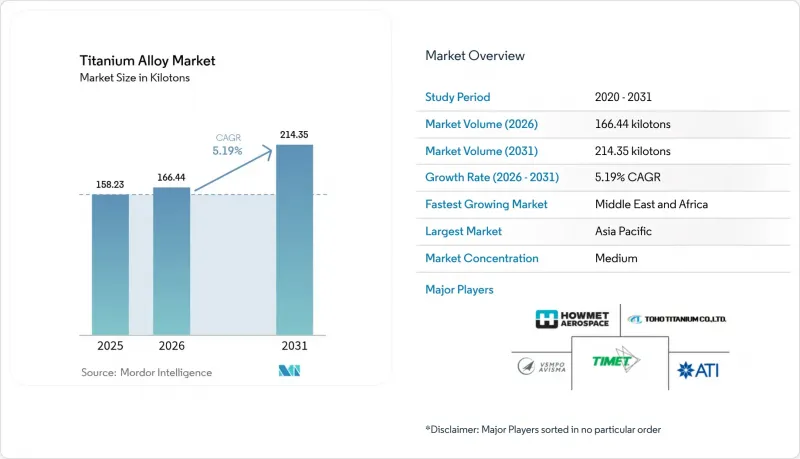
本報告按微觀結構(α相和近α相、α-BETA相、BETA相)、終端用戶產業(航太、汽車和造船、化學加工、電力和海水淡化、醫療和牙科植入以及其他終端用戶產業)和地區(亞太地區、北美、歐洲、南美洲以及中東和非洲)進行細分。市場預測以產量(千噸)為單位。
全球鈦合金市場趨勢與洞察
航太和國防領域對飛機的需求不斷成長
鈦合金已獲得超過15,000架民航機的訂單,可靠地應用於結構件、起落架和引擎部件,其輕量化優勢有助於降低燃油成本。 ATI預計,2025年第一季其66%的收入將來自航太和國防領域,並已與空中巴士簽署了一份價值10億美元的五年供應合約。由於引擎需求激增,Haumet Aerospace公司2024年第三季商用航太部門的營收成長了17%。目前,鈦合金佔噴射引擎重量的15%至25%,國防項目也指定使用鈦合金以確保隱身性和耐久性。為擺脫對俄羅斯原料的依賴,鈦合金市場正逐步多元化,並與日本和中東的供應商建立新的合作關係,進一步加速鈦合金市場的生產結構重組。
軍用地面車輛減重計劃
為了在不降低防護性能的前提下提升航程和負載容量,國防負責人正擴大用鈦合金取代裝甲、傳動系統和懸吊系統中的鋼材。美國國防部授予IperionX公司一份價值4710萬美元的契約,凸顯了美國致力於確保安全且低成本的鈦合金生產能力的決心。北約統一的材料規格標準正在擴大跨境需求,而實地數據顯示,以鈦合金零件取代鋼材可節省15%至20%的燃料。先進的製造技術減少了零件的數量,減輕了部署車輛的維護負擔,並推動了鈦合金市場的長期成長。
生產成本高且冶金製程複雜
傳統的克羅爾製程每噸鈦消耗11-13兆瓦時的能量,使得鈦的價格比鋁高3-4倍,比鋼高10-15倍。高反應性的冶金製程需要惰性氣氛和特殊的切削液,這阻礙了下游加工製程的生產效率。雖然氫輔助還原法可望降低反應溫度,但仍處於實用化應用前的階段。東京大學開發的利用釔反應的除氧技術具有降低成本的潛力,但需要數年時間才能實現工業化規模生產。在新製程成熟之前,高昂的轉換成本將限制鈦合金市場的發展潛力。
細分市場分析
預計到2031年,BETA合金的複合年成長率將達到6.02%,但截至2025年,α-BETA合金已佔據鈦合金市場51.12%的佔有率。 Ti-5553合金具有優異的鑄造性能,實現了高強度重量比,這對於機翼貫穿段和起落架結構至關重要。對鋯和鉿高熵金屬間化合物的研究表明,其在8%塑性應變下的屈服強度可達1.5 GPa,從而拓展了高超音速應用領域的選擇。
積層製造技術的持續應用實現了近淨成形生產,從採購到飛行的時間縮短了高達60%,同時也實現了渦輪葉片複雜的冷卻通道結構。預計到本十年末,BETA型鈦合金的市場規模將佔總銷售量的約25%,這得益於粉末霧化技術的進步以及關鍵飛行硬體認證測試的協同效應。同時,市場對適用於500 度C以上高溫環境的α型和近α型合金的需求,也支撐了燃氣渦輪機和航太推進領域的市場需求。生產商對真空電弧重熔參數的標準化,正在穩定合金的化學成分,並增強航太和國防領域關鍵參與者的信心。
區域分析
到2025年,亞太地區將佔全球鈦合金市場41.02%的佔有率,其中中國(佔全球鈦合金產量的60%)將構成該市場的基礎。然而,該地區航太認證的延遲阻礙了其即時進入高附加價值噴射機計畫。印度正與印度斯坦航空有限公司(HAL)和國防研究與發展組織(DRDO)合作,擴大其國內海綿鈦產能;同時,澳洲礦業公司正在探索下游製程中的合金化業務,以確保在價值鏈上游獲得更多利潤。儘管品質挑戰依然存在,但這些努力的共同作用正在推動產量穩定成長。
中東和非洲地區正以5.85%的複合年成長率快速成長,並受益於沙烏地阿拉伯460億美元的礦業策略。該策略旨在2030年將礦業佔GDP的比重提升至750億美元,並將沙烏地阿拉伯打造成為中性鈦供應國。在北美,海綿鈦產量仍然很低,而消費量卻居高不下。在北卡羅來納州坎伯蘭縣,一項耗資8.67億美元的工廠項目已獲批准,該項目將採用氫輔助還原法重建國內海綿鈦產能。該廠全面運作後,預計年產量將達1萬噸。在加拿大,魁北克省的一座水力發電鈦鐵礦正在探索垂直整合,以生產低碳海綿鈦。
在大西洋彼岸,歐洲的原始設備製造商(OEM)正努力在遵守制裁規定和維持生產之間取得平衡,並正在與哈薩克和日本的供應商商討成立合資企業事宜。此外,歐盟的《基本原料法》正在加速挪威和西班牙海綿鈦計畫的授權程序。儘管南美洲仍然是鈦礦的主要出口地區,但巴西國家開發銀行已表示有興趣為現有鈦鐵礦附近的下游合金工廠提供聯合融資。整體而言,供應鏈格局的變化仍在推動鈦合金市場的重組。
其他好處:
- Excel格式的市場預測(ME)表
- 3個月的分析師支持
目錄
第1章:引言
- 研究假設和市場定義
- 調查範圍
第2章:調查方法
第3章執行摘要
第4章 市場狀況
- 市場概覽
- 市場促進因素
- 航太和國防領域對飛機的需求不斷成長
- 軍用地面車輛減重計劃
- 擴大醫療和牙科植入手術
- 積層製造技術催生了一種新的材料等級。
- 新興氫能經濟對熱交換器的需求
- 市場限制因素
- 生產成本高且冶金製程複雜
- 全球海綿生產能力短缺
- 對俄羅斯原物料的地緣政治依賴
- 價值鏈分析
- 波特五力分析
第5章 市場規模與成長預測
- 透過微觀結構
- Alpha 和 Near Alpha
- 阿爾法貝塔
- 測試版
- 按最終用戶行業分類
- 航太
- 汽車和造船業
- 化學處理
- 電力和海水淡化
- 醫療和牙科植入
- 其他終端用戶產業(石油和天然氣等)
- 地區
- 亞太地區
- 中國
- 日本
- 印度
- 韓國
- 其他亞太國家
- 北美洲
- 美國
- 加拿大
- 墨西哥
- 歐洲
- 德國
- 英國
- 法國
- 義大利
- 俄羅斯
- 其他歐洲國家
- 南美洲
- 巴西
- 阿根廷
- 其他南美國家
- 中東和非洲
- 沙烏地阿拉伯
- 南非
- 其他中東和非洲國家
- 亞太地區
第6章 競爭情勢
- 市場集中度
- 策略趨勢
- 市佔率(%)** / 排名分析
- 公司簡介
- ATI
- Alleima
- AMG
- BAOTI Group Co.,Ltd.
- Corporation VSMPO-AVISMA
- CRS Holdings, LLC
- Daido Steel Co., Ltd.
- Hermith GmbH
- Howmet Aerospace
- KOBE STEEL, LTD.
- OSAKA Titanium Technologies Co.,Ltd.
- Perryman Company
- PJSC VSMPO-AVISMA Corporation
- TIMET(Precision Castparts Corp.)
- Toho Titanium Co., Ltd.
- Weber Metals(OTTO FUCHS Kommanditgesellschaft)
- Western Superconducting Technologies Co., Ltd
第7章 市場機會與未來展望
According to Mordor Intelligence, the titanium alloy market size is expected to grow from 158.23 kilotons in 2025 to 166.44 kilotons in 2026 and is forecast to reach 214.35 kilotons by 2031 at 5.19% CAGR over 2026-2031.
This report is Segmented by Microstructure (Alpha and Near-Alpha, Alpha-Beta, and Beta), End-User Industry (Aerospace, Automotive and Shipbuilding, Chemical Processing, Power and Desalination, Medical and Dental Implants, and Other End-User Industries), and Geography (Asia-Pacific, North America, Europe, South America, and Middle-East and Africa). The Market Forecasts are Provided in Terms of Volume (Kilotons).
Global Titanium Alloy Market Trends and Insights
Growing Aerospace and Defense Airframe Demand
Orders exceeding 15,000 commercial aircraft place titanium squarely in structural, landing-gear, and engine components, where weight reduction translates into fuel savings. ATI drew 66% of Q1 2025 revenue from aerospace and defense and locked in a five-year USD 1 billion supply pact with Airbus. Howmet Aerospace recorded 17% commercial-aerospace sales growth in Q3 2024 on surging engine demand. Titanium intensity now reaches 15-25% of a jet engine's weight, while defense programs specify the alloy for stealth and durability. Diversification away from Russian feedstock is driving new partnerships with Japanese and Middle Eastern suppliers, reinforcing the titanium alloy market's production realignment.
Military Ground-Vehicle Light-Weighting Programs
Defense planners increasingly swap steel for titanium in armor, drivetrains, and suspensions to boost range and payload without sacrificing protection. The U.S. Department of Defense's USD 47.1 million award to IperionX underscores a national push for secure, low-cost titanium capacity. NATO standards that harmonize material specifications amplify cross-border demand, and field data show 15-20% fuel savings when titanium components replace steel. Advanced manufacturing shortens part lists, easing maintenance burden for deployed vehicle fleets and fueling long-run momentum in the titanium alloy market.
High Production Cost and Complex Metallurgy
The legacy Kroll route burns 11-13 MWh per ton, making titanium 3-4 times pricier than aluminum and 10-15 times pricier than steel. Reactive metallurgy demands inert atmospheres and specialized cutting fluids, hampering productivity in downstream machining. Hydrogen-assisted reduction pathways promise lower temperatures but remain pre-commercial. University of Tokyo techniques for oxygen removal via yttrium reactions offer potential cost savings, yet industrial scaling is several years. Until new processes mature, elevated conversion costs cap the full potential of the titanium alloy market.
Other drivers and restraints analyzed in the detailed report include:
- Expansion of Medical and Dental Implant Procedures
- Additive Manufacturing Unlocking Novel Grades
- Geopolitical Dependence on Russian Feedstock
For complete list of drivers and restraints, kindly check the Table Of Contents.
Segment Analysis
Beta alloys are projected to register a 6.02% CAGR through 2031, while Alpha-Beta grades retained 51.12% of the titanium alloy market share in 2025. Ti-5553 demonstrates superior castability, delivering high strength-to-weight ratios vital for wing-carry-throughs and landing-gear structures. Research into high-entropy intermetallics incorporating zirconium and hafnium achieves yield strengths of 1.5 GPa with 8% plastic strain, expanding options for hypersonic applications.
Ongoing additive-manufacturing deployments enable near-net-shape production, slashing buy-to-fly ratios by up to 60% and supporting intricate cooling-channel architectures in turbine blades. Beta alloys' titanium alloy market size is on track to close the decade at roughly 25% of overall volume, supported by synergistic gains in powder-atomization capacity and qualification tests for critical flight hardware. Parallel interest in Alpha and Near-Alpha alloys for temperatures above 500 °C preserves demand in gas turbines and space-propulsion contexts. As producers standardize vacuum-arc-remelting parameters, alloy chemistries stabilize, improving confidence among aerospace and defense primes.
Complete Report Scope:
- By Microstructure
- Alpha and Near-Alpha
- Alpha-Beta
- Beta
- By End-User Industry
- Aerospace
- Automotive and Shipbuilding
- Chemical Processing
- Power and Desalination
- Medical and Dental Implants
- Other End-user Industries (Oil and Gas, etc.)
- Geography
- Asia-Pacific
- China
- Japan
- India
- South Korea
- Rest of Asia-Pacific
- North America
- United States
- Canada
- Mexico
- Europe
- Germany
- United Kingdom
- France
- Italy
- Russia
- Rest of Europe
- South America
- Brazil
- Argentina
- Rest of South America
- Middle-East and Africa
- Saudi Arabia
- South Africa
- Rest of Middle-East and Africa
- Asia-Pacific
Geography Analysis
Asia-Pacific commanded 41.02% of the titanium alloy market in 2025, anchored by China's 60% share of global metal output. However, the region's aerospace certification gap curtails immediate penetration into high-value jet programs. India collaborates with HAL and DRDO on indigenous sponge capacity, while Australian miners explore downstream alloying to capture margin farther along the value chain. These initiatives collectively support robust volume gains, although quality hurdles remain.
The Middle East and Africa region, expanding at a 5.85% CAGR, benefits from Saudi Arabia's USD 46 billion mining strategy, which aims to lift mining GDP share to 75 billion by 2030 and position the kingdom as a neutral titanium supplier. North American consumption stays high despite minimal sponge output. Cumberland County, North Carolina, secured a USD 867 million plant to rebuild domestic capacity with hydrogen-assisted reduction that could supply 10,000 tons annually once fully operational. In Canada, Quebec's hydro-powered ilmenite operations explore vertically integrating into low-carbon sponge.
Across the Atlantic, European OEMs juggle sanction compliance and production continuity, prompting joint-venture discussions with Kazakh and Japanese suppliers; the EU's Critical Raw Materials Act expedites permitting for sponge projects in Norway and Spain. South America remains largely a raw-ore exporter, but Brazil's state development bank signals interest in co-financing downstream alloy plants near existing ilmenite mines. Overall, shifting supply footprints continue to reshape the titanium alloy market.
- ATI
- Alleima
- AMG
- BAOTI Group Co.,Ltd.
- Corporation VSMPO-AVISMA
- CRS Holdings, LLC
- Daido Steel Co., Ltd.
- Hermith GmbH
- Howmet Aerospace
- KOBE STEEL, LTD.
- OSAKA Titanium Technologies Co.,Ltd.
- Perryman Company
- PJSC VSMPO-AVISMA Corporation
- TIMET (Precision Castparts Corp.)
- Toho Titanium Co., Ltd.
- Weber Metals (OTTO FUCHS Kommanditgesellschaft)
- Western Superconducting Technologies Co., Ltd
Additional Benefits:
- The market estimate (ME) sheet in Excel format
- 3 months of analyst support
TABLE OF CONTENTS
1 Introduction
- 1.1 Study Assumptions and Market Definition
- 1.2 Scope of the Study
2 Research Methodology
3 Executive Summary
4 Market Landscape
- 4.1 Market Overview
- 4.2 Market Drivers
- 4.2.1 Growing Aerospace and Defense Airframe Demand
- 4.2.2 Military Ground-Vehicle Light-Weighting Programs
- 4.2.3 Expansion of Medical and Dental Implant Procedures
- 4.2.4 Additive Manufacturing Unlocking Novel Grades
- 4.2.5 Heat-Exchanger Demand in Emerging Hydrogen Economy
- 4.3 Market Restraints
- 4.3.1 High Production Cost and Complex Metallurgy
- 4.3.2 Limited Global Sponge Capacity
- 4.3.3 Geopolitical Dependence on Russian Feedstock
- 4.4 Value Chain Analysis
- 4.5 Porter's Five Forces Analysis
- 4.5.1 Bargaining Power of Suppliers
- 4.5.2 Bargaining Power of Buyers
- 4.5.3 Threat of New Entrants
- 4.5.4 Threat of Substitutes
- 4.5.5 Competitive Rivalry
5 Market Size and Growth Forecasts (Volume)
- 5.1 By Microstructure
- 5.1.1 Alpha and Near-Alpha
- 5.1.2 Alpha-Beta
- 5.1.3 Beta
- 5.2 By End-User Industry
- 5.2.1 Aerospace
- 5.2.2 Automotive and Shipbuilding
- 5.2.3 Chemical Processing
- 5.2.4 Power and Desalination
- 5.2.5 Medical and Dental Implants
- 5.2.6 Other End-user Industries (Oil and Gas, etc.)
- 5.3 Geography
- 5.3.1 Asia-Pacific
- 5.3.1.1 China
- 5.3.1.2 Japan
- 5.3.1.3 India
- 5.3.1.4 South Korea
- 5.3.1.5 Rest of Asia-Pacific
- 5.3.2 North America
- 5.3.2.1 United States
- 5.3.2.2 Canada
- 5.3.2.3 Mexico
- 5.3.3 Europe
- 5.3.3.1 Germany
- 5.3.3.2 United Kingdom
- 5.3.3.3 France
- 5.3.3.4 Italy
- 5.3.3.5 Russia
- 5.3.3.6 Rest of Europe
- 5.3.4 South America
- 5.3.4.1 Brazil
- 5.3.4.2 Argentina
- 5.3.4.3 Rest of South America
- 5.3.5 Middle-East and Africa
- 5.3.5.1 Saudi Arabia
- 5.3.5.2 South Africa
- 5.3.5.3 Rest of Middle-East and Africa
- 5.3.1 Asia-Pacific
6 Competitive Landscape
- 6.1 Market Concentration
- 6.2 Strategic Moves
- 6.3 Market Share (%)**/Ranking Analysis
- 6.4 Company Profiles (includes Global level Overview, Market level overview, Core Segments, Financials as available, Strategic Information, Market Rank/Share for key companies, Products and Services, and Recent Developments)
- 6.4.1 ATI
- 6.4.2 Alleima
- 6.4.3 AMG
- 6.4.4 BAOTI Group Co.,Ltd.
- 6.4.5 Corporation VSMPO-AVISMA
- 6.4.6 CRS Holdings, LLC
- 6.4.7 Daido Steel Co., Ltd.
- 6.4.8 Hermith GmbH
- 6.4.9 Howmet Aerospace
- 6.4.10 KOBE STEEL, LTD.
- 6.4.11 OSAKA Titanium Technologies Co.,Ltd.
- 6.4.12 Perryman Company
- 6.4.13 PJSC VSMPO-AVISMA Corporation
- 6.4.14 TIMET (Precision Castparts Corp.)
- 6.4.15 Toho Titanium Co., Ltd.
- 6.4.16 Weber Metals (OTTO FUCHS Kommanditgesellschaft)
- 6.4.17 Western Superconducting Technologies Co., Ltd
7 Market Opportunities and Future Outlook
- 7.1 White-space and Unmet-Need Assessment

 鈦合金市場預測至2034年-全球分析(按合金類型、產品形式、製造流程、等級、應用、最終用途產業和地區分類)
 鈦合金市場:2026-2032年全球市場預測(依產品類型、產品形態、製造流程、終端用戶產業及分銷通路分類)
 全球鈦合金市場(至2035年):產業趨勢與預測
 2026-2034年全球鈦合金市場規模、佔有率、趨勢及成長分析報告工業鈦合金市場:依等級、形狀、合金類型、最終用途和應用分類-2026年至2032年全球預測
 鈦合金市場規模、佔有率、趨勢和預測:按微觀結構、終端應用產業和地區分類,2026-2034年
 Ti-6Al-4V鈦合金市場規模、佔有率和成長分析(按形態、等級、應用和地區分類)-產業預測(2026-2033年)
 Ti-6Al-4V鈦合金的全球市場全球鈦合金市場鈦合金市場 - 預測 2025-2030