


 |
市場調查報告書
商品編碼
2121509
智慧採礦:市場佔有率分析、產業趨勢與統計、成長預測(2026-2031)Smart Mining - Market Share Analysis, Industry Trends & Statistics, Growth Forecasts (2026 - 2031) |
||||||

※ 本網頁內容可能與最新版本有所差異。詳細情況請與我們聯繫。
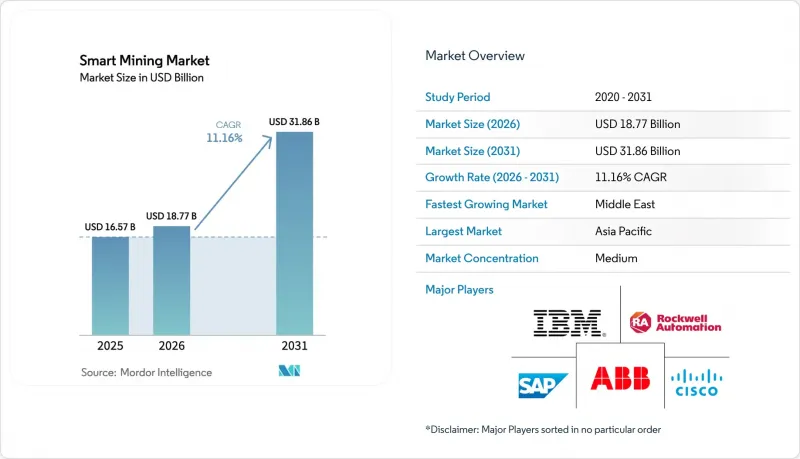
根據 Mordor Intelligence 預測,智慧挖礦市場規模預計將在 2025 年達到 165.7 億美元,2026 年達到 187.7 億美元,到 2031 年達到 318.6 億美元,2026 年至 2031 年的複合年成長率為 11.16%。
本報告按解決方案(智慧控制系統、智慧資產管理等)、服務類型(系統整合、諮詢服務、工程和維護、託管服務)、採礦方法(地下採礦、露天採礦)、技術(物聯網 (IoT)、機器人和自動化等)以及地區進行細分。市場預測以價值(美元)表示。
全球智慧採礦市場趨勢及洞察
引進自動駕駛運輸車輛
大規模引入自動駕駛卡車消除了因換班造成的停機時間,並將地理空間遙測數據整合到採礦規劃演算法中,從而即時最佳化採礦策略。到2025年,力拓集團將在皮爾巴拉地區營運超過360輛自動駕駛運輸卡車,與有人駕駛車輛相比,每公升柴油的噸公里數將提高15%。日本小松公司的FrontRunner平台目前正在內華達黃金礦業公司管理一支混合車隊,旨在實現24小時全天候運轉率,這是人工操作無法實現的。改裝400噸卡車的成本在50萬至80萬美元之間,因此人事費用較低地區的礦業公司正在推遲採購,直到大宗商品價格穩定下來。在拉丁美洲和非洲,核准流程較為分散,有時會使運作延遲長達12個月,但早期採用者與同行相比,生產力提升幅度達到了兩位數。
利用物聯網和人工智慧進行預測性維護
感測器網路和邊緣分析引擎將意外停機時間轉換為計畫內工作時段,從而保障了處理能力和備件預算。 ABB 的 Ability 平台已在 47 個礦場部署,透過振動和油質監測提前數週預測軸承故障,從而降低了 12% 的維護成本,並將整體設備效率 (OEE) 提高了 9%。 SAP 將其資產智慧網路與德勤的模型整合,使智利一家銅礦的輸送機緊急維修減少了 18%。工業加速計的價格預計將從 2020 年的 120 美元降至 2025 年的 35 美元,從而擴大其可部署的設備範圍。傳統的監控和數據採集 (SCADA) 系統仍然缺乏即插即用的感測器功能,除頂級公司外,其他公司的資料科學能力仍然不足。
高額資本支出(CAPEX)和投資報酬率的不確定性
大規模智慧採礦的實施成本通常超過5000萬美元,而大宗商品價格的波動意味著銅、金和鐵礦石生產商可能面臨四年或更長時間的投資回收期。麥肯錫2024年的一項調查發現,38%的高階主管表示,收益的不確定性是延後計畫的原因之一,尤其是在該地貨幣對美元計價的設備融資貶值的情況下。非洲和東南亞的中小型礦業公司難以取得無形資產的銀行融資,只能依賴高利率的供應商租賃。圍繞碳定價機制的監管不確定性也影響了內部評估,因為礦業公司尚未能將透過自動駕駛運輸和能源最佳化實現的減排效益貨幣化。
細分市場分析
到2025年,控制系統將佔銷售額的39.87%,這反映了其作為中央指揮層在露天礦和地下礦中統籌通風、配電和製程迴路方面發揮的重要作用。由控制系統驅動的智慧採礦市場規模將在2025年超過70億美元,進一步鞏固了該領域的穩固地位。營運商優先考慮即時掌握能源負荷、輸送機性能和氣體濃度等信息,而這些信息現在都可以透過整合數位孿生的SCADA框架來實現。開放平台架構的興起使得礦業公司無需進行大規模系統改造即可添加分析和視覺化模組,從而能夠在節省資金的同時分階段實現現代化。
自主運輸和鑽探是成長最快的解決方案類別,預計到2031年將以12.57%的複合年成長率成長。其經濟可行性得益於每噸運輸量15-20%的生產率提升,以及輪胎磨損和燃油消耗的降低。力拓、必和必拓和福特埃斯克金屬集團都在推動智慧採礦市場向全自動駕駛車隊邁進,並計劃在2025年部署超過90輛自動駕駛卡車。隨著美國礦山安全與健康管理局(MSHA)收緊近距離檢測法規,對安全系統(尤其是基於雷射雷達的防撞系統)的需求在2024年激增。資料管理軟體透過將卡車、鑽孔機和破碎機的Petabyte遙測資料轉化為可操作的洞察,完善了整個解決方案,從而能夠提高剝離比並最佳化破碎機節流閥設定。
由於礦業公司依賴了解其專有設備協定和雲端原生分析方法的專家,系統整合將在2025年佔業務收益的47.63%。這些整合商在智慧礦業市場佔據著較高的佔有率,因為他們以多年合約的形式提供硬體、軟體和變更管理的捆綁式解決方案。同時,受礦業公司希望將全天候監控和網路安全責任委託給擁有認證控制中心的供應商的需求驅動,託管服務正以11.93%的複合年成長率快速成長。為了滿足這項需求,Accenture計畫在2024年將礦業託管服務團隊規模擴大22%。
諮詢服務在綠地計畫中仍然至關重要,因為設計面向未來的網路至關重要。然而,「即服務」模式正在將收入來源從一次性工程任務轉向持續支援。維護服務正在擺脫基於日曆的調度方式,轉而採用基於車輛遙測資料的預測模型。這些服務整體上正在改變智慧採礦市場,降低了缺乏內部數位化團隊的中型企業的進入門檻。
區域分析
預計到2025年,亞太地區將佔全球收入的35.24%,這主要得益於中國強制要求年產能120萬噸及以上的煤礦在2024年底前實施智慧採礦系統的政策。澳洲皮爾巴拉鐵礦石叢集繼續發揮「活實驗室」的作用,州政府830萬美元的聯合投資加速了中型礦業公司開展的自動駕駛運輸試點計畫。該地區還擁有豐富的鋰和稀土元素礦床,吸引了大規模位化投資,以確保電池超級工廠的供應。
在北美,完善的專用頻段法規使得礦業公司能夠部署LTE和5G網路而無需擔心干擾風險。紐蒙特礦業公司的佩納斯基特礦於2024年部署了專用LTE網路,支援120台連網設備,並可對鑽孔機和挖土機進行遠端故障排除。創業投資,從而擴展了技術供應鏈。
由於煤炭需求下降以及社會對新礦場許可證申請的抵制,歐洲經濟成長緩慢。然而,斯堪地那維亞的礦業公司正在率先部署電池驅動的自動駕駛卡車,以實現碳中和目標,展現了其在細分技術領域的領導地位。南美洲擁有高等級銅和鋰礦藏,科德爾科公司於2024年在其丘基卡馬塔地下礦部署了自動駕駛運輸系統,柴油消耗量減少了12%。中東和非洲部分地區的市場正在迅速成熟。沙烏地阿拉伯礦業公司(Maaden)於2024年向西門子訂購了一份價值4700萬美元的自動化契約,旨在最佳化輸送機和破碎機,從而提高能源效率15%。中東是成長最快的地區,預計到2031年複合年成長率將達到12.19%。這得益於政府的資金支持以及遠端營運中心對數百公里外礦場的管理。儘管非洲仍在努力解決電網可靠性問題和資金籌措,但南非的鉑金礦正在推進按需通風系統的安裝,以符合修訂後的安全法規。
其他好處:
- Excel格式的市場預測(ME)表
- 3個月的分析師支持
目錄
第1章:引言
- 研究假設和市場定義
- 調查範圍
第2章:調查方法
第3章執行摘要
第4章 市場狀況
- 市場概覽
- 市場促進因素
- 引進自動駕駛卡車
- 利用物聯網和人工智慧進行預測性維護
- 以安全為重點的監測的需求
- 私有5G網路的部署
- 與永續發展掛鉤的金融獎勵
- 對必需礦物質的需求激增
- 市場限制因素
- 高額資本投入與投資報酬率的不確定性
- 舊有系統整合方面的差距
- 網路安全漏洞
- 熟練數位人才短缺
- 產業價值鏈分析
- 監理情勢
- 技術展望
- 波特五力分析
- 宏觀經濟因素對市場的影響
- 投資分析
第5章 市場規模與成長預測
- 透過解決方案
- 智慧控制系統
- 智慧資產管理
- 安全系統
- 資料管理與分析軟體
- 監測和可視化
- 自主運輸與挖掘
- 其他解決方案
- 按服務類型
- 系統整合
- 諮詢服務
- 工程和維護
- 託管服務
- 按採礦類型
- 地下採礦
- 露天採礦
- 透過技術
- 物聯網 (IoT)
- 人工智慧 (AI) 和分析
- 機器人與自動化
- 連接性(5G/LTE)
- 雲端邊緣運算
- 按地區
- 北美洲
- 美國
- 加拿大
- 墨西哥
- 歐洲
- 德國
- 英國
- 法國
- 俄羅斯
- 其他歐洲國家
- 亞太地區
- 中國
- 日本
- 印度
- 韓國
- 澳洲
- 其他亞太國家
- 中東和非洲
- 中東
- 沙烏地阿拉伯
- 阿拉伯聯合大公國
- 其他中東國家
- 非洲
- 南非
- 埃及
- 其他非洲國家
- 中東
- 南美洲
- 巴西
- 阿根廷
- 其他南美國家
- 北美洲
第6章 競爭情勢
- 市場集中度
- 策略趨勢
- 市佔率分析
- 公司簡介
- ABB Ltd
- Caterpillar Inc.
- Cisco Systems Inc.
- Komatsu Ltd
- Epiroc AB
- Hexagon AB
- Sandvik AB
- Rockwell Automation Inc.
- SAP SE
- Trimble Inc.
- IBM Corporation
- Wenco International Mining Systems Ltd
- Symboticware Inc.
- Metso Outotec Oyj
- Siemens AG
- Hitachi Construction Machinery Co., Ltd.
- Honeywell International Inc.
- Schneider Electric SE
- Accenture plc
第7章 市場機會與未來展望
According to Mordor Intelligence, the smart mining market size is projected to be USD 16.57 billion in 2025, USD 18.77 billion in 2026, and reach USD 31.86 billion by 2031, growing at a CAGR of 11.16% from 2026 to 2031.
This report is Segmented by Solution (Smart Control Systems, Smart Asset Management, and More), Service Type (System Integration, Consulting Services, Engineering and Maintenance, Managed Services), Mining Type (Underground Mining, and Surface (Open-Pit) Mining), Technology (Internet of Things (IoT), Robotics and Automation, and More), and Geography. The Market Forecasts are Provided in Terms of Value (USD).
Global Smart Mining Market Trends and Insights
Autonomous Haulage Adoption
Fleet-scale driverless trucks eliminate shift change downtime and feed geospatial telemetry into mine-planning algorithms that refine pit strategy in real time. Rio Tinto operated more than 360 autonomous haul trucks in the Pilbara during 2025 and lifted tonne-kilometers per liter of diesel by 15% compared with crewed fleets. Komatsu's FrontRunner platform now manages mixed fleets at Nevada Gold Mines, targeting around-the-clock utilization rates that manual operations cannot sustain. Retrofitting a 400-ton truck costs USD 500,000-800,000, so miners in low-labor-cost jurisdictions defer purchases until commodity prices stabilize. Fragmented approval processes in Latin America and Africa extend commissioning by up to 12 months, yet operators that move early secure double-digit production gains over peers.
IoT-AI Predictive Maintenance
Sensor networks and edge analytics engines shift unplanned downtime into scheduled work windows, protecting throughput and spare parts budgets. ABB's Ability platform at 47 mines cut maintenance expense by 12% and raised overall equipment effectiveness by 9% through vibration and oil-quality monitoring that predicts bearing failures weeks in advance. SAP linked its Asset Intelligence Network with Deloitte models to reduce emergency conveyor repairs by 18% at a Chilean copper site. Industrial accelerometer prices fell from USD 120 in 2020 to USD 35 in 2025, expanding addressable fleets. Legacy supervisory control and data-acquisition systems still resist plug-and-play sensors, and data-science capability remains scarce outside top-tier companies.
High CAPEX and ROI Uncertainty
Large smart-mining rollouts often top USD 50 million, and volatile commodity cycles stretch payback periods to more than 4 years for copper, gold, and iron-ore producers. McKinsey's 2024 survey found that 38% of executives are delaying projects due to unclear returns, especially when local currencies depreciate against USD-linked equipment financing. Smaller African and Southeast Asian miners struggle to secure bank credit for intangible assets, relying instead on vendor leasing, which carries higher interest rates. Regulatory uncertainty surrounding carbon-pricing schemes clouds internal valuations because miners cannot yet monetize emissions cuts achieved by autonomous haulage and energy optimization.
Other drivers and restraints analyzed in the detailed report include:
- Private 5G Roll-Outs
- Surge in Critical-Mineral Demand
- Cyber-Security Vulnerabilities
For complete list of drivers and restraints, kindly check the Table Of Contents.
Segment Analysis
Control systems captured 39.87% of 2025 revenue, reflecting their role as the central command layer that orchestrates ventilation, power distribution, and process loops across open-pit and underground sites. The smart mining market size attributed to control systems surpassed USD 7 billion in 2025, confirming the segment's entrenched status. Operators value real-time visibility into energy load, conveyor performance, and gas levels, all delivered through SCADA frameworks that now integrate digital twins. The rise of open-platform architectures lets miners bolt on analytics and visualization modules without forklift upgrades, preserving capital and enabling incremental modernization.
Autonomous haulage and drilling is the fastest-growing solution category, advancing at a 12.57% CAGR through 2031. Productivity gains of 15-20% per tonne hauled, along with reduced tire wear and lower fuel burn, underpin the economic case. Rio Tinto, BHP, and Fortescue Metals Group each deployed 90-plus autonomous trucks in 2025, pulling the smart mining market toward fully crewless fleets. Safety and security systems, particularly LiDAR-based collision-avoidance systems, saw a surge in demand after the United States Mine Safety and Health Administration tightened proximity-detection mandates in 2024. Data-management software rounds out the stack by turning petabytes of truck, drill, and crusher telemetry into actionable insights that improve strip ratios and optimize crusher choke settings.
System integration accounted for 47.63% of 2025 service revenue, as miners depend on specialists who understand proprietary equipment protocols and cloud-native analytics. Smart mining market share for these integrators remains high because they bundle hardware, software, and change management under multi-year contracts. Managed services, however, are advancing at an 11.93% CAGR, fueled by miners that offload 24/7 monitoring and cyber-security liability to vendors with certified control centers. Accenture expanded its mining managed-services headcount by 22% in 2024 to meet this demand.
Consulting retains a core position for greenfield projects that must blueprint future-proof networks, yet as-a-service models shift revenue from one-time engineering to recurring support. Maintenance services adopt predictive models derived from fleet telemetry, moving away from calendar-based schedules. Collectively, services transform the smart mining market by lowering entry barriers for mid-tier operators that lack in-house digital teams.
Complete Report Scope:
- By Solution
- Smart Control Systems
- Smart Asset Management
- Safety and Security Systems
- Data Management and Analytics Software
- Monitoring and Visualization
- Autonomous Haulage and Drilling
- Other Solutions
- By Service Type
- System Integration
- Consulting Services
- Engineering and Maintenance
- Managed Services
- By Mining Type
- Underground Mining
- Surface (Open-Pit) Mining
- By Technology
- Internet of Things (IoT)
- Artificial Intelligence and Analytics
- Robotics and Automation
- Connectivity (5G/LTE)
- Cloud and Edge Computing
- By Geography
- North America
- United States
- Canada
- Mexico
- Europe
- Germany
- United Kingdom
- France
- Russia
- Rest of Europe
- Asia-Pacific
- China
- Japan
- India
- South Korea
- Australia
- Rest of Asia-Pacific
- Middle East and Africa
- Middle East
- Saudi Arabia
- United Arab Emirates
- Rest of Middle East
- Africa
- South Africa
- Egypt
- Rest of Africa
- Middle East
- South America
- Brazil
- Argentina
- Rest of South America
- North America
Geography Analysis
Asia Pacific commanded 35.24% of 2025 revenue, led by China's mandate that coal mines above 1.2 million-ton annual capacity install smart-mine systems by the end of 2024. Australia's Pilbara iron-ore cluster remains a living lab, with state co-funding of USD 8.3 million catalyzing autonomous-haulage pilots across mid-tier operations. The region also benefits from concentrated lithium and rare-earth deposits that attract significant digital investment to secure supply for battery gigafactories.
North America follows with robust private-spectrum rules that let miners deploy LTE and 5G without interference risk. Newmont's Penasquito site integrated private LTE in 2024, supporting 120 connected devices that enabled remote troubleshooting of drills and shovels. Venture capital is flowing into start-ups developing edge AI chips and emissions-tracking dashboards, widening the technology supply chain.
Europe's growth is slower because coal declines and greenfield mine permitting faces social resistance. Scandinavian operators, however, are pioneering battery-electric autonomous trucks to meet carbon-neutrality goals, signaling a niche tech leadership role. South America hosts high-grade copper and lithium belts; Codelco installed autonomous haulage at Chuquicamata underground in 2024 to cut diesel burn by 12%. Select Middle East and Africa markets mature quickly. Saudi Arabia's Ma'aden awarded a USD 47 million automation contract to Siemens in 2024 to optimize conveyors and crushers for a 15% energy-efficiency gain. The Middle East is the fastest-growing region, with a 12.19% CAGR through 2031, buoyed by sovereign wealth funding and remote operations centers that manage sites hundreds of kilometers away. Africa continues to struggle with grid reliability and limited project finance, yet South African platinum mines are installing ventilation-on-demand systems to comply with revised safety laws.
- ABB Ltd
- Caterpillar Inc.
- Cisco Systems Inc.
- Komatsu Ltd
- Epiroc AB
- Hexagon AB
- Sandvik AB
- Rockwell Automation Inc.
- SAP SE
- Trimble Inc.
- IBM Corporation
- Wenco International Mining Systems Ltd
- Symboticware Inc.
- Metso Outotec Oyj
- Siemens AG
- Hitachi Construction Machinery Co., Ltd.
- Honeywell International Inc.
- Schneider Electric SE
- Accenture plc
Additional Benefits:
- The market estimate (ME) sheet in Excel format
- 3 months of analyst support
TABLE OF CONTENTS
1 INTRODUCTION
- 1.1 Study Assumptions and Market Definition
- 1.2 Scope of the Study
2 RESEARCH METHODOLOGY
3 EXECUTIVE SUMMARY
4 MARKET LANDSCAPE
- 4.1 Market Overview
- 4.2 Market Drivers
- 4.2.1 Autonomous Haulage Adoption
- 4.2.2 IoT-AI Predictive Maintenance
- 4.2.3 Safety-Driven Monitoring Demand
- 4.2.4 Private 5G Roll-Outs
- 4.2.5 Sustainability-Linked Financing Incentives
- 4.2.6 Surge in Critical-Mineral Demand
- 4.3 Market Restraints
- 4.3.1 High CAPEX and ROI Uncertainty
- 4.3.2 Legacy-System Integration Gaps
- 4.3.3 Cyber-Security Vulnerabilities
- 4.3.4 Skilled Digital-Talent Shortage
- 4.4 Industry Value Chain Analysis
- 4.5 Regulatory Landscape
- 4.6 Technological Outlook
- 4.7 Porter's Five Forces Analysis
- 4.7.1 Bargaining Power of Suppliers
- 4.7.2 Bargaining Power of Buyers
- 4.7.3 Threat of New Entrants
- 4.7.4 Intensity of Rivalry
- 4.7.5 Threat of Substitutes
- 4.8 Impact of Macroeconomic Factors on the Market
- 4.9 Investment Analysis
5 MARKET SIZE AND GROWTH FORECASTS (VALUE)
- 5.1 By Solution
- 5.1.1 Smart Control Systems
- 5.1.2 Smart Asset Management
- 5.1.3 Safety and Security Systems
- 5.1.4 Data Management and Analytics Software
- 5.1.5 Monitoring and Visualization
- 5.1.6 Autonomous Haulage and Drilling
- 5.1.7 Other Solutions
- 5.2 By Service Type
- 5.2.1 System Integration
- 5.2.2 Consulting Services
- 5.2.3 Engineering and Maintenance
- 5.2.4 Managed Services
- 5.3 By Mining Type
- 5.3.1 Underground Mining
- 5.3.2 Surface (Open-Pit) Mining
- 5.4 By Technology
- 5.4.1 Internet of Things (IoT)
- 5.4.2 Artificial Intelligence and Analytics
- 5.4.3 Robotics and Automation
- 5.4.4 Connectivity (5G/LTE)
- 5.4.5 Cloud and Edge Computing
- 5.5 By Geography
- 5.5.1 North America
- 5.5.1.1 United States
- 5.5.1.2 Canada
- 5.5.1.3 Mexico
- 5.5.2 Europe
- 5.5.2.1 Germany
- 5.5.2.2 United Kingdom
- 5.5.2.3 France
- 5.5.2.4 Russia
- 5.5.2.5 Rest of Europe
- 5.5.3 Asia-Pacific
- 5.5.3.1 China
- 5.5.3.2 Japan
- 5.5.3.3 India
- 5.5.3.4 South Korea
- 5.5.3.5 Australia
- 5.5.3.6 Rest of Asia-Pacific
- 5.5.4 Middle East and Africa
- 5.5.4.1 Middle East
- 5.5.4.1.1 Saudi Arabia
- 5.5.4.1.2 United Arab Emirates
- 5.5.4.1.3 Rest of Middle East
- 5.5.4.2 Africa
- 5.5.4.2.1 South Africa
- 5.5.4.2.2 Egypt
- 5.5.4.2.3 Rest of Africa
- 5.5.4.1 Middle East
- 5.5.5 South America
- 5.5.5.1 Brazil
- 5.5.5.2 Argentina
- 5.5.5.3 Rest of South America
- 5.5.1 North America
6 COMPETITIVE LANDSCAPE
- 6.1 Market Concentration
- 6.2 Strategic Moves
- 6.3 Market Share Analysis
- 6.4 Company Profiles {(includes Global Level Overview, Market Level Overview, Core Segments, Financials as Available, Strategic Information, Market Rank/Share for Key Companies, Products and Services, and Recent Developments)}
- 6.4.1 ABB Ltd
- 6.4.2 Caterpillar Inc.
- 6.4.3 Cisco Systems Inc.
- 6.4.4 Komatsu Ltd
- 6.4.5 Epiroc AB
- 6.4.6 Hexagon AB
- 6.4.7 Sandvik AB
- 6.4.8 Rockwell Automation Inc.
- 6.4.9 SAP SE
- 6.4.10 Trimble Inc.
- 6.4.11 IBM Corporation
- 6.4.12 Wenco International Mining Systems Ltd
- 6.4.13 Symboticware Inc.
- 6.4.14 Metso Outotec Oyj
- 6.4.15 Siemens AG
- 6.4.16 Hitachi Construction Machinery Co., Ltd.
- 6.4.17 Honeywell International Inc.
- 6.4.18 Schneider Electric SE
- 6.4.19 Accenture plc
7 MARKET OPPORTUNITIES AND FUTURE OUTLOOK
- 7.1 White-Space and Unmet-Need Assessment

 地下採礦自動化市場到 2035 年的分析和預測:按類型、產品類型、服務、技術、組件、應用、最終用戶、設備、解決方案和方法。無水採礦技術市場分析及預測(至2035年):依類型、產品、服務、技術、組件、應用、製程、最終用戶、設備及解決方案分類
 傳統型採礦技術市場規模、佔有率和趨勢分析報告:按技術、資源回收、地區和細分市場分類(2026-2033 年)
 智慧採礦市場-全球產業規模、佔有率、趨勢、機會和預測:按解決方案、服務類型、採礦類型、地區和競爭對手分類,2021-2031年
 智慧採礦市場規模、佔有率、成長及全球產業分析:按類型、應用和地區分類的洞察,2026-2034 年預測
 智慧採礦市場:按硬體、解決方案、服務和區域分類
 智慧採礦市場規模、佔有率、趨勢及預測(按類型、組件、自動化設備及地區分類),2026-2034年
 智慧採礦市場規模、佔有率和成長分析(按類型、組件和地區分類)-2026-2033年產業預測
 智慧採礦市場機會、成長動力、產業趨勢分析與預測 2025 - 2034