


 |
市場調查報告書
商品編碼
2121507
汽車溫度感測器:市場佔有率分析、產業趨勢與統計、成長預測(2026-2031)Automotive Temperature Sensor - Market Share Analysis, Industry Trends & Statistics, Growth Forecasts (2026 - 2031) |
||||||

※ 本網頁內容可能與最新版本有所差異。詳細情況請與我們聯繫。
據 Mordor Intelligence 稱,2025 年汽車溫度感測器市場價值為 71 億美元,預計到 2031 年將達到 104.7 億美元,而 2026 年為 75.8 億美元,預測期(2026-2031 年)的複合年成長率為 6.70%。
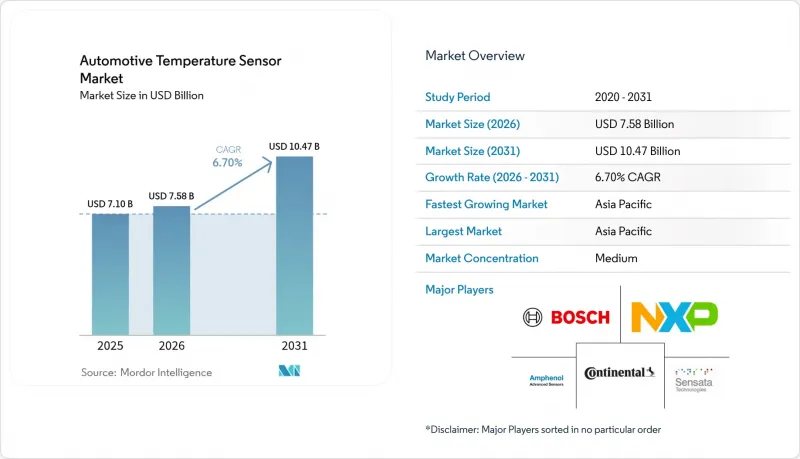
本報告按車輛類型(乘用車、輕型商用車等)、應用領域(動力傳動系統、車身電子設備、新能源汽車等)、感測器類型(熱敏電阻器、熱電偶等)、銷售管道(OEM原廠配套等)和地區進行細分。市場規模和預測均以美元計價。
全球汽車溫度感測器市場趨勢及洞察
SiC基電力電子技術的加速應用,對電動車逆變器的熱精度提出了更嚴格的要求。
碳化矽(SiC)開關使驅動模組能夠承受接近 600 度C的結溫,同時與矽相比,轉換效率提升 30%。因此,每個 SiC 半橋都整合了兩到三個額外的溫度感測點,以防止熱失控並最佳化 800V 快速充電期間的降額曲線。安森美半導體和其他供應商擴大晶圓代工廠規模,凸顯了熱數據對於閘極驅動校準和延長逆變器保固期的重要性。
區域架構ECU的快速普及推動了多點溫度監測的發展。
基於區域控制器的車載網路取代了數十個獨立的ECU,在密封鋁製外殼內減少了30%的佈線,同時提高了熱密度。設計人員現在透過本地I3C鏈路分發小型數位感測器,使韌體能夠即時平衡負載、風扇轉速和冗餘。在歐洲高階車型上的早期部署已證明了其在實際應用中的可靠性,基於這一成功,量產車領域的OEM廠商也計劃在2026年後採用這項技術。
由於一級供應商之間NTC熱敏電阻器的標準化,價格有所下降。
一級線束製造商已將其特性曲線在 1 kΩ 至 100 kΩ 範圍內的規格標準化。這使得批量採購成為可能,並帶來了每年 3% 至 5% 的價格下降。作為回應,熱敏電阻器專業供應商正將其生產轉向用於 250 度C溫度範圍的高價值環氧塗層熱敏電阻,並將市場重心轉移到內置校準表的數位IC等高價值產品,以確保利潤率。
細分市場分析
由於熱敏電阻成本低廉,且在冷卻液、空調系統和入門級電池模組中展現出可靠的性能,預計到2025年,熱敏電阻器仍將佔據汽車溫度感測器市場42.62%的佔有率。每輛純電動車(BEV)目前都整合了超過100個NTC元件,儘管單位成本有所下降,但基於熱敏電阻器電阻的汽車溫度感測器市場規模預計將穩定成長。傳統技術的這種既有地位,使得高階車型必須將NTC元件與基於區域的計算中心內的線性化演算法結合,以彌補精度上的不足。
到2031年,基於半導體的積體電路感測器將以8.66%的複合年成長率成長。 ±0.4 度C的精度和直接輸出至I3C/I2C介面簡化了狹小空間內的佈線,例如需要毫米級精度的輪轂馬達功率電子設備。隨著系統設計人員逐步淘汰笨重的補償表,汽車溫度感測器市場正受惠於性能和材料清單(BOM)效率的同步提升。儘管金屬價格波動,熱電阻(RTD)仍繼續應用於高精度排氣回饋迴路,而熱電偶則繼續整合到溫度超過900 度C的渦輪增壓器殼體中。
到2025年,乘用車將佔汽車總銷量的67.94%,繼續成為汽車溫度感測器市場的支柱。先進的高階車載舒適性演算法利用多個感測節點來控制微噴射系統、座椅加熱器和區域性空調通風口。大陸集團的工廠測試表明,在生產線上部署額外的熱診斷系統後,整體設備效率(OEE)提高了15%,這表明上游製造流程也是感測器的重要消耗環節。
純電動車(BEV)是成長最快的細分市場,複合年成長率(CAGR)高達10.12%。所有電池模組都配備了安裝在匯流排上的熱敏電阻器、嵌入電池極耳下方的薄膜熱電阻(RTD)以及用於非接觸式監測的紅外線晶片。這些技術使得汽車溫度感測器市場規模是混合動力汽車的兩倍。輕型商用電動貨車現在也配備了氣體排放檢測感測器,透過將預警數據傳輸到車輛管理儀錶板,將熱安全和資產運轉率指標連結起來。亞洲人口稠密的都市區的二輪車市場也在不斷擴張,這得益於抗震、緊湊型環氧樹脂封裝的NTC熱敏電阻。
區域分析
預計到2025年,亞太地區將佔據汽車溫度感測器市場41.12%的佔有率,這反映了其作為全球最大汽車生產中心的地位。中國汽車製造商計劃在2030年將先進電子元件的在地採購率從15%提高到60%,這將為國內熱敏電阻器和積體電路製造廠提供更多設計應用機會。日本和韓國繼續大力投資整合高密度感測陣列的固態電池試點項目,預計未來十年將進一步提升該地區對汽車溫度感測器市場規模的貢獻。
歐洲則位居第二,這得益於歐盟七國集團嚴格的法規,這些法規強制要求進行即時廢氣分析,以及高階車型強大的開發平臺,這些車型優先考慮提升車載空調性能。德國汽車製造商在採用基於區域的架構方面主導,每個新的控制器叢集都擁有獨立的晶片,分別用於環境溫度、基板邊緣和MOSFET背面,從而將需求分散到多個產品系列中。位於萊茵河地區的供應商正在透過推出鎳膜RTD生產線來應對鉑金供不應求,從而增強區域自主供應能力。
北美市場憑藉皮卡和SUV日益普及的碳化矽驅動模組(這些車輛通常需要800V驅動以牽引拖車)而保持強勁地位。針對本地電池製造的法律激勵措施正促使感測器採購轉向美國垂直整合的工廠。中東市場目前規模較小,但預計隨著配備冗餘溫度控管節點(用於保護計算叢集免受沙漠高溫影響)的L4級自動駕駛穿梭巴士在利雅得和杜拜等地建立的自動駕駛區域成為標配,該市場將實現9.03%的複合年成長率。南美洲市場的穩定成長與仍需廢氣感測器的靈活燃料動力傳動系統以及在巴西主要大都會圈運營的新興電動公車密切相關。
其他好處:
- Excel格式的市場預測(ME)表
- 3個月的分析師支持
目錄
第1章:引言
- 本研究的假設和市場定義;研究範圍
第2章:調查方法
第3章執行摘要
第4章 市場狀況
- 市場概覽
- 市場促進因素
- SiC 基電力電子裝置的應用正在加速,電動車逆變器對熱設計的精度要求也越來越嚴格。
- 區域架構ECU的快速普及推動了多點溫度監測技術的應用。
- 歐盟7國和中國的VI-b排放氣體法規要求安裝工作範圍更廣的廢氣溫度感知器。
- 固態電池組溫度控管的重要性
- 豪華汽車對車載健康感測器(透過 HVAC 系統監測空氣品質和座椅舒適度)的需求日益成長。
- 半導體封裝向汽車級晶圓級感測器的過渡
- 市場限制因素
- 由於一級供應商之間NTC熱敏電阻器的標準化,價格有所下降。
- 用於熱電阻器的高純度鎳和鉑的供應鏈波動性。
- 商用車輛車隊的低改裝率
- 低成本MEMS感測器的交叉靈敏度和漂移問題阻礙了其在售後市場的普及。
- 價值供應鏈分析
- 監理展望
- 技術展望
- 波特五力分析
- 投資分析
第5章 市場規模與成長預測
- 依感測器類型
- 熱敏電阻器(NTC/PTC)
- 電阻溫度檢測器(RTD)
- 熱電偶
- 基於半導體的積體電路感測器
- MEMS和紅外線感測器
- 車輛類型
- 搭乘用車
- 輕型商用車
- 大型商用車輛
- 摩托車和微型交通工具
- 透過使用
- 動力傳動系統(內燃機、混合動力)
- 電池和電力驅動系統
- 底盤和安全系統
- 車身及舒適性相關電子設備
- 遠端資訊處理和連接模組
- 按銷售管道
- 原廠正品零件
- 售後市場
- 按地區
- 北美洲
- 美國
- 加拿大
- 南美洲
- 巴西
- 阿根廷
- 歐洲
- 德國
- 法國
- 義大利
- 西班牙
- 英國
- 北歐的
- 其他歐洲國家
- 中東
- 波灣合作理事會(GCC)
- 土耳其
- 其他中東國家
- 非洲
- 南非
- 奈及利亞
- 其他非洲國家
- 亞太地區
- 中國
- 日本
- 印度
- 韓國
- ASEAN-5
- 其他亞太國家
- 北美洲
第6章 競爭情勢
- 市場集中度
- 策略趨勢
- 市佔率分析
- 公司簡介
- NXP Semiconductors NV
- Sensata Technologies, Inc.
- Amphenol Advanced Sensors
- Robert Bosch GmbH
- Continental AG
- Texas Instruments Inc.
- TE Connectivity Ltd.
- Panasonic Holdings Corp.
- Murata Manufacturing Co., Ltd.
- TDK Corporation
- Honeywell International Inc.
- Infineon Technologies AG
- STMicroelectronics NV
- Denso Corporation
- BorgWarner Inc.(Delphi Technologies)
- Vishay Intertechnology, Inc.
- Microchip Technology Inc.
- Analog Devices, Inc.
- Renesas Electronics Corporation
- Littelfuse, Inc.
第7章 市場機會與未來展望
According to Mordor Intelligence, the automotive temperature sensor market size was valued at USD 7.1 billion in 2025 and estimated to grow from USD 7.58 billion in 2026 to reach USD 10.47 billion by 2031, at a CAGR of 6.70% during the forecast period (2026-2031).
This report is Segmented by Vehicle Type (Passenger Cars, Light Commercial Vehicles, and More), Application (Powertrain, Body Electronics, Alternative Fuel Vehicles, and More), Sensor Type (Thermistor, Thermocouple, and More), Sales Channel(OEM-Fitted and More) and Geography. The Market Sizes and Forecasts are Provided in Terms of Value in (USD).
Global Automotive Temperature Sensor Market Trends and Insights
Accelerating Adoption of SiC-Based Power Electronics Intensifying Thermal Accuracy Requirements in EV Inverters
SiC switches enable drive modules to sustain junction temperatures near 600 °C while boosting conversion efficiency by 30% compared with silicon. Each SiC half-bridge therefore integrates two to three extra temperature sensing points to guard against thermal runaway and to optimise derating curves during 800 V fast charging. Foundry expansions at Onsemi and other suppliers underline how thermal data has become mission-critical for gate-drive calibration and extended inverter warranties.
Rapid Growth of Zonal-Architecture ECUs Driving Multi-Point Temperature Monitoring
Vehicle networks built on zone controllers replace dozens of standalone ECUs, trimming wiring mass by 30% yet raising heat density inside sealed aluminium housings. Designers now distribute small digital sensors on local I3C links so that firmware can balance load, fan speed and redundancy in real time. Early deployments across premium European platforms are demonstrating field reliability that is convincing volume-segment OEMs to transition from 2026 onward.
Price-Erosion from Standardisation of NTC Thermistors among Tier-1s
Tier-1 harness builders have harmonised specifications around 1 kΩ to 100 kΩ curves, allowing large volume buys that drive annual price concessions of 3%-5%. Pure-play thermistor vendors are responding by shifting output to higher-value epoxy--coated beads for 250 °C zones or by moving up-market into digital ICs that embed calibration tables to secure margins.
Other drivers and restraints analyzed in the detailed report include:
- EU7 and China VI-b Emission Norms Mandating Exhaust Gas Sensors with Wider Range
- Thermal Management Imperatives in Solid-State Battery Packs
- Supply-Chain Volatility of High-Purity Nickel & Platinum Used in RTDs
For complete list of drivers and restraints, kindly check the Table Of Contents.
Segment Analysis
Thermistors retained a 42.62% share of the automotive temperature sensor market in 2025 owing to their low cost and proven reliability in coolant, HVAC and entry-level battery modules. Each BEV already deploys more than 100 NTC elements, and the automotive temperature sensor market size attributable to thermistors is on course to rise steadily even as unit prices drift lower. The firm grip of this legacy technology has forced higher-end vehicles to pair NTCs with linearisation algorithms inside zonal compute hubs to reconcile accuracy gaps.
Semiconductor-based IC sensors are advancing at an 8.66% CAGR through 2031. Their +-0.4 °C accuracy and direct I3C/I^2C output simplify harnessing in confined zones such as in-wheel power electronics, where every millimetre counts. As system designers phase out bulky compensation tables, the automotive temperature sensor market benefits from simultaneous gains in performance and bill-of-materials efficiency. RTDs continue serving precision exhaust feedback loops despite metal volatility, while thermocouples stay embedded in turbo housings that exceed 900 °C.
Passenger cars commanded 67.94% of 2025 revenue and remain the anchor for the automotive temperature sensor market. Sophisticated cabin comfort algorithms in premium trims exploit multiple sensing nodes to modulate micro-jets, seat heaters and zoned HVAC louvers. Continental's factory trials reported a 15% uplift in overall equipment effectiveness after equipping production lines with additional thermal diagnostics - evidence that upstream manufacturing is also a consumption vector for sensors.
BEVs represent the fasting-growing cohort at a 10.12% CAGR. Every battery module clips thermistors to bus bars, embeds thin-film RTDs under cell tabs, and situates infrared die for non-contact monitoring-collectively doubling the automotive temperature sensor market size per vehicle relative to hybrids. Light commercial e-vans now integrate gas-generation detection sensors that relay early warning data to fleet dashboards, aligning thermal safety with asset-availability metrics. Two-wheelers in dense Asian cities add scale, leveraging compact, epoxy-sealed NTC beads resistant to vibration.
Complete Report Scope:
- By Sensor Type
- Thermistor (NTC/PTC)
- Resistance Temperature Detector (RTD)
- Thermocouple
- Semiconductor-Based IC Sensor
- MEMS and Infra-Red Sensor
- By Vehicle Type
- Passenger Cars
- Light Commercial Vehicles
- Heavy Commercial Vehicles
- Two-Wheelers and Micro-Mobility
- By Application
- Powertrain (ICE, Hybrid)
- Battery and Electric Drive-Train
- Chassis and Safety Systems
- Body and Comfort Electronics
- Telematics and Connectivity Modules
- By Sales Channel
- OEM-Fitted
- Aftermarket
- By Geography
- North America
- United States
- Canada
- South America
- Brazil
- Argentina
- Europe
- Germany
- France
- Italy
- Spain
- United Kingdom
- Nordics
- Rest of Europe
- Middle East
- Gulf Cooperation Council
- Turkey
- Rest of Middle East
- Africa
- South Africa
- Nigeria
- Rest of Africa
- Asia-Pacific
- China
- Japan
- India
- South Korea
- ASEAN-5
- Rest of Asia-Pacific
- North America
Geography Analysis
Asia-Pacific held 41.12% of automotive temperature sensor market share in 2025, reflecting its status as the world's largest vehicle production hub. Chinese assemblers are localising advanced electronic content from 15% to 60% by 2030, funnelling additional design-win opportunities to domestic thermistor and IC fabs. Japan and South Korea continue to invest heavily in solid-state battery pilots, which embed denser sensing arrays and lift the region's contribution to automotive temperature sensor market size through the decade.
Europe ranks second, propelled by stringent EU7 rules that require real-time exhaust gas analytics and by a strong premium vehicle pipeline that emphasises in-cabin climate refinement. German OEMs spearhead zonal architecture rollouts; each new controller cluster carries its own ambient, board-edge, and MOSFET backside die, spreading demand across multiple product families. Suppliers located near the Rhine valley are setting up nickel-film RTD lines to navigate platinum scarcity, reinforcing regional self-sufficiency.
North America maintains a robust position thanks to high uptake of SiC-based drive modules in pickup trucks and SUVs that favour 800 V propulsion for trailer towing. Legislative incentives for local battery manufacturing are steering sensor sourcing toward vertically integrated US facilities. The Middle East, although small today, is forecast to clock a 9.03% CAGR as purpose-built autonomous mobility zones in Riyadh and Dubai standardise L4 shuttles loaded with redundant thermal nodes to safeguard compute clusters against desert heat. South America's incremental growth is linked to flex-fuel powertrains that still need exhaust gas sensors alongside emergent electric buses operating in Brazilian megacities.
- NXP Semiconductors N.V.
- Sensata Technologies, Inc.
- Amphenol Advanced Sensors
- Robert Bosch GmbH
- Continental AG
- Texas Instruments Inc.
- TE Connectivity Ltd.
- Panasonic Holdings Corp.
- Murata Manufacturing Co., Ltd.
- TDK Corporation
- Honeywell International Inc.
- Infineon Technologies AG
- STMicroelectronics N.V.
- Denso Corporation
- BorgWarner Inc. (Delphi Technologies)
- Vishay Intertechnology, Inc.
- Microchip Technology Inc.
- Analog Devices, Inc.
- Renesas Electronics Corporation
- Littelfuse, Inc.
Additional Benefits:
- The market estimate (ME) sheet in Excel format
- 3 months of analyst support
TABLE OF CONTENTS
1 INTRODUCTION
- 1.1 Study Assumptions and Market Definition Scope of the Study
2 RESEARCH METHODOLOGY
3 EXECUTIVE SUMMARY
4 MARKET LANDSCAPE
- 4.1 Market Overview
- 4.2 Market Drivers
- 4.2.1 Accelerating Adoption of SiC-based Power Electronics Intensifying Thermal Accuracy Requirements in EV Inverters
- 4.2.2 Rapid Growth of Zonal-Architecture ECUs Driving Multi-Point Temperature Monitoring
- 4.2.3 EU7 and China VI-b Emission Norms Mandating Exhaust Gas Temperature Sensors with Wider Operating Range
- 4.2.4 Thermal Management Imperatives in Solid-State Battery Packs
- 4.2.5 Rising Demand for Cabin Health Sensors (HVAC Air Quality and Seat Comfort) in Premium Vehicles
- 4.2.6 Semiconductor Packaging Shift to Automotive-Grade Wafer-Level Sensors
- 4.3 Market Restraints
- 4.3.1 Price-Erosion from Standardization of NTC Thermistors among Tier-1s
- 4.3.2 Supply-Chain Volatility of High-Purity Nickel and Platinum Used in RTDs
- 4.3.3 Slow Retrofit Rates in Commercial Vehicle Fleets
- 4.3.4 Cross-Sensitivity and Drift Issues in Low-Cost MEMS Sensors Limiting Aftermarket Adoption
- 4.4 Value / Supply-Chain Analysis
- 4.5 Regulatory Outlook
- 4.6 Technological Outlook
- 4.7 Porter's Five Forces Analysis
- 4.7.1 Threat of New Entrants
- 4.7.2 Bargaining Power of Buyers
- 4.7.3 Bargaining Power of Suppliers
- 4.7.4 Threat of Substitutes
- 4.7.5 Competitive Rivalry
- 4.8 Investment Analysis
5 MARKET SIZE AND GROWTH FORECASTS (VALUE)
- 5.1 By Sensor Type
- 5.1.1 Thermistor (NTC/PTC)
- 5.1.2 Resistance Temperature Detector (RTD)
- 5.1.3 Thermocouple
- 5.1.4 Semiconductor-Based IC Sensor
- 5.1.5 MEMS and Infra-Red Sensor
- 5.2 By Vehicle Type
- 5.2.1 Passenger Cars
- 5.2.2 Light Commercial Vehicles
- 5.2.3 Heavy Commercial Vehicles
- 5.2.4 Two-Wheelers and Micro-Mobility
- 5.3 By Application
- 5.3.1 Powertrain (ICE, Hybrid)
- 5.3.2 Battery and Electric Drive-Train
- 5.3.3 Chassis and Safety Systems
- 5.3.4 Body and Comfort Electronics
- 5.3.5 Telematics and Connectivity Modules
- 5.4 By Sales Channel
- 5.4.1 OEM-Fitted
- 5.4.2 Aftermarket
- 5.5 By Geography
- 5.5.1 North America
- 5.5.1.1 United States
- 5.5.1.2 Canada
- 5.5.2 South America
- 5.5.2.1 Brazil
- 5.5.2.2 Argentina
- 5.5.3 Europe
- 5.5.3.1 Germany
- 5.5.3.2 France
- 5.5.3.3 Italy
- 5.5.3.4 Spain
- 5.5.3.5 United Kingdom
- 5.5.3.6 Nordics
- 5.5.3.7 Rest of Europe
- 5.5.4 Middle East
- 5.5.4.1 Gulf Cooperation Council
- 5.5.4.2 Turkey
- 5.5.4.3 Rest of Middle East
- 5.5.5 Africa
- 5.5.5.1 South Africa
- 5.5.5.2 Nigeria
- 5.5.5.3 Rest of Africa
- 5.5.6 Asia-Pacific
- 5.5.6.1 China
- 5.5.6.2 Japan
- 5.5.6.3 India
- 5.5.6.4 South Korea
- 5.5.6.5 ASEAN-5
- 5.5.6.6 Rest of Asia-Pacific
- 5.5.1 North America
6 COMPETITIVE LANDSCAPE
- 6.1 Market Concentration
- 6.2 Strategic Moves
- 6.3 Market Share Analysis
- 6.4 Company Profiles {(includes Global level Overview, Market level overview, Core Segments, Financials as available, Strategic Information, Market Rank/Share for key companies, Products and Services, and Recent Developments)}
- 6.4.1 NXP Semiconductors N.V.
- 6.4.2 Sensata Technologies, Inc.
- 6.4.3 Amphenol Advanced Sensors
- 6.4.4 Robert Bosch GmbH
- 6.4.5 Continental AG
- 6.4.6 Texas Instruments Inc.
- 6.4.7 TE Connectivity Ltd.
- 6.4.8 Panasonic Holdings Corp.
- 6.4.9 Murata Manufacturing Co., Ltd.
- 6.4.10 TDK Corporation
- 6.4.11 Honeywell International Inc.
- 6.4.12 Infineon Technologies AG
- 6.4.13 STMicroelectronics N.V.
- 6.4.14 Denso Corporation
- 6.4.15 BorgWarner Inc. (Delphi Technologies)
- 6.4.16 Vishay Intertechnology, Inc.
- 6.4.17 Microchip Technology Inc.
- 6.4.18 Analog Devices, Inc.
- 6.4.19 Renesas Electronics Corporation
- 6.4.20 Littelfuse, Inc.
7 MARKET OPPORTUNITIES AND FUTURE OUTLOOK
- 7.1 White-Space and Unmet-Need Assessment

 2026年全球汽車溫度感測器市場報告
 汽車溫度感測器市場:產品類型、技術、應用、銷售管道、最終用途-2026-2032年全球市場預測2026年全球汽車溫度感測器市場報告
 汽車溫度感測器市場規模、佔有率、成長及全球產業分析:按類型、應用和地區的洞察,2026-2034年預測環境空氣溫度感測器市場:按感測器類型、技術、應用、終端用戶產業和分銷管道分類-2026-2032年全球預測
 汽車溫度感測器市場規模、佔有率及成長分析(按產品類型、車輛類型、應用和地區分類)-2026-2033年產業預測
 汽車溫度感測器市場-全球產業規模、佔有率、趨勢、機會和預測(按車輛類型、應用、地區和競爭格局分類,2020-2030 年)
 汽車用溫度感測器的全球市場:車輛類別,各元件類型,應用類別,各地區,機會,預測,2018年~2032年汽車溫度感測器市場(按類型、應用、車輛類型和地區劃分),2024 年至 2031 年