


 |
市場調查報告書
商品編碼
2121506
電子簽章:市場佔有率分析、產業趨勢與統計、成長預測(2026-2031)Digital Signatures - Market Share Analysis, Industry Trends & Statistics, Growth Forecasts (2026 - 2031) |
||||||

※ 本網頁內容可能與最新版本有所差異。詳細情況請與我們聯繫。
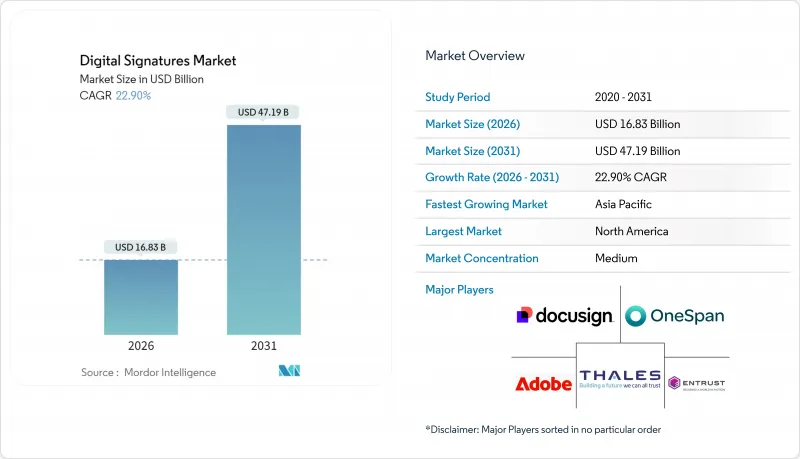
預計到 2026 年,電子簽章市場規模將達到 168.3 億美元,到 2031 年將達到 471.9 億美元,2026 年至 2031 年的複合年成長率為 22.90%。
本報告按部署類型(本地部署和雲端部署)、交付類型(軟體、硬體和服務)、最終用戶產業(銀行、金融服務和保險、政府、醫療保健、石油和天然氣、軍事和國防、物流和運輸等)、簽章類型(基本電子簽章、高階電子簽章等)以及地區進行細分。市場預測以美元計價。
全球電子簽章市場趨勢與洞察
加速歐盟合格電子簽章(eIDAS 2.0)合規要求的實施
eIDAS 2.0 的分階段實施正迫使歐盟各地的公司採用合格的電子簽章,這種電子簽名在所有司法管轄區都具有與手寫簽名相同的法律效力。實施條例 2025/1569 對加密演算法和審計要求進行了規範,導致合格證書的簽發量激增,2025 年上半年同比成長 340%。公證處、土地登記處和政府採購入口網站正在適應新的規範,迫使傳統的認證機構在現代化或退出市場之間做出選擇。該條例的域外適用性在杜拜國際金融中心 (DIFC) 也顯而易見,該中心正在修訂其《電子交易法》以符合 eIDAS 的要求,這表明電子簽名市場正朝著協調統一的方向發展,這將重振電子簽章市場。
亞太地區公共部門工作流程的大規模數位化項目
在印度,2024年透過「電子簽名」(eSign)框架處理了12億份經Aadhaar認證的簽名,增幅高達68%,其影響波及銀行和車輛登記等領域。新加坡的「Singpass簽名」系統預計到2025年中期將在所有機構中實現95%的普及率,屆時公共住宅的核准週期將從五天縮短至不到兩小時。澳洲的「數位身分」(Digital ID)系統於2024年11月正式上線,預計在未來十年內節省114億澳元(約76億美元)。這些項目正在建構一個可供私人企業利用的國家級信任基礎設施,加速網路效應的發揮,並提升電子簽章市場的標準。
各國不同的資料本地化法規阻礙了跨境效率的提升。
中國2024年修訂的《網路安全法》規定,所有簽章金鑰和日誌必須儲存在國內,這阻礙了跨國雲端服務供應商在全部區域提供統一的服務。在印度,所有提交給政府機構的文件都必須使用國內頒發的證書,這導致企業簽署公共和私人合約的工作流程被分割。巴西的《個人資料保護法》(LGPD)對金鑰是否構成敏感資料存在不確定性,迫使企業為每個子公司部署獨立的簽章系統。這些重疊的法規增加了合規成本,減緩了中型企業採用電子簽名的速度,並降低了全球電子簽章市場的複合年成長率。
細分市場分析
到2025年,雲端採用將佔電子簽章市場佔有率的66.22%,預計到2031年,該細分市場將以25.66%的複合年成長率成長。這是因為企業更傾向於採用多租戶平台,以便將單次簽章成本控制在0.10美元以下。微軟決定向Microsoft 365 E5用戶免費提供簽章功能,加速了這項轉型,並抑制了供應商數量的激增。受雲端工作流程驅動的電子簽章市場規模在受監管產業中成長最為迅速,這些產業目前正積極採用ISO/IEC 27001認證的外包服務。
儘管本地部署解決方案對於空氣間隙的安全網路仍然至關重要,但混合模式也正在興起。醫院透過將患者密鑰儲存在醫院內部,同時透過雲端協調器處理供應商契約,從而將處理時間從幾天縮短到幾小時。邊緣部署(即物聯網閘道離線檢驗韌體簽章)在海上能源供應商中越來越受歡迎。這些細微的趨勢凸顯了電子簽章市場為何在雲端運算推動整體成長的同時,仍保持多元化的特徵。
儘管到2025年軟體仍將佔據電子簽章市場78.44%的佔有率,但隨著企業面臨整合舊有系統的挑戰,服務領域正以24.76%的複合年成長率快速擴張。包括託管PKI、合規諮詢和用戶培訓在內的配套服務彌補了軟體本身無法解決的不足。 OneSpan專業服務營收年增32%,也反映了這項轉變。
由於合格簽名需要防篡改模組,硬體支出已趨於平穩,但通用型USB Token以低於 20 美元的價格支援高級簽名工作流程。培訓和變更管理計劃減輕了實施合格簽名相關的服務台負擔,並支持基於結果的參與模式。隨著企業越來越傾向於尋求承包解決方案而非許可證,預計服務領域在推動電子簽章市場整體成長方面將優於軟體領域。
區域分析
北美地區擁有成熟的《電子簽名法案》(ESIGN Act)和眾多主要供應商,預計到2025年將佔據全球電子簽章市場40.12%的佔有率。加拿大金融機構預測,到2025年,84%的房屋抵押貸款申請將使用電子簽章;而在墨西哥,2024年的法律改革已推動公證流程在線化。法院強制執行的確定性以及豐富的供應商選擇,使得金融科技、醫療保健和房地產行業的交易量保持強勁成長。
亞太地區是成長最快的地區,到2031年複合年成長率將達到23.22%。印度的「電子簽章簽名」(eSign)系統將在2025年前處理76%的車輛所有權轉移,使其應用範圍擴展到銀行業以外。新加坡政府機構的近乎全面採用以及澳洲全國性的數位身分計畫表明,公共部門的主導能夠迅速刺激私營部門的需求。中國嚴格的數據本地化法規雖然減緩了外國雲端供應商的進入,但也促進了能夠滿足本地數據居住要求的國內領先企業的成長。在日本,2024年通過的法律修正案使得出口文件的數位化成為可能,從而推動了製造業對電子簽名的應用。
歐洲的電子簽名市場格局正日趨複雜。 eIDAS 2.0 強制要求歐盟範圍內相互承認合格的電子簽名,到 2025 年,僅德國就已簽發了 230 萬份電子載貨證券證書。英國脫歐後,已根據 2024 年的法規批准了電子提單,加速了貿易融資的數位化進程。法國在 2025 年實施了更嚴格的審計規則,並將認可的信任服務供應商數量減少至 12 家,導致市場佔有率更加集中於主要參與者手中。中東和非洲等小規模的地區也受益於符合歐盟標準的框架,例如巴西的 ICP-Brasil 為整個南美洲的合格稅務申報提供支援。這些區域性的發展趨勢共同凸顯了電子簽章市場的全球擴張。
其他好處:
- Excel格式的市場預測(ME)表
- 3個月的分析師支持
目錄
第1章:引言
- 研究假設和市場定義
- 調查範圍
第2章:調查方法
- 研究框架
- 第二次調查
- 初步調查
- 數據三角測量與洞察生成
第3章執行摘要
第4章 市場狀況
- 市場概覽
- 市場促進因素
- 加速歐盟合格電子簽章合規要求(eIDAS 2.0)
- 亞太地區公共部門工作流程的大規模數位化計畫。
- 電子簽章API 整合到企業級 SaaS 套件(Microsoft 365、Salesforce)中
- 後量子密碼證書堆疊的更新周期
- 推廣基於ESG原則的無紙化交易,並減少範圍3的碳排放。
- 物聯網設備韌體更新中嵌入的電子簽章
- 市場限制因素
- 各國資料本地化法規阻礙了跨境效率的提高。
- 在碎片化的世界中,信任服務認證
- 低頻寬行動網路上生物識別的使用者體驗挑戰
- 對於中小企業而言,基於 HSM 的合格簽名成本高昂。
- 產業價值鏈分析
- 監理展望
- 技術展望
- 宏觀經濟因素對市場的影響
- 波特五力分析
第5章 市場規模與成長預測
- 不同的發展
- 現場
- 雲
- 報價
- 軟體
- 硬體
- 服務
- 按簽名類型
- 基本電子簽章
- 高級電子簽章
- 合格的電子簽章
- 按最終用戶行業分類
- BFSI
- 政府
- 衛生保健
- 石油和天然氣
- 軍事/國防
- 物流/運輸
- 其他終端用戶產業(研究和教育、房地產、製造業、法律、IT和電信)
- 按地區
- 北美洲
- 美國
- 加拿大
- 墨西哥
- 南美洲
- 巴西
- 阿根廷
- 智利
- 秘魯
- 其他南美國家
- 歐洲
- 德國
- 英國
- 法國
- 義大利
- 西班牙
- 其他歐洲國家
- 亞太地區
- 中國
- 日本
- 韓國
- 印度
- 澳洲
- 紐西蘭
- 其他亞太國家
- 中東
- 阿拉伯聯合大公國
- 沙烏地阿拉伯
- 土耳其
- 非洲
- 南非
- 肯亞
- 奈及利亞
- 其他非洲國家
- 北美洲
第6章 競爭情勢
- 市場集中度
- Strategic Developments
- 市佔率分析
- Vendor Positioning Analysis
- 公司簡介
- DocuSign Inc.
- Adobe Inc.(Adobe Sign)
- OneSpan Inc.
- Thales Group(SafeNet)
- Entrust Corporation
- Nitro Software Ltd.
- airSlate Inc.(SignNow)
- Dropbox Inc.(HelloSign)
- Box Inc.(SignRequest)
- SIGNiX Inc.
- Ascertia Limited
- GlobalSign GMO
- Signeasy
- PandaDoc Inc.
- RPost Communications Ltd.
- CertiSign Certificadora Digital SA
- Kofax Ltd.
- DigiCert Inc.
- Signicat AS
- Zoho Corporation Pvt. Ltd.(Zoho Sign)
- eMudhra Ltd.
- Namirial SpA
第7章 市場機會與未來展望
According to Mordor Intelligence, the digital signatures market size is USD 16.83 billion in 2026 and is forecast to reach USD 47.19 billion by 2031, expanding at a 22.90% CAGR during 2026-2031.
This report is Segmented by Deployment (On-Premise, and Cloud), Offering (Software, Hardware, and Services), End-User Industry (BFSI, Government, Healthcare, Oil and Gas, Military and Defense, Logistics and Transportation, and More), Signature Type (Basic Electronic Signatures, Advanced Electronic Signatures, and More), and Geography. The Market Forecasts are Provided in Terms of Value (USD).
Global Digital Signatures Market Trends and Insights
Accelerated Compliance Mandates For Qualified E-Signatures In EU (eIDAS 2.0)
The phased rollout of eIDAS 2.0 is forcing enterprises to adopt qualified electronic signatures that carry the same legal weight as handwritten ink across all EU jurisdictions. Implementing Regulation 2025/1569 spells out cryptographic algorithms and audit requirements, prompting a surge in qualified certificate issuance that climbed 340% year-over-year in H1 2025. Notaries, land registries, and government procurement portals are aligning on the new specifications, compressing timelines for legacy certificate authorities to modernize or exit. The regulation's extraterritorial pull is visible in Dubai International Financial Centre, which amended its Electronic Transactions Law to mirror eIDAS requirements, signaling a broader harmonization trend that stimulates the digital signatures market.
Mega-Scale Digitization Programs In Asia Pacific Public-Sector Workflows
India processed 1.2 billion Aadhaar-authenticated signatures in 2024 under its eSign framework, a 68% jump that spilled into banking and vehicle registration use cases. Singapore's Sign with Singpass had reached 95% adoption across agencies by mid-2025, cutting approval cycles for public housing from five days to less than two hours. Australia's Digital Identity system, live since November 2024, is projected to save AUD 11.4 billion (USD 7.6 billion) over 10 years. These programs establish national trust infrastructures that private firms can tap, accelerating network effects and raising the floor for the digital signatures market.
Country-Specific Data-Localization Rules Hindering Cross-Border Validity
China's 2024 Cybersecurity Law revision forces all signature keys and logs to stay onshore, blocking multinational clouds from offering unified services across Asia Pacific. India mandates domestic certificates for any document addressed to government entities, fragmenting workflows for firms signing both public and private contracts. Brazil's LGPD raises uncertainty around whether keys constitute sensitive data, pushing firms to host separate signature stacks for subsidiaries. These overlapping rules inflate compliance costs and slow adoption among mid-market firms, moderating the global CAGR of the digital signatures market.
Other drivers and restraints analyzed in the detailed report include:
- Embedded E-Signature APIs In Enterprise SaaS Suites
- Renewal Cycle Toward Post-Quantum Cryptography Certificate Stacks
- Fragmented Global Trust-Service Accreditation Regimes
For complete list of drivers and restraints, kindly check the Table Of Contents.
Segment Analysis
Cloud deployments accounted for 66.22% of the digital signatures market share in 2025, and the segment is projected to grow at a 25.66% CAGR to 2031 as firms favor multi-tenant platforms that keep per-signature costs below USD 0.10. Microsoft's decision to include signatures at no extra charge for Microsoft 365 E5 subscribers accelerated migration and reduced vendor sprawl. The digital signatures market size attributable to cloud workflows is expanding fastest in regulated industries that now accept ISO/IEC 27001-certified outsourcing.
While on-premise remains important for air-gapped defense networks, hybrid models are emerging. Hospitals hold patient keys on-site yet route vendor contracts through cloud-based orchestrators, compressing turnaround from days to hours. Edge deployments, where IoT gateways validate firmware signatures offline, are gaining traction among offshore energy operators. These nuanced patterns underscore why the digital signatures market retains diversity even as cloud dominates overall growth.
Software still captured 78.44% of the 2025 digital signatures market size, but services are expanding at a 24.76% CAGR as firms confront legacy integrations. Managed PKI, compliance consulting, and user-training bundles address gaps that pure software cannot. OneSpan's professional-services revenue jumped 32% year-over-year, reflecting this pivot.
Hardware spends remain steady because qualified signatures require tamper-resistant modules, yet commoditized USB tokens serve advanced-signature workflows at sub-USD 20 price points. Training and change-management programs reduce help-desk load for qualified signature rollouts, supporting outcome-based engagement models. As enterprises demand turnkey solutions rather than licenses, the services segment will outpace software in contribution to overall digital signatures market growth.
Complete Report Scope:
- By Deployment
- On-Premise
- Cloud
- By Offering
- Software
- Hardware
- Services
- By Signature Type
- Basic Electronic Signatures
- Advanced Electronic Signatures
- Qualified Electronic Signatures
- By End-User Industry
- BFSI
- Government
- Healthcare
- Oil and Gas
- Military and Defense
- Logistics and Transportation
- Other End-User Industries (Research and Education, Real Estate, Manufacturing, Legal, IT and Telecom)
- By Geography
- North America
- United States
- Canada
- Mexico
- South America
- Brazil
- Argentina
- Chile
- Peru
- Rest of South America
- Europe
- Germany
- United Kingdom
- France
- Italy
- Spain
- Rest of Europe
- Asia Pacific
- China
- Japan
- South Korea
- India
- Australia
- New Zealand
- Rest of Asia Pacific
- Middle East
- United Arab Emirates
- Saudi Arabia
- Turkey
- Africa
- South Africa
- Kenya
- Nigeria
- Rest of Africa
- North America
Geography Analysis
North America accounted for 40.12% of the digital signatures market in 2025, buoyed by the mature ESIGN Act and concentration of major vendors. Canadian lenders report that 84% of mortgage applications used electronic signatures in 2025, while Mexico's 2024 code amendment has pushed notarial acts online. Court enforcement certainty and abundant vendor choice sustain robust transaction volumes across fintech, healthcare, and real estate.
Asia Pacific is the fastest-growing region with a 23.22% CAGR to 2031. India's eSign handled 76% of vehicle transfers through digital signatures in 2025, extending reach beyond banking. Singapore's near-universal government adoption and Australia's national digital identity scheme prove public-sector leadership can jump-start private demand. China's tight data-localization rules slow foreign cloud vendors but foster domestic champions that satisfy local residency mandates. Japan's 2024 legal update unlocked export-documentation digitization, lifting usage among manufacturers.
Europe shows complex dynamics. eIDAS 2.0 mandates pan-EU recognition of qualified signatures, and Germany alone issued 2.3 million certificates in 2025. The United Kingdom, outside the EU, recognizes electronic bills of lading under its 2024 regulations, spurring trade-finance digitization. France reduced accredited trust providers to 12 under stricter 2025 audit rules, consolidating share among larger players. Smaller regions such as the Middle East and Africa benefit from EU-aligned frameworks, and Brazil's ICP-Brasil underpins qualified tax filings across South America. Together these regional trends underscore the global breadth of the digital signatures market.
- DocuSign Inc.
- Adobe Inc. (Adobe Sign)
- OneSpan Inc.
- Thales Group (SafeNet)
- Entrust Corporation
- Nitro Software Ltd.
- airSlate Inc. (SignNow)
- Dropbox Inc. (HelloSign)
- Box Inc. (SignRequest)
- SIGNiX Inc.
- Ascertia Limited
- GlobalSign GMO
- Signeasy
- PandaDoc Inc.
- RPost Communications Ltd.
- CertiSign Certificadora Digital S.A.
- Kofax Ltd.
- DigiCert Inc.
- Signicat AS
- Zoho Corporation Pvt. Ltd. (Zoho Sign)
- eMudhra Ltd.
- Namirial S.p.A.
Additional Benefits:
- The market estimate (ME) sheet in Excel format
- 3 months of analyst support
TABLE OF CONTENTS
1 INTRODUCTION
- 1.1 Study Assumptions and Market Definition
- 1.2 Scope of the Study
2 RESEARCH METHODOLOGY
- 2.1 Research Framework
- 2.2 Secondary Research
- 2.3 Primary Research
- 2.4 Data Triangulation and Insight Generation
3 EXECUTIVE SUMMARY
4 MARKET LANDSCAPE
- 4.1 Market Overview
- 4.2 Market Drivers
- 4.2.1 Accelerated Compliance Mandates for Qualified E-Signatures in EU (eIDAS 2.0)
- 4.2.2 Mega-Scale Digitisation Programmes in Asia Pacific Public Sector Workflows
- 4.2.3 Embedded E-Signature APIs in Enterprise SaaS Suites (Microsoft 365, Salesforce)
- 4.2.4 Renewal Cycle Toward Post-Quantum Cryptography Certificate Stacks
- 4.2.5 ESG-Linked Push for Paperless Transactions and Scope-3 Carbon Reduction
- 4.2.6 Digital Signatures Embedded in IoT Device Firmware Updates
- 4.3 Market Restraints
- 4.3.1 Country-Specific Data-Localisation Rules Hindering Cross-Border Validity
- 4.3.2 Fragmented Global Trust-Service Accreditation Regimes
- 4.3.3 UX Gaps for Biometric Signatures on Low-Bandwidth Mobile Networks
- 4.3.4 High Cost of HSM-Backed Qualified Signatures for SMBs
- 4.4 Industry Value Chain Analysis
- 4.5 Regulatory Outlook
- 4.6 Technological Outlook
- 4.7 Impact of Macroeconomic Factors on the Market
- 4.8 Porter's Five Forces Analysis
- 4.8.1 Bargaining Power of Suppliers
- 4.8.2 Bargaining Power of Buyers
- 4.8.3 Threat of New Entrants
- 4.8.4 Threat of Substitute Products
- 4.8.5 Intensity of Competitive Rivalry
5 MARKET SIZE AND GROWTH FORECASTS (VALUE)
- 5.1 By Deployment
- 5.1.1 On-Premise
- 5.1.2 Cloud
- 5.2 By Offering
- 5.2.1 Software
- 5.2.2 Hardware
- 5.2.3 Services
- 5.3 By Signature Type
- 5.3.1 Basic Electronic Signatures
- 5.3.2 Advanced Electronic Signatures
- 5.3.3 Qualified Electronic Signatures
- 5.4 By End-User Industry
- 5.4.1 BFSI
- 5.4.2 Government
- 5.4.3 Healthcare
- 5.4.4 Oil and Gas
- 5.4.5 Military and Defense
- 5.4.6 Logistics and Transportation
- 5.4.7 Other End-User Industries (Research and Education, Real Estate, Manufacturing, Legal, IT and Telecom)
- 5.5 By Geography
- 5.5.1 North America
- 5.5.1.1 United States
- 5.5.1.2 Canada
- 5.5.1.3 Mexico
- 5.5.2 South America
- 5.5.2.1 Brazil
- 5.5.2.2 Argentina
- 5.5.2.3 Chile
- 5.5.2.4 Peru
- 5.5.2.5 Rest of South America
- 5.5.3 Europe
- 5.5.3.1 Germany
- 5.5.3.2 United Kingdom
- 5.5.3.3 France
- 5.5.3.4 Italy
- 5.5.3.5 Spain
- 5.5.3.6 Rest of Europe
- 5.5.4 Asia Pacific
- 5.5.4.1 China
- 5.5.4.2 Japan
- 5.5.4.3 South Korea
- 5.5.4.4 India
- 5.5.4.5 Australia
- 5.5.4.6 New Zealand
- 5.5.4.7 Rest of Asia Pacific
- 5.5.5 Middle East
- 5.5.5.1 United Arab Emirates
- 5.5.5.2 Saudi Arabia
- 5.5.5.3 Turkey
- 5.5.6 Africa
- 5.5.6.1 South Africa
- 5.5.6.2 Kenya
- 5.5.6.3 Nigeria
- 5.5.6.4 Rest of Africa
- 5.5.1 North America
6 COMPETITIVE LANDSCAPE
- 6.1 Market Concentration
- 6.2 Strategic Developments
- 6.3 Market Share Analysis
- 6.4 Vendor Positioning Analysis
- 6.5 Company Profiles (Includes Global Level Overview, Market Level Overview, Core Segments, Financials as Available, Strategic Information, Market Rank/Share for Key Companies, Products and Services, and Recent Developments)
- 6.5.1 DocuSign Inc.
- 6.5.2 Adobe Inc. (Adobe Sign)
- 6.5.3 OneSpan Inc.
- 6.5.4 Thales Group (SafeNet)
- 6.5.5 Entrust Corporation
- 6.5.6 Nitro Software Ltd.
- 6.5.7 airSlate Inc. (SignNow)
- 6.5.8 Dropbox Inc. (HelloSign)
- 6.5.9 Box Inc. (SignRequest)
- 6.5.10 SIGNiX Inc.
- 6.5.11 Ascertia Limited
- 6.5.12 GlobalSign GMO
- 6.5.13 Signeasy
- 6.5.14 PandaDoc Inc.
- 6.5.15 RPost Communications Ltd.
- 6.5.16 CertiSign Certificadora Digital S.A.
- 6.5.17 Kofax Ltd.
- 6.5.18 DigiCert Inc.
- 6.5.19 Signicat AS
- 6.5.20 Zoho Corporation Pvt. Ltd. (Zoho Sign)
- 6.5.21 eMudhra Ltd.
- 6.5.22 Namirial S.p.A.
7 MARKET OPPORTUNITIES AND FUTURE OUTLOOK
- 7.1 White-Space and Unmet-Need Assessment

 全球數位簽章市場規模、佔有率、趨勢和成長分析報告(2026-2034年)
 數位簽章市場:按類型、組件、金鑰類型、組織規模和最終用戶分類-2026-2032年全球市場預測
 數位簽章軟體市場:按組件、最終用戶、行業和地區分類電子認證市場:按組件、技術、認證方式、部署方式和最終用戶分類-2026-2032年全球市場預測
 2026年全球數位簽章市場報告
 數位簽章市場分析及預測(至2035年):依類型、產品類型、服務、技術、組件、應用、流程、部署類型、最終使用者及解決方案分類
 數位簽章市場規模、佔有率和趨勢分析報告:按組件、等級、部署模式、最終用途、產業、地區和細分市場預測(2026-2033 年)全球數位簽章市場:市場規模、佔有率、成長、依類型和應用劃分的產業分析、區域洞察及預測(2026-2034)
 數位簽章市場 - 全球產業規模、佔有率、趨勢、機會和預測(2021-2031 年)(按組件、部署類型、最終用戶、地區和競爭格局分類)數位簽章解決方案市場-全球產業規模、佔有率、趨勢、機會、預測:按組件、部署、應用、技術、地區和競爭格局分類,2021-2031年