


 |
市場調查報告書
商品編碼
2121495
特種功能聚合物:市場佔有率分析、產業趨勢與統計、成長預測(2026-2031)Specialty Polymers - Market Share Analysis, Industry Trends & Statistics, Growth Forecasts (2026 - 2031) |
||||||

※ 本網頁內容可能與最新版本有所差異。詳細情況請與我們聯繫。
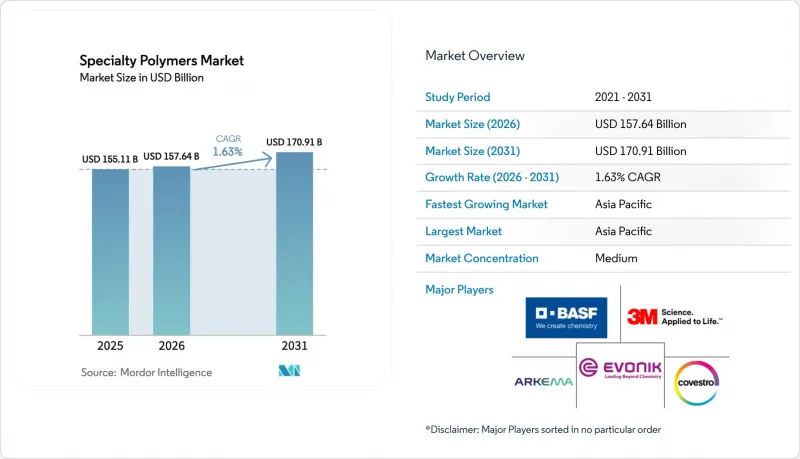
預計特種功能聚合物市場將從 2025 年的 1,551.1 億美元成長到 2026 年的 1,576.4 億美元,到 2031 年達到 1,709.1 億美元,2026 年至 2031 年的複合年成長率為 1.63%。
本報告按類型(特殊彈性體、特殊複合材料、特殊熱塑性塑膠、特殊熱固性樹脂及其他)、終端用戶產業(汽車及交通運輸、消費品、建築及施工等)及地區(亞太、北美、歐洲、南美、中東及非洲)進行細分。市場預測以美元計價。
全球特種功能聚合物市場趨勢及洞察
汽車和航太領域對輕量化的需求
隨著燃油效率和排放氣體法規日益嚴格,汽車製造商和飛機製造商正透過用結構碳纖維複合材料和玻璃纖維增強熱塑性塑膠取代鋼和鋁來減輕重量,從而在不影響碰撞性能的前提下,將重量減輕30%至50%。波音787夢幻客機大量使用複合材料,與鋁製前代機型相比,燃油消耗降低了20%,這充分證明了其聚合物基體的有效性,該基體可承受6萬次加壓循環。在電動車電池組中,阻燃聚碳酸酯和聚醯胺6,6的使用日益增多,以實現400英里的續航里程,同時滿足UL 94 V-0標準。美國能源局已撥款2億美元,旨在2025年將碳纖維的成本降低到每公斤10美元以下。這被認為是碳纖維在汽車量產市場普及應用的關鍵閾值。
在建築和電子產業中不斷拓展應用。
玻璃化轉變溫度超過 400 度C的聚醯亞胺薄膜正在取代環氧樹脂層壓板,用於 5G 基地台電路基板,從而確保 28 GHz 頻段的訊號完整性。預計到 2025 年底,中國將擁有超過 360 萬個 5G 基站,將持續推動對低損耗液晶聚合物和含氟聚合物的需求。在建築領域,更新後的國際節能標準 (IECC) 強制要求使用每英吋 R-6.5 隔熱值的噴塗聚氨酯泡棉隔熱材料,從而將建築能耗降低高達 40%。德國已累計15 億歐元,計劃在 2025 年以高性能聚合物隔熱材料維修商業建築的外牆。
原物料價格波動
2024年至2025年間,布蘭特原油價格在每桶70美元至90美元之間波動,亨利樞紐天然氣價格在每百萬英熱單位2.50美元至4.20美元之間波動,導致乙烯和丙烯成本波動幅度達35%。依賴與布蘭特原油價格掛鉤的石腦油的歐洲生產商,與美國頁岩氣生產商相比,面臨每噸超過400美元的現金成本劣勢,這給其利潤率帶來了壓力。BASF估計,如果油價上漲延遲,原油價格每上漲10美元,特種功能聚合物的營業利潤率將下降約150個基點。規模小規模的複合材料生產商缺乏有效對沖的規模,因此現貨價格飆升時,長期合約風險較高。
細分市場分析
到2025年,特種熱塑性塑膠將佔總銷售額的38.46%,反映出它們在汽車引擎室、半導體濕式工作台和一次性醫療設備機殼等領域的強勢地位。 PEEK、PPS和液晶聚合物符合通用樹脂無法達到的耐熱性和耐化學性標準,因此能夠維持較高的價格溢價和超過20%的營業利潤率。特種複合材料雖然絕對規模較小,但到2031年將以6.28%的複合年成長率成長,這主要得益於航太和離岸風力發電領域對碳纖維增強聚合物的日益普及,這些聚合物的拉伸強度超過600兆帕,能夠承受1000萬次疲勞循環。儘管每磅材料成本較高,但複合材料的價值正透過其在A350 XWB、787和未來窄體飛機等項目中的應用得到體現,因為它們可以降低飛機20%至25%的燃油提案。
熱固性聚合物在印刷電路基板和結構性黏著劑領域仍發揮重要作用,但其成長率低於市場平均值。這是因為交聯網路為滿足歐盟和美國汽車法規規定的回收目標帶來了挑戰。因此,隨著原始設備製造商 (OEM) 仔細審查報廢處置途徑,熱固性聚合物中特種功能聚合物的市場規模落後於複合材料的複合年成長率 (CAGR)。特種彈性體佔據著盈利的細分市場,例如電動車電池密封件和半導體晶圓處理,其中氟化彈性體尤其展現出對電解和電漿蝕刻溶液的耐受性。超高分子量聚乙烯和聚四氟乙烯 (PTFE) 完善了產品組合,在整形外科植入和化學製程襯裡中發揮重要作用。這些產品都通過了 ISO 21304 和 ASTM D3159 認證,從而保護現有市場參與者免受快速崛起的新興企業的衝擊。
區域分析
預計到2025年,亞太地區將佔全球特種聚合物市場佔有率的45.27%,並在2031年之前以5.94%的複合年成長率持續成長。 2025年,中國國內鋰離子電池產量超過750吉瓦時,消耗約15萬噸聚丙烯及聚乙烯隔膜。受緩釋片對羥丙基甲基纖維素和聚乙烯醇(PVA)需求成長的推動,印度用於藥物輸送系統的特種聚合物出口在2025年增加了28%。越南和泰國正在增加對電子設備組裝的投資,這些設備需要符合IPC-4101標準的高純度聚醯亞胺薄膜。同時,日本和韓國正在投資研發用於折疊式顯示器的無色聚醯亞胺基板。
在北美,頁岩氣帶來的經濟效益和《通膨降低法案》的誘因正被充分利用。美國能源局批准了一項價值20億加元的擴建計劃,用於擴大其高密度聚苯乙烯生產設施,以生產管道和襯裡應用所需的材料。墨西哥2025年350萬輛輕型汽車的產量將依賴在克雷塔羅州和新萊昂州生產的增強熱塑性塑膠,這些塑膠將用於美墨加協定(USMCA)的供應鏈。
歐洲特種聚合物市場正受到REACH法規和報廢產品回收指令合規性的影響。預計到2025年,德國機械回收商將處理18萬噸工程熱塑性塑膠,比2023年增加22%。法國正投資8億歐元進行化學回收試點項目,旨在2025年從PET和PLA中回收單體。英國正在投資1.5億英鎊用於碳纖維回收,以恢復其95%的拉伸強度,用於航太領域。中東生產商正利用乙烯現金成本低於每噸250美元的優勢,向亞洲加工商出口特殊聚乙烯和EVA。在南美,Braschem繼續專注於巴西汽車和包裝市場,其位於聖保羅的聚丙烯混煉廠為這些市場供貨。
其他好處:
- Excel格式的市場預測(ME)表
- 3個月的分析師支持
目錄
第1章:引言
- 研究假設和市場定義
- 調查範圍
第2章:調查方法
第3章執行摘要
第4章 市場狀況
- 市場概覽
- 市場促進因素
- 汽車和航太領域對輕量化的需求
- 在建築和電子產業中不斷拓展應用。
- 豐富的氣態原料
- 3D列印專用功能性聚合物絲材的當前應用現況。
- 鈣鈦礦太陽能電池封裝膜市場蓬勃發展
- 市場限制因素
- 原物料價格波動
- 快速技術更新周期
- 強制使用可生物分解材料對傳統等級的產品產生了負面影響。
- 價值鏈分析
- 波特五力模型
第5章 市場規模與成長預測
- 按類型
- 特殊彈性體
- 特殊複合材料
- 特種熱塑性塑膠
- 特殊熱固性樹脂
- 其他類型
- 按最終用戶行業分類
- 汽車和運輸業
- 消費品
- 建築/施工
- 油漆、黏合劑、密封劑
- 電氣和電子設備
- 衛生保健
- 其他終端用戶產業
- 按地區
- 亞太地區
- 中國
- 印度
- 日本
- 韓國
- 東南亞國協
- 其他亞太國家
- 北美洲
- 美國
- 加拿大
- 墨西哥
- 歐洲
- 德國
- 英國
- 法國
- 義大利
- 俄羅斯
- 其他歐洲國家
- 南美洲
- 巴西
- 阿根廷
- 其他南美國家
- 中東和非洲
- 沙烏地阿拉伯
- 南非
- 其他中東和非洲國家
- 亞太地區
第6章 競爭情勢
- 市場集中度
- 策略趨勢
- 市佔率和排名分析
- 公司簡介
- 3M
- Arkema Group
- Ashland Inc.
- Associated Industries Inc.
- BASF SE
- Braskem
- Chemtura Corporation
- Covestro
- Croda International PLC
- Elantas GmbH
- Endurance Technologies Limited
- Evonik Industries AG
- Hexion Inc.
- Huntsman Corp.
- Koninklijke DSM NV
- PolyOne
- S&E Specialty Polymers LLC
- Solvay
- Speciality Polymers Pvt. Ltd.
第7章 市場機會與未來展望
According to Mordor Intelligence, the specialty polymers market size is expected to increase from USD 155.11 billion in 2025 to USD 157.64 billion in 2026 and reach USD 170.91 billion by 2031, growing at a CAGR of 1.63% over 2026-2031.
This report is Segmented by Type (Specialty Elastomers, Specialty Composites, Specialty Thermoplastics, Specialty Thermosets, and Other Types), End-User Industry (Automotive and Transportation, Consumer Goods, Building and Construction, and More), and Geography (Asia-Pacific, North America, Europe, South America, and Middle-East and Africa). The Market Forecasts are Provided in Terms of Value (USD).
Global Specialty Polymers Market Trends and Insights
Lightweighting Demand in Automotive and Aerospace
More stringent fuel-economy and emissions regulations are urging automakers and aircraft OEMs to trim weight by swapping steel and aluminum with structural carbon-fiber composites and glass-fiber-reinforced thermoplastics that pare mass by 30-50% without sacrificing crash performance. Boeing's composite-rich 787 Dreamliner cuts fuel burn 20% versus aluminum predecessors, validating polymer matrices that withstand 60,000 pressurization cycles. Electric-vehicle battery packs increasingly rely on flame-retardant polycarbonate and polyamide 6,6 to reach 400-mile ranges while meeting UL 94 V-0 standards. The U.S. Department of Energy directed USD 200 million in 2025 toward lowering carbon-fiber costs below USD 10 per kg, a threshold seen as critical for mass-market vehicle adoption.
Expanding Construction and Electronics Uses
Polyimide films rated above 400 °C glass-transition temperature now replace epoxy laminates in 5G base-station circuit boards, safeguarding signal integrity at 28 GHz frequencies. China installed more than 3.6 million 5G base stations by end-2025, generating sustained demand for low-loss liquid-crystal polymers and fluoropolymers. In construction, spray polyurethane foam insulation delivering R-6.5 per inch is mandated in updated International Energy Conservation Code revisions, cutting building energy loads by up to 40%. Germany earmarked EUR 1.5 billion in 2025 to retrofit commercial property envelopes with high-performance polymer insulation.
Feedstock Price Volatility
Brent prices oscillated between USD 70 and USD 90 per barrel during 2024-2025, and Henry Hub ranged from USD 2.50 to USD 4.20 per MMBtu, driving a 35% swing in ethylene and propylene costs. European producers reliant on Brent-indexed naphtha faced cash-cost disadvantages above USD 400 per t versus U.S. shale-gas peers, squeezing margins. BASF calculated a USD 10 per barrel oil uptick trims specialty-polymer operating margins by roughly 150 basis points when price pass-through lags. Smaller compounders lack hedging scale, making long-term contracts risky when spot spikes surface.
Other drivers and restraints analyzed in the detailed report include:
- Abundant Gas-Based Feedstocks
- 3-D Printable Specialty Polymer Filaments Uptake
- Rapid Technology Replacement Cycles
For complete list of drivers and restraints, kindly check the Table Of Contents.
Segment Analysis
Specialty thermoplastics delivered 38.46% of 2025 revenue, reflecting entrenched positions in automotive under-hood, semiconductor wet benches, and single-use medical device housings. PEEK, PPS, and liquid-crystal polymers satisfy thermal and chemical resistance benchmarks unmet by commodity resins, sustaining price premiums and operating margins above 20%. Specialty composites, while smaller in absolute size, climb at a 6.28% CAGR through 2031 as aerospace and offshore wind adopt carbon-fiber-reinforced polymers that reach tensile strengths above 600 MPa and endure 10 million fatigue cycles. Because composites reduce aircraft fuel burn 20-25%, program adoption (A350 XWB, 787, future narrow-body designs) validates the value proposition even at high dollar-per-pound material costs.
Thermosets remain important in printed-circuit boards and structural adhesives yet grow below the market average because cross-linked networks challenge recyclability targets in EU and U.S. automotive regulations. The specialty polymers market size for thermosets therefore trails the composites CAGR as OEMs scrutinize end-of-life pathways. Specialty elastomers occupy lucrative niches in EV battery seals and semiconductor wafer-handling where fluoroelastomers resist electrolytes and plasma etchants. Ultra-high-molecular-weight polyethylene and PTFE round out the portfolio with critical roles in orthopedic implants and chemical process linings, aided by ISO 21304 and ASTM D3159 certifications that protect incumbents from fast-moving entrants.
Complete Report Scope:
- By Type
- Specialty Elastomers
- Specialty Composites
- Specialty Thermoplastics
- Specialty Thermosets
- Other Types
- By End-user Industry
- Automotive and Transportation
- Consumer Goods
- Building and Construction
- Coatings, Adhesives and Sealants
- Electrical and Electronics
- Healthcare
- Other End-user Industries
- By Geography
- Asia-Pacific
- China
- India
- Japan
- South Korea
- ASEAN Countries
- Rest of Asia-Pacific
- North America
- United States
- Canada
- Mexico
- Europe
- Germany
- United Kingdom
- France
- Italy
- Russia
- Rest of Europe
- South America
- Brazil
- Argentina
- Rest of South America
- Middle-East and Africa
- Saudi-Arabia
- South Africa
- Rest of Middle-East and Africa
- Asia-Pacific
Geography Analysis
Asia-Pacific held 45.27% of the global specialty polymers market share in 2025 and is set to expand at a 5.94% CAGR to 2031. Domestic Chinese lithium-ion battery output topped 750 GWh in 2025, consuming roughly 150,000 t of polypropylene and polyethylene separators. India's specialty polymer exports for drug-delivery systems jumped 28% in 2025 as hydroxypropyl methylcellulose and PVA gained traction in controlled-release tablets. Vietnam and Thailand collect electronics-assembly investment that requires high-purity polyimide films meeting IPC-4101 specifications, while Japan and South Korea channel government funds into colorless polyimide substrates for foldable displays.
North America leverages shale-gas economics and Inflation Reduction Act incentives. DOE awarded USD 3.1 billion in 2025 to battery mega-factories, boosting demand for PVDF binders and polyethylene separators. Canada's Nova Chemicals green-lit a CAD 2 billion high-density polyethylene build-out aimed at pipe and liner applications. Mexico's 3.5 million-unit light-vehicle output in 2025 relies on reinforced thermoplastics compounded in Queretaro and Nuevo Leon for USMCA supply chains.
Europe's specialty polymers market is shaped by REACH compliance and end-of-life recycling directives. German mechanical recyclers processed 180,000 t of engineering thermoplastics in 2025, up 22% from 2023. France devoted EUR 800 million in 2025 to chemical recycling pilots for PET and PLA monomer recovery. The UK's GBP 150 million investment targets carbon-fiber recycling, recovering 95% of tensile strength for aerospace reuse. Middle Eastern producers capitalize on sub-USD 250 per t ethylene cash costs, exporting specialty polyethylene and EVA to Asian converters. South America remains focused on Brazilian automotive and packaging outlets serviced by Braskem's Sao Paulo polypropylene compounding hub.
- 3M
- Arkema Group
- Ashland Inc.
- Associated Industries Inc.
- BASF SE
- Braskem
- Chemtura Corporation
- Covestro
- Croda International PLC
- Elantas GmbH
- Endurance Technologies Limited
- Evonik Industries AG
- Hexion Inc.
- Huntsman Corp.
- Koninklijke DSM NV
- PolyOne
- S&E Specialty Polymers LLC
- Solvay
- Speciality Polymers Pvt. Ltd.
Additional Benefits:
- The market estimate (ME) sheet in Excel format
- 3 months of analyst support
TABLE OF CONTENTS
1 Introduction
- 1.1 Study Assumptions and Market Definition
- 1.2 Scope of the Study
2 Research Methodology
3 Executive Summary
4 Market Landscape
- 4.1 Market Overview
- 4.2 Market Drivers
- 4.2.1 Lightweighting demand in automotive and aerospace
- 4.2.2 Expanding construction and electronics uses
- 4.2.3 Abundant gas-based feedstocks
- 4.2.4 3-D printable specialty polymer filaments uptake
- 4.2.5 Perovskite-solar encapsulation film boom
- 4.3 Market Restraints
- 4.3.1 Feedstock price volatility
- 4.3.2 Rapid technology replacement cycles
- 4.3.3 Biodegradable-mandate drag on conventional grades
- 4.4 Value Chain Analysis
- 4.5 Porter's Five Forces
- 4.5.1 Bargaining Power of Suppliers
- 4.5.2 Bargaining Power of Buyers
- 4.5.3 Threat of New Entrants
- 4.5.4 Threat of Substitutes
- 4.5.5 Degree of Competition
5 Market Size and Growth Forecasts (Value)
- 5.1 By Type
- 5.1.1 Specialty Elastomers
- 5.1.2 Specialty Composites
- 5.1.3 Specialty Thermoplastics
- 5.1.4 Specialty Thermosets
- 5.1.5 Other Types
- 5.2 By End-user Industry
- 5.2.1 Automotive and Transportation
- 5.2.2 Consumer Goods
- 5.2.3 Building and Construction
- 5.2.4 Coatings, Adhesives and Sealants
- 5.2.5 Electrical and Electronics
- 5.2.6 Healthcare
- 5.2.7 Other End-user Industries
- 5.3 By Geography
- 5.3.1 Asia-Pacific
- 5.3.1.1 China
- 5.3.1.2 India
- 5.3.1.3 Japan
- 5.3.1.4 South Korea
- 5.3.1.5 ASEAN Countries
- 5.3.1.6 Rest of Asia-Pacific
- 5.3.2 North America
- 5.3.2.1 United States
- 5.3.2.2 Canada
- 5.3.2.3 Mexico
- 5.3.3 Europe
- 5.3.3.1 Germany
- 5.3.3.2 United Kingdom
- 5.3.3.3 France
- 5.3.3.4 Italy
- 5.3.3.5 Russia
- 5.3.3.6 Rest of Europe
- 5.3.4 South America
- 5.3.4.1 Brazil
- 5.3.4.2 Argentina
- 5.3.4.3 Rest of South America
- 5.3.5 Middle-East and Africa
- 5.3.5.1 Saudi-Arabia
- 5.3.5.2 South Africa
- 5.3.5.3 Rest of Middle-East and Africa
- 5.3.1 Asia-Pacific
6 Competitive Landscape
- 6.1 Market Concentration
- 6.2 Strategic Moves
- 6.3 Market Share/Ranking Analysis
- 6.4 Company Profiles {(includes Global level Overview, Market level overview, Core Segments, Financials as available, Strategic Information, Market Rank/Share for key companies, Products and Services, and Recent Developments)}
- 6.4.1 3M
- 6.4.2 Arkema Group
- 6.4.3 Ashland Inc.
- 6.4.4 Associated Industries Inc.
- 6.4.5 BASF SE
- 6.4.6 Braskem
- 6.4.7 Chemtura Corporation
- 6.4.8 Covestro
- 6.4.9 Croda International PLC
- 6.4.10 Elantas GmbH
- 6.4.11 Endurance Technologies Limited
- 6.4.12 Evonik Industries AG
- 6.4.13 Hexion Inc.
- 6.4.14 Huntsman Corp.
- 6.4.15 Koninklijke DSM NV
- 6.4.16 PolyOne
- 6.4.17 S&E Specialty Polymers LLC
- 6.4.18 Solvay
- 6.4.19 Speciality Polymers Pvt. Ltd.
7 Market Opportunities and Future Outlook
- 7.1 White-space and Unmet-need Assessment

 生物基特種聚合物市場預測至2034年-按聚合物類型、原料、性能、應用、終端用戶產業和地區分類的全球分析
 特種聚合物市場規模、佔有率和成長分析:按聚合物類型、產品類型、加工技術、形態、原料、最終用途產業和地區分類-2026-2033年產業預測特種聚合物市場預測至2034年-按聚合物類型、形態、加工技術、應用、終端用戶產業和地區分類的全球分析
 特種聚合物市場報告:按產品類型、最終用途產業和地區分類(2026-2034 年)
 特殊聚合物市場:依類型、應用和行業劃分 - 至2036年的全球預測
 特種聚合物市場規模、佔有率和趨勢分析報告:按來源、形式、產品類型、最終用途、地區和細分市場預測,2025 年至 2033 年
 特種聚合物市場:2025-2030 年預測