


 |
市場調查報告書
商品編碼
2121494
超高速雷射:市場佔有率分析、行業趨勢和統計數據以及成長預測(2026-2031 年)Ultrafast Lasers - Market Share Analysis, Industry Trends & Statistics, Growth Forecasts (2026 - 2031) |
||||||

※ 本網頁內容可能與最新版本有所差異。詳細情況請與我們聯繫。
據 Mordor Intelligence 稱,超快雷射市場預計到 2026 年價值 32.9 億美元,高於 2025 年的 28.6 億美元,預計到 2031 年將達到 66.4 億美元。
預計 2026 年至 2031 年的複合年成長率為 15.07%。
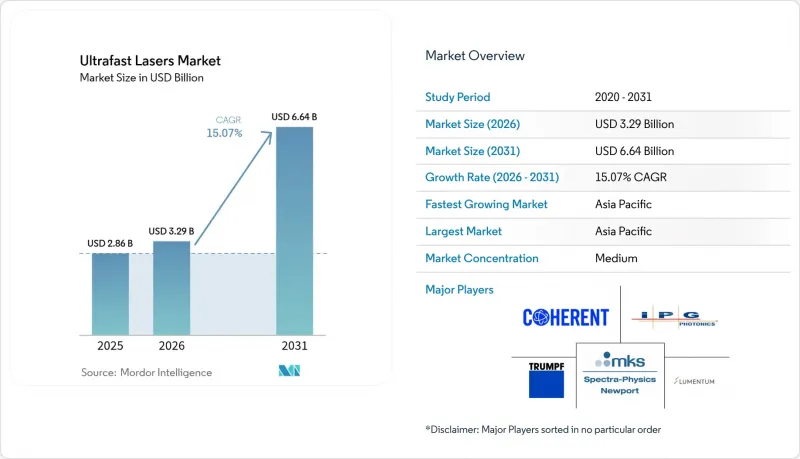
本報告按雷射類型(光纖雷射、固體雷射等)、脈衝寬度(飛秒、皮秒)、波長(紅外線等)、應用領域(材料加工、微加工等)、終端用戶(家用電子電器、醫療設備等)和地區進行細分。市場預測以美元計價。
全球超快雷射市場趨勢及洞察
半導體小型化浪潮推動了對小於 20µm 的材料微加工的需求。
晶片製造商正朝著3D封裝架構邁進,他們依靠飛秒脈衝技術在矽穿孔(TSV)上鑽孔,實現超過10:1的長寬比,同時消除熱影響區。三星和SK海力士已將此類系統應用於高頻寬記憶體的堆疊。根據廠商報告顯示,超快雷射平台在2024年的新晶圓加工訂單中佔比將達到35%,高於2022年的18%。 20奈米以下製程節點的持續小型化正在淘汰機械加工和連續波雷射加工方案,從而擴大了超快雷射器的潛在市場。隨著亞太地區大規模生產的推進,相關光掩模和基板製造商對設備的需求也不斷成長。
電動車電池箔的切割正在轉向超高速「脈衝模式」雷射。
根據Gigafactory的數據,飛秒脈衝模式切割可將6µm箔片的加工效率提高40%,同時消除可能導致短路的邊緣毛邊。寧德時代(CATL)和比亞迪(BYD)計劃在2024年投資1.5億美元用於雷射切割生產線,這表明該技術正朝著商業化方向穩步邁進。隨著電池能量密度的提高,對精度的需求也日益成長,製造商開始採用更薄的箔片,這種箔片更適合燒蝕而非機械剪切。多工分束技術能夠同時加工多層箔片,從而提高設備運轉率,並為更高的資本投資提供合理的依據。這些因素正在推動超快雷射在汽車製造生產線中的市場佔有率不斷擴大。
摻鐿纖維供應鏈瓶頸
2024年,高功率鐿光纖的前置作業時間延長至六個月,因為只有極少數公司能夠實現飛秒穩定性所需的稀土元素均勻性。新興的中國製造商正努力解決雜質問題,這些問題會導致模式不穩定,限制了其市場滲透,使其只能在100瓦以下的系統領域中佔有一席之地。供應限制正威脅全光纖飛秒雷射(超快雷射市場中成長最快的細分領域)的產能擴張。供應商正透過尋求雙源認證來應對,但製程的複雜性預計至少會將產能擴張推遲到2026年。儘管下游需求激增,但長期的供不應求仍可能導致收入成長停滯。
細分市場分析
到2025年,光纖架構將佔據超快雷射器市場45.68%的佔有率,其平均故障間隔時間(MTBF)超過50,000小時,足以滿足工廠的運轉率目標。固體和二極體泵浦體雷射平台在峰值能量高於1 mJ時仍然效用,但其生產線銷售成長正在放緩。由於無需對準的佈局減少了維護次數,全光纖飛秒雷射市場預計將以16.28%的複合年成長率成長。像Coherent這樣的供應商正在將光源、電源和冷卻系統整合到節省空間的機架中,從而能夠直接整合到晶圓和電池製造設備中。
系統的簡化使得原始設備製造商 (OEM) 能夠將雷射整合到運動平台中,從而消除了先前造成污染的外部光路。整合還能提高服務保留率,因為更換品牌需要對整個系統進行重新認證。因此,領先的光纖雷射製造商正透過擴展韌體、掃描器和人工智慧光學套件,進一步鞏固其在超快雷射市場的主導地位,從而增加了切換成本。同時,大型雷射專家正將目光轉向特定波長的應用和細分市場,在這些領域,光纖雷射在脈衝能量和波長調諧能力方面存在不足。
預計到2025年,飛秒雷射設備將佔銷售額的62.35%。這主要歸功於其非熱燒蝕的特性,能夠避免矽、玻璃和聚合物薄膜等基板的損傷。脈衝串模式架構的進步使得材料去除率提高了五倍,同時熱穿透深度仍維持在100奈米以下。隨著設備成本逐漸接近皮秒雷射設備,預計到2031年,超快雷射市場將以16.42%的複合年成長率成長。在對熱影響區要求不高且需要高平均功率進行大面積表面紋理化處理的應用中,皮秒雷射光源仍將繼續使用。
隨著飛秒雷射價格降低、速度加快,兩者之間的界線正變得模糊。設備採購商擴大根據應用所需的物理特性而非預算限制來指定脈衝寬度,這加劇了市場競爭。供應商正在改進其控制器,使其能夠在單脈衝和脈衝串序列之間切換,從而實現使用單個雷射頭在同一生產線上進行切割、打標和修邊等操作,進一步拓展了超快雷射市場的潛在範圍。
區域分析
預計到2025年,亞太地區將佔據超快雷射市場38.14%的佔有率,並在2031年之前以18.21%的複合年成長率成長。這主要歸功於中國、日本和韓國晶圓工廠、電池超級工廠和顯示器生產線的集中分佈。儘管中國的優惠政策正在扶持國內雷射供應商,但歐美品牌在精度要求低於300飛秒的高精度領域仍佔據主導地位。日本保持其創新領先地位。濱松光子學以8億美元收購NKT光電,拓展了其在量子和生物醫學領域的業務組合,並提高了日本的系統整合密度。韓國領導企業支撐著穩定的設備需求,確保該地區將繼續成為超快雷射市場的主要收入驅動力。
北美正受惠於科學研究經費和回流津貼。例如,馬薩諸塞州的「製造業加速計畫」提供20萬美元的補助金,用於抵消IEC 60825認證費用,這促進了中小企業採用飛秒雷射設備。在美國實驗室進行量子光電原型試點的同時,密西根州和德克薩斯州的汽車零件供應商正在為電動車模組採用脈衝模式雷射。加拿大各大學正在加強光纖雷射研究,並持續培養光電領域的畢業生,從而支持區域服務生態系統的發展。
歐洲在汽車和醫療設備領域保持著強勁的地位。德國一級供應商指定使用超快系統焊接電池機殼和製造支架,維持了高利潤率。法國和立陶宛供應商提供專用波長模組,增強了歐盟內部的供應穩定性。同時,隨著阿拉伯聯合大公國政府資助研究機構,中東和非洲的超快雷射市場也逐漸發展。儘管產量仍然較低,但用於航太複合材料和光電感測器的試驗生產線展現出未來為超快雷射市場做出貢獻的潛力,前提是能夠培養出足夠的技術人才。
其他好處:
- Excel格式的市場預測(ME)表
- 3個月的分析師支持
目錄
第1章:引言
- 研究假設和市場定義
- 調查範圍
第2章:調查方法
第3章執行摘要
第4章 市場狀況
- 市場概覽
- 市場促進因素
- 半導體小型化浪潮推動了對小於 20µm 材料的微結構加工的需求。
- 電動車電池箔片的切割正在轉向超高速「脈衝模式」雷射。
- 在高長寬比玻璃上折疊式,用於製作可折疊顯示器
- 晶圓上量子光電原型開發需要小於 200 fs 的脈衝。
- 政府獎勵措施吸引先進製造業回流日本
- 人工智慧驅動的自適應光學技術提高了多光束處理能力。
- 市場限制因素
- 摻鐿纖維供應鏈瓶頸
- 連續波光纖雷射與厚板切割之間的生產效率差距。
- 中小企業遵守IEC 60825雷射安全標準的成本
- 當平均輸出功率超過 500 瓦時,熱透鏡會發生不穩定。
- 產業供應鏈分析
- 監理情勢
- 技術展望
- 波特五力分析
第5章 市場規模與成長預測
- 雷射型
- 光纖雷射
- 固體雷射
- 二極體激勵體雷射
- 全光纖飛秒雷射
- 按脈衝持續時間
- 飛秒
- 皮秒
- 波長
- 紅外線(約1030奈米)
- 綠色(約 515 奈米)
- 紫外線(約 355 奈米)
- 深紫外光(波長266奈米或更短)
- 透過使用
- 材料加工和微加工
- 生物醫學和生物成像
- 光譜學和計量學
- 科學研究
- 最終用戶
- 家用電子產品
- 醫療器材
- 車
- 航太/國防
- 研究機構
- 其他最終用戶
- 按地區
- 北美洲
- 美國
- 加拿大
- 墨西哥
- 南美洲
- 巴西
- 阿根廷
- 哥倫比亞
- 其他南美國家
- 歐洲
- 英國
- 德國
- 法國
- 義大利
- 西班牙
- 其他歐洲國家
- 亞太地區
- 中國
- 日本
- 韓國
- 印度
- 其他亞太國家
- 中東和非洲
- 中東
- 沙烏地阿拉伯
- 阿拉伯聯合大公國
- 其他中東國家
- 非洲
- 南非
- 埃及
- 其他非洲國家
- 中東
- 北美洲
第6章 競爭情勢
- 市場集中度
- 策略趨勢
- 市佔率分析
- 公司簡介
- TRUMPF SE+Co. KG
- Coherent Corp.
- IPG Photonics Corporation
- MKS Instruments Inc.(Spectra-Physics and Newport)
- Lumentum Holdings Inc.
- Amplitude Laser Group SA
- Novanta Inc.(Laser Quantum Ltd.)
- NKT Photonics A/S
- Light Conversion UAB
- Ekspla UAB(EKSMA Group)
- Clark-MXR Inc.
- IMRA America Inc.(Aisin Corp.)
- Jenoptik AG
- Hamamatsu Photonics KK
- Menlo Systems GmbH
- Fluence Sp. z oo
- Wuhan Huaray Precision Laser Co., Ltd.
- YSL Photonics Co., Ltd.
- Raycus Fiber Laser Technologies Co., Ltd.
- nLIGHT, Inc.
第7章 市場機會與未來展望
According to Mordor Intelligence, ultrafast lasers market size in 2026 is estimated at USD 3.29 billion, growing from 2025 value of USD 2.86 billion with 2031 projections showing USD 6.64 billion, growing at 15.07% CAGR over 2026-2031.
This report is Segmented by Laser Type (Fiber Laser, Solid-State Laser, and More), Pulse Duration (Femtosecond, and Picosecond), Wavelength (Infra-Red, and More), Application (Material Processing and Micromachining, and More), End User (Consumer Electronics, Medical Devices, and More), and Geography. The Market Forecasts are Provided in Terms of Value (USD).
Global Ultrafast Lasers Market Trends and Insights
Semiconductor Mini-Miniaturization Wave Fuels <20 µm Feature Machining Demand
Chipmakers migrating to 3D packaging architectures depend on femtosecond pulses that drill through-silicon vias with aspect ratios beyond 10:1 while eliminating heat-affected zones. Samsung and SK Hynix already deploy such systems for high-bandwidth memory stacking. Tool vendors report that ultrafast platforms represented 35% of new wafer-processing orders in 2024, up from 18% in 2022. Continuous node shrinkage below 20 nm widens the addressable ultrafast lasers market by forcing abandonment of mechanical or CW-laser options. Volume ramps in Asia-Pacific amplify equipment demand across allied photomask and substrate houses.
EV Battery Foil Cutting Shift to Ultrafast "Burst-Mode" Lasers
Gigafactory data show femtosecond burst-mode cutting improves 6 µm foil throughput by 40% while eliminating edge burrs that trigger short circuits. CATL and BYD invested USD 150 million in laser cutting lines during 2024, illustrating commercialization momentum. Precision demand rises as battery energy density climbs, pushing manufacturers to thinner foils that favor ablation over mechanical shearing. Multiplexed beam splitting allows simultaneous processing of stacked sheets, lifting utilization, and justifying higher capital expenditure. These factors enlarge the ultrafast lasers market share devoted to automotive manufacturing lines.
Supply-Chain Choke Points in Ytterbium-Doped Fiber
Lead times for high-power ytterbium fibers lengthened to six months in 2024 as only a handful of firms master the rare-earth uniformity needed for femtosecond stability. Chinese newcomers struggle with impurities that trigger mode instabilities, limiting penetration to sub-100 W systems. Restricted supply threatens production ramps for all-fiber femtosecond lasers, the fastest expanding slice of the ultrafast lasers market. Vendors respond by qualifying dual sources, yet process complexity slows capacity additions until at least 2026. Any prolonged shortage risks capping revenue even as downstream demand spikes.
Other drivers and restraints analyzed in the detailed report include:
- High-Aspect-Ratio Glass Drilling for Foldable Displays
- On-Wafer Quantum Photonics Prototyping Needs Sub-200 fs Pulses
- Productivity Gap vs. CW Fiber Lasers in Thick-Metal Cutting
For complete list of drivers and restraints, kindly check the Table Of Contents.
Segment Analysis
Fiber architectures captured 45.68% of the ultrafast lasers market in 2025, underpinned by a mean time between failures above 50,000 hours that satisfy factory uptime targets. Solid-state and diode-pumped bulk platforms retain utility for peak energies above 1 mJ, yet they see slower sales into production lines. The ultrafast lasers market size for all-fiber femtosecond units is projected to climb at a 16.28% CAGR as alignment-free layouts cut maintenance visits. Vendors like Coherent compress sources, power supplies, and chiller units into footprint-saving racks, allowing direct integration inside wafer or battery tools.
System simplification lets OEMs embed lasers within motion stages, removing external beam paths that previously invited contamination. Integration also strengthens service stickiness, because swapping brands would mean requalifying the entire machine. Fiber leaders thus extend firmware, scanner, and AI optics suites that raise switching costs, deepening control of the ultrafast lasers market. Bulk-laser specialists pivot toward research or exotic-wavelength niches where fibers lag in pulse energy or tunability.
Femtosecond devices owned 62.35% revenue in 2025 because non-thermal ablation prevents substrate damage in silicon, glass, and polymer films. Advancing burst-mode architectures now achieve fivefold material-removal rate jumps while restraining heat below 100 nm penetration. The ultrafast lasers market segment is forecast at 16.42% CAGR to 2031 as tooling costs converge with picosecond options. Picosecond sources persist where slight heat zones are acceptable, and higher average power is required for large-area texturing.
Convergence blurs the boundary as femtosecond prices fall and speed rises. Equipment buyers increasingly specify pulse duration by application physics rather than budget constraints, tightening competition. Suppliers augment controllers that switch between single-pulse and burst sequences, enabling one head to serve dicing, marking, and trimming within the same line, broadening the ultrafast lasers market addressable reach.
Complete Report Scope:
- By Laser Type
- Fiber Laser
- Solid-State Laser
- Diode-Pumped Bulk Laser
- All-Fiber Femtosecond Laser
- By Pulse Duration
- Femtosecond
- Picosecond
- By Wavelength
- Infra-red (Approx. 1030 nm)
- Green (Approx. 515 nm)
- UV (Approx. 355 nm)
- Deep-UV (Less than or Equal to 266 nm)
- By Application
- Material Processing and Micromachining
- Biomedical and Bio-imaging
- Spectroscopy and Metrology
- Scientific Research
- By End User
- Consumer Electronics
- Medical Devices
- Automotive
- Aerospace and Defense
- Research Institutes
- Other End Users
- By Geography
- North America
- United States
- Canada
- Mexico
- South America
- Brazil
- Argentina
- Colombia
- Rest of South America
- Europe
- United Kingdom
- Germany
- France
- Italy
- Spain
- Rest of Europe
- Asia-Pacific
- China
- Japan
- South Korea
- India
- Rest of Asia-Pacific
- Middle East and Africa
- Middle East
- Saudi Arabia
- United Arab Emirates
- Rest of Middle East
- Africa
- South Africa
- Egypt
- Rest of Africa
- Middle East
- North America
Geography Analysis
Asia-Pacific commanded 38.14% of the ultrafast lasers market in 2025 and is forecast at 18.21% CAGR to 2031 because wafer fabs, battery gigafactories, and display lines cluster across China, Japan, and South Korea. China's policy incentives nurture domestic laser suppliers, but Western brands still dominate high-precision tiers that demand sub-300 fs stability. Japan retains innovation leadership; Hamamatsu's USD 800 million NKT Photonics buy enlarges its quantum and biomedical portfolio, increasing local system integration density. South Korean chip and display leaders anchor steady tool demand, ensuring the region remains the primary engine for ultrafast lasers market revenue.
North America benefits from research funding and reshoring grants. Programs like Massachusetts' Manufacturing Accelerate deliver USD 200,000 subsidies that offset IEC 60825 certification costs, prompting SMEs to adopt femtosecond tools. U.S. labs pilot quantum-photonics prototypes, while automotive suppliers in Michigan and Texas turn to burst-mode lasers for EV modules. Canadian universities bolster fiber-laser research, providing a pipeline of photonics graduates who sustain regional service ecosystems.
Europe maintains strongholds in automotive and medical devices. German tier-ones specify ultrafast systems for battery enclosure welding and stent machining, preserving premium margins. French and Lithuanian vendors contribute specialty wavelength modules, enhancing intra-EU supply security. Meanwhile, Middle East and Africa emerge slowly as governments fund research hubs in the United Arab Emirates. Though volume remains small, pilot lines in aerospace composites and photonic sensors foreshadow future contributions to the ultrafast lasers market once technical workforces mature.
- TRUMPF SE + Co. KG
- Coherent Corp.
- IPG Photonics Corporation
- MKS Instruments Inc. (Spectra-Physics and Newport)
- Lumentum Holdings Inc.
- Amplitude Laser Group SA
- Novanta Inc. (Laser Quantum Ltd.)
- NKT Photonics A/S
- Light Conversion UAB
- Ekspla UAB (EKSMA Group)
- Clark-MXR Inc.
- IMRA America Inc. (Aisin Corp.)
- Jenoptik AG
- Hamamatsu Photonics K.K.
- Menlo Systems GmbH
- Fluence Sp. z o.o.
- Wuhan Huaray Precision Laser Co., Ltd.
- YSL Photonics Co., Ltd.
- Raycus Fiber Laser Technologies Co., Ltd.
- nLIGHT, Inc.
Additional Benefits:
- The market estimate (ME) sheet in Excel format
- 3 months of analyst support
TABLE OF CONTENTS
1 INTRODUCTION
- 1.1 Study Assumptions and Market Definition
- 1.2 Scope of the Study
2 RESEARCH METHODOLOGY
3 EXECUTIVE SUMMARY
4 MARKET LANDSCAPE
- 4.1 Market Overview
- 4.2 Market Drivers
- 4.2.1 Semiconductor mini-maturization wave fuels Less than 20 µm feature machining demand
- 4.2.2 EV battery foil cutting shift to ultrafast "burst-mode" lasers
- 4.2.3 High-aspect-ratio glass drilling for foldable displays
- 4.2.4 On-wafer quantum photonics prototyping needs sub-200 fs pulses
- 4.2.5 Government incentives for reshoring advanced manufacturing
- 4.2.6 AI-assisted adaptive optics boosting multi-beam throughput
- 4.3 Market Restraints
- 4.3.1 Supply-chain choke points in ytterbium-doped fiber
- 4.3.2 Productivity gap vs. CW fiber lasers in thick-metal cutting
- 4.3.3 IEC 60825 laser-safety compliance costs for SMEs
- 4.3.4 Thermal-lens instability above 500 W average power
- 4.4 Industry Supply Chain Analysis
- 4.5 Regulatory Landscape
- 4.6 Technological Outlook
- 4.7 Porter's Five Forces Analysis
- 4.7.1 Bargaining Power of Suppliers
- 4.7.2 Bargaining Power of Buyers
- 4.7.3 Threat of New Entrants
- 4.7.4 Threat of Substitutes
- 4.7.5 Intensity of Competitive Rivalry
5 MARKET SIZE AND GROWTH FORECASTS (VALUE)
- 5.1 By Laser Type
- 5.1.1 Fiber Laser
- 5.1.2 Solid-State Laser
- 5.1.3 Diode-Pumped Bulk Laser
- 5.1.4 All-Fiber Femtosecond Laser
- 5.2 By Pulse Duration
- 5.2.1 Femtosecond
- 5.2.2 Picosecond
- 5.3 By Wavelength
- 5.3.1 Infra-red (Approx. 1030 nm)
- 5.3.2 Green (Approx. 515 nm)
- 5.3.3 UV (Approx. 355 nm)
- 5.3.4 Deep-UV (Less than or Equal to 266 nm)
- 5.4 By Application
- 5.4.1 Material Processing and Micromachining
- 5.4.2 Biomedical and Bio-imaging
- 5.4.3 Spectroscopy and Metrology
- 5.4.4 Scientific Research
- 5.5 By End User
- 5.5.1 Consumer Electronics
- 5.5.2 Medical Devices
- 5.5.3 Automotive
- 5.5.4 Aerospace and Defense
- 5.5.5 Research Institutes
- 5.5.6 Other End Users
- 5.6 By Geography
- 5.6.1 North America
- 5.6.1.1 United States
- 5.6.1.2 Canada
- 5.6.1.3 Mexico
- 5.6.2 South America
- 5.6.2.1 Brazil
- 5.6.2.2 Argentina
- 5.6.2.3 Colombia
- 5.6.2.4 Rest of South America
- 5.6.3 Europe
- 5.6.3.1 United Kingdom
- 5.6.3.2 Germany
- 5.6.3.3 France
- 5.6.3.4 Italy
- 5.6.3.5 Spain
- 5.6.3.6 Rest of Europe
- 5.6.4 Asia-Pacific
- 5.6.4.1 China
- 5.6.4.2 Japan
- 5.6.4.3 South Korea
- 5.6.4.4 India
- 5.6.4.5 Rest of Asia-Pacific
- 5.6.5 Middle East and Africa
- 5.6.5.1 Middle East
- 5.6.5.1.1 Saudi Arabia
- 5.6.5.1.2 United Arab Emirates
- 5.6.5.1.3 Rest of Middle East
- 5.6.5.2 Africa
- 5.6.5.2.1 South Africa
- 5.6.5.2.2 Egypt
- 5.6.5.2.3 Rest of Africa
- 5.6.5.1 Middle East
- 5.6.1 North America
6 COMPETITIVE LANDSCAPE
- 6.1 Market Concentration
- 6.2 Strategic Moves
- 6.3 Market Share Analysis
- 6.4 Company Profiles (includes Global-level Overview, Market-level Overview, Core Segments, Financials as available, Strategic Information, Market Rank/Share, Products and Services, Recent Developments)
- 6.4.1 TRUMPF SE + Co. KG
- 6.4.2 Coherent Corp.
- 6.4.3 IPG Photonics Corporation
- 6.4.4 MKS Instruments Inc. (Spectra-Physics and Newport)
- 6.4.5 Lumentum Holdings Inc.
- 6.4.6 Amplitude Laser Group SA
- 6.4.7 Novanta Inc. (Laser Quantum Ltd.)
- 6.4.8 NKT Photonics A/S
- 6.4.9 Light Conversion UAB
- 6.4.10 Ekspla UAB (EKSMA Group)
- 6.4.11 Clark-MXR Inc.
- 6.4.12 IMRA America Inc. (Aisin Corp.)
- 6.4.13 Jenoptik AG
- 6.4.14 Hamamatsu Photonics K.K.
- 6.4.15 Menlo Systems GmbH
- 6.4.16 Fluence Sp. z o.o.
- 6.4.17 Wuhan Huaray Precision Laser Co., Ltd.
- 6.4.18 YSL Photonics Co., Ltd.
- 6.4.19 Raycus Fiber Laser Technologies Co., Ltd.
- 6.4.20 nLIGHT, Inc.
7 MARKET OPPORTUNITIES AND FUTURE OUTLOOK
- 7.1 White-space and Unmet-need Assessment

 超快雷射市場規模、佔有率和趨勢分析報告:按雷射類型、脈衝寬度、應用、地區和細分市場預測(2026-2033 年)
 全球超快雷射市場規模、佔有率、趨勢和成長分析報告(2026-2034)
 超快雷射市場-全球產業規模、佔有率、趨勢、機會、預測:按類型、脈衝持續時間、應用、地區和競爭格局分類,2021-2031年
 光纖雷射(2025):技術、應用與市場趨勢
 超快雷射器市場(2025)-技術、應用及市場趨勢:超快雷射器助力從科學研究到工業生產等各領域的創新。超快雷射市場:全球按雷射類型、脈衝持續時間、最終用戶和地區分類,2026 年至 2032 年