


 |
市場調查報告書
商品編碼
2121481
二苯基甲烷二異氰酸酯(MDI):市場佔有率分析、行業趨勢和統計數據以及成長預測(2026-2031 年)Methylene Diphenyl Di-isocyanate (MDI) - Market Share Analysis, Industry Trends & Statistics, Growth Forecasts (2026 - 2031) |
||||||

※ 本網頁內容可能與最新版本有所差異。詳細情況請與我們聯繫。
預計二苯基甲烷二異氰酸酯的市場規模將從 2025 年的 862 萬噸擴大到 2026 年的 906 萬噸,然後從 2026 年到 2031 年以 5.13% 的複合年成長率成長,到 2031 年達到 1164 萬噸。
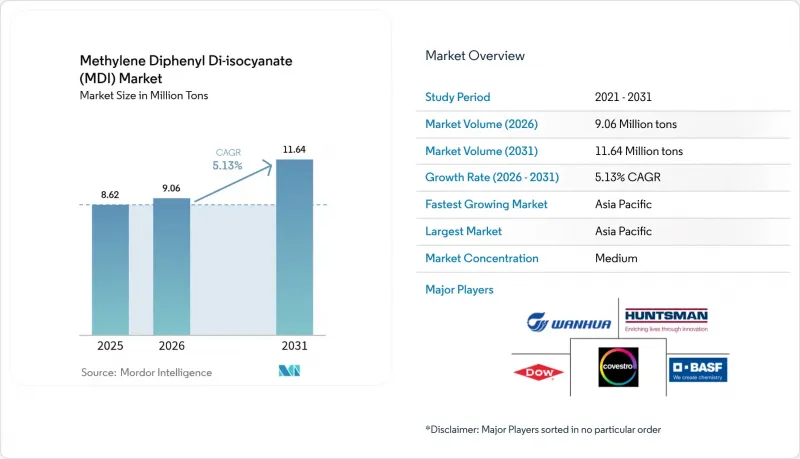
本報告按應用領域(硬質發泡體、軟質發泡體、塗料、彈性體、黏合劑和密封劑、其他)、終端用戶產業(建築、家具及室內裝潢、電子及家電、汽車、鞋類、其他)和地區(亞太地區、北美地區、歐洲、其他)進行細分。市場預測以噸為單位。
全球二苯基甲烷二異氰酸酯(MDI) 市場趨勢及洞察
由於淨零能耗建築的推行,對聚氨酯隔熱材料的需求激增。
在歐洲、美國和亞洲部分地區,能源法規規定牆體的R值必須在20到30之間。這項標準是透過使用聚異氰脲酸酯板(polyisoboard)而非更厚的礦棉來實現的。歐盟的《建築能源性能指令》將推動數百萬戶住宅維修。預計這項措施將在未來幾年內促進硬質發泡體的消費。加州第24號法規修正案將於2026年1月生效,該修正案將提高全州屋頂的R值,從而鞏固對A級防火聚異氰脲酸酯板的需求。德國和奧地利的被動式房屋認證數量正在顯著成長,這支持了住宅採用「連續保溫」來降低全年供暖負荷的趨勢。
擴大食品和藥品冷鏈運輸能力
生物製藥和mRNA疫苗需要儲存在2°C至8°C的溫度範圍內,但在運輸過程中經常會經歷低於-70°C的低溫。 Cencora公司承諾投資將其位於阿拉巴馬州的冷藏空間擴大五倍,並採用噴塗式MDI泡沫來確保溫度穩定性。隨著全球冷藏倉庫容量的預期成長,硬質MDI板仍將是首選的隔熱材料材料。
更嚴格的二異氰酸酯工人接觸標準
REACH法規附件十七規定,處理濃度超過0.1%(重量比)二異氰酸酯的使用者必須每五年接受一次認證訓練。這項規定增加了現場合規成本,並促使企業升級通風系統。英國於2024年制定了類似的空氣中二異氰酸酯濃度標準,日本也正在最終確定相應的法規,目標是在2027年實施。雖然大規模加工企業能夠承擔這些額外成本,但小規模企業的利潤率卻面臨壓力,導致產業整合趨勢日益明顯。
細分市場分析
預計到2025年,硬質發泡體將佔二苯基甲烷二異氰酸酯(MDI)市場佔有率的36.81%,到2031年將以5.69%的複合年成長率成長。連續面板隔熱材料因其在維持比押出成型聚苯乙烯更薄的結構的同時,還能達到R-20的牆體保溫性能目標,而越來越受到建築師的青睞。此外,由於資金投入的增加,使用噴塗泡沫的維修工程也呈現顯著成長動能。同時,隨著家用電器發泡材轉向碳氫化合物基發泡,人們對聚合物基MDI的閉孔密度也越來越青睞。
在各種硬質發泡材材料中,噴塗泡沫隔熱材料憑藉著良好的氣密性和防潮性,正迅速成為成長最快的選擇。硬質MDI板材也是商用的標準材料。彈性體和塗料雖然主要服務於小眾市場,但作為高耐磨輥筒和耐化學腐蝕的地板材料,需求仍然穩定。此外,源自MDI預聚物的黏合劑,憑藉其在熱循環下的高剪切強度,正被用於黏合渦輪葉片和汽車複合材料。
區域分析
預計到2025年,亞太地區將佔全球二苯基甲烷二異氰酸酯(MDI)市場的46.77%,並在2031年之前以5.97%的複合年成長率成長。中國都市區住宅建設的年度成長目標,以及龐大的萬華綜合體項目,正在增強該地區的供應基礎。在印度,隔熱標準的推廣和冷凍設施的擴建正在推動需求成長。同時,越南和印尼正在成為家具和鞋類產業轉移的中心。在日本和韓國,提高家用電器的隔熱性能是一項優先事項,這得益於「頂級節能家電」計畫和能源效率標籤制度等舉措。
在北美,儘管住宅存量已較為成熟,但由於隔熱維修和使用環戊烷作為發泡的冷藏庫泡沫材料的普及,該地區的消費量仍在成長,而北美正是泡沫塑膠需求的主要市場。在加拿大,建築規範的修訂促使噴塗泡沫塑膠的使用量激增,尤其是在暖氣度日數超過5000的省份。
歐洲在全球產量中佔據相當大的佔有率,當地生產商面臨高昂的能源成本,這對其生產造成了影響。然而,嚴格的建築規範為維修提供了明確的路徑,這項改造將持續到2033年。其餘市場則分佈在南美洲以及中東和非洲。隨著利率的下降,巴西市場呈現出復甦跡象,而沙烏地阿拉伯的薩達拉公司正策略性地從朱拜勒向歐洲和亞洲出口價格具有競爭力的產品。
其他好處:
- Excel格式的市場預測(ME)表
- 3個月的分析師支持
目錄
第1章:引言
- 研究假設和市場定義
- 調查範圍
第2章:調查方法
第3章執行摘要
第4章 市場狀況
- 市場概覽
- 市場促進因素
- 由於淨零能耗建築的推行,對聚氨酯隔熱材料的需求激增。
- 擴大食品和藥品冷鏈運輸能力
- 暖通空調能源效率法規正在推動家用電器中使用的發泡材的需求成長。
- 發泡材在電動車電池組溫度控管的應用日益廣泛
- 獲得 ISCC-Plus 認證的物料平衡/MDI(多分佈式店內)系統正在引起關注。
- 市場限制因素
- 更嚴格限制工人接觸二異氰酸酯。
- 原油價格波動影響苯胺原料的價格。
- 不含異氰酸酯的新興聚氨酯(PU)化學技術
- 價值鏈分析
- 監理政策分析
- 波特五力模型
- 生產流程分析
- 技術授權和專利分析
- 價格趨勢情景
第5章 市場規模與成長預測
- 透過使用
- 硬質發泡體
- 軟性發泡體
- 塗層
- 彈性體
- 黏合劑和密封劑
- 其他
- 按最終用戶行業分類
- 建造
- 家具和室內設計
- 電子設備及家用電器
- 車
- 鞋類
- 其他
- 按地區
- 亞太地區
- 中國
- 印度
- 日本
- 韓國
- 其他亞太國家
- 北美洲
- 美國
- 加拿大
- 墨西哥
- 歐洲
- 德國
- 英國
- 法國
- 義大利
- 俄羅斯
- 其他歐洲國家
- 南美洲
- 巴西
- 阿根廷
- 其他南美國家
- 中東和非洲
- 沙烏地阿拉伯
- 南非
- 其他中東和非洲國家
- 亞太地區
第6章 競爭情勢
- 市場集中度
- 策略趨勢
- 市佔率和排名分析
- 公司簡介
- BASF
- Covestro AG
- Dow
- Hexion Inc.
- Huntsman International LLC
- Karoon Petrochemical Company
- Kumho Mitsui Chemicals Inc
- KURMY CORPORATIONS
- Sadara
- Shanghai Lianheng Isocyanate Co. Ltd
- Sumitomo Chemical Co. Ltd
- Tosoh Corporation
- Vardhman Chemicals
- Wanhua
第7章 市場機會與未來展望
According to Mordor Intelligence, the methylene diphenyl di-isocyanate market size is expected to grow from 8.62 million tons in 2025 to 9.06 million tons in 2026 and is forecast to reach 11.64 million tons by 2031 at a 5.13% CAGR over 2026-2031.
This report is Segmented by Application (Rigid Foams, Flexible Foams, Coatings, Elastomers, Adhesives and Sealants, and Others), End-User Industry (Construction, Furniture and Interiors, Electronics and Appliances, Automotive, Footwear, and Others), and Geography (Asia-Pacific, North America, Europe, and More). Market Forecasts are Provided in Terms of Volume (Tons).
Global Methylene Diphenyl Di-isocyanate (MDI) Market Trends and Insights
Surge in Polyurethane-Insulation Demand From Net-Zero Buildings
Across Europe, the U.S., and parts of Asia, energy codes mandate wall R-values between 20 and 30. This benchmark is achieved using polyiso boards, as opposed to opting for thicker mineral wool. The EU Energy Performance of Buildings Directive is set to drive upgrades in millions of homes. This initiative is projected to boost the consumption of rigid foam in the coming years. Starting January 2026, California's Title 24 update will elevate roof R-values statewide, solidifying the demand for Class A fire-rated polyiso boards. Passive House certifications in Germany and Austria saw a significant increase, underscoring a homeowner trend towards continuous insulation, which curtails heating loads annually.
Cold-Chain Capacity Build-Out for Food and Pharma
Biologic drugs and mRNA vaccines mandate storage temperatures between 2 °C and 8 °C, frequently dipping below -70 °C during transit. Cencora pledged an investment to quintuple its refrigerated space in Alabama, employing spray-applied MDI foam to ensure temperature stability. Global refrigerated-warehouse volume is projected to increase, with rigid MDI boards continuing as the preferred insulation choice.
Stricter Worker-Exposure Limits for Di-Isocyanates
aREACH Annex XVII has introduced a mandate: users processing more than 0.1% di-isocyanate by weight must undergo certified training every five years. This requirement has led to an increase in site compliance costs and has also necessitated upgrades to ventilation systems. In 2024, the United Kingdom set similar airborne limits, and Japan is in the process of finalizing comparable regulations, targeting a 2027 implementation. While larger converters are able to absorb these added costs, smaller operations are feeling the pinch on their margins, leading to a trend of consolidation in the industry.
Other drivers and restraints analyzed in the detailed report include:
- HVAC Efficiency Regulations Boosting Appliance Foams
- Rise of Battery-Thermal-Management Foams in EV Packs
- Crude-Oil Volatility Hitting Aniline Feedstock
For complete list of drivers and restraints, kindly check the Table Of Contents.
Segment Analysis
Rigid foams captured 36.81% of the methylene diphenyl di-isocyanate market share in 2025 and will rise at a 5.69% CAGR through 2031. Continuous-panel insulation achieves R-20 wall targets with a thinner profile compared to extruded polystyrene, steering architects towards polyiso boards. Spray-foam retrofits gained significant traction due to increased funding support. Additionally, as appliance foams transition to hydrocarbon blowing agents, there's an increased preference for polymeric MDI's closed-cell density.
Among the rigid-foam options, spray-foam insulation emerged as the fastest-growing choice, with contractors prioritizing its air-sealing and vapor-barrier benefits. Rigid MDI boards are also the go-to for commercial baking ovens, refrigerated trailers, and walk-in coolers aiming to maintain sub-zero temperatures. While elastomers and coatings cater to niche markets, they remain steady, being utilized in high-abrasion rollers and chemically resistant floor finishes. Furthermore, adhesives derived from MDI prepolymers are bonding turbine blades and automotive composites, capitalizing on their high shear strength during thermal cycling.
Complete Report Scope:
- By Application
- Rigid Foams
- Flexible Foams
- Coatings
- Elastomers
- Adhesives and Sealants
- Others
- By End-user Industry
- Construction
- Furniture and Interiors
- Electronics and Appliances
- Automotive
- Footwear
- Others
- By Geography
- Asia-Pacific
- China
- India
- Japan
- South Korea
- Rest of Asia-Pacific
- North America
- United States
- Canada
- Mexico
- Europe
- Germany
- United Kingdom
- France
- Italy
- Russia
- Rest of Europe
- South America
- Brazil
- Argentina
- Rest of South America
- Middle-East and Africa
- Saudi Arabia
- South Africa
- Rest of Middle-East and Africa
- Asia-Pacific
Geography Analysis
Asia-Pacific held 46.77% of the global methylene diphenyl di-isocyanate market volume in 2025 and is set for a 5.97% CAGR through 2031. China's ambitious addition of urban housing annually, paired with Wanhua's expansive complex, solidifies the region's supply foundation. In India, a push for insulation codes and enhanced cold-storage facilities is driving volume expansion. Meanwhile, Vietnam and Indonesia are becoming hubs for relocated furniture and footwear industries. Japan and South Korea are prioritizing appliance insulation upgrades, driven by initiatives like Top Runner and energy labeling.
North America, holding a significant share in demand, sees rising consumption buoyed by weatherization retrofits and a transition to cyclopentane-blown refrigerator foams, even with a mature housing stock. In Canada, revised codes are spurring a surge in spray-foam adoption, especially in provinces experiencing more than 5,000 heating degree-days.
Europe, accounting for a notable portion of the global volume, grapples with high energy costs impacting local producers. However, stringent building directives pave a clear retrofit pathway extending through 2033. The remaining market is split between South America and the Middle-East and Africa. Brazil is poised for a rebound with easing interest rates, while Saudi Arabia's Sadara is strategically exporting competitively priced cargoes from Jubail to Europe and Asia.
- BASF
- Covestro AG
- Dow
- Hexion Inc.
- Huntsman International LLC
- Karoon Petrochemical Company
- Kumho Mitsui Chemicals Inc
- KURMY CORPORATIONS
- Sadara
- Shanghai Lianheng Isocyanate Co. Ltd
- Sumitomo Chemical Co. Ltd
- Tosoh Corporation
- Vardhman Chemicals
- Wanhua
Additional Benefits:
- The market estimate (ME) sheet in Excel format
- 3 months of analyst support
TABLE OF CONTENTS
1 Introduction
- 1.1 Study Assumptions and Market Definition
- 1.2 Scope of the Study
2 Research Methodology
3 Executive Summary
4 Market Landscape
- 4.1 Market Overview
- 4.2 Market Drivers
- 4.2.1 Surge in Polyurethane-insulation demand from net-zero buildings
- 4.2.2 Cold-chain capacity build-out for food and pharma
- 4.2.3 HVAC efficiency regulations boosting appliance foams
- 4.2.4 Rise of battery-thermal-management foams in EV packs
- 4.2.5 Mass-balanced / ISCC-Plus certified MDI gaining traction
- 4.3 Market Restraints
- 4.3.1 Stricter worker-exposure limits for di-isocyanates
- 4.3.2 Crude-oil volatility hitting aniline feedstock
- 4.3.3 Emerging non-isocyanate PU chemistries
- 4.4 Value Chain Analysis
- 4.5 Regulatory Policy Analysis
- 4.6 Porter's Five Forces
- 4.6.1 Bargaining Power of Suppliers
- 4.6.2 Bargaining Power of Consumers
- 4.6.3 Threat of New Entrants
- 4.6.4 Threat of Substitute Products and Services
- 4.6.5 Degree of Competition
- 4.7 Production Process Analysis
- 4.8 Technology Licensing and Patent Analysis
- 4.9 Price Trend Scenario
5 Market Size and Growth Forecasts (Volume)
- 5.1 By Application
- 5.1.1 Rigid Foams
- 5.1.2 Flexible Foams
- 5.1.3 Coatings
- 5.1.4 Elastomers
- 5.1.5 Adhesives and Sealants
- 5.1.6 Others
- 5.2 By End-user Industry
- 5.2.1 Construction
- 5.2.2 Furniture and Interiors
- 5.2.3 Electronics and Appliances
- 5.2.4 Automotive
- 5.2.5 Footwear
- 5.2.6 Others
- 5.3 By Geography
- 5.3.1 Asia-Pacific
- 5.3.1.1 China
- 5.3.1.2 India
- 5.3.1.3 Japan
- 5.3.1.4 South Korea
- 5.3.1.5 Rest of Asia-Pacific
- 5.3.2 North America
- 5.3.2.1 United States
- 5.3.2.2 Canada
- 5.3.2.3 Mexico
- 5.3.3 Europe
- 5.3.3.1 Germany
- 5.3.3.2 United Kingdom
- 5.3.3.3 France
- 5.3.3.4 Italy
- 5.3.3.5 Russia
- 5.3.3.6 Rest of Europe
- 5.3.4 South America
- 5.3.4.1 Brazil
- 5.3.4.2 Argentina
- 5.3.4.3 Rest of South America
- 5.3.5 Middle-East and Africa
- 5.3.5.1 Saudi Arabia
- 5.3.5.2 South Africa
- 5.3.5.3 Rest of Middle-East and Africa
- 5.3.1 Asia-Pacific
6 Competitive Landscape
- 6.1 Market Concentration
- 6.2 Strategic Moves
- 6.3 Market Share(%)/Ranking Analysis
- 6.4 Company Profiles (includes Global Overview, Market Overview, Core Segments, Financials, Strategic Information, Products and Services, Recent Developments)
- 6.4.1 BASF
- 6.4.2 Covestro AG
- 6.4.3 Dow
- 6.4.4 Hexion Inc.
- 6.4.5 Huntsman International LLC
- 6.4.6 Karoon Petrochemical Company
- 6.4.7 Kumho Mitsui Chemicals Inc
- 6.4.8 KURMY CORPORATIONS
- 6.4.9 Sadara
- 6.4.10 Shanghai Lianheng Isocyanate Co. Ltd
- 6.4.11 Sumitomo Chemical Co. Ltd
- 6.4.12 Tosoh Corporation
- 6.4.13 Vardhman Chemicals
- 6.4.14 Wanhua
7 Market Opportunities and Future Outlook
- 7.1 White-space and Unmet-need Assessment

 全球二苯基甲烷二異氰酸酯(MDI)產業(2026-2030 年)-產能和資本支出,包括所有在運作中規劃工廠的詳細信息
 2026年全球二苯基甲烷二異氰酸酯(MDI)基聚氨酯市場報告
 二苯基甲烷二異氰酸酯市場規模、佔有率及成長分析(按應用、最終用途、類型、配方和地區分類)-2026-2033年產業預測
 二苯基甲烷二異氰酸酯市場 - 全球產業規模、佔有率、趨勢、機會及預測(按類型、應用、最終用途產業、地區和競爭格局分類,2021-2031年)
 2018-2034年全球二苯甲烷二異氰酸酯(MDI)市場需求及預測分析
 二苯醚的全球市場
 2025-2029年二苯基甲烷二異氰酸酯(MDI)市場
 二苯基甲烷二異氰酸酯市場報告:2031年趨勢、預測與競爭分析
 二苯醚全球市場(2024-2028)