


 |
市場調查報告書
商品編碼
2121477
醫療資產管理:市場佔有率分析、產業趨勢與統計、成長預測(2026-2031)Healthcare Asset Management - Market Share Analysis, Industry Trends & Statistics, Growth Forecasts (2026 - 2031) |
||||||

※ 本網頁內容可能與最新版本有所差異。詳細情況請與我們聯繫。
醫療保健資產管理市場預計將從 2025 年的 379 億美元成長到 2026 年的 465.6 億美元,然後在 2031 年達到 1,301.8 億美元,2026 年至 2031 年的複合年成長率為 22.85%。
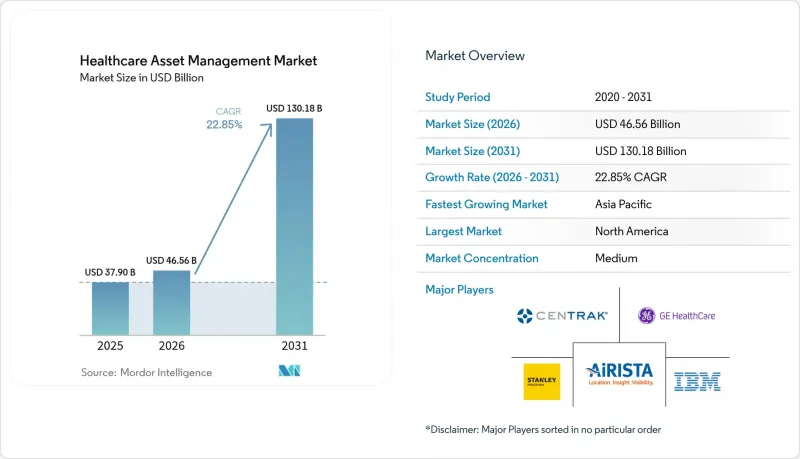
本報告按技術(RFID、即時定位系統等)、組件(硬體、軟體、服務)、應用(設備追蹤、庫存和供應鏈管理等)、最終用戶(醫院和診所、檢查室和診斷中心等)以及地區進行細分。市場預測以價值(美元)表示。
全球醫療資產管理市場趨勢及洞察
為遏止藥品造假,對RFID技術的需求日益成長
藥品造假每年對全球經濟造成約2,000億美元的損失,促使監管機構強制實施序列化和溯源要求,使得端到端的可視性至關重要。根據美國《藥品供應鏈安全法案》,製藥公司、批發商和分銷公司必須在每次交付時證明其產品的來源。目前,大多數此類部署都採用具有加密認證功能的RFID技術,因為它將物品級識別與即時環境監測相結合,這對溫度敏感型生技藥品至關重要。儘管2024年後的半導體短缺已導致標籤價格上漲高達20%,但由於違規罰款和召回成本遠遠超過硬體支出,各機構仍在繼續投資。像SATO這樣的供應商正在推出耐消毒標籤,這些標籤可在單一流程中同時提供認證和工作流程效率。這些因素構成了2025年至2030年製藥和生物技術製造業客戶預期複合年成長率(CAGR)為26.8%的基礎。
由於護理人員短缺,提高效率的壓力越來越大。
在一些大城市醫院,護理人員短缺率超過15%,迫使護理團隊人手不足,管理者也必須盡可能運用輔助科技來提高效率。研究表明,護理師每班要花費超過五分之一的時間尋找遺失的設備。因此,實施即時定位系統(RTLS)可將搜尋時間縮短90%以上,直接惠及員工,無需增加人員編制。英國的醫療機構已將每個設備的搜尋時間從60分鐘縮短至10分鐘,提高了病患安全性和員工留任率。目前,先進的實施方案結合了藍牙低功耗(BLE)徽章、緊急呼叫按鈕和預測分析技術,可以在臨床人員提出請求之前將設備部署到病房,從而減輕工作流程的負擔並提高滿意度。
對資料隱私和網路安全的擔憂
2024年,醫療保健產業資料外洩事件的平均成本達到每次977萬美元,安全風險成為快速部署的主要障礙。美國食品藥物管理局(FDA)2024年的指導草案要求加強上市前安全測試,要求購買者在運作前投資加密、網路分段和持續監控。因此,許多醫院開始採用本地部署或空氣間隙網路,限制資料流向雲端,犧牲部分分析能力以降低風險。缺乏安全韌體的舊設備進一步加劇了整合難度,延長了專案週期,並推高了預算。
細分市場分析
預計到2025年,RFID將佔銷售額的55.60%。數十年的協議成熟和穩健的供應鏈使其成為追蹤藥品庫存和手術包的標準技術。預計到2025年,RFID在醫療資產管理市場的規模將達到210.7億美元,顯示該技術已深度應用於臨床櫃和中央消毒部門。然而,軟體定義的工作流程不僅需要識別訊息,還需要位置資訊。因此,預計到2031年,利用藍牙低功耗(BLE)、Wi-Fi和超寬頻(UWB)技術的即時定位系統(RTLS)的複合年成長率將達到27.20%,超過靜態RFID的成長速度。
在第二階段成長中,供應商正在整合RFID和RTLS技術,開發可在被動式ID和即時遙測之間切換的多模標籤。這種設計能夠在維持原有資本投入的同時,也能實現更高階的分析。兒童醫療中心的案例研究證明了這種雙模方法的價值。被動式RFID可以防止昂貴藥物的流失,而RTLS則確保輸液幫浦放置在病人病情最危急的位置。雖然硬體仍然佔據大部分支出,因為標籤、閘道器和激勵器覆蓋了整個園區,但利潤來源正在轉向平台許可,這些許可將設備識別、位置和使用資料整合到一個統一的控制面板中。隨著這種融合的推進,單模產品很可能在醫療資產管理市場中成為小眾產品。
隨著數百萬個標籤、讀卡機和吸頂式信標的持續採購,硬體在2025年佔總收入的61.60%。然而,隨著醫院從資本投資模式轉向以結果為導向的模式,服務領域正以24.90%的複合年成長率快速成長。根據訂閱協議,供應商保證運轉率、韌體更新和合規審計日誌,使IT團隊能夠專注於患者護理工作。預計到2031年,與服務相關的醫療保健資產管理市場規模將達到553.2億美元,進入成熟階段,基礎設施已廣泛普及,差異化重點將轉向基於諮詢的最佳化服務。
專業服務和託管服務能夠解決僅靠現成硬體無法解決的諸多難題,例如變更管理、系統整合和網路安全認證。服務合約通常包含遠端設備健康檢查、演算法更新和合規性文件等服務,費用在多年合約期間內平均分攤,並與還款週期相符。醫院越來越重視這些合約的合法性,並證明每月訂閱費用可以透過減少護理人員加班、提高床位周轉率和降低醫療設備租賃成本來抵消。
區域分析
預計到2025年,北美將佔全球收入的37.20%,這主要得益於美國全面的序列化法案、成熟的電子健康記錄(EHR)基礎設施以及醫療設備日益成長的網路威脅,這些因素共同推動了整合式安全平台的發展。加拿大各省正在推行類似政策,而墨西哥的私立醫院則投資於資產追蹤系統,以留住醫療旅客並滿足美國保險公司的審計要求。政府的報銷模式對安全缺陷進行處罰,使得可追溯性成為董事會層面的重要指標,進一步促進了全部區域醫療資產管理市場的普及。
亞太地區是成長最快的地區,預計到2031年年複合成長率(CAGR)將達到21.90%。中國、印度和東南亞的公立醫院建設計畫正在推動待開發區部署,繞過傳統的條碼階段,從一開始就整合RFID和RTLS技術。許多此類醫院正在將資產管理系統與國家數位健康雲端平台整合,從而實現全部區域供應鏈中藥品的即時認證。隨著資本投資與全民健保目標的契合,供應商報告已與數百家新建醫院簽署了多年期綜合合約。
在歐洲,隨著歐盟醫療器材法規 (EU-MDR) 的強制實施、歐盟醫療資料庫(EUDAMED) 的部署以及強調生命週期最佳化的國家永續性目標的推進,可追溯性正穩步普及。德國和英國在可追溯性方面處於主導,但隨著結構基金將重點放在數位轉型上,東歐的資金籌措機制也在迎頭趕上。隨著 GDPR 對網路安全的要求日益提高,對本地資料駐留的本地部署或混合雲的需求不斷成長,迫使平台提供者擴展其配置選項。由於英國脫歐使跨境醫療產品貿易的清關程序更加複雜,英國供應商正依靠可追溯性來避免港口延誤和產品損失。
其他好處:
- Excel格式的市場預測(ME)表
- 3個月的分析師支持
目錄
第1章:引言
- 研究假設和市場定義
- 調查範圍
第2章:調查方法
第3章執行摘要
第4章 市場洞察
- 市場概覽
- 市場促進因素
- 對RFID技術在打擊假藥品方面的需求日益成長
- 由於護理人員短缺,提高效率的壓力越來越大。
- 病人安全法規(例如,UDI、歐盟醫療器材法規)
- 嵌入標籤的基於人工智慧的預測性維護
- 與資產可追溯性掛鉤的績效薪酬體系
- 市場限制因素
- 資料隱私和網路安全問題
- RTLS/RFID基礎設施的初始部署成本較高
- 對關鍵無線醫療設備的無線電干擾
- 分散式的傳統電腦化維護管理系統(CMMS)正在延緩系統整合。
- 產業價值鏈分析
- 監理情勢
- 技術展望
- 產業吸引力—五力分析
- 供應商的議價能力
- 買方的議價能力
- 新進入者的威脅
- 替代品的威脅
- 競爭公司之間的競爭
- 宏觀經濟因素對市場的影響
第5章 市場規模與成長預測
- 透過技術
- RFID
- 即時位置資訊系統(RTLS)
- 低功耗藍牙 (BLE) 和 Wi-Fi
- 紅外線和超音波
- 按組件
- 硬體(標籤、讀卡機、閘道器)
- 軟體(分析、中介軟體)
- 服務(實施、管理服務、訓練)
- 透過使用
- 設備和器材的追蹤
- 庫存/供應鏈管理
- 病患和員工追蹤
- 床位和入住率管理
- 環境和狀態監測
- 最終用戶
- 醫院和診所
- 檢查室和診斷中心
- 製藥和生物技術製造
- 長期照護機構及輔助住宅
- 按地區
- 北美洲
- 美國
- 加拿大
- 墨西哥
- 南美洲
- 巴西
- 阿根廷
- 智利
- 其他南美國家
- 歐洲
- 德國
- 英國
- 法國
- 義大利
- 西班牙
- 俄羅斯
- 其他歐洲國家
- 亞太地區
- 中國
- 印度
- 日本
- 韓國
- 澳洲
- 馬來西亞
- 新加坡
- 其他亞太國家
- 中東和非洲
- 中東
- 阿拉伯聯合大公國
- 沙烏地阿拉伯
- 土耳其
- 其他中東國家
- 非洲
- 南非
- 奈及利亞
- 埃及
- 其他非洲國家
- 中東
- 北美洲
第6章 競爭情勢
- 市場集中度
- 策略趨勢
- 市佔率分析
- 公司簡介
- Stanley Healthcare(Stanley Black & Decker)
- CenTrak Inc.
- AiRISTA Flow Inc.
- GE HealthCare Technologies Inc.
- IBM Corporation
- Infor Inc.
- Motorola Solutions Inc.
- Siemens Healthineers AG
- Accenture plc
- Sonitor Technologies AS
- Zebra Technologies Corporation
- Johnson Controls(Tyco International)
- Honeywell International Inc.
- Impinj Inc.
- Alien Technology LLC
- HID Global Corporation
- Ascom Holding AG
- Midmark Corporation(Versus RTLS)
- Trimble Inc.(Atrius)
- Cerner Corporation(Oracle Health)
- TagMaster AB
- Radianse LLC
- Kontakt.io Inc.
- Litum IoT Technologies
- Elpas Ltd.(Securitas)
第7章 市場機會與未來趨勢
- 評估閒置頻段和未滿足的需求
According to Mordor Intelligence, the healthcare asset management market size is expected to grow from USD 37.90 billion in 2025 to USD 46.56 billion in 2026 and is forecast to reach USD 130.18 billion by 2031 at 22.85% CAGR over 2026-2031.
This report is Segmented by Technology (RFID, Real-Time Location Systems, and More), Component (Hardware, Software, and Services), Application (Equipment and Device Tracking, Inventory/Supply-Chain Management, and More), End-User (Hospitals and Clinics, Laboratories and Diagnostic Centers, and More), and Geography. The Market Forecasts are Provided in Terms of Value (USD).
Global Healthcare Asset Management Market Trends and Insights
Rising demand for RFID to curb drug counterfeiting
Pharmaceutical counterfeiting drains an estimated USD 200 billion from the global economy each year, prompting regulators to impose serialisation and pedigree requirements that make end-to-end visibility indispensable. Under the U.S. Drug Supply Chain Security Act, drug makers, wholesalers, and dispensers must prove product provenance at every hand-off. RFID with cryptographic authentication now underpins most of these deployments because it combines item-level identification with real-time environmental monitoring, a necessity for temperature-sensitive biologics. Semiconductor shortages since 2024 lifted tag prices by up to 20%, yet organisations still invest because non-compliance fines and recall costs far exceed hardware spending. Vendors such as SATO have introduced sterilisation-resistant tags that deliver both authentication and workflow efficiency in one process step. These factors underpin the 26.8% CAGR projected for pharmaceutical and biotech manufacturing customers between 2025 and 2030.
Efficiency pressures from nursing-staff shortages
Nursing vacancy rates above 15% in major urban hospitals leave care teams stretched and force administrators to squeeze every efficiency gain possible from support technology. Studies reveal that nurses spend over one-fifth of each shift searching for missing equipment; RTLS implementations that cut search time by more than 90% therefore provide a direct labour dividend that keeps beds staffed without adding headcount. British facilities have demonstrated time reductions from 60 minutes to 10 minutes per device, translating into heightened patient-safety scores and improved staff retention. Advanced deployments now combine BLE badges, panic buttons, and predictive analytics that stage equipment on units before clinicians request it, easing workflow strain and boosting satisfaction.
Data-privacy and cybersecurity concerns
Average breach costs in healthcare reached USD 9.77 million per incident in 2024, making security risk a material deterrent to rapid roll-outs. The FDA's 2024 draft guidance urges stronger pre-market security testing, compelling buyers to fund encryption, network segmentation, and continuous monitoring before go-live. Many hospitals, therefore, begin with on-premises deployments or air-gapped networks that limit data flow to the cloud, trading some analytics capability for risk reduction. Legacy devices without secure firmware further complicate integrations, extending project timelines and inflating budgets.
Other drivers and restraints analyzed in the detailed report include:
- Patient-safety regulations (UDI, EU-MDR)
- AI-based predictive maintenance embedded in tags
- High upfront RTLS/RFID infrastructure cost
For complete list of drivers and restraints, kindly check the Table Of Contents.
Segment Analysis
RFID accounted for 55.60% of 2025 revenue, underlining decades of protocol maturity and robust supply chains that made the technology the default for drug inventory and surgical kit tracking. The healthcare asset management market size for RFID was USD 21.07 billion in 2025, showing how deeply the modality is entrenched at point-of-care cabinets and central sterile processing. Yet software-defined workflows increasingly require location, not just identity. Real-Time Location Systems leveraging BLE, Wi-Fi, and ultra-wideband are therefore forecast to compound at 27.20% CAGR to 2031, eating into static RFID growth.
A second growth phase emerges as vendors collapse RFID and RTLS into multi-mode tags that pivot between passive ID and real-time telemetry, a design that preserves prior capital investment while enabling richer analytics. Deployments at paediatric-care centres demonstrate this twin-mode value: passive RFID limits shrinkage of high-value drugs, while RTLS ensures infusion pumps circulate where patient acuity is highest. Hardware still dominates spending because tags, gateways, and exciters blanket entire campuses; however, the profit pool is shifting toward platform licences that unite device identity, location, and utilisation into one dashboard. As this convergence proceeds, the healthcare asset management market will likely regard single-mode offerings as a niche.
Hardware captured 61.60% of 2025 sales thanks to ongoing purchases of millions of tags, readers, and ceiling-mounted beacons. Even so, services are pacing ahead with a 24.90% CAGR as hospitals pivot from capital expense toward managed outcomes. Under subscription agreements, vendors guarantee uptime, firmware currency, and regulatory-ready audit logs, freeing IT teams to focus on patient-facing initiatives. The healthcare asset management market size tied to services is forecast to reach USD 55.32 billion by 2031, pointing to a maturation cycle where infrastructure becomes ubiquitous and differentiation shifts to consultative optimisation.
Professional and managed services also address the hardest obstacles-change management, systems integration, and cybersecurity accreditation-that no amount of shelf hardware alone can solve. Service contracts typically bundle remote device health checks, algorithm updates, and compliance documentation generation, costs that spread evenly across multi-year terms and match reimbursement cycles. Hospitals increasingly justify deals by showing that avoided nursing overtime, faster bed turnover, and reduced device rentals offset monthly subscription fees.
Complete Report Scope:
- By Technology
- RFID
- Real-Time Location Systems (RTLS)
- Bluetooth Low Energy (BLE) and Wi-Fi
- Infrared and Ultrasound
- By Component
- Hardware (Tags, Readers, Gateways)
- Software (Analytics, Middleware)
- Services (Deployment, Managed, Training)
- By Application
- Equipment and Device Tracking
- Inventory/Supply-Chain Management
- Patient and Staff Tracking
- Bed and Capacity Management
- Environmental and Condition Monitoring
- By End-user
- Hospitals and Clinics
- Laboratories and Diagnostic Centers
- Pharmaceutical and Biotech Manufacturing
- Long-Term Care and Assisted-Living Facilities
- By Geography
- North America
- United States
- Canada
- Mexico
- South America
- Brazil
- Argentina
- Chile
- Rest of South America
- Europe
- Germany
- United Kingdom
- France
- Italy
- Spain
- Russia
- Rest of Europe
- Asia-Pacific
- China
- India
- Japan
- South Korea
- Australia
- Malaysia
- Singapore
- Rest of Asia-Pacific
- Middle East and Africa
- Middle East
- United Arab Emirates
- Saudi Arabia
- Turkey
- Rest of Middle East
- Africa
- South Africa
- Nigeria
- Egypt
- Rest of Africa
- Middle East
- North America
Geography Analysis
North America held 37.20% of 2025 revenue, sustained by the United States' comprehensive serialisation law, a mature EHR backbone, and rising incidents of medical device cyber threats that favour integrated, secure platforms. Canadian provinces are adopting similar policies, while Mexican private-sector hospitals invest in asset tracking to retain medical tourists and satisfy U.S. insurer audits. Government reimbursement models that penalise safety lapses make traceability a board-level metric, further supporting healthcare asset management market adoption across the region.
Asia-Pacific is the fastest-growing area with a 21.90% CAGR expected through 2031. Public-hospital construction programmes in China, India, and Southeast Asia enable greenfield deployments that skip legacy bar-code steps and implement RFID-RTLS convergence from day one. Many of these facilities integrate asset management with national digital-health clouds, allowing real-time drug authentication across regional supply chains. As capital investment aligns with universal health-coverage goals, vendors report multi-year master contracts covering hundreds of new hospitals.
Europe shows steady uptake led by the EU-MDR mandate, EUDAMED database roll-outs, and national sustainability targets that favour lifecycle optimisation. Germany and the United Kingdom drive early deployments, but funding mechanisms in Eastern Europe are catching up as structural funds emphasise digital transformation. Cybersecurity expectations anchored in GDPR elevate demand for on-premises or hybrid clouds with local data residency, nudging platform suppliers to broaden configuration options. With Brexit adding customs complexity for cross-channel medical trade, British providers rely on traceability to avoid port delays and product waste.
- Stanley Healthcare (Stanley Black & Decker)
- CenTrak Inc.
- AiRISTA Flow Inc.
- GE HealthCare Technologies Inc.
- IBM Corporation
- Infor Inc.
- Motorola Solutions Inc.
- Siemens Healthineers AG
- Accenture plc
- Sonitor Technologies AS
- Zebra Technologies Corporation
- Johnson Controls (Tyco International)
- Honeywell International Inc.
- Impinj Inc.
- Alien Technology LLC
- HID Global Corporation
- Ascom Holding AG
- Midmark Corporation (Versus RTLS)
- Trimble Inc. (Atrius)
- Cerner Corporation (Oracle Health)
- TagMaster AB
- Radianse LLC
- Kontakt.io Inc.
- Litum IoT Technologies
- Elpas Ltd. (Securitas)
Additional Benefits:
- The market estimate (ME) sheet in Excel format
- 3 months of analyst support
TABLE OF CONTENTS
1 INTRODUCTION
- 1.1 Study Assumptions and Market Definition
- 1.2 Scope of the Study
2 RESEARCH METHODOLOGY
3 EXECUTIVE SUMMARY
4 MARKET INSIGHTS
- 4.1 Market Overview
- 4.2 Market Drivers
- 4.2.1 Rising demand for RFID to curb drug counterfeiting
- 4.2.2 Efficiency pressures from nursing?staff shortages
- 4.2.3 Patient-safety regulations (e.g., UDI, EU-MDR)
- 4.2.4 AI-based predictive maintenance embedded in tags
- 4.2.5 Pay-for-performance reimbursement tied to asset traceability
- 4.3 Market Restraints
- 4.3.1 Data-privacy and cybersecurity concerns
- 4.3.2 High upfront RTLS/RFID infrastructure cost
- 4.3.3 Radio-interference with critical wireless medical devices
- 4.3.4 Fragmented legacy CMMS slowing integration
- 4.4 Industry Value Chain Analysis
- 4.5 Regulatory Landscape
- 4.6 Technological Outlook
- 4.7 Industry Attractiveness - Porter's Five Forces Analysis
- 4.7.1 Bargaining Power of Suppliers
- 4.7.2 Bargaining Power of Buyers
- 4.7.3 Threat of New Entrants
- 4.7.4 Threat of Substitute Products
- 4.7.5 Intensity of Competitive Rivalry
- 4.8 Impact of Macroeconomic Factors on the Market
5 MARKET SIZE AND GROWTH FORECASTS (VALUES)
- 5.1 By Technology
- 5.1.1 RFID
- 5.1.2 Real-Time Location Systems (RTLS)
- 5.1.3 Bluetooth Low Energy (BLE) and Wi-Fi
- 5.1.4 Infrared and Ultrasound
- 5.2 By Component
- 5.2.1 Hardware (Tags, Readers, Gateways)
- 5.2.2 Software (Analytics, Middleware)
- 5.2.3 Services (Deployment, Managed, Training)
- 5.3 By Application
- 5.3.1 Equipment and Device Tracking
- 5.3.2 Inventory/Supply-Chain Management
- 5.3.3 Patient and Staff Tracking
- 5.3.4 Bed and Capacity Management
- 5.3.5 Environmental and Condition Monitoring
- 5.4 By End-user
- 5.4.1 Hospitals and Clinics
- 5.4.2 Laboratories and Diagnostic Centers
- 5.4.3 Pharmaceutical and Biotech Manufacturing
- 5.4.4 Long-Term Care and Assisted-Living Facilities
- 5.5 By Geography
- 5.5.1 North America
- 5.5.1.1 United States
- 5.5.1.2 Canada
- 5.5.1.3 Mexico
- 5.5.2 South America
- 5.5.2.1 Brazil
- 5.5.2.2 Argentina
- 5.5.2.3 Chile
- 5.5.2.4 Rest of South America
- 5.5.3 Europe
- 5.5.3.1 Germany
- 5.5.3.2 United Kingdom
- 5.5.3.3 France
- 5.5.3.4 Italy
- 5.5.3.5 Spain
- 5.5.3.6 Russia
- 5.5.3.7 Rest of Europe
- 5.5.4 Asia-Pacific
- 5.5.4.1 China
- 5.5.4.2 India
- 5.5.4.3 Japan
- 5.5.4.4 South Korea
- 5.5.4.5 Australia
- 5.5.4.6 Malaysia
- 5.5.4.7 Singapore
- 5.5.4.8 Rest of Asia-Pacific
- 5.5.5 Middle East and Africa
- 5.5.5.1 Middle East
- 5.5.5.1.1 United Arab Emirates
- 5.5.5.1.2 Saudi Arabia
- 5.5.5.1.3 Turkey
- 5.5.5.1.4 Rest of Middle East
- 5.5.5.2 Africa
- 5.5.5.2.1 South Africa
- 5.5.5.2.2 Nigeria
- 5.5.5.2.3 Egypt
- 5.5.5.2.4 Rest of Africa
- 5.5.5.1 Middle East
- 5.5.1 North America
6 COMPETITIVE LANDSCAPE
- 6.1 Market Concentration
- 6.2 Strategic Moves
- 6.3 Market Share Analysis
- 6.4 Company Profiles (includes Global level Overview, Market level overview, Core Segments, Financials as available, Strategic Information, Market Rank/Share for key companies, Products and Services, and Recent Developments)
- 6.4.1 Stanley Healthcare (Stanley Black & Decker)
- 6.4.2 CenTrak Inc.
- 6.4.3 AiRISTA Flow Inc.
- 6.4.4 GE HealthCare Technologies Inc.
- 6.4.5 IBM Corporation
- 6.4.6 Infor Inc.
- 6.4.7 Motorola Solutions Inc.
- 6.4.8 Siemens Healthineers AG
- 6.4.9 Accenture plc
- 6.4.10 Sonitor Technologies AS
- 6.4.11 Zebra Technologies Corporation
- 6.4.12 Johnson Controls (Tyco International)
- 6.4.13 Honeywell International Inc.
- 6.4.14 Impinj Inc.
- 6.4.15 Alien Technology LLC
- 6.4.16 HID Global Corporation
- 6.4.17 Ascom Holding AG
- 6.4.18 Midmark Corporation (Versus RTLS)
- 6.4.19 Trimble Inc. (Atrius)
- 6.4.20 Cerner Corporation (Oracle Health)
- 6.4.21 TagMaster AB
- 6.4.22 Radianse LLC
- 6.4.23 Kontakt.io Inc.
- 6.4.24 Litum IoT Technologies
- 6.4.25 Elpas Ltd. (Securitas)
7 MARKET OPPORTUNITIES AND FUTURE TRENDS
- 7.1 White-Space and Unmet-Need Assessment

 全球醫療保健即時定位系統(RTLS)市場規模、佔有率、趨勢和成長分析報告(2026-2034年)全球醫療保健資產管理市場規模、佔有率、趨勢和成長分析報告(2026-2034年)醫療資產管理市場規模、佔有率、成長、全球產業分析、區域趨勢以及 2026 年至 2034 年的預測。
 室內定位和即時定位系統 (RTLS) 市場規模、佔有率和成長分析:按服務類型、技術、應用、最終用戶產業和地區分類-2026-2033 年產業預測即時分析市場規模、佔有率、成長、全球產業分析、區域趨勢以及 2026 年至 2034 年的預測。
 2035 年醫療保健領域即時定位系統 (RTLS) 市場分析與預測:類型、產品類型、服務、技術、組件、應用、部署模式、最終用戶、解決方案
 醫療保健產業即時定位系統 (RTLS) 市場規模、佔有率和趨勢分析報告:按組件、技術、應用、最終用途、地區和細分市場預測 (2026–2033)
 醫療資產管理市場:依醫療設備、資訊科技基礎設施、設施管理、藥品和實驗室設備分類-2026-2032年全球預測即時野生動物追蹤市場分析及預測(至2035年):依類型、產品類型、服務、技術、組件、應用、設備、部署類型、最終用戶及解決方案分類
 醫療保健資產管理市場報告:按產品、應用、最終用戶和地區分類(2026-2034 年)