


 |
市場調查報告書
商品編碼
2121471
海上自主水下航行器(AUV)和遙控水下航行器(ROV):市場佔有率分析、行業趨勢和統計數據以及成長預測(2026-2031 年)Offshore AUV And ROV - Market Share Analysis, Industry Trends & Statistics, Growth Forecasts (2026 - 2031) |
||||||

※ 本網頁內容可能與最新版本有所差異。詳細情況請與我們聯繫。
2026年海上AUV和ROV市場價值為41.1億美元,預計2031年將達到67.8億美元。
這意味著在預測期內複合年成長率將達到 10.54%,支撐了該行業的快速獲利和強勁需求。
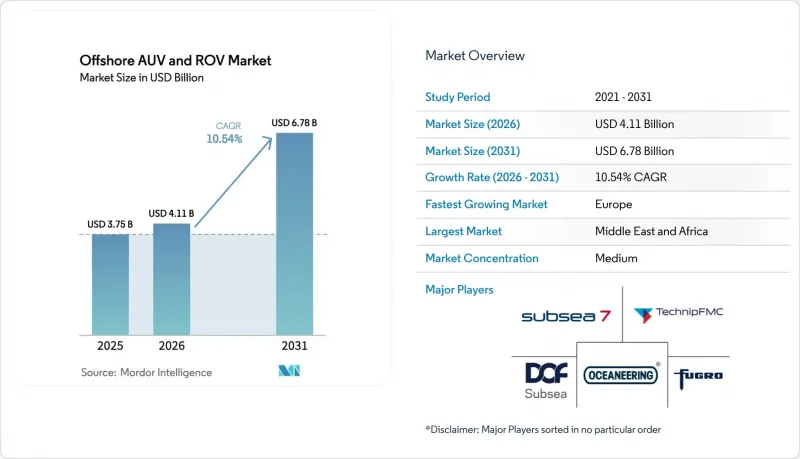
本報告按車輛類型(ROV 和 AUV)、車輛等級(作業級和觀察級)、深度容差(淺水、中水、深水)、推進系統(電動、液壓、混合動力)、活動(檢查、修理、維護等)、最終用戶應用(石油和天然氣、離岸風電等)和地區(中東和非洲、歐洲等)進行分類。
全球海上自主水下航行器(AUV)及遙控水下航行器(ROV)市場趨勢及洞察
從 2024 年開始,隨著原油價格的復甦,預計深海探勘和生產 (E&P) 投資將大幅成長。
預計2025年布蘭特原油價格將穩定在每桶80美元以上,此前因疫情引發的經濟衰退而停滯的超深水項目的最終投資決策預計將會恢復。巴西石油公司(Petrobras)累計1,020億美元用於2024年至2028年的資本支出,其中80%將用於深度超過2,000公尺的鹽鹽層下油田。這些油田分別需要高耐久性的遙控潛水器(ROV)進行立管安裝和採油樹干預作業。雪佛龍公司計劃在2026年將上游資本支出增加10%,優先推進其在墨西哥灣的回接項目和西非的探勘項目。這些項目需要使用固定式巡檢無人機來最大限度地減少鑽機的運作。預計到2027年,全球海上資本支出將達到1,800億美元,比2023年成長22%。深水項目預計將佔這一成長的60%。由於拆除計畫的推遲,北海老舊平台的運作得以延長,因此對能夠評估疲勞程度和封裝暫停中油井的檢查型水下機器人的需求仍然存在。
歐洲、亞太地區和美國的離岸風力發電裝置容量正在加速擴張。
根據全球風力發電理事會(GWEC)的數據,2024年新增離岸風力發電裝置容量為35吉瓦,其中歐洲和中國佔28吉瓦。國際能源總署(IEA)預測,隨著固定式和浮體式海上風電場投入商業運作,到2027年,新增年裝置容量將超過40吉瓦。英國的道格灘專案裝置容量為3.6吉瓦,需要使用配備多波束聲吶和海底剖面儀的電動水下航行器(AUV)對電纜埋設狀態進行全年檢驗。丹麥的「能源島」舉措目標是到2030年實現10吉瓦的裝置容量,並根據Energinet標準,強制要求對陣列間電纜進行即時檢測,以維持電網可靠性。日本在2025年劃定了11個離岸風電促進區,為此,三菱重工正在使用遙控水下航行器(ROV)對易受颱風影響海域的浮體式平台錨碇狀態進行驗證測試。為響應台灣到 2026 年實現 5.6 吉瓦裝機容量的目標,Austoed 和 JERA 已簽訂契約,組建一支專門的海底勘測船隊,用於在強流環境下進行沖刷監測。
禁止在加州、紐西蘭和歐盟部分地區發放淺水油氣開發許可證。
加州透過第N-82-20號行政命令將海上鑽探禁令延長至2030年。此舉凍結了州屬水域內的新租賃,並減少了聖塔芭芭拉海峽淺水區對水下機器人(ROV)的需求。紐西蘭《皇家礦產法》修正案於2024年永久禁止新的海上探勘,並將水下機器人技術的應用轉向塔拉納基盆地老舊資產的退役。丹麥根據其氣候協議,於2024年停止了北海的新許可證競標,並加快了平台退役進度。儘管探勘活動減少,但由於歐盟指令2013/30/EU等法規強制要求進行油井封裝和結構拆除,水下機器人在退役作業中的應用仍在繼續。
細分市場分析
到2025年,ROV將佔據海上AUV和ROV市場佔有率的90.8%,這主要得益於其在閥門激活和熱管作業等即時操作任務中的不可或缺性。然而,隨著業者將AUV廣泛應用於管道勘測和環境監測,海上自主平台AUV和ROV市場預計將以13.5%的複合年成長率成長。巴西石油公司(Petrobras)計劃在2025年部署12艘AUV,用於繪製具有探勘前景的鹽鹽層下區域地圖,與拖曳式陣列相比,這將降低50%的勘測成本。監管方面的澄清工作也在推進中,正在進行的國際海事組織(IMO)SOLAS公約修正案預計將把自主水下航行器歸類為無人系統,這有望降低保險門檻並加速其部署。
海上自主水下航行器(AUV)和遙控水下航行器(ROV)產業正日益分化。有線作業ROV正發展成為具有力回饋控制的移動機械手臂,而自主航行器則作為感測器融合中心,整合合成孔徑聲吶和磁力計等設備。像薩博的「劍齒虎」(Sabertooth)這樣的混合模式可以在有線和無線模式之間切換。美國海軍已訂購了價值2500萬美元的同類型航行器,用於2025年的掃雷作業。預計國防規範將逐步應用於商業標準,從而進一步提升對雙模多功能性的需求。
至2025年,作業級ROV將佔海上AUV和ROV市場的74.2%,預計2031年將維持主導地位,年複合成長率達12.1%。輕型作業級ROV主要用於淺水離岸風力發電電場的電纜檢測和閥門操作,而重型作業級ROV則用於巴西和西非4000公尺深處的立管連接作業。諸如Soil Machine Dynamics公司的eWROV等電動作業級ROV可將甲板重量減輕40%,從而使其能夠從較小的DP-1級船舶上部署,並降低每日租賃成本。
由於營運商更傾向於使用多功能作業平台,無需重新部署即可在雷射測量和切割作業之間切換,因此對觀測級車輛的需求成長緩慢。富格羅公司的「藍色精華」(Blue Essence)就是一個模組化作業平台結構的典型例子,它允許互換研磨機和雷射掃描儀,有助於降低營運成本。基於OSPAR標準的環保排放法規正在加速向電動驅動的轉型,進一步推動了對作業平台的需求。
區域分析
到2025年,中東和非洲地區將佔總銷售額的36.1%,成為最大的市場。這主要得益於沙烏地阿美Marjan擴建計畫和卡達能源North Field East計畫需要80多台作業級ROV用於海底採油樹安裝和輸油管線監測。阿布達比國家石油公司(ADNOC)於2025年授予七家海底工程公司的價值16.5億美元的EPC契約,凸顯了該地區對200公里基礎設施永久性檢測無人機的重視。奈及利亞的Bonga Southwest油田和南非的Burulpada探勘區進一步推動了對深海ROV的需求,而埃及的Zol氣田則持續產生多年的IRM(檢查、維護和維修)需求。政治風險和能源轉型政策限制了長期成長潛力,但短期油氣投資仍然強勁。
在歐洲,離岸風力發電的擴張和北海風力渦輪機的強制退役推動了該領域最高的年複合成長率(CAGR)。在多格爾灘計畫的最後階段,使用具備掃描功能的自主水下航行器(AUV)進行持續的電纜健康檢查至關重要。挪威的「Hydrone-R」駐場無人機每年可在惡劣環境下減少40天的船舶運作時間。丹麥的克里格斯弗拉克計畫和德國7吉瓦波羅的海競標計畫推動了對淺水作業車輛的需求成長,而法國的浮式風電試點計畫則需要使用AUV進行錨碇監測。歐盟委員會的《歐斯帕公約》規定,發電設施停運後三年內必須拆除相關結構,因此需要迅速部署浮動式風力發電航行器(ROV)進行拆除工作。
亞太地區、南美洲和北美洲共同佔據了剩餘的近海AUV和ROV市場。中國計劃在2025年安裝6.3吉瓦的離岸風力發電,並已在強流區域部署ROV進行動態電纜鋪設。在日本五島近海的一個浮動式風力發電試驗計畫中,AUV正被用來檢查能夠抵禦颱風的錨碇設施。巴西每天從鹽層下油田生產290萬桶原油,需要在水深超過2000公尺的深海區域使用ROV進行作業。在美國墨西哥灣,成熟油田的ROV需求依然旺盛,而東岸的離岸風力發電計畫也帶來了新的檢查需求。加拿大已為其未來ROV部署奠定了基礎,並計劃於2025年在其大西洋沿岸省份啟動探勘租賃項目。
其他好處:
- Excel格式的市場預測(ME)表
- 3個月的分析師支持
目錄
第1章:引言
- 研究假設和市場定義
- 調查範圍
第2章:調查方法
第3章執行摘要
第4章 市場狀況
- 市場概覽
- 市場促進因素
- 從 2024 年開始,隨著原油價格回升,預計對深海探勘和生產 (E&P) 的投資將大幅成長。
- 歐洲、亞太地區和美國正在加速部署離岸風力發電設施。
- ROC/USV-AUV 工作流程可降低遠端操作成本 40% 以上。
- 在水下1公里深處安裝的永久性水下機器人基地(Equinor和Petrobras的試點計畫)
- 人工智慧驅動的多模態偵測車輛可減少 IRM 停機時間。
- 增加國防預算以保護水下基礎設施(AUKUS,北約)
- 市場限制因素
- 禁止在加州、紐西蘭和歐盟部分地區進行淺水油氣鑽探。
- 全球深放電鋰離子電池(經認證可用於潛水艇)供應短缺
- 由於關稅,特種合金和伺服馬達的進口成本飆升(美國,2025)。
- 聲頻譜擁塞阻礙了棕地。
- 供應鏈分析
- 技術展望
- 監理情勢
- 波特五力模型
第5章 市場規模與成長預測
- 車輛類型
- ROV
- AUV
- 按車輛類別
- 工人階級
- 輕體力勞動班
- 中等規模的工作級別
- 重體力勞動等級
- 天文台課程
- 工人階級
- 按詳細程度
- 淺海(水深300公尺以下)
- 中層水域(300-1000公尺)
- 深海(深度超過1000公尺)
- 透過推進系統
- 電的
- 油壓
- 混合
- 按活動
- 挖掘與開發
- 施工/安裝
- 檢查、維修和維護 (IRM)
- 退休
- 環境監測
- 透過最終用戶應用程式
- 石油和天然氣
- 離岸風力發電
- 國防與安全
- 研究與學術
- 水產養殖和海洋基礎設施
- 按地區
- 北美洲
- 美國
- 加拿大
- 墨西哥
- 歐洲
- 英國
- 挪威
- 丹麥
- 德國
- 法國
- 俄羅斯
- 其他歐洲國家
- 亞太地區
- 中國
- 印度
- 日本
- 韓國
- 東南亞國協
- 其他亞太國家
- 南美洲
- 巴西
- 阿根廷
- 哥倫比亞
- 其他南美國家
- 中東和非洲
- 沙烏地阿拉伯
- 阿拉伯聯合大公國
- 卡達
- 南非
- 埃及
- 奈及利亞
- 其他中東和非洲國家
- 北美洲
第6章 競爭情勢
- 市場集中度
- 策略趨勢(併購、聯盟、購電協議)
- 市場佔有率分析(主要公司的市場排名和佔有率)
- 公司簡介
- Oceaneering International Inc.
- Subsea 7 SA
- Fugro NV
- TechnipFMC plc
- DOF Subsea AS
- DeepOcean AS
- Saipem SpA
- Helix Energy Solutions Group Inc.
- Kongsberg Maritime
- Saab AB(Ocean-eye)
- Teledyne Technologies Inc.
- Forum Energy Technologies
- Soil Machine Dynamics(SMD)
- Nauticus Robotics Inc.
- Ocean Infinity
- Reach Subsea
- IKM Subsea
- Modus Subsea Services
- Bluefin Robotics
- SeaRobotics Corp.
第7章 市場機會與未來展望
According to Mordor Intelligence, the offshore AUV and ROV market size is valued at USD 4.11 billion in 2026 and is projected to reach USD 6.78 billion by 2031, registering a 10.54% CAGR over the forecast period, underscoring the sector's rapid monetization curve and resilient demand drivers.
This report is Segmented by Vehicle Type (ROV and AUV), Vehicle Class (Work-Class Vehicle and Observatory-Class Vehicles), Depth Rating (Shallow, Mid-Water, and Deep-Water), Propulsion System (Electric, Hydraulic, and Hybrid), Activity (Inspection, Repair, and Maintenance, and More), End-User Application (Oil and Gas, Offshore Wind, and More), and Geography (Middle East and Africa, Europe, and More).
Global Offshore AUV And ROV Market Trends and Insights
Upsurge In Deep-Water E&P Spending Post-2024 Oil-Price Recovery
Brent crude stabilized above USD 80 per barrel through 2025, reinstating final investment decisions on ultra-deep projects that had stalled during the pandemic downturn. Petrobras allocated USD 102 billion for 2024-2028 capital spending, with 80% directed to pre-salt fields exceeding 2,000 meters, each requiring heavy-duty work-class ROVs for riser installation and tree intervention. Chevron raised upstream capex by 10% for 2026, prioritizing Gulf of Mexico tie-backs and West African prospects that demand resident inspection drones to minimize rig time. Global offshore capital expenditure is projected to climb to USD 180 billion by 2027, a 22% rise over 2023, with deep-water projects accounting for 60% of incremental spending. Extended field life for aging North Sea platforms, owing to delayed decommissioning, is sustaining demand for inspection ROVs capable of evaluating fatigue and plugging suspended wells.
Accelerating Offshore Wind Capacity Build-Outs In Europe, APAC & U.S.
The Global Wind Energy Council recorded 35 GW of new offshore wind commissioned in 2024, with Europe and China delivering 28 GW. The International Energy Agency projects annual additions above 40 GW by 2027 as fixed-bottom and floating arrays reach commercial operation. The United Kingdom's Dogger Bank, at 3.6 GW, requires year-round cable-burial verification via electric-propulsion AUVs outfitted with multibeam sonar and sub-bottom profilers. Denmark's Energy Island initiative aims for 10 GW by 2030, mandating real-time inspections of inter-array cables to preserve grid reliability under Energinet standards. Japan designated 11 promotion zones in 2025, prompting Mitsubishi Heavy Industries to trial ROVs for floating-platform mooring checks in typhoon-exposed waters. Taiwan's 5.6 GW target by 2026 has driven Orsted and JERA to contract dedicated subsea fleets for scour monitoring in high-current environments.
Shallow-Water O&G Licence Bans In California, New Zealand, Parts Of EU
California extended its offshore drilling moratorium to 2030 via Executive Order N-82-20, freezing new leases within state waters and curtailing shallow-water ROV demand in the Santa Barbara Channel. New Zealand's Crown Minerals Act amendment imposed a permanent ban on new offshore exploration in 2024, re-directing subsea robotics toward decommissioning of legacy Taranaki basin assets. Denmark halted new North Sea licensing rounds in 2024 under its Climate Agreement, accelerating platform removal timelines. Although exploration declines, regulatory directives such as EU Directive 2013/30/EU obligate well plugging and structure removal, sustaining ROV utilization for abandonment campaigns.
Other drivers and restraints analyzed in the detailed report include:
- Remote-Operations Cost Savings above 40% Via ROC/USV-AUV Workflows
- AI-Enabled Multi-Modal Inspection Vehicles Reducing IRM Downtime
- Tight Global Supply Of Deep-Rated Li-Ion Batteries (Subsea Qualified)
For complete list of drivers and restraints, kindly check the Table Of Contents.
Segment Analysis
ROVs captured 90.8% of the offshore AUV and ROV market share in 2025, a testament to their indispensability for real-time manipulation tasks such as valve actuation and hot-stab operations. The offshore AUV and ROV market size for autonomous platforms, however, is projected to expand at a 13.5% CAGR as operators deploy AUVs for wide-area pipeline surveys and environmental monitoring. Petrobras deployed 12 AUVs in 2025 to map pre-salt prospects, lowering survey costs by 50% compared to towed arrays. Regulatory clarity is emerging: pending IMO SOLAS amendments would classify autonomous subsea vehicles as unmanned systems, potentially easing insurance hurdles and accelerating uptake.
The offshore AUV and ROV industry is witnessing a bifurcation: tethered work-class ROVs evolve into mobile manipulators with force-feedback control, while autonomous vehicles serve as sensor-fusion hubs integrating synthetic-aperture sonar and magnetometers. Hybrid models like Saab's Sabertooth can toggle between tethered and untethered modes; the U.S. Navy ordered USD 25 million worth of such units for mine neutralization in 2025. Defense specifications are expected to cascade into commercial standards, reinforcing demand for dual-mode versatility.
Work-class ROVs held 74.2% of the offshore AUV and ROV market size in 2025 and will retain leadership with a projected 12.1% CAGR to 2031. Light work-class units dominate cable inspections and valve manipulations in shallow-water wind farms, while heavy work-class vehicles manage riser connections at 4,000-meter depths in Brazil and West Africa. Electric work-class variants such as Soil Machine Dynamics' eWROV reduce deck weight by 40%, enabling deployment from smaller DP-1 vessels and lowering daily charter rates.
Observatory-class vehicles trail as operators favor multi-role work-class platforms that can shift between laser metrology and cutting tasks without re-mobilization. Fugro's Blue Essence exemplifies modular work-class architecture capable of carrying a grinder or laser scanner interchangeably, trimming campaign costs. Environmental discharge regulations under OSPAR are accelerating the transition to electric actuation, further reinforcing work-class demand.
Complete Report Scope:
- By Vehicle Type
- ROV
- AUV
- By Vehicle Class
- Work-class
- Light Work-class
- Medium Work-class
- Heavy Work-class
- Observatory-class
- Work-class
- By Depth Rating
- Shallow (Up to 300 m)
- Mid-water (300 to 1,000 m)
- Deep-water (Above 1,000 m)
- By Propulsion System
- Electric
- Hydraulic
- Hybrid
- By Activity
- Drilling and Development
- Construction and Installation
- Inspection, Repair and Maintenance (IRM)
- Decommissioning
- Environmental Monitoring
- By End-user Application
- Oil and Gas
- Offshore Wind
- Defense and Security
- Research and Academia
- Aquaculture and Marine Infrastructure
- By Geography
- North America
- United States
- Canada
- Mexico
- Europe
- United Kingdom
- Norway
- Denmark
- Germany
- France
- Russia
- Rest of Europe
- Asia-Pacific
- China
- India
- Japan
- South Korea
- ASEAN Countries
- Rest of Asia-Pacific
- South America
- Brazil
- Argentina
- Colombia
- Rest of South America
- Middle East and Africa
- Saudi Arabia
- United Arab Emirates
- Qatar
- South Africa
- Egypt
- Nigeria
- Rest of Middle East and Africa
- North America
Geography Analysis
Middle East and Africa led with 36.1% of revenue in 2025 as Saudi Aramco's Marjan expansion and Qatar Energy's North Field East project required more than 80 work-class ROVs for subsea-tree installation and flowline monitoring. ADNOC's USD 1.65 billion EPC contract awarded to Subsea 7 in 2025 underscores the region's commitment to resident inspection drones for 200 kilometers of infrastructure. Nigeria's Bonga Southwest field and South Africa's Brulpadda prospect add further pull for deep-water ROVs, while Egypt's Zohr gas continues to generate multiyear IRM demand. Political risk and energy-transition policies temper long-term upside, but near-term hydrocarbon spend remains strong.
Europe is forecast to post the fastest CAGR at 18.7% through 2031, driven by offshore wind expansion and North Sea decommissioning mandates. Dogger Bank's final phase necessitates continuous cable integrity checks via scanning AUVs. Norway's Hydrone-R resident drone reduces vessel days by 40 per year in harsh conditions. Denmark's Kriegers Flak and Germany's 7 GW Baltic auctions intensify demand for shallow-rated vehicles, while France's floating-wind pilots require AUV-mediated mooring surveillance. OSPAR Commission rules stipulate structure removal within three years of production cessation, pushing rapid ROV mobilization for dismantling.
Asia-Pacific, South America, and North America share the remainder of the offshore AUV and ROV market. China installed 6.3 GW of offshore wind in 2025, deploying ROVs for dynamic cable burial in high-current zones. Japan's floating-wind pilots off Goto rely on AUVs for typhoon-resilient mooring inspection. Brazil produced 2.9 million barrels per day from pre-salt assets, necessitating deep-water ROV support at depths beyond 2,000 meters. The U.S. Gulf of Mexico sustains ROV demand for mature assets, and the East Coast wind pipeline is triggering new inspection requirements. Canada initiated exploratory leasing in Atlantic provinces in 2025, laying the groundwork for future ROV deployments.
- Oceaneering International Inc.
- Subsea 7 SA
- Fugro NV
- TechnipFMC plc
- DOF Subsea AS
- DeepOcean AS
- Saipem SpA
- Helix Energy Solutions Group Inc.
- Kongsberg Maritime
- Saab AB (Ocean-eye)
- Teledyne Technologies Inc.
- Forum Energy Technologies
- Soil Machine Dynamics (SMD)
- Nauticus Robotics Inc.
- Ocean Infinity
- Reach Subsea
- IKM Subsea
- Modus Subsea Services
- Bluefin Robotics
- SeaRobotics Corp.
Additional Benefits:
- The market estimate (ME) sheet in Excel format
- 3 months of analyst support
TABLE OF CONTENTS
1 Introduction
- 1.1 Study Assumptions & Market Definition
- 1.2 Scope of the Study
2 Research Methodology
3 Executive Summary
4 Market Landscape
- 4.1 Market Overview
- 4.2 Market Drivers
- 4.2.1 Upsurge in deep-water E&P spending post-2024 oil-price recovery
- 4.2.2 Accelerating offshore wind capacity build-outs in Europe, APAC & U.S.
- 4.2.3 Remote-operations cost savings above 40 % via ROC/USV-AUV workflows
- 4.2.4 Resident subsea robotics hubs at ?1 km depth (Equinor, Petrobras pilots)
- 4.2.5 AI-enabled multi-modal inspection vehicles reducing IRM downtime
- 4.2.6 Growing defense budgets for seabed-infrastructure protection (AUKUS, NATO)
- 4.3 Market Restraints
- 4.3.1 Shallow-water O&G licence bans in California, New Zealand, parts of EU
- 4.3.2 Tight global supply of deep-rated Li-ion batteries (sub-sea qualified)
- 4.3.3 Tariff-driven surge in specialty-alloy & servo-motor import costs (US-2025)
- 4.3.4 Acoustic spectrum crowding hindering reliable subsea comms in brownfields
- 4.4 Supply-Chain Analysis
- 4.5 Technological Outlook
- 4.6 Regulatory Landscape
- 4.7 Porter's Five Forces
- 4.7.1 Bargaining Power of Suppliers
- 4.7.2 Bargaining Power of Buyers
- 4.7.3 Threat of New Entrants
- 4.7.4 Threat of Substitutes
- 4.7.5 Competitive Rivalry
5 Market Size & Growth Forecasts
- 5.1 By Vehicle Type
- 5.1.1 ROV
- 5.1.2 AUV
- 5.2 By Vehicle Class
- 5.2.1 Work-class
- 5.2.1.1 Light Work-class
- 5.2.1.2 Medium Work-class
- 5.2.1.3 Heavy Work-class
- 5.2.2 Observatory-class
- 5.2.1 Work-class
- 5.3 By Depth Rating
- 5.3.1 Shallow (Up to 300 m)
- 5.3.2 Mid-water (300 to 1,000 m)
- 5.3.3 Deep-water (Above 1,000 m)
- 5.4 By Propulsion System
- 5.4.1 Electric
- 5.4.2 Hydraulic
- 5.4.3 Hybrid
- 5.5 By Activity
- 5.5.1 Drilling and Development
- 5.5.2 Construction and Installation
- 5.5.3 Inspection, Repair and Maintenance (IRM)
- 5.5.4 Decommissioning
- 5.5.5 Environmental Monitoring
- 5.6 By End-user Application
- 5.6.1 Oil and Gas
- 5.6.2 Offshore Wind
- 5.6.3 Defense and Security
- 5.6.4 Research and Academia
- 5.6.5 Aquaculture and Marine Infrastructure
- 5.7 By Geography
- 5.7.1 North America
- 5.7.1.1 United States
- 5.7.1.2 Canada
- 5.7.1.3 Mexico
- 5.7.2 Europe
- 5.7.2.1 United Kingdom
- 5.7.2.2 Norway
- 5.7.2.3 Denmark
- 5.7.2.4 Germany
- 5.7.2.5 France
- 5.7.2.6 Russia
- 5.7.2.7 Rest of Europe
- 5.7.3 Asia-Pacific
- 5.7.3.1 China
- 5.7.3.2 India
- 5.7.3.3 Japan
- 5.7.3.4 South Korea
- 5.7.3.5 ASEAN Countries
- 5.7.3.6 Rest of Asia-Pacific
- 5.7.4 South America
- 5.7.4.1 Brazil
- 5.7.4.2 Argentina
- 5.7.4.3 Colombia
- 5.7.4.4 Rest of South America
- 5.7.5 Middle East and Africa
- 5.7.5.1 Saudi Arabia
- 5.7.5.2 United Arab Emirates
- 5.7.5.3 Qatar
- 5.7.5.4 South Africa
- 5.7.5.5 Egypt
- 5.7.5.6 Nigeria
- 5.7.5.7 Rest of Middle East and Africa
- 5.7.1 North America
6 Competitive Landscape
- 6.1 Market Concentration
- 6.2 Strategic Moves (M&A, Partnerships, PPAs)
- 6.3 Market Share Analysis (Market Rank/Share for key companies)
- 6.4 Company Profiles (includes Global level Overview, Market level overview, Core Segments, Financials as available, Strategic Information, Products & Services, and Recent Developments)
- 6.4.1 Oceaneering International Inc.
- 6.4.2 Subsea 7 SA
- 6.4.3 Fugro NV
- 6.4.4 TechnipFMC plc
- 6.4.5 DOF Subsea AS
- 6.4.6 DeepOcean AS
- 6.4.7 Saipem SpA
- 6.4.8 Helix Energy Solutions Group Inc.
- 6.4.9 Kongsberg Maritime
- 6.4.10 Saab AB (Ocean-eye)
- 6.4.11 Teledyne Technologies Inc.
- 6.4.12 Forum Energy Technologies
- 6.4.13 Soil Machine Dynamics (SMD)
- 6.4.14 Nauticus Robotics Inc.
- 6.4.15 Ocean Infinity
- 6.4.16 Reach Subsea
- 6.4.17 IKM Subsea
- 6.4.18 Modus Subsea Services
- 6.4.19 Bluefin Robotics
- 6.4.20 SeaRobotics Corp.
7 Market Opportunities & Future Outlook
- 7.1 White-space & Unmet-need Assessment

 海上自主水下航行器/遙控水下航行器市場-2026-2032年全球市場預測
 海上AUV/ROV市場分析及預測(至2035年):依類型、產品、服務、技術、組件、應用、最終用戶、功能、部署及解決方案分類
 海上IRM AUV & ROV市場規模、佔有率、成長及全球產業分析:依類型、深度、應用和地區劃分的洞察與預測(2026-2034)
 海上AUV和ROV市場-全球產業規模、佔有率、趨勢、機會及預測(按推進系統、深度、應用、最終用戶、地區和競爭格局分類,2021-2031年)
 中東和非洲的 AUV 和 ROV:市場佔有率分析、行業趨勢、統計和成長預測(2025-2030 年)亞太地區 AUV 和 ROV:市場佔有率分析、行業趨勢和統計、成長預測(2025-2030 年)北美 AUV 和 ROV:市場佔有率分析、行業趨勢和統計、成長預測(2025-2030 年)南美 AUV 和 ROV:市場佔有率分析、行業趨勢和統計、成長預測(2025-2030 年)歐洲 AUV 和 ROV:市場佔有率分析、行業趨勢和統計、成長預測(2025-2030 年)