


 |
市場調查報告書
商品編碼
2121445
X光管:市場佔有率分析、產業趨勢與統計、成長預測(2026-2031年)X-Ray Tube - Market Share Analysis, Industry Trends & Statistics, Growth Forecasts (2026 - 2031) |
||||||

※ 本網頁內容可能與最新版本有所差異。詳細情況請與我們聯繫。
根據 Mordor Intelligence 預測,X光管市場規模預計將在 2025 年達到 36.4 億美元,2026 年達到 37.8 億美元,2031 年達到 47.7 億美元,在預測期內複合年成長率為 4.76%。
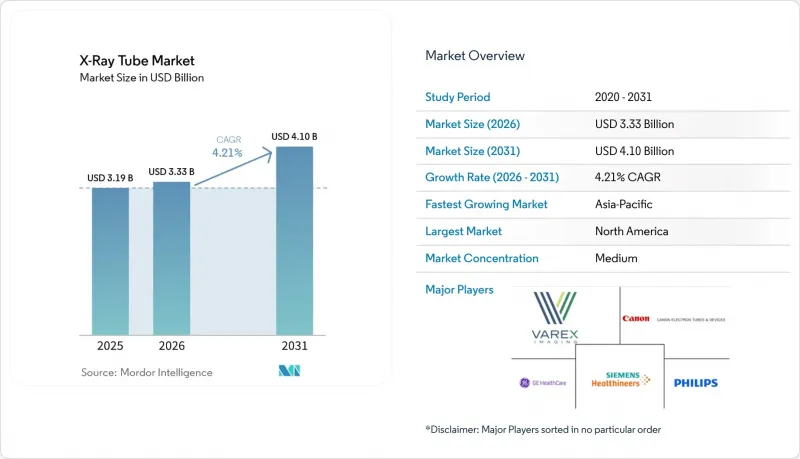
本報告按管型(旋轉陽極管、固定陽極管等)、組件(陰極組件、陽極/靶、管殼等)、應用(電腦斷層掃描、數位放射線攝影、移動式C臂/透視設備等)、終端用戶行業(醫院和醫療系統、診斷影像中心等)以及地區進行細分。市場預測以美元計價。
全球X光管市場趨勢及洞察
全球慢性疾病負擔日益加重,需要進行診斷性影像檢查
目前,心血管疾病、腫瘤和呼吸系統疾病佔全球死亡人數的70%以上,導致CT血管造影術、胸部X光和乳房X光檢查的增加,直接推動了X光管市場的需求。國際癌症研究機構(IARC)預測,到2040年,全球每年將新增2,840萬例癌症病例,這意味著全球將需要額外15,000台CT掃描儀和相應的X光管。 65歲以上人口接受影像檢查的頻率是年輕人的三倍,這種人口結構的變化將長期推動篩檢業務的成長。中國和印度政府已將影像能力置於國家衛生戰略的核心地位,並在其政策藍圖中納入了X光管採購目標。在成熟市場,基於價值的支付模式鼓勵早期診斷,即使每次掃描的報銷率有所提高,反而會促進篩檢的增加。
加速數位化X光成像和多切面CT系統的升級週期
在北美和歐洲,隨著醫療機構轉向需要高頻發生器和脈衝曝光管的基於檢測器的工作流程,類比放射成像設備正以每年 8-10% 的速度被淘汰。雖然多切面CT 掃描儀在已開發國家的普及率已接近 80%,但從 64 層到 256 層系統的轉變需要升級 X光管,以適應更快的機架旋轉和雙能量協議。Canon將於 2024 年推出的 0.25 毫米焦距 CT 掃描儀凸顯了掃描儀創新如何推動 X 光管設計沿著性能曲線發展。在新興市場,膠片的完全淘汰以及 90% 的新檢查室採用數位放射成像設備,推動了對入門級 X光管替換件的需求成長。此外,歐盟法規強制要求具備劑量報告功能,導致現有模擬設備及其相關 X 光管庫存逐漸淘汰。
嚴格的醫療設備認證和輻射安全法規
國際電工委員會(IEC)對診斷X光設備安全標準的修訂顯著降低了標準測量距離下的允許輻射洩漏量,迫使製造商重新設計屏蔽裝置並延長合格評定週期。這些變更通常會延長檢驗週期,可能導致產品上市延遲長達一年。美國食品藥物管理局(FDA)的510(k)審查現在強制要求在連續運行期間進行熱測試,迫使供應商投資高達100萬美元用於加速壽命測試設備。歐洲醫療設備法規(MDR)對所有醫療設備施加了上市後監測和單一器材標誌(UDI)要求,給參與企業帶來了沉重的合規成本負擔。中國國家藥品監督管理局(NMPA)引入了國產化率標準,迫使外國供應商轉向本地生產,否則將犧牲市場佔有率。這些法規共同導致產品更新周期延長和固定成本增加,減緩了X光管市場的短期成長。
細分市場分析
在這一細分市場中,旋轉陽極X光管的銷售量最大,預計到2025年將佔X光管市場佔有率的52.63%。這主要歸功於其5兆焦耳的熱容量,使其適用於多切面CT的工作負載。冷陰極場發射X光管預計將以5.13%的複合年成長率成長,成為成長最快的類別,因為瞬時啟動的奈米碳管發送器消除了燈絲燒斷,並實現了用於固定式CT的緊湊型多源陣列。固定陽極X光管由於面積小、功耗低,仍廣泛應用於牙科和可攜式成像領域,使其適用於臨床應用,但隨著數位檢測器縮短曝光時間,其市場佔有率正在逐漸下降。微焦點X光管為工業無損檢測和分析提供了一個細分市場,其焦點小於10微米,可用於分辨複合材料材料和生物樣本中的微裂紋。
Excillum 的 MetalJet 系統是突破性潛力的典範。該系統採用自癒式鎵銦陽極,可承受高達固體靶材 10 倍的功率密度,亮度水準達到以往只有同步加速器才能企及的水平。攜帶式奈米碳管陰極消除了預熱延遲,並將電池消耗降低了 30%,這對於災害緊急部署至關重要。監管機構高度重視冷陰極的安全優勢,因為無需燈絲電路簡化了電氣隔離,並有助於符合 IEC 60601-1-2 標準。性能、運轉率和合規性方面的綜合優勢預計將加速冷陰極的普及應用,最終重塑 X光管市場的競爭格局。
作為主要的散熱和輻射屏蔽層,管殼和包覆層在2025年佔銷售額的30.26%,而陰極組件的成長速度更快,到2031年複合年成長率將達到5.21%。分配器式陰極將氧化鋇發送器嵌入多孔鎢中,可保持長達50,000小時的穩定發射,並實現光子計數CT所需的更窄聚焦光斑。鎢錸靶材仍佔組件成本的約三分之二,由於全球供應商少於五家,製造商正在尋求垂直整合以確保原料供應並維持利潤率。
在額定能量高於 4 兆焦耳的 X光管中,液態金屬軸承正迅速取代滾珠軸承,消除機械磨損和振動,並將使用壽命延長至 10 萬次循環。Canon的鉬基陽極底層設計減少了高運轉率X 光攝影中的焦點軌跡裂紋,展現了精細的材料調整如何帶來競爭優勢。轉子和定子系統現在採用磁浮技術,可實現機架以每秒 4 轉的速度靜音旋轉。這對於 24 小時運作的心臟 CT 室來說是一項重要的賣點。模組化架構允許現場僅更換陰極或陽極,而無需更換整個 X光管,從而減少了停機時間,並符合主導 X光管市場的以結果為導向的服務模式。
區域分析
預計到2025年,北美將佔全球銷售額的40.26%。這主要得益於需要更換2010年至2015年間安裝的CT掃描儀,以及聯邦政府撥款30億美元用於地方醫院現代化改造,其中影像設備是重點。一項涵蓋每年3000萬次CT掃描的劑量指數登記系統,正迫使醫療機構採用針對低劑量運行最佳化的X光管,進一步推動了設備升級。加拿大聯合採購的整合雖然給供應商的利潤率帶來了壓力,但也促進了X光管型號的標準化,簡化了供應鏈,並提高了業務收益。
亞太地區是成長最快的地區,預計到2031年複合年成長率將達到4.22%。中國的「健康中國2030」計畫累計1,500億美元,用於興建1萬個新的區域醫療中心。每個中心都將配備採用國產球管的數位化X光和CT室。印度的「阿尤斯曼·巴拉特」(Ayushman Bharat)計劃為5000家地區醫院的診斷成像提供補貼,翻新掃描儀得到廣泛應用,擴大了二手球管市場。在日本,由於人口老化,更換需求保持穩定,但由於醫院合併,醫療設施數量減少,購買力增強。泰國和新加坡的醫療旅遊業正在推動高階CT和檢查室的需求,主要針對自費外國患者。
歐洲在全球市場中扮演著舉足輕重的角色,其中德國、法國和英國是該地區的主要銷售貢獻者。東歐市場正經歷成長,這得益於歐盟用於醫療基礎設施現代化建設的結構基金。在中東,「沙烏地阿拉伯2030願景」計畫和阿拉伯聯合大公國的醫療旅遊計畫正在推動市場發展,但地緣政治風險限制著長期訂單的達成。在非洲,CT掃描儀的普及率仍然很低,整個非洲大陸的CT掃描儀數量不足2000台,但得益於多邊融資,首個大型採購項目已經啟動,為X光管市場的長期發展奠定了基礎。
其他好處:
- Excel格式的市場預測(ME)表
- 3個月的分析師支持
目錄
第1章:引言
- 研究假設和市場定義
- 調查範圍
第2章:調查方法
第3章執行摘要
第4章 市場狀況
- 市場概覽
- 市場促進因素
- 全球慢性疾病負擔日益加重,需要進行影像影像檢查。
- 高熱旋轉陽極設計的性能快速提升
- 加速數位化X光成像設備和多切面CT系統的升級換代。
- 擴大新興國家的醫療保健基礎設施
- 人工智慧驅動的預測性維護經營模式正在擴大對管道更換的需求。
- 冷陰極多源陣列的出現正在創造新的需求領域。
- 市場限制因素
- 嚴格的醫療設備認證和輻射安全法規
- 先進管材的初始成本和維護成本都很高
- 高純度鎢錸和液相合金的供應鏈風險
- 在成熟的即時成像領域,市場佔有率正向超音波和低場磁振造影轉移。
- 產業價值鏈分析
- 監理情勢
- 技術展望
- 波特五力分析
第5章 市場規模與成長預測
- 按管型
- 旋轉陽極管
- 固定陽極管
- 微焦點管
- 冷陰極場發射管
- 按組件
- 陰極組件
- 陽極/靶材
- 管殼和外殼
- 轉子和定子
- 其他規則
- 透過使用
- 電腦斷層掃描(CT)
- 數位廣播(DR)/普通X光成像
- 移動式C臂/透視設備
- 乳房X光檢查
- 牙科影像診斷
- 安全測試和非安全測試
- 科學與研究
- 按最終用戶行業分類
- 醫院和醫療系統
- 診斷影像中心
- 門診護理及門診醫療
- 航太和國防領域的無損檢測 (NDT) 設施
- 食品和飲料檢測
- 研究機構和學術機構
- 按地區
- 北美洲
- 美國
- 加拿大
- 墨西哥
- 南美洲
- 巴西
- 阿根廷
- 其他南美國家
- 歐洲
- 德國
- 英國
- 法國
- 義大利
- 西班牙
- 其他歐洲國家
- 亞太地區
- 中國
- 日本
- 印度
- 韓國
- ASEAN
- 其他亞太國家
- 中東
- 沙烏地阿拉伯
- 阿拉伯聯合大公國
- 其他中東國家
- 非洲
- 南非
- 奈及利亞
- 其他非洲國家
- 北美洲
第6章 競爭情勢
- 市場集中度
- 策略趨勢
- 市佔率分析
- 公司簡介
- Varex Imaging Corporation
- GE Healthcare Technologies Inc.
- Siemens Healthineers AG
- Canon Electron Tubes & Devices Co., Ltd.
- Koninklijke Philips NV
- Comet Holding AG
- Philips Medical Systems BV(Dunlee)
- Toshiba Electron Tubes & Devices Co., Ltd.
- Hangzhou Wandong Medical Equipment Co., Ltd.
- IAE Indsutrie Apparecchi Elettronici Srl
- Gulmay Limited
- Control-X Medical, Inc.
- Shimadzu Corporation
- Micro X-Ray Inc.
- Oxford Instruments plc
- Malvern Panalytical Ltd.
- Proto Manufacturing Inc.
- Lohmann X-Ray GmbH & Co. KG
- Kailong Medical Instruments Co., Ltd.
- Richardson Healthcare, Inc.
- Excillum AB
- Nanjing Keyway Electronics Co., Ltd.
- Zhuzhou Weilai New Materials Technology Co., Ltd.
第7章 市場機會與未來展望
According to Mordor Intelligence, the x-Ray tube market size stood at USD 3.64 billion in 2025, USD 3.78 billion in 2026 and is projected to reach USD 4.77 billion by 2031, translating into a 4.76% CAGR over the forecast period.
This report is Segmented by Tube Type (Rotating Anode, Stationary Anode, and More), Component (Cathode Assembly, Anode/Target, Tube Housing and Envelope, and More), Application (Computed Tomography, Digital Radiography, Mobile C-arm/Fluoroscopy, and More), End-User Industry (Hospitals and Health Systems, Diagnostic Imaging Centers, and More), and Geography. The Market Forecasts are Provided in Terms of Value (USD).
Global X-Ray Tube Market Trends and Insights
Escalating Global Burden of Chronic Diseases Necessitating Diagnostic Imaging
Cardiovascular, oncologic, and respiratory disorders now account for over 70% of global deaths, pushing CT angiography, chest radiography, and screening mammography volumes higher and directly stimulating X-Ray Tube market demand. The International Agency for Research on Cancer projects 28.4 million new cancer cases annually by 2040, implying the need for 15,000 additional CT scanners and commensurate tube inventories worldwide. Populations aged 65 years and older undergo diagnostic imaging at triple the rate of younger cohorts, a demographic shift that maintains a long runway for volume growth. Governments in China and India place imaging capacity at the center of national health strategies, embedding tube procurement targets in policy roadmaps. In mature markets, value-based payment models reward early diagnosis, which paradoxically lifts exam counts even when reimbursement per scan tightens.
Accelerating Upgrade Cycle to Digital Radiography and Multi-slice CT Systems
Analog radiography units are retiring at an 8-10% annual clip in North America and Europe as providers pivot to detector-based workflows that mandate high-frequency generators and pulsed-exposure tubes. Multi-slice CT penetration nears 80% in developed economies, yet the leap from 64-slice to 256-slice platforms forces tube upgrades to handle faster gantry rotations and dual-energy protocols. Canon's 0.25-millimeter focal-spot CT launched in 2024 spotlighted how scanner innovation pulls tube design along the performance curve. Emerging markets bypass film entirely, installing digital radiography in 90% of new rooms, thereby enlarging the replacement pool for entry-level tubes. EU regulations additionally require dose-reporting functions that obsolete legacy analog gear and its associated tube stock.
Stringent Device-Approval and Radiation-Safety Regulations
Updates to the IEC safety standard for diagnostic X-ray equipment have significantly reduced the allowable radiation leakage at a standard measurement distance, forcing manufacturers to redesign shielding and extend their compliance testing. These changes have commonly stretched validation timelines, pushing product launches back by as much as a year. FDA 510(k) review now demands continuous-duty thermal testing, forcing vendors to invest as much as USD 1 million in accelerated life-test rigs. Europe's Medical Device Regulation imposes post-market surveillance and unique device identification requirements on every device, placing a disproportionate burden on smaller entrants in terms of compliance spending. China's National Medical Products Administration rolled out domestic-content thresholds, compelling foreign suppliers to localize or cede share. Collectively, these rules slow product refresh cycles and raise fixed costs, tempering near-term X-Ray Tube market expansion.
Other drivers and restraints analyzed in the detailed report include:
- Rapid Performance Gains in High-Heat Rotating-Anode Designs
- Healthcare-Infrastructure Build-outs in Emerging Economies
- High Upfront and Service Costs of Advanced Tubes
For complete list of drivers and restraints, kindly check the Table Of Contents.
Segment Analysis
The segment generated the largest revenue from rotating anode variants, which held a 52.63% X-Ray Tube market share in 2025, due to its 5 megajoule heat capacity, suited to multi-slice CT workloads. Cold-cathode field-emission models are forecast to expand at a 5.13% CAGR, making them the most dynamic category as instant-on carbon-nanotube emitters eliminate filament burnout and permit compact multi-source arrays for stationary CT. Stationary-anode products remain prevalent in dental and portable imaging because their smaller footprints and lower power draw fit point-of-care scenarios, though their share gradually slips as digital detectors shorten exposure times. Micro-focus tubes anchor industrial nondestructive testing and research niches, delivering sub-10 µm focal-spots that resolve micro-cracks in composite airframes and biological samples.
Excillum's MetalJet system exemplifies disruptive potential, utilizing a self-healing gallium-indium anode to tolerate ten times higher power density than solid targets, unlocking brightness once limited to synchrotrons. Carbon-nanotube cathodes in portable units eliminate warm-up delay and reduce battery draw by 30%, a critical feature for disaster-response deployment. Regulatory bodies recognize the merit of cold-cathode safety advantages, as eliminating filament circuits simplifies electrical isolation, thereby easing compliance with IEC 60601-1-2. The confluence of performance, uptime, and compliance benefits is expected to accelerate cold-cathode adoption, ultimately redefining competitive boundaries in the X-Ray Tube market.
Tube housing and envelopes delivered 30.26% of 2025 revenue as the primary heat-sink and radiation-shield layers, yet cathode subassemblies are on a faster 5.21% CAGR track through 2031. Dispenser cathodes embed barium-oxide emitters in porous tungsten, maintaining stable emission for up to 50,000 hours and enabling tighter focal spots demanded by photon-counting CT. Tungsten-rhenium targets still account for roughly two-thirds of bill-of-materials cost, and with fewer than five suppliers globally, manufacturers pursue vertical integration to lock in feedstock and margin.
Liquid-metal bearings are quickly supplanting ball bearings in tubes rated above 4 megajoules, eradicating mechanical wear and vibration while extending life to 100,000 exposures. Canon's molybdenum-underlayer anode design mitigates focal-track cracking in high-duty mammography, evidence of how micro-material tweaks translate into competitive differentiation. Rotor and stator systems now use magnetic levitation to support 4-revolution-per-second gantry spins without noise, a selling point for cardiac CT suites that operate around the clock. Modular architectures that allow in-field replacement of cathode or anode only, rather than the whole tube, reduce downtime and align with outcome-based service models that dominate the X-Ray Tube market.
Complete Report Scope:
- By Tube Type
- Rotating Anode Tube
- Stationary Anode Tube
- Micro-focus Tube
- Cold-cathode Field-Emission Tube
- By Component
- Cathode Assembly
- Anode/Target
- Tube Housing and Envelope
- Rotor and Stator
- Other Components
- By Application
- Computed Tomography (CT)
- Digital Radiography (DR)/General Radiography
- Mobile C-arm/Fluoroscopy
- Mammography
- Dental Imaging
- Security and Non-Security Testing
- Scientific and Research
- By End-User Industry
- Hospitals and Health Systems
- Diagnostic Imaging Centers
- Outpatient Clinics and Ambulatory Care
- Aerospace and Defense NDT Facilities
- Food and Beverage Inspection
- Research Institutes and Academia
- By Geography
- North America
- United States
- Canada
- Mexico
- South America
- Brazil
- Argentina
- Rest of South America
- Europe
- Germany
- United Kingdom
- France
- Italy
- Spain
- Rest of Europe
- Asia-Pacific
- China
- Japan
- India
- South Korea
- ASEAN
- Rest of Asia-Pacific
- Middle East
- Saudi Arabia
- United Arab Emirates
- Rest of Middle East
- Africa
- South Africa
- Nigeria
- Rest of Africa
- North America
Geography Analysis
North America held 40.26% of 2025 revenue, buoyed by a replacement wave of CT scanners installed between 2010 and 2015 and a federal USD 3 billion rural-hospital modernization fund that prioritizes imaging equipment. Dose-index registries covering 30 million annual CT exams push providers to adopt tubes optimized for low-dose operation, adding another lever for upgrade activity. Group-purchasing consolidation in Canada compresses vendor margins yet standardizes tube models, simplifying supply chains and lifting service revenues.
Asia-Pacific is the fastest-growing region at 4.22% CAGR through 2031. China's Healthy China 2030 earmarked USD 150 billion to add 10,000 community health centers, each with digital radiography and CT rooms stocked with locally manufactured tubes. India's Ayushman Bharat subsidizes imaging for 5,000 district hospitals but often opts for refurbished scanners, expanding the secondary tube market. Japan's aging population sustains replacement volumes, though hospital mergers reduce site counts and amplify purchasing power. Medical tourism in Thailand and Singapore spurs demand for premium CT and fluoroscopy suites aimed at cash-pay international patients.
Europe plays a significant role in the global market, with Germany, France, and the United Kingdom being key contributors to the regional turnover. Eastern Europe is experiencing growth driven by EU structural funds allocated for healthcare infrastructure upgrades. The Middle East benefits from Saudi Vision 2030 and United Arab Emirates medical-tourism projects, though geopolitical risk tempers long-horizon orders. Africa remains under-penetrated with fewer than 2,000 CT scanners continent-wide, yet multilateral financing initiates the first significant procurement tranches, planting seeds for long-term X-Ray Tube market development.
- Varex Imaging Corporation
- GE Healthcare Technologies Inc.
- Siemens Healthineers AG
- Canon Electron Tubes & Devices Co., Ltd.
- Koninklijke Philips N.V.
- Comet Holding AG
- Philips Medical Systems B.V. (Dunlee)
- Toshiba Electron Tubes & Devices Co., Ltd.
- Hangzhou Wandong Medical Equipment Co., Ltd.
- I.A.E Indsutrie Apparecchi Elettronici S.r.l
- Gulmay Limited
- Control-X Medical, Inc.
- Shimadzu Corporation
- Micro X-Ray Inc.
- Oxford Instruments plc
- Malvern Panalytical Ltd.
- Proto Manufacturing Inc.
- Lohmann X-Ray GmbH & Co. KG
- Kailong Medical Instruments Co., Ltd.
- Richardson Healthcare, Inc.
- Excillum AB
- Nanjing Keyway Electronics Co., Ltd.
- Zhuzhou Weilai New Materials Technology Co., Ltd.
Additional Benefits:
- The market estimate (ME) sheet in Excel format
- 3 months of analyst support
TABLE OF CONTENTS
1 INTRODUCTION
- 1.1 Study Assumptions and Market Definition
- 1.2 Scope of the Study
2 RESEARCH METHODOLOGY
3 EXECUTIVE SUMMARY
4 MARKET LANDSCAPE
- 4.1 Market Overview
- 4.2 Market Drivers
- 4.2.1 Escalating Global Burden of Chronic Diseases Necessitating Diagnostic Imaging
- 4.2.2 Rapid Performance Gains in High-Heat Rotating-Anode Designs
- 4.2.3 Accelerating Upgrade Cycle to Digital Radiography and Multi-slice CT Systems
- 4.2.4 Healthcare-infrastructure Build-outs in Emerging Economies
- 4.2.5 AI-enabled Predictive-maintenance Business Models Expanding Tube-replacement Demand (under-the-radar)
- 4.2.6 Emergence of Cold-athode Multi-source Arrays Creating New Demand Pockets (under-the-radar)
- 4.3 Market Restraints
- 4.3.1 Stringent Device-approval and Radiation-safety Regulations
- 4.3.2 High Upfront and Service Costs of Advanced Tubes
- 4.3.3 Supply-chain Risk for High-purity Tungsten/Rhenium and Liquid-bearing Alloys (under-the-radar)
- 4.3.4 Share-shift to Ultrasound and Low-field MRI for POC Imaging in Mature Markets (under-the-radar)
- 4.4 Industry Value Chain Analysis
- 4.5 Regulatory Landscape
- 4.6 Technological Outlook
- 4.7 Porter's Five Forces Analysis
- 4.7.1 Bargaining Power of Suppliers
- 4.7.2 Bargaining Power of Buyers
- 4.7.3 Threat of New Entrants
- 4.7.4 Threat of Substitutes
- 4.7.5 Intensity of Competitive Rivalry
5 MARKET SIZE AND GROWTH FORECASTS (VALUE)
- 5.1 By Tube Type
- 5.1.1 Rotating Anode Tube
- 5.1.2 Stationary Anode Tube
- 5.1.3 Micro-focus Tube
- 5.1.4 Cold-cathode Field-Emission Tube
- 5.2 By Component
- 5.2.1 Cathode Assembly
- 5.2.2 Anode/Target
- 5.2.3 Tube Housing and Envelope
- 5.2.4 Rotor and Stator
- 5.2.5 Other Components
- 5.3 By Application
- 5.3.1 Computed Tomography (CT)
- 5.3.2 Digital Radiography (DR)/General Radiography
- 5.3.3 Mobile C-arm/Fluoroscopy
- 5.3.4 Mammography
- 5.3.5 Dental Imaging
- 5.3.6 Security and Non-Security Testing
- 5.3.7 Scientific and Research
- 5.4 By End-User Industry
- 5.4.1 Hospitals and Health Systems
- 5.4.2 Diagnostic Imaging Centers
- 5.4.3 Outpatient Clinics and Ambulatory Care
- 5.4.4 Aerospace and Defense NDT Facilities
- 5.4.5 Food and Beverage Inspection
- 5.4.6 Research Institutes and Academia
- 5.5 By Geography
- 5.5.1 North America
- 5.5.1.1 United States
- 5.5.1.2 Canada
- 5.5.1.3 Mexico
- 5.5.2 South America
- 5.5.2.1 Brazil
- 5.5.2.2 Argentina
- 5.5.2.3 Rest of South America
- 5.5.3 Europe
- 5.5.3.1 Germany
- 5.5.3.2 United Kingdom
- 5.5.3.3 France
- 5.5.3.4 Italy
- 5.5.3.5 Spain
- 5.5.3.6 Rest of Europe
- 5.5.4 Asia-Pacific
- 5.5.4.1 China
- 5.5.4.2 Japan
- 5.5.4.3 India
- 5.5.4.4 South Korea
- 5.5.4.5 ASEAN
- 5.5.4.6 Rest of Asia-Pacific
- 5.5.5 Middle East
- 5.5.5.1 Saudi Arabia
- 5.5.5.2 United Arab Emirates
- 5.5.5.3 Rest of Middle East
- 5.5.6 Africa
- 5.5.6.1 South Africa
- 5.5.6.2 Nigeria
- 5.5.6.3 Rest of Africa
- 5.5.1 North America
6 COMPETITIVE LANDSCAPE
- 6.1 Market Concentration
- 6.2 Strategic Moves
- 6.3 Market Share Analysis
- 6.4 Company Profiles (includes Global level Overview, Market Level Overview, Core Segments, Financials as Available, Strategic Information, Market Rank/Share for Key Companies, Products and Services, and Recent Developments)
- 6.4.1 Varex Imaging Corporation
- 6.4.2 GE Healthcare Technologies Inc.
- 6.4.3 Siemens Healthineers AG
- 6.4.4 Canon Electron Tubes & Devices Co., Ltd.
- 6.4.5 Koninklijke Philips N.V.
- 6.4.6 Comet Holding AG
- 6.4.7 Philips Medical Systems B.V. (Dunlee)
- 6.4.8 Toshiba Electron Tubes & Devices Co., Ltd.
- 6.4.9 Hangzhou Wandong Medical Equipment Co., Ltd.
- 6.4.10 I.A.E Indsutrie Apparecchi Elettronici S.r.l
- 6.4.11 Gulmay Limited
- 6.4.12 Control-X Medical, Inc.
- 6.4.13 Shimadzu Corporation
- 6.4.14 Micro X-Ray Inc.
- 6.4.15 Oxford Instruments plc
- 6.4.16 Malvern Panalytical Ltd.
- 6.4.17 Proto Manufacturing Inc.
- 6.4.18 Lohmann X-Ray GmbH & Co. KG
- 6.4.19 Kailong Medical Instruments Co., Ltd.
- 6.4.20 Richardson Healthcare, Inc.
- 6.4.21 Excillum AB
- 6.4.22 Nanjing Keyway Electronics Co., Ltd.
- 6.4.23 Zhuzhou Weilai New Materials Technology Co., Ltd.
7 MARKET OPPORTUNITIES AND FUTURE OUTLOOK
- 7.1 White-space and Unmet-Need Assessment

 X光管市場:按類型、組件、材質、管型、應用、最終用戶和分銷管道分類-2026-2032年全球市場預測
 X光管市場規模:按類型、最終用戶和地區分類(2026-2034年)工業微焦點X光管市場:依管型、功率等級、應用和最終用途分類,全球預測(2026-2032年)
 2026年全球工業X光管市場報告
 工業微焦點X光管:全球市場佔有率和排名、總收入和需求預測(2025-2031年)奈米碳管冷陰極X光管:全球市佔率及排名、總收入及需求預測(2025-2031年)工業X光管:全球市佔率及排名、總收入及需求預測(2025-2031年)
 全球工業微焦X射線管市場(2025年)
 工業微焦點X射線管的全球市場、性能與預測(2019-2030年)