


 |
市場調查報告書
商品編碼
2121429
汽車塗料:市場佔有率分析、產業趨勢與統計、成長預測(2026-2031)Automotive Coatings - Market Share Analysis, Industry Trends & Statistics, Growth Forecasts (2026 - 2031) |
||||||

※ 本網頁內容可能與最新版本有所差異。詳細情況請與我們聯繫。
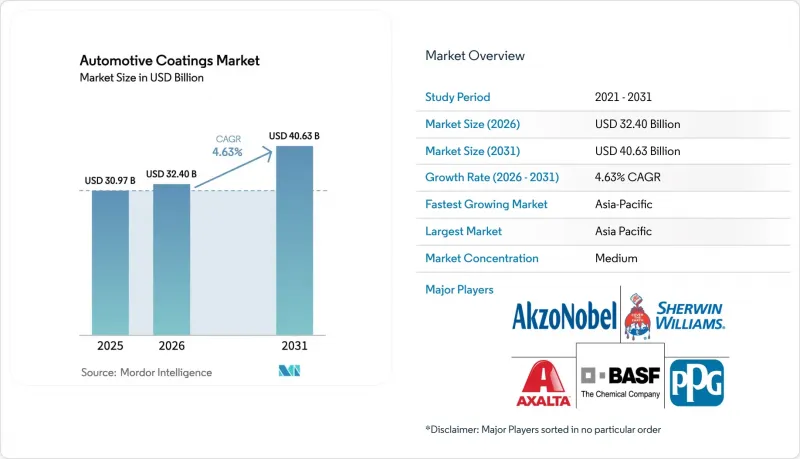
預計汽車塗料市場將從 2025 年的 309.7 億美元成長到 2026 年的 324 億美元,然後在 2031 年達到 406.3 億美元,2026 年至 2031 年的複合年成長率為 4.63%。
本報告按樹脂類型(丙烯酸樹脂、聚氨酯樹脂、環氧樹脂及其他樹脂)、工藝(溶劑型、水性、粉末塗料)、塗層(透明塗層、電著底漆、底漆、底塗層)、應用(OEM及修補漆)和地區(亞太地區、北美地區、歐洲地區、南美地區以及中東和非洲地區)進行細分。市場預測以美元計價。
全球汽車塗料市場趨勢及洞察
全球汽車生產復甦
隨著半導體短缺緩解和新增產能投入運作,預計2024年全球微型車產量將恢復至9,250萬輛,並在2026年超過9,500萬輛。中國產量為3,128萬輛,印度和日本合計產量超過1,400萬輛,鞏固了亞太地區的領先地位。每輛車每層電塗裝塗層、底漆、底塗層和透明塗層都需要消耗3至5公斤油漆,因此產量激增與油漆用量增加直接相關。印度35億美元的「生產連結獎勵計畫計畫」正在加速馬蒂鈴木、現代和塔塔汽車等公司的投資,預計到2027年將新增約18萬噸油漆需求。隨著企業規避供應鏈風險,東南亞的組裝生產正在擴張,供應商也建立在地化生產廠以降低關稅和前置作業時間。
過渡到水性和粉末塗料系統,以符合有關揮發性有機化合物 (VOC) 含量上限的規定。
美國國家有害空氣污染物排放標準(NHSHAP)第二階段將於2025年1月起,將底漆/底塗劑的排放量限制在每公升420克,面漆的排放量限制在每公升250克。同時,歐盟指令2004/42/EC對雙組分體系施加了更嚴格的限制。水性塗料可將每平方公尺揮發性有機化合物(VOC)的排放量減少60-80%,而粉末塗料則完全無需溶劑,有助於塗料廠將排放量控制在企業碳預算上限以下。 PPG工業公司預計,2024年汽車水性塗料產品的銷售量將成長8%,完全抵消溶劑型塗料需求的下降。中國的GB 24409-2020標準迫使國內塗料生產商重新設計其樹脂體系,否則將面臨失去OEM認證的風險。因此,江蘇和廣東兩省正將投資轉向大規模水性塗料生產線。雖然粉末透明塗層技術尚未在車身外板上達到A級光潔度,但艾仕得薄膜技術的最新突破正在縮小差距,使門框和後備箱內飾等特殊應用成為可能。
對接觸溶劑和異氰酸酯有嚴格的規定。
美國職業安全與健康管理局 (OSHA) 已將甲苯二異氰酸酯的暴露限值設定為 0.02 ppm,將二苯基甲烷二異氰酸酯的暴露限值設定為 0.005 ppm,並強制要求升級局部排氣通風系統,並在噴漆室配備呼吸防護設備。歐盟的分類、標籤和包裝法規進一步強制要求對含異氰酸酯的產品進行危險標籤標註,迫使供應商改用低遊離單體聚氨酯樹脂,這種固態成本高出 10-15%,且固含量更低。美國國家職業安全與健康研究所 (NIOSH) 2024 年的一項研究發現,即使使用個人防護設備,仍有 5-10% 的汽車噴漆工在五年內出現過敏反應,這加速了向水性交聯體系的轉變。
細分市場分析
儘管丙烯酸樹脂在2025年佔據了48.12%的市場佔有率,但受原始設備製造商(OEM)對用於電池式電動車結構且不增加重量的抗刮性透明塗層的需求推動,聚氨酯體系預計到2031年將以5.04%的複合年成長率成長。聚氨酯透明塗層的鉛筆硬度為2H至3H,比丙烯酸樹脂高約30%。即使經過2000小時的加速老化試驗,其光澤度仍能維持在85%以上。環氧樹脂仍然是電塗裝的首選,因為它們可以均勻地塗覆在包括電池機殼在內的複雜形狀上。
在中國,隨著比亞迪和蔚來汽車等品牌追求高階定位,聚氨酯的應用正在加速成長。同時,伊士曼化學公司140度C低溫固化環氧樹脂在鋁材密集車型的應用也日益廣泛。樹脂產品的多樣化確保了供應的柔軟性,並保護汽車塗料市場免受原料價格劇烈波動的影響。
儘管溶劑型塗料在2025年仍佔總產量的70.21%,但監管限制已導致全球塗料生產線向水性塗料和粉末塗料轉變,預計到2031年,粉末塗料的複合年成長率將達到4.97%。目前,北美和歐洲幾乎所有新的塗料生產線都採用水性底塗層,在實現與溶劑型塗料相當的金屬薄片著色效果的同時,可將揮發性有機化合物(VOC)排放量減少60-80%。
在印度、東南亞和南美,由於高濕度和缺乏空調導致水性塗料固化不穩定,溶劑型塗料仍然佔據主導地位。在歐洲,粉末塗料擴大應用於商用車底盤,因為在這些應用中,耐刮擦性比A級光潔度更為重要。同時,艾仕得的薄膜粉末透明塗層在40-50微米的厚度下即可達到90或更高的光澤度,從而擴大了適用基材的範圍。能夠靈活調整化學成分並投資建造濕度控制噴漆室的供應商將推動汽車塗料市場的未來成長。
區域分析
預計到2025年,亞太地區將佔全球銷售額的58.89%,複合年成長率達6.12%,主要得益於中國3,128萬輛的產量、印度35億美元的激勵基金以及東南亞市場對整車組裝的多元化發展。隨著中國將揮發性有機化合物(VOC)的排放上限設定為670克/公升,塗料市場正轉向水性配方,而比亞迪的垂直整合使其在定價和規格方面擁有了強大的議價能力。一家韓國大型電池製造商正在尋求氮化鋁薄膜,這在汽車塗料市場創造了一個高利潤的細分領域。
在北美,Ultrium平台的擴張和特斯拉在德克薩斯州增產正在推動整車製造商(OEM)的成長,但由於全損事故頻繁,重新噴漆市場仍面臨壓力。墨西哥的生產正在推動當地產能的提升,PPG運營著三家工廠,以規避關稅並滿足福特、通用汽車和Stellantis生產線的即時需求。在加拿大,該省的揮發性有機化合物(VOC)法規正在推廣水性塗料的使用,鼓勵中小型供應商升級設備。
在歐洲,歐盟指令2004/42/EC對排放設定了嚴格的上限,大眾汽車的永續發展債券也規定,低揮發性有機化合物(VOC)指標是供應商合約的強制要求。隨著北歐國家計劃在2030年將其所有汽車銷售量全部替換為零排放汽車,對溫度控管塗層的需求正在不斷成長。南美、中東和非洲雖然市佔率較小,但其成長速度高於全球平均。巴西正在推廣靈活燃料混合動力汽車,沙烏地阿拉伯則在資助本土電動車品牌,這些品牌需要使用優質塗層來應對沙漠腐蝕風險。
其他好處:
- Excel格式的市場預測(ME)表
- 3個月的分析師支持
目錄
第1章:引言
- 研究假設和市場定義
- 調查範圍
第2章:調查方法
第3章執行摘要
第4章 市場狀況
- 市場概覽
- 市場促進因素
- 全球汽車產量正處於復甦趨勢。
- 過渡到水性和粉末系統,以符合揮發性有機化合物 (VOC) 含量上限的規定。
- 對用於電池溫度控管。
- 成熟市場碰撞維修的恢復
- 將利率與繪畫過程中揮發性有機化合物 (VOC) 含量的強度掛鉤的永續發展貸款。
- 市場限制因素
- 溶劑和異氰酸酯的嚴格暴露限值
- 石化原料價格波動
- 減少電動滑板平台的噴漆面積
- 價值鏈分析
- 波特五力模型
第5章 市場規模與成長預測
- 依樹脂類型
- 丙烯酸纖維
- 聚氨酯
- 環氧樹脂
- 其他樹脂類型
- 透過技術
- 溶劑型
- 水溶液
- 粉末
- 透過塗層
- 透明塗層
- E-coat
- 底漆
- 底塗層
- 透過使用
- OEM
- 翻新
- 按地區
- 亞太地區
- 中國
- 印度
- 日本
- 韓國
- 東南亞國協
- 其他亞太國家
- 北美洲
- 美國
- 加拿大
- 墨西哥
- 歐洲
- 德國
- 英國
- 法國
- 義大利
- 北歐國家
- 其他歐洲國家
- 南美洲
- 巴西
- 阿根廷
- 其他南美國家
- 中東和非洲
- 沙烏地阿拉伯
- 南非
- 埃及
- 其他中東和非洲國家
- 亞太地區
第6章 競爭情勢
- 市場集中度
- 策略趨勢
- 市佔率和排名分析
- 公司簡介
- Akzo Nobel NV
- Asian Paints PPG Pvt., Ltd.
- Axalta Coating Systems, LLC
- BASF
- Beckers Group
- Cabot Corporation
- Eastman Chemical Company
- Hempel A/S
- HMG Paints Limited
- Jotun
- Kansai Nerolac Paints Limited
- KCC Corporation
- Nippon Paint Holdings Co., Ltd.
- Parker Hannifin Corp
- PPG Industries Inc.
- RPM International Inc.
- Shanghai Kinlita Chemical Co., Ltd.
- The Sherwin-Williams Company
第7章 市場機會與未來展望
According to Mordor Intelligence, the automotive coatings market size is expected to grow from USD 30.97 billion in 2025 to USD 32.40 billion in 2026 and is forecast to reach USD 40.63 billion by 2031 at 4.63% CAGR over 2026-2031.
This report is Segmented by Resin Type (Acrylic, Polyurethane, Epoxy, and Other Resin Types), Technology (Solvent-Borne, Water-Borne, and Powder), Coating Layer (Clear Coat, E-Coat, Primer, and Base Coat), Application (OEM and Refinish), and Geography (Asia-Pacific, North America, Europe, South America, and Middle-East and Africa). The Market Forecasts are Provided in Terms of Value (USD).
Global Automotive Coatings Market Trends and Insights
Growing Global Vehicle-Production Rebound
Global light-vehicle output recovered to 92.5 million units in 2024 and is projected to surpass 95 million by 2026 as semiconductor shortages ease and new capacity comes online. China delivered 31.28 million units, while India and Japan collectively added more than 14 million units, anchoring Asia-Pacific's dominance. Each vehicle consumes 3-5 kilograms of coatings across electro-coat, primer, basecoat, and clear-coat layers, translating the production surge directly into higher coating volumes. India's USD 3.5 billion Production-Linked Incentive scheme accelerates investment by Maruti Suzuki, Hyundai, and Tata Motors, which will add roughly 180,000 metric tons of incremental demand by 2027. Southeast Asian assembly is expanding as firms hedge supply-chain risk, prompting suppliers to establish localized blending plants to trim tariffs and lead times.
Shift Toward Water-Borne and Powder Systems to Meet Volatile Organic Content Caps
The United States National Emission Standards for Hazardous Air Pollutants Phase II caps emissions at 420 grams per liter for primer-surfacers and 250 grams per liter for topcoats from January 2025, while the European Union's Directive 2004/42/EC enforces even stricter limits for two-pack systems. Water-borne substitutes emit 60-80% fewer volatile organic compounds per square meter, and powder coatings remove solvents completely, which helps paint shops stay below corporate carbon-budget ceilings. PPG Industries recorded 8% revenue growth in its water-borne automotive lines during 2024, fully offsetting declines in solvent-borne demand. China's GB 24409-2020 standard compels domestic formulators to re-engineer resin systems or risk losing OEM approvals, and investment is shifting toward large-scale water-borne lines in Jiangsu and Guangdong. Powder clearcoat technology still lacks Class A finish on exterior panels, but recent thin-film breakthroughs from Axalta close the gap, making niche adoption viable for door jambs and trunk interiors.
Stringent Solvent and Isocyanate Exposure Limits
The United States Occupational Safety and Health Administration caps toluene diisocyanate exposure at 0.02 ppm and methylene diphenyl diisocyanate at 0.005 ppm, obliging paint booths to upgrade local exhaust ventilation and supply respiratory protection. The EU's Classification, Labelling and Packaging Regulation further mandates hazard statements on isocyanate-bearing products, pushing suppliers toward low-free-monomer polyurethane resins that cost 10-15% more and deliver lower solids. A 2024 National Institute for Occupational Safety and Health study found 5-10% of automotive painters develop sensitization within five years even when personal protective equipment is used, accelerating substitution to water-borne crosslinker systems.
Other drivers and restraints analyzed in the detailed report include:
- Rising EV-Specific Coating Demand for Battery Thermal Management
- Recovery of Collision-Repair Volumes in Mature Markets
- Volatile Petrochemical-Based Raw-Material Pricing
For complete list of drivers and restraints, kindly check the Table Of Contents.
Segment Analysis
Acrylic resins commanded 48.12% revenue in 2025, yet polyurethane systems are forecast for a 5.04% CAGR through 2031 because OEMs want scratch-resistant clear layers without mass penalties on battery-electric structures. Polyurethane clearcoats offer 2H-3H pencil hardness, about 30% higher than acrylic equivalents, and keep gloss above 85% after 2,000 hours of accelerated weathering. Epoxy resins remain the go-to for electro-coat primers thanks to uniform deposition on complex geometries including battery enclosures.
Polyurethane uptake accelerates in China as BYD and NIO chase premium positioning, while Eastman Chemical's 140 °C low-bake epoxy widens adoption in aluminum-heavy platforms. This diversified resin slate preserves supply flexibility and shields the automotive coatings market from raw-material shocks.
Solvent-borne held 70.21% of 2025 volume, but regulatory limits already steer global paint lines toward water-borne and powder alternatives, positioning powder for a 4.97% CAGR through 2031. Water-borne basecoats now cover nearly all new lines in North America and Europe, achieving 60-80% lower volatile organic compound output and offering color parity with metallic-flake orientation that rivals solvent systems.
India, Southeast Asia, and South America still rely on solvent-borne because high humidity and limited climate control make water-borne curing unpredictable. Powder uptake climbs in Europe for commercial-vehicle chassis where chip resistance outranks Class A finish, while Axalta's thin-film powder clearcoat achieving 40-50 µm thickness at more than 90 gloss expands addressable substrates. Suppliers able to flex between chemistries and invest in humidity-controlled booths will capture future gains in the automotive coatings market.
Complete Report Scope:
- By Resin Type
- Acrylic
- Polyurethane
- Epoxy
- Other Resin Types
- By Technology
- Solvent-borne
- Water-borne
- Powder
- By Coating Layer
- Clear Coat
- E-coat
- Primer
- Base Coat
- By Application
- OEM
- Refinish
- By Geography
- Asia-Pacific
- China
- India
- Japan
- South Korea
- ASEAN Countries
- Rest of Asia-Pacific
- North America
- United States
- Canada
- Mexico
- Europe
- Germany
- United Kingdom
- France
- Italy
- NORDIC Countries
- Rest of Europe
- South America
- Brazil
- Argentina
- Rest of South America
- Middle-East and Africa
- Saudi Arabia
- South Africa
- Egypt
- Rest of Middle-East and Africa
- Asia-Pacific
Geography Analysis
Asia-Pacific contributed 58.89% of 2025 revenue and is set for a 6.12% CAGR thanks to China's 31.28 million-unit output, India's USD 3.5 billion incentive fund, and Southeast Asian diversification that attracts OEM assembly. China's volatile organic compound cap of 670 g/L pushes reformulation toward water-borne, and BYD's vertical integration gives it bargaining muscle on pricing and specification. South Korea's battery majors request aluminum nitride films, carving high-margin niches within the automotive coatings market.
In North America, Ultrium platform expansion and Tesla's Texas ramp sustain OEM growth, yet refinish remains under pressure from elevated total-loss frequency. Mexico's production drives localized capacity, and PPG runs three plants to dodge tariffs and service Ford, General Motors, and Stellantis lines in real time. Canada pushes water-borne adoption under provincial volatile organic compound rules, nudging smaller suppliers toward capital upgrades.
In Europe, Directive 2004/42/EC enforces stringent emission ceilings, and Volkswagen's sustainability bond makes low-volatile organic compound metrics a must-have for supplier contracts. Nordic plans to shift to 100% zero-emission sales by 2030 lift thermal-management coating demand. South America and Middle-East and Africa contributed smaller share, yet grow faster than the global average as Brazil pursues flex-fuel hybrids and Saudi Arabia funds a domestic electric-vehicle brand that needs premium coatings for desert corrosion risk.
- Akzo Nobel N.V.
- Asian Paints PPG Pvt., Ltd.
- Axalta Coating Systems, LLC
- BASF
- Beckers Group
- Cabot Corporation
- Eastman Chemical Company
- Hempel A/S
- HMG Paints Limited
- Jotun
- Kansai Nerolac Paints Limited
- KCC Corporation
- Nippon Paint Holdings Co., Ltd.
- Parker Hannifin Corp
- PPG Industries Inc.
- RPM International Inc.
- Shanghai Kinlita Chemical Co., Ltd.
- The Sherwin-Williams Company
Additional Benefits:
- The market estimate (ME) sheet in Excel format
- 3 months of analyst support
TABLE OF CONTENTS
1 Introduction
- 1.1 Study Assumptions and Market Definition
- 1.2 Scope of the Study
2 Research Methodology
3 Executive Summary
4 Market Landscape
- 4.1 Market Overview
- 4.2 Market Drivers
- 4.2.1 Growing Global Vehicle-Production Rebound
- 4.2.2 Shift Toward Water-Borne And Powder Systems To Meet Volatile Organic Content Caps
- 4.2.3 Rising EV-Specific Coating Demand for Battery Thermal Management
- 4.2.4 Recovery Of Collision-Repair Volumes in Mature Markets
- 4.2.5 Sustainability-Linked Financing Tying Interest Rates to Paint-Shop Volatile Organic Content Intensity
- 4.3 Market Restraints
- 4.3.1 Stringent Solvent and Isocyanate Exposure Limits
- 4.3.2 Volatile Petrochemical-Based Raw-Material Pricing
- 4.3.3 EV Skateboard Platforms Reducing Painted Surface Area
- 4.4 Value Chain Analysis
- 4.5 Porter's Five Forces
- 4.5.1 Bargaining Power of Suppliers
- 4.5.2 Bargaining Power of Buyers
- 4.5.3 Threat of New Entrants
- 4.5.4 Threat of Substitute Products and Services
- 4.5.5 Degree of Competition
5 Market Size and Growth Forecasts (Value)
- 5.1 By Resin Type
- 5.1.1 Acrylic
- 5.1.2 Polyurethane
- 5.1.3 Epoxy
- 5.1.4 Other Resin Types
- 5.2 By Technology
- 5.2.1 Solvent-borne
- 5.2.2 Water-borne
- 5.2.3 Powder
- 5.3 By Coating Layer
- 5.3.1 Clear Coat
- 5.3.2 E-coat
- 5.3.3 Primer
- 5.3.4 Base Coat
- 5.4 By Application
- 5.4.1 OEM
- 5.4.2 Refinish
- 5.5 By Geography
- 5.5.1 Asia-Pacific
- 5.5.1.1 China
- 5.5.1.2 India
- 5.5.1.3 Japan
- 5.5.1.4 South Korea
- 5.5.1.5 ASEAN Countries
- 5.5.1.6 Rest of Asia-Pacific
- 5.5.2 North America
- 5.5.2.1 United States
- 5.5.2.2 Canada
- 5.5.2.3 Mexico
- 5.5.3 Europe
- 5.5.3.1 Germany
- 5.5.3.2 United Kingdom
- 5.5.3.3 France
- 5.5.3.4 Italy
- 5.5.3.5 NORDIC Countries
- 5.5.3.6 Rest of Europe
- 5.5.4 South America
- 5.5.4.1 Brazil
- 5.5.4.2 Argentina
- 5.5.4.3 Rest of South America
- 5.5.5 Middle-East and Africa
- 5.5.5.1 Saudi Arabia
- 5.5.5.2 South Africa
- 5.5.5.3 Egypt
- 5.5.5.4 Rest of Middle-East and Africa
- 5.5.1 Asia-Pacific
6 Competitive Landscape
- 6.1 Market Concentration
- 6.2 Strategic Moves
- 6.3 Market Share(%)/Ranking Analysis
- 6.4 Company Profiles (includes Global level Overview, Market level overview, Core Segments, Financials as available, Strategic Information, Products and Services, and Recent Developments)
- 6.4.1 Akzo Nobel N.V.
- 6.4.2 Asian Paints PPG Pvt., Ltd.
- 6.4.3 Axalta Coating Systems, LLC
- 6.4.4 BASF
- 6.4.5 Beckers Group
- 6.4.6 Cabot Corporation
- 6.4.7 Eastman Chemical Company
- 6.4.8 Hempel A/S
- 6.4.9 HMG Paints Limited
- 6.4.10 Jotun
- 6.4.11 Kansai Nerolac Paints Limited
- 6.4.12 KCC Corporation
- 6.4.13 Nippon Paint Holdings Co., Ltd.
- 6.4.14 Parker Hannifin Corp
- 6.4.15 PPG Industries Inc.
- 6.4.16 RPM International Inc.
- 6.4.17 Shanghai Kinlita Chemical Co., Ltd.
- 6.4.18 The Sherwin-Williams Company
7 Market Opportunities and Future Outlook
- 7.1 White-space and Unmet-need Assessment
- 7.2 Self-Cleaning Coating Technology

 2026-2030年全球汽車塗料市場
 全球汽車粉末塗料市場:依樹脂類型、車輛類型和地區分類-預測至2031年
 汽車塗料市場預測至2034年—按產品類型、樹脂類型、技術、層數、車輛類型、應用和地區分類的全球分析
 汽車塗料市場:2026-2032年全球市場預測(依樹脂技術、塗料類型、樹脂類型、應用、車輛類型及通路分類)汽車塗料市場預測至2034年—按塗層、樹脂類型、技術、車輛類型、最終用戶和地區分類的全球分析汽車塗料市場預測至2034年-全球分析(按塗層、樹脂類型、車輛類型、技術、應用、基材、性能特徵和地區分類)
 汽車塗料市場規模、佔有率和趨勢分析報告:按產品、技術、應用、最終用途、地區和細分市場分類(2026-2033 年)
 汽車耐腐蝕樹脂市場:依樹脂類型、應用、車輛類型和地區分類。
 汽車塗料添加劑市場報告:按類型、車輛類型、應用和地區分類(2026-2034 年)
 汽車塗料市場規模、佔有率、成長率及全球產業分析:按類型、應用和地區分類的洞察,2026-2034 年預測