


 |
市場調查報告書
商品編碼
2121421
包裝自動化:市場佔有率分析、產業趨勢與統計、成長預測(2026-2031)Packaging Automation - Market Share Analysis, Industry Trends & Statistics, Growth Forecasts (2026 - 2031) |
||||||

※ 本網頁內容可能與最新版本有所差異。詳細情況請與我們聯繫。
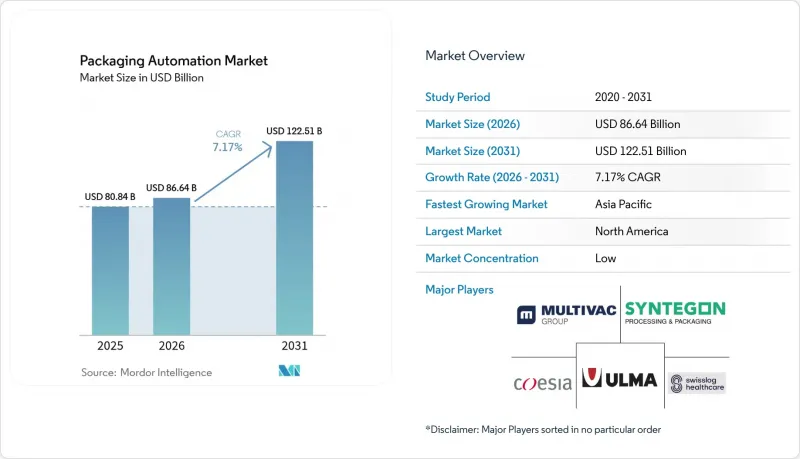
據 Mordor Intelligence 稱,2025 年包裝自動化市場價值為 808.4 億美元,預計到 2031 年將達到 1225.1 億美元,而 2026 年為 866.4 億美元,預測期(2026-2031 年)的複合年成長率為 7.17%。
本報告按產品類型(填充、貼標、裝箱等)、最終用戶(食品、飲料、藥品等)、自動化程度(全自動生產線、半自動生產線、協作/混合系統)、解決方案(硬體等)、包裝階段(初級包裝、二級包裝、三級包裝/生產線末端包裝)和地區進行細分。市場預測以美元(USD)為單位。
全球包裝自動化市場趨勢與洞察
食品飲料、製藥和電子商務產業自動化應用範圍擴大。
2024年,包裝器材出貨量成長,主要得益於大規模食品生產企業和製藥生產線對彈性小批量生產的需求。製藥公司計劃在2025年投資1,600億美元升級其生產設施,以實現個人化藥物的包裝。電商履約中心正在實施「合理化」包裝系統,可產生數千種不同的包裝盒,在提高勞動生產率的同時,將紙板用量減少一半。隨著一個產業中成熟的解決方案推廣到其他產業,跨產業的技術轉移正在加速,推動了包裝自動化市場的滲透。這些協同效應正在推動對自適應機器人和整合視覺系統的需求,這些機器人和系統能夠在最大限度減少停機時間的情況下切換不同的SKU類別。
電子商務驅動的對高速二次包裝的需求
將尺寸合適的包裝箱系統與移動機器人結合,僅幾個月就使某物流中心的生產效率提升了97%,凸顯了二次包裝對於提高效率的重要性。可變尺寸自動化目前佔包裝自動化市場41.42%的佔有率,反映出快速處理混合訂單的需求。亞太地區線上零售額的激增預計將推動該地區的資本投資在2024年達到180億美元。加之歐洲和北美全通路模式的興起,這一轉變持續對生產線速度、軟體編配和符合人體工學的碼垛方式提出更高的要求,從而推動整個包裝自動化市場的不斷升級。
高昂的資本投資成本與網路安全風險
對於許多中小企業而言,建造完整的包裝單元所需的大量前期投資構成了一道障礙。同時,日益增強的網路連接性也增加了操作技術遭受網路威脅的風險,製造業佔工業安全事故的四分之一以上。企業必須同時投資自動化硬體和多層安全防護,這加劇了預算壓力,並減緩了科技普及的速度。 「機器人即服務 (RaaS)」模式透過將支出轉移到營運支出 (OPEX) 並在訂閱協議中提供託管網路安全服務來應對這一雙重挑戰。雖然這種方法可以減輕對資產負債表的影響,但要在整個包裝自動化市場廣泛應用,仍需提高市場認知度。
細分市場分析
預計到2025年,紙箱包裝將佔自動化包裝市場31.74%的佔有率,凸顯其在整個分銷過程中保護貨物的關鍵作用。紙箱包裝領域正經歷強勁成長,這主要得益於永續性舉措,這些舉措推動了瓦楞紙板的減薄和黏合劑應用的精準化。托盤包裝雖然銷售額小規模,但其複合年成長率(CAGR)也達到了11.94%。FANUC)的新型CRX-25iA協作機器人可處理高達30公斤的負載,具有較小的單元面積,並配備了易於使用的示教器。協作機器人是該領域自動化普及的領先指標,因為它們可以縮短試運行週期,並改善操作人員的工作環境。
在上游工程中,隨著靈活的無菌灌裝方法能夠滿足個人化醫療的需求,製藥業對灌裝機的投資正在增加。貼標生產線正在透過序列化模組進行升級,以滿足製藥和飲料行業的監管可追溯性要求。在包裝和封蓋領域,由於輕質薄膜技術的進步,需求正在成長;而捆紮技術在試驗應用中已將塑膠用量減少了80%。製袋生產線正在磨料行業中廣泛應用,其中耐磨的Hardox鋼延長了使用壽命。這些產品之間的相互作用表明,市場正在向融合多種任務的端到端單元模式轉變,從而形成高度靈活的包裝自動化解決方案。
到2025年,食品製造商將佔據自動化包裝市場28.07%的佔有率,這得益於其大批量SKU生產和嚴格的衛生標準。儘管基準較小,但由於注射劑需求不斷成長,醫藥包裝市場預計將以11.55%的複合年成長率成長。 Syntegon的「Pharmatag 2025」生產線可快速更換包裝規格,以適應小批量生產,同時在嚴格的無菌條件下填充液體。在亞太地區,高速罐頭和套標包裝設備正被引入飲料生產線,以滿足中產階級日益成長的需求。
個人護理品牌正專注於高階客製化包裝,而自動化多線揀貨則使之成為可能。化學製造商正利用Fest的防爆認證執行器,並採用密封填充和封口方法,以減少產品暴露於腐蝕性介質的風險。隨著藥品序列化作為打擊仿冒品的措施逐漸擴展到消費品領域,各項技術的交叉融合正在加速,從而擴大了自動化包裝市場的規模。
區域分析
到2025年,北美將佔據包裝自動化市場33.78%的佔有率,這得益於其先進的製造基礎設施和FDA序列化要求。預計到2025年,製藥公司將投資1,600億美元用於設施升級,以滿足對無塵室機器人的需求。 ABB在密西根州投資2,000萬美元進行擴建,體現了供應商對本地客戶的堅定承諾。電子商務履約中心的激增也推動了對高度適應性二級包裝的需求成長。
亞太地區預計將成為成長最快的地區,到2031年複合年成長率將達到10.32%。中國計劃在2024年投資66億美元用於工業機器人,體現了其機器人密度翻倍的政策目標。在上海舉辦的ProPak 2025吸引了超過2,500家來自智慧包裝解決方案領域的參展,凸顯了該地區從人工生產線向數位化工廠的轉型。像易斯頓自動化這樣的國內供應商正憑藉價格極具競爭力的機械臂擴大市場佔有率,推動著本地包裝自動化市場的成長。
在歐洲,永續發展法規和工業4.0津貼正在推動包裝自動化技術的應用。瑞典一家工廠透過自動化捆紮減少了80%的塑膠包裝材料,實現了循環經濟目標。一家領先的德國機械製造商正在引入人工智慧模組,以保持出口競爭力。此外,中東和非洲正在試驗自動化乳製品生產線,以增強食品安全;而南美一家巴西工廠正在引入堆垛機,以滿足該地區日益成長的飲料需求。這些多元化的措施共同推動了全球包裝自動化市場的擴張。
其他好處:
- Excel格式的市場預測(ME)表
- 3個月的分析師支持
目錄
第1章:引言
- 研究假設和市場定義
- 調查範圍
第2章:調查方法
第3章執行摘要
第4章 市場狀況
- 市場概覽
- 市場促進因素
- 食品飲料、製藥和電子商務產業自動化應用範圍擴大。
- 電子商務對高速二次包裝的需求
- 人手不足正在加速機器人技術的應用。
- 利用人工智慧驅動的預測性維護減少停機時間(一個被低估的趨勢)
- 中小企業的模組化協作機器人單元(一個研究不足的領域)
- 自動化技術可減少材料用量,主導永續性(但卻鮮少受到關注)
- 市場限制因素
- 高昂的資本成本和網路安全風險
- 熟練操作人員短缺
- 供應商對專有控制軟體的鎖定(這一點並未公開討論)
- 衛生區域缺乏經過認證的開放原始碼機器視覺庫(一個被忽視的問題)
- 供應鏈分析
- 監理情勢
- 技術展望
- 波特五力分析
第5章 市場規模與成長預測
- 依產品類型
- 填充
- 標籤
- 包裝箱
- 已裝袋
- 托盤堆疊
- 封頂
- 包裝
- 其他產品類型
- 最終用戶
- 食物
- 飲料
- 製藥
- 個人護理用品和盥洗用品
- 工業和化學
- 其他最終用戶
- 按自動化級別
- 全自動生產線
- 半自動生產線
- 協作/混合系統
- 透過解決方案
- 硬體(機器人、輸送機、感測器)
- 軟體(SCADA、MES、分析)
- 服務(安裝、維護、維修)
- 透過包裝過程
- 初級包裝自動化
- 二級包裝自動化
- 三級工序/生產線末端自動化
- 按地區
- 北美洲
- 美國
- 加拿大
- 墨西哥
- 歐洲
- 德國
- 英國
- 法國
- 義大利
- 西班牙
- 俄羅斯
- 其他歐洲國家
- 亞太地區
- 中國
- 印度
- 日本
- 韓國
- 澳洲和紐西蘭
- 其他亞太國家
- 中東和非洲
- 中東
- 阿拉伯聯合大公國
- 沙烏地阿拉伯
- 土耳其
- 其他中東國家
- 非洲
- 南非
- 奈及利亞
- 埃及
- 其他非洲國家
- 中東
- 南美洲
- 巴西
- 阿根廷
- 其他南美國家
- 北美洲
第6章 競爭情勢
- 市場集中度
- 策略趨勢
- 市佔率分析
- 公司簡介
- Multivac Group
- Coesia SpA
- ULMA Packaging
- Syntegon Technology
- Swisslog Healthcare
- Rockwell Automation Inc.
- Sealed Air Corporation
- Mitsubishi Electric Corporation
- Automated Packaging Systems LLC
- ABB Ltd.
- Fanuc Corp.
- KUKA AG
- Schneider Electric SE
- Siemens AG
- Tetra Pak International SA
- ProMach Inc.
- Barry-Wehmiller Companies Inc.
- Sidel Group
- Ishida Co. Ltd.
- Yaskawa Motoman Robotics
第7章 市場機會與未來展望
According to Mordor Intelligence, the packaging automation market size was valued at USD 80.84 billion in 2025 and estimated to grow from USD 86.64 billion in 2026 to reach USD 122.51 billion by 2031, at a CAGR of 7.17% during the forecast period (2026-2031).
This report is Segmented by Product Type (Filling, Labeling, Case Packaging, and More), End-User (Food, Beverage, Pharmaceuticals, and More), Automation Level (Fully-Automated Lines, Semi-Automated Lines, Collaborative/Hybrid Systems), Solution (Hardware, and More), Packaging Stage (Primary, Secondary, Tertiary/End-of-Line), and Geography. The Market Forecasts are Provided in Terms of Value (USD).
Global Packaging Automation Market Trends and Insights
Rising Adoption of Automation Across F&B, Pharma and E-commerce Sectors
Packaging machinery shipments climbed in 2024, propelled by pharmaceutical lines that demand flexible, small-batch formats beside high-volume food operations. Pharmaceutical manufacturers are committing USD 160 billion to site upgrades in 2025 to enable personalized medicine packaging. E-commerce fulfillment centers adopt right-sizing systems generating thousands of box variations, halving corrugate use while boosting labor productivity. Cross-industry technology transfer quickens as solutions proven in one sector migrate to another, accelerating packaging automation market penetration. The combined momentum amplifies demand for adaptive robotics and integrated vision that can shift between SKU classes with limited downtime.
E-commerce-Induced Demand for High-Speed Secondary Packaging
Right-sized box systems coupled with mobile robots lifted a distribution site's productivity by 97% within months, underscoring how secondary packaging has become the pivotal efficiency lever. Variable-dimension automation now comprises 41.42% of the packaging automation market, reflecting the need to process mixed orders at speed. Asia-Pacific's surging online retail sales are projected to escalate regional equipment outlays to USD 18 billion in 2024. Coupled with omnichannel models in Europe and North America, the shift places sustained pressure on line speeds, software orchestration, and ergonomic palletizing, stimulating continuous upgrades across the packaging automation market.
High Capital Cost and Cybersecurity Risks
Full-scale packaging cells require significant upfront cash that many SMEs find prohibitive. Simultaneously, rising connectivity exposes operational technology to cyber threats, with manufacturing representing over one quarter of industrial incidents. Firms must invest in both automation hardware and layered security, stretching budgets and slowing adoption. Robots-as-a-Service models address this dual hurdle by shifting spending to OPEX and providing managed cybersecurity within the subscription. The approach lessens balance-sheet impact, yet market education is still needed before it scales across the packaging automation market.
Other drivers and restraints analyzed in the detailed report include:
- Labor Shortages Accelerating Robotics Deployment
- AI-Driven Predictive Maintenance Lowering Downtime
- Skilled-Operator Scarcity
For complete list of drivers and restraints, kindly check the Table Of Contents.
Segment Analysis
Case packaging accounted for 31.74% of packaging automation market share in 2025, underscoring its essential role in safeguarding goods during distribution. Growth within the case segment remains steady as sustainability pushes thinner corrugate and precision glue application. Palletizing, though smaller in revenue, is expanding at 11.94% CAGR. FANUC's new CRX-25iA cobot, able to handle 30 kg loads, compresses cell footprints while offering easy teach pendants. Collaborative robots shorten commissioning and improve worker ergonomics, making the segment a leading indicator of wider automation uptake.
Upstream, filling machines win pharmaceutical investment as flexible aseptic formats accommodate personalized therapies. Labeling lines add serialization modules that satisfy regulatory traceability in medicine and beverages. Wrapping and capping rise on the back of lightweight film advances, with banding technology reducing plastic by 80% in pilot deployments. Bagging lines gain footing in abrasive material sectors where ruggedized Hardox steel prolongs service life. The interplay among these products signals a move toward end-to-end cells that fuse multiple tasks into an adaptive packaging automation market solution.
Food manufacturers held 28.07% of the packaging automation market in 2025, benefiting from high-volume SKUs and rigid hygiene standards. Despite its smaller baseline, pharmaceutical packaging is poised for 11.55% CAGR as injectable therapies rise. Syntegon's Pharmatag 2025 line fills liquids under strict sterility while switching formats quickly to handle short runs. Beverage lines in Asia-Pacific install high-speed canning and sleeving to satisfy rising middle-class demand.
Personal-care brands focus on luxurious, custom packs enabled by automated multi-line order picking. Chemical producers adopt enclosed filling and sealing to limit exposure to aggressive media, leveraging Festo's EX-certified actuators. Technology crossover accelerates as pharma serialization migrates into consumer goods to combat counterfeits, broadening application scope for the packaging automation market.
Complete Report Scope:
- By Product Type
- Filling
- Labeling
- Case Packaging
- Bagging
- Palletizing
- Capping
- Wrapping
- Other Product Types
- By End-user
- Food
- Beverage
- Pharmaceuticals
- Personal Care and Toiletries
- Industrial and Chemicals
- Other End-users
- By Automation Level
- Fully-Automated Lines
- Semi-Automated Lines
- Collaborative/Hybrid Systems
- By Solution
- Hardware (Robots, Conveyors, Sensors)
- Software (SCADA, MES, Analytics)
- Services (Installation, Maintenance, Retrofits)
- By Packaging Stage
- Primary Packaging Automation
- Secondary Packaging Automation
- Tertiary / End-of-Line Automation
- By Geography
- North America
- United States
- Canada
- Mexico
- Europe
- Germany
- United Kingdom
- France
- Italy
- Spain
- Russia
- Rest of Europe
- Asia-Pacific
- China
- India
- Japan
- South Korea
- Australia and New Zealand
- Rest of Asia-Pacific
- Middle East and Africa
- Middle East
- United Arab Emirates
- Saudi Arabia
- Turkey
- Rest of Middle East
- Africa
- South Africa
- Nigeria
- Egypt
- Rest of Africa
- Middle East
- South America
- Brazil
- Argentina
- Rest of South America
- North America
Geography Analysis
North America contributed 33.78% to the packaging automation market in 2025, leveraging sophisticated manufacturing infrastructure and FDA serialization mandates. Drug makers will spend USD 160 billion on facility upgrades during 2025, sustaining demand for clean-room ready robots. ABB's USD 20 million expansion in Michigan underscores vendor commitment to regional customers. E-commerce fulfillment hubs proliferate, amplifying calls for adaptive secondary packaging.
Asia-Pacific is the fastest region at 10.32% CAGR through 2031. China spent USD 6.6 billion on industrial robots in 2024, reflecting policy ambitions to double robot density. Shanghai's ProPak 2025 will gather more than 2,500 exhibitors in smart packaging solutions, highlighting the region's shift from manual lines to digital factories. Domestic suppliers such as Estun Automation are winning share with competitively priced robotic arms, expanding the packaging automation market locally.
Europe drives adoption through sustainability regulation and Industry 4.0 grants. A Swedish facility cut plastic wrap by 80% via automated banding, satisfying circular-economy goals. Germany's advanced machine builders add AI modules to retain export competitiveness. Elsewhere, Middle East and Africa pilot automated dairy lines to bolster food security, while South American plants in Brazil install palletizers to serve growing regional beverage demand. These diverse initiatives collectively extend the global packaging automation market footprint.
- Multivac Group
- Coesia S.p.A.
- ULMA Packaging
- Syntegon Technology
- Swisslog Healthcare
- Rockwell Automation Inc.
- Sealed Air Corporation
- Mitsubishi Electric Corporation
- Automated Packaging Systems LLC
- ABB Ltd.
- Fanuc Corp.
- KUKA AG
- Schneider Electric SE
- Siemens AG
- Tetra Pak International SA
- ProMach Inc.
- Barry-Wehmiller Companies Inc.
- Sidel Group
- Ishida Co. Ltd.
- Yaskawa Motoman Robotics
Additional Benefits:
- The market estimate (ME) sheet in Excel format
- 3 months of analyst support
TABLE OF CONTENTS
1 INTRODUCTION
- 1.1 Study Assumptions and Market Definition
- 1.2 Scope of the Study
2 RESEARCH METHODOLOGY
3 EXECUTIVE SUMMARY
4 MARKET LANDSCAPE
- 4.1 Market Overview
- 4.2 Market Drivers
- 4.2.1 Rising adoption of automation across FandB, pharma and e-commerce sectors
- 4.2.2 E-commerce-induced demand for high-speed secondary packaging
- 4.2.3 Labor shortages accelerating robotics deployment
- 4.2.4 AI-driven predictive maintenance lowering downtime (under-radar)
- 4.2.5 Modular cobot cells for SMEs (under-radar)
- 4.2.6 Sustainability-led material-reduction automation (under-radar)
- 4.3 Market Restraints
- 4.3.1 High capital cost and cybersecurity risks
- 4.3.2 Skilled-operator scarcity
- 4.3.3 Vendor lock-in to proprietary control software (under-radar)
- 4.3.4 Lack of certified open-source machine-vision libraries for hygienic zones (under-radar)
- 4.4 Supply-Chain Analysis
- 4.5 Regulatory Landscape
- 4.6 Technological Outlook
- 4.7 Porter's Five Forces Analysis
- 4.7.1 Bargaining Power of Suppliers
- 4.7.2 Bargaining Power of Buyers
- 4.7.3 Threat of New Entrants
- 4.7.4 Threat of Substitutes
- 4.7.5 Intensity of Competitive Rivalry
5 MARKET SIZE AND GROWTH FORECASTS (VALUE)
- 5.1 By Product Type
- 5.1.1 Filling
- 5.1.2 Labeling
- 5.1.3 Case Packaging
- 5.1.4 Bagging
- 5.1.5 Palletizing
- 5.1.6 Capping
- 5.1.7 Wrapping
- 5.1.8 Other Product Types
- 5.2 By End-user
- 5.2.1 Food
- 5.2.2 Beverage
- 5.2.3 Pharmaceuticals
- 5.2.4 Personal Care and Toiletries
- 5.2.5 Industrial and Chemicals
- 5.2.6 Other End-users
- 5.3 By Automation Level
- 5.3.1 Fully-Automated Lines
- 5.3.2 Semi-Automated Lines
- 5.3.3 Collaborative/Hybrid Systems
- 5.4 By Solution
- 5.4.1 Hardware (Robots, Conveyors, Sensors)
- 5.4.2 Software (SCADA, MES, Analytics)
- 5.4.3 Services (Installation, Maintenance, Retrofits)
- 5.5 By Packaging Stage
- 5.5.1 Primary Packaging Automation
- 5.5.2 Secondary Packaging Automation
- 5.5.3 Tertiary / End-of-Line Automation
- 5.6 By Geography
- 5.6.1 North America
- 5.6.1.1 United States
- 5.6.1.2 Canada
- 5.6.1.3 Mexico
- 5.6.2 Europe
- 5.6.2.1 Germany
- 5.6.2.2 United Kingdom
- 5.6.2.3 France
- 5.6.2.4 Italy
- 5.6.2.5 Spain
- 5.6.2.6 Russia
- 5.6.2.7 Rest of Europe
- 5.6.3 Asia-Pacific
- 5.6.3.1 China
- 5.6.3.2 India
- 5.6.3.3 Japan
- 5.6.3.4 South Korea
- 5.6.3.5 Australia and New Zealand
- 5.6.3.6 Rest of Asia-Pacific
- 5.6.4 Middle East and Africa
- 5.6.4.1 Middle East
- 5.6.4.1.1 United Arab Emirates
- 5.6.4.1.2 Saudi Arabia
- 5.6.4.1.3 Turkey
- 5.6.4.1.4 Rest of Middle East
- 5.6.4.2 Africa
- 5.6.4.2.1 South Africa
- 5.6.4.2.2 Nigeria
- 5.6.4.2.3 Egypt
- 5.6.4.2.4 Rest of Africa
- 5.6.4.1 Middle East
- 5.6.5 South America
- 5.6.5.1 Brazil
- 5.6.5.2 Argentina
- 5.6.5.3 Rest of South America
- 5.6.1 North America
6 COMPETITIVE LANDSCAPE
- 6.1 Market Concentration
- 6.2 Strategic Moves
- 6.3 Market Share Analysis
- 6.4 Company Profiles {(includes Global level Overview, Market level overview, Core Segments, Financials as available, Strategic Information, Market Rank/Share for key companies, Products and Services, and Recent Developments)}
- 6.4.1 Multivac Group
- 6.4.2 Coesia S.p.A.
- 6.4.3 ULMA Packaging
- 6.4.4 Syntegon Technology
- 6.4.5 Swisslog Healthcare
- 6.4.6 Rockwell Automation Inc.
- 6.4.7 Sealed Air Corporation
- 6.4.8 Mitsubishi Electric Corporation
- 6.4.9 Automated Packaging Systems LLC
- 6.4.10 ABB Ltd.
- 6.4.11 Fanuc Corp.
- 6.4.12 KUKA AG
- 6.4.13 Schneider Electric SE
- 6.4.14 Siemens AG
- 6.4.15 Tetra Pak International SA
- 6.4.16 ProMach Inc.
- 6.4.17 Barry-Wehmiller Companies Inc.
- 6.4.18 Sidel Group
- 6.4.19 Ishida Co. Ltd.
- 6.4.20 Yaskawa Motoman Robotics
7 MARKET OPPORTUNITIES AND FUTURE OUTLOOK
- 7.1 White-space and Unmet-Need Assessment

 人工智慧驅動的智慧包裝市場預測至2034年——全球分析(按包裝類型、智慧等級、嵌入式技術、智慧包裝技術、應用、最終用戶和地區分類)
 包裝自動化市場:2026-2032年全球市場預測(依自動化類型、機器類型、包裝類型及最終用途產業分類)人工智慧驅動的包裝自動化市場預測至2034年-全球分析(按組件、包裝類型、部署模式、企業規模、技術、最終用戶和地區分類)包裝自動化軟體市場預測至2034年-全球分析(按組件、包裝類型、功能、部署模式、企業規模、最終用戶和地區分類)包裝自動化解決方案市場:按產業分類-食品飲料、製藥、汽車、電子和消費品-2026-2032年全球預測
 全球包裝自動化市場規模、佔有率、趨勢和成長分析報告(2026-2034年)
 2026年全球包裝自動化市場報告按需包裝系統解決方案市場(按包裝類型、包裝材料、技術、自動化程度、最終用戶產業和分銷管道分類)—2026-2032年全球預測全球包裝自動化市場:市場規模、佔有率、成長率、產業分析、依類型、應用和地區劃分的分析以及未來預測(2026-2034)
 包裝自動化市場規模、佔有率和成長分析(按組件、產品類型、包裝技術、包裝材料、最終用途和地區分類)-2026-2033年產業預測