


 |
市場調查報告書
商品編碼
2121411
汽車電池:市場佔有率分析、產業趨勢與統計、成長預測(2026-2031)Automotive Battery - Market Share Analysis, Industry Trends & Statistics, Growth Forecasts (2026 - 2031) |
||||||

※ 本網頁內容可能與最新版本有所差異。詳細情況請與我們聯繫。
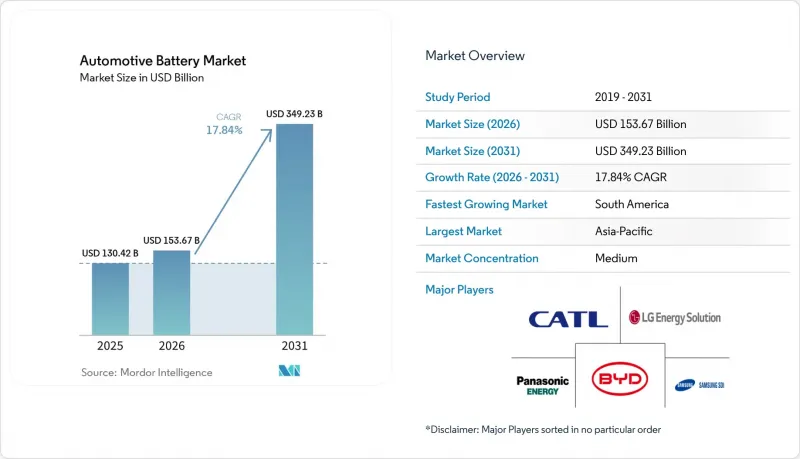
據 Mordor Intelligence 稱,2025 年汽車電池市值為 1,304.2 億美元,預計 2026 年將達到 1,536.7 億美元。
此外,預計從 2026 年到 2031 年,該產業將以 17.84% 的複合年成長率成長,到 2031 年達到 3,492.3 億美元。
本報告按電池類型(鉛酸電池、鋰離子電池等)、車輛類型(乘用車、商用車等)、驅動系統類型(內燃機(SLI、怠速熄火)、混合動力(HEV、PHEV等))、應用(SLI、推進等)、銷售管道和地區進行分類。市場預測以美元(USD)計價。
全球汽車電池市場趨勢及洞察
電動車產量和銷售快速成長
到2025年,全球電動車銷量將超過2,000萬輛,佔全球整體銷量的25%。這將顯著擴大乘用車和商用車平台對汽車電池的需求。中國將繼續成為這一成長的主要驅動力,預計到2025年,中國新能源汽車滲透率將超過50%,並在2025年12月超過60%。因此,乘用車和豪華車市場對電池的需求將保持強勁。需求成長的影響已不再僅取決於車輛數量,因為電動商用卡車需要更大的電池組。寧德時代宣布,到2025年底,一輛重型電動卡車的電池容量將相當於三到四輛乘用車。這正在改變採購行為,因為即使是小型車隊契約,與同等規模的乘用車合約相比,對電芯生產、電池組組裝、物流規劃和未來更換服務的需求也將更大。此外,成長的基數也變得更加分散。預計到2024年,巴西電動車市場規模將加倍,達到12.5萬輛,在地化生產預計2026年開始。這將推動汽車電池市場製造地的更廣泛擴張,打破中國主導的成長格局。因此,即使銷售並非市場領先,能夠同時為乘用車和高容量車隊平台供貨的供應商也有機會佔據不斷成長的GWh需求的更大佔有率。
政府獎勵和排放氣體法規
政策仍然是汽車電池市場需求的最直接促進因素之一,因為獎勵機制如今會影響電池的生產地點、供應鏈的記錄方式以及哪些製造商符合本地採購激勵政策的資格。在美國,根據第45X條規定提供的先進製造稅額扣抵持續支持國內電池和模組的生產,即使不同細分市場的消費者需求趨勢不均衡,也能確保工廠投資的持續進行。在歐洲,歐盟第2023/1542號法規建立了一個具有約束力的框架,涵蓋碳足跡揭露、回收材料含量、實質審查、標籤和數位電池護照要求。這使得電池競爭的重點從單純的價格轉向合規性。這些法規至關重要,因為它們提高了可追溯性不足的成本,並有利於那些能夠在車輛專案週期早期就提供採購、回收和性能數據認證的供應商。實際上,電池供應商現在不僅評估化學成分和容量,還評估原始設備製造商(OEM)是否能確保在每個汽車平臺的整個生命週期中都能進入受監管的終端市場。因此,即使在國家和補貼計畫導致零售市場電動車普及率暫時波動期間,相關法規也能持續支持汽車電池市場的需求。
重要礦產供應波動
由於鋰、鎳和鈷的供應鏈集中度遠高於汽車需求本身,這些關鍵礦物仍然是汽車電池市場的結構性阻礙因素。據提煉(IEA)稱,全球鈷提煉產能主要集中在前三大國家,這意味著下游電池製造商仍然容易受到少數國家上游供應中斷的影響。即使電池製造商對其化學成分進行多元化,這種集中度仍然是一個重要問題,因為對礦物的依賴並沒有消失;改變的只是材料組合,而這仍然會影響正極材料、價格或認證供應。因此,與鋰離子電池成長小規模時期相比,採購團隊現在更加重視長期供應的穩定性、回收機制和化學成分選擇。這也是磷酸鋰鐵(LFP)策略重要性日益凸顯的原因。 LFP降低了對鈷的依賴,使製造商更容易應對價格波動,而價格波動歷來是鎳含量較高的電池系統面臨的沉重負擔。然而,由於採礦、提煉和加工能力的成長速度仍慢於電動車的需求成長速度,汽車電池市場仍將對上游產業的衝擊保持敏感。
細分市場分析
預計到2025年,鉛酸電池仍將佔汽車電池總銷量的48.72%,這表明汽車電池市場仍然高度依賴全球內燃機(ICE)汽車的數量以及啟動、照明和點火系統的定期更換週期。由於大量車輛仍需要低成本、易於取得的12V電池,而且更換需求受經濟波動的影響小於新車生產,因此此市場地位預計將保持強勁。此外,鉛酸電池還擁有許多優勢,例如完善的服務網路、高可回收性以及與眾多現有汽車平臺的標準化相容性,即使電動車日益普及,其商業性重要性依然不減。然而,在一些新型車輛架構中,隨著循環壽命的提升和快速充電能力在怠速熄火系統和低電壓支援應用中變得越來越重要,鉛酸電池的作用正在減弱。簡而言之,雖然鉛酸電池仍然是銷售的主要來源,但汽車電池市場的未來價值正穩步轉向支援電氣化平台和高能量輸出的化學電池。
由於插電式混合動力汽車(PHEV) 需求不斷成長,以及對日益增加的 12V 輔助電源和怠速控制系統升級的需求,汽車電池市場仍然是主要的成長引擎。鎳氫電池在傳統混合動力汽車中仍然扮演著一定的角色,尤其是在汽車製造商 (OEM) 仍然傾向於採用成熟的混合動力汽車 (HEV) 架構和適中的電池容量,而不是完全轉型為電動車的情況下。 「其他」細分市場預計到 2031 年將以 18.06% 的複合年成長率成長,這反映了整個行業為減少對有限礦產資源的依賴以及提高在寒冷氣候下的性能、安全性或成本柔軟性而做出的努力。 2026 年 5 月,寧德時代 (CATL) 宣布其「Naxtra」鈉離子電池將於 2026 年底開始量產。這將使該細分市場獲得切實的短期立足點,不再僅僅停留在實驗室階段,這對汽車電池產業具有重大意義。這是因為化學成分多樣化正從戰略討論階段轉向產品規劃階段,這將在整個預測期內逐步改變製造商在成本、對原料的依賴性和車輛適用性之間取得平衡的方式。
預計到2025年,乘用車銷量將佔汽車電池總銷量的70.05%,仍將是汽車電池市場最大的貢獻者。這是因為在中國、歐洲和北美,電動車的普及仍然主要由主流和高階乘用車的銷售所推動。這種主導地位反映了內燃機(ICE)、混合動力和純電動驅動系統在乘用車領域的廣泛應用,這意味著乘用車既吸引了替換電池的需求,也吸引了OEM(原始設備製造商)專案的需求。目前,乘用車市場也享有最強力的政策支持、更完善的充電基礎設施以及豐富的車型選擇,這有助於其在各國普及率不一的情況下保持一定的市場規模。然而,僅憑乘用車需求已無法整體情況,因為不同細分市場的單車電池使用量差異顯著,供應商尋找新增GWh成長點的領域也不斷變化。隨著汽車電池市場的日益成熟,那些只專注於乘用車銷售的供應商可能會錯過大型汽車平臺帶來的更強勁的能源需求。
預計到2031年,商用車市場將以18.61%的複合年成長率成長,佔據市場成長的相當大一部分。這是因為商用車的電池容量很可能遠大於一般乘用車。寧德時代指出,到2025年底,一輛純電動重型卡車的電池容量就相當於三到四輛乘用車。這意味著在車隊電氣化速度超過銷售量之前,產能規劃本身就可以進行調整。因此,儘管車輛數量不多,但市政車隊、物流營運商、公車和都市區配送專案對電池供應商而言都是具有戰略意義的重要客戶。在亞洲,摩托車也扮演著重要角色,即使電池容量不大,它們也能擴大電氣化的基礎,並在低成本旅遊領域貢獻可觀的銷售量。非公路用車目前仍是小規模市場,但由於更嚴格的排放氣體法規和提前採購活動,預計未來專用工作車輛將成為汽車電池市場更重要的需求來源。
區域分析
到2025年,亞太地區將佔全球汽車電池銷售額的42.68%,成為該地區最大的汽車電池市場貢獻者,並在生產規模和電動車普及率方面鞏固其主導地位。中國的地位得益於以下事實:到2025年12月,中國新能源汽車(NEV)的滲透率將超過60%,這將使汽車需求、電池生產和供應商活動緊密聯繫在一個龐大的市場中。這一點至關重要,因為本土電池製造商接近性、密集的供應商生態系統以及足以消化快速產品週期和實現規模經濟的國內市場。日本和韓國在汽車電池市場仍然舉足輕重,但它們的發展路徑更多是技術主導而非成本主導,專注於差異化的化學成分、高階應用和戰略研發,而不是在大眾市場中主導價格優勢。中國也正在加強對廢棄電池的管治,2026年,工信部採取措施,提高廢舊動力電池整個供應鏈的可追溯性。從長遠來看,這將促進更正規的回收和再利用系統的發展。
歐洲和北美是汽車電池市場下一個主要需求中心,但這兩個地區在本輪週期中呈現不同的發展趨勢。歐洲仍然深受政策影響,電池法規、碳排放揭露、實質審查和電池護照要求迫使供應商建立更透明且符合區域法規的價值鏈。這種法律規範鼓勵長期本地化,同時也提高了製造商的營運預期,以確保其能夠持續獲得歐洲OEM項目和售後市場管道的准入。北美則更依賴本地生產支援和零售需求之間的平衡,即使汽車動力傳動系統類型的銷售組合發生變化,第45X條法規仍繼續支援國內電池生產。 Northvolt的倒閉也影響了該地區的思路,因為它表明,僅靠資金不足以確保成本競爭力,尤其是在中國製造商在整個汽車電池市場保持著更強的規模和更成熟的經驗積累的情況下。
預計到2031年,南美洲將以18.01%的複合年成長率成長,成為成長最快的地區。關稅主導的本地化進程以及都市區電動車普及率的不斷提高,將進一步促進這一成長。巴西正處於這一轉變的核心,其電動車市場快速成長,關稅結構促使比亞迪和長城汽車等中國汽車製造商制定在地化生產計畫,巴西擁有深化區域供應鏈的潛力。中東和非洲仍處於起步階段,但政策主導的大規模車輛採購和貿易准入正在提升其在未來電池組裝、電動車分銷和服務網路中的重要性。因此,汽車電池市場呈現明顯的區域趨勢。亞太地區正在推動市場規模的成長,歐洲和北美正在塑造監管合規和在地化進程,而南美洲則為預測期內的快速成長提供了最肥沃的土壤。
其他好處:
- Excel格式的市場預測(ME)表
- 3個月的分析師支持
目錄
第1章:引言
- 研究假設和市場定義
- 調查範圍
第2章:調查方法
第3章執行摘要
第4章 市場狀況
- 市場概覽
- 市場促進因素
- 電動車的生產和銷售迅速成長
- 政府獎勵和排放氣體法規
- 鋰離子電池價格(千瓦時)大幅下降
- 車網互動(V2G)試點計畫正在推動對 Second Life 的需求。
- 透過 IRA / 歐盟電池法規實現在地化 / 超級工廠補貼
- 對用於怠速怠速熄火。
- 市場限制因素
- 重要礦產供應波動
- 因熱失控引發的召回以及對安全問題的認知不足
- 全固體鈉離子技術的相關風險可能導致現有資產閒置。
- 回收業的產能過剩正在給利潤率帶來壓力。
- 價值供應鏈分析
- 監理情勢
- 技術展望
- 波特五力模型
第5章 市場規模與成長預測
- 依電池類型
- 鉛酸
- 鋰離子
- 鎳氫化物
- 其他(鋰硫、鈉離子、鋅空氣等)
- 車輛類型
- 搭乘用車
- 掀背車
- 轎車
- MPV/SUV
- 商用車輛
- 輕型商用車
- 中型和大型卡車
- 巴士和長途汽車
- 摩托車
- 非公路
- 施工機械
- 農業機械
- 搭乘用車
- 按驅動類型
- ICE(SLI -怠速熄火)
- 混合動力(HEV/PHEV)
- BEV
- FCEV
- 透過使用
- SLI
- 晉升
- 怠速熄火
- 輔助/12V系統
- 電池即服務/電池更換
- 按銷售管道
- OEM
- 售後市場
- 按地區
- 北美洲
- 美國
- 加拿大
- 其他北美國家
- 南美洲
- 巴西
- 阿根廷
- 其他南美國家
- 歐洲
- 德國
- 法國
- 英國
- 義大利
- 西班牙
- 其他歐洲國家
- 亞太地區
- 中國
- 日本
- 印度
- 韓國
- 其他亞太國家
- 中東和非洲
- 阿拉伯聯合大公國
- 沙烏地阿拉伯
- 埃及
- 南非
- 其他中東和非洲國家
- 北美洲
第6章 競爭情勢
- 市場集中度
- 策略趨勢
- 市佔率分析
- 公司簡介
- Contemporary Amperex Technology Co., Limited(CATL)
- LG Energy Solution
- Panasonic Energy Co., Ltd.
- BYD Co. Ltd.
- Samsung SDI Co., Ltd.
- Clarios
- GS Yuasa Corporation
- VARTA AG
- Exide Technologies
- EnerSys
- A123 Systems Corp.
- Prime Planet Energy & Solutions, Inc.
- Robert Bosch GmbH
- SK On
- EVE Energy Co., Ltd.
- Farasis Energy
- SVOLT Energy Technology Co., Ltd
- Saft Groupe SA
第7章 市場機會與未來展望
According to Mordor Intelligence, the automotive battery market size was valued at USD 130.42 billion in 2025 and is estimated at USD 153.67 billion in 2026, and is forecast to reach USD 349.23 billion by 2031 at a 17.84% CAGR over 2026-2031.
This report is Segmented by Battery Type (Lead-Acid, Lithium-Ion, and More), Vehicle Type (Passenger Cars, Commercial Vehicles, and More), Drive Type (Internal Combustion Engine (SLI and Start-Stop), Hybrid (HEV and PHEV), and More), Application (Starting-Lighting-Ignition (SLI), Propulsion, and More), Sales Channel, and Geography. The Market Forecasts are Provided in Terms of Value (USD).
Global Automotive Battery Market Trends and Insights
Surging EV Production and Sales
Global EV sales exceeded 20 million units in 2025, and electric cars accounted for 25% of all cars sold worldwide, which materially lifted the volume base for the automotive battery market across both passenger and commercial platforms. China remained the dominant engine of this expansion, with domestic new energy vehicle penetration moving above 50% in 2025 and then above 60% in December 2025, which kept local battery demand high across mainstream and premium vehicle categories . The demand effect is no longer explained by vehicle counts alone because electric commercial trucks require much larger battery packs, and CATL stated in late 2025 that one battery-electric heavy truck can carry battery capacity equal to 3 to 4 passenger cars. That changes procurement behavior because a smaller number of fleet wins can generate a much larger call on cell output, pack assembly, logistics planning, and future replacement services than passenger vehicle contracts of similar unit size. The growth base is also becoming more geographically distributed, as Brazil's EV market doubled to 125,000 units in 2024 and local production activity started moving into 2026, which supports a broader manufacturing footprint for the automotive battery market beyond China-centric growth patterns. As a result, suppliers that can serve both passenger vehicles and high-capacity fleet platforms are positioned to capture a larger share of incremental GWh demand even if their unit volumes do not lead the market.
Government Incentives and Emission Norms
Policy remains one of the clearest demand anchors for the automotive battery market because incentive design now affects where cells are made, how supply chains are documented, and which producers can qualify for local sourcing benefits. In the United States, the advanced manufacturing production credit under Section 45X continues to support domestic cell and module output, which keeps plant investment active even when consumer demand signals move unevenly across vehicle segments. In Europe, Regulation (EU) 2023/1542 established a binding framework for carbon footprint disclosure, recycled content, due diligence, labeling, and digital battery passport requirements, which shifts battery competition away from price alone and toward compliance readiness. These rules matter because they raise the cost of weak traceability and reward suppliers that can certify sourcing, recycling, and performance data early in the vehicle program cycle. The practical effect is that battery suppliers are now being assessed not only on chemistry and capacity but also on whether they can protect OEM access to regulated end markets over the life of each vehicle platform. That makes regulation a continuing demand support for the automotive battery market, even in periods when retail EV adoption temporarily varies by country or subsidy structure.
Critical Mineral Supply Volatility
Critical minerals remain a structural restraint on the automotive battery market because lithium, nickel, and cobalt supply chains are still more concentrated than vehicle demand itself. The International Energy Agency reported that the top 3 refining countries accounted for the majority of global cobalt refining capacity, which means downstream battery producers remain exposed to disruptions that originate far upstream in a limited number of countries. This concentration matters even when battery makers diversify chemistry because mineral exposure does not disappear; it simply shifts from one material mix to another and can still affect cathodes, pricing, or qualifying supply volumes. The practical result is that procurement teams now place more value on long-term offtake security, recycling pathways, and chemistry optionality than they did when lithium-ion growth was starting from a smaller base. It also explains why LFP has gained strategic weight, since it reduces cobalt exposure and helps producers manage part of the volatility that has historically weighed more heavily on nickel-rich systems. Even so, the automotive battery market will remain sensitive to upstream shocks because mining, refining, and processing capacity still scale more slowly than demand for electrified mobility.
Other drivers and restraints analyzed in the detailed report include:
- Rapid Decline in Li-Ion Price/kWh
- Vehicle-To-Grid Pilots Boosting Second-Life Demand
- Thermal-Runaway Recalls and Safety Perceptions
For complete list of drivers and restraints, kindly check the Table Of Contents.
Segment Analysis
Lead-Acid held 48.72% of revenue in 2025, which shows that the automotive battery market still depends heavily on the installed global ICE fleet and its recurring replacement cycle for starting, lighting, and ignition systems. This position remains durable because a very large vehicle parc continues to require low-cost and widely available 12V batteries, and replacement demand is less cyclical than new vehicle production. The segment also benefits from familiar service networks, strong recycling economics, and standardized fitment across many established vehicle platforms, which keep it commercially relevant even as EV penetration rises. At the same time, the operating role of lead-acid is narrowing in some newer vehicle architectures because start-stop systems and low-voltage support applications increasingly reward better cycle life and faster recharge performance. That means Lead-Acid still anchors volume, but the automotive battery market is steadily assigning more future value to chemistries that support electrified platforms and higher energy throughput.
Lithium-ion remains the main growth engine inside the automotive battery market because it serves BEV propulsion, a rising share of PHEV requirements, and a growing number of 12V auxiliary and start-stop upgrades. Nickel-Metal Hydride still holds a niche role in conventional hybrids, especially where OEMs continue to favor proven HEV architectures and modest battery sizing over full battery-electric transitions. The Others segment is projected to grow at 18.06% CAGR through 2031, which reflects a broader industry push to reduce dependence on a narrow set of mineral pathways and to improve cold-weather performance, safety, or cost flexibility. CATL stated in May 2026 that its Naxtra sodium-ion battery will enter mass production by the end of 2026, which gives the segment a concrete near-term anchor rather than only a laboratory narrative CATL. That matters for the automotive battery industry because chemistry diversification is moving from strategic discussion into product planning, and that will gradually reshape how manufacturers balance cost, raw material exposure, and vehicle fit across the forecast period.
Passenger Cars held 70.05% of revenue in 2025, which kept them as the largest contributor to the automotive battery market because EV adoption is still led by mainstream and premium passenger vehicle volumes in China, Europe, and North America. This dominance reflects a broad installed base across ICE, hybrid, and battery-electric drivetrains, which means passenger cars draw demand from both replacement batteries and original equipment programs. The segment is also where policy support, charging access, and consumer model choice are currently the most developed, which helps it retain scale even as adoption rates vary across countries. Even so, passenger car demand no longer tells the whole story because battery intensity per vehicle differs sharply across segments, and that is changing where suppliers find incremental GWh growth. As the automotive battery market matures, suppliers that focus only on car volumes may miss the stronger energy demand now emerging from larger vehicle platforms.
Commercial Vehicles is projected to expand at 18.61% CAGR through 2031, and that growth carries unusual weight because each fleet vehicle can require far more battery capacity than a typical passenger car. CATL noted in late 2025 that one battery-electric heavy truck can carry battery capacity equal to 3 to 4 passenger cars, which means fleet electrification can reshape capacity planning even before it dominates unit sales. This is why municipal fleets, logistics operators, buses, and urban delivery programs have become strategically important accounts for battery suppliers despite their smaller vehicle counts. Two-wheelers also matter in Asia because they widen the electrification base and add large unit volumes in lower-cost mobility segments, even when pack sizes are modest. Off-highway equipment remains a smaller category, but tightening emissions rules and early procurement activity suggest that specialized work vehicles will become a more visible demand pocket for the automotive battery market over time.
Complete Report Scope:
- By Battery Type
- Lead-Acid
- Lithium-ion
- Nickel-Metal Hydride
- Others (Li-S, Na-ion, Zinc-air)
- By Vehicle Type
- Passenger Cars
- Hatchback
- Sedan
- Multi-Purpose Vehicle and Sport-Utility Vehicle
- Commercial Vehicles
- Light Commercial Vehicles
- Medium and Heavy Trucks
- Bus and Coach
- Two-Wheelers
- Off-Highway
- Construction Equipment
- Agricultural Machinery
- Passenger Cars
- By Drive Type
- Internal Combustion Engine (SLI and Start-Stop)
- Hybrid (HEV and PHEV)
- Battery Electric Vehicle (BEV)
- Fuel-Cell Electric Vehicle (FCEV)
- By Application
- Starting-Lighting-Ignition (SLI)
- Propulsion
- Start-Stop
- Auxiliary/12 V Systems
- Battery-as-a-Service / Swap
- By Sales Channel
- OEM
- Aftermarket
- By Geography
- North America
- United States
- Canada
- Rest of North America
- South America
- Brazil
- Argentina
- Rest of South America
- Europe
- Germany
- France
- United Kingdom
- Italy
- Spain
- Rest of Europe
- Asia-Pacific
- China
- Japan
- India
- South Korea
- Rest of Asia-Pacific
- Middle-East and Africa
- United Arab Emirates
- Saudi Arabia
- Egypt
- South Africa
- Rest of Middle-East and Africa
- North America
Geography Analysis
Asia-Pacific held 42.68% of revenue in 2025, which made it the largest regional contributor to the automotive battery market and confirmed the region's lead in both manufacturing scale and EV adoption. China anchors that position because domestic new energy vehicle penetration moved above 60% in December 2025, which kept vehicle demand, battery production, and supplier activity tightly linked in one large market. This matters because local battery makers benefit from proximity to automakers, dense supplier ecosystems, and a domestic market large enough to absorb rapid product cycles and scale advantages. Japan and South Korea remain important in the automotive battery market, but their path is more technology-led than cost-led, with stronger emphasis on differentiated chemistries, premium applications, and strategic R&D rather than mass-market price leadership. China is also tightening end-of-life governance, and the Ministry of Industry and Information Technology moved in 2026 toward stronger full-chain traceability for retired power batteries, which supports more formal recycling and reuse systems over time.
Europe and North America together form the next major demand center for the automotive battery market, but the two regions are moving through the current cycle in different ways. Europe remains strongly policy-shaped, with battery regulation, carbon disclosure, due diligence, and battery passport requirements pushing suppliers to build more transparent and regionally compliant value chains. That regulatory structure supports long-term localization, but it also raises operating expectations for manufacturers that want durable access to European OEM programs and aftermarket channels. North America is more dependent on the balance between local manufacturing support and retail demand conditions, and Section 45X continues to support domestic cell production even when vehicle sales mix changes across powertrain types. The Northvolt failure also shaped regional thinking because it showed that capital alone does not ensure cost competitiveness, especially when Chinese producers retain stronger scale and established learning curves across the automotive battery market.
South America is projected to grow at 18.01% CAGR through 2031, which makes it the fastest-growing region as tariff-led localization and urban EV adoption begin to reinforce each other. Brazil is the center of that shift because its EV market has grown quickly and the tariff structure has pushed Chinese automakers such as BYD and GWM toward local production plans that should deepen regional supply chains. The Middle East and Africa remain earlier-stage regions, but policy-led fleet procurement and trade access are making them more relevant to future battery assembly, EV distribution, and service networks. That leaves the automotive battery market with a clear geographic pattern, Asia-Pacific sets the scale, Europe and North America shape compliance and localization, and South America provides the sharpest growth runway during the forecast period.
- Contemporary Amperex Technology Co., Limited (CATL)
- LG Energy Solution
- Panasonic Energy Co., Ltd.
- BYD Co. Ltd.
- Samsung SDI Co., Ltd.
- Clarios
- GS Yuasa Corporation
- VARTA AG
- Exide Technologies
- EnerSys
- A123 Systems Corp.
- Prime Planet Energy & Solutions, Inc.
- Robert Bosch GmbH
- SK On
- EVE Energy Co., Ltd.
- Farasis Energy
- SVOLT Energy Technology Co., Ltd
- Saft Groupe SA
Additional Benefits:
- The market estimate (ME) sheet in Excel format
- 3 months of analyst support
TABLE OF CONTENTS
1 Introduction
- 1.1 Study Assumptions and Market Definition
- 1.2 Scope of the Study
2 Research Methodology
3 Executive Summary
4 Market Landscape
- 4.1 Market Overview
- 4.2 Market Drivers
- 4.2.1 Surging Electric Vehicle Production and Sales
- 4.2.2 Government Incentives and Emission Norms
- 4.2.3 Rapid Decline in Li-Ion Price/kWh
- 4.2.4 Vehicle-To-Grid Pilots Boosting Second-Life Demand
- 4.2.5 Localization Via IRA/EU Battery Reg. Gigafactory Subsidies
- 4.2.6 Growing Demand for 12 V Li-Ion Start-Stop Replacements
- 4.3 Market Restraints
- 4.3.1 Critical Mineral Supply Volatility
- 4.3.2 Thermal-Runaway Recalls and Safety Perceptions
- 4.3.3 Solid-State and Na-Ion Tech Risk Stranding Current Assets
- 4.3.4 Recycling Over-Capacity Pressuring Margins
- 4.4 Value / Supply-Chain Analysis
- 4.5 Regulatory Landscape
- 4.6 Technological Outlook
- 4.7 Porter's Five Forces
- 4.7.1 Bargaining Power of Suppliers
- 4.7.2 Bargaining Power of Buyers
- 4.7.3 Threat of New Entrants
- 4.7.4 Threat of Substitutes
- 4.7.5 Intensity of Competitive Rivalry
5 Market Size and Growth Forecasts (Value in USD)
- 5.1 By Battery Type
- 5.1.1 Lead-Acid
- 5.1.2 Lithium-ion
- 5.1.3 Nickel-Metal Hydride
- 5.1.4 Others (Li-S, Na-ion, Zinc-air)
- 5.2 By Vehicle Type
- 5.2.1 Passenger Cars
- 5.2.1.1 Hatchback
- 5.2.1.2 Sedan
- 5.2.1.3 Multi-Purpose Vehicle and Sport-Utility Vehicle
- 5.2.2 Commercial Vehicles
- 5.2.2.1 Light Commercial Vehicles
- 5.2.2.2 Medium and Heavy Trucks
- 5.2.2.3 Bus and Coach
- 5.2.3 Two-Wheelers
- 5.2.4 Off-Highway
- 5.2.4.1 Construction Equipment
- 5.2.4.2 Agricultural Machinery
- 5.2.1 Passenger Cars
- 5.3 By Drive Type
- 5.3.1 Internal Combustion Engine (SLI and Start-Stop)
- 5.3.2 Hybrid (HEV and PHEV)
- 5.3.3 Battery Electric Vehicle (BEV)
- 5.3.4 Fuel-Cell Electric Vehicle (FCEV)
- 5.4 By Application
- 5.4.1 Starting-Lighting-Ignition (SLI)
- 5.4.2 Propulsion
- 5.4.3 Start-Stop
- 5.4.4 Auxiliary/12 V Systems
- 5.4.5 Battery-as-a-Service / Swap
- 5.5 By Sales Channel
- 5.5.1 OEM
- 5.5.2 Aftermarket
- 5.6 By Geography
- 5.6.1 North America
- 5.6.1.1 United States
- 5.6.1.2 Canada
- 5.6.1.3 Rest of North America
- 5.6.2 South America
- 5.6.2.1 Brazil
- 5.6.2.2 Argentina
- 5.6.2.3 Rest of South America
- 5.6.3 Europe
- 5.6.3.1 Germany
- 5.6.3.2 France
- 5.6.3.3 United Kingdom
- 5.6.3.4 Italy
- 5.6.3.5 Spain
- 5.6.3.6 Rest of Europe
- 5.6.4 Asia-Pacific
- 5.6.4.1 China
- 5.6.4.2 Japan
- 5.6.4.3 India
- 5.6.4.4 South Korea
- 5.6.4.5 Rest of Asia-Pacific
- 5.6.5 Middle-East and Africa
- 5.6.5.1 United Arab Emirates
- 5.6.5.2 Saudi Arabia
- 5.6.5.3 Egypt
- 5.6.5.4 South Africa
- 5.6.5.5 Rest of Middle-East and Africa
- 5.6.1 North America
6 Competitive Landscape
- 6.1 Market Concentration
- 6.2 Strategic Moves
- 6.3 Market Share Analysis
- 6.4 Company Profiles (Includes Global Level Overview, Market Level Overview, Core Segments, Financials as Available, Strategic Information, Market Rank/Share for Key Companies, Products and Services, SWOT Analysis, and Recent Developments)
- 6.4.1 Contemporary Amperex Technology Co., Limited (CATL)
- 6.4.2 LG Energy Solution
- 6.4.3 Panasonic Energy Co., Ltd.
- 6.4.4 BYD Co. Ltd.
- 6.4.5 Samsung SDI Co., Ltd.
- 6.4.6 Clarios
- 6.4.7 GS Yuasa Corporation
- 6.4.8 VARTA AG
- 6.4.9 Exide Technologies
- 6.4.10 EnerSys
- 6.4.11 A123 Systems Corp.
- 6.4.12 Prime Planet Energy & Solutions, Inc.
- 6.4.13 Robert Bosch GmbH
- 6.4.14 SK On
- 6.4.15 EVE Energy Co., Ltd.
- 6.4.16 Farasis Energy
- 6.4.17 SVOLT Energy Technology Co., Ltd
- 6.4.18 Saft Groupe SA
7 Market Opportunities and Future Outlook

 固體汽車電池市場-2026-2032年全球市場預測汽車電池市場:2026-2032年全球市場預測(按電池類型、驅動系統、容量、電壓、電池形狀、回收生命週期、車輛類型和應用分類)
 固體汽車電池市場分析及至2035年預測:類型、產品類型、技術、組件、應用、材料類型、最終用戶、功能、安裝方式、解決方案汽車電池市場分析及預測(至2035年):依類型、產品、技術、組件、應用、材料類型、最終用戶、功能及安裝方式分類汽車電池盒市場分析及預測(至2035年):依類型、產品、技術、組件、應用、材料類型、製程、最終用戶、功能及安裝類型分類
 汽車低壓電池配件及工具市場-歐洲、中東和非洲區域及國家分析:產品、應用、國家分析及預測(2025-2035)
 結構電池市場:按材料類型、應用、最終用戶、電池類型、功率容量、銷售管道和地區分類
 汽車電池市場報告:按電池類型、車輛類型和地區分類(2026-2034 年)
 2026年全球車用電池市場報告汽車電池盒市場:依設計類型、材質、車輛類型、最終用戶和銷售管道分類-2026-2032年全球預測